

Bloomberg

Xi’s Covid Policy Crosses a Line With Invasive Home Disinfection

(Bloomberg) — President Xi Jinping’s punishing Covid Zero policy has angered Chinese citizens by invading the one place they’ve retained some small bit of privacy: their homes.

A video of “Big White” hazmat pandemic enforcers dousing disinfectant over an apartment in the eastern Chinese city of Xuzhou — even emptying the refrigerator for sterilization — sparked outrage on China’s Twitter-like Weibo. The clip was shared 50,000 times and clocked 10 million views before being censored.   

“Home is the last frontier for the Chinese,” a blogger who goes by the name West Slope wrote afterward, in an essay viewed 100,000 times on messaging app WeChat. “Videos of unruly household invasions break the last psychological line of defense for many.”

READ MORE: Anger Erupts at Xi’s ‘Big White’ Army of Lockdown Enforcers

China has some of the world’s harshest anti-epidemic controls. In Shanghai, authorities put its 25 million residents under lockdown for nearly two months, erecting metal barriers outside residential compounds, as the city tried with military precision to achieve zero infections in the community.  

Disinfecting the home and clothes of any confirmed case is a key part of that strategy, Shanghai officials confirmed May 10. But even citizens used to near-constant surveillance online and in public by closed circuit cameras have questioned the legality and scientific value of the practice. Not only might it damage private property, they say, but it’s also an unusual violation of personal space.

China’s Covid Zero strategy is hitting waves of resistance as the rest of the world reopens. Shanghai residents have pushed back against food shortages in lockdown and the isolation of all cases and close contacts in government quarantine. Students at Beijing’s prestigious Peking University earlier this month protested pandemic prevention measures on campus. 

That unrest comes in a pivotal political year in which Xi had instructed the ruling Communist Party to maintain stability as he prepares to clinch a landmark third term in office. Instead, Covid Zero is devastating the economy, leading to speculation there are divergent views within his government.

“If the procedures continue to be inadequately handled, the discontent could spread and lead to doubts about Xi’s leadership at a sensitive time,” said Chen Shih-Min, an associate political science professor at National Taiwan University. 

“Party cadres including Shanghai chief Li Qiang are probably aware and trying to tame the practice,” he added. “But as with all policies, there are bound to be slips in execution.” 

READ MORE: Video Shows Beijing College Students Protesting Covid Curbs

Home sterilizations have drawn comparisons with the practice of ransacking private property during the Cultural Revolution, a decade of political and social chaos driven by Mao Zedong’s desire for complete control — a period that Chinese internet users euphemistically refer to as “those 10 years.” 

“Have those 10 years started again without us noticing? Or will this one last more than 10 years?” one user wrote. 

“If the dynamic clearance lasts for 10 years, then you probably can understand our father generation’s feelings in those 10 years,” another wrote. “In fact, the misfortunes they experienced were not limited to those 10 years — they lasted a lifetime.”

In a Weibo post with 32,000 shares, fantasy novelist Dun Huang cited anxiety felt by the older generation around the destruction of artwork, a target of the Cultural Revolution. 

“Many people’s life’s work and emotions are in these books and paintings,” he wrote. “If these things were indiscriminately sprayed with disinfectant, once, twice or even three times, just imagine — someone could have a heart attack. And that’s something that could really happen and would really kill them.”

While Chinese people have drawn historical parallels to darker times for centuries, there are parallels between some Mao-era campaigns and current problems arising from Xi’s Covid Zero policy, said Tuvia Gering, a research fellow at the Jerusalem Institute for Strategy and Security. 

Locked-down people going hungry due to a lack of food distribution had faint echoes of the Great Leap Forward, while the sporadic culling of pets by health workers recalled the “Four Pests” campaign that eliminated millions of sparrows. 

READ MORE: Xi in a Bind Over Who to Blame for Shanghai’s Covid Outbreak

“It’s a case of disinfect everything, even if it doesn’t make sense from a public health perspective,” Gering said. 

Adam Ni, the Shanghai-born publisher of the China Neican newsletter on politics, said analogies to Mao-era campaigns were extreme but represented a fundamental concern among Chinese people over how the guiding principles of the top leadership are changing. 

“In the reform and opening era, the Communist Party loosened its grip on the private lives of the Chinese people and the focus was on economic development,” he said. “But under Xi, the trend has gone the other way: the Party-state has tightened control over many aspects of Chinese society.” 

“Many Chinese see Beijing’s stringent Covid measures in light of this regression,” he added.

Since taking power a decade ago, the leader of the world’s second-largest economy has led China into a new era of personality-driven rule, incorporating “Xi Jinping Thought” into the constitution and holding so many titles he’s been called the Chairman of Everything. His bid at a leadership congress later this year to become the first leader since Mao to rule for more than two terms only stands to strengthen his grip on society.

Still, various local districts have responded to the pushback over wantonly sterilizing people’s homes. The Shanghai Municipal Health Commission said in a statement that cooperation has to be obtained before entering a property and that home disinfection is an important virus-control step. 

READ MORE: China’s Economic Activity Collapses Under Xi’s Covid Zero Policy 

“Disinfection of the homes of those infected with the new coronavirus is agreed upon, but the implementation should be meticulous and steady, not undifferentiated and crude,” the Swordsman Island, an overseas media channel run by Communist Party mouthpiece the People’s Daily, wrote in an editorial responding to the Xuzhou video.

But in Dandong, a city bordering North Korea, authorities said the home must be disinfected even if the resident is absent because the virus can linger. If the apartment cannot be entered easily, they said, technicians will pick the lock. 

Blogger West Slope summed up why that policy had left such a bad taste in people’s mouths. 

“We can choose not to go to a park that is full of litter,” he wrote. “We can choose to avoid walking through places where people spit. We can choose not to read about injustices online. But you can always comfort yourself with this: I still have a home.”

More stories like this are available on bloomberg.com

©2022 Bloomberg L.P.

China’s Gen Z Has the Power to Make or Break Western Brands

(Bloomberg) — They’ve got money to burn, eschew foreign labels, and are driven by a swelling sense of nationalism that can ensnare even the biggest global brands. 

They’re China’s Generation Z and they’re shaking up shopping.

The 270-million-strong cohort born since the mid-1990s is already flexing their power: they have the fastest spending growth out of any generation in China, are top buyers of cosmetics and tourism services, and have upended online shopping. Their influence will only grow, with spending set to rise fourfold to 16 trillion yuan ($2.4 trillion) by 2035, according to China Renaissance.

Meeting the demands of the young, nationalistic and exacting Gen Z will require an immense shift in how Western companies — who have bet that decades of demand for foreign goods will endure — do business in China and poses an unprecedented challenge to their market dominance. It also sets the stage for a rise in domestic companies to meet growing appetite for, and pride in, China-made goods. 

“Gen Z is the first real consumer generation in China,” said Zak Dychtwald, founder of trend research company Young China Group. “Similar to the baby boomers in the U.S., China’s Gen Z are redefining the country’s consumer economy and will continue to do so in every single life stage that they go through.”

It’s not just the sheer size of the market that sets them apart from their peers. Unlike their counterparts in the U.S. or Europe, who grew up during the global financial crisis and its aftermath, China’s young shoppers have known nothing but sustained growth – the pandemic is the first major blight on the economy in their lifetimes – and many were only-child ‘emperors,’ doted upon by parents willing to spend to meet their every need.

That’s now reflected in their money habits. About a quarter of China’s Gen Z don’t save at all, compared with the global average of 15%, according to an OC&C report. They’re also more likely to be impulsive with their purchases. The term Moonlight Clan has been coined to describe people who spend their entire paychecks each month — or an entire lunar cycle, according to McKinsey & Co. 

The group also prefers to spend their money on themselves, and is less inclined to have kids or buy property, which are becoming increasingly unaffordable. 

Read more: China Canceled H&M and Every Other Brand Needs to Understand Why

But what truly sets China’s Gen Z apart from previous generations, and poses the greatest threat for multinationals from Sony Group Corp. to Christian Dior SE and Nike Inc. is their growing nationalism, fueled by Beijing’s desire to flex the country’s rising global clout. It’s put governments and companies on an increasingly delicate footing, lest they find themselves at the center of a storm of criticism.

Young, proud Chinese drove the backlash against Hennes & Mauritz AB and Nike after the companies denounced the use of cotton from the contentious Xinjiang region due to accusations of human rights violations against its Uyghur minority. H&M, in particular, has become a cautionary tale with its business in China yet to recover.

The gap left behind paved the way for local rivals like Anta Sports Products Ltd. and Li Ning Co. – who support Xinjiang cotton – to surpass them in sales by introducing products targeting local consumers, including apparel emblazoned with Chinese characters and sneakers inspired by the Forbidden City. By the end of January 2022, Anta and Li Ning dominated 28% of sneaker sales, 12 percentage points higher than before the Xinjiang outcry.

Read more: Nationalism in China Has Dethroned Nike and Adidas

It’s a shift echoed across other consumer segments, with local drink maker Genki Forest to cosmetic brand Perfect Diary gaining market share and customer loyalty in sectors that used to be dominated by international names. 

Local brands’ “key focus is maintaining their brand position relevant to the Chinese consumers, while global brands must balance not only the trends in China, but also globally to ensure it does not become different things in different countries,” said Kenny Yao, a director at AlixPartners Shanghai, a consulting firm that advises clients on developing businesses in China. 

Unimpressed

Unlike their parents, China’s Gen Z tends to be less impressed by products simply because they’re foreign. 

Western trends dominated the market once China started to open up to foreign investment in the late 1970s. It sparked an influx of brands from McDonald’s Corp. to Toshiba Corp., Adidas and Starbucks Corp. That helped fuel China’s rise into the world’s second-biggest economy.

Sarah Lin, a 22-year-old student in Beijing, said her parents still get excited by items that only have foreign-language labels because they assume it’s a premium product. But during the time she studied abroad, she realized many brands considered high end in China are mass-market names at home. Now, she prefers to research products and is happy to buy domestic names due to their improving quality and designs that appeal to her.

“In the past, people would think those who wear Li Ning can’t afford Nike, but foreign brands are not as mysterious to me as to my parents,” said Lin. “I don’t want to pay any premium for a brand’s origin, I’ll only pay for its designs and value for money.”

Meeting the needs of more discerning customers is also proving a challenge for some foreign brands. Each year, companies from LVMH to Zara roll out collections of handbags to sweaters to mark the Lunar New Year, but their styles — usually emblazoned with traditional folk art and lots of red and gold — are often made fun of by young Chinese consumers who want to express their individual style rather than buy mass-produced fashion that treats them as a monolith. 

Other firms have been more targeted in appealing to Gen Z. Prada SpA’s recent Lunar New Year collection involved a competition for under-30s artists to have their work judged and chosen for a project.  Toothpaste brand Crest used a multi-day immersive event that had users solving a murder mystery as part of a new-product launch.

Growing Pride

A growing sense of cultural pride has developed alongside a maturation of Chinese brands. And while the shift to buying local isn’t unique to China, few places in the world have the extensive government support and state media apparatus to push the idea on to consumers so comprehensively.

The revival of hanfu — a traditional, flowing style of clothing characterized by a robe worn over a skirt – is a case in point. Initially a small-scale movement in the mid-2000s, it’s grown into a market worth 10 billion yuan ($1.5 billion) a year and is drawing investor interest. Designer Shisanyu raised over 100 million yuan in an April last year, led by Loyal Valley Capital and Bilibili, while Sequoia-backed retailer Shierguangnian has emerged as a top seller.

Like their peers worldwide, China’s Gen Z grew up online and the country’s use of social-commerce has become an increasingly important tool for brands. The sales channel, which allows users to buy products through social media platforms and interact directly with live streamers, is expected to grow into a more than $1.6 trillion business by 2025. That’s about half of total e-commerce sales and up from one-fifth in 2019, according to China Renaissance.

It’s proved to be a fertile source of revenue for domestic brands. Florasis, a Chinese cosmetics brand founded in 2017, has become the country’s biggest, supported by livestreamers who demonstrate products and engage with users.

Read more: The Future of Shopping Is Already Happening in China

But Western firms, not as accustomed to the method of selling, have had more mixed results. An hour-long livestream by Louis Vuitton in 2020 drew viewers, but also complaints that the setting was too low-end for the luxury label. 

Both domestic and foreign firms are also grappling with mounting short-term headwinds as China’s pursuit of Covid Zero leaves it stuck in a cycle of lockdowns and reopenings that are taking a growing economic and social toll. The youth jobless rate hit a record in April and Gen Z has the most conservative view on increasing spending this year, according to an OC&C report in December.

Demanding Tastes

Still, Gen Z’s increasing power means their preferences will re-shape the consumer sector for decades to come.

“Foreign brands need to be aware that, compared with older generations, China’s young shoppers are even more demanding,” said Veronica Wang, partner at OC&C Strategy Consultants. They “can no longer enter the market arrogantly, saying ‘hey this is our cool product, take it’. They need to try understanding better what Chinese consumers want and like, embracing Chinese culture and being more open-minded to adjust themselves to fit in the local market.”

Wang highlighted South Korean eye-wear brand Gentle Monster as an overseas label able to gain ground with younger Chinese consumers through constant product innovation and themed stores, which speak to Gen Z’s desire for a memorable experience. Foreign companies will also need to empower their teams in China, who can better read local consumption patterns and make rolling out new products more efficient.

“The greatest mis-perception of China is that modernization means Westernization,” said trend researcher Dychtwald. “That’s been the gamble for all brands.”


More stories like this are available on bloomberg.com

©2022 Bloomberg L.P.

Stripe to Resume Processing Bitcoin Conversions in Crypto Push

(Bloomberg) — Payments company Stripe Inc. plans to give customers access to Bitcoin four years after suspending support for the cryptocurrency.

Stripe teamed up with crypto startup OpenNode to allow its customers to accept Bitcoin payments through a new app, the companies announced Tuesday. Using the app, Stripe customers will be able to convert incoming payments and any amount of their balance into Bitcoin. The service will be part of a public beta of a new apps marketplace from Stripe slated to launch in the next few weeks. OpenNode uses Lightning Network, which aims to make Bitcoin transactions faster and cheaper, to settle payments.  

The OpenNode app is another move forward into the crypto space for Stripe, which announced a stablecoin payments option through its Stripe Connect service for creators on Twitter in April. Stripe revived its push into crypto after rivals such as Block Inc., PayPal Holdings Inc. and Checkout.com made headway in the industry. The company began recruiting crypto talent last year and in March said it was helping digital-asset exchanges FTX and Blockchain.com with online payments and customer verification. 

The partnership with OpenNode, which specializes in Bitcoin and raised $20 million at a $220 million valuation in February, shows Stripe’s renewed interest in Bitcoin, the world’s most widely held digital currency. While Stripe had been an early adopter of Bitcoin payments, the company ended support for the cryptocurrency in 2018, citing slow transaction times, rising fees and a lack of interest from customers as reasons for the decision.

Stripe’s renewed Bitcoin support has the potential to broaden usage of the cryptocurrency among its millions of customers. The company’s embrace of Bitcoin is seen as a positive development for crypto enthusiasts as digital currency prices fall following the collapse of the TerraUSD stablecoin. The price of Bitcoin has dropped 26% over the past 30 days. 

More stories like this are available on bloomberg.com

©2022 Bloomberg L.P.
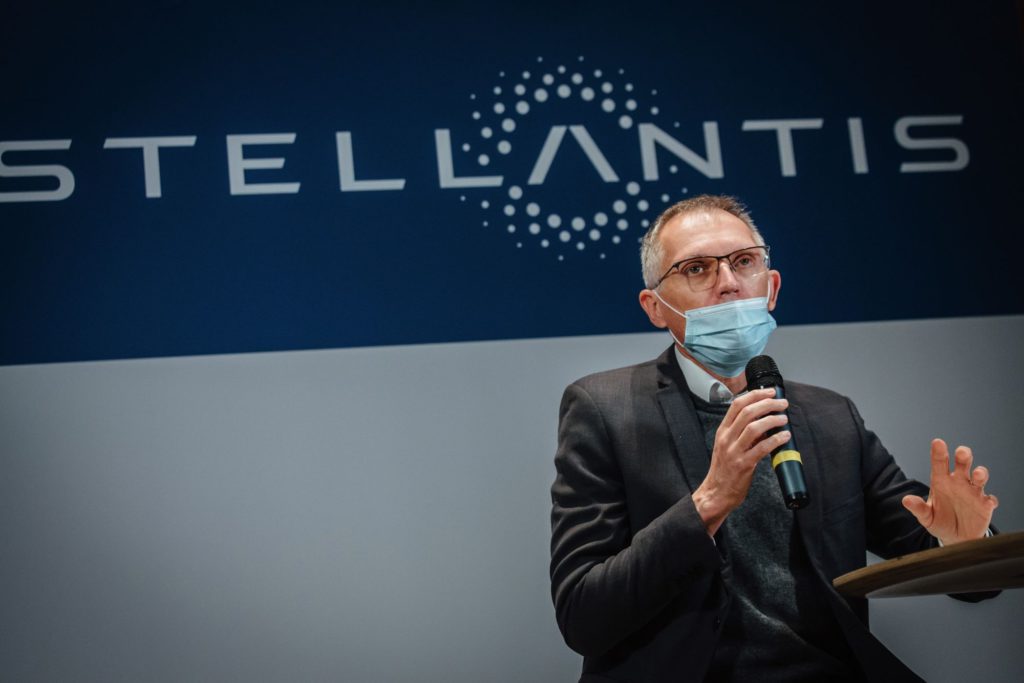
Samsung SDI, Stellantis Invest $2.5 Billion in US Battery Plant

(Bloomberg) — Stellantis NV and South Korean battery maker Samsung SDI Co. will invest $2.5 billion to build a battery plant in Kokomo, Indiana, as the automaker speeds its shift to electric vehicles.

Samsung’s first US battery plant will have annual output of about 23 gigawatt hours when it opens in 2025 and eventually will raise that to 33 gigawatt hours, the companies said Tuesday. The project will create 1,400 new jobs in and around Kokomo, which already is home to Stellantis engine and transmission plants. The city is roughly halfway between the automaker’s vehicle-assembly plants in Illinois and Ohio.

Competition among battery makers to ramp up capacity is intensifying in North America as auto manufacturers including General Motors Co. and Ford Motor Co. electrify their fleets and President Joe Biden looks to encourage the technological shift. 

Stellantis Chief Executive Officer Carlos Tavares is racing to transform the sprawling manufacturer after it was formed in the mega-merger between Fiat Chrysler and PSA Group last year. As part of its electrification plan, Stellantis is developing five large battery factories across North America and Europe to produce 400 gigawatt hours of capacity by 2030.

Stellantis already employs about 7,000 people at its engine, transmission, and casting plants in Indiana, including 6,300 members of the United Automobile Workers union, according to the company. The automaker said it will respect the right of its future hourly workers to form a union at the battery plant.

“Those future employees have the right to decide their representational status through secret ballot elections,” spokeswoman Jodi Tinson said in an email.

Cindy Estrada, director of the union’s Stellantis department, said in a statement that the UAW looks forward to reaching an agreement that “brings this new plant under our master agreement with traditional wages and benefits.”

Stellantis and Samsung initially agreed to form a joint venture to build a US battery plant last October. Samsung owns 51% of the venture while Stellantis owns 49%, and their investment in the Indiana plant could eventually reach $3.1 billion. 

The Indiana Economic Development Corp. said it has pledged $186.5 million to support the project, including tax credits, training grants, infrastructure improvements and payments tied to performance targets. Howard County, Duke Energy Indiana, Northern Indiana Public Service Company and the Greater Kokomo Economic Development Alliance are offering additional incentives, the IEDC said, without specifying the amount.

Stellantis, the owner of the Jeep, Peugeot and Ram brands, has pledged to sell 5 million battery-electric vehicles by the end of 2030. It aims to make all of its European passenger car sales fully electric by that time, as well to make half of its North American car and truck sales either plug-in hybrids or fully battery powered.

In March, Stellantis and Samsung rival LG Energy Solution announced a $4.1 billion joint venture to build a new electric-vehicle battery plant in Windsor, Canada.

(Updates Stellantis job numbers in Indiana in fifth paragraph)

More stories like this are available on bloomberg.com

©2022 Bloomberg L.P.
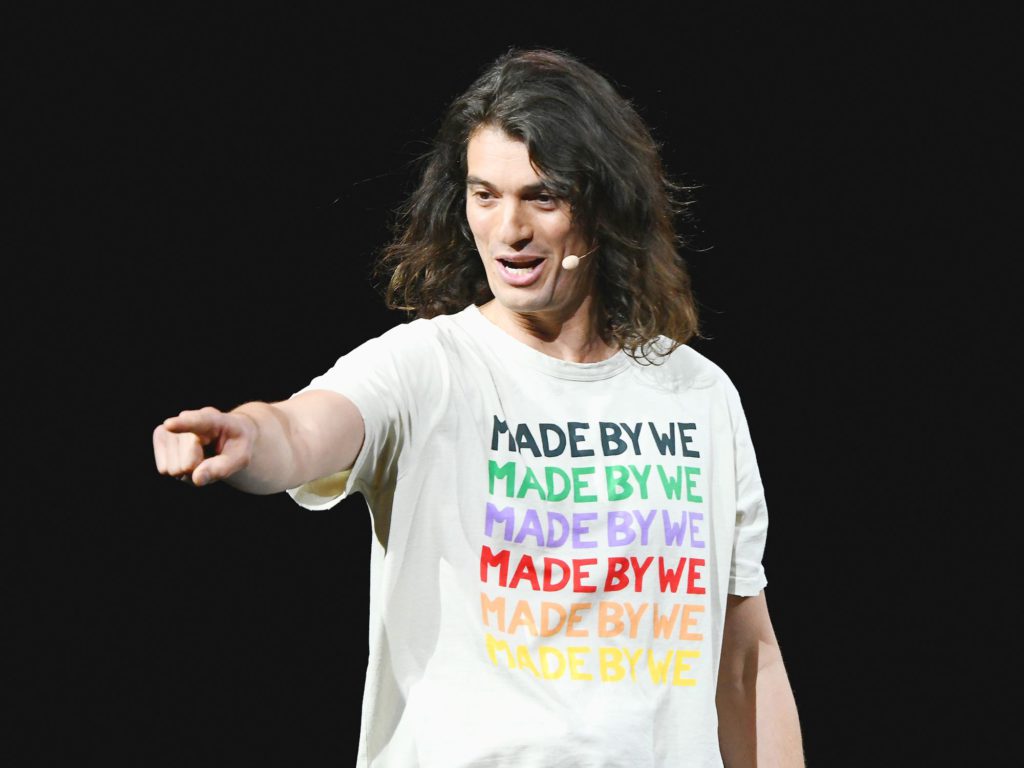
WeWork’s Adam Neumann Resurfaces in Crypto Carbon-Credit Startup

(Bloomberg) — A carbon-credit startup co-founded by Adam Neumann raised $70 million from venture capitalists and other backers, showing investors are still willing to bet on the controversial WeWork Inc. entrepreneur.

Neumann, the co-founder and former chief executive officer of the co-working provider WeWork, is listed as both a founder and an investor in the climate startup, Flowcarbon. The company sells carbon credits and keeps a record of the transactions on the blockchain. Flowcarbon has 35 employees and offices in Berlin, Montana and New York, the company said in a statement.

The carbon-credit market is notably opaque, which often leads to low-quality credits being sold and purchased that have little actual effect on carbon reduction. Recent efforts that have incorporated crypto as a way to bring transparency have backfired. 

Still, investors saw an opportunity for Flowcarbon. The startup raised traditional funding from backers such as Andreessen Horowitz’s crypto arm, General Catalyst and Samsung Next. Neumann is an investor through his family office. Flowcarbon also raised money by selling its token, called the Goddess Nature Token, which bundles together certified credits issued in the past five years.

Neumann, who stepped down as CEO of WeWork in 2019 after the company’s failed attempt at an initial public offering, helped conceive of the idea for the startup, but the company is run by CEO Dana Gibber, COO Caroline Klatt and Phil Fogel, its chief blockchain officer. Neumann’s wife, Rebekah Neumann, is also listed as a founder of Flowcarbon, as is Ilan Stern, who runs their family office.

Adam Neumann told the Financial Times in March that he and his wife came up with the branding for the company. One of his favorite words is “flow,” which reminds him of the flow state found in surfing, a hobby.

More stories like this are available on bloomberg.com

©2022 Bloomberg L.P.
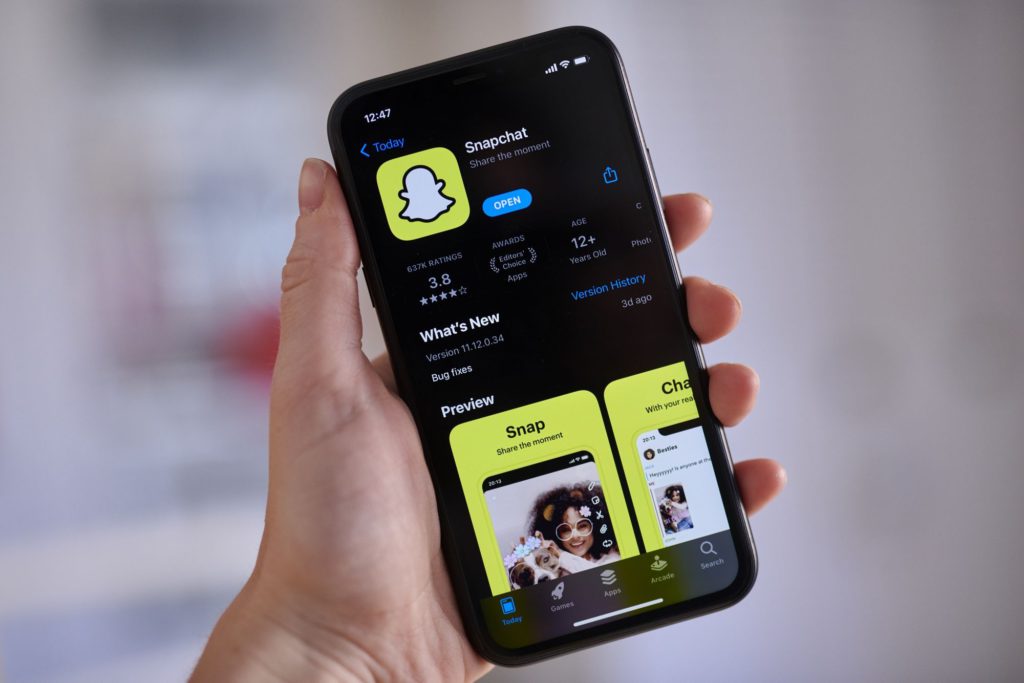
Social Media Stocks Sink to Erase $135 Billion on Snap Warning

(Bloomberg) — Social media stocks lost more than $135 billion in market value Tuesday after Snap Inc.’s profit warning, adding to woes for a sector that is already reeling from stalling user growth and rate-hike fears. 

Shares in digital ad-dependent Snap tumbled 43%, their biggest intraday decline ever to trade below its 2017 initial public offering price of $17. The selloff erased almost $16 billion in market value, and added to declines for peers including Facebook-owner Meta Platforms Inc., Google-owner Alphabet Inc., Twitter Inc. and Pinterest Inc.

The news spurred widespread selling across the advertising and ad-tech space. Among notable decliners, Trade Desk Inc. sank 19%, fuboTV Inc. lost 7%, Magnite Inc. lost 13%, LiveRamp Holdings Inc. slid 8%, Roku Inc. dropped 14%, and Vizio Holding Corp. was down almost 10%. In addition, Omnicom Group Inc. fell 8.4% and Interpublic Group of Cos lost 4.9%.

“At this point, our sense is this is more macro and industry-driven versus Snap specific,” Piper Sandler analyst Tom Champion wrote in a note. 

Others on Wall Street agreed, with Citi analyst Ronald Josey saying “a slowing macro is likely impacting advertising results across the broader Internet sector, although we believe platforms more exposed to brand advertising—like Twitter, Google’s YouTube, and Pinterest—are likely experiencing a greater impact overall.”

The owner of the Snapchat app, which sends disappearing messages and adds special effects to videos, reported quarterly user growth in April that topped estimates. But with the company saying just a month later that it won’t meet prior forecasts for revenue and profit, analysts noted a rapid deterioration of the economic environment.

Snap and platforms like Facebook and Google are competing for advertising dollars at a challenging time. Spiraling inflation is putting pressure on companies and consumer spending, while recent privacy changes, such as Apple Inc.’s tracking restrictions, have slowed businesses that were booming during much of the pandemic.

User growth is another a big focus for social media firms as they vie to attract new customers to target ads in an already saturated market. In February, Facebook-parent Meta posted the biggest one-day wipeout in market value for any U.S. company ever after saying that user additions stalled.

And broader concerns for the tech sector have also been hitting social media stocks, with the Federal Reserve’s path of rate hikes particularly weighing on technology stocks that are valued on future growth expectations.

Nasdaq 100 Index declined 2.2% on Tuesday, erasing Monday’s advance for the gauge. The tech-heavy index is down 28% this year, wiping out several hundred billions in value from the likes of Apple to other so-called growth peers like Netflix Inc.

(Updates share price moves throughout.)

More stories like this are available on bloomberg.com

©2022 Bloomberg L.P.
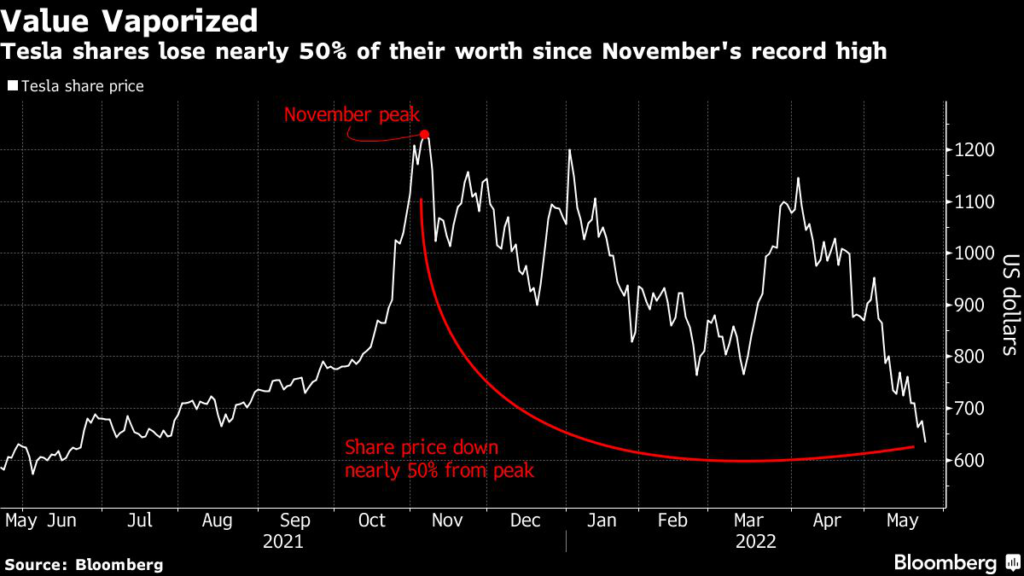
Tesla Resumes Plunge as Fears of Slow Production Weigh

(Bloomberg) — Tesla Inc. shares struggled Tuesday as the electric-vehicle maker’s production woes in China refuse to go away, leading another analyst to slash his 12-month price target on the once high-flying stock.

“With about 13,000 units of production per week and higher than average margins, any production loss at Shanghai is bound to have a significant impact on margins and earnings,” said Daiwa analyst Jairam Nathan, who cut his price target to $800 from $1,150.

Until recently, Tesla was considered the ultimate growth stock, rising 50% last year and closing at $1,145 on April 4, when CEO Elon Musk announced his 9.2% stake in Twitter Inc. Since then, Musk has been engaged in a highly public attempt to buy the social media platform. And Tesla’s stock has been in a freefall, sinking to $620.57 at its lowest on Tuesday and wiping out almost half its market capitalization after touching a record high in November.

Since Musk revealed his Twitter stake, Tesla shares have plunged 42% compared with a 13% decline in the S&P 500 Index and a 26% drop in the S&P 500 consumer discretionary sector. It’s the seventh-worst performing stock in the S&P 500 over that time and the third-biggest drag in terms of index points. 

Tesla also has dramatically underperformed most of the market’s other major tech growth stocks since April 4, including Facebook parent Meta Platforms Inc., Apple Inc.. Amazon.com Inc. and Google parent Alphabet Inc. Streaming service Netflix Inc. is the only FAANG name to be putting up a worse performance than Tesla since the news broke of Musk’s Twitter position.

The stock closed down 6.9% at $628.16 in New York on Tuesday.

All of this helps explain why Musk’s highly-public back-and-forth with Twitter has captivated markets, particularly as he sold $8.5 billion of Tesla stock to pay for the buyout. With the billionaire’s seeming recent reluctance to go forward with the purchase, Musk and Tesla are getting the wrong kind of publicity at a pivotal time for investors. The deal spread, or the difference between Musk’s offer price and Twitter’s share price, is $18, the widest since the takeover plan was announced in April. 

Beyond the Twitter distraction, Tesla’s key Shanghai factory has faced disruptions due to long-running Covid-19 lockdowns in the city. The company also was dropped from the ESG version of the S&P 500 earlier this month, a move that could lead to some forced selling by funds benchmarked to that gauge. The company has also dealt with the supply shortages and surging raw material costs that other automakers face.

Read more: Tesla Weighs on S&P 500 as Twitter Waffling, China Hit Stock

The broader market environment has turned against highly valued growth companies, with the Federal Reserve raising interest rates to tame inflation. Goldman Sachs on Monday said hedge funds continue to reduce exposure to growth stocks, incrementally rotating away from Apple, Amazon and Tesla.

“Tesla is a high-growth company, so the majority of its valuation is driven by future growth expectations,” said Seth Goldstein, equity strategist at Morningstar Research Services. “Even small changes in future growth assumptions can have a large impact on the stock’s valuation.”

(Updates stock move in third, fourth and sixth paragraphs.)

More stories like this are available on bloomberg.com

©2022 Bloomberg L.P.
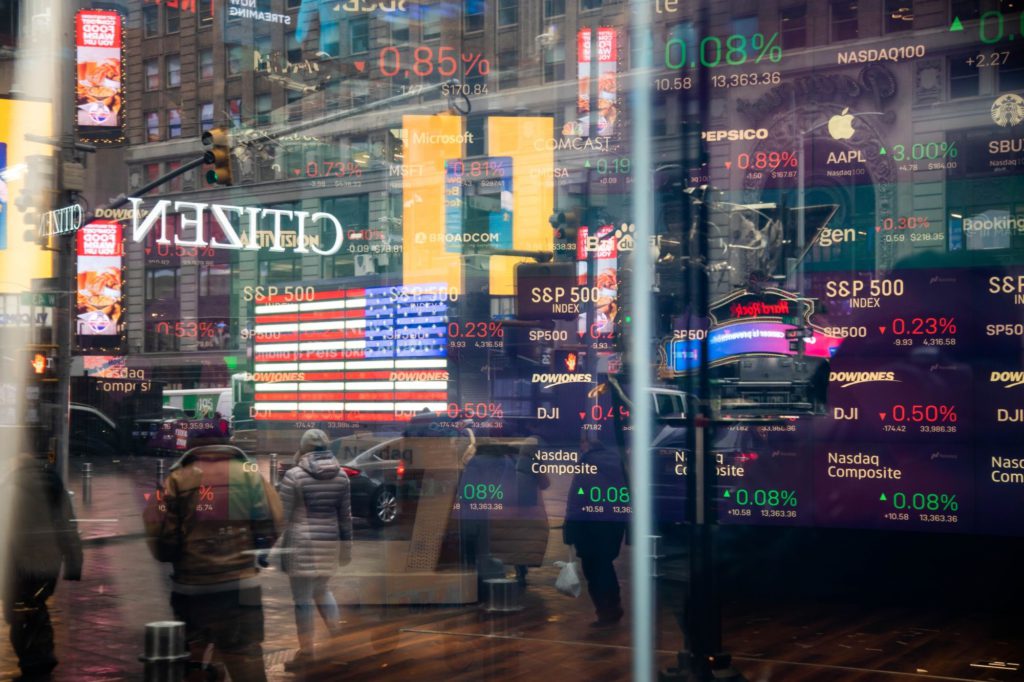
Big Tech Stocks’ Latest Dive Snuffs Out Hopes They’ve Hit a Bottom

(Bloomberg) — Megacap technology stocks sank again along with hopes that this year’s selloff has reached the point of exhaustion. 

Google parent Alphabet Inc. tumbled 5% on Tuesday after Snap Inc. cut forecasts issued just a month ago, citing deteriorating macroeconomic conditions and raising concerns about a broad slump in digital advertising.

The turmoil is giving investors flashbacks to some of the worst days of the pandemic, with Alphabet at a 52-week low after suffering its worst drop since October 2020. Meanwhile, Amazon.com Inc. dropped 3.2%, leaving the e-commerce giant close to falling below $1 trillion in market value for the first time since April 2020. 

“It appears to be clear that most companies will not avoid the troubling macro backdrop,” said Edward Moya, senior market analyst at Oanda.

The tech-heavy Nasdaq 100 Stock Index has fallen nearly 30% from its peak last year as the Federal Reserve pushes an aggressive campaign of rate hikes to fight soaring inflation. The stock slump has brought price-to-estimated profit gauges back near their long-term averages, fueling optimism that perhaps the selling could be nearing a bottom. 

Facebook owner Meta Platforms Inc. plunged 7.6% on Tuesday to within striking distance of a new low. The social media giant has fallen more than 50% from a September record amid its own problems of slowing user growth.

Investors are bracing for more volatility with earnings due from chipmaker Nvidia Corp. on Wednesday along with the release of minutes from the Fed’s last FOMC meeting.

(Updates with closing prices throughout)

More stories like this are available on bloomberg.com

©2022 Bloomberg L.P.
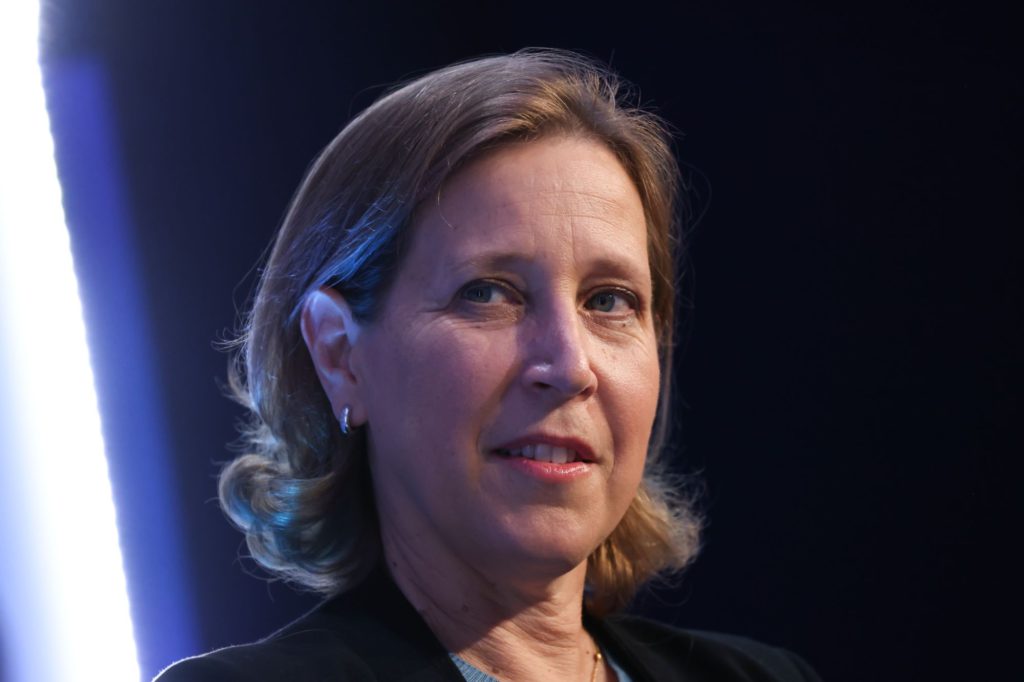
YouTube CEO Says Work Remains to Curb Misinformation

(Bloomberg) — YouTube can always improve its work to combat misinformation, Chief Executive Officer Susan Wojcicki said, touting the company’s progress over the past six years — even as falsehoods about the Covid-19 pandemic and elections have surged on the platform.

“There will always be incentives for people to be creating misinformation,” Wojcicki said Tuesday at the World Economic Forum in Davos, where she touched on everything from the war in Ukraine to her views on Roe v. Wade. “The challenge will be to keep staying ahead of that and making sure that we are understanding what they are.”

The video-streaming service owned by Alphabet Inc.’s Google has long been challenged by falsehoods and conspiracies. In January, a global coalition of fact checkers penned an open letter calling on YouTube to take effective action on misinformation, stating the company had largely escaped scrutiny in spite of problematic content appearing daily on the platform. In April, a report from the City University of New York and Dartmouth College found that YouTube had enabled audiences of resentful people to easily and repeatedly access extremist content on the platform.

Wojcicki said she hadn’t seen that report, “but there are certainly many other reports that give us a good grade there.” She added that in enforcing its policies, which aim to reduce the spread of borderline and harmful misinformation while promoting authoritative sources, YouTube was missing only about 10 to 12 content-violating videos per 100,000 views of videos on the platform, according to its latest research.

Wojcicki also described the challenges faced by YouTube in moderating content during global crises, including the war on Ukraine. In 2019, facing public criticism that it had provided a platform for hateful ideologies, the company reversed its stance on allowing the denial of violent events like the Holocaust. Earlier this year, Wojcicki said, the video site extended that policy to disallow content that promoted the denial or trivialization of the Russia-Ukraine war, blocking channels connected to Russian state-backed outlets RT and Sputnik across Europe.

But YouTube continues to operate in Russia in order to deliver independent news into the country, Wojcicki said. “The average citizen in Russia can access, for free, the same information that you can access here from Davos,” she said.

What the video platform won’t give up, Wojcicki said, is its commitment to free speech. In response to a question on her views about the US Supreme Court’s move to potentially overturn Roe v. Wade, which has cemented abortion rights in the country for half a century, Wojcicki said she personally believed that women should have the right to choose when to become a mother.

“To take away a law and a right that we’ve had for almost 50 years will be a big setback for women, but that’s my personal view,” Wojcicki said. “Running a company that has that really focused on free speech, we want to make sure that we’re enabling a broad set of opinions that everyone has a right to express their point of view — provided they meet our community guidelines.”


(Updates to add information on Davos conference. An earlier version of this story corrected the proper name of Dartmouth College)

More stories like this are available on bloomberg.com

©2022 Bloomberg L.P.
Hackers Breached Some GM Accounts, Accessing Personal Data

(Bloomberg) — Hackers compromised some online accounts of General Motors Co. customers in April, potentially accessing addresses, phone numbers and other personal information, according to a data breach notice filed with California regulators.

In a letter to affected customers, GM said it identified suspicious login attempts to an unspecified number of accounts between April 11 and April 29. The intrusions allowed hackers in some cases to redeem gift cards using reward points. 

It was unclear how many accounts were affected, although the California Attorney General’s Office reported that nearly 5,000 breach letters were sent to state residents. Social Security numbers and driver’s license details weren’t compromised, the company said.

GM told customers that hackers didn’t obtain passwords from GM’s systems but rather pilfered them from other websites where customers might reuse their login credentials. The company recommended its customers reset their passwords and use unique credentials for each website.

A GM spokesperson didn’t immediately respond to a request for comment from Bloomberg News. The breach was previously reported by cybernews.com.

More stories like this are available on bloomberg.com

©2022 Bloomberg L.P.

Close Bitnami banner
Bitnami
