Bloomberg

TripActions Negotiates New Funds at $9 Billion Valuation

(Bloomberg) — Startup TripActions is in talks for new round of funding at a higher valuation, signaling investors remain interested in some private technology companies amid a plunge in publicly-traded shares and as travel rebounds following the Covid-19 pandemic. 

Palo Alto, California-based TripActions is in discussions with investors to raise new money at around a $9 billion valuation, according to people familiar with the matter, who asked not to be identified because the discussions are private. 

A spokesperson for TripActions declined to comment. 

The potential funding round comes as many technology startups, including Klarna Bank AB, Gorillas Technologies GmbH and Gopuff have announced staff reductions to save money amid rising interest rates and soaring inflation. In the US, the tech-heavy Nasdaq 100 has fallen by over a quarter so far this year and is trading near November 2020 lows.

TripActions manages corporate travel and expense reporting. The travel firm raised $275 million in October from investors including Greenoaks Capital Management LLC, Base Partners and entrepreneur Elad Gil, giving it a $7.25 billion valuation. At the time, it said its booking volumes had exceeded pre-pandemic levels because of increased market share. 

Earlier this month, the firm announced a partnership with Deutsche Lufthansa AG on an online travel booking site aimed at small and medium-sized businesses. TripActions has nearly 9,000 customers, including Lyft Inc. and Pinterest Inc., according to its website.

Founded in 2015, TripActions’ investors include Lightspeed Venture Partners, Addition, Zeev Ventures and Group 11. 

More stories like this are available on bloomberg.com

©2022 Bloomberg L.P.

Hunt for Lithium Sparks Frantic Rush Into Argentine Mountains

(Bloomberg) — At a lavish lunch this month in Buenos Aires, 400 mining executives and government officials gathered to toast Argentina’s natural resource riches amid the kind of corporate giddiness not seen since the country’s first attempt to develop its shale oil resources a decade ago.

The attraction for investors this time around is Argentina’s lithium. There’s a looming shortage of the rare metal, a key raw material in the batteries used in electric vehicles. Elon Musk signaled Tesla Inc. might get involved in mining to secure supplies. Chinese and US companies engaged in bidding wars for Argentina’s lithium resources, while Rio Tinto Group and Zijin Mining Group Co. are pouring more than a billion dollars into the country.

“If Argentina didn’t come through, it’d be almost impossible for the lithium market to stay well-supplied,”  said Michael Widmer, head of metals research at Bank of America.

Argentina has 13 lithium projects in the pipeline, more than any other country. The US has 10.

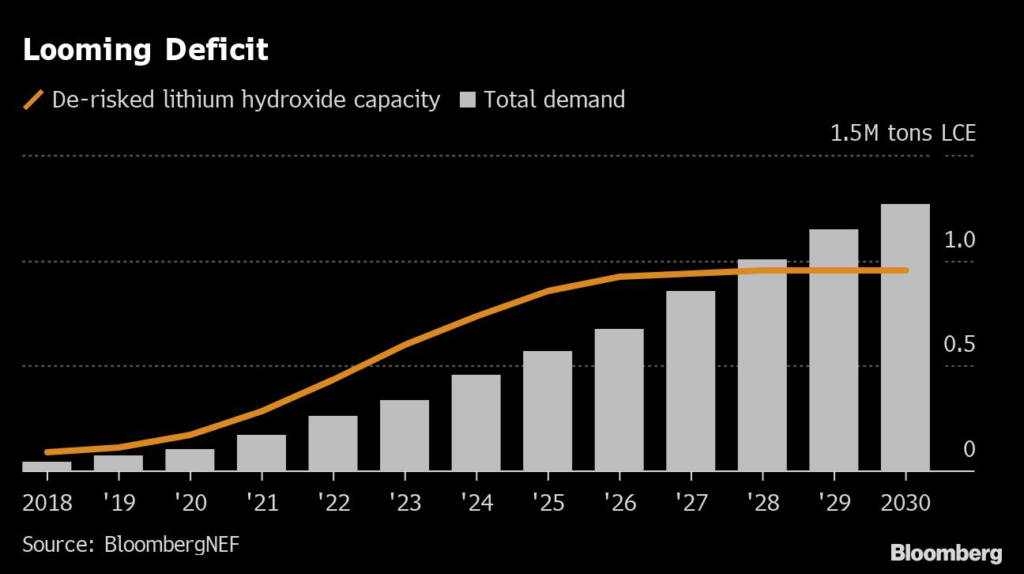
The world needs lithium supplies to grow fivefold by the end of the decade to meet projected demand as the electric-vehicle revolution gets into full swing, according to BloombergNEF. It could be Argentina’s last shot at moving beyond its traditional offerings of soybeans, grains and beef to emerge as a global heavyweight in a new sector.

The country has 19 million metric tons of lithium resources that haven’t yet been mined, twice as much as Chile. But Argentina has long struggled to lure the consistent, hefty international capital flows needed for mass development of oil, natural gas, gold and silver locked underground.

Patagonian shale formation Vaca Muerta is perhaps the best example. A decade ago, it was all buzz and promise. There was a special exemption from capital controls that attracted Chevron Corp. But the trickle never became a flood: Argentina’s broader woes and interventions in fuel markets kept development in check. 

Now, the world’s largest lithium producer, Albemarle Corp., plans to restart exploration in the Salar de Antofalla in Argentina, a more remote and less developed area than Australia and Chile, where the company has been mining so far.

“We don’t always get to choose where our resources are. Now, the EV market is accelerating and demand is really growing, we need to develop that next resource,” said Kent Masters, chief executive of Albemarle. 


It’s a tall order. A two-year price slump through the middle of 2020 had put some new mines on hold and had driven investors away, meaning that additional supply isn’t growing fast enough now.

“It’s more mature on the demand side now. You can bank on it more,” said Jon Lamb, portfolio manager at a metals and mining investment firm Orion Resource Partners. Consultancy Benchmark Mineral Intelligence expects the lithium market to grow to $40 billion by 2030 from just $1.2 billion in 2015.

Posco Holdings Inc., one of the largest steelmakers, is investing $830 million in a lithium hydroxide plant in Argentina. 

Such investment is crucial, considering that Australia and Chile’s dominance in lithium is set to fade. While Australia and Chile account for 76% of output, their share in the project pipeline is only around 34%, BofA’s Widmer said in a note. 

Argentina will overtake Chile in lithium production around 2027, according to Daisy Jennings-Gray, senior analyst at Benchmark Mineral Intelligence, which advises governments on critical minerals. Lithium Americas Corp. and Ganfeng Lithium Co.’s Cauchari-Olaroz is likely to be the first new project to produce significant volumes in 2023. 

Argentina, Chile and Bolivia — the so-called lithium triangle — account for more than half of global resources, and are looking to cooperate on ways to move beyond mining the metal into producing higher-value products.

“The three countries have different perspectives on how to produce the lithium, but we have a shared perspective on what to do next with it,” Argentina Mining Undersecretary Fernanda Avila said. “We’re working together to develop new technologies and techniques to go further in the value chain.”

With history of capital controls, which Argentina uses to protect its foreign reserves, the country fights the perception of being “like ‘Hotel California’. You can come in anytime you want, but you can never leave,” said Andy Bowering of American Lithium Corp., which has a project in Peru.

Argentina makes companies turn export revenues into pesos. It then stops them from freely accessing dollars or pounds again and moving them abroad. For instance, several commodities companies including top shale oil driller YPF SA had to re-finance dollar bonds because Argentina won’t let it buy enough greenbacks to service debt. But with the country stuck for ways to grow the economy, especially in the mining sector, it recently created capital-control loopholes for big investors.


The world’s hunger for lithium outweighs all the hesitancy, said Jon Evans, chief executive of Lithium Americas, which outbid China’s Contemporary Amperex Technology Co. Ltd., the world’s largest battery maker, to buy Millennial Lithium Corp. last year. The three-way bidding battle for Millennial’s lithium assets in Argentina lasted four months and included two Chinese suitors.

Argentina “is the best lithium opportunity in South America,” Evans said. 

More stories like this are available on bloomberg.com

©2022 Bloomberg L.P.

Bridgewater Sees US on the Cusp of Stagflation: Davos Update

(Bloomberg) — The US is on the on the verge of stagflation and markets are under-discounting gains in consumer prices, according to Bob Prince of Bridgewater Associates, marking the latest grim warning about risks at the World Economic Forum in Davos.

European Commission President Ursula von der Leyen earlier made an urgent appeal for international action to prevent a global food crisis that she said is being maliciously stoked by Russian President Vladimir Putin. The impact of Russia’s invasion of Ukraine is dominating the gathering in the Swiss Alps, which has returned in-person after a two-year hiatus due to the pandemic. 

European Central Bank President Christine Lagarde told Bloomberg Television that officials won’t rush into withdrawing stimulus and her French colleague echoed her to insist there’s no consensus for a half-point interest-rate hike.

Bloomberg will host panels later on Tuesday on energy, security and South Asia with guests including the prime ministers of Spain and Belgium, NATO Secretary General Jens Stoltenberg and Pakistani Foreign Minister Hina Rabbani Khar.

Key Developments

  • European Leaders in Davos Decry Russia Using Food as ‘Blackmail’
  • Lagarde Says ECB Won’t Rush as Consensus Shuns Half-Point Hike
  • Goldman Staff Outpace Credit Suisse in Return to Office Stakes
  • BofA CEO Says He Understands Elon Musk’s ‘Frustration’ Over ESG
  • UBS CEO Says Wealth Clients Digesting a Triple Whammy of Shocks

All times CET:

Citigroup Sees Greater European Inflation Risks (3:40 p.m.)

Citigroup Inc. has seen European corporate clients become more cautious, according to the bank’s top executive in the region. While there’s still enormous liquidity available to companies across Europe, many are struggling with growth as the continent battles inflation and energy disruptions caused by Russia’s invasion of Ukraine, David Livingstone, head of Citigroup’s businesses in Europe, the Middle East and Africa, said in an interview with Bloomberg Television.

“In the U.S., inflation hasn’t been present like this for four decades,” and the situation is similar in western Europe, Livingstone said. “The distinction in Europe, of course, is energy input volatility — gas prices much higher here. And if there’s further interruption I think that’s going to have very significant inflationary effects and that’s going to pass onto the consumer very quickly.”

Dubai Conglomerate Says Higher Food Inflation Coming (3:15 p.m.)

The chief executive officer of Majid Al Futtaim Holding LLC, the Dubai-based retail and property conglomerate that owns the Carrefour hypermarket franchise in the Middle East, said it would no longer be able to stop passing on price rises to customers.

“It’s not possible any more,” Alain Bejjani said in an interview. The impact of the Ukrainian conflict on global supply chains is “huge.” Saudi Arabia and Dubai are “bright spots” for the company, he said, with demand in those two almost back to pre-Covid levels.

IPO Pipeline ‘Incredibly Strong’: NYSE (3 p.m.)

The number of companies planning to go public on the New York Stock Exchange remains robust even amid the recent market downturn, NYSE President Lynn Martin said.

“The good news is the demand to go public has never been stronger,” Martin told Bloomberg TV. “The pipeline’s incredibly strong,” she said, adding that many companies are just trying to figure out the right moment to sell shares.

Monkeypox Can Be Contained, Officials Say (2:50 p.m.)

Monkeypox isn’t the next Covid-19, and the world already has the tools it needs to contain the outbreak, according to public health experts.

The virus probably won’t trigger the next pandemic, Seth Berkley, chief executive officer of the GAVI Alliance, said in an interview with Bloomberg TV. WHO officials said that the disease can be contained if people are informed of the symptoms so they can recognize it quickly.

Spain’s Economy ‘Much Better Prepared’: Sanchez (2:45 p.m.)

Spain’s economy will suffer from the fallout of the war in Ukraine but the nation is “much better prepared” than some of its European peers due to a relatively low dependence on Russian energy, according to Prime Minister Sanchez.

“It is also true that we have good fundamentals, strong fundamentals of the Spanish economy,” Sanchez said in an interview with Bloomberg TV. Spain gets less than 8% of its gas and less than 5% of its oil from Russia, and renewables account for 57% of installed capacity, Sanchez said.

Luxembourg Defends EU Unity on Sanctions (2:35 p.m.)

The EU shouldn’t go ahead with a Russian oil embargo without Hungary, Luxembourg’s Prime Minister Xavier Bettel told Bloomberg on the sidelines. Solidarity remains key,  he said, adding it wouldn’t be helpful if sanctions packages were agreed only among 26 of the EU’s 27 countries this time, and 25 next time.

“It’s not sanctions a la carte, unity is important,” he said, adding that within those packages there could be modalities, like delays or quantities, for different countries to comply with those sanctions.

Ukraine War Triggering New Fossil-Fuel Drive (2:25 p.m.)

The war in Ukraine is prompting a “headlong plunge” to expand fossil fuel production, US Climate Envoy John Kerry told a panel.

The next eight years will be crucial in terms of the world’s ability to meet the Paris Agreement target, but “we cannot do this if the new theology is to build out massive new gas infrastructure” without abatement, he said.

New World Order Adds Fresh Impetus to M&A (2:20 p.m.)

The emergence of a new geopolitical order in the coming years will help to drive cross-border mergers and acquisitions, according to senior dealmakers. 

“From a US policy perspective, hopefully we will see the emergence of a US-European super block that rearranges the global order and has significant implications for M&A transactions,” Peter Orszag, chief executive officer of financial advisory at Lazard Ltd., said on a panel. A desire to relocate supply chains in the wake of Russia’s war in Ukraine will underpin the trend, said Luisa Gomez Bravo, global head of corporate and investment banking at Banco Bilbao Vizcaya Argentaria SA.

Bridgewater Sees US on Verge of Stagflation (1:30 p.m.)

“We could very easily be into this very quickly,” Bridgewater’s Prince, who is co-chief investment officer alongside founder Ray Dalio and Greg Jensen, said on the prospect of stagflation. The world’s largest hedge fund firm runs the Pure Alpha II fund, which jumped 26.4% through April, outperforming peers.

Ireland’s Varadkar Warns London to Consider Rest of UK (1:10 p.m.)

The UK government needs to consider the impact of imposing decisions on other parts of the UK and its potential impact on the strength of the union, Ireland’s Deputy Prime Minister Leo Varadkar said in a Bloomberg Television interview.

“London and Westminster needs to think about the consequences of imposing things on Northern Ireland and Scotland that they don’t want, and I’m not sure they think about that enough,” the Minister for Enterprise, Trade and Employment said, as a row continues between the UK and EU over the part of the Brexit agreement dealing with Northern Ireland.

“The U.K. is our nearest neighbor, a really important trading partner,” he said, adding that he wants to see a stable and successful UK that is “sure about its place in the world.”

Gopinath Says Food Prices May Continue to Increase (12:45 p.m.)

IMF First Deputy Managing Director Gita Gopinath predicted that restrictions on food exports and a shortage of fertilizer mean global food prices are likely to continue to increase.

IMF officials “worry a lot about what’s going to happen with food prices,” she said on Bloomberg TV. Gopinath also said it’s premature to talk about a global recession, though some regions are being hit harder than others, and a technical recession is possible in some countries, such as in Europe.

World ‘Can Win Ukraine, Climate Change Battles’ (12:30 p.m.)

US Climate Envoy Kerry said the world must not retreat from its goal of tackling climate change even as Russia’s war in Ukraine stokes soaring energy prices. America will help make up Europe’s shortfall of Russian gas and more oil production from the Middle East may be required to quell inflationary pressures, but that does not mean there should be a “massive build out” of fossil-fuel infrastructure, he said.

“If we make the right choices here, we can win all of these battles,” he said at a panel alongside EU climate chief Frans Timmermans and IEA Executive Director Fatih Birol. “We can do what we need to do with respect to Ukraine, we can do what we need to do with respect to the climate crisis,” Kerry said. “But we cannot be seduced into believing that this suddenly is an open door to going back and doing what we were doing, which created the crisis in the first place.”

NATO Chief Confident on Sweden, Finland (12:15 p.m.)

NATO’s Stoltenberg said he’s confident that the alliance will find a way to resolve Turkish concerns and accept Finland and Sweden into the military alliance.

Russia’s Putin “wanted less NATO on his borders and launched a war. Now, he’s getting more NATO on his borders and more members,” Stoltenberg said. NATO allies are in talks to overcome Ankara’s opposition to the admission of Sweden and Finland, over their alleged support for autonomy-seeking Kurdish militants who’ve been battling Turkey for years.

Poland Sees Unrest in North Africa Over Grain (11:50 a.m.)

Polish President Andrzej Duda warned of civil unrest in North Africa unless Ukraine is able to ship its grains that are trapped in the country because of the war.

Ukraine accounts for about 80% of grains exports to countries like Egypt, and it’s key to ensure the shipments are made through ports including on the Baltic Sea in Poland, Latvia and Lithuania, he told a panel. If that doesn’t happen, many in northern Africa could face starvation, he said.

Von der Leyen Denounces Russian ‘Blackmail’ (11:30 a.m.)

“Russian artillery is bombarding grain warehouses across Ukraine –- deliberately — and Russian warships in the Black Sea are blockading Ukrainian ships full of wheat and sunflower seeds,” von der Leyen said in a speech, denouncing what she called “Russia’s blackmail.”

Europe is “working hard to get grain to global markets,” including 20 million tons of wheat currently stuck in Ukraine, she said. The bloc is also boosting its own production and working with the World Food Programme make sure vulnerable countries can buy food at affordable prices, she added.

Estonia Sees Turkey Spat Slowing NATO Enlargement (11 a.m.)

Estonian President Alar Karis said he’s confident that negotiations with Turkey will overcome its objections to Sweden and Finland joining NATO. But he told Bloomberg that the dispute over support for Kurdish groups, which Ankara regards as terrorists, could potentially slow down their inclusion in the military alliance.

“Maybe in 6 months,” he said. “Within a year it should be there. But again it’s very difficult to predict especially in this stage of this process.” Asked what would be the repercussion if Turkey refused to budge, he replied “I don’t know, I don’t think about it. NATO’s a collective organization and then we have to sit down and think about it. If it’s right to have a veto from one country or if we should have a voting system, I don’t know.”

Goldman Sees ‘Cyclical Carnage’ in Tech Stocks (10:45 a.m.)

Goldman Sachs sees strong long-term returns in tech once it weathers the current rough patch. “The very big picture for technology — I just want to be super clear — is that we’re facing cyclical carnage at the moment in public markets,” Katie Koch, CIO of public markets equity at Goldman Asset Management, said in a Bloomberg TV interview. “The long-term opportunity here is actually exceptional.” 

Private markets discounting bad news on technology is “still a couple of quarters away,” she added. The market has priced in a lot of bad news in China, but there are selective opportunities in Chinese firms driving climate transition and those in digitalization of the economy, she told a panel on markets.

IBM Warns of Cyber-Attack Risk (10:40 a.m.)

IBM CEO Arvind Krishna said a major cyber attack on “critical infrastructure is going to happen.” Speaking on a panel, he said it was inevitable that “a bad actor, probably a nation state” will hack essential public services. He revealed that digital coverage of the Augusta Masters golf tournament was hit with 40 million cyber attacks.

War Must Not be Excuse for Climate U-Turn: Sanchez (10:30 a.m.)

Spain’s Sanchez warned fellow leaders that the war in Ukraine must not be used as an excuse for backpedaling on climate goals.

“I think it’s very important to reaffirm this commitment today, because perhaps for some leaders this war could be used as an excuse not to fulfill their commitments on climate,” Sanchez said during a Q&A. “We should not forget that for climate change we don’t have a vaccine,” he added. “And for that we need to strengthen multilateralism and not forget the biggest threat that we have ahead of us.”

Enel Seeks Viable Buyer for Russia Unit (10:10 a.m.)

Enel SpA needs to find a “viable buyer” for its Russian unit after starting the selling process in the wake of Russia’s invasion of Ukraine, CEO Francesco Starace said in an interview on Bloomberg Television.

Starace also said “we need to be prepared for shocks” on Russia fossil-fuel supply. “We have to be prepared for the worst. This is not a simple situation,” he added.

Gnodde Says M&A Business ‘Surprisingly Strong’ (9:40 a.m.)

Goldman Sachs Group Inc.’s Richard Gnodde said the M&A pipeline is “still surprisingly strong” as companies continue to look to buy assets as prices fall.

“We really haven’t seen a slowdown,” the chief executive officer of Goldman Sachs International said on Bloomberg TV. About 70% of Goldman’s workforce are now typically in the office and that number is “drifting upwards,” he added.

CATL Sees Switch From Combustion Cars by 2035 (9:30 a.m.)

The world’s biggest maker of electric-vehicle batteries said it expects sales of combustion vehicles to end in major markets by 2035 at the latest.

Contemporary Amperex Technology Co. is pouring billions into rapidly expanding production to meet anticipated demand as batteries displace engines powered by fossil fuels. Chief Manufacturing Officer Jun Ni made the forecast at a panel on Tuesday, in which he didn’t specify any geographical markets. Still, it’s in line with major automakers like Volkswagen AG also planning to eliminate combustion car sales in Europe by 2035.

Swiss Re Quantifies Ukraine War Hit (9:20 a.m.)

Swiss Re expects a hit of $10 billion to $20 billion for the insurance industry from the war in Ukraine, Chairman Sergio Ermotti said in an interview with Bloomberg TV. Between the war and the Covid-19 pandemic, the reinsurer has seen its share of volatility in recent quarters, he said.

“You see more people taking on life-insurance protections, you see people taking on more cyber-risk protections as a consequence of what’s going on in Ukraine,” he added.

UBS Sees Clouds Clearing in the Next Three Months (9:15 a.m.)

UBS CEO Hamers said that he expects to see more clarity in global markets within the next three months as clients digest the fallout from recent geopolitical events. “We had to digest three major shocks: the pandemic shock, the war shock and the energy-transition shock,” he said. “Supply shocks and demand shocks all mixed in one.”

Wealthy clients, he said, aren’t panicking. They are staying invested, though not necessarily putting new money into the market. “I’m not sure they’re worried about what’s coming,” Hamers said. “It’s just they don’t know what’s coming.”

Unilever Sees Commercial Rationale for ESG Moves (9:15 a.m.)

Investors are exhorting us to put sustainability and ESG at the heart of our business model and that’s for hard commercial purposes, said Unilever CEO Alan Jope, citing consumer demand, cost efficiencies and the ability to attract top talent. 

But a lack of clear, harmonized metrics is a major challenge. “We are in danger of letting perfect get in the way of good, of letting complex get in the way of simple, and of local getting in the way of the global,” he said.

BofA’s Moynihan Understands Musk’s ESG Frustration (9:05 a.m.)

Bank of America CEO Brian Moynihan said that he can “understand the frustration” of Tesla Inc.’s Elon Musk over ESG metrics that penalize companies for historical or obscure reasons.

Speaking on a panel, Moynihan said his bank faced similar issues with old acquisitions that had overhanging litigation, for example, despite a broader commitment to investors to meet ESG standards. He was responding to a question about Musk’s recent tweet calling ESG an “outrageous scam.”

Unilever’s Jope chimed into the debate, saying “Elon can relax.” Tesla could be “at the top of the pack” at one of the ESG ratings agencies, he said on the same panel. But we shouldn’t be able to “pick and choose” the standards, he added.

Recession Not ECB Baseline, Lagarde Says (9 a.m.)

Lagarde rejected the idea that the euro area is heading for a recession for the time being, while acknowledging the need to be “very attentive” to economic developments. “We don’t have that as a baseline,” she said. 

“We are not in a panic mode,” she added. “We are now at a stage where there is every certainty that we will stop net assets purchases very early in July, deciding so in June, which will then clear the way for rate hikes that will come reasonably shortly after that.”

Lagarde: Monetary Policy at ‘Turning Point’ (8:50 a.m.)

Lagarde said she decided to set out the future path of monetary policy in a blog post on Monday in part to address “expectations that were not necessarily founded.”

Read more: Lagarde’s Rate-Hike Plan Irks Some at ECB Who Want Faster Option

“We are clearly now at a turning point, and I thought it was appropriate at this point to explain what the journey is, what the direction of travel is, what the destination is in the relatively short term and what is our aim point as well,” Lagarde said in an interview with Bloomberg TV.

“I thought it was a good time given the combination of volatility that was out there, expectations that were not necessarily founded and the strong convergence that arose from the Governing Council due to the multiple positions as expressed during the last few days,” she added.

Top Polluters Face $67 Trillion Bill to Hit Climate Goal (8:45 a.m.)

The world’s seven-biggest polluters will have to spend $67 trillion by the end of this decade to stay on the path of achieving climate neutrality mid-century, according to a report from Polish Economic Institute that’s due to be presented in Davos on Tuesday.

The economies — China, the US, the EU, Brazil, India, Russia and Japan — are responsible for 70% of global greenhouse gas emissions. Their efforts are key for the world to meet the goals of the 2015 Paris Agreement to limit warming to “well below” 2 degrees Celsius above preindustrial levels.

With current investment pledges to green their economies, the EU will reach climate neutrality in 2056, followed by the US four years later and China only in 2071 — 11 years later than its target, according to the report. Russia won’t be able to reach climate neutrality until 2086.

Edelman CEO Praises More Intimate, ‘Less Cold’ Davos (7:25 a.m.)

Richard Edelman, chief executive officer of public-relations firm Edelman, said he was a fan of this year’s iteration of Davos saying its smaller scale was provoking better conversations.

“Davos has been actually great because its smaller, CEOs are really looking to talk,” Edelman said in a Bloomberg Television interview. Plus, he said, it is “less cold.”

More stories like this are available on bloomberg.com

©2022 Bloomberg L.P.

Social Media Stocks Sink to Erase $165 Billion on Snap Warning

(Bloomberg) — Social media stocks lost about $165 billion in market value Tuesday after Snap Inc.’s profit warning, adding to woes for the sector which is already reeling amid stalling user growth and rate-hike fears.

Shares in digital ad-dependent Snap tumbled as much as 40%, their biggest intraday decline ever, erasing about $15 billion in market value. Added to the value of declines for peers including Facebook-owner Meta Platforms Inc., Google-owner Alphabet Inc., Twitter Inc. and Pinterest Inc., the group has seen $165.6 billion billion wiped out. 

Snap was trading at $13.60 as of 9:50 a.m. in New York, below its 2017 initial public offering price of $17.

“At this point, our sense is this is more macro and industry-driven versus Snap specific,” Piper Sandler analyst Tom Champion wrote in a note. 

Others on Wall Street agreed, with Citi analyst Ronald Josey saying “a slowing macro is likely impacting advertising results across the broader Internet sector, although we believe platforms more exposed to brand advertising—like Twitter, Google’s YouTube, and Pinterest—are likely experiencing a greater impact overall.”

The owner of the Snapchat app, which sends disappearing messages and adds special effects to videos, reported quarterly user growth in April that topped estimates. But with the company saying just a month later that it won’t meet prior forecasts for revenue and profit, analysts noted a rapid deterioration of the economic environment.

The news spurred widespread selling across the advertising and ad-tech space. Among notable decliners, Trade Desk Inc. sank 18%, fuboTV Inc. lost 7.7%, Magnite Inc. lost 10%, LiveRamp Holdings Inc. slid 7.4%, Roku Inc. dropped 13%, and Vizio Holding Corp. was down 5.5%. In addition, Omnicom Group Inc. fell 6.4% and Interpublic Group of Cos lost 4.9%.

Snap and platforms like Facebook and Google are competing for advertising dollars at a challenging time. Spiraling inflation is putting pressure on companies and consumer spending, while recent privacy changes, such as Apple Inc.’s tracking restrictions, have slowed businesses that were booming during much of the pandemic.

User growth is another a big focus for social media firms as they vie to attract new customers to target ads in an already saturated market. In February, Facebook-parent Meta posted the biggest one-day wipeout in market value for any U.S. company ever after saying that user additions stalled.

And broader concerns for the tech sector have also been hitting social media stocks, with the Federal Reserve’s path of rate hikes particularly weighing on technology stocks that are valued on future growth expectations.

Nasdaq 100 Index declined more than 2.7% on Tuesday, set to reverse Monday’s advance for the gauge. The tech-heavy index is down 28% this year, wiping out several hundred billions in value from the likes of Apple to other so-called growth peers like Netflix Inc.

(Updates share price moves throughout.)

More stories like this are available on bloomberg.com

©2022 Bloomberg L.P.

Snap Plunges 40%, Slips Below IPO Price on Profit Warning

(Bloomberg) — Snap Inc. plunged as much as 40% Tuesday morning, dipping below its initial public offering price after the social media company cut its revenue and profit forecasts as it grapples with a wide range of macroeconomic issues.

“Like many companies, we continue to face rising inflation and interest rates, supply chain shortages and labor disruptions, platform policy changes, the impact of the war in Ukraine, and more,” Chief Executive Officer Evan Spiegel said in a note to staff on Monday. The company will also slow hiring. 

Snap marked its biggest intraday decline since it went public in March 2017, falling to as low as $13.55. The collapse in Snap’s share spread to other internet and advertising stocks, with Meta Platforms Inc. falling 9.6%. Major advertising houses also dropped, with WPP Plc dropping 3.9% in London. 

In total, social media stocks were on course to shed more than $100 billion in market value following Snap’s announcement. 

Read More: Evan Spiegel’s Full Memo to Staff

Snap benefited from a surge in usage of its Snapchat app during the pandemic, when people were looking for entertainment and connection from their homes. Now, as people return to offices and schools, the company is reeling from the same combination of economic pressures that are also facing its competitors. 

Snap will add 500 roles before the end of the year, on top of 900 jobs already offered this year. This compares to about 1,800 new staff added over 2021. Both Meta and Uber have cut back on the speed of hiring, after warning about the increasing cost of doing business.

“The macroeconomic environment has deteriorated further and faster than anticipated,” Snap said in a filing. “As a result, we believe it is likely that we will report revenue and adjusted Ebitda below the low end of our Q2 2022 guidance range.”

The company’s second-quarter forecast, for 20% to 25% year-over-year revenue growth, was already below analysts’ estimates. The warning immediately hit other companies reliant on advertising, including Twitter Inc., Alphabet Inc. and Pinterest Inc. 

The companies “are having to bring these unattainable, unrealistic investors’ expectations back down to Earth,” said Dan Suzuki, deputy chief investment officer at Richard Bernstein Advisors, on Bloomberg Television Monday. “Underlying growth is slowing as these companies mature and it gets more competitive.” Suzuki’s firm, which has about $15 billion of assets under management, does not hold Snap stock directly.

The platforms are all competing for ad dollars at a challenging time. Advertisers are facing a shaky economy as well as recent privacy changes, such as Apple Inc.’s tracking restrictions, which have slowed businesses that were booming during much of the pandemic.

Facebook parent Meta last month cut spending because of the macroeconomic environment. Twitter recently announced a hiring freeze and other cost cutting measures to try and save cash. “The global macroeconomic environment has become less favorable, the war in Ukraine has impacted our results, and may continue to do so,” Twitter Chief Executive Officer Parag Agrawal said in an email to employees. “Many other companies have been experiencing a similar effect.”

Spiegel told staff that company leaders have been asked to review spending, to see if there are any other areas worth cutting. “Our most meaningful gains over the coming months will come as a result of improved productivity from our existing team members,” he wrote.

More stories like this are available on bloomberg.com

©2022 Bloomberg L.P.
Elon Musk Lawyers Up With Tesla Autopilot Among Washington’s Targets

(Bloomberg) —

Hours before FX and Hulu released Elon Musk’s Crash Course, a New York Times documentary outlining how Tesla’s chief executive officer has oversold his company’s automated-driving capabilities, the billionaire made a foreboding Friday afternoon announcement.

“Tesla is building a hardcore litigation department where we directly initiate & execute lawsuits,” Musk tweeted. He wrote that the team would report directly to him and declared he was looking for “streetfighters” and “out for blood.”

At first, the film’s director and producer, Emma Schwartz, didn’t know what to make of Musk’s posts. It seemed likely they were in response to Insider’s report that SpaceX had paid $250,000 to settle a sexual misconduct claim a former flight attendant made against the billionaire in 2018.

Then again, “that was SpaceX, and he was saying he wanted to start a litigation department at Tesla,” Schwartz said in an interview on Monday. She wondered if something else is happening with the carmaker, such as potential regulatory action. The documentary notes in its closing credits that the US National Highway Traffic Safety Administration has opened two defect investigations into Tesla’s driver-assistance system Autopilot.

The probes aren’t the only reasons to suspect something is up in Washington pertaining to Tesla.

The Securities and Exchange Commission has been probing whether Musk and his brother Kimbal, a Tesla board member, violated insider-trading rules when the two sold shares in the carmaker late last year. The SEC also sent Tesla a subpoena in November about a subject that refuses to go away: Musk’s tweeting and the carmaker’s governance and compliance processes.

And last month, Tesla revealed the Equal Employment Opportunity Commission had started investigating the company before California’s civil rights agency alleged racism is rampant at its California car factory, and claimed it was caught up in a “turf war” between the federal and state regulators.

It would be entirely unsurprising, however, if Musk’s lawyering up does indeed have to do with a clash over the safety of Autopilot and the Full Self-Driving features that Tesla has been selling for years before they live up to their name. And if this is what’s happening, it would be a mistake to fall for Musk’s framing of what’s to come as political motivated “dirty tricks” intended to derail his fight for free speech.

In two of the most memorable moments in Schwartz’s documentary, former NHTSA spokesman Bryan Thomas and former National Transportation Safety Board Chairman Robert Sumwalt describe what happened when their agencies informed Tesla they were opening investigations into two fatal crashes involving Autopilot — the first in Florida in 2016, and the second two years later in California.

Thomas recounts how Musk started shouting at NHTSA’s general counsel, accusing the agency of unfairly singling Tesla out and suggesting the company would sue. Musk was similarly argumentative and threatening toward the NTSB before hanging up on Sumwalt.

Both these incidents were reported previously, but this doesn’t take away from the drama of Thomas and Sumwalt’s retelling. Tesla is also starting to feel actual consequences: S&P Dow Jones Indices cited how the company has handled NHTSA’s investigation of deaths and injuries linked to Autopilot as among the reasons it removed the company from the ESG version of the S&P 500 Index.

Schwartz said it was difficult to convince former Tesla employees to go on camera for the documentary because of Musk’s influence and litigiousness. One of the factors that worked in her favor: Musk has freely spoken many times over the years about Tesla being on the cusp of solving self-driving, only to emphasize the limitations of its driver-assistance system when crashes occur.

“So many years have gone by with so many promises,” she said. “Especially with the launch of the FSD beta, it’s kind of ratcheted up the question even further. And while it’s not like we’ve seen loads of fatal accidents — which certainly the Tesla fans will note — it’s also pretty clear that the technology is a long way off from being fully self-driving.”

Like getting this newsletter? Subscribe to Bloomberg.com for unlimited access to trusted, data-driven journalism and subscriber-only insights.

More stories like this are available on bloomberg.com

©2022 Bloomberg L.P.

Best Buy Cuts Forecast While Sales Fall Less Than Feared

(Bloomberg) — Best Buy Co.’s first-quarter revenue surpassed analyst estimates but the company wasn’t able to avoid joining the litany of retailers cutting outlooks for the year.

Revenue fell 8.5% to $10.6 billion in the three months ended in late April, Best Buy said in a statement Tuesday. That exceeded the $10.4 billion average of analyst estimates. Same-store sales also declined less than expected, while a moderate increase in inventories contrasted with the surges that prompted markdowns at Walmart Inc. and Target Corp.

The results offered investors a measure of relief as US retailers struggle to shore up profit while costs soar and consumers grapple with the highest inflation rates in four decades. While the quarter was expected to be weak as the US economy lapped an injection of government stimulus in early 2021, Best Buy dodged the sharp earnings deterioration suffered by some other retail chains.

“Even with the expected slowdown this year, we continue to be in a fundamentally stronger position than we were before the pandemic from both a revenue and operating income rate perspective,” Chief Executive Officer Corie Barry said in the statement. 

Best Buy rose 0.1% at 9:42 a.m. in New York. The shares had fallen 29% this year through Monday, while an S&P 500 index of consumer-discretionary stocks declined 31%.

The worsening economic backdrop prompted Best Buy to cut its annual forecast for earnings, revenue and same-store sales. The company also revised its outlook for operating profit to between 5.2% and 5.4% of sales, down from the previous prediction of 5.4%. On a call with analysts, Barrie said she expected “elements of soft demand” this year but not a full-on US recession. 

“We think investors were bracing for an even larger outlook reduction,” Scot Ciccarelli, an analyst at Truist Securities, said in a note to clients. “However, with such a modest reduction, we suspect investors will be asking, ‘Is that enough?’”

Specialized Retailers

In the first quarter, adjusted earnings fell to $1.57 a share, trailing the $1.60 average of analyst estimates compiled by Bloomberg. Comparable sales fell 8%, while analysts had expected a 9.4% drop.

Specialized retailers like Best Buy appear to be faring better than the big discounters and department stores whose weak results roiled markets last week. Petco Health and Wellness Co. posted stronger-than-expected adjusted earnings and sales on Tuesday, causing its shares, which had been heavily shorted by investors, to gain as much as 7.5%.

Similarly, AutoZone Inc. shares got a boost when comparable sales in its just-ended third quarter were stronger than Wall Street expected. Investors recently have been betting against the stock, which was down 14% this year through Monday’s close.

(Updates with analyst comment in seventh paragraph.)

More stories like this are available on bloomberg.com

©2022 Bloomberg L.P.

Bitcoin Falls When the US Market Opens, Pointing to Cash Raising

(Bloomberg) — Crypto, stocks, bonds. Just about everything’s been having a tough time of late. But maybe Bitcoin’s poor performance can be blamed on the equities market. 

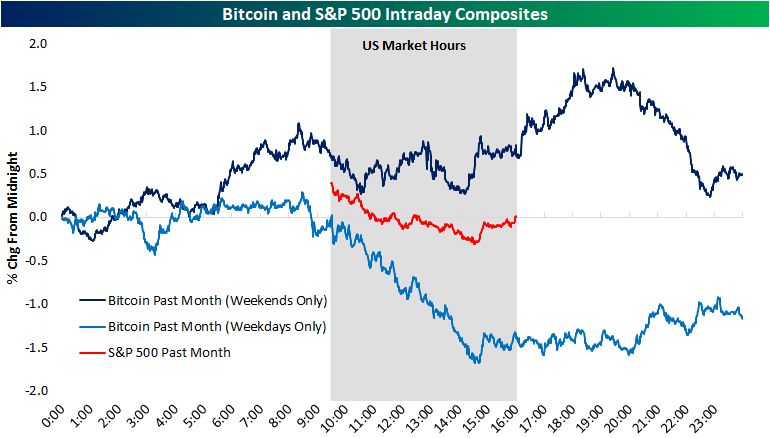
Bitcoin, which trades 24/7, has largely tended to move higher on weekends, and the coin hasn’t been posting any abnormal moves between 9:30 a.m. and 4 p.m. on Saturdays and Sundays, which are the stock market’s US operating hours during the week. But Monday through Friday, its intraday path looks much different, according to Bespoke Investment Group. Bitcoin was marginally lower at 9:40 a.m. in New York at about $29,180 on Tuesday. 

Before stocks open on weekdays, the largest cryptocurrency tends to trade relatively flat. But once the market opens, Bitcoin falls “off a cliff,” averaging declines of around 1.5% during market hours. When US stock trading ends, the token goes back to trading sideways for a few hours, and then tends to rally from 8 p.m. to midnight, Bespoke found. 

“Basically all of Bitcoin’s decline over the last month has come when US markets have been open,” Bespoke strategists wrote in a note. “This signals to us that recent declines for Bitcoin have been more about investors raising cash and selling assets more broadly rather than a more Bitcoin-specific trend.”

Analysts have been noting all year that cryptocurrencies and stocks have been joined at the hip when it comes to their moves. When one goes up on any given day, the other tends to follow, and vice versa. Correlations between stocks and Bitcoin have been strong, and the relationship is even more pronounced between the coin and tech stocks, which can sometimes be thought of as more speculative plays in the market. 

The 90-day correlation coefficient of Bitcoin and the tech gauge now stands above 0.68, among the highest such readings in Bloomberg data going back to 2010. A coefficient of 1 means the assets are moving in lockstep, while minus-1 would show they’re moving in opposite directions. 

All manner of riskier assets have been in distress this year as the Federal Reserve slowly removes the accommodative policies it had put in place to help the US economy through the pandemic. The central bank is raising interest rates in an attempt to cool inflation, which has hurt companies and assets on the riskier or more speculative spectrum. 

“On top of the more stable price action of Bitcoin on weekends and outside normal market hours, the risk-off sentiment in equity markets during regular US trading hours appears to be playing a significant role in why Bitcoin has seen such large declines almost solely during US hours,” Bespoke said in the note. “Essentially, as the stock market drives the cab, Bitcoin has been the unwitting passenger in the back.”

More stories like this are available on bloomberg.com

©2022 Bloomberg L.P.

EQT Mulls Sale of Stake in $7.5 Billion Nordic Fiber Arm

(Bloomberg) — Private equity firm EQT AB is considering the sale of a minority stake in Nordic fiber network operator GlobalConnect, people with knowledge of the matter said. 

EQT’s infrastructure arm is working with advisers on the potential divestment, which could attract interest from other investment funds as well as pension managers, the people said. A deal could value GlobalConnect at between 7 billion euros ($7.5 billion) and 10 billion euros including debt, according to the people, who asked not to be identified because the information is private. 

GlobalConnect offers high-speed internet services to enterprises as well as home fiber optic connections. It operates about 100,000 kilometers (62,100 miles) of fiber, connecting more than 650,000 homes and about 30,000 corporate customers, according to EQT’s website. 

Demand for infrastructure assets has been booming due to the steady, long-term returns they generate. EQT first invested in GlobalConnect in 2017 and has since expanded it through acquisitions. 

The company’s revenue rose 2.5% last year to 609 million euros, while adjusted earnings before interest, taxes, depreciation and amortization increased 13% to 307 million euros. GlobalConnect had about 28 billion krona ($2.8 billion) of net interest-bearing liabilities at the end of the year, according to its annual report. 

EQT owns GlobalConnect through its third infrastructure fund, which was raised in 2017, and a successor pool which closed two years later, its website shows. 

Deliberations are ongoing, and there’s no certainty they will lead to a transaction, the people said. A representative for GlobalConnect referred queries to the company’s private equity owner. A spokesperson for EQT declined to comment. 

More stories like this are available on bloomberg.com

©2022 Bloomberg L.P.

Pound Tumbles as Rate-Hike Bets Cut on Fresh Recession Fears

(Bloomberg) — The pound tumbled and investors rushed to the safety of government bonds after an index of UK private sector growth unexpectedly slid in May to reawaken fears of a recession.

That led traders to rein in bets on further interest-rate hikes from the Bank of England, given the risk that higher borrowing costs will halt growth. The pound fell nearly 1% against the dollar, reversing Monday’s gains and making it the most volatile Group-of-10 currency this week.

Traders piled into short-dated government debt, driving down the two-year gilt yield by as much as 14 basis points to 1.44%, its biggest drop in two weeks. Bonds are benefiting as money markets expect about 15 basis points fewer rate increases this year, a day after BOE Governor Andrew Bailey said a cost-of-living crisis will be factored into policy decisions.

“After Governor Bailey’s not-so-hawkish comments yesterday, today’s PMI figures underscore the real income shock on the UK economy,” said Geoffrey Yu, a senior foreign-exchange strategist at Bank of New York Mellon. “If we had to pick one G-10 central bank most likely to pause soon, it would likely be the BOE.”

Read more: UK Faces Risk of Recession as Firms Wilt Under Soaring Costs

S&P Global’s index of private sector growth unexpectedly slumped in May to levels last seen in February 2021, when coronavirus lockdowns were still in place, the firm said Tuesday. The speed of the slowdown was the fourth-largest on record and worse than anything seen before the pandemic hit. 

“These are stunning decreases over such a short period of time,” said Christopher Dembik, head of macro analysis at Saxo Bank, adding that inflation is still “out of control” and a technical recession is likely in the UK this year.

The data give policy makers bandwidth for just one more 25 basis-point hike at June’s meeting at a maximum, according to Simon Harvey, head of currency analysis at Monex Europe. The BOE has already implemented four back-to-back increases to deal with surging inflation. 

The pound is also falling against the euro, which is getting a boost on Tuesday after the European Central Bank’s president made it clear that she sees the end of negative monetary policy. The single currency is up about 1% at 85.76 pence. 

“As the market reacts to Christine Lagarde’s ECB Policy roadmap, it’s much easier to see sterling as the weakest currency in Europe,” Kit Juckes, chief currency strategist at Societe Generale, wrote in a note. 


(Updates chart, price moves, adds quote.)

More stories like this are available on bloomberg.com

©2022 Bloomberg L.P.
Close Bitnami banner
Bitnami