Bloomberg

Zoom Jumps on Sales Forecast, Signaling Success of New Products

(Bloomberg) — Zoom Video Communications Inc. offered a glimpse of optimism that it can expand beyond its consumer-friendly video software that helped the company to a pandemic boom. Investors who have soured on Zoom aren’t entirely convinced.

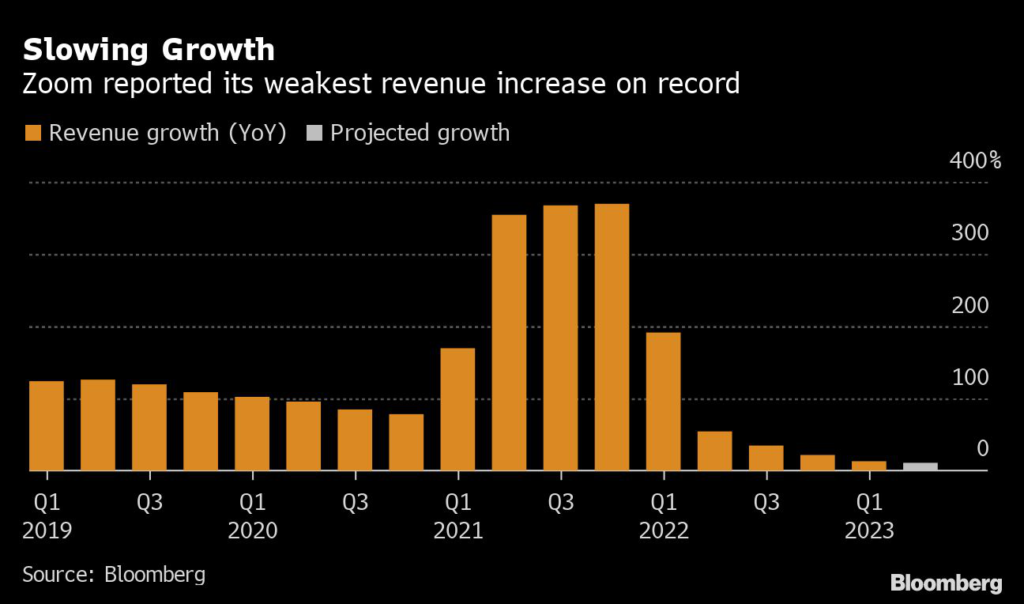
The software maker projected revenue would increase about 10% in the current period, better than analysts’ estimates, but still its slowest quarterly sales growth. The shares initially jumped 21% in extended trading after the company announced results, though they gave up most of the gains and were up only 2.4% in early trading in New York on Tuesday.

While Zoom became ubiquitous during the pandemic as a tool for people to stay in touch with family and friends, Chief Executive Officer Eric Yuan now is focused on business customers who will make up an increasingly larger share of revenue. Yuan on Monday touted new products aimed at enterprise customers, which increased 24% to 198,900 in the period ended April 30.

Benchmark Co.’s Matthew Harrigan said in a note before the results that investors have overlooked Zoom’s potential as a key tool for hybrid workplaces as major industries embrace remote work. The company is focusing on its enterprise offerings by adding products for customer service contact centers and analytics. Zoom recently announced the acquisition of Solvvy, a conversational AI startup, and unveiled Zoom IQ, a call analytics tool for sales departments.


“These new product launches encapsulate our strategy to expand horizontally and vertically to ensure our customers are getting more out of the platform,” Yuan said in a conference call. He also touted customers for Zoom’s enterprise phone system, including Humana Inc., Avis Budget Group Inc. and Franklin Covey Co. 

Zoom is making progress on diversifying its product portfolio, Bloomberg Intelligence analysts John Butler and Hoa Nguyen said in a note after the results.

“Zoom’s path to higher growth lies in expanding enterprise revenue, with this segment climbing 20% in 1Q,” they wrote.

Zoom hasn’t maintained the breakneck triple-digit growth it experienced during the pandemic as offices reopen and competition increases from Microsoft Corp.’s rival video communications platform. Fiscal first-quarter sales increased 12% to $1.07 billion, Zoom’s slowest year-over-year growth on record.

Revenue will be as much as $1.12 billion in the period ending in July, the San Jose, California-based company said in the statement. Profit, excluding some items, will be as much as 92 cents a share. For the full year, Zoom raised its earnings forecast to as much as $3.77 a share from its February projection of $3.51. 

Read More: Zoom’s 85% Selloff Has Analysts Calling for a Rally: Tech Watch

“I think the market wants to see signs that Zoom isn’t just a Covid stock,” said Tejas Dessai, a research analyst at Global X, which counts Zoom as a top holding of its cloud-focused exchange traded fund. “We would like to see increased consumption from larger enterprises, especially those with more than $100K in annual spending on the platform,” Dessai said in an interview before the results were released.

The stock has plummeted 51% this year as part of a broad decline among software makers.

(Updates shares in second paragraph.)

More stories like this are available on bloomberg.com

©2022 Bloomberg L.P.

Jefferies Moves Banking Services to Cloud in Deal With Amazon

(Bloomberg) — Jefferies Financial Group Inc. is moving its information-technology services to the cloud in partnership with Amazon.com Inc. 

The move is the latest among financial firms that started to expand into cloud-based software and data analytics in recent months. The four-year agreement with Amazon Web Services allows Jefferies to transfer its core business systems, internal and customer-facing applications, IT resources and data to AWS, according to a statement Tuesday. 

“This is a game changer for our firm and for the industry overall,” Vikram Dewan, chief information officer at Jefferies, said in an interview. “We are becoming more and more data-dependent, and we’re trying to develop better analytics, but doing all of that on-premise takes a lot of time and is expensive. On the cloud it can be procured and provisioned on a much quicker time-frame.”

The investment bank’s efforts follow similar plans from exchange operators Nasdaq Inc. and CME Group Inc., which partnered with Amazon and Alphabet Inc.’s Google to move data and eventually trading services to the cloud. Cloud computing, which allows companies to outsource processing and data storage to the big tech firms rather than operating the systems in-house, has been one of the fastest-growing areas of tech. 

The top cloud providers have been pushing into financial services, an industry that has lagged other markets because banks and other financial firms face restrictions on what they can run on a public cloud due to regulatory requirements and security concerns. Google Cloud has struck deals with HSBC Holdings Plc and Deutsche Bank AG. Other cloud providers include Microsoft Corp. and China’s Alibaba Group Holding Ltd.

Read More: Nasdaq Partners With Amazon to Migrate Markets to the Cloud

Jefferies, based in New York, has been a longtime Amazon Web Services customer. The deal will expand on previous work, with plans to migrate all IT systems and data over the next four years, according to the release. The bank says its goal is to have cloud-native platforms that will be the base for more than 90% of its new, “modernized workloads.”

The bank is also in the process of moving its equity derivatives trading platform to the cloud, in a hybrid manner, Dewan said. “It will take years to migrate dozens of applications to the cloud because we want to do it in a safe manner,” he said.

More stories like this are available on bloomberg.com

©2022 Bloomberg L.P.

SoftBank-Backed Delhivery Jumps More Than 10% in Mumbai Debut

(Bloomberg) — SoftBank-backed Indian logistics firm Delhivery Ltd. surged as investors brushed off rising global risks to support the nation’s second-largest initial public offering of the year in its market debut.

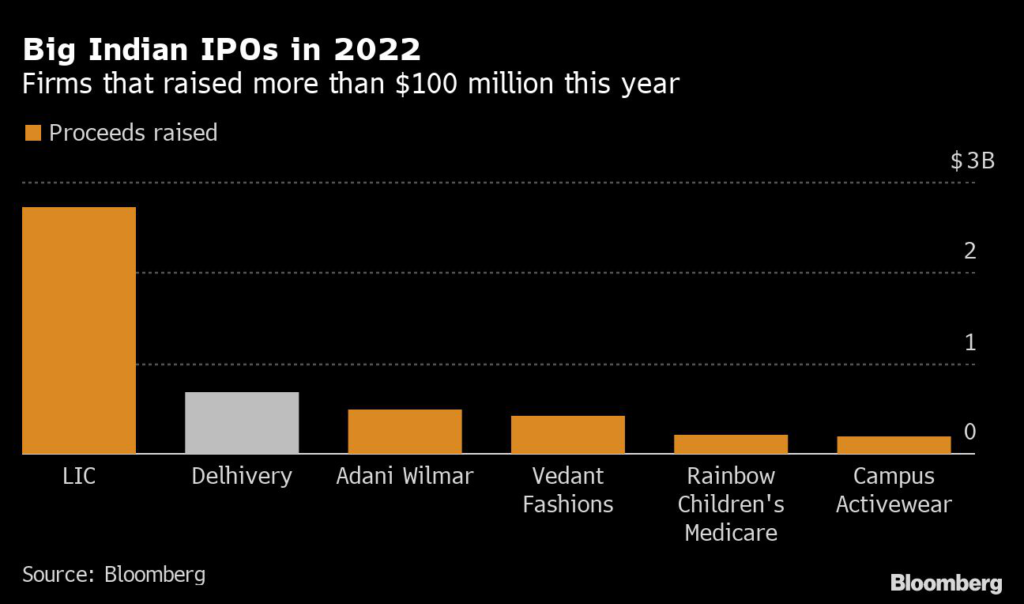
The shares climbed over 10% to 536.35 rupees in Mumbai, versus the issue price of 487 rupees. The company and its shareholders, including Carlyle’s CA Swift Investments and SoftBank Vision Fund’s SVF Doorbell, raised 52.35 billion rupees ($675 million) through the sale of both new and secondary shares. Venus Pipes & Tubes Ltd., which also debuted on the exchanges on Tuesday, closed with a gain of 8.7%.

The listing day pop contrasts with last week’s debut of state-run insurer LIC, which dropped 7.8% on its first trading day after an IPO that raised $2.7 billion, an Indian record. Delhivery’s positive start may provide encouragement for companies waiting to tap capital markets amid ongoing global volatility. 

Read: Aramco-Style Dividend Is What LIC Investors Seek Post Flop Debut

Founded in 2011, Delhivery is one of India’s largest fully-integrated logistics companies, serving over 17,000 postal codes with a team of 86,000 people, according to its website.

Its equity sale was oversubscribed 1.63 times, with a pick-up in demand coming on the last day and supported mostly by qualified institutional buyers. Non-institutional investors, retail individuals and employees placed smaller bids than the portions reserved for them.

Like LIC, Delhivery previously cut its offering size and delayed its listing on the back of market volatility. The logistics startup and its shareholders initially had been seeking to raise about $1 billion in a deal that was expected to be priced in March. 

Still, both companies managed to raise significant funds despite the slowdown in IPOs globally. Total proceeds raised in India since January are higher than those in venues such as Hong Kong and London.

Read: Advent Sees Drop in Private Valuations in India After Stock Rout

(Updates closing stock price, Venus Pipes’ performance in second paragraph)

More stories like this are available on bloomberg.com

©2022 Bloomberg L.P.

SoftBank-Backed Oyo to Shelve Plans for IPO in 2022, Sources Say

(Bloomberg) — Oyo Hotels, the once high-flying Indian startup, is shelving plans for an initial public offering in 2022 after a market downturn that would hurt its valuation, according to people familiar with the matter. 

The board of Oyo, formally known as Oravel Stays Ltd., talked through a change in the offering’s timing during multiple meetings last week and earlier this week after consulting with its bankers and investors, said the people, asking not to be identified because the decisions aren’t yet public. If the company picks up the process again by year end, the earliest possibility for an IPO would be in 2023, they said.

The Gurgaon-headquartered company, which filed preliminary IPO documents last year, is seeking regulatory permission to update its draft prospectus with fresh financial information after the close of the September quarter, said the people. Its bankers, led by Kotak Investment Banking, have filed the request with the Securities and Exchange Board of India, the people said.

The decision could make Oyo’s IPO a high-profile casualty from a global downturn in the technology industry. With inflation fears rising, lingering Covid-19 infections and the war in Ukraine, investors have roiled markets and pulled back from risky investments. The tech-heavy Nasdaq index has tumbled 26% this year.

“This isn’t the best of times for any IPO,” said Ashutosh Sharma, head of research, Forrester Research Inc. “Why Oyo, any startup anywhere in the world looking to raise money through IPO, VC funding or PE placement or any other channel, won’t get the best valuation.”

An IPO delay would also mark another setback for Oyo and founder Ritesh Agarwal, once celebrated for their vision of changing the hotel and lodging industry by backers like SoftBank Group Corp. founder Masayoshi Son. SoftBank holds about 47% stake in the startup, while the 28-year-old chief executive officer owns about one third.

Oyo has yet to hear back from the securities regulator on its request, but indications are that it will get a response either late this week or next week, said one of the people. Oyo filed its preliminary document, the so-called Draft Red Herring Prospectus or DRHP, for a $1.1 billion IPO in September last year, and about eight months have since lapsed without the IPO being cleared.

If it gets a green light from the regulator, the startup will seek to file as an addendum five or six pages of financials for the fiscal year that ended in March, as well as for the six months through September, said the people. The updated financial results are likely to be more representative of Oyo’s current business as travel has picked up.

Oyo was started in 2013 by Agarwal, then 19, who dropped out of college to travel around the country. The startup began to work with small hotels to standardize everything from bed linen to bathroom shower fittings that it then branded with its bright red & white Oyo logo.

With backing from high-profile investors such as SoftBank and Lightspeed Venture Partners, it expanded in Southeast Asia, China, Europe and the U.S. as it signed on hotel partners with agreements of guaranteed returns. 

During the pandemic, Agarwal was forced to overhaul the startup’s business model. Oyo fired thousands of employees, stopped providing hotel vendors any guaranteed returns or capital to refurbish their properties. He described the shift as a transition to an “asset light” model.  

In a sign that the effects of the pandemic were ebbing and travel was returning after curbs were relaxed, Oyo said in a statement that it had received over 800,000 bookings during the week of April 11. It expected demand to rise an average 60% in the coming days, the startup said.

(adds analyst comment in fifth paragragh.)

More stories like this are available on bloomberg.com

©2022 Bloomberg L.P.

Uber Agrees to Add Local Italian Taxis to Ride-Hailing App

(Bloomberg) — Uber Technologies Inc. signed a deal with Italy’s largest taxi dispatcher that will add more than 12,000 drivers to the US company’s platform.

The partnership between the ride-hailing giant and IT Taxi will bring the Uber app to more than 80 new cities in Italy starting from June, Uber said in a statement on Tuesday.

Read more: Uber to List New York Taxis on Its App in New Alliance 

It’s a move that follows similar partnerships aimed at easing driver shortages and fare pressure, and San Francisco-based Uber wants to add all taxis to its app by 2025. The Italian deal comes after similar partnerships in New York, San Francisco, Hong Kong and Madrid. 

“The agreement signed with Uber is an important milestone that will progressively bring more rides to the taxi drivers of our consortium,” Loreno Bittarelli, president of IT Taxi, said in the statement. 

More stories like this are available on bloomberg.com

©2022 Bloomberg L.P.

Pound Tumbles as Rate-Hike Bets Cut on Renewed Recession Fears

(Bloomberg) — The pound tumbled and investors rushed to the safety of government bonds after an index of UK private sector growth unexpectedly slid in May to reawaken fears of a recession.

That led traders to rein in bets on further interest-rate hikes from the Bank of England, given the risk that higher borrowing costs will halt growth. The pound fell nearly 1% against the dollar, reversing Monday’s gains and making it the most volatile Group-of-10 currency this week.

Traders piled into short-dated government debt, driving down the two-year gilt yield by 12 basis points to 1.45%, its biggest drop in two weeks. Bonds are benefiting as money markets expect about 15 basis points fewer rate increases this year, a day after BOE Governor Andrew Bailey said a cost-of-living crisis will be factored into policy decisions.

“After Governor Bailey’s not-so-hawkish comments yesterday, today’s PMI figures underscore the real income shock on the UK economy,” said Geoffrey Yu, a senior foreign-exchange strategist at Bank of New York Mellon. “If we had to pick one G-10 central bank most likely to pause soon, it would likely be the BOE.”

Read more: UK Faces Risk of Recession as Firms Wilt Under Soaring Costs

S&P Global’s index of private sector growth unexpectedly slumped in May to levels last seen in February 2021, when coronavirus lockdowns were still in place, the firm said Tuesday. The speed of the slowdown was the fourth-largest on record and worse than anything seen before the pandemic hit. 

“These are stunning decreases over such a short period of time,” said Christopher Dembik, head of macro analysis at Saxo Bank, adding that inflation is still “out of control” and a technical recession is likely in the UK this year.

The data gives policy makers bandwidth for just one more 25 basis-point hike at June’s meeting at a maximum, according to Simon Harvey, head of currency analysis at Monex Europe. The BOE has already implemented four back-to-back hikes to deal with surging inflation. 

More stories like this are available on bloomberg.com

©2022 Bloomberg L.P.

Social Media Stocks Set to Erase $100 Billion On Snap Warning

(Bloomberg) — Social media stocks are on course to shed more than $100 billion in market value after Snap Inc.’s profit warning, adding to woes for the sector which is already reeling amid stalling user growth and rate-hike fears.

Shares in digital ad-dependent Snap are set for a record one-day drop, down 30% in premarket trading. If that move holds, the company will lose about $10 billion in market value. Added to the value of premarket declines for peers including Facebook-owner Meta Platforms Inc., Google-owner Alphabet Inc., Twitter Inc. and Pinterest Inc., the group may see about $100 billion wiped out.

“At this point, our sense is this is more macro and industry-driven versus Snap specific,” Piper Sandler analyst Tom Champion wrote in a note. 

Others on Wall Street agreed, with RBC Capital Markets analyst Brad Erickson saying that implications for the digital advertising space are broadly negative, with Meta and Alphabet likely best insulated among the group.

The owner of the Snapchat app, which sends disappearing messages and adds special effects to videos, reported quarterly user growth in April that topped estimates. But with the company saying just a month later that it won’t meet prior forecasts for revenue and profit, analysts noted a rapid deterioration of the economic environment.

Snap and platforms like Facebook and Google are competing for advertising dollars at a challenging time. Spiraling inflation is putting pressure on companies and consumer spending, while recent privacy changes, such as Apple Inc.’s tracking restrictions, have slowed businesses that were booming during much of the pandemic.

User growth is another a big focus for social media firms as they vie to attract new customers to target ads in an already saturated market. In February, Facebook-parent Meta posted the biggest one-day wipeout in market value for any U.S. company ever after saying that user additions stalled.

And broader concerns for the tech sector have also been hitting social media stocks, with the Federal Reserve’s path of rate hikes particularly weighing on technology stocks that are valued on future growth expectations.

Nasdaq 100 futures fell 1.7% in premarket trading on Tuesday, set to reverse most of Monday’s advance for the gauge. The tech-heavy index is down 26% this year, wiping out several hundred billions in value from the likes of Apple to other so-called growth peers like Netflix Inc.

(Updates share moves, adds Facebook details.)

More stories like this are available on bloomberg.com

©2022 Bloomberg L.P.

Von Der Leyen Denounces Russian Food ‘Blackmail’: Davos Update

(Bloomberg) — European Commission President Ursula von der Leyen made an urgent appeal for international action to prevent a global food crisis that she said is being maliciously stoked by Russian President Vladimir Putin.

The impact of Russia’s invasion of Ukraine is dominating the World Economic Forum in Davos, which has returned in-person after a two-year hiatus due to the pandemic. Bloomberg will host panels later on Tuesday on energy, security and South Asia with guests including the prime ministers of Spain and Belgium, NATO Secretary General Jens Stoltenberg and Pakistani Foreign Minister Hina Rabbani Khar.

Earlier, European Central Bank President Christine Lagarde told Bloomberg Television that officials won’t rush into withdrawing stimulus as her French colleague echoed her to insist there’s no consensus for a half-point interest-rate hike.

Key Developments

  • Lagarde Says ECB Won’t Rush as Consensus Shuns Half-Point Hike
  • BofA CEO Says He Understands Elon Musk’s ‘Frustration’ Over ESG
  • UBS CEO Says Wealth Clients Digesting a Triple Whammy of Shocks
  • Energy Crisis Makes Transition an ‘Unprecedented Challenge’
  • Ukraine Urges Musk’s Starlink to Keep Helping Alongside Weapons

All times CET:

Poland Sees Unrest in North Africa Over Grain (11:50 a.m.)

Polish President Andrzej Duda warned of civil unrest in North Africa unless Ukraine is able to ship its grains that are trapped in the country because of the war.

Ukraine accounts for about 80% of grains exports to countries like Egypt, and it’s key to ensure the shipments are made through ports including on the Baltic Sea in Poland, Latvia and Lithuania, he told a panel. If that doesn’t happen, many in northern Africa could face starvation, he said.

Von der Leyen Denounces Russian ‘Blackmail’ (11:30 a.m.)

“Russian artillery is bombarding grain warehouses across Ukraine –- deliberately — and Russian warships in the Black Sea are blockading Ukrainian ships full of wheat and sunflower seeds,” von der Leyen said in a speech, denouncing what she called “Russia’s blackmail.”

Europe is “working hard to get grain to global markets,” including 20 million tons of wheat currently stuck in Ukraine, she said. The bloc is also boosting its own production and working with the World Food Programme make sure vulnerable countries can buy food at affordable prices, she added.

Estonia Sees Turkey Spat Slowing NATO Enlargement (11 a.m.)

Estonian President Alar Karis said he’s confident that negotiations with Turkey will overcome its objections to Sweden and Finland joining NATO. But he told Bloomberg that the dispute over support for Kurdish groups, which Ankara regards as terrorists, could potentially slow down their inclusion in the military alliance.

“Maybe in 6 months,” he said. “Within a year it should be there. But again it’s very difficult to predict especially in this stage of this process.” Asked what would be the repercussion if Turkey refused to budge, he replied “I don’t know, I don’t think about it. NATO’s a collective organization and then we have to sit down and think about it. If it’s right to have a veto from one country or if we should have a voting system, I don’t know.”

IBM Warns of Cyber-Attack Risk (10:40 a.m.)

IBM CEO Arvind Krishna said a major cyber attack on “critical infrastructure is going to happen.” Speaking on a panel, he said it was inevitable that “a bad actor, probably a nation state” will hack essential public services. He revealed that digital coverage of the Augusta Masters golf tournament was hit with 40 million cyber attacks.

War Must Not be Excuse for Climate U-Turn: Sanchez (10:30 a.m.)

Spanish Prime Minister Pedro Sanchez warned fellow leaders that the war in Ukraine must not be used as an excuse for backpedaling on climate goals.

“I think it’s very important to reaffirm this commitment today, because perhaps for some leaders this war could be used as an excuse not to fulfill their commitments on climate,” Sanchez said during a Q&A. “We should not forget that for climate change we don’t have a vaccine,” he added. “And for that we need to strengthen multilateralism and not forget the biggest threat that we have ahead of us.”

ECB’s Villeroy Sees No Consensus for Half-Point Hike (10:20 a.m.)

ECB Governing Council member Francois Villeroy de Galhau pushed back against the idea of a half-point rate increase.

“A 50 basis-point hike is not part of the consensus at this point,” the Bank of France governor told Bloomberg TV. “Interest rate hikes will be gradual.”

Enel Seeks Viable Buyer for Russia Unit (10:10 a.m.)

Enel SpA needs to find a “viable buyer” for its Russian unit after starting the selling process in the wake of Russia’s invasion of Ukraine, CEO Francesco Starace said in an interview on Bloomberg Television.

Starace also said “we need to be prepared for shocks” on Russia fossil-fuel supply. “We have to be prepared for the worst. This is not a simple situation,” he added.

Gnodde Says M&A Business ‘Surprisingly Strong’ (9:40 a.m.)

Goldman Sachs Group Inc.’s Richard Gnodde said the M&A pipeline is “still surprisingly strong” as companies continue to look to buy assets as prices fall.

“We really haven’t seen a slowdown,” the chief executive officer of Goldman Sachs International said on Bloomberg TV. About 70% of Goldman’s workforce are now typically in the office and that number is “drifting upwards,” he added.

CATL Sees Switch From Combustion Cars by 2035 (9:30 a.m.)

The world’s biggest maker of electric-vehicle batteries said it expects sales of combustion vehicles to end in major markets by 2035 at the latest.

Contemporary Amperex Technology Co. is pouring billions into rapidly expanding production to meet anticipated demand as batteries displace engines powered by fossil fuels. Chief Manufacturing Officer Jun Ni made the forecast at a panel on Tuesday, in which he didn’t specify any geographical markets. Still, it’s in line with major automakers like Volkswagen AG also planning to eliminate combustion car sales in Europe by 2035.

Swiss Re Quantifies Ukraine War Hit (9:20 a.m.)

Swiss Re expects a hit of $10 billion to $20 billion for the insurance industry from the war in Ukraine, Chairman Sergio Ermotti said in an interview with Bloomberg TV. Between the war and the Covid-19 pandemic, the reinsurer has seen its share of volatility in recent quarters, he said.

“You see more people taking on life-insurance protections, you see people taking on more cyber-risk protections as a consequence of what’s going on in Ukraine,” he added.

UBS Sees Clouds Clearing in the Next Three Months (9:15 a.m.)

UBS CEO Hamers said that he expects to see more clarity in global markets within the next three months as clients digest the fallout from recent geopolitical events. “We had to digest three major shocks: the pandemic shock, the war shock and the energy-transition shock,” he said. “Supply shocks and demand shocks all mixed in one.”

Wealthy clients, he said, aren’t panicking. They are staying invested, though not necessarily putting new money into the market. “I’m not sure they’re worried about what’s coming,” Hamers said. “It’s just they don’t know what’s coming.”

Unilever Sees Commercial Rationale for ESG Moves (9:15 a.m.)

Investors are exhorting us to put sustainability and ESG at the heart of our business model and that’s for hard commercial purposes, said Unilever CEO Alan Jope, citing consumer demand, cost efficiencies and the ability to attract top talent. 

But a lack of clear, harmonized metrics is a major challenge. “We are in danger of letting perfect get in the way of good, of letting complex get in the way of simple, and of local getting in the way of the global,” he said.

BofA’s Moynihan Understands Musk’s ESG Frustration (9:05 a.m.)

Bank of America CEO Brian Moynihan said that he can “understand the frustration” of Tesla Inc.’s Elon Musk over ESG metrics that penalize companies for historical or obscure reasons.

Speaking on a panel, Moynihan said his bank faced similar issues with old acquisitions that had overhanging litigation, for example, despite a broader commitment to investors to meet ESG standards. He was responding to a question about Musk’s recent tweet calling ESG an “outrageous scam.”

Unilever’s Jope chimed into the debate, saying “Elon can relax.” Tesla could be “at the top of the pack” at one of the ESG ratings agencies, he said on the same panel. But we shouldn’t be able to “pick and choose” the standards, he added.

Recession Not ECB Baseline, Lagarde Says (9 a.m.)

Lagarde rejected the idea that the euro area is heading for a recession for the time being, while acknowledging the need to be “very attentive” to economic developments. “We don’t have that as a baseline,” she said. 

“We are not in a panic mode,” she added. “We are now at a stage where there is every certainty that we will stop net assets purchases very early in July, deciding so in June, which will then clear the way for rate hikes that will come reasonably shortly after that.”

Lagarde: Monetary Policy at ‘Turning Point’ (8:50 a.m.)

Lagarde said she decided to set out the future path of monetary policy in a blog post on Monday in part to address “expectations that were not necessarily founded.”

Read more: Lagarde’s Rate-Hike Plan Irks Some at ECB Who Want Faster Option

“We are clearly now at a turning point, and I thought it was appropriate at this point to explain what the journey is, what the direction of travel is, what the destination is in the relatively short term and what is our aim point as well,” Lagarde said in an interview with Bloomberg TV.

“I thought it was a good time given the combination of volatility that was out there, expectations that were not necessarily founded and the strong convergence that arose from the Governing Council due to the multiple positions as expressed during the last few days,” she added.

Top Polluters Face $67 Trillion Bill to Hit Climate Goal (8:45 a.m.)

The world’s seven-biggest polluters will have to spend $67 trillion by the end of this decade to stay on the path of achieving climate neutrality mid-century, according to a report from Polish Economic Institute that’s due to be presented in Davos on Tuesday.

The economies — China, the US, the EU, Brazil, India, Russia and Japan — are responsible for 70% of global greenhouse gas emissions. Their efforts are key for the world to meet the goals of the 2015 Paris Agreement to limit warming to “well below” 2 degrees Celsius above preindustrial levels.

With current investment pledges to green their economies, the EU will reach climate neutrality in 2056, followed by the US four years later and China only in 2071 — 11 years later than its target, according to the report. Russia won’t be able to reach climate neutrality until 2086.

Edelman CEO Praises More Intimate, ‘Less Cold’ Davos (7:25 a.m.)

Richard Edelman, chief executive officer of public-relations firm Edelman, said he was a fan of this year’s iteration of Davos saying its smaller scale was provoking better conversations.

“Davos has been actually great because its smaller, CEOs are really looking to talk,” Edelman said in a Bloomberg Television interview. Plus, he said, it is “less cold.”

More stories like this are available on bloomberg.com

©2022 Bloomberg L.P.

Snap Falls After Cutting Forecast, Shock Spreads to Rivals

(Bloomberg) — Snap Inc. cut its revenue and profit forecasts below the low end of its previous guidance, sending shares plunging as much as 31% and pushing other social media stocks down.

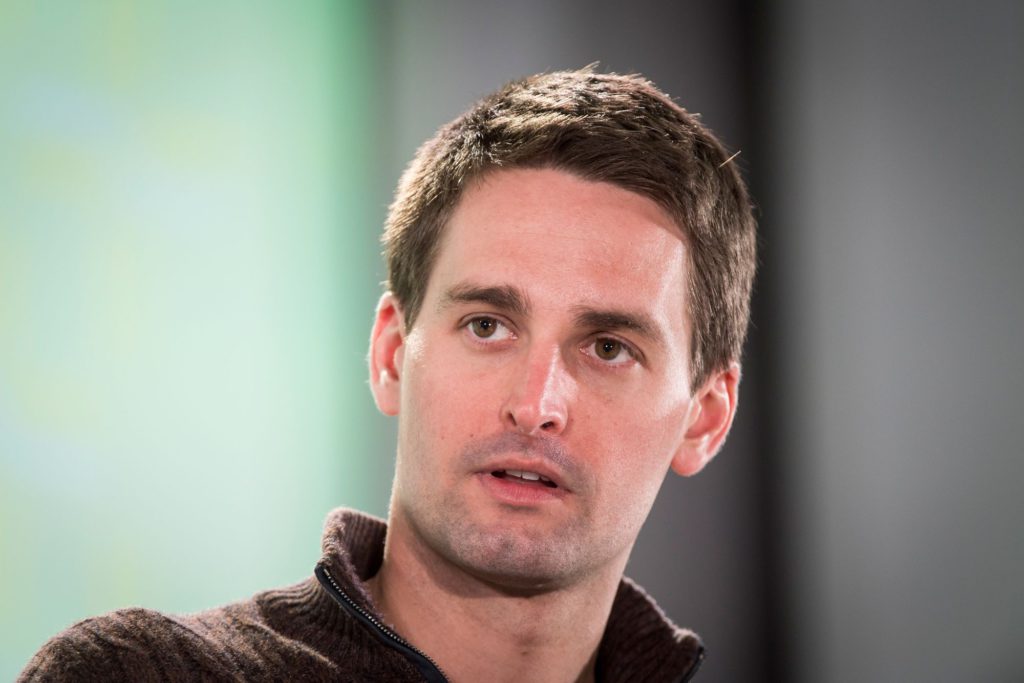
The company will also slow hiring, Chief Executive Officer Evan Spiegel said in a note to staff. “Like many companies, we continue to face rising inflation and interest rates, supply chain shortages and labor disruptions, platform policy changes, the impact of the war in Ukraine, and more,” he wrote in the memo obtained by Bloomberg.

The collapse in Snap’s share spread to other internet and advertising stocks, with Meta Platforms Inc. falling 7% in pre-market trading on Tuesday. Major advertising houses also dropped, with WPP Plc dropping as much as 3.9% in early trading in London.

In total, social media stocks were on course to shed more than $100 billion in market value following Snap’s announcement. 

Read More: Evan Spiegel’s Full Memo to Staff

Snap benefited from a surge in usage of its Snapchat app during the pandemic, when people were looking for entertainment and connection from their homes. Now, as people return to offices and schools, the company is reeling from the same combination of economic pressures that are also facing its competitors. 

Snap will add 500 roles before the end of the year, on top of 900 jobs already offered this year. This compares to about 1,800 new staff added over 2021. Both Meta and Uber have cut back on the speed of hiring, after warning about the increasing cost of doing business.

“The macroeconomic environment has deteriorated further and faster than anticipated,” Snap said in a filing. “As a result, we believe it is likely that we will report revenue and adjusted Ebitda below the low end of our Q2 2022 guidance range.”

The company’s second-quarter forecast, for 20% to 25% year-over-year revenue growth, was already below analysts’ estimates. The warning immediately hit other companies reliant on advertising, including Twitter Inc., Alphabet Inc. and Pinterest Inc. 

The companies “are having to bring these unattainable, unrealistic investors’ expectations back down to Earth,” said Dan Suzuki, deputy chief investment officer at Richard Bernstein Advisors, on Bloomberg Television Monday. “Underlying growth is slowing as these companies mature and it gets more competitive.” Suzuki’s firm, which has about $15 billion of assets under management, does not hold Snap stock directly.

The platforms are all competing for ad dollars at a challenging time. Advertisers are facing a shaky economy as well as recent privacy changes, such as Apple Inc.’s tracking restrictions, which have slowed businesses that were booming during much of the pandemic.

Facebook parent Meta last month cut spending because of the macroeconomic environment. Twitter recently announced a hiring freeze and other cost cutting measures to try and save cash. “The global macroeconomic environment has become less favorable, the war in Ukraine has impacted our results, and may continue to do so,” Twitter Chief Executive Officer Parag Agrawal said in an email to employees. “Many other companies have been experiencing a similar effect.”

Spiegel told staff that company leaders have been asked to review spending, to see if there are any other areas worth cutting. “Our most meaningful gains over the coming months will come as a result of improved productivity from our existing team members,” he wrote.

(Updates with CEO memo to staff, share prices, hiring context.)

More stories like this are available on bloomberg.com

©2022 Bloomberg L.P.
America Has a Solar Red-Tape Nightmare. Here’s How to Fix It

(Bloomberg) — The invasion of Ukraine has put the US and Europe on a wartime mission to abandon Russian fossil fuels. This series looks at speeding up zero-carbon alternatives by lowering political and financial barriers. Sign up here to get the next story sent to your inbox.

Lengthy power outages caused by hurricanes, wildfires and even deep freezes are spurring more Americans to place solar panels atop their homes. The appeal of energy resilience amid ever-common climate crises is mounting. Last year was a record-breaking year for US residential-solar installations. And yet only 4% of US houses are topped with panels—compared with about 25% in Australia.

There are several reasons why residential installations have traditionally been slow in the US, but the solar industry’s big headline constraints—supply chain and trade—didn’t emerge until fairly recently. Among the key factors slowing adoption: a mishmash of permitting rules around the country, which contribute to high customer-acquisition costs.

“It is a crazy jurisdictional patchwork,” said Vikram Aggarwal, founder of EnergySage, a Boston-based company that allows prospective solar customers to solicit quotes from installers. “Solar installers sometimes don’t want to support certain towns or municipalities because the permitting is notoriously difficult.”

A pathway to faster permitting exists. It’s called Solar Automated Permit Processing Plus, or SolarAPP+, which the National Renewable Energy Laboratory helped fashion as a fast, standardized system for US communities. It automatically performs a compliance check against code requirements to verify installation practices and workmanship, according to a January presentation. “The novelty of the tool is that it gets rid of the lengthy, inefficient, bureaucratic and manual process of permit approvals without compromising on safety,” said Pol Lezcano, an analyst at BloombergNEF. “It may or may not be perfect, but it’s definitely way better than the current permitting process and reduces the risk of human error.”

Speeding up permitting alone wouldn’t lead to the US catching up to Australia, but it might broaden the universe of Americans who can afford it. (Adding rooftop systems and home batteries, after all, helps climate-minded consumers directly reduce emissions from the electrical system). Installers say “they could reduce their total costs by as much as 40%, including gross margins, if they could make the sale, installation and interconnection of the system in one to three days—which I totally believe,” Lezcano said.

Read More: How to Get Cleaner Energy, Faster

Early results are promising. Tucson, Arizona, cut residential permitting reviews from about 20 days to zero, US Energy Secretary Jennifer Granholm said in a September letter to mayors.

Yet only 16 jurisdictions in the US use SolarAPP+ after it was formally launched almost a year ago. About 400 others are looking into adopting it, said Jeff Cook, program manager of SolarAPP+ at NREL. There are more than 20,000 cities and counties in the US, of which NREL has approached 900 with high solar volumes. “It’s a Sisyphean task,” said Nat Kreamer, chairman emeritus of the Solar Energy Industries Association. He suggests appealing to states to mandate faster permitting. “It takes a long time to sign up jurisdiction by jurisdiction.”

Infinity Energy saw permitting take up to 12 days before the pandemic, said Chief Executive Officer Yan Purba. It then stretched to as many as 27 days, but now up to 31 days due to labor shortages.

Now that rooftop measurement and design can happen almost instantaneously, “everything that delays the project from there is red tape and bureaucracy,” said Brian Eglsaer, chief operating officer of California-based installer Freedom Forever. “The actual physical part—sale, design and installation—could take 24 hours.”

Delayed systems cost installers about $200 per day for a $30,000 system (assuming an average installation time of 45 to 60 days), according to Sam Adeyemo, a co-founder of Aurora Solar, whose artificial-intelligence technology has helped speed installations in a different way—by enabling companies to remotely design rooftop systems in less than 30 seconds. He pointed to idle equipment, labor, financing and other fixed costs. That isn’t the worst outcome. “Oftentimes, it annoys customers enough to back out of the deal entirely,” Lezcano said. Attrition has increased from about 21% before the pandemic to more than 25% as permitting and supply delivery times lengthen, Infinity Energy has found.

While faster permitting could help cut system costs, US installers will need to find a way to slash customer-acquisition costs if they want to get closer to the prices offered to Australian homeowners. Systems cost about $20,000 in the States, whereas in Australia, they can be had for under $5,000. Panels, interestingly, aren’t the big expense for residential installations—it’s typically the cost to find and sign up customers. A key selling point is the potential cost savings over utility bills, but the difference in the US varies depending on region.

Installers are hyping SolarAPP+ as a way to simplify and standardize the permitting process for all involved—and to get more clean power online faster. For them, it’s avoiding the maze of rules and systems that confound them. For local governments, it’s a chance to ditch paperwork that stacks up on desks.

“On paper, it sounds like an obvious and helpful innovation—that it should make the whole process easier, and not just for the installer,” Lezcano said. But even communities in politically progressive California and Massachusetts can be leery. Local governments tend to be concerned about safety and, inevitably, liability, so they need to be educated about the merits. “There’s skepticism that if you deviate from the ways they’ve done things for ages that there will be problems. And they don’t want to be responsible for problems.”

Permitting is “the most enduring bottleneck,” Aurora’s Adeyemo said. But addressing it wouldn’t be costly for communities. “We’re not talking about some big agreement in Congress. It’s just shining a light on things.”

More stories like this are available on bloomberg.com

©2022 Bloomberg L.P.
Close Bitnami banner
Bitnami