

Bloomberg

Battery Startup Eschews Costly Metals for Thermodynamic Storage

(Bloomberg) — Carbon dioxide is the greenhouse gas most responsible for our rapidly warming planet. But it also has useful properties that help to store electricity from renewable energy sources when it’s converted from gas to liquid.

Italian startup Energy Dome is harnessing those attributes through a system that can store power generated from wind and solar when it’s plentiful and dispatch electricity as demand rises. If successful, the energy storage company’s technology could play a crucial role in the rapidly expanding market for long-duration, utility-scale storage systems — a sector comprised of more than 40 startups that collectively raised more than $1 billion last year, according to clean energy research group BloombergNEF.

Energy Dome’s battery charges by drawing CO₂ gas from a sealed dome through a compressor and condensing it into a liquid, which is then stored under pressure at ambient temperature in vessels. Heat generated during the compression process is captured and stored. To discharge, the system evaporates the liquid CO₂ with the recovered heat, then pushes the gas through a turbine to generate power and back into the dome. There are no emissions from the closed-loop system.

We recently spoke with Energy Dome founder Claudio Spadacini about how his battery system works and global storage opportunities. The interview has been edited for length and clarity.

Can you describe the basics of how your CO2 battery works? This is a new process that has never been done before, although it’s based on the principle of storing energy with pressure and heat, which is used in biogas plants. To charge the battery, we take CO₂ at near atmospheric temperature and pressure and we compress it. The heat that is generated during compression is stored. When we exchange the thermal energy with the atmosphere, the CO₂ gas becomes liquid.

To generate and dispatch electricity, the liquid CO₂ is heated up and converted back into a gas that powers a turbine, which generates power. The CO₂ gas is always contained and the entire system is sealed.

We don’t use any exotic materials. The technology uses steel, CO₂ and water. So there is no dependency on rare earth materials like cobalt, or lithium. This makes our technology geopolitically independent. It can be produced everywhere and it can be used everywhere. This is a very important.

What are the optimal conditions for the Energy Dome battery to operate as it should?Our sweet spot is the long duration market, in which power is typically stored or dispatched over a period of between four and 24 hours. This market is potentially very big and aims to store solar energy captured during daylight hours to use after sunset.Being able to switch to green energy from the period when it is mostly produced to the period when demand is high, that is the big market we are chasing and this is what grids need for deeper penetration of solar and wind.What is the status of your first demonstration project?We are commissioning our first commercial demonstration facility right now in Ottana, Sardinia. This is an island that has a lot of renewable sources, including solar and wind and a very weak connection to the continent. It’s phasing out two coal-fired power plants so there is very high demand for green energy. Hopefully we’ll be fully tested in a few weeks and we’ll demonstrate that the technology works. As soon as [the battery] is successfully tested, the technology will ready be for commercial deployment.Have companies or governments expressed interest in your technology?We have had a lot of requests to come and see our plant. There is big demand for long-duration energy storage technologies because lithium is simply too expensive and has too short a lifespan. We have had interest from large companies and utilities in Europe, the Middle East and North America.

More stories like this are available on bloomberg.com

©2022 Bloomberg L.P.
Energy Crisis Makes Green Transition an ‘Unprecedented Challenge’

(Bloomberg) — The world is rethinking its energy transition after a shortage of traditional fuels has left billions either in the dark or paying skyrocketing prices for power. 

Trying to rapidly deploy clean energy without investing enough in conventional sources has led to a series of lurches in the transition, author Daniel Yergin said at a World Economic Forum panel in Davos on Tuesday. 

“The energy transition is going to be more complicated,” Yergin said. “The amnesia we had about energy security has been put aside.”

Meanwhile, China’s biggest utility said it is under “big pressure” to ensure security of supply as it makes decarbonization viable, all while keeping electricity affordable.

“This is an unprecedented challenge,” said Zhang Zhigang, president of State Grid Corp. of China, which delivers power to more than 1.1 billion people.

Zhang and Yergin spoke at the panel along with Ni Jun, chief manufacturing officer of Contemporary Amperex Technology Co., and Elizabeth Gaines, chief executive officer of Fortescue Metals Group Ltd., who both focused on investments their companies were making to help speed the transition.

Ni, whose company is the world’s biggest maker of electric vehicle batteries, said he expects fossil-fuel vehicle sales to end in major markets by 2035 at the latest. Gaines said her iron ore miner expects all of its customers and suppliers to reach net zero emissions by 2040, which would mean China’s steel mills that buy most of her metal hitting the target two decades before Xi Jinping’s nationwide goal. 

“Whilst we obviously applaud setting a goal of 2060, we actually think there’s a real opportunity to bring that forward, and it could be as much as two decades earlier,” Gaines said.

More stories like this are available on bloomberg.com

©2022 Bloomberg L.P.

Sumitomo Mitsui Trust to Set Up Digital Asset Custody Company

(Bloomberg) — Sumitomo Mitsui Trust Holdings Inc. is teaming up with a Japanese crypto firm to create a trust company to manage digital assets for institutional investors. 

The bank has signed a memorandum of understanding with crypto exchange operator bitbank inc. to offer custody services for public blockchain-based crypto assets, including NFTs. 

Custodian services are seen as crucial for the institutional adoption of bitcoin and other crypto assets as investment asset class. While growth in the US crypto market has been driven by institutional investors, Japan remains predominantly retail, according to bitbank Chief Executive Officer Noriyuki Hirosue.

“The biggest problem is that there is not a trustworthy digital custody service,” he said at a briefing Tuesday. “Given the past incidents, crypto companies do not enjoy public trust. We need cooperation of a major trust bank,” he added, referring to the large-scale theft of crypto assets at exchanges in Japan and overseas. 

Sumitomo Mitsui Trust is the second major Japanese financial institution after Nomura Holdings Inc. to announce its intention to enter the crypto custody services.

In October, Japan’s biggest brokerage and its joint venture Komainu agreed with Crypto Garage Inc. to explore providing digital asset custody services.

The trust company to be launched by Sumitomo Mitsui Trust and bitbank is pending regulatory approval to start operations, Hirosue said.

More stories like this are available on bloomberg.com

©2022 Bloomberg L.P.
SoftBank-Backed Oyo Is Said to Shelve Plans for IPO in 2022

(Bloomberg) — Oyo Hotels, the once high-flying Indian startup, is shelving plans for an initial public offering in 2022 after a market downturn that would hurt its valuation, according to people familiar with the matter. 

The board of Oyo, formally known as Oravel Stays Ltd., talked through a change in the offering’s timing during multiple meetings last week and earlier this week after consulting with its bankers and investors, said the people, asking not to be identified because the decisions aren’t yet public. If the company picks up the process again by year end, the earliest possibility for an IPO would be in 2023, they said.

The Gurgaon-headquartered company, which filed preliminary IPO documents last year, is seeking regulatory permission to update its draft prospectus with fresh financial information after the close of the September quarter, said the people. Its bankers, led by Kotak Investment Banking, have filed the request with the Securities and Exchange Board of India, the people said.

The decision could make Oyo’s IPO a high-profile casualty from a global downturn in the technology industry. With inflation fears rising, lingering Covid-19 infections and the war in Ukraine, investors have roiled markets and pulled back from risky investments. The tech-heavy Nasdaq index has tumbled 26% this year.

An IPO delay would also mark another setback for Oyo and founder Ritesh Agarwal, once celebrated for their vision of changing the hotel and lodging industry by backers like SoftBank Group Corp. founder Masayoshi Son. SoftBank holds about 47% stake in the startup, while the 28-year-old chief executive officer owns about one third.

Oyo has yet to hear back from the securities regulator on its request, but indications are that it will get a response either late this week or next week, said one of the people. Oyo filed its preliminary document, the so-called Draft Red Herring Prospectus or DRHP, for a $1.1 billion IPO in September last year, and about eight months have since lapsed without the IPO being cleared.

If it gets a green light from the regulator, the startup will seek to file as an addendum five or six pages of financials for the fiscal year that ended in March, as well as for the six months through September, said the people. The updated financial results are likely to be more representative of Oyo’s current business as travel has picked up.

Oyo was started in 2013 by Agarwal, then 19, who dropped out of college to travel around the country. The startup began to work with small hotels to standardize everything from bed linen to bathroom shower fittings that it then branded with its bright red & white Oyo logo.

With backing from high-profile investors such as SoftBank and Lightspeed Venture Partners, it expanded in Southeast Asia, China, Europe and the U.S. as it signed on hotel partners with agreements of guaranteed returns. 

During the pandemic, Agarwal was forced to overhaul the startup’s business model. Oyo fired thousands of employees, stopped providing hotel vendors any guaranteed returns or capital to refurbish their properties. He described the shift as a transition to an “asset light” model.  

In a sign that the effects of the pandemic were ebbing and travel was returning after curbs were relaxed, Oyo said in a statement that it had received over 800,000 bookings during the week of April 11. It expected demand to rise an average 60% in the coming days, the startup said.

More stories like this are available on bloomberg.com

©2022 Bloomberg L.P.
Crypto Crash Not a ‘Systemic Issue,’ Evercore’s Emanuel Says

(Bloomberg) — The steep drop in cryptocurrencies and the recent implosion of a $19 billion stablecoin aren’t enough to label the sector a threat to broader markets, said Evercore ISI strategist Julian Emanuel. 

The collapse of the TerraUSD stablecoin earlier this month spurred a debate about whether blowups of crypto experiments could pose a risk to the wider financial system, along with calls for stronger regulation. Stablecoins are a key cog in the digital-assets system, serving as a stand-in for regular cash, and they’re explicitly designed to hold their value. 

When Terra tumbled from its dollar peg, it sparked a cryptocurrency selloff that hit even Tether, the biggest stablecoin. Even so, the crypto industry isn’t yet at the stage where it risks triggering wider market turmoil, according to Emanuel. 

In a research note dated May 22, Emanuel and two colleagues cited the US railroad crash that followed the so-called Panic of 1873 as an example of an industry shakeout that laid the foundation for longer-term prosperity.  

“At this point, we think it is too early to believe that Crypto could become a systemic issue like the railroads were in the 1870’s,” he said in an emailed response to questions. “For Crypto to really become a “systemic issue” will require a loss of faith in the “store of value” concept as well as the “medium of exchange” concept.”

Many regulators beg to differ. The increase in size and complexity of crypto markets puts them on track to become a risk to financial stability that must urgently be regulated, the European Central Bank said in a pre-released chapter from its financial stability review on Tuesday. 

“Based on the developments observed to date, crypto-asset markets currently show all the signs of an emerging financial stability risk,” the central bank said. “As this is a global market and therefore a global issue, global coordination of regulatory measures is necessary.”

Industry proponents like Andreessen Horowitz’s Chris Dixon have argued in recent days that industry swoons like the current one tend to serve as springboards for new technological leaps. Emanuel echoed that view, referring to the dot-com crash of the early 2000s, which eventually gave way to giants like Facebook and Twitter Inc. 

Crypto’s role in providing the “building blocks” for 21st-century finance “will take much longer (if ever) to dissipate,” Emanuel said in the email. “It didn’t dissipate with respect to the Railroads.” 


(Updates with comment from ECB in seventh paragraph.)

More stories like this are available on bloomberg.com

©2022 Bloomberg L.P.
Terra Collapse Triggers $83 Billion Decentralized Finance Slump

(Bloomberg) — The collapse of one of decentralized finance’s most ambitious experiments has knocked more than $83 billion off the sector’s total value, as investors fled for safer havens.

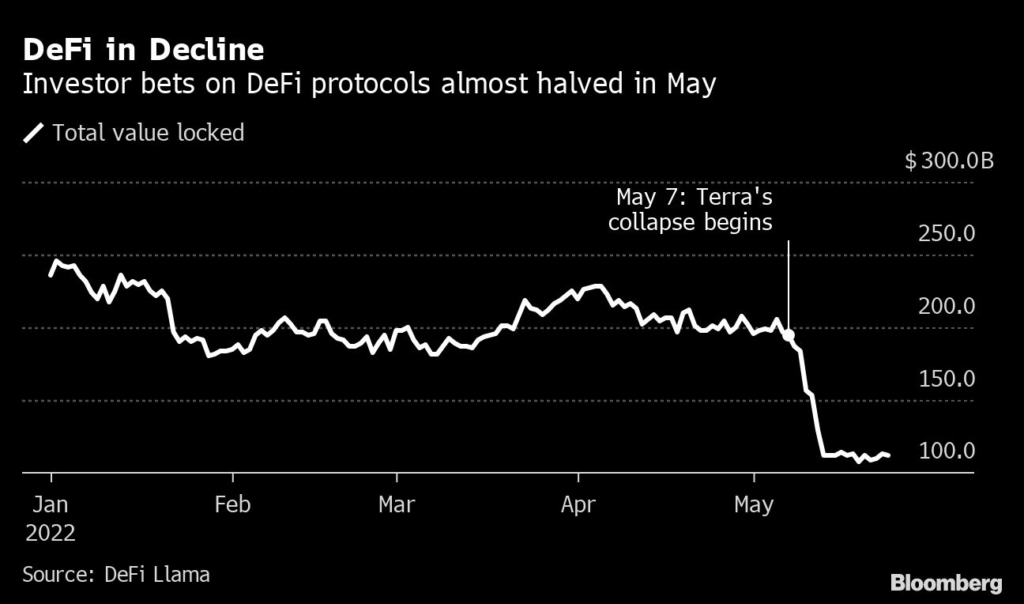
A crash in the prices of stablecoin TerraUSD, or UST, and its sister token Luna in the first half of May sent shock waves through the DeFi sector, where investors borrow, lend and stake cryptocurrencies without intermediaries like banks. The total value locked across all major protocols has slumped to $112 billion from $195 billion at the start of the month, data from industry tracker DeFi Llama show. 

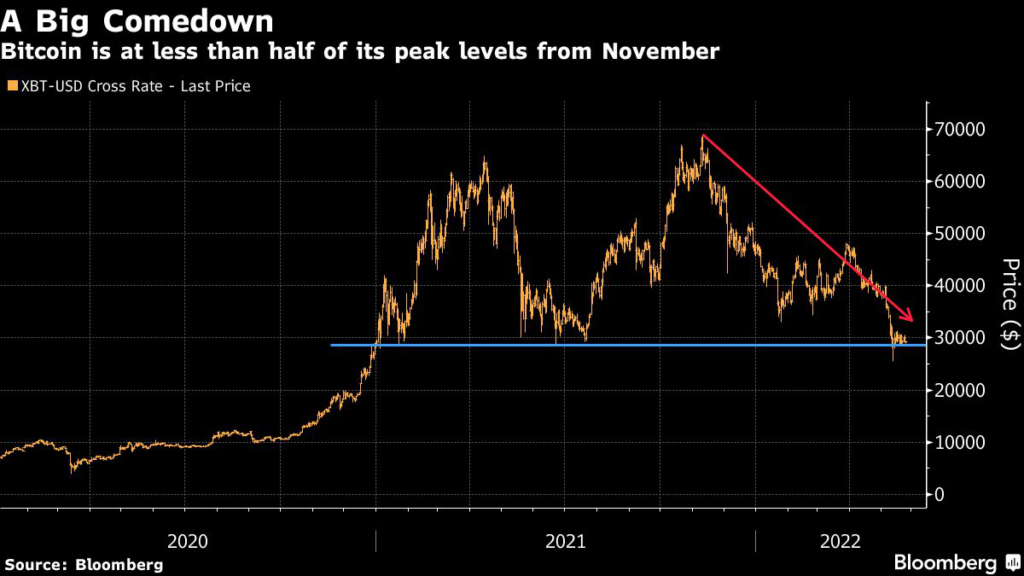
The fallout from Terra’s implosion also inflicted widespread damage on cryptocurrencies. Bitcoin and Ether, the two largest tokens, tumbled below key support levels earlier this month and have struggled to break above them since, caught just below $30,000 and $2,000 respectively. A Bloomberg index of digital coins is down 30% this month. 

DeFi projects entice investors to purchase their native tokens and deposit them to help order transactions on the underlying blockchain, a process known as staking. In return, they are offered yields that top those of traditional financial products. Terra’s main staking platform Anchor, responsible for driving most of the $40 billion ecosystem’s value, had advertised yields as high as 20% prior to UST’s collapse.

Read more: DeFi Believers Never Say Die, Even After They See Terra’s Demise

MakerDAO, the largest DeFi project by total value staked, has seen its total value locked drop by almost a third over the past month, to $9.8 billion, DeFi Llama data show. Curve, a popular platform for swapping stablecoins, has suffered a more than 55% plunge, to $9 billion.

Crypto research firm Kaiko said in a note Monday that the decline in staking demand on DeFi applications indicates “strong capital outflows from the space,” exemplified by rising liquidity for Ether and Bitcoin on centralized crypto exchanges.

“Fear is rampant. And you’d have to look long and hard to find a bullish investor across any risk asset,” Jeff Dorman, chief investment officer of Arca, an investor in Terra, wrote in a blog post on digital assets published Monday. “Those that are expressing bullish views are being bullied.” 

More stories like this are available on bloomberg.com

©2022 Bloomberg L.P.
Kuaishou’s Revenue Beat Estimates, Defying Slowdown in China

(Bloomberg) — Kuaishou Technology’s revenue narrowly beat estimates, as China’s No. 2 short-video platform defied a weakening economy and competition with TikTok-owner ByteDance Ltd.

Revenue rose to 21.07 billion yuan ($3.16 billion) for the three months ended March, versus the 20.6 billion yuan projected by analysts. Growth decelerated to the slowest pace since the company went public in February last year. Net loss came at 6.25 billion yuan, compared with the estimated 6.4 billion yuan loss.

China’s largest tech corporations find themselves in a new era of cautious expansion, more than a year into Beijing’s crackdown that engulfed the internet ecosystem from e-commerce to gaming and social media. Senior government officials have shown public support of digital-platform companies in recent weeks, but the country’s Covid lockdowns and economic malaise have resulted in some of the tech sector’s worst quarterly earnings in more than a decade.

Kuaishou is locked in a prolonged duel with ByteDance, whose viral hit Douyin continues to snap up users and advertisers from the broader Chinese social media sphere. Kuaishou has joined streaming hubs iQiyi Inc. and Bilibili Inc. and is outlining clearer goals to break even. Its China division should turn profitable sometime in 2022 on an adjusted net income basis, Chief Executive Cheng Yixiao said in March, by ramping up monetization while cutting costs.

In the wake of stricter rules on content and spending, the company is moving away from generating revenue from live-stream tips to more lucrative businesses like e-commerce, advertising and game publishing. This month, it unveiled plans to provide more traffic to over 500 selected merchants who will be licensed to sell products like cosmetics and clothes under the official “Kuai” brand.

Longer term, Kuaishou is seeking to replicate ByteDance’s success globally. While its two apps Kwai and Snack Video have made inroads in places like Brazil and Indonesia, they have yet to face off against TikTok in major markets like the U.S. In March, Kuaishou’s international chief Tony Qiu left the company due to personal reasons.

More stories like this are available on bloomberg.com

©2022 Bloomberg L.P.

Crypto Shows All the Signs of Financial Stability Risk, ECB Says

(Bloomberg) — A dramatic increase in the size and complexity of crypto markets means the sector is on track to become a risk for financial stability that must urgently be regulated, the European Central Bank said. 

While recent volatility has not proved contagious to the rest of the global financial system, the threat is increasing with institutional investors increasingly involved, the ECB said in a pre-released chapter from its financial stability review. 

“Based on the developments observed to date, crypto-asset markets currently show all the signs of an emerging financial stability risk,” the central bank said. “As this is a global market and therefore a global issue, global coordination of regulatory measures is necessary.”

The ECB has stepped up warnings and calls for tighter regulation in recent days since the stablecoin TerraUSD tumbled from its intended dollar peg earlier this month. 

President Christine Lagarde said last week that in her view crypto is “worth nothing,” and Governing Council member Francois Villeroy de Galhau added to the skepticism on Monday saying that the promises of rewards in crypto were “an illusion.”

In an interview with Bloomberg Television’s Francine Lacqua on Tuesday from Davos, Lagarde reiterated that sentiment.

“All I know is that it has moved up and has moved down and it is a highly speculative asset as I have said all along,” she said. “Some are experiencing this at the moment.”

Doubtful Diversification

In its review, the central bank also said that increasing correlation between crypto and more mainstream risky assets, which “casts doubt over their usefulness for portfolio diversification.”

Trading in assets like Bitcoin, Ether and Tether has at times surpassed volumes on the New York Stock Exchange, the central bank said. And despite recent declines, crypto markets are still similar in size to those for the sub-prime mortgages, which triggered the 2008 global financial crisis. 

The ECB urged the European Union to approve its regulation known as MiCA “as a matter of urgency” and to take further measures to mitigate risks to financial stability.

“Any further steps that allow the traditional financial sector to increase its interconnectedness with the crypto-asset market space should be carefully weighed up,” the ECB said.

More stories like this are available on bloomberg.com

©2022 Bloomberg L.P.
UBS Clients Are Holding Tight, Not Panicking: Davos Update

(Bloomberg) — UBS Group AG Chief Executive Officer Ralph Hamers said wealthy clients are sticking with their investments, though not necessarily putting new money into the market amid uncertainty over where the world is heading.

After a series of shocks, “of course it is unclear at this moment in time,” Hamers said in a Bloomberg Television interview on Tuesday at the World Economic Forum in Davos, adding that he expects more clarity in a few months. 

European Central Bank President Christine Lagarde sought to provide a path ahead, saying the euro area will leave the era of negative interest rates in the coming months as the currency bloc has reached a “turning point” in monetary policy. In an exclusive Bloomberg TV interview, she added that a recession isn’t the central bank’s base-line scenario for the euro zone.

Russia’s war in Ukraine is hanging over the gathering in the Swiss Alps as global leaders also grapple with energy inflation, food shortages and climate change. Speeches by Spanish Prime Minister Pedro Sanchez, European Commission President Ursula von der Leyen and NATO Secretary General Jens Stoltenberg are among highlights on the second day of the in-person event, which returned after a two-year hiatus due to the pandemic.

Key Developments

  • Lagarde Says Recession Is Not ECB Baseline for the Euro Area
  • Ukraine Urges Musk’s Starlink to Keep Helping Alongside Weapons
  • Latvia’s President Wants a NATO Brigade to Deter Russia

All times CET:

UBS Sees Clouds Clearing in the Next Three Months (9:15 a.m.)

UBS CEO Hamers said that he expects to see more clarity in global markets within the next three months as clients digest the fallout from recent geopolitical events. “We had to digest three major shocks: the pandemic shock, the war shock and the energy-transition shock,” he said. “Supply shocks and demand shocks all mixed in one.”

Wealthy clients, he said, aren’t panicking. They are staying invested, though not necessarily putting new money into the market. “I’m not sure they’re worried about what’s coming,” Hamers said. “It’s just they don’t know what’s coming.”

Recession Not ECB Baseline, Lagarde Says (9 a.m.)

Lagarde rejected the idea that the euro area is heading for a recession for the time being, while acknowledging the need to be “very attentive” to economic developments. “We don’t have that as a baseline,” she said. 

“We are not in a panic mode,” she added. “We are now at a stage where there is every certainty that we will stop net assets purchases very early in July, deciding so in June, which will then clear the way for rate hikes that will come reasonably shortly after that.”

Lagarde: Monetary Policy at ‘Turning Point’ (8:50 a.m.)

Lagarde said she decided to set out the future path of monetary policy in a blog post on Monday in part to address “expectations that were not necessarily founded.”

Read more: Lagarde’s Rate-Hike Plan Irks Some at ECB Who Want Faster Option

“We are clearly now at a turning point, and I thought it was appropriate at this point to explain what the journey is, what the direction of travel is, what the destination is in the relatively short term and what is our aim point as well,” Lagarde said in an interview with Bloomberg TV.

“I thought it was a good time given the combination of volatility that was out there, expectations that were not necessarily founded and the strong convergence that arose from the Governing Council due to the multiple positions as expressed during the last few days,” she added.

Top Polluters Face $67 Trillion Bill to Hit Climate Goal (8:45 a.m.)

The world’s seven-biggest polluters will have to spend $67 trillion by the end of this decade to stay on the path of achieving climate neutrality mid-century, according to a report from Polish Economic Institute that’s due to be presented in Davos on Tuesday.

The economies — China, the US, the EU, Brazil, India, Russia and Japan — are responsible for 70% of global greenhouse gas emissions. Their efforts are key for the world to meet the goals of the 2015 Paris Agreement to limit warming to “well below” 2 degrees Celsius above preindustrial levels.

With current investment pledges to green their economies, the EU will reach climate neutrality in 2056, followed by the US four years later and China only in 2071 — 11 years later than its target, according to the report. Russia won’t be able to reach climate neutrality until 2086.

Edelman CEO Praises More Intimate, ‘Less Cold’ Davos (7:25 a.m.)

Richard Edelman, chief executive officer of public-relations firm Edelman, said he was a fan of this year’s iteration of Davos saying its smaller scale was provoking better conversations.

“Davos has been actually great because its smaller, CEOs are really looking to talk,” Edelman said in a Bloomberg Television interview. Plus, he said, it is “less cold.”

More stories like this are available on bloomberg.com

©2022 Bloomberg L.P.

JPMorgan Says UK Digital Bank Now Has Almost £8 Billion in Deposits

(Bloomberg) — JPMorgan Chase & Co.’s new UK digital lender has attracted more than 500,000 customers and gathered about $10 billion in deposits since launching in September.

Chase UK, its British digital-only bank, is “off to a strong start,” JPMorgan said in an investor presentation Monday. But such growth hasn’t come cheap with losses at the US lender’s overseas digital banks likely to exceed $1 billion over the next five years.

The New York-headquartered financial group said it would lose about $450 million in 2022 on such projects and expected further losses in the coming years with the digital lenders forecast to breakeven five to six years from now.

Nutmeg, the digital wealth manager bought by JPMorgan last year, saw $1.5 billion of net new money post acquisition, the bank also said. The US lender also has a stake in C6 Bank of Brazil, which has more than 16 million retail customers.

More stories like this are available on bloomberg.com

©2022 Bloomberg L.P.

Close Bitnami banner
Bitnami