

Bloomberg

Activision Union Gets Legal Recognition in Gaming First

(Bloomberg) — Video game testers at Activision Blizzard Inc. voted on Monday to form a union with the Communications Workers of America in a first for a US-listed game company.

Nineteen quality assurance testers at subsidiary Raven Software, who assess the performance of games in the lucrative Call of Duty series, voted for legal recognition of the union they’d first organized in January. Three voted against. 

The outcome ends a protracted battle that began when management refused voluntarily to recognize the group. Workers came together in response to layoffs at the company last December, and their push for official status at the company comes as it’s also battling explosive allegations of sexism. 

“Our biggest hope is that our union serves as inspiration for the growing movement of workers organizing at video game studios to create better games and build workplaces that reflect our values and empower all of us,” the newly created union, the Game Workers Alliance, said in a statement. “We look forward to working with management to positively shape our working conditions and the future of Activision Blizzard through a strong union contract.”

Microsoft Corp. plans to buy Activision for $69 billion, and the deal is expected to be completed by June 2023 pending regulatory approval. Labor experts say other groups within Activision that are looking to follow Raven’s lead may face a much tougher foe if the purchase goes through.

Activision management had refused to recognize the union saying that the unit, which consists of 28 testers, comprised only a fraction of Raven’s staff. After a court battle, the National Labor Relations Board decided that the effort could move ahead.

The vote came the same day US labor board prosecutors determined that Activision illegally threatened staff and enforced a social media policy that conflicts with workers’ collective action rights. The NLRB said it will issue a complaint unless the company settles.

Pushing Back

In recent weeks, Activision management pushed hard against the union effort, encouraging employees to vote against the union, according to documentation seen by Bloomberg. “Having a union at Raven could fundamentally alter the way Raven works in ways that can have a significant, negative impact for the studio and for individual Raven employees,” company management wrote in an internal Q&A. The company also linked to a Bloomberg Law article about how long it can take for a union to negotiate its first contract.

In a series of videos sent to Raven staff and reviewed by Bloomberg, management at Activision and Raven listed bullet-points such as “A union can’t guarantee a pay increase” and “Union contracts often put an end to flexible scheduling.”

“We respect and believe in the right of all employees to decide whether or not to support or vote for a union,” a spokesperson for Activision said. “We believe that an important decision that will impact the entire Raven Software studio of roughly 350 people should not be made by 19 Raven employees.”

This will be the first union at a listed video game company in North America, where some top game studios have been accused of fostering cultures of sexism and overwork. The 13-person independent game studio Vodeo Games formed the first US-based video game union last year.

Recently, the US has experienced a unionization wave across tech and other industries. Just this year, workers at Starbucks and Trader Joe’s have announced unionization pushes. 

(Updates with comments from union and Activision, adds background from fourth paragraph.)

More stories like this are available on bloomberg.com

©2022 Bloomberg L.P.

Madison Cawthorn Under House Investigation Over Crypto Promotion

(Bloomberg) — The House Ethics Committee said Monday it is investigating whether North Carolina GOP Representative Madison Cawthorn may have improperly promoted a cryptocurrency in which he had a undisclosed financial interest.

It is the latest trouble for the first term House member, who lost his primary last Tuesday as a result of multiple controversies and miscues that prompted many prominent Republicans in the state to campaign against him.

The announcement from the bipartisan ethics panel said the investigation also will include looking into whether “Cawthorn engaged in an improper relationship with an individual employed on his congressional staff.”

The committee provided no details about the accusations, though North Carolina Senator Thom Tillis had publicly called for an investigation into whether Cawthorn engaged in insider trading and pictures leaked before the primary had raised questions about the relationship between Hawthorn and the staff member.

Cawthorn’s chief of staff, Blake Harp, called the ethics inquiry “a formality.”

“We welcome the opportunity to prove that Congressman Cawthorn committed no wrongdoing and that he was falsely accused by partisan adversaries for political gain,” Harp said in a statement. 

The Washington Examiner reported on April 26 that several independent watchdog groups questioned whether Cawthorn violated insider trading laws when he promoted the Let’s Go Brandon token, which refers to a euphemism for a vulgar anti-Biden sentiment.

“Tomorrow we go to the moon!” Cawthorn, 26, said Dec. 29 on his Instagram account on a photo of him with James Koutoulas, a co-founder of the cryptocurrency. The next day Nascar driver Brandon Brown, who inspired the “Let’s Go Brandon” meme, announced the token was his racing team’s primary partner for 2022. 

The value of the LGB token spiked after Brown’s announcement, according to the Examiner. 

After publication of the Washington Examiner report, Tillis tweeted that, “Insider trading by a member of Congress is a serious betrayal of their oath, and Congressman Cawthorn owes North Carolinians an explanation. There needs to be a thorough and bipartisan inquiry into the matter by the House Ethics Committee. #ncpol”

More stories like this are available on bloomberg.com

©2022 Bloomberg L.P.
Bitcoin Drifts After Longest Run of Weekly Losses Since 2011

(Bloomberg) — Bitcoin drifted around the $30,000 level it’s been hovering around since the collapse of the TerraUSD algorithmic stablecoin triggered a selloff in cryptocurrencies.

The largest digital token was down 0.6% to trade at $29,720 as of 3:02 p.m. in New York. It had moved higher earlier in the session, offering a reprieve to traders who watched it fall for seven straight weeks, the longest losing streak since August 2011, according to data compiled by Bloomberg. That mirrored the length of the declines in the S&P 500, underscoring how stocks and crypto remain closely linked.

“If the S&P falls some more, that should create one final flush and a great buying opportunity for Bitcoin,” Fundstrat Global technical strategist Mark Newton said. “There’s a lot of bearishness, and we should be approaching a time when you really want to buy into that in the next couple of months.”

Bitcoin has struggled in recent weeks as inflation remains elevated even with central banks in rate-hiking mode, boosting prospects for more monetary tightening. Also weighing on the outlook for crypto markets, regulators across the world have stepped up calls for stricter oversight since the TerraUSD stablecoin tumbled from its intended dollar peg earlier this month. 

Lagarde Says Crypto Is ‘Worth Nothing’ and Should Be Regulated

While Bitcoin has been touted in the past as a hedge against inflation, it’s proved in recent months to be highly correlated with risk assets like companies in the Nasdaq 100, which has tumbled amid the changing monetary regime. 

“The markets right now are just punishing anything that’s on the speculative side,” said Chris Gaffney, president of world markets at TIAA Bank.

The tendency to trade in line with stocks means crypto traders are now closely watching economic indicators for signs of where monetary policy — and, by extension, digital-asset prices — is heading.  

“Bitcoin is likely to hover around $29,000 to $31,000 for the next couple of weeks,” said Noelle Acheson and Konrad Laesser of Genesis Global Trading in a note Friday. They added that some economic-data releases, like US gross domestic product or inflation measures, “could change the narrative.”

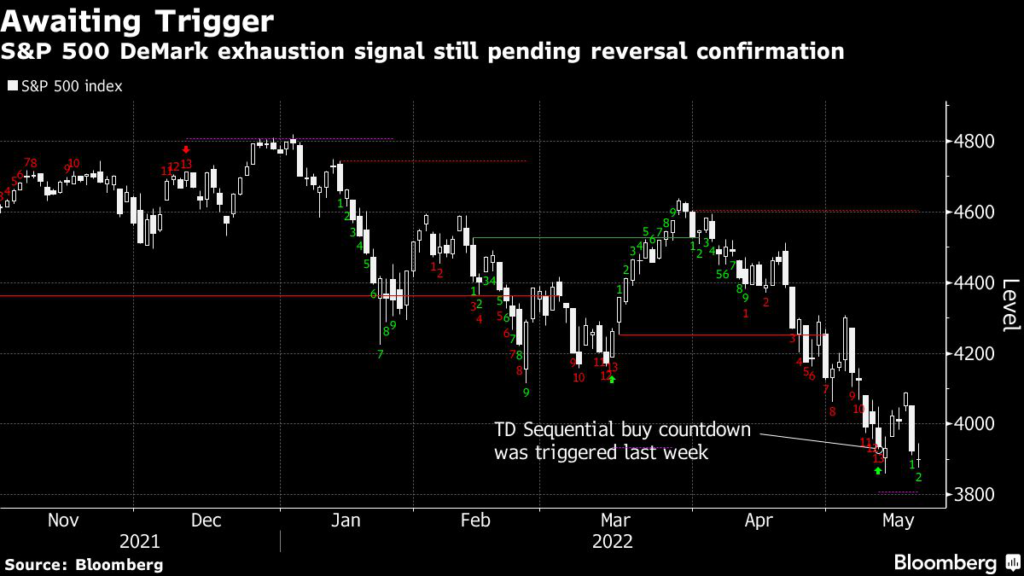
Rick Bensignor, president of Bensignor Investment Strategies and a former Morgan Stanley strategists, uses DeMark technical indicators — which compare the most recent maximum and minimum prices to the previous period’s equivalent price to measure demand — to argue Bitcoin likely won’t break higher anytime soon.

“I’d still expect another four weeks of heaviness,” he said in a note Monday. The May 12 low around $25,425 and the bounce from that keeps support intact at $28,900, he said.

(Updates prices throughout, adds Gaffney comment.)

More stories like this are available on bloomberg.com

©2022 Bloomberg L.P.

Wall Street Bank Lobby Lines Up Against a US Digital Dollar

(Bloomberg) — Wall Street lenders are calling on the US government to hold off on launching a digital dollar, arguing that a virtual currency backed by the Federal Reserve risks draining hundreds of billions of dollars out of the banking system.

An American central bank digital currency, or CBDC as it’s known, would act as a direct competitor to private bank deposits and make credit less available to businesses and households, according to the American Bankers Association and the Bank Policy Institute. The trade groups were responding to a Fed discussion paper released in January that laid out the potential benefits and risks of launching a new virtual tender. 

“As we have evaluated the likely impacts of issuing a CBDC it has become clear that the purported benefits of a CBDC are uncertain and unlikely to be realized, while the costs are real and acute,” the ABA said in a May 20 letter to the Fed. “Based on this analysis, we do not see a compelling case for a CBDC in the United States today.”

The prospect of a Fed-backed CBDC has become a hot-button issue in Washington as crypto has grown to a more than $1 trillion market and so-called stablecoins have drawn concerns from regulators and lawmakers. In March, the White House said in an executive order on cryptocurrency policy that it was placing “highest urgency” on research and possible development of a US digital dollar. 

While supporters say a Fed-backed digital currency would help ensure the dollar’s dominance as countries including China move forward with their own versions, the Wall Street trade groups say such a move could backfire. 

BPI, for example, said that a digital dollar would dry up a key source of funding for banks. “By attracting deposits away from banks, particularly during a period of economic stress, a CBDC likely would undermine the commercial banking system in the United States, and severely constrict the availability of credit to the economy,” the group said in a separate letter also dated May 20.  

Even if banks and other financial firms were to act as intermediaries, any funds their customers place into a CBDC account couldn’t be used to finance loans and other investments in the economy, the groups said. ABA and BPI said that’s because unlike standard commercial deposits, the tender would remain a direct liability of the Fed. 

Furthermore, capping the size of CBDC accounts to limit fallout is unlikely to help much, the groups said. The ABA predicted that a cap of $2,500 would still drain $446 billion in deposits from traditional banking. A $10,000 limit would result in more than $1 trillion in deposits leaving the system, the group said. 

More stories like this are available on bloomberg.com

©2022 Bloomberg L.P.

Activision Illegally Threatened Staff, Labor Officials Find

(Bloomberg) — US labor board prosecutors determined that Activision Blizzard Inc. illegally threatened staff and enforced a social media policy that conflicts with workers’ collective action rights, according to a government spokesperson. The finding is a setback for the company as it tries to fend off a unionization effort and finalize a $68.7 billion sale to Microsoft Corp.

Unless Activision settles, the Los Angeles-based regional director of the National Labor Relations Board will issue a complaint, the agency’s press secretary Kayla Blado said Monday. The NLRB enforces the National Labor Relations Act, the New Deal law establishing workers’ collective action and organizing rights.

Activision denied wrongdoing. “These allegations are false,” company spokesperson Jessica Taylor said in an emailed statement. “Employees may and do talk freely about these workplace issues without retaliation, and our social media policy expressly incorporates employees’ NLRA rights.”

The labor board is slated to count ballots on Monday from an election held among around 21 employees at Activision’s Raven studio in Wisconsin, which could establish a rare foothold for organized labor in the video game industry.

The allegations in the labor board case were brought to the agency last September by the Communications Workers of America, the same union organizing at Raven. CWA, which has increasingly focused in recent years on organizing non-union workers in the tech and video game industries, said in an emailed statement at the time that it was “very inspired by the bravery” of Activision employees and that it filed with the agency to ensure that violations by the company “will not go unanswered.” In an emailed statement Monday, CWA’s organizing director Tom Smith said the labor officials’ finding underscored the need for Activision’s CEO to change course: “In order to rebuild trust at Activision, Bobby Kotick needs to take the high road and start listening to workers instead of doing everything possible – including breaking the law – to silence them.”

Activision, the games-entertainment behemoth behind Call of Duty, has had a tumultuous year. It was hit last summer with an explosive complaint from California’s Department of Fair Employment and Housing, accusing the company of fostering a “bro culture” of sexism. Activision’s chief compliance officer, who served as Homeland Security adviser to President George W. Bush, called those claims “factually incorrect, old and out of context.” Workers there moved to unionize after news of job cuts in December 2021, which preceded weeks of strikes. In January, Activision agreed to the deal with Microsoft.

Complaints issued by labor board regional directors are considered by agency judges, whose rulings can be appealed to NLRB members in Washington, D.C., and from there to federal court. The agency can require remedies such as posting of notices and reversals of policies or punishments but has no authority to impose punitive damages. Jennifer Abruzzo, the labor board’s general counsel appointed by President Joe Biden, takes a much broader view of workers’ legal rights than her Trump-appointed predecessor. She has signaled she’ll seek to establish new precedents on numerous issues, including how much companies can restrict employees’ social media posts.

(Updates with company and union statements starting in third paragraph)

More stories like this are available on bloomberg.com

©2022 Bloomberg L.P.
Stock Selloff to Intensify as Fresh 10% Plunge Looms, Survey Finds

(Bloomberg) — Get ready for a fresh slump in the world’s most-watched stock index, as economic growth fears spiral and the Federal Reserve embarks on its biggest policy-tightening campaign in decades.

With the S&P 500 flirting with a bear market last week and notching more than $1 trillion in losses, participants in the latest MLIV Pulse survey reckon there’s more pain to come. 

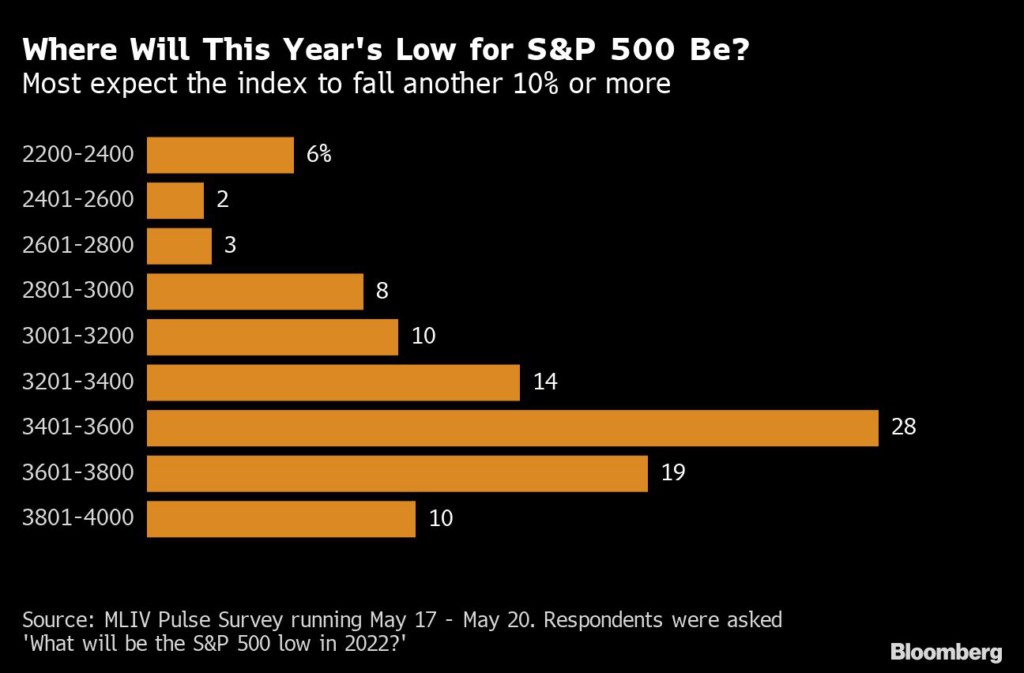
The gauge is likely to keep falling this year before bottoming at around 3,500, according to the median projection of 1,009 respondents. That represents a decline of at least 10% from the Friday close of 3,901 — and a gut-wrenching 27% drop from the January peak. The market received some respite Monday, with the equity benchmark jumping as much as 2%, but derivatives suggest that investors remain concerned that it’s just a temporary rebound.

The Fed’s hawkish-at-all-costs posture, the chaos in supply chains and intensifying threats to the business cycle are all undermining confidence in Corporate America’s profit machine, while equity valuations have sunk.

After the longest run of weekly losses in more than two decades, just 4% of the MLIV readers reckon the S&P 500 has found a bottom for the year based on closing levels. And a handful see a historic rout in motion to 2,240 — re-testing the pandemic lows.

Money managers endured a worse drawdown in the Covid-spurred tumult of 2020, but that’s scant consolation with projected losses of this scale. 

“I still think the worst is not behind us,” said Savita Subramanian, head of US equity and quantitative strategy at Bank of America Corp., on Bloomberg Television Friday. “There’s a pervasive fog of negative sentiment out there.”

Sobering profit assessments from the likes of retailer Target Corp. and network-equipment company Cisco Systems Inc. saw investors take the ax to share prices last week. Short interest in a popular exchange-traded equity fund jumped near levels last seen in March 2020.

The renewed haven bid for US government bonds suggests money managers are getting increasingly fearful about the economic trajectory, with lockdowns in China and the prolonged Russia-Ukraine conflict taking their toll.

Rebecca Patterson, chief investment strategist at Bridgewater Associates, said that much of the decline in stocks so far has simply stemmed from increases in the discount rate. “You haven’t seen a major change in expected earnings growth and so that to us is the thing we’re watching,” she said in a Bloomberg Television interview from Davos, Switzerland on Monday. “If the Fed continues to tighten to try to reduce demand to get inflation under control I would expect to see that flow through into discounted growth, which then eventually should bring equities that next leg lower.”

Option markets show that traders remain cautious about the prospect of further declines, particularly at the single-stock level. While the market rout of recent weeks has tempered somewhat investors’ fervor for hedging at the index level, the ratio of put to call contracts on individual equities on the Cboe rose to the highest level since March 2020.

As the retail-stock meltdown kicked off last week, respondents to the MLIV survey became more bearish over the latter part of the May 17-20 polling period. On average MLIV professionals in the research, risk management and sales community were more pessimistic than their peers in portfolio management and sell-side trading. (The mean data can be skewed by outlier views.)

Meanwhile, Marko Kolanovic at JPMorgan Chase & Co. is downplaying fears of an oncoming US recession and the median estimate from prominent Wall Street strategists suggests the index will close the year out at 4,800, suggesting hopes for a market bounce later this year. For Kristina Hooper, while an economic downturn is “pretty much priced in,” she doesn’t see that happening.

“Sentiment is very negative, which supports the view we’re closer to the bottom,” said the chief global market strategist at Invesco Ltd.

Yet as central bankers seek to engineer a tightening of financial conditions to moderate excesses, the risks of further cross-asset chaos is very real.

Asked which event will take place before the Fed shifts to dovish policy, 47% of respondents said they anticipated the S&P 500 falling 30% from its peak, while a similar proportion said US unemployment would rise to 6%, from 3.6% currently. 

More than 40% expect US investment-grade credit spreads to blow out beyond 250 basis points before the monetary-easing cycle kicks in, while around one-in-four see American home prices tumbling 20%.

Asked which asset class would need to see further declines before the risk-aversion cycle blows over, readers overwhelmingly cited equities, while housing, commodities and bonds also received submissions. 

Meanwhile, some 31% of respondents said the end of the Fed’s hiking cycle would deliver the biggest boost to growth and 27% indicated a preference for a scenario whereby China ends its zero-Covid policy. 

Around one in five said that a bigger growth dividend would come if the war in Ukraine were to end, and a similar proportion voted for a drop in crude oil to $70 a barrel.

  • For more markets analysis, see the MLIV blog. For previous surveys, and to subscribe, see NI MLIVPULSE.

(Updates with latest market moves, comments from strategist, information on options.)

More stories like this are available on bloomberg.com

©2022 Bloomberg L.P.

Didi’s Move From NYSE to Hong Kong — What to Know

(Bloomberg) — Didi Global Inc. is preparing to delist from the New York Stock Exchange, after its initial public offering there last year drew the wrath of Beijing. The Chinese ride-hailing giant said it plans to list in Hong Kong instead, allowing existing shareholders to convert their holdings in the company. There are challenges ahead — for Didi, its shareholders and other Chinese companies looking to go public. Meanwhile, the government’s ongoing investigation and new regulatory measures have hit Didi’s bottom line.

1. Why is Didi going to delist?

Chinese regulators opposed the US listing, saying it could expose Didi’s vast troves of data to foreign powers. The firm pressed ahead with the June 2021 IPO anyway, in a move that Beijing saw as a challenge to its authority. Days after the listing, the government announced a cybersecurity probe into the firm and forced its services off domestic app stores. Later the Cyberspace Administration of China, the agency responsible for data security, was said to have asked Didi’s top executives to devise a plan to delist because of concerns about leakage of sensitive data.

2. How will it work?

Didi has said that listing on the Hong Kong Stock Exchange will ensure that its American depositary shares can be swapped for “freely tradable shares of the Company on another internationally recognized stock exchange.” However, the firm was said to have suspended preparations for a Hong Kong listing after being informed by regulators that its proposals to prevent security and data leaks had fallen short. Shareholders approved the US delisting on May 23 and Didi is expected to work with Chinese regulators on an overhaul of its data systems. The company has put forward several ideas, including ceding management of its data to an outside party in China. Settling the data issue and then preparing for a Hong Kong listing could take months. 

3. What are the challenges?

Some institutional shareholders may be forced to sell once Didi stops trading in New York as they can’t hold unlisted equity. A Hong Kong listing carries its own challenges as the local exchange makes more stringent demands on companies seeking to list than its New York peers. Even if Didi pulls off a listing in Hong Kong, some investors may choose to sell rather than swap their US shares, which have fallen drastically. Didi in December disclosed a $4.7 billion loss in the September quarter after revenue slid 13% from the previous three months.

4. Why is this such a big deal?  

Didi’s blockbuster IPO was the second-biggest in the US by a company based in China (Alibaba Group Holding Ltd.’s was bigger) and gave Didi a market value of about $68 billion. The listing, which was shepherded by a who’s who of Wall Street banks, appeared to be a model for how international investors could tap into China’s red-hot tech sector. Didi’s largest shareholder was Japan’s SoftBank Group Corp., with more than 20%. 

5. Will China force other companies to change listings?

Didi’s exit is unlikely to be the last. The Chinese internet regulator began probing two more US-listed companies, Full Truck Alliance Co. and Kanzhun Ltd., soon after launching the review into Didi. In December the government unveiled tighter regulations for Chinese companies seeking to go public abroad using the so-called variable interest entity (VIE) structure, as Didi did. Meanwhile, the US is moving to implement a new law that mandates foreign companies open their books to U.S. regulators or face delisting starting in 2024. The US Securities and Exchange Commission says that only two jurisdictions historically have not allowed the required inspections, China and Hong Kong.

6. Will this end Didi’s troubles? 

Unlikely. The cybersecurity probe into Didi is ongoing, and regulators may still impose an array of punishments such as a fine, suspension of certain operations or the introduction of a state-owned investor. The municipal government of Beijing, where Didi is based, was said to have proposed that the Shouqi Group — part of the influential Beijing Tourism Group — and others acquire a stake in Didi, which would give control to state-run firms. Media including the South China Morning Post have reported that regulators may force Didi to reshuffle its top management. President Xi Jinping’s campaign to achieve “common prosperity” has heaped pressure on platform companies like Didi to offer better wages and benefits to its army of drivers. More fundamentally, the Chinese government is expected to maintain strict curbs on and scrutiny over big tech enterprises that amass sensitive data.

(Updates after shareholders approved New York delisting in question 2)

More stories like this are available on bloomberg.com

©2022 Bloomberg L.P.
IMF’s Georgieva Urges Against Abandoning All Crypto After Terra’s Crash

(Bloomberg) — People shouldn’t completely shun the crypto world after the recent collapse of a popular stablecoin, an official at the International Monetary Fund said Monday. 

TerraUSD, or UST, imploded earlier this month, setting off a chain reaction that saw the overall value of the cryptocurrency market slashed by hundreds of billions of dollars. 

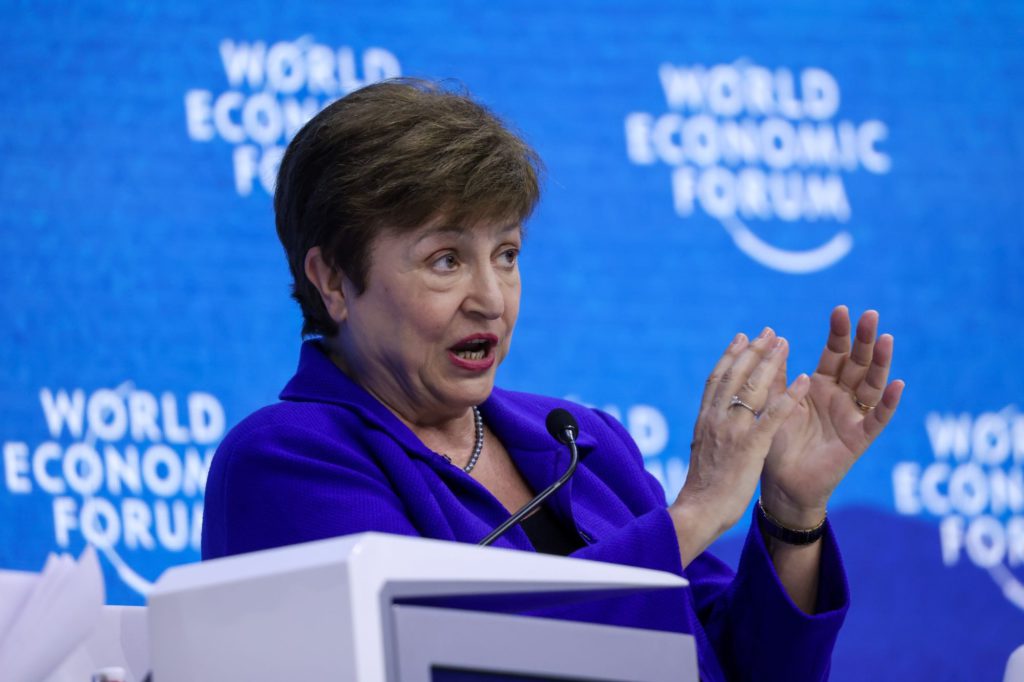
“I would beg you not to pull out of the importance of this world,” said Kristalina Georgieva, the IMF’s managing director, said at the World Economic Forum’s annual meeting in Davos. “It offers us all faster service, much lower costs, and more inclusion, but only if we separate apples from oranges and bananas,” she said, adding that it’s the responsibility of regulators across the globe to put up guardrails and offer education to protect investors. 

Georgieva noted that there are many different types of assets with varying levels of associated risk. For instance, there’s a big difference between stablecoins that are backed by cash and other assets and those that rely on algorithms to maintain their value, like the Terra coin, she said. Stablecoins are a type of cryptocurrency that are supposed to maintain a 1-to-1 value to a reserve asset like the US dollar. 

“The less there is backing it, the more you should be prepared to take the risk of this thing blowing up in your face,” Georgieva said. But she added that not all digital money should be tarnished with the same brush.

Georgieva was speaking alongside other members of the world’s financial elite on a panel discussing central bank digital currencies. Francois Villeroy de Galhau, governor at the Central Bank of France, dismissed concerns that central banks are slowly losing people’s trust as cryptocurrencies and decentralized finance rise in popularity.

“My impression is more that in recent weeks, citizens have lost trust in crypto, more than in central banks,” Villeroy said, referring to Terra’s collapse.

More stories like this are available on bloomberg.com

©2022 Bloomberg L.P.
Activision Illegally Threatened Staff, US Labor Officials Find

(Bloomberg) — US labor board prosecutors determined that Activision Blizzard Inc. illegally threatened staff and enforced a social media policy that conflicts with workers’ rights, according to a government spokesperson. Unless the company settles, the National Labor Relations Board’s Los Angeles-based regional director will issue a complaint, the agency’s press secretary Kayla Blado said Monday.

Activision did not immediately respond to a request for comment. The labor board is slated to count ballots on Monday from an election held among around 21 employees at the company’s Raven studio in Wisconsin, which could establish a rare labor foothold in the video game industry.

More stories like this are available on bloomberg.com

©2022 Bloomberg L.P.

Stocks Climb, Bonds Fall as Risk Appetite Returns: Markets Wrap

(Bloomberg) — Stocks rose after President Joe Biden signaled he’d reconsider China tariffs imposed by the Trump administration. The dollar and bonds fell.

Big banks led gains in the S&P 500 after JPMorgan Chase & Co.’s chief Jamie Dimon said “storm clouds” over the US economy may dissipate. The euro climbed after European Central Bank Chief Christine Lagarde said higher interest rates are coming in July.

“The markets have been due for a rally for quite some time,” wrote Paul Nolte, portfolio manager at Kingsview Investment Management. “It is not likely to mean the end of the decline that began at the start of the year, but a respite from the persistent selling of the past two months.”

Read: Gartman Advises Selling Rallies in This Year’s ‘Bear Market’

Separately, Biden said the US military would intervene to defend Taiwan in any attack from China, comments that appeared to break from the longstanding policy of “strategic ambiguity” before they were walked back by White House officials. Meanwhile, his administration announced that a dozen Indo-Pacific countries will join the US in a sweeping economic initiative designed to counter China’s influence in the region.

Russia’s blockade of Ukraine’s ports is a “declaration of war” that threatens to trigger mass migration and a global food crisis, a United Nations official said, adding to the dire warnings on the opening day of the World Economic Forum in Davos. A diplomat at Russia’s UN mission in Geneva has resigned in protest at President Vladimir Putin’s invasion of Ukraine, becoming the first envoy to publicly criticize the war.

Equities have been volatile as investors assess the impact of China’s Covid policies and monetary tightening on the outlook for the world’s largest economies. Beijing reported a record number of cases, reviving concerns about a lockdown, and adopted multiple measures to further stabilize the economy.

Minutes of the most recent Federal Reserve rate-setting meeting will give markets insight this week into the US central bank’s tightening path. St. Louis Fed President James Bullard said the central bank should front-load an aggressive series of rate hikes to push rates to 3.5% at year’s end, which if successful would push down inflation and could lead to easing in 2023 or 2024.

“The macro backdrop remains challenging, but a lot of bad news has been absorbed. We are probably approaching a near-term bottom in risk assets,” Barclays Plc strategist Ajay Rajadhyaksha wrote in a note.

Here are some key events to watch this week:

  • Eurozone S&P Global PMIs Tuesday
  • US new home sales, S&P Global PMIs Tuesday
  • Reserve Bank of New Zealand rate decision Wednesday
  • FOMC minutes Wednesday
  • ECB publishes its Financial Stability Review Wednesday
  • Bank of Korea rate decision Thursday
  • US GDP, initial jobless claims Thursday
  • US core PCE price index; personal income and spending; wholesale inventories; University of Michigan consumer sentiment Friday

Some of the main moves in markets:

Stocks

  • The S&P 500 rose 1.9% as of 12:14 p.m. New York time
  • The Nasdaq 100 rose 1.6%
  • The Dow Jones Industrial Average rose 2.1%
  • The MSCI World index rose 1.5%

Currencies

  • The Bloomberg Dollar Spot Index fell 0.6%
  • The euro rose 1% to $1.0670
  • The British pound rose 0.8% to $1.2575
  • The Japanese yen was little changed at 127.82 per dollar

Bonds

  • The yield on 10-year Treasuries advanced eight basis points to 2.86%
  • Germany’s 10-year yield advanced seven basis points to 1.02%
  • Britain’s 10-year yield advanced eight basis points to 1.97%

Commodities

  • West Texas Intermediate crude rose 0.2% to $110.52 a barrel
  • Gold futures rose 0.4% to $1,855.10 an ounce

More stories like this are available on bloomberg.com

©2022 Bloomberg L.P.

Close Bitnami banner
Bitnami