Bloomberg

Gartman Advises Selling Rallies in This Year’s ‘Bear Market’

(Bloomberg) — Dennis Gartman is telling prospective dip buyers to sell any rallies in US stocks during a bear market that he dates to the start of the year, and expects to last for many months.

“The bear market started January 5,” the chairman of the University of Akron Endowment told Bloomberg Radio on Monday, referring to a day after the S&P 500 hit an intraday record. “People have to understand that fact, and adjust their trading perspectives and investment perspectives accordingly. Rally selling is the viable strategy.”

Gartman said it’s ‘amusing’ that a debate exists on whether stocks are in a bear market. The S&P 500 temporarily registered a 20% drop on Friday from its most-recent closing high, only to recover slightly from the level that traditionally defines a bear market.

“I’ve always gone under the the notion that anything under 7% is bear-market territory,” he said. “You have to be more defensive once we take things down 7%, and 20% is pretty far down before you start to become bearish.”

He reduced the university endowment’s stock position on Dec. 31, 2021, and put the money into Treasury securities maturing in two, three, four and five years, “which I consider to be essentially cash holdings,” Gartman said.

 “I’ve got about 25% cash” in his personal portfolio, said the former publisher of the influential Gartman Letter. “And the only major positions I have are in gold and crude oil and commodities. I’ve had a nice period of time here for myself for the last several weeks, and I’m going to continue.” 

His bearish sentiment on financial assets stems from the hawkish regime of interest-rate increases and balance sheet reduction planned by the Federal Reserve in its attempt to rein in the fastest inflation since the 1980s.

Gartman, who has invested in and analyzed commodities markets throughout his decades-long career, said he is bullish on commodities in general except for soybeans. 

“You want to own the gold market” as an inflation hedge, Gartman said. “You want to avoid if at all possible cryptocurrencies.”

More stories like this are available on bloomberg.com

©2022 Bloomberg L.P.

Russian Port Sieges ‘Declaration of War,’ UN Says: Davos Update

(Bloomberg) — Russia’s blockade of Ukraine’s ports is a “declaration of war” that threatens to trigger mass migration and a global food crisis, a United Nations official said, adding to the dire warnings on the opening day of the World Economic Forum in Davos.

In a keynote speech via video link, Ukraine President Volodymyr Zelenskiy reinforced his call for embargoes on oil, technology and other trade with Russia, and said there should be no exceptions in sanctions on the country’s banking sector. The WEF began Monday under the shadow of the Ukraine conflict after a two-year hiatus due to the pandemic, albeit with fewer big names from Wall Street and politics.

Among a host of Bloomberg TV interviews on the sidelines of the event, the head of the International Energy Agency said that oil producers need to act responsibly to help keep a lid on prices otherwise there is a risk of global recession. International Monetary Fund chief Kristalina Georgieva acknowledged that strains on the global economy have intensified but pushed back against concerns about a contraction in output.

That wraps our Davos coverage for the day. Join us on Tuesday when we’ll have Bloomberg TV interviews including European Central Bank President Christine Lagarde, Spanish Prime Minister Pedro Sanchez and UBS AG Chief Executive Officer Ralph Hamers as well as speeches by European Commission President Ursula von der Leyen and NATO Secretary General Jens Stoltenberg.

Key Developments

  • Zelenskiy Issues Davos Demand to Shun Russia, Invest in Ukraine
  • Biden, Georgieva Push Against Recession Fears Amid Davos Gloom
  • Credit Suisse CEO Says We’ll Never Go Back to Office Full Time
  • Stiglitz Says US Rate Hikes Killing Economy Won’t Fix Inflation
  • Latvia’s President Wants a NATO Brigade to Deter Russia

All times CET:

Qualcomm ‘Faring Better Than Peers’: CEO 

Qualcomm Inc. Chief Executive Officer Cristiano Amon said that the company is faring better than its peers due to the geographic mix in its supply chain as semiconductors are in short supply globally.

“We have done better than some of our peers because we have been diversified since the very beginning,” Amon said in an interview with Bloomberg TV. “We are very well balanced between Taiwan and South Korea.” As governments spend to bolster semiconductor production and consumption increases, “there is opportunity to build in different places,” he said.

Saudi Arabia: No Immediate Need for Transfers to Sovereign Fund (5 p.m.)

Saudi Arabia’s windfall from high oil prices won’t end up in its Public Investment Fund just yet, according to the kingdom’s finance minister, Mohammed Al-Jadaan.

“PIF actually has ample liquidity,” he said on a panel. The sovereign wealth fund is one of Crown Prince Mohammed bin Salman’s main vehicles to achieve his “Vision 2030” economic diversification plan. Saudi Arabia is expected to achieve its first budget surplus in nearly a decade this year.

Germany Sees EU Oil Embargo ‘Within Days’ (4:45 p.m.)

Germany expects the European Union to resolve differences delaying agreement on an embargo of Russian oil within days, according to Economy Minister Robert Habeck, amid resistance from Hungary and others.

“Hungary and some other countries they still raised some problems,” Habeck told Bloomberg TV. “I think they’re solvable and I hope to have an oil embargo within days,” he added. “I think we should stick together and not do our national thing alone. This was the great strength in the past months that Europe, and also the transatlantic partnership, stood together.”

Saint-Gobain CEO Doesn’t Fear Recession (4:30 p.m.)

Cie. de Saint-Gobain Chief Executive Officer Benoit Bazin said he doesn’t currently fear recession and expressed confidence about the outlook for the French building-materials firm based on strong demand for building renovation projects.

“There is a perfect alignment on jobs for renovation towards energy efficiency so there is a large backlog of orders in Europe,” Bazin said in an interview with Bloomberg TV. “It varies country by country but overall no I don’t see a recession coming,” he added. “Renovation is 50% of our sales and it’s strong so I’m very confident about that.”

US Senator Urges Fed to Fight Inflation (3 p.m.)

Retiring Republican Senator Pat Toomey urged the Federal Reserve to “stay the course” and fight inflation, even if it means pushing the US into a recession. “The Fed’s got to do its job,” he said. 

If the US does slip into recession, “it could be mild, it could be brief, unemployment could rise very modestly,” he said on Bloomberg TV. “But we never get back to really strong growth and really good opportunity unless we get stability in the dollar.”

General Atlantic Sees Opportunity in Public Markets (3 p.m.)

General Atlantic is planning to move capital into public markets because stocks have dropped so much. The private equity firm, known for its focus on technology deals, is becoming a public market investor right now because there are so many “terrific opportunities,” Martin Escobari, co-president and head of General Atlantic’s Latin America unit, said in a Bloomberg Television interview.

The effect of that capital shift won’t be felt immediately in private markets because there’s currently so much liquidity, but it will impact those firms in the next six to nine months, he added.

Blocking Ukraine Ports ‘Declaration of War’: UN (2:30 p.m.)

The world was already facing a global food crisis before the Ukraine war but sidelining a nation — known as the breadbasket of Europe, which normally feeds 400 million people — has compounded it and now threatens to trigger mass migration, the head of UN’s World Food Programme said.

“Failure to open up the ports is a declaration of war on global food security,” David Beasley said referring to a Russian blockade, particularly of Odesa, which is preventing shipments of grain out of the country. He said opening the ports wouldn’t solve the entire problem but would provide more stability in the global food market.

Every 1% increase in hunger results in a 2% increase in migration, Beasley said, noting that 49 million people were “knocking on famine’s door” in 43 countries. “Those are the 43 countries we’ve got to be extremely concerned about that will result in destabilization and mass migration if we don’t get ahead of this,” he said.

Carbon Capture Needs Oil-Industry Scale: Swiss Re CEO (2:25 p.m.)

To help combat climate change, carbon capture will be a key solution, but it needs to be scaled “by a factor of one million” to be the size of the oil and gas industry by 2050, according to Christian Mumenthaler, chief executive officer of reinsurer Swiss Re Group. “It’s important to invest now,” he said on a climate panel.

To increase the money flowing to carbon-removal technologies like direct air capture and carbon sequestration, governments must “make it worth the while” of the private sector, said Varun Sivaram, senior director for clean energy and innovation at the US Department of State. There’s three ways to do so, he said: help to develop the technology, create financial incentives and put the right industrial architecture in place.

Stiglitz Calls for Supply-Side Action (2:20 p.m)

The US economy needs supply-side interventions rather than interest-rate hikes by the Federal Reserve that will fail to bring inflation under control, said Nobel laureate economist Joseph Stiglitz.

“Raising interest rates is not going to solve the problem of inflation,” the Columbia University professor said on Bloomberg TV. “It’s not going to create more food. It’s going to make it more difficult because you aren’t going be able to make the investments.” 

Mammoth CEO Sees Opportunity in Biotech Dip (2:15 p.m.)

The sinking biotech market is an opportunity for companies to focus on executing on their plans, said Trevor Martin, founder and chief executive of Crispr specialist Mammoth Biosciences Inc.

“I’m a big believer that when times are tough, that’s when you really can put the pedal to the metal, in a responsible way of course,” Martin said in an interview on the sidelines of the WEF. “It’s a huge opportunity for technologies that are really delivering to just completely get into that execution mode.”

Putin Wants to Rebuild Russian Empire: Kyiv Mayor (2 p.m.)

Vladimir Putin views Ukraine as a key part of a plan to reestablish the former Russian empire, according to the mayor of the capital Kyiv, Vitali Klitschko.

Speaking on the same Bloomberg panel, Klitschko’s younger brother Wladimir, who is also a former world boxing champion, criticized what he said was Europe’s inability to fight Russian propaganda. The first thing he saw on TV in his Swiss hotel room was a Russian channel showing pictures from Mariupol claiming that the port city had been destroyed by Ukrainians, he said.

Kerry: Gas Still Needed As Bridging Fuel (2 p.m.)

US Presidential Climate Envoy John Kerry said gas is still needed as a bridging fuel, but over time will be made redundant by new technologies such as green hydrogen and improved battery storage.

“It is appropriate to have a gas transition for some period of time while you bring technology to scale that is going to change altogether what we’re doing,” he said in an interview with Bloomberg TV. The US government is planning a major announcement on Wednesday with Microsoft Co-founder Bill Gates and Salesforce’s Marc Benioff around corporate emissions reductions and investments in new green technologies, Kerry said.

US Lawmakers Expect Continued Cooperation on Ukraine (1:50 p.m.)

US lawmakers from both parties are confident the country will continue to support Ukraine’s efforts to fight off Russia’s invasion, downplaying the idea that electoral politics will soon interfere with bipartisan cooperation.

Republican Senator Roger Wicker said the Senate was “reflecting public opinion” when it passed a $40 billion bill last week to help Ukraine. Democrat Chris Coons, however, acknowledged that the pandemic and inflation, especially rising energy prices, will divert attention ahead of the November midterm elections that will decide control of both the House and Senate.

“I think Putin is counting on the West to lose focus,” Coons said. “And I think that is our real challenge. To ensure we are providing enough support for Ukraine so they can make real gains on the battle field soon and get to some negotiation that is obviously Ukrainian led.”

Bridgewater Highlights Dollar Vulnerability (1:30 p.m.)

The U.S. dollar is vulnerable on a cyclical as well as on a structural basis, according to Rebecca Patterson, the chief investment strategist at Bridgewater Associates, the world’s largest hedge fund. The current account deficit for the US had widened to about 3.5% of gross domestic product officially, but her firm’s latest estimates suggest that it’s closer to as much as 6%, she said.

“For the dollar to stay supported, we need to continue getting enough capital to offset them, and we think there’s a growing risk around that,” she said in an interview with Bloomberg Television. “The most important thing to understand about the dollar right now is how quickly our external need for foreign capital is increasing.”

Anti-Russia Unity to Endure, Latvian President Says (1:25 p.m.)

The “unusual unity” against Russia is likely to last as countries now have “no illusions” about the dangers posed by Moscow, according to Latvian President Egils Levits. That includes an appreciation of the threat to global agricultural supply posed by the conflict, he told Bloomberg News.

Phasing out Russian oil and gas will be difficult for all countries in Europe, and harder for some, Levits added. Despite the difficulties, he insisted that the will remained to agree on an oil embargo as “we shouldn’t finance the war against Ukraine.” There is an understanding that some countries require special consideration and exemptions on potential time lines, he said.

AstraZeneca Seeks Partnerships to Boost Vaccines Unit (1:20 p.m.)

AstraZeneca Plc is looking for partnerships to expand its newly-created vaccine and immune therapies unit as well as seeking to speed its existing portfolio, unit chief Iskra Reic said. The UK drugmaker is interested in partnerships that would give it access to new technologies or accelerate development in the areas of vaccines or antibody treatments.

“We are really looking at how to accelerate and step up with internal resources, and as always we are very much open to external partnership,” Reic said in an interview on the sidelines of the WEF. The UK company still sees a role for its Covid vaccine in places like Latin America and Asia, where it’s the most-used vaccine, she said.

Bankers Not Rushing Back to the Office (12:05 p.m.)

Credit Suisse Chief Executive Officer Thomas Gottstein doesn’t think banks will ever return to working full-time from the office. “It’s unrealistic and it is not what employees want,” he said in an interview. “We are in a soft way trying to encourage people to come back, but it’s counterproductive if you push too hard.”

“We will never go back to the old 80% to 90% of the people in the office,” Gottstein said. Based on the company’s policies, about 60% of employees should be working from the office but the true number is 37%, and Gottstein indicated there’s not much that can be done to force people back.

Zelenskiy Asks for Help With Grain, Reconstruction (11:55 a.m.)

Zelenskiy also said Russia was stealing Ukraine’s grain supplies and asked for help from the international community to reject shipments, while urging safe corridors so the country can import its own supplies.

He also asked for financial assistance to help the Ukraine recover from Putin’s invasion. Russia is “blocking our ports, they ruined our refinery, our fuel deposits,” he said, responding to questions from WEF Chairman Klaus Schwab. “Ukraine faces many challenges,” Zelenskiy added. “I ask for help for Ukraine. The economy must work. I ask you to act promptly. If it is not promptly, we will lose a lot.”

Zelenskiy Calls for Russian Isolation (11:45 a.m.)

In a video address, Zelenskiy also called on the international community to establish a precedent to deter the Kremlin now as well as prevent future aggression.

“If brute force dominates, then there is no need to gather in Davos,” he said in a keynote address. “Brute force does not discuss, It kills.” He said that Ukraine was open for companies that leave Russia. “You will have access not only to a market of 40 million consumers but also to the EU market,” he said, with reference to his country’s comprehensive trade deal with bloc.

Thai Central Bank Upbeat on Inflation Target (11:45 a.m.)

Thailand’s central bank is confident inflation will return to target next year, signaling there was no rush to change monetary policy settings just yet to check price gains hovering around a 13-year high.

“Inflation is no doubt trending higher,” Governor Sethaput Suthiwartnarueput said in an interview with Bloomberg TV. “It’s relatively concentrated in energy and food. And we don’t see the kind of demand-side inflationary pressures in terms of an overheating economy.”

Hong Kong IPOs ‘Held Back by Sentiment’ (11:40 a.m.)

Hong Kong Exchanges & Clearing Ltd. Chief Executive Officer Nicolas Aguzin said that the main message he took with him from a recent visit to mainland China was the importance of Hong Kong continuing to develop as a key international financial center.

The CEO also said the pipeline of initial public offerings in the city also remains high — with between 170 to 180 applications — but are being held back by market sentiment. It was too early to predict when deals will pick up again, but “eventually the market will come back,” he said in an interview in with Bloomberg TV.

Winters ‘Skeptical’ of HSBC Breakup (11:30 a.m.)

Standard Chartered Plc Chief Executive Officer Bill Winters said he was “skeptical” of any push to break up rival lender HSBC Holdings Plc, which is under pressure from its largest shareholder to consider carving out its Asian operations.

“You end up taking something which is a reasonably well-functioning whole and splitting it up in pieces,” he said in an interview with Bloomberg TV. “Certainly for Standard Chartered bank, the cost would be much greater than the benefit. But frankly, nobody is suggesting that in our case.”

Canada Offers Help With ‘Critical Minerals’ (11:20 a.m.)

Canada can be “part of the solution” as countries and businesses seek more energy security, Francois-Philippe Champagne, Canada’s innovation, science and industry minister, told Bloomberg TV.

Supply chains are becoming more regional, “certainly more emphasis on resiliency than pure efficiency,” and Canada can help with critical minerals, he said. The country can also help power the world with “greener solutions,” he said.

Ukraine Makes War Crimes Case (11:05 a.m.)

Ukrainian officials in Davos, including a group of mayors, launched an exhibit of photos and video showing alleged war crimes committed by Russian troops. Speaking at the exhibition launch by video address, Andriy Yermak — an aide to President Zelenskiy — said the exhibit, which features 4,600 pieces of evidence, was not just a symbolic move. “It is honest, it is fair,” he said.

The WEF this year features a large Ukrainian continent, including Zelenskiy’s keynote via video link, and no Russian presence. The site of exhibit was particularly poignant, occupying the building that usually serves as “Russia House” at the WEF, but now dubbed “Russian War Crimes House.”

Germany Wants Market Changes to Limit Energy Prices (10:45 a.m.)

Germany’s Habeck called for changes in the rules governing energy markets to try to keep a lid on surging prices and limit Russia’s earnings from selling fossil fuels.

“Not only Gazprom and Putin have earned a fortune but also some companies have,” Habeck said on an energy panel. “So this is what I meant when I said that we have to keep the markets open but we have to change the rules,” he said, adding that one option could be for consumers to “agree that we don’t pay any price.”

“There has to be more creativity, more flexibility to think the unthinkable, to find solutions over the short term that we don’t give all the money to Putin,” Habeck said. “We have to find new solutions and we have to find them fast.”

Ukraine Calls for Further Russian Isolation (10:35 a.m.)

Speaking hours before Zelenskiy addresses the conference virtually, Ukraine’s First Deputy Prime Minister Yulia Svyrydenko took to a Davos stage to say Russia’s invasion had put the “world on edge” and more could be done to isolate it.

“Russia uses its leverage like a weapon,” she said. “Food, energy. Now it’s treating the world with world hunger. Their actions are intentional. There should be reaction on its weaponization of everything.”

She said companies that have bypassed the economic curbs imposed after the invasion should face sanctions too. “Armies win battles but the economy wins wars,” she said. “Now is not the time for a cost benefit analysis. We have to cut Russia off from the global economy completely.”

Tougher Sanctions on Russia Urged (9:30 a.m.)

The world needs to do more to “impose pain on Russia’s elite,” Republican Congresswoman Ann Wagner said. “The Russian elite must understand that continued support for Putin is no longer in their interests,” she said.

During a panel on sanctions, Eric Cantor, vice chairman of Moelis & Co., also called for “tightening the vice” on Russia but stressed that the US should secure the support of its allies. Because of the dollar’s status as a reserve currency, “every time we use it even our allies and our friends start to wonder why is it that you can do this, and how are we going to make sure that we don’t become subject to those sanctions,” he said.

Further Forecast Downgrades Possible: IMF (9:20 a.m.)

The International Monetary Fund may need to further trim forecasts for economic growth this year but doesn’t expect a global recession, according to Managing Director Kristalina Georgieva.

She told Bloomberg TV in Davos that there have been some “incremental changes” since the Fund last month cut its global growth forecast to 3.6%, including “tightening of financial conditions,” the rise in the value of the dollar and a “slowdown in China.”

“All of this is making further downgrades not out of the question and for some countries there is now an increased risk of recession,” she said. “But we do not anticipate a global recession.”

Algebris Sees Stocks Tumbling Further (9:10 a.m.)

U.S. stocks have further to fall because expectations for earnings are still too high, according to Davide Serra, chief executive officer of Algebris Investments.

The S&P 500 will fall to a base of 3200 to 3400 points, down from 3901 currently, Serra said in a Bloomberg TV interview. The money manager, who founded Algebris in 2006, also flagged a “sad” mood at Davos because of the war in Ukraine. “Three hours from here, people are dying and shooting each other,” he said. “And so I think that’s why it’s different.”

IEA’s Birol Warns of Global Recession Risk (8:45 a.m.)

Oil producers need to act responsibly to help keep a lid on prices otherwise there is a risk of global recession, according to Fatih Birol, the executive director of the International Energy Agency.

“If we don’t make a positive contribution here we may see prices even going higher, being much more volatile and becoming a major risk for recession for the global economy,” Birol said in an interview with Bloomberg TV from Davos. “This summer will be difficult because as we know in summer oil demand normally goes up,” he said, adding that a major question is whether demand from China will remain flat due to weakness in the economy there.

Credit Suisse CEO Says He Has ‘Clear Mandate’ (8:25 a.m.)

Credit Suisse CEO Gottstein, who has been under pressure because of a string of scandals and earnings setbacks, said he has a “clear mandate” from the board to continue in his position.

Responding to questions about his future, Gottstein said in a Bloomberg Television interview that he is focused on executing the bank’s strategy and is working well with other members of the executive board.

Germany Warns of Food ‘Catastrophe’ (8 a.m.)

Germany’s Habeck said the WEF can help policy makers coordinate strategy on how to address a looming global food “catastrophe” and reiterated an accusation that Russian President Vladimir Putin is weaponizing hunger.

“We shouldn’t kid ourselves that there are limits to Putin’s brutality,” Habeck said in an interview with Germany’s Deutschlandfunk radio. “The task here at Davos is for us to recognize that hunger is being used as a weapon,” he added. “That’s why it’s good that the discussions are taking place in person here again and so many people are coming.”

More stories like this are available on bloomberg.com

©2022 Bloomberg L.P.

Mark Zuckerberg Sued Over Cambridge Analytica Data Breach, D.C. Says

(Bloomberg) — The District of Columbia said it sued Meta Platforms Inc. Chief Executive Officer Mark Zuckerberg for his alleged role in the data breach that allowed political consulting firm Cambridge Analytica to target Facebook users during the 2016 presidential election.

A “sweeping investigation” revealed that Zuckerberg contributed to lax oversight of user data and the creation of misleading privacy agreements that resulted in Cambridge Analytica and other third parties getting their hands on the personal information of 87 million Americans, D.C. Attorney General Karl Racine said in a statement on Monday.

Cambridge Analytica was hired by then-candidate Donald Trump during his 2016 campaign against Hillary Clinton. Racine called it “the largest consumer privacy scandal in the nation’s history.”

The lawsuit mirrors an earlier suit Racine filed against Facebook in 2018, though the judge overseeing that case rejected as “almost bad faith” the Democratic attorney general’s attempt to add Zuckerberg as a defendant earlier this year.

“You want to change this from a case about Facebook to a case about Mr. Zuckerberg,” D.C. Superior Court Judge Maurice Ross said at a March hearing. “What value does it add to name him? There’s no more relief for the consumers of the District.”

Racine on Monday said it was important for his office to go after Zuckerberg.

“We continue to persist and have followed the evidence right to Mr. Zuckerberg,” Racine said in the statement. “The evidence shows Mr. Zuckerberg was personally involved in Facebook’s failure to protect the privacy and data of its users leading directly to the Cambridge Analytica incident. 

Meta declined comment. The company has previously derided Racine’s claims as “little more than a broadside against Facebook’s business model.”

Cambridge Analytica worked in support of the 2016 campaigns of Trump, Ted Cruz and Ben Carson, all Republicans. It was founded in 2013 by former Renaissance Technologies co-CEO Robert Mercer, a major supporter of Trump in 2016. Steve Bannon, Trump’s former chief strategist, was one of the campaign’s liaisons to Cambridge Analytica, which collapsed after revelations about its harvesting and use of personal data.

(Updates with Meta declining to comment and detail on earlier court case)

More stories like this are available on bloomberg.com

©2022 Bloomberg L.P.
D.C. Sues Zuckerberg Over Cambridge Analytica Data Breach

(Bloomberg) — The District of Columbia said it sued Meta Platforms Inc. Chief Executive Officer Mark Zuckerberg for his alleged role in the data breach that allowed political consulting firm Cambridge Analytica to target Facebook users during the 2016 presidential election.

A “sweeping investigation” revealed that Zuckerberg contributed to lax oversight of user data and the creation of misleading privacy agreements that resulted in Cambridge Analytica and other third parties getting their hands on the personal information of 87 million Americans, D.C. Attorney General Karl Racine said in a statement on Monday.

Cambridge Analytica was hired by then-candidate Donald Trump during his 2016 campaign against Hillary Clinton. Racine called it “the largest consumer privacy scandal in the nation’s history.”

The lawsuit mirrors an earlier suit Racine filed against Facebook in 2018, though the judge overseeing that case rejected as “almost bad faith” the Democratic attorney general’s attempt to add Zuckerberg as a defendant earlier this year.

“You want to change this from a case about Facebook to a case about Mr. Zuckerberg,” D.C. Superior Court Judge Maurice Ross said at a March hearing. “What value does it add to name him? There’s no more relief for the consumers of the District.”

Racine on Monday said it was important for his office to go after Zuckerberg.

“We continue to persist and have followed the evidence right to Mr. Zuckerberg,” Racine said in the statement. “The evidence shows Mr. Zuckerberg was personally involved in Facebook’s failure to protect the privacy and data of its users leading directly to the Cambridge Analytica incident. 

Meta declined comment. The company has previously derided Racine’s claims as “little more than a broadside against Facebook’s business model.”

Cambridge Analytica worked in support of the 2016 campaigns of Trump, Ted Cruz and Ben Carson, all Republicans. It was founded in 2013 by former Renaissance Technologies co-CEO Robert Mercer, a major supporter of Trump in 2016. Steve Bannon, Trump’s former chief strategist, was one of the campaign’s liaisons to Cambridge Analytica, which collapsed after revelations about its harvesting and use of personal data.

(Updates with Meta declining to comment and detail on earlier court case)

More stories like this are available on bloomberg.com

©2022 Bloomberg L.P.
VMware’s Old CEO Has Mixed Feelings About Broadcom Acquisition

(Bloomberg) — Intel Corp. Chief Executive Officer Pat Gelsinger said he has mixed feelings about the potential acquisition of software maker VMWare Inc. by Broadcom Inc.

“I’m sort of mixed on the current thinking,” Gelsinger said in an interview with Bloomberg TV in Davos, Switzerland, on Monday. “If it helps VMware be a more compelling, innovative growth story, then it’s good – if it does not, then it’s not good.”

Bloomberg reported Sunday that semiconductor giant Broadcom is in talks to acquire cloud software provider VMware, which Gelsinger led as CEO before returning to Intel, where he started his career. “I put eight years of my life – my soul – into VMware. So, I was a bit startled reading that,” he said.

With sinking tech valuations, further industry consolidation is likely, Gelsinger said. He added that more initial public offerings are also likely, and he hopes that Intel will complete the IPO of Mobileye this year. The autonomous driving company was acquired by Intel in 2017.

As for the supply chain challenges which have plagued the semiconductor industry over recent years – Gelsinger doesn’t see a balance between demand and supply until 2024.

More stories like this are available on bloomberg.com

©2022 Bloomberg L.P.

Global Trade Rebound Stalls as War, Covid Hit Supply Chains

(Bloomberg) — Russia’s war with Ukraine and China’s Covid-19 lockdowns have “short-circuited” global trade’s nascent rebound, the World Trade Organization said.

The WTO’s goods trade barometer — the first to be released since Russia’s invasion began in late February — showed how the conflict “triggered sharp rises in food and energy prices” that have further disrupted the flow of international commerce. 

The WTO’s periodic goods barometer edged up to 99 from the previous reading of 98.7 announced in February, according to a report published Monday. A level of 100 indicates growth over the next quarter that’s in line with medium-term trends, so the latest figures suggest “continued slow growth in merchandise trade.”

Container shipping statistics are below trend due to “persistent port backlogs,” the WTO report said. Meanwhile, export orders for cars, electronic components and air freight are above their baseline values. 

The WTO said its latest barometer is broadly consistent with the trade body’s April forecast of a 3% increase in global merchandise volumes in 2022, down from the 4.7% growth predicted last October.

More stories like this are available on bloomberg.com

©2022 Bloomberg L.P.

Ukraine Urges Musk’s Starlink to Keep Helping Alongside Weapons

(Bloomberg) — With Russia’s invasion entering its fourth month, sustaining the fight will require not only more weapons but also that billionaire Elon Musk keep facilitating access to high-speed broadband internet, Ukraine’s information minister said. 

The SpaceX founder has provided over 12,000 Starlink dishes to Ukraine so far, Mykhailo Fedorov, the minister for digital transformation, said in an interview on Monday on the sidelines of the World Economic Forum in Davos. Those terminals are proving crucial in supporting infrastructure across Ukraine as it wages its own information war on social media against Russia.

Ukraine is getting the help from Musk free of charge, according to Fedorov, who added there may be a different arrangement between Musk and the US Agency for International Development and European entities which provided most of the Starlinks to Ukraine. He didn’t elaborate. 

“All critical infrastructure uses Starlink, all structures that are needed for the state’s functioning use them,” Fedorov said. “We need to receive them constantly because they are one of the elements of the foundation of our fight and resilience.”

Zelenskiy Issues Davos Demand to Shun Russia, Invest in Ukraine

Musk in turn is gaining the ability to test his Starlink dishes in new circumstances. For the Tesla Inc. chief executive officer, Fedorov said, helping Ukraine is “also a unique experience for him. He will get to know a lot of new information about the technology he has created.”

That can be seen in the dishes Ukraine is receiving, as each new batch that comes is upgraded in some fashion, Fedorov said.

The co-operation with Musk was prompted by the 31-year-old minister, who appealed to Musk for help on Twitter shortly after the invasion started in late February. Since then, he said his country, international donors and Musk have been in close contact.

With the war dragging on — now focused on Ukraine’s eastern Donbas region after Russia’s failure to quickly take the capital — the passing weeks and months are raising concern among Ukrainian officials and others of momentum fading in international support, including economic and military assistance. 

Addressing the WEF by video link on Monday, President Volodymyr Zelenskiy urged the global community to “act preventively” in its support. “Ukraine has little time,” he said. “I want you not to lose this unity.”

Fedorov also sounded a note of concern as to whether donors, companies and individuals will remain focused and committed to sending Ukraine financial aid. “Yes, of course we worry a lot” about losing momentum, he said.

For now, though, donations are still coming in. In cryptocurrency alone, Ukraine has received over $70 million in aid, he said, although he noted the flow was a little erratic.

Even social media platforms have stepped up their focus on eradicating fake content.

Fedorov said “direct communication” with Facebook owner Meta Platforms has improved and the company is doing more to delete questionable content. Ukraine does not have issues with other social media platforms, he said, noting YouTube also deleted over 9,000 disinformation videos. 

Facebook Slammed for Spreading Putin’s Propaganda in NATO’s East

For a minister without a budget, as all funds are now going toward the military’s needs, Fedorov praised the “IT army” of cyber companies and volunteers that has formed to fight against what he said were constant Russian cyberattacks.

Ukraine has been able to put up a fight in the cyber universe as well, by targeting Russian institutions like banks and government databases, Federov said. There’s also a lot of activity in the non-public sphere, he said, but declined to elaborate on whether Ukraine was targeting Russian military assets for cyberattacks.

While the country’s IT sector has been buoyed by the war, Fedorov also estimated as many as 10% of its IT specialists may choose to leave as soon as general conscription ends. “We must invest in education and reforms” to stop that, he said.

More stories like this are available on bloomberg.com

©2022 Bloomberg L.P.

Balenciaga Hosts Its Spring Fashion Show at the New York Stock Exchange

(Bloomberg) — Balenciaga hosted its spring 2023 fashion show on the trading floor of the New York Stock Exchange on Sunday, in a symbolic move before the fashion house moves to start accepting certain cryptocurrencies as payment.

Models wearing face-obscuring latex masks and bodysuits walked around a dimly-lit NYSE trading floor as the screens that usually display market tickers glitched and flickered. The show debuted the closely held fashion house’s spring 2023 collection and a hotly-anticipated Adidas collaboration, which includes a $795 t-shirt with the NYSE logo on it. 

Event invitations were printed on stacks of Balenciaga-branded $100 bills bearing a disclaimer that “This invitation is for personal use only and is not tender.” Celebrity guests included Kanye West, now known as Ye, as well as Alexa Demie, Megan Thee Stallion and New York City Mayor Eric Adams. 

Balenciaga recently gained additional cultural popularity for frequently dressing Kim Kardashian and West. Kardashian famously wore a black bodystocking at the 2021 Met Gala, and West wore Balenciaga in promotion for his most recent album “Donda.”

More stories like this are available on bloomberg.com

©2022 Bloomberg L.P.
Top HSBC Venture Capital Dealmaker Leaves to Start New Fund

(Bloomberg) — Ore Adeyemi, a top dealmaker in HSBC Holdings Plc’s corporate venture capital arm, is leaving to start his own investment firm with two others from the bank, people with knowledge of the matter said. 

Adeyemi has been at the bank about 16 years, most recently as managing director and global head of strategic innovation investments based in the San Francisco area. He’s planning to launch a venture capital fund with Tom Bussey, an investment director in the HSBC venture capital group, the people said, asking not to be identified because the information is private. 

Thomas Caine, an investment manager at HSBC, will also be joining the new fund, the people said.

A representative for HSBC couldn’t immediately comment. Adeyemi, Bussey and Caine didn’t reply to messages on LinkedIn seeking comment.

HSBC’s corporate venture capital arm places bets on financial technology firms and other companies that could bring strategic benefits to the London-based bank. It has previously invested in cybersecurity provider CrowdStrike Holdings Inc., which is now listed in New York with a $34 billion market value, and data-analytics firm Platfora, which was bought by Workday Inc. in 2016.

The lender’s portfolio also includes anti-money laundering system Silent Eight, authentication software maker Callsign, ESG data provider MioTech and payment platform developer Episode Six, according to its website. 

Adeyemi, who grew up in Nigeria, completed his undergraduate studies at the Massachusetts Institute of Technology and later returned to earn an MBA at the MIT Sloan School of Management. 

He worked as a consultant at Booz Allen Hamilton earlier in his career and joined HSBC in 2006 as a mergers and acquisitions banker, his LinkedIn profile shows. Adeyemi later moved to do private equity deals for the lender’s principal investments unit before eventually moving up the ranks of its venture capital arm, first in London and then the US. 

Other banking industry veterans have also jumped into the world of startup investing. Former star research analyst Mary Meeker, known for her predictions on internet trends, left Morgan Stanley in 2010 to join Kleiner Perkins and later started her own venture capital firm.  

Adeyemi’s departure comes as global banks struggle to retain some of their top-ranking Black executives. Bloomberg News reported in April that Goldman Sachs Group Inc.’s youngest Black partner, Darren Dixon, is leaving his role as head of global capital solutions to start his own infrastructure-focused fund. 

The HSBC alumni will be courting investors at a turning point in the world of startup investment. Technology stocks have been getting pummeled, hurting prospects for profitable exits and making institutions wary of committing too much capital to the sector.

More stories like this are available on bloomberg.com

©2022 Bloomberg L.P.

Zoom’s 85% Selloff Has Analysts Calling for a Rally 

(Bloomberg) — The selloff in Zoom Video Communications Inc.’s stock may have gone too far.

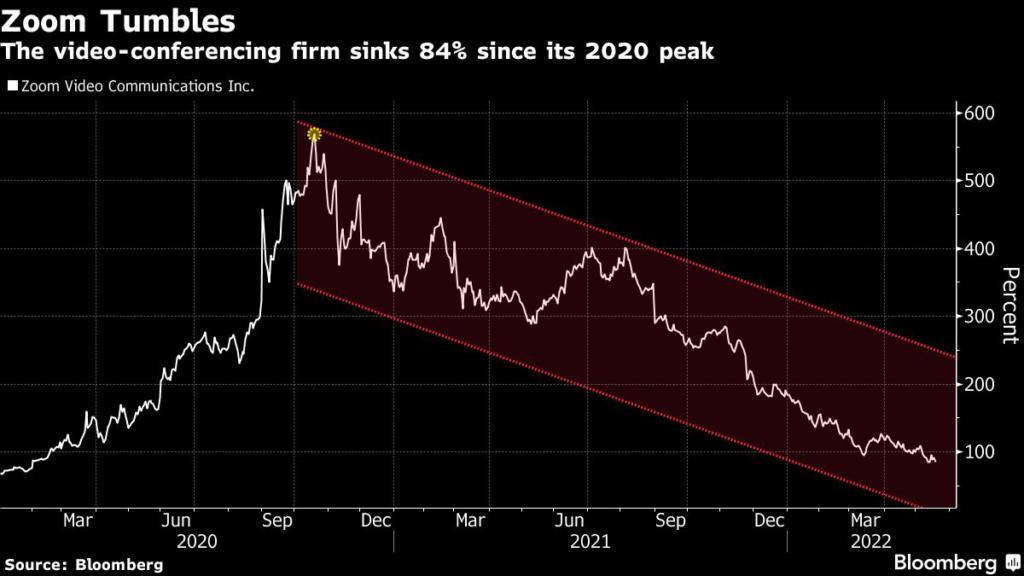
That’s the message from Benchmark Co.’s Matthew Harrigan and other analysts, who say the video-conferencing company is well positioned as a hybrid work services provider after riding the stay-at-home boom. And with the stock having cratered almost 85% from its 2020 pandemic peak, wiping out about $135 billion of market value, they see scope for a rally.

“The fixation on Zoom as a Covid pandemic lockdown aberration is exaggerated as global tech and financial firms recognize the permanence of hybrid work,” Harrigan said in a note to clients previewing first-quarter results that are due for release after US markets close on Monday.

Most major companies now offer employees the flexibility to work both from the office and from home, though even that has faced challenges due to rising Covid cases in many countries. Apple Inc. this month delayed a plan to require workers to come back to the office three days a week. Credit Suisse Group AG Chief Executive Officer Thomas Gottstein said he doesn’t think banks will ever return to working full-time from the office. 

All of that bodes well for Zoom, which unlike some pandemic darlings is still showing growth in its key metrics. After a more than 12-fold rise in sales in its last three fiscal years, analysts expect a 12% increase in the first quarter.

Compare that with Netflix Inc., which wasn’t able to sustain a massive pull forward in new customers during the pandemic and shocked Wall Street last month with its first decline in subscribers in over a decade.

Analysts like Harrigan think Zoom’s product offerings can make it a post-Covid winner as more employees seek flexible work arrangements.

“I think the Street is not filtering through all the tea leaves with Zoom,” said Daniel Morgan, senior portfolio manager at Synovus Trust. “They’re just kind of stamping it with the stay-at-home Covid trade like Amazon or Netflix and are not really looking at the bigger fundamentals.”

Morgan Stanley analyst Meta Marshall says the quarterly report should act as a catalyst to disprove the overly bearish sentiment about Zoom’s growth.

“Renewals for contracts signed in the early stages of Covid will have passed for another year in the March/April timeframe, which will provide a better view into enterprise customer retention,” Marshall wrote in a note. She has an overweight recommendation on Zoom.

Forecast Upside

Backing up the largely bullish sentiment, analysts forecast that the shares will rise 65% to $143.30 in the next 12 months, according to data compiled by Bloomberg. While that’s a far cry from its 2020 closing high of $568.34, it represents a hefty potential return for those purchasing the shares at current depressed levels. Zoom closed at $89.74 on Friday.

Furthermore, the stock’s valuation is nowhere near as frothy as it once was. The San Jose, California-based company trades at about 25 times forward earnings, down from 225 times in September 2020.

To be sure, Zoom’s growth is slowing as schools restart in person, offices reopen and competition increases from Microsoft Corp.’s Teams software, Salesforce Inc.’s Slack platform and Cisco Systems Inc.’s Webex.

Volatility Expected

Traders are bracing for some volatility after the results, with the stock expected to move more than 21% in either direction — that’s bigger than the moves seen after the past six quarterly reports were issued, according to data compiled by Bloomberg.

Yet overall, there is a feeling of optimism that Zoom is positioned to prosper in a post-pandemic world.

“Even as we shift into a more hybrid working environment, we will need a reliable platform for virtual communication to supplement in-person meetings, and there is a strong sentiment in Zoom’s favor already from a user perspective,” said Pedro Palandrani, director of research at Global X.


Tech Chart of the Day

Top Tech Stories

  • Broadcom Inc. is in talks to acquire cloud-computing company VMware Inc., according to people familiar with the matter, setting up a blockbuster tech deal that would vault the chipmaker into a highly specialized area of software. VMware shares surged as much as 19% in premarket trading on Monday.
  • Tencent Holdings Ltd.’s billionaire co-founder Pony Ma shared a viral opinion piece on the economic costs of China’s strict Covid Zero measures, in a rare show of frustration after his company struggled to grow during the first quarter
  • Didi Global Inc. is widely expected to secure a blessing from shareholders on Monday to delist in New York, capping an 11-month ordeal that wiped out around $60 billion of its market value and turned the ride-hailing giant into a symbol of China’s tech crackdown
  • Xiaomi Corp., the world’s third-biggest smartphone maker behind Samsung Electronics Co. and Apple Inc., announced a long-term partnership with Leica Camera AG on the co-development of smartphone cameras.

(Updates return potential in paragraph 11.)

More stories like this are available on bloomberg.com

©2022 Bloomberg L.P.

Close Bitnami banner
Bitnami