
Bloomberg

Investor John Doerr: Silicon Valley Should ‘Triple Down’ on Clean Tech

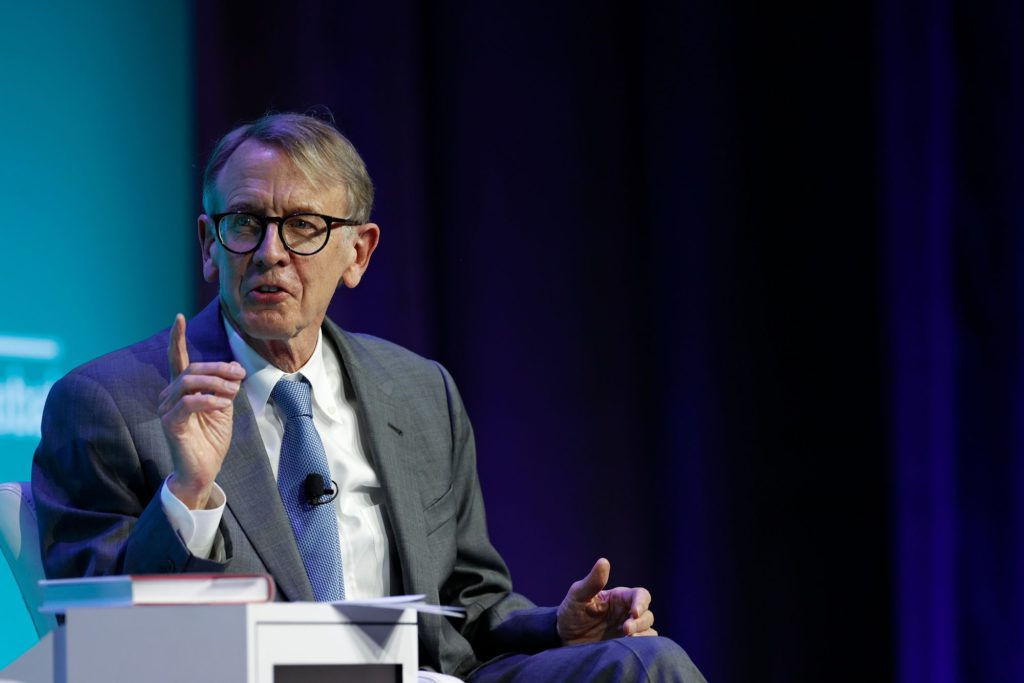
(Bloomberg) — Venture capitalist John Doerr, who bankrolled some green technology firms that collapsed a decade ago, believes the current explosion in clean energy financing won’t repeat history, even as investing markets begin to sour.


“People often ask us, ‘Is this a bubble?’” Doerr said on Friday at a climate tech conference in San Francisco. “No, it’s not a bubble. I prefer to think of it as a boom. Boom periods, yes, lead to some excesses, but they produce much greater investment, full of employment and rapid innovation.”

Doerr’s firm, Kleiner Perkins, is one of the several Silicon Valley stalwarts who have plowed money into areas like electric vehicles, batteries, and carbon accounting. Climate tech companies raised a record $53.7 billion in private financing in 2021, according to figures from BloombergNEF, a clean energy research group.

Those startups now face a brutal market turndown that has prompted cost cutting and investor caution across Silicon Valley. For some company founders and financiers, that may echo the chill from a decade ago, when clean energy companies like Solyndra went bankrupt or failed to live up to lofty valuations.

Doerr, whose firm struggled with clean tech investments, said that final financial calculus on the earlier clean tech wave wasn’t as bad as people think. The $1 billion his firm put in then is worth “about 3 billion today,” he said at an hosted by Climate Draft, a new industry group for entrepreneurs and investors. “Not as great as WhatsApp,” Doerr added, “but a positive return that we should be celebrating.”

The investor ascribed the current market turmoil to an “inept” handling of Covid-19, supply chain woes and the war in Ukraine, which has caused a surge in oil production. He said that current market conditions were an invitation to put more funding into the sector, not pull back. “We should not be doubling down but tripling down on clean energy, alternative policies and technologies,” he said. While oil and gas companies have seen a surge in growth since the war in Ukraine, public renewable energy and clean tech companies have suffered. Invesco Wilderhill Clean Energy EFT, a clean energy fund that includes solar and electric vehicles companies, is down 30% from the start of the year.

At the event on Friday, Ryan Panchadsaram, an adviser with Kleiner Perkins who joined Doerr on stage, asked the audience to raise their hand if they had raised a dedicated climate fund in the last six months. Several people did. “I don’t see a slowdown,” he said. “I think valuations will be more responsible.”

Doerr, the seasoned investor, told entrepreneurs in the audience to be cautious around risks, costs and incumbent companies in their sectors. “Lesson number two,” he said, “You will always be raising money. Get good at it. Get to where you enjoy it.”

Earlier this month Doerr announced a donation of $1.1 billion to Stanford University to create a school focused on climate change and sustainability, the biggest donation in the institution’s history.

More stories like this are available on bloomberg.com

©2022 Bloomberg L.P.

Average Age of US Cars Hits Record 12.2 Years in Fifth Straight Annual Increase

(Bloomberg) — Cars on US roads are as old as they’ve ever been, potentially complicating efforts to expand the use of new safety and emissions-reduction technologies.

The age of light vehicles domestically is now 12.2 years on average, up almost two months from last year’s figure, according to S&P Global Mobility. That’s a record high and marks the fifth straight year of increases.

Analysts at the data provider pointed to the global microchip shortage, supply-chain snags and inventory challenges — all of which likely kept drivers in their old cars longer. The rising cost of new vehicles — $46,526 last month, according to Kelley Blue Book — was another deterrent for prospective buyers.

The combination could put a damper on manufacturers’ efforts to introduce newer safety technologies and to spur faster adoption of more fuel-efficient hybrid and electric vehicles. 

“Everything is going to be delayed when it comes to MPGs because new vehicles are selling at a lower rate than expected,” Todd Campau, associate director of aftermarket solutions at S&P Global Mobility, said in an interview. 

Carmakers sold over 15 million new cars in the US in 2021, according to Cox Automotive data. EVs made up just over 3% of the total, with hybrids accounting for another 6.4%.

Campau said in addition to getting older, US cars are facing more wear and tear as overall driving levels have bounced back from lows at the beginning of the Covid-19 pandemic. The group said the vehicles averaged 12,300 miles in 2021, up more than 10% from the prior year. 

“Coupled with increasing average age, strong average vehicle miles traveled points to the potential for a notable increase in repair revenue in the coming year,” Campau said.

More stories like this are available on bloomberg.com

©2022 Bloomberg L.P.
Stocks Rise on Biden Tariff Comments; Dollar Drops: Markets Wrap

(Bloomberg) — Stocks and the yuan advanced after President Joe Biden said China tariffs imposed by the Trump administration were under consideration. The dollar and Treasuries retreated.

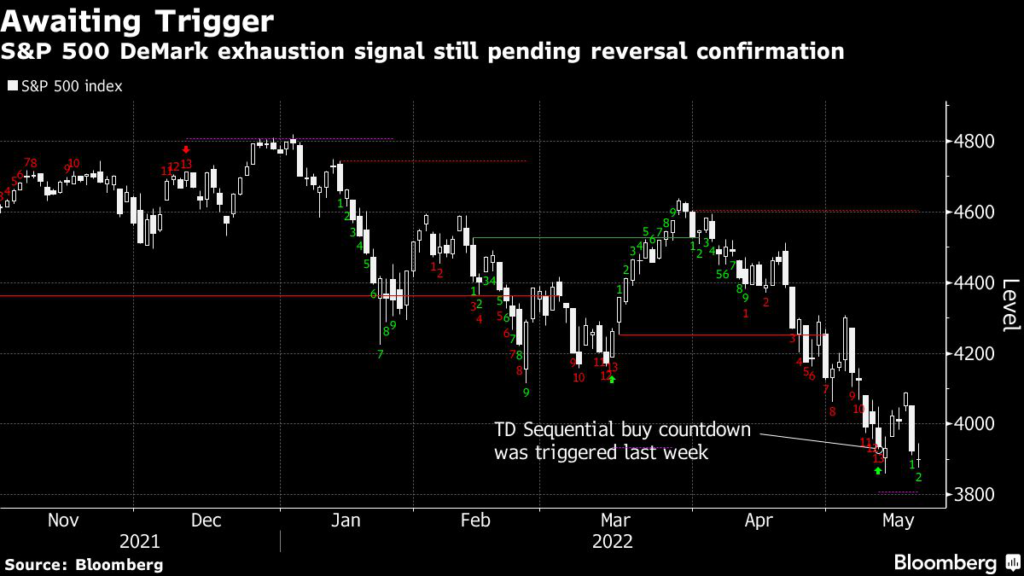
US equity futures rose amid expectations bargain hunters will help pull the S&P 500 back from bear-market levels. Energy and basic resources led gains in Europe’s Stoxx 600 Index, while Asian and emerging markets shares climbed.

The euro rose to its highest level in four weeks and most of the region’s bonds fell after European Central Bank President Christine Lagarde said the ECB is likely to start raising interest rates in July and exit sub-zero territory by the end of September. Treasuries dropped as investors debate the Federal Reserve’s tightening path amid mounting worries about an economic slowdown. 

Traders interpreted Biden’s comments that he’ll discuss the US tariffs on Chinese imports with Treasury Secretary Janet Yellen when he returns from his Asia trip as a signal there could be a reversal of some Trump-imposed measures. 

“Today’s appetite for risk has been sparked by the US President’s announcement that trade tariffs imposed on China by the previous Trump administration will be discussed,” said Pierre Veyret, a technical analyst at ActivTrades. “Investors see this as a possible de-escalation of the trade war between the two economic superpowers, and this has revived trading optimism towards riskier assets.”


Separately, Biden said the US military would intervene to defend Taiwan in any attack from China, comments that appeared to break from the longstanding US policy of “strategic ambiguity” before they were walked back by White House officials. Meanwhile, his administration announced that a dozen Indo-Pacific countries will join the US in a sweeping economic initiative designed to counter China’s influence in the region.

Among notable moves in premarket trading, VMware surged after Bloomberg News reported that Broadcom is in talks to acquire the cloud-computing company. Antiviral and vaccine stocks also rose amid spreading cases of the monkeypox virus.

In Europe, oil stocks rose with crude prices and Siemens Gamesa Renewable Energy SA rallied after Siemens Energy AG made a takeover offer. Base metals extended their rebound from a five-month low as the demand outlook was bolstered by the weaker dollar. 

Ukraine President Volodymyr Zelenskiy reinforced his call for embargoes on oil, technology and other trade with Russia, and said there should be no exceptions in sanctions on the country’s banking sector.

Equities have been volatile as investors assess the impact of China’s Covid policies and monetary tightening on the outlook for the world’s largest economies. Beijing reported a record number of cases, reviving concerns about a lockdown. 

Minutes of the most recent Fed rate-setting meeting will give markets insight this week into the US central bank’s tightening path. St. Louis Fed President James Bullard said the central bank should front-load an aggressive series of rate hikes to push rates to 3.5% at year’s end, which if successful would push down inflation and could lead to easing in 2023 or 2024.

“As macro-economic concerns stemming from aggressive monetary tightening, the Russia-Ukraine conflict and China’s stringent Covid lockdowns persist, we anticipate great volatility in the market,” Louise Dudley, portfolio manager global equities at Federated Hermes Ltd., said in a note.

Read: Stock Selloff to Intensify as Fresh 10% Plunge Looms: MLIV Pulse

Read: After Meltdown, Tech-Bottom Signals Have Yet to Scream ‘Buy Now’

Here are some key events to watch this week:

  • Atlanta Fed President Raphael Bostic, Kansas City Fed President Esther George speak at events Monday
  • ECB Governing Council members Robert Holzmann and Joachim Nagel, BOE Governor Andrew Bailey discuss inflation at event Monday
  • Eurozone S&P Global PMIs Tuesday
  • US new home sales, S&P Global PMIs Tuesday
  • Reserve Bank of New Zealand rate decision Wednesday
  • FOMC minutes Wednesday
  • ECB publishes its Financial Stability Review Wednesday
  • Bank of Korea rate decision Thursday
  • US GDP, initial jobless claims Thursday
  • US core PCE price index; personal income and spending; wholesale inventories; University of Michigan consumer sentiment Friday

Some of the main moves in markets:

Stocks

  • Futures on the S&P 500 rose 0.9% as of 6:45 a.m. New York time
  • Futures on the Nasdaq 100 rose 0.7%
  • Futures on the Dow Jones Industrial Average rose 0.8%
  • The Stoxx Europe 600 rose 0.7%
  • The MSCI World index rose 0.4%

Currencies

  • The Bloomberg Dollar Spot Index fell 0.7%
  • The euro rose 1% to $1.0665
  • The British pound rose 0.8% to $1.2574
  • The Japanese yen rose 0.3% to 127.49 per dollar

Bonds

  • The yield on 10-year Treasuries advanced four basis points to 2.82%
  • Germany’s 10-year yield advanced three basis points to 0.98%
  • Britain’s 10-year yield advanced three basis points to 1.92%

Commodities

  • West Texas Intermediate crude rose 1.1% to $111.48 a barrel
  • Gold futures rose 1% to $1,867.40 an ounce

More stories like this are available on bloomberg.com

©2022 Bloomberg L.P.
Bitcoin Recovers After Longest Run of Weekly Losses Since 2011

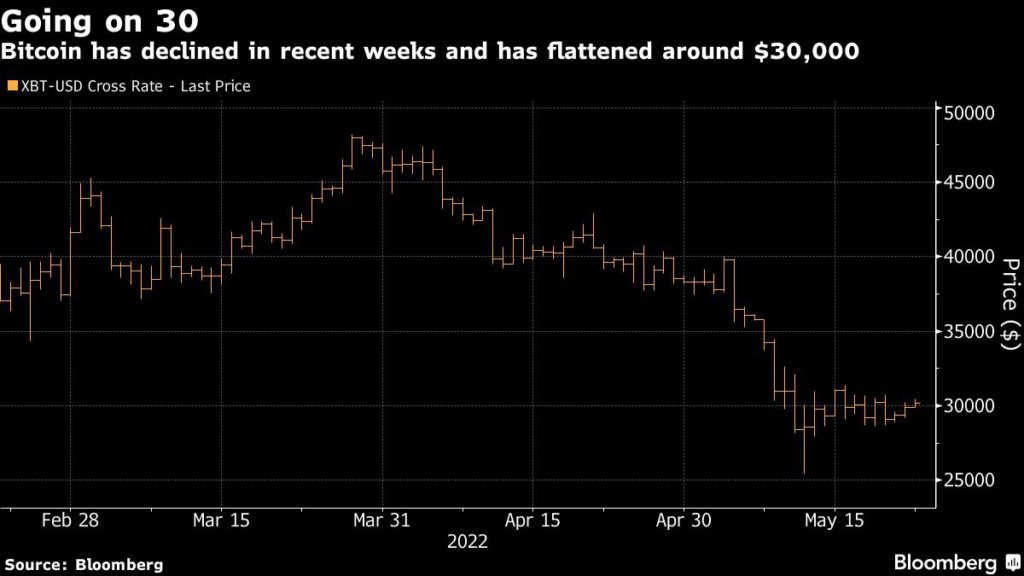
(Bloomberg) — Bitcoin recovered to trade just above the $30,000 level where it’s been mostly hovering since the collapse of the TerraUSD algorithmic stablecoin triggered a selloff in cryptocurrencies.

The largest digital token rose 1.7% to $30,425 at 11:35 a.m. in London. Monday’s gain came after it fell for seven straight weeks, the longest losing streak since August 2011, according to data compiled by Bloomberg. That mirrored the length of the decline in the S&P 500, underscoring how stocks and crypto remain closely linked.

“If the S&P falls some more, that should create one final flush and a great buying opportunity for Bitcoin,” Fundstrat Global technical strategist Mark Newton said. “There’s a lot of bearishness, and we should be approaching a time when you really want to buy into that in the next couple of months.”

Bitcoin has struggled in recent weeks as inflation remains elevated even with central banks in rate-hiking mode, boosting prospects for more monetary tightening. Also weighing on the outlook for crypto markets, regulators across the world have stepped up calls for stricter oversight since the TerraUSD stablecoin tumbled from its intended dollar peg earlier this month. 

Lagarde Says Crypto Is ‘Worth Nothing’ and Should Be Regulated

While Bitcoin has been touted in the past as a hedge against inflation, it’s proved in recent months to be highly correlated with risk assets like companies in the Nasdaq 100, which has tumbled amid the changing monetary regime. 

The tendency to trade in line with stocks means crypto traders are now closely watching economic indicators for signs of where monetary policy — and by extension, digital-asset prices — is heading.  

“Bitcoin is likely to hover around $29,000 to $31,000 for the next couple of weeks,” said Noelle Acheson and Konrad Laesser of Genesis Global Trading in a note Friday. They added that some economic-data releases, like US gross domestic product or inflation measures, “could change the narrative.”

Rick Bensignor, president of Bensignor Investment Strategies and a former Morgan Stanley strategists, uses DeMark technical indicators — which compare the most recent maximum and minimum prices to the previous period’s equivalent price to measure demand — to argue Bitcoin likely won’t break higher anytime soon.

“I’d still expect another four weeks of heaviness,” he said in a note Monday. The May 12 low around $25,425 and the bounce from that keeps support intact at $28,900, he said.

More stories like this are available on bloomberg.com

©2022 Bloomberg L.P.

UN Rights Chief Says Her Rare China Trip Isn’t an Investigation

(Bloomberg) — The United Nations’ human rights chief told diplomats her trip to Xinjiang this week wouldn’t be an “investigation,” in an apparent attempt to manage expectations of her landmark visit to China.

Michelle Bachelet said her trip aimed to promote, protect and respect human rights, according two people who attended the Monday video call with some 100 participants, who were mostly Beijing-based diplomats. The people asked not to be identified discussing the sensitive issue. 

Bachelet said setting high expectations would lead to disappointment, according to the people, addressing concerns raised mainly by Western diplomats on the call over whether she’d be granted unfettered access to Xinjiang. 

Rights groups and countries including the US have accused Beijing of putting mostly Muslim ethnic Uyghurs in mass detention camps in the far western region as part of a campaign of “genocide.” China rejects charges that human rights abuses or genocide occur in Xinjiang, which has become one of the biggest points of tension between the world’s two largest economies. 

US Ambassador Nicholas Burns expressed to Bachelet “profound concerns” about China’s human rights record in Xinjiang and attempts by Beijing to manipulate the trip, according to multiple people on the call who asked for anonymity as they weren’t authorized to speak. 

The UN Human Rights Office didn’t immediately respond to a request for comment on criticisms of the meeting.

Still, Bachelet said she’d make the most of being in China, where her arrival in Beijing this week marked the first time a UN human rights chief had visited the country since 2005. 

The UN official also confirmed she’ll visit a detention center in Xinjiang and has set up meetings independently of Chinese authorities, one of the people said. Bachelet added that she will produce a report on Xinjiang, separate to the delayed one her office is already working on, without sharing publication dates of either.  

She’ll also deliver a lecture at Guangzhou University in the southern province of Guangdong, visit Kashgar and Urumqi in Xinjiang, and hold a press conference on Saturday to wrap up the trip, the UN Human Rights Office said in a Friday statement. 

Chinese Foreign Ministry spokesman Wang Wenbin said Monday at a regular press briefing in Beijing that Bachelet would travel in a “closed loop as agreed by the two sides” without traveling press. China is battling virus outbreaks in several cities, as it clings to a Covid Zero policy of eliminating the virus. 

Bachelet’s visit has taken years to arrange, after being delayed by the pandemic and negotiations over access. Discussions between China and Europe about a trip to Xinjiang by a group of ambassadors reached a deadlock last year, with an official from the region complaining the envoys wanted to meet “criminals.” China routinely has police follow reporters who travel to the region.

The State Department this month outlined plans to boost pressure on China over what it called “horrific abuses” of Uyghur and other ethnic minorities in Xinjiang. A US law set to take effect next month would ban the import of goods from Xinjiang unless companies can prove they weren’t made with forced labor. 

Washington is also weighing the unprecedented step of imposing severe Treasury Department sanctions on Hangzhou Hikvision Digital Technology Co., which makes surveillance systems used in Xinjiang.

More stories like this are available on bloomberg.com

©2022 Bloomberg L.P.
Dell Becomes Billionaire Kingmaker in Broadcom, VMware Deal

(Bloomberg) — Technology entrepreneur Michael Dell once again finds himself at the center of one of his industry’s biggest deals.

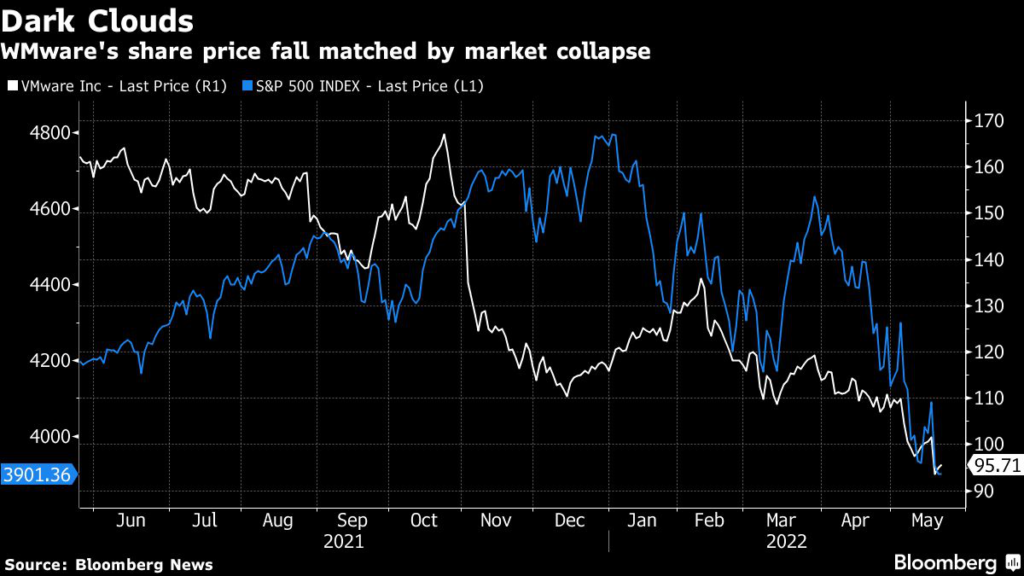
Dell holds a roughly $16.2 billion stake in VMware Inc., meaning he’s likely to have a important say in a potential takeover of the cloud-computing provider by chip maker Broadcom Inc. The two companies are in talks about a transaction, Bloomberg News reported Sunday. 

While it’s not known what price Broadcom is willing to pay for VMware, which has a market value of $40 billion, it may have to offer a sizable premium to get the company’s shareholders on board. 

VMware’s market capitalization touched $70 billion as recently as October, when Dell’s interest would have been worth some $28 billion. Shares in VMware rose 15% in premarket trading on Monday, which would value the company at about $46 billion.

“Valuation and Michael Dell’s 40% stake could be hurdles to Broadcom’s reported M&A interest in VMware,” said Woo Jin Ho, analyst at Bloomberg Intelligence. “Deal synergies exist, but we believe VMware may seek a valuation prior to the recent market drop.”

Buyers offered an average 34.1% premium in takeovers of software companies announced over the past five years, data compiled by Bloomberg show. Assuming Broadcom offered a similar add-on, that would still only value VMware at around $54 billion and it’s unclear whether that would be enough for Dell.

The 57-year old founder of Dell Technologies Inc. has a net worth of $44.2 billion, according to the Bloomberg Billionaires Index, and isn’t shy about getting into a corporate fight.

He took his eponymous PC maker private in 2013 in a $24.9 billion deal in the face of fierce opposition from renowned activist investor Carl Icahn. Around three years later, he led a $67 billion acquisition of EMC Corp. in what remains one of the biggest tech deals in history. 

Then, in 2018, he won a battle to buy out shareholders of stock that tracked Dell’s stake in VMware — created after the EMC takeover — once again defeating opposition from Icahn. 

There may also be the chance of rival offers for VMware tempting Dell to hold out. “We believe VMware could attract interest from other suitors pursuing software such as Cisco,” said Jin Ho.

More stories like this are available on bloomberg.com

©2022 Bloomberg L.P.
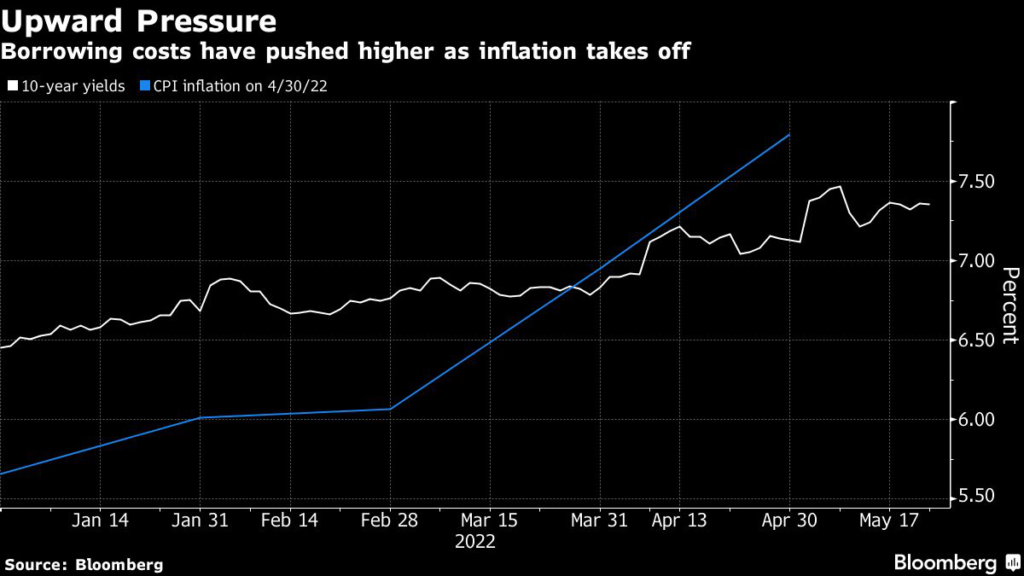
India Flags Rate Hikes, Tax Cuts in Coordinated Inflation Fight

(Bloomberg) — India’s economic leaders are undertaking a coordinated attack on inflation, with fiscal and monetary authorities seeking to slow price increases and blunt the impact of higher costs on consumers.

The joint moves come as inflation in Asia’s third-largest economy tracks at an eight-year high, breaching the central bank’s target for the past four months, and as markets test the ability of policy makers to smooth currency moves and keep borrowing costs in check.

“We have entered another phase of coordinated action between fiscal and monetary authorities to check inflation,” Reserve Bank of India Governor Shaktikanta Das said in an interview Monday with CNBC-TV18, adding that the measures would have a “sobering impact” on consumer prices. 

India joins policy makers globally struggling to slow a surge in consumer prices that threatens their recoveries from the pandemic and risks tipping economies back into recession. 

Das said the central bank will raise interest rates at its “next few” meetings, following on a surprise hike earlier this month that ended two years of pro-growth cheap credit support to weather the pandemic.

His comments come days after the government of Prime Minister Narendra Modi announced fiscal measures, including tax and fuel price cuts, that are estimated to cost $26 billion and drive government borrowing higher. 

Read more: India Unveils $26 Billion Inflation Plan, Risks Higher Borrowing

Expectations for higher rates are “a no brainer,” Das said in the interview Monday, adding that policy makers are aiming to remove a liquidity “overhang.” He also said that the RBI won’t allow a “runaway” depreciation of the rupee. 

The currency has seen a series of record lows in recent weeks amid investment outflows of more than $20 billion this year. After Das spoke, the rupee recouped earlier losses to trade down 0.1% to 77.595 to the dollar.

While economists see the new fiscal plan widening the deficit — Barclays Plc predicts it will hit 6.9% of gross domestic product — Das said he expects the government to stick with its 6.4% goal. Bond yields briefly fell after his comments. 

“My sense is that the government remains committed to maintaining the fiscal deficit target given in the budget,” Das said. “I cannot speak on behalf of the government, but having worked in the finance ministry, there is no one-to-one correlation” between spending and borrowing needs, he said.

While the cuts and subsidies could soften headline inflation and ease pressure on the central bank, they may not be enough to divert the RBI from its monetary tightening path, economists wrote in reports Sunday and Monday. 

Read more: India Tax Cuts Seen Easing CPI Pressure, RBI Still to Tighten

Other points Das made in the interview include:

  • The central bank will, at its next meeting in June, revise its 5.7% inflation forecast for the current fiscal year to March
  • The RBI remains committed to ensuring a non-disruptive government borrowing. “We will use various policy instruments”
  • “We will move toward positive real interest rates,” without proving a timeline. External member of the rate setting panel Ashima Goyal last week pitched for frontloading hikes to prevent real rates from becoming too negative
  • Cryptocurrencies will “seriously” undermine monetary and fiscal stability

(Recasts top, updates with details throughout.)

More stories like this are available on bloomberg.com

©2022 Bloomberg L.P.

Tesla Suppliers’ Caution at Odds With EV Maker’s China Optimism

(Bloomberg) — Elon Musk’s enthusiasm for China doesn’t seem to have dimmed despite the lockdown-induced issues being weathered by Tesla’s factory in Shanghai. Suppliers don’t necessarily share the same sentiments.

During the latest earnings season, there was a sense of déjà vu. Executives at Taiwan-based Tesla suppliers offered candid comments about plans to diversify manufacturing away from China as they assessed the fallout from the government’s punitive lockdowns. It was almost as if we’d returned to the height of the trade war initiated by the Trump administration.

“Covid is turning localized supply chains into a growing trend,” Hon Hai Precision Industry Chairman Young Liu told analysts during an earnings call May 12. Hon Hai is the flagship unit of China’s largest private employer, Foxconn — best known as Apple’s key assembly partner. It also supplies components to Tesla and other automakers.

In mid-April, fellow Tesla parts supplier Delta Electronics also waxed lyrical about plans to add more capacity outside of China, even though it admitted the country will remain its largest manufacturing base.

And a week later, Tesla’s camera module supplier Primax Electronics unveiled a target to lower manufacturing in China to below 50% of total output by 2024. Primax said it’s seeking to increase production in Thailand, the Czech Republic and is potentially considering a site in the US.

“China has always positioned itself as the world’s factory but it may no longer work under the current situation,” Chairman Raymond Liang told analysts. “We’ll have more regional production bases,” he said, adding that increasing costs in China, geopolitical tensions and tariffs were being factored into the company’s thinking.

Tesla suppliers’ caution echoes a rethink among foreign firms about their China investments, too. Yet it’s in stark contrast to Musk’s unabated zeal toward the country — perhaps understandable for a nation of 1.4 billion with rising purchasing power.

In recent weeks, the outspoken billionaire has again predicted China’s economy will overtake the US, praised “super-talented and hardworking” Chinese workers and largely dismissed the impact of Shanghai’s lockdown on the company’s operations.

But the damage being caused can’t be ignored. Tesla’s China sales crumbled in April with domestic deliveries plunging almost 90% from a year earlier.

Even renowned Tesla bull Dan Ives, an analyst at Wedbush Securities, wasn’t impressed. 

“It’s a new reality for Tesla in China,” Ives told Bloomberg TV last week after he cut his target price to $1,000 from $1,400. (The stock closed on Friday in the US at $663.90, down 37% for the year.)

As Shanghai’s lockdown drags on, perhaps there’s something to what Tesla’s suppliers are saying that deserves a second listen.

More stories like this are available on bloomberg.com

©2022 Bloomberg L.P.
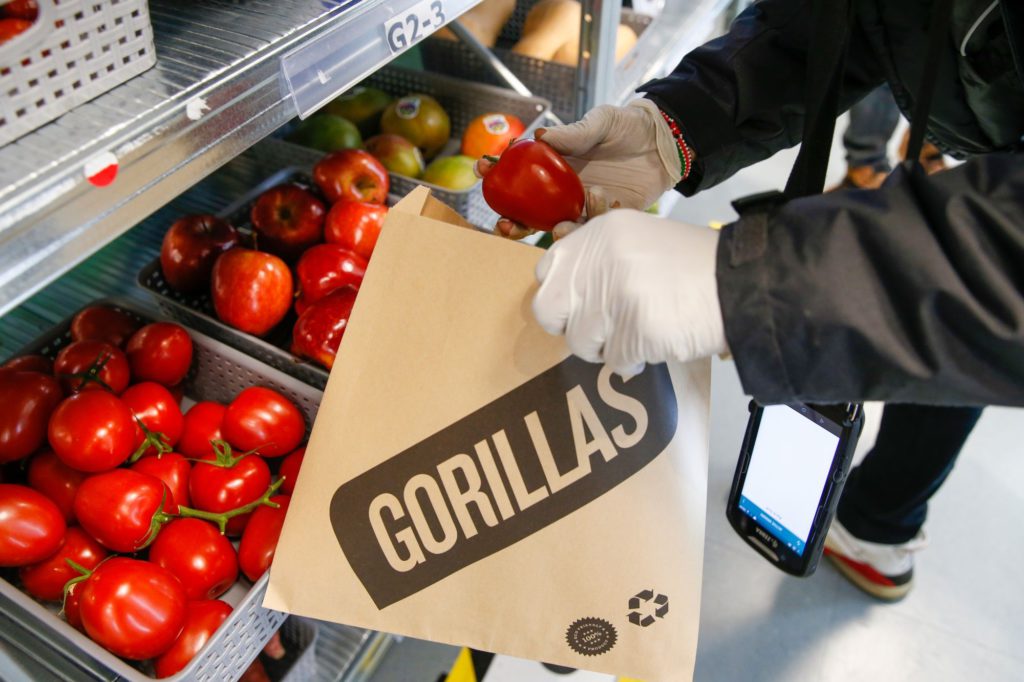
Rapid Grocery Apps Take it Slowly After Dutch Cities Push Back

(Bloomberg) — Rapid delivery companies have curbed their ambitions in the Netherlands after disgruntled Dutch cities put a halt on the explosive growth of their distribution centers.

After months of consultations, Flink SE, Getir and Gorillas signed a joint code of conduct that could crimp their ability to make super fast deliveries in a concession to Dutch municipalities. 

The companies pledged to limit the speed of their delivery riders’ e-bikes to 25 kilometers (16 miles) per hour and said they will not open the so-called “dark stores” in central shopping streets, pedestrian zones or near schools.

The voluntary restrictions in the European Union’s fifth-largest economy come as the rapid delivery business faces growing headwinds, including investors increasingly cautious about loss-making technology companies, intense competition and consumers returning to in-person shopping as they resume commuting following the Covid-19 pandemic. 

The joint action comes after Amsterdam, Rotterdam and Utrecht imposed a one-year freeze on new distribution hubs from flash delivery companies. The cites said the rapid growth of dark stores, which are warehouses often placed in residential areas close to customers, had led to an surge in noise and nuisance complaints from locals.

Demand for e-grocery may be waning now that most economies have reopened after the pandemic, according to Bloomberg Intelligence analyst Charles Allen. Assumptions that rapid delivery will become a significant part of the grocery market and that there will be “few winners but those that do win will win big” flooded these companies with capital and allowed them to operate at a loss for an extended period, Allen said.

Getir Perakende Lojistik AS, a Turkish startup, was valued at $11.8 billion after a $768 million funding round in March led by Mubadala Investment Co. Flink agreed on a deal this month that valued it at $5 billion, according to a person familiar with the matter who asked for anonymity because the matter is private. The Sunday Times reported in March that Gorillas Technologies GmbH, backed by Delivery Hero SE and Tencent, was seeking new funding that would value it at $5 billion. 

Berlin-based Flink, which is backed by DoorDash Inc., has 60 locations in the Netherlands and wants to open more hubs this year. But the new limitations mean it will not always be able to make deliveries within its target of ten minutes, according to a company spokesperson.  

Companies are starting to question how fast deliveries can be while remaining profitable, even as customers value the convenience. Christopher Payne, chief operating officer of DoorDash, said at a March conference it may be hard to make the economics of 15-minute delivery work. 

This month Getir opened its first “Art Store” concept in Rotterdam, with the aim of providing a more attractive alternative to dark stores, which usually have their windows covered. The pilot initiative offers local artists a stage to exhibit and sell their work by displaying art in the windows of the distribution center, a Getir spokesperson said.

Gorillas is considering larger warehouses and storing bicycles inside its centers instead of on the street to reduce complaints, according to a spokesperson for the startup.

More stories like this are available on bloomberg.com

©2022 Bloomberg L.P.

Stocks Rise After Biden Comments; Dollar Drops: Markets Wrap

(Bloomberg) — Stocks and the yuan advanced after President Joe Biden said China tariffs imposed by the Trump administration were under consideration. The dollar and Treasuries retreated.

Energy and basic resources shares led gains in Europe’s Stoxx 600 Index and US equity futures jumped more than 1% after the S&P 500 dropped for a seventh straight week. Stocks also rose in Asia and emerging markets.

Traders interpreted Biden’s comments that he’ll discuss the US tariffs on Chinese imports with Treasury Secretary Janet Yellen when he returns from his Asia trip as a signal there could be a reversal of some Trump-imposed measures. He also said the US military would intervene to defend Taiwan in any attack from China and announced that a dozen Indo-Pacific countries will join the US in a sweeping economic initiative designed to counter China’s influence in the region.

Treasuries dropped as traders debate the Federal Reserve’s tightening path amid mounting worries about an economic slowdown. Base metals extended their rebound from a five-month low as the demand outlook was bolstered by the weaker dollar and China’s loan-rate cut. Bitcoin recovered from some weekend weakness to trade around $30,000.

Equities have been volatile as investors assess the impact of China’s Covid policies on growth and the outlook for the world’s largest economies. Beijing reported a record number of Covid cases, reviving concerns about a lockdown. China’s stringent adherence to Covid Zero has stifled economic growth and prompted banks last week to cut a key interest rate for long-term loans by a record amount. 

“It seems that while there is an initial attempt to ride on some dip-buying sentiments from Wall Street, an increase in virus cases in Beijing is putting a cap on risk sentiments in the region, with China’s zero-Covid policy set to remain for the foreseeable future,” said Jun Rong Yeap, a market strategist at IG Asia.

Investors are grappling with concerns about an economic slowdown and prospects for more monetary tightening. The war in Ukraine is fanning commodity prices, and supply chains remain disrupted by China’s adherence to its Covid zero policy. 

“As macro-economic concerns stemming from aggressive monetary tightening, the Russia-Ukraine conflict and China’s stringent Covid lockdowns persist, we anticipate great volatility in the market,” Louise Dudley, portfolio manager global equities at Federated Hermes Ltd., said in a note.

Minutes of the most recent Fed rate-setting meeting will give markets insight this week into the US central bank’s tightening path. St. Louis Fed President James Bullard said the central bank should front-load an aggressive series of rate hikes to push rates to 3.5% at year’s end, which if successful would push down inflation and could lead to easing in 2023 or 2024.

Read: Stock Selloff to Intensify as Fresh 10% Plunge Looms: MLIV Pulse

Read: After Meltdown, Tech-Bottom Signals Have Yet to Scream ‘Buy Now’

Here are some key events to watch this week:

  • Atlanta Fed President Raphael Bostic, Kansas City Fed President Esther George speak at events Monday
  • ECB Governing Council members Robert Holzmann and Joachim Nagel, BOE Governor Andrew Bailey discuss inflation at event Monday
  • Eurozone S&P Global PMIs Tuesday
  • US new home sales, S&P Global PMIs Tuesday
  • Reserve Bank of New Zealand rate decision Wednesday
  • FOMC minutes Wednesday
  • ECB publishes its Financial Stability Review Wednesday
  • Bank of Korea rate decision Thursday
  • US GDP, initial jobless claims Thursday
  • US core PCE price index; personal income and spending; wholesale inventories; University of Michigan consumer sentiment Friday

Some of the main moves in markets:

Stocks

  • The Stoxx Europe 600 rose 1% as of 8:40 a.m. London time
  • Futures on the S&P 500 rose 1.1%
  • Futures on the Nasdaq 100 rose 1.2%
  • Futures on the Dow Jones Industrial Average rose 0.9%
  • The MSCI Asia Pacific Index rose 1.5%
  • The MSCI Emerging Markets Index rose 2%

Currencies

  • The Bloomberg Dollar Spot Index fell 0.4%
  • The euro rose 0.3% to $1.0599
  • The Japanese yen rose 0.2% to 127.66 per dollar
  • The offshore yuan rose 0.3% to 6.6800 per dollar
  • The British pound rose 0.6% to $1.2558

Bonds

  • The yield on 10-year Treasuries advanced three basis points to 2.81%
  • Germany’s 10-year yield was little changed at 0.95%
  • Britain’s 10-year yield advanced one basis point to 1.90%

Commodities

  • Brent crude rose 1% to $113.68 a barrel
  • Spot gold rose 0.5% to $1,854.99 an ounce

More stories like this are available on bloomberg.com

©2022 Bloomberg L.P.

Close Bitnami banner
Bitnami