Bloomberg

UK Designer Ted Baker Picks Preferred Bidder After Sycamore Bows Out

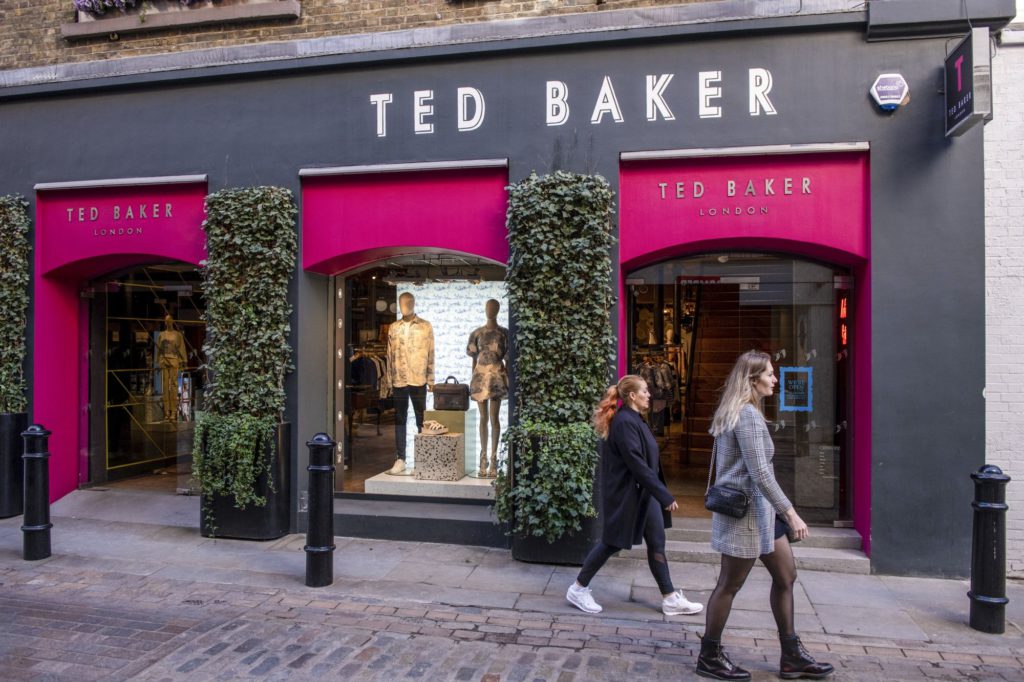
(Bloomberg) — Ted Baker Plc picked a preferred bidder after receiving a number of revised takeover proposals and said that private equity fund Sycamore Partners Management LP has dropped out of the process.

The UK designer said Monday it will begin a due diligence process with the preferred bidder, which will probably take several weeks. The stock rose as much as 4.6% in early trading.  

Chief Executive Officer Rachel Osborne has been seeking to revive Ted Baker by cutting debt and product markdowns, boosting online sales and refreshing the brand. The shares have lost more than 90% of their value in the past four years. 

The retailer’s founder Ray Kelvin departed in 2019 after being accused of inappropriate hugs and other behavior in the workplace, which he denied. The company reported a 35% gain in fiscal fourth-quarter revenue in February. 

The board reserves the right to reject any approach or terminate talks with any bidder at any time, Ted Baker said.

(Updates with share price move in second paragraph)

More stories like this are available on bloomberg.com

©2022 Bloomberg L.P.

Morgan Stanley Says Too Soon to Turn Bullish on Stocks

(Bloomberg) — Even as the S&P 500 on Friday narrowly avoided plunging into a bear market, Morgan Stanley strategists say it’s too early to turn optimistic on stocks. 

“Equity clients are bearish, a necessary condition for a sustainable low, but an insufficient one,” strategists led by Michael Wilson wrote in a note on Monday. “Given the risks to growth are just emerging, it’s too early to get bullish.”

Stock Selloff Seen Deepening Another 10% in Poll: MLIV Pulse

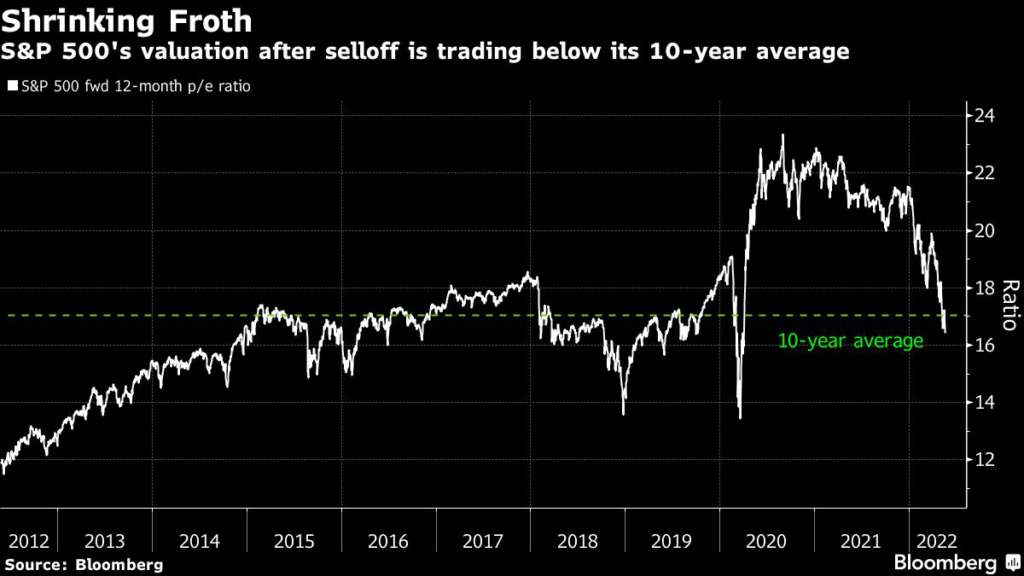
US stocks have been roiled in the past two months, with the S&P 500 on Friday posting its longest weekly losing streak since 2001 and flirting with a bear market, on concerns that the Federal Reserve’s tightening will push the economy into a recession. A Bank of America Corp. fund manager survey last week showed recession fears trumped the tail risks from inflation and the war in Ukraine, with investors turning the most underweight on equities in two years. 

Morgan Stanley’s Wilson, who continues to be among Wall Street’s most prominent bears and who correctly predicted the latest market selloff, said the biggest areas of risk include the consumers’ ability and willingness to spend, margin pressure, excess inventory and a cyclical downturn for tech spending. 

Wilson said 3,400 points for the S&P 500 — 13% lower from the current level — more accurately reflects the risks to earnings growth, and expects to see this level by the end of the second-quarter earnings season. 

“Until then, vicious bear market rallies should be used to lighten up on the areas most vulnerable to the oncoming earnings reset,” he said. 

The strategist retains underweight positioning in cyclical technology and consumer discretionary stocks, and is neutral on internet and software shares.

At the same time, not everyone is as pessimistic. Goldman Sachs Group Inc.’s David J. Kostin expects the S&P 500 to end this year 10% higher thanks to a forecast 8% earnings-per-share growth. 

More stories like this are available on bloomberg.com

©2022 Bloomberg L.P.

B&Q-Owner Kingfisher Holds Outlook Steady: The London Rush

(Bloomberg) — Here’s the key business news from London-listed companies this morning.

Kingfisher Plc: The operator of B&Q and Screwfix reiterated its profit guidance, even as faster inflation risks might deter British consumers from renovating their homes.

  • The home renovation stockist said it is “effectively” managing supply chain and inflationary pressures, adding that product availability is “very close” to normal levels

MoonPig Group Plc: The personalized gift website is looking to buy Smartbox Group UK Limited, also known as Buyagift, for £124 million in cash.

  • The purchase of the gift experiences platform will give the company access to the experience gifting market, and increase its margin in the medium term

Ted Baker Plc: The high street fashion brand selected a preferred takeover bidder to take into due diligence, after private equity firm Sycamore Partners Management LP dropped out of the bidding.

  • The brand received a number of revised takeover proposals, as its chief executive officer looks to revive the company by cutting debt, boosting online sales and refreshing the brand


Outside The City

The UK should cancel its planned corporate tax increase in order to ensure Britain remains an attractive place to do business, according to a new report by the Centre for Policy Studies. 

Meanwhile, Boris Johnson is readying himself for another dressing-down over illegal parties in Downing Street. 

In Case You Missed It 

The soaring cost of construction materials and labor is holding back office projects in London, increasing the risk the city will be left with stranded properties that need green overhauls.

And, after almost four decades spent targeting London’s office workers with upscale fare like salmon and avocado protein pots, Pret A Manger Ltd. is taking aim at a different clientele: suburban Brits. 

Looking Ahead

Tomorrow, the UK composite purchasing managers index is expected to move lower again as taxes and energy costs continue to weigh on activity. 

More stories like this are available on bloomberg.com

©2022 Bloomberg L.P.

One Mine Auction Draws 3,448 Bids Amid Scramble For Lithium

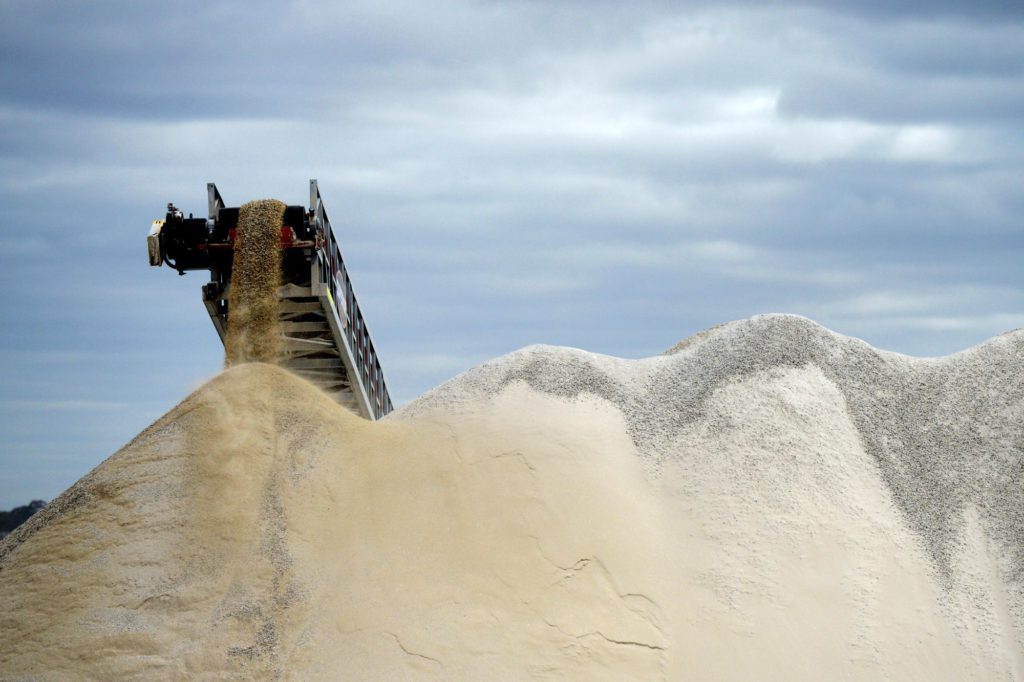
(Bloomberg) — An auction for a controlling stake in a Chinese lithium mine has garnered 3,448 bids, underscoring the scramble to secure the battery metal that’s key to the clean-energy transition.

The 54.3% stake in Yajiang Snowway Mining Development, which owns the mine in Sichuan, a southwestern province in China, was sold for about 2 billion yuan ($299 million), according to the JD.com’s judicial auction platform. That’s nearly 600 times higher than the starting price of about 3.35 million yuan. Details of the winning bidder weren’t immediately available. 

The heated bidding war, which concluded on Saturday, was joined by 21 participants, while over 980,000 people watched online throughout the five-day event.  

“We believe the auction price indicates a bullish Chinese primary market for future lithium prices as well as the strategic importance of Sichuan spodumene assets,” Daiwa Capital Markets’ analysts Dennis Ip and Leo Ho said in a note.

The shift to electric vehicles has spurred a global rush for lithium, which is used in virtually all EV batteries, and seen Chinese prices of lithium carbonate surge more than 400% over the past year. The highest bid in a tender in April by Australia’s Pilbara Minerals Ltd. for spodumene concentrate, a partly-processed form of lithium, more than doubled in just six months.

Yajiang Snowway is undergoing a bankruptcy process. The Dechenonba lithium mine in Sichuan’s Yajiang area covers 1.14 square kilometers, with estimated reserves of 24.9 million tons and a planned 1-million-ton capacity per year. 

More stories like this are available on bloomberg.com

©2022 Bloomberg L.P.

Tencent Billionaire Airs Frustration During China’s Slowdown

(Bloomberg) — Tencent Holdings Ltd.’s billionaire co-founder Pony Ma shared a viral opinion piece on the economic costs of China’s strict Covid Zero measures, in a rare show of frustration after his company struggled to grow during the first quarter.

Ma, usually reluctant to step into the spotlight, re-posted the column on his semi-public WeChat feed over the weekend. From the long piece — which called out economists, academics and even average internet users for dismissing the economic impact of Beijing’s harsh Covid measures — Ma extracted a short segment that accused Chinese internet users of taking online service providers like Tencent for granted, saying netizens would rather see those businesses go bankrupt than conduct layoffs or let their staff work overtime.

“This is a really vivid description,” the Tencent chief commented, according to a screengrab of a WeChat post that Bloomberg News verified with people in Ma’s WeChat circle. He went on to quote the article: “But of course, if their meal orders come 10 minutes late, they would be cursing the delivery guys.”

Ma lifted that quote from a long opinion piece originally posted May 20 by history author Zhang Mingyang, entitled “Apart from Hu Xijin, no one else cares about the economy.” That column referred to comments by Hu, the influential former editor-in-chief of the nationalist tabloid Global Times. Hu had previously suggested that the economic costs of containing the virus shouldn’t exceed the public-health benefits. 

Ironically, the former newspaper editor had also commented on Zhang’s column after it was widely shared across the Chinese social media sphere — he called it sensationalist clickbait.

Read More: Xi Moves to Silence Covid Zero Critics in Sign of Brewing Tumult

China’s top leaders this month warned against questioning President Xi Jinping’s Covid Zero strategy. The Politburo’s supreme seven-member Standing Committee pledged to “fight against any speech that distorts, questions or rejects our country’s Covid-control policy,” state broadcaster China Central Television said.

Ma expressed no further judgment on the overall article himself. But the fact that the boss of China’s most valuable company shared the post made waves on the Chinese internet. Representatives for Tencent didn’t respond to requests for comment.

Tencent reported revenue growth all but evaporated in the three months ended March, walloped by sweeping government restrictions as well as lockdowns across the country. Executives warned that the current quarter could be even worse, as a quarantine covering much of Shanghai — China’s media and finance hub — hammered commercial payments and ad spending.

The country’s largest tech corporations have resigned themselves to a new era of low growth, more than a year into a Chinese government crackdown that’s engulfed every internet arena from e-commerce to gaming and online education. Companies from Tencent to Alibaba Group Holding Ltd. have reduced headcount and streamlined laggard businesses, among other measures, to improve margins and control costs.

Why China Is Sticking With Its Covid Zero Strategy: QuickTake

(Updates with more detail from the opinion piece in the second paragraph)

More stories like this are available on bloomberg.com

©2022 Bloomberg L.P.

Advent Sees Drop in Private Valuations in India After Stock Rout

(Bloomberg) — The rout in global stocks is keeping the head of Advent International Corp.’s India business, Shweta Jalan, increasingly busy because more deals are being routed into the private-equity space. 

Yet, Jalan says, she’s growing more cautious in her investment picks on concerns about valuations and multiple uncertainties, including the war raging in Ukraine, the global inflation surge and supply chain disruptions. 

Valuations in private markets will eventually need to come down, to match the declines in public markets, Jalan said in an interview in the Mumbai offices of the global private-equity firm, which has headquarters in Boston and had $88 billion in assets under management worldwide at the end of December. 

“People are still living in a bit of paradise of the valuations they have seen in the last two years,” Jalan said. “There is a lag between private and public market valuations. It will take some time for the valuations to reset to a new normal.”

In India, Jalan’s fund has completed eight investments in under three years, including the purchases of majority stakes in the engineering services company Encora and consumer durables firm Eureka Forbes. 

Jalan says she’s steered clear of India’s red-hot fintech space, where startups are too early stage or too expensive for her firm’s strategy, which leans towards investments in late-stage cash-generating businesses. Advent’s key investment areas will continue to be healthcare, consumer, financial services and information technology in India, she said.

Like much of the world, India is grappling with a flareup in inflation, which led to an emergency interest-rate hike this month and removed billions in liquidity from the banking system. Foreign funds are withdrawing money at a record pace from Indian equities. All that’s weighing on the market for new offerings after a heady 2021 which saw Indian firms raise nearly $18 billion, according to data compiled by Bloomberg.

The government was able to float Life Insurance Corp. of India, the nation’s biggest first-time share sale, only after slashing the offering size by 60%. Delhivery Ltd., a logistics provider, downsized its share sale by nearly 30% amid muted risk appetite. 

Amid the global macro economic uncertainties, Jalan says her strategy is to “assume 6-12 months of some challenges in everything you are looking at given the macro environment.”

One of the few women in top roles in the Indian private-equity industry, she learnt the business early on from Renuka Ramnath, one of the pioneers in the space, during a stint at ICICI Venture. Her first deal, where she worked closely with Ramnath, was the acquisition of Tata Infomedia Ltd. in 2003, one of the first leveraged buyouts in the country. 

Having a backup plan is one of the key business lessons Jalan says she’s learnt and it’s what she’s advising her portfolio companies to do these days. 

“In emerging markets, there is one gospel truth – nothing will go as per plan,” she said. “So you will need to have a plan B and a plan C. You need to have a waterfall of things to do if market growth doesn’t play out.”

Some of Advent India’s recent investments:

(Adds more comments in sixth paragraph)

More stories like this are available on bloomberg.com

©2022 Bloomberg L.P.

US, Japan Launch Bid to Put First Japanese Astronaut on Moon

(Bloomberg) — The US and Japan agreed to work to put the first Japanese astronaut on the moon, accompanied by an American astronaut, as the longtime allies develop a partnership aimed at countering China.

The two countries said in a joint statement they’d collaborate on human and robotic moon missions “including a shared ambition to see a future Japanese astronaut on the lunar surface,” with a goal of signing an implementation agreement this year. 

Following a meeting Monday in Tokyo between President Joe Biden and Japanese Prime Minister Fumio Kishida, the countries also said they “are committed to a Japanese astronaut opportunity on the Gateway, a human outpost in the lunar vicinity, as part of expanding Artemis collaboration.” 

The joint lunar exploration development ties into the Artemis project, a US-led effort to return astronauts to the moon and eventually send humans to Mars.

US-Japanese space cooperation “is taking off, looking toward the moon and to Mars,” Biden said Monday at a press conference with Kishida.

“I’m excited about the work we will do together on the Gateway Station around the moon and look forward to the first Japanese astronaut joining us in the mission to the lunar surface, under the Artemis program,” he added.

The US and Japan are seeking to work more closely on space exploration after NASA officials warned of growing tensions between Washington and Beijing.

Monday’s news comes amid the race to start extracting potentially hundreds of billions of dollars’ worth of resources on the moon and elsewhere.

Read more: China, US Race to Make Billions From Mining the Moon’s Minerals

The moon may contain large amounts of helium-3, an isotope potentially useful as an alternative to uranium for nuclear power plants because it’s not radioactive. Experts believe 5,000 tons of coal could be replaced by about three tablespoons of helium-3. 

The geopolitics of space mirrors the competition between the US and its allies against China and Russia. The world’s top superpowers have been struggling to agree upon a common set of rules to govern the next generation of space activity. 

Japan and South Korea are among 19 countries that have agreed to support the Artemis Accords, a non-legally binding set of principles for exploration of the moon, Mars and beyond.

But China and Russia have led opposition to the accords. They are jointly promoting an alternative project on the moon they say is open to all other countries: the International Lunar Research Station. 

Japan itself has one of the world’s most advanced space programs, and in 2020 the Japan Aerospace Exploration Agency succeeded in bringing back material from an asteroid using the unmanned Hayabusa2 probe. 

About a dozen Japanese nationals have experienced space travel, putting the country roughly even with China, Germany and France, but far behind the US and Russia in the global rankings. The country’s space budget jumped by more than 20% to about 450 billion yen ($3.5 billion) last year. 

The lack of cooperation between the US and China on space exploration is particularly dangerous in an era where the cosmos are becoming more crowded, and billionaires like Elon Musk and Jeff Bezos are increasingly launching satellites to delve into commercial opportunities.

Japanese e-commerce billionaire Yusaku Maezawa spent time on the International Space Station last year in preparation for becoming the first private passenger on a planned trip around the moon on Musk’s SpaceX in 2023. No Japanese citizens have actually landed on the moon. 

NASA in April conducted tests for the launch of Artemis I, a fully robotic mission to the moon — the first since Apollo 17 in 1972. China is swiftly moving toward a goal of matching US capabilities. China is the only country to operate its own space station, and last year became only the second nation after the US to land a rover on Mars.

US legislation first passed in 2011 prevents NASA from most interactions with its Chinese counterpart, and the US has blocked China from taking part in the International Space Station — a move that simply prompted Beijing to build its own. 

(Adds Biden comment in fifth and sixth paragraph)

More stories like this are available on bloomberg.com

©2022 Bloomberg L.P.

Here’s What Markets See as Priorities for Australia’s Albanese

(Bloomberg) —

Climate change, cost-of-living pressures and cryptocurrency regulation are among the policy issues Australia’s new Prime Minister Anthony Albanese should have at the top of his agenda, according to market watchers.

Albanese takes control at a time when households are feeling the pinch of accelerating inflation. He’s also facing calls for more aggressive climate action. With the possibility that his Labor Party could fall short of a majority in the lower house of parliament of 76 seats, he’ll likely need to negotiate with the Greens party and a slew of climate-warrior independent lawmakers who want more ambitious targets.

Here’s what analysts are expecting from the government under Albanese:

David Bassanese, chief economist at BetaShares:

  • The government needs to provide more clarity on climate change policy, as well as tax and investment incentives “to promote Sydney as a leading Asian financial hub as a rival to Hong Kong”
  • The government should focus on economic decentralization and development to address housing affordability issues in major cities

Caroline Bowler, chief executive officer of BTC Markets:

  • The government is expected to continue work that’s already started around cryptocurrency regulation
  • For the crypto market, “the primary concern would be to put together the appropriate regulatory regime for the marketplace, but also to leave room for innovation”
  • “There is a real opportunity for the government to assist with innovation and support it, relating to the significant role that financial services play in the Australian economy, but also its position globally”

Su-Lin Ong, head of Australian economic and fixed-income strategy at Royal Bank of Canada

  • The likelihood that a Labor government increases spending will have an impact at the margin on RBA policy and therefore on markets
  • “This keeps pressure on the RBA to continue to normalize policy and move toward neutral sooner rather than later. This has more mixed longer-term implications for markets all else being equal -– slightly positive for the Australian dollar and marginally negative for bonds”

Craig James, chief economist at CommSec:

  • With the job market continuing to tighten, a priority of the new government will need to be on measures to expand labor supply and broader economic capacity issues
  • The electorate will also be keen to see what measures the government will employ to address cost-of-living issues

Chris Nicol, equity strategist at Morgan Stanley:

  • The government will need a bolstered climate agenda to placate independents and Greens, and “we would look for policy that drives faster adoption rates from both consumer and business in the first instance”
  • “Labor will inherit a recent strengthening of defense-linked ties with Western allies, as well as a challenged relationship with its key trade partner in China. Ideological differences will sustain a persistence of friction, but also investors should be on watch for any off ramps a new government and conversation could bring”

Matt Ingram, Bloomberg Intelligence analyst:

  • Australian banks are more likely to reach their A$215 billion ($152 billion) renewable finance target following Albanese’s win
  • The rise of climate-focused independents may make the execution of Labor’s A$47 billion green investment commitment over the next decade more of a priority

Shane Oliver, head of investment strategy at AMP Capital:

  • Macro policy similarities between Labor and the Coalition suggests minimal investor reaction to the election and that markets “will quickly move on to other things”
  • Key challenges for the new government include inflation, interest rates and housing affordability

(Updates with additional commentary)

More stories like this are available on bloomberg.com

©2022 Bloomberg L.P.
Stocks Steady as China Sours Mood; Dollar Dips: Markets Wrap

(Bloomberg) — Asian stocks traded mixed Monday as investors assess the impact of China’s Covid policies on growth and the outlook for the world’s largest economies. The dollar and Treasuries retreated.

Equities rose modestly in Japan, but a slide in Chinese tech stocks and a virus outbreak in Beijing weighed on an MSCI Inc. gauge of the region’s stocks. Nasdaq 100 and S&P 500 futures jumped about 1% after the S&P 500 dropped for a seventh straight week in a stretch of weakness not seen since 2001. 

Beijing reported a record number of Covid cases, reviving concerns about a lockdown. China’s stringent adherence to Covid Zero has stifled economic growth and prompted banks last week to cut a key interest rate for long-term loans by a record amount. Still, the one-year loan prime rate — the de facto benchmark lending rate — was kept unchanged.

“It seems that while there is an initial attempt to ride on some dip-buying sentiments from Wall Street, an increase in virus cases in Beijing is putting a cap on risk sentiments in the region, with China’s zero-Covid policy set to remain for the foreseeable future,” said Jun Rong Yeap, a market strategist at IG Asia.

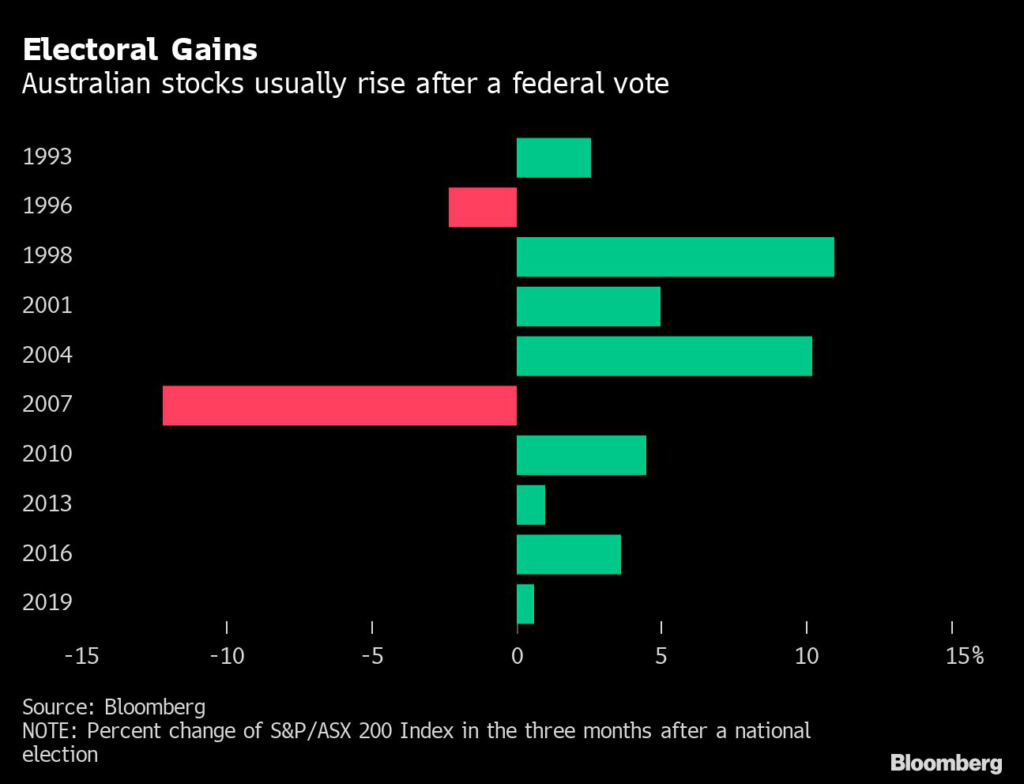
A dollar gauge declined. The Australian dollar gained after a weekend election delivered a clear outcome, with Labor ousting the Liberal-National coalition. Treasuries pared Friday’s advance as traders debate the Federal Reserve’s tightening path amid mounting worries about an economic slowdown. Bitcoin recovered from some weekend weakness to trade around $30,000.

Read: Stock Selloff to Intensify as Fresh 10% Plunge Looms: MLIV Pulse

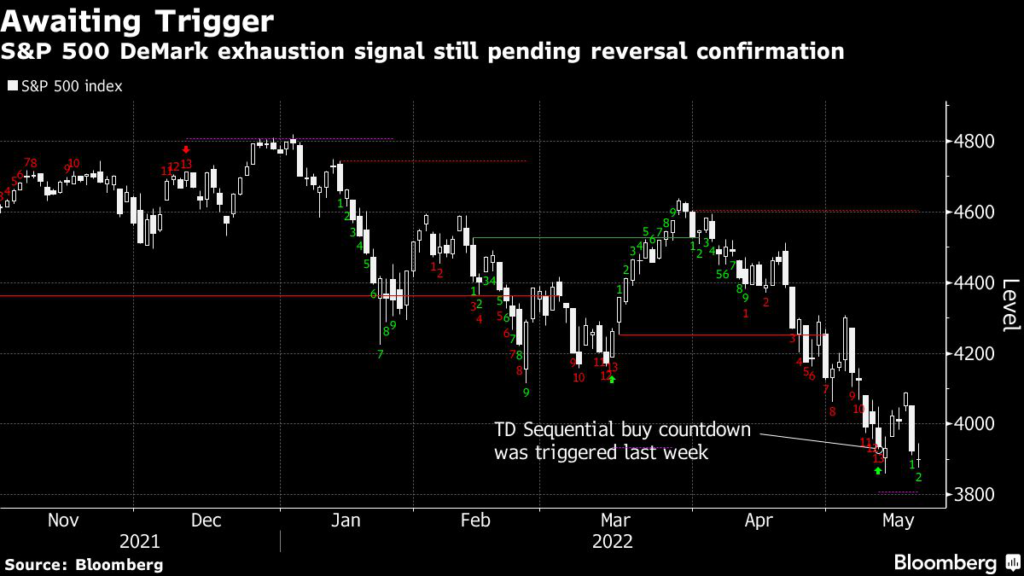
Read: After Meltdown, Tech-Bottom Signals Have Yet to Scream ‘Buy Now’

Investors are grappling with concerns about an economic slowdown and prospects for more monetary tightening. The war in Ukraine is fanning commodity prices, and supply chains remain disrupted by China’s adherence to its Covid zero policy. 

“As macro-economic concerns stemming from aggressive monetary tightening, the Russia-Ukraine conflict and China’s stringent Covid lockdowns persist, we anticipate great volatility in the market,” Louise Dudley, portfolio manager global equities at Federated Hermes Ltd., said in a note.

Minutes of the most recent Fed rate-setting meeting will give markets insight this week into the US central bank’s tightening path. St. Louis Fed President James Bullard said the central bank should front-load an aggressive series of rate hikes to push rates to 3.5% at year’s end, which if successful would push down inflation and could lead to easing in 2023 or 2024.

Here are some key events to watch this week:

  • Atlanta Fed President Raphael Bostic, Kansas City Fed President Esther George speak at events Monday
  • ECB Governing Council members Robert Holzmann and Joachim Nagel, BOE Governor Andrew Bailey discuss inflation at event Monday
  • Eurozone S&P Global PMIs Tuesday
  • US new home sales, S&P Global PMIs Tuesday
  • Reserve Bank of New Zealand rate decision Wednesday
  • FOMC minutes Wednesday
  • ECB publishes its Financial Stability Review Wednesday
  • Bank of Korea rate decision Thursday
  • US GDP, initial jobless claims Thursday
  • US core PCE price index; personal income and spending; wholesale inventories; University of Michigan consumer sentiment Friday

Some of the main moves in markets:

Stocks

  • S&P 500 futures rose 1% as of 1:33 p.m. in Tokyo. The S&P 500 was little changed Friday.
  • Nasdaq 100 futures advanced 1.3%. The Nasdaq 100 fell 0.3%.
  • Topix index rose 0.8%
  • Australia’s S&P/ASX 200 Index was flat
  • Kospi index was little changed
  • Hang Seng Index fell 1.9%
  • Shanghai Composite Index fell 0.6%
  • Euro Stoxx 50 futures rose 0.8%

Currencies

  • The Bloomberg Dollar Spot Index fell 0.3%
  • The Japanese yen rose 0.4% to 127.36 per dollar
  • The offshore yuan was at 6.6933 per dollar
  • The euro was at $1.0594, up 0.3%

Bonds

  • The yield on 10-year Treasuries rose four basis points to 2.82%
  • Australia’s 10-year bond yield fell one basis point to 3.30%

Commodities

  • West Texas Intermediate crude rose 0.6% to $110.89 a barrel
  • Gold was at $1,854.20 an ounce, up 0.4%

More stories like this are available on bloomberg.com

©2022 Bloomberg L.P.
American Car Shoppers Are Least Likely to Buy an Electric Vehicle

(Bloomberg) — American car buyers are far less interested in electric vehicles than their overseas counterparts, put off by high prices and not enough charging stations.

That’s the finding of a new survey of 13,000 potential car buyers worldwide by consultant EY, also known as Ernst & Young. Just 29% of US respondents said they intended to go electric with their next vehicle purchase, compared to 52% globally. American consumers’ commitment to EVs was the lowest among the 18 major markets EY surveyed.

EVs accounted for only about 3% of overall US auto sales last year.

The nearly three-quarters of American car buyers committed to traditional internal combustion engines told EY they weren’t interested in EVs due to “a lack of charging infrastructure” and because plug-in models are too pricey. Their reticence stands in contrast to buyers in Europe and Asia, where stricter regulations are boosting demand. Italian shoppers were the most eager for EVs, with 73% planning to get one next time, while about two-thirds of buyers in China and South Korea also expect to plug in their next car.

This is the first time more than half of global car buyers in the EY survey have said they plan to go electric. It represents a 22-point jump from the last time the consultant conducted the survey in 2020. The respondents were polled in late February and early March, before the war in Ukraine sent gasoline prices soaring to record levels.

“These findings truly mark a tipping point in the global car-buying market,” Randy Miller, EY’s global advanced manufacturing & mobility leader, said in a statement. “There is no doubt that global gas price rises have played their part in making internal combustion engines more expensive, but environmental concerns also remain top of the list of motivators.”

US automakers are betting big that Americans will eventually join the rest of the world in embracing EVs. The manufacturers are spending billions to electrify their lineups with the expectation that roughly half the US car market will be battery-powered by 2030.

EV market leader Tesla Inc. has a new 8-million square foot factory in Austin, Texas. Ford Motor Co. is spending $7 billion on battery factories and EV assembly plants in Tennessee and Kentucky and just rolled out an electric version of its top seller, the F-150 pickup truck.

More stories like this are available on bloomberg.com

©2022 Bloomberg L.P.

Close Bitnami banner
Bitnami