Bloomberg

DeFi Believers Never Say Die, Even After They See Terra’s Demise

(Bloomberg) — Hardcore believers in the future of decentralized finance aren’t giving up on algorithmic stablecoins even after the spectacular collapse of TerraUSD (UST), saying they remain key for moving to a world without intermediaries such as banks and brokerages. 

“An algo stable will exist in the next five-to-seven years,” said Hassan Bassiri, a portfolio manager at Arca, which was an investor in Terra. “And it has to exist or else what are we even doing in this space?” 

DeFi had been one of the fastest growing sectors in crypto the past few years, with a slew of borrowing and lending applications offering double- and triple-digit returns. Like most crypto projects, they are dependent on attracting enough transactional volume to keep the blockchain networks going. The model appeared to work until central banks began removing Covid-era stimulus, triggering a retreat in risk appetite and raising questions about whether the incentive-based systems are sustainable. 

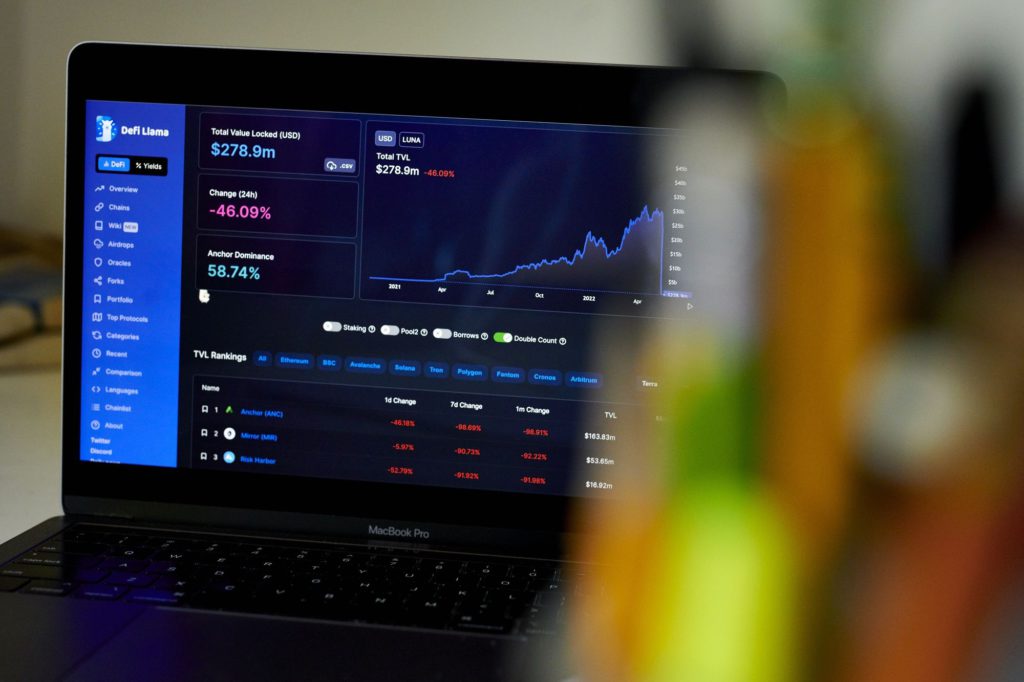
Terra collapsed in early May after the software intended to keep UST stable — allowing it avoid the normal volatility in crypto prices so that it could be a more reliable tool for transactions– couldn’t overcome a plunge in demand for its related Luna token. While it was the largest algo stablecoin by far at around $18 billion in market value, it was only one of about a dozen that have failed or were unable to maintain promised 1-to-1 pegs to assets such as the dollar. 

Among the handful of algo stablecoins that survive is the USDD token launched by controversial crypto entrepreneur Justin Sun on his Tron network just before the collapse of UST. 

Sun defended the project in an interview with Bloomberg News, saying he saw the need for a stablecoin free from regulators as someone who experienced the fall of the crypto market in China after the country announced a ban on the sector.

“If tomorrow regulators decide to ban stablecoins, like when China announced a ban in crypto, it would pose great risks to the whole crypto system,” Sun said. “We must have a stablecoin that’s not controlled by a third party outside crypto,” referring to popular stablecoins such as USDC that are backed by traditional assets like cash and short-term securities. 

USDD went live on the Tron blockchain in early May, according to Sun. It can be used on the Ethereum and Binance Smart Chain blockchains through so-called bridging software. The stablecoin uses an arbitrage mechanism similar to what Terra used to maintain its peg. For example, when 1 USDD drops below $1, traders can make an instant profit by sending 1 USDD to the Tron blockchain in exchange for $1 worth of Tron, the native token of the network, with the arbitrage incentive designed to bring USDD’s price back to $1.

Terra showed that an integration of such algorithmic programming to keep a token stable is easier said than done, largely because the stablecoin is dependent on investors believing that its sister cryptocurrency will continue to appreciate. 

“If you really want to make these things, you kind of have to have this really sharp technical ability but also this crazy wondrous gaze in your eyes,” said Tarun Chitra, founder and chief executive officer at Gauntlet, a financial modeling platform for crypto. “Because you have to somehow believe you’re going to get over all the failures that have happened historically.”

Sun agreed that Terra’s failure shows the flaw of algorithmic stablecoins, but said it also gives an opportunity for new projects to adjust. USDD aims to raise $10 billion through the Tron DAO Reserve — which it called an “alliance” of market participants including Alameda Research and Amber Group — to defend USDD’s peg. That’s a similar setup to Terra’s main developer Do Kwon’s Singapore-based non-profit Luna Foundation Guard. 

“Our definition of an algorithmic stablecoin is not that it’s free from any people,” Sun said. “We want something without any connections to banks or any stablecoins associated with assets managed by banks.”

Regulators around the world already have been concerned about stablecoins as a source of risk in the financial system. US Treasury Secretary Janet Yellen said recently that Terra’s meltdown underscores the urgent need for guardrails and said it would be “highly appropriate” for lawmakers to enact legislation as soon as this year.

USDD is also offering promotional high returns, even topping the 20% yields offered on Terra with a promised return of at least 30%. Exchanges like Huobi have already launched USDD-related high-yield products. Sun said the outsize yields would be reviewed by Tron DAO Reserve on a monthly basis and would “actively adjust” the number based on market conditions. Still, not everyone is convinced USDD and even the entire sector will avoid the same fate as UST.

I “think the sector is done,” said Ryan Watkins, co-founder of crypto hedge fund Pangea Fund Management. “I was holding out hope that Terra could pivot in time.”   

More stories like this are available on bloomberg.com

©2022 Bloomberg L.P.

Electric Cars Are Cheaper to Own in New Jersey Than California

(Bloomberg) — What’s cheaper to buy, a gasoline car or an electric one? The answer might surprise you.

Whether new or used, gas-powered or pure plug-in, in recent months manufacturers’ suggested retail prices (MSRP) on all cars in the US have led to some serious sticker shock.

In April, the average new vehicle listing price was above $45,000, according to Cox Automotive, a number first reached in September (and an all-time-high at that point). 

The prices reflect low inventory across the US, caused in large part by continued supply chain disruptions. The total supply of available unsold new vehicles stood at 1.13 million units at the end of April, Cox reported, compared with 1.10 million vehicles in March. That’s about 800,000 fewer vehicles than the same period in 2021; and 2.2 million less than in 2020.

So yes, there are fewer cars of all kinds at US dealerships, pushing up the sticker prices on those vehicles. Still, that doesn’t automatically mean that a new electric car will cost you more.

According to a recent report from Energy Innovation Policy and Technology LLC, a climate policy think tank, in many states, across a number of models, electric cars are cheaper to buy than traditional gas cars. The report focuses on the terms around the purchase and financing of EVs, and what the monthly cost will be.

“What does the average consumer look at? Our research is mostly focused on that question — how people purchase cars, how they finance them,” says Robbie Orvis, the lead researcher and author of the study. “The day you drive it off the lot, you don’t want to spend more on an EV.”

About 85% of car buyers in the US finance vehicle purchases. Key factors for those buyers, the report notes, are “how much they’ll have to pay to own and operate a vehicle each month, not necessarily how much a vehicle will save them over its lifetime.”

In most US states, according to the report’s findings, an electric car can be cheaper on a monthly basis than a comparable gasoline car. Orvis’s analysis looked at: financing costs; state taxes and fees;  state and federal rebates and tax credits, especially the $7500 federal tax credit; fuel costs; maintenance costs; and insurance costs.

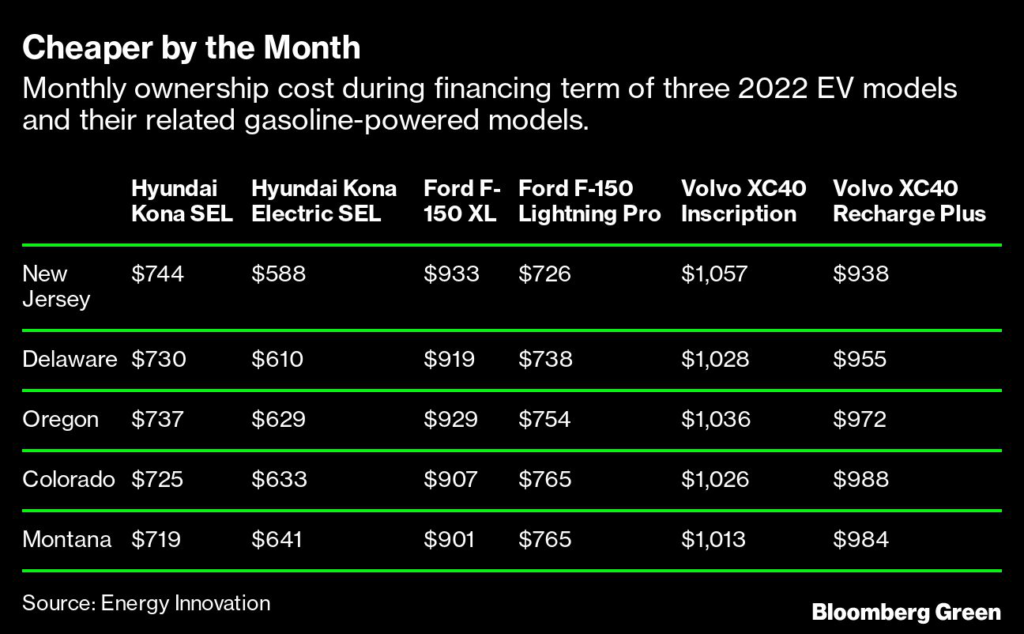
Six EV models were studied, alongside related gas versions: the Volvo XC40 ($56,395 MSRP), the Nissan Leaf ($28,425 MSRP; compared to the Nissan Versa), the Kia Niro EV EX Premium ($45,865 MSRP), the Hyundai Kona Limited ($43,745 MSRP), the Hyundai Kona SEL ($35,245 MSRP) and the Ford F-150 Lightning ($41,669). The goal, Orvis says, was to get a fairly representative group of different size classes; and, as best they could, to “really have an apples to apples comparison.” (The top 5 states with the lowest costs for three of the six models studied are shown on the chart above.)

According to Energy Innovation’s analysis, the electric versions of the Kona SEL and the F-150 are cheaper to own in every state across the country  — on average 8.5% and 12.3% less, respectively. “I am surprised at how economic some of the vehicles are,” Orvis says. “The fact that two of the models, including the F-150, were cheaper in every single state, I didn’t expect to see that.”

Orvis cautions that “the big picture numbers aren’t reflective of how people pay for their vehicles. When you finance a car purchase, it’s a lot more manageable.”

Matt Haiken, the owner and dealer principal of the Prestige Collection Auto Group in northern New Jersey, says EV prices and financing options are even more competitive right now, given the supply shortages and lower inventories on traditional gas cars. “It’s making the delta between EV and internal combustion engine cars even greater,” Haiken says. His group consists of four dealerships (two Volvo; one Lincoln; one Polestar). “Also, there were discounts on cars before that are virtually gone now,” he adds — another factor making the gas cars costlier.

That’s even more true for sales at Haiken’s dealerships in New Jersey. “It’s the No. 1 state in the country to own an EV,” Orvis says. The state offers a $5,000 Charge Up New Jersey rebate when you buy or lease the car; plus, there is no purchase tax on EVs. Then, when combined with other offers and the federal subsidies and breaks, “they’re really good incentives.”

Among the least advantageous states for EV purchases, according to Orvis’s research, Georgia leads the list, with the highest annual tax on EVs and no state rebate at all. And a surprising find: California offers many EV incentives but those are offset by the high price of electricity.

Haiken, who says he started buying up EVs from around the country back in 2016 and 2017 for his dealerships, believes the US is near a tipping point. He’s confident EV costs will start to come down so that the cars will be more affordable to a wider range of people.

“It’s night and day different now,” he said. “Everyone is coming in and asking for electric. It’s a very diverse group. For those who don’t decide to buy an EV now, they’ll make a comment like, ‘This is my last ICE [internal combustion engine] vehicle.’”

More stories like this are available on bloomberg.com

©2022 Bloomberg L.P.

After Meltdown, Tech-Bottom Signals Have Yet to Scream ‘Buy Now’

(Bloomberg) — Calling the bottom in the tech-sector meltdown isn’t easy, even after a $5.5 trillion wipe-out, yet there are some signals giving investors hope.

Tech stocks have been hammered this year as rising interest rates, slowing economic growth and soaring inflation form a perfect storm of negative catalysts. That’s hurt everyone from retail investors who loaded up on Cathie Wood’s Ark Investment exchange-traded funds last year to deep-pocketed asset managers who invested in Apple Inc.

The price charts paint a dire picture: The tech-heavy Nasdaq 100 Index just capped its seventh straight week of declines, the longest such streak since 2011, and has shed nearly 30% from its peak last year. The U.S. trillion-dollar quartet of Apple, Microsoft Corp., Amazon.com Inc. and Alphabet Inc. has led the charge lower in the latest leg of this selloff.

Yet a number of investors are starting to see a light at the end of the tunnel. The Nasdaq 100 now trades for about 20 times its estimated forward earnings — in-line with long-term averages — as frothy valuations built up during the pandemic recede. The Philadelphia Semiconductor Index, home to chipmakers including Intel Corp. and ASML Holding NV, trades at about 15 times expected earnings for the next 12 months, well below a peak of 24 hit in early 2021.

“It’s hard to be patient when there’s been so much carnage. But the pain should end, possibly soon,” said Jordan Stuart, client portfolio manager at Federated Hermes. “Our recommendation is growth investors need to be ready.”

Last week, Jefferies strategists turned bullish on the information-technology sector, saying in a note that a “dash for cash” by investors discounting extreme interest-rate scenarios “has been more than reflected in the compression of market multiples.”

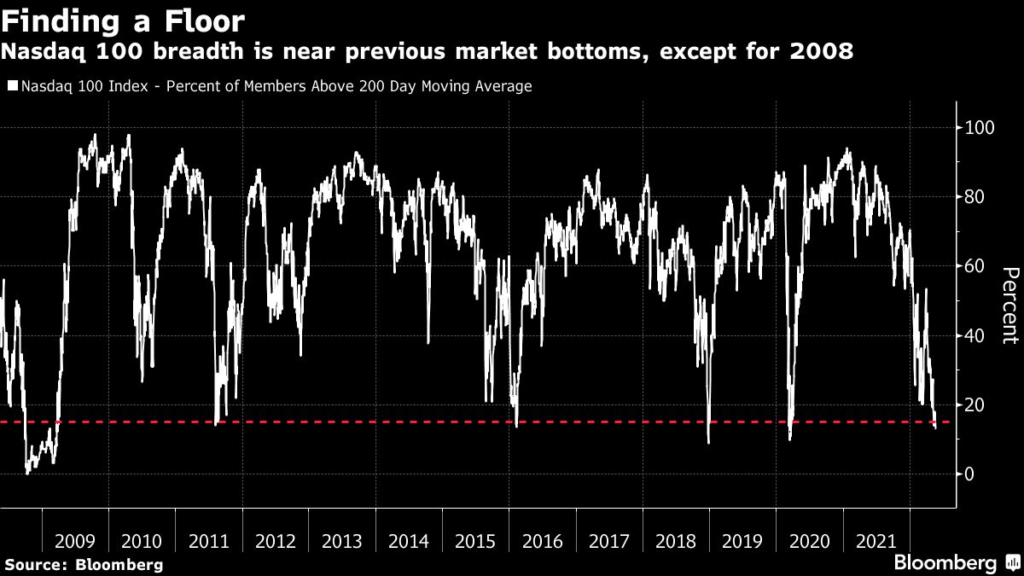
Wells Fargo Securities said it is pausing its negative view on growth names since bearish sentiment hit a near-term extreme. Indeed, the number of companies trading above their 200-day moving average has hit rock-bottom levels last seen in the first part of 2020, while Bank of America Corp.’s popular gauge of investor sentiment is in what it called “unambiguous contrarian buy territory.”

For Kevin Mahn, who runs Hennion & Walsh Asset Management, cash-rich Apple and Microsoft will recover losses over time as “most of the damage is done” and some good opportunities are being created in tech. 

He is cautious on the timing of a rebound, however, as the market hasn’t yet shown signs of capitulation. “I’m certainly not going to call a bottom, and I’m sure there will be further bouts of selling ahead,” he said.

The New Paradigm

Like Mahn, many investors are torn between prices that now look more attractive and the reality that the outlook for the global economy remains highly uncertain.

“Markets are getting used to the fact that the very driver, which drove this fantastic investment environment for the last 10 years, is not going to be there any more,” Maria Elena Lagomasino, chief executive officer of WE Family Offices, said in an interview on Bloomberg TV. Without favorable conditions, such as low inflation and rates, “the market is now trying to figure out what the new paradigm is going to look like.”

In terms of market positioning, there has been an exodus already. A recent BofA survey showed fund managers are “very short” tech, with allocation to the sector at its lowest since August 2006. 

The options market is also pointing to a potential rally. Options on the $157 billion Invesco QQQ Trust Series 1 ETF tracking the Nasdaq 100 Index show a put-to-call ratio based on open contracts that recently hit the lowest level in two years. Outstanding calls have surged to the highest since 2008. A drop in the put-call ratio is usually a bullish sign that investors are preparing for a move upward. 

Bottom Fishing in China

There’s support from abroad, also. Chinese internet stocks emerged as an unexpected bright spot in another turbulent week for tech, thanks to repeated pledges from Beijing to prop up the beaten-down group and a reduction in the interest rate on long-term loans. That helped fuel a 4.7% rise in an index of 81 US-listed Chinese stocks last week.

The Nasdaq Golden Dragon China Index, which historically has been positively correlated with the Nasdaq 100, is once again testing its 50-day moving average, a key technical hurdle it has failed to consistently rise above this year. This time may be different after the index outperformed the Nasdaq 100 last week, and the benchmark has remained above its low hit in March, a positive technical signal.

Of course, that has to be taken with a grain of salt given the recent disappointing economic data, Tencent Holdings Ltd.’s weaker-than-expected earnings and the persistence of China’s Covid Zero strategy. Yet, speculation of more economic stimulus from Beijing is building. 

“Investors are betting on China turning toward greater growth focus as it just saw one of its worst growth numbers last quarter,” said Jason Hsu, chief investment officer for Rayliant Global Advisors Ltd. “Everyone has been waiting for that big stimulus package from Beijing. It is not an ‘if’ but a ‘when.’”

More stories like this are available on bloomberg.com

©2022 Bloomberg L.P.

How Robots Can Help Build Offshore Wind Turbines More Quickly

(Bloomberg) — The invasion of Ukraine has put the US and Europe on a wartime mission to abandon Russian fossil fuels. This series looks at speeding up zero-carbon alternatives by lowering political and financial barriers. Sign up here to get the next story sent to your inbox.

Trying to attach a million-dollar, 60-ton wind turbine blade to its base is challenging in any circumstance — getting the angle wrong by even a fraction of a degree could affect the machine’s ability to generate power. Now imagine trying to do it in the middle of the North Sea, one of the world’s windiest spots, with waves swelling around you. It’s like tying a thread to a kite at the beach and then trying to put it through the eye of a needle.

That’s the challenge confronting Western leaders who want to wean their economies off Russian fossil fuels. Building more offshore wind is one of the more efficient ways for some countries to replace that dirty energy. Turbines built at sea benefit from stronger and more consistent wind speeds. They also avoid one of the biggest hurdles to constructing a wind farm: neighbors who don’t want windmills ruining their view.

Read More: How to Fuel a Fast Transition to Clean Energy

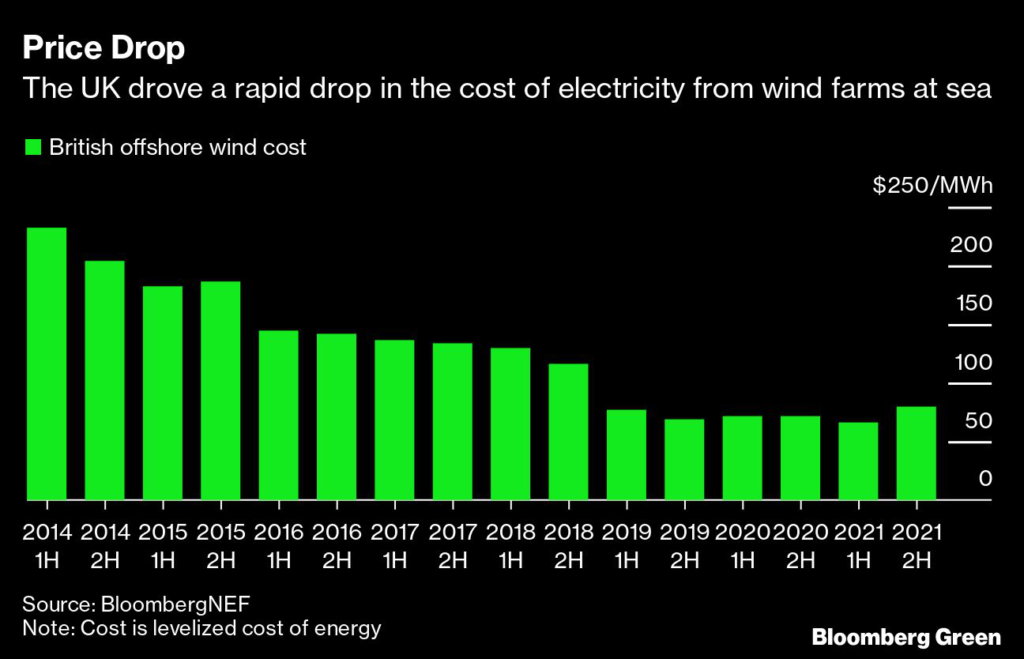
The UK in particular has supported the industry by allocating vast tracts of seabed to developers and doling out generous subsidies, helping improve the technology and lower costs. Since the first British project was completed in 2000, turbines have become more than five times as powerful and the price of wind-generated electricity has fallen below power from fossil fuel or nuclear plants. By the end of the decade, Prime Minister Boris Johnson aims to boost the UK’s offshore wind capacity to 50 gigawatts, more than triple the current fleet.

Achieving that goal will require speeding up development of the $33 billion industry. It currently takes as long as 15 years to complete a major offshore wind project in the UK, according to Aurora Energy Research. Some of that time could be cut by simplifying the permitting process, but even then it may still take a decade.

The real timesaver would be installing turbines more quickly. Erecting the giant structures requires highly specialized and expensive ships known as jack-up vessels. When they get to the site of a new wind turbine, a moveable foundation descends to the seabed to hoist the vessel out of the waves so it can work without being pushed back and forth. Under ideal conditions, this can take as little as three hours, but that can also drag to 20 hours if the currents are strong.Floating vessels that don’t have to be lifted up can complete work 50% faster than those commonly used today, according to clean energy research group BloombergNEF. “You can make installations more efficient,” said Amanda Ahl, a BloombergNEF analyst. Because ships don’t have to haul the heavy structures used to tie them to the seabed, they can carry materials for more turbines at a time. That means fewer voyages back and forth to shore that can sometimes take up to 10 hours.

The catch is that using ships that float makes the precise work of assembling wind turbines much more difficult. That’s where the robots come in.

X-Laboratory, a company founded by former European Space Agency researcher André Schiele, sells software and robotics systems to wind turbine construction companies that allows the giant cranes on their ships to be controlled remotely. The technology that Schiele helped develop — initially intended to help conduct research on other planets from Earth — may shave years off the time needed to put up a wind farm in the ocean.

One of the world’s biggest installers of offshore wind, Jan De Nul Group, is starting to adopt the technology. The company has moved some of its operations to ships that float while they work. The first vessel, named Les Alizes, will get to work later this year and be able to carry three times more weight than a similar vessel that also has to haul equipment to attach it to the ground.

Read More: World Will Spend $1 Trillion on Offshore Wind by 2031As a start, Jan De Nul’s new ships will use X-Laboratory’s system to control a giant claw that will help compensate for any unexpected movements in the water. The technology could cut the total time to install a wind farm by more than 25% due to its ability to work in windier conditions. For now, the claw will only be used to install the foundations for wind turbines, not the more sensitive work of attaching blades.The company is optimistic that the robotic technology will counter the challenges of working out at sea on floating vessels. A “few years ago it was thought this was too difficult to overcome,” said Geert Weymeis, the company’s head of offshore installation analysis. The claw “could be a game changer.”

Schiele recalls celebrating in 2015 as an astronaut held a joystick on the International Space Station and moved a four-wheeled robot in a lab in the Netherlands. It was a breakthrough for space research. But he quickly started thinking about other applications, which led to X-Laboratory and the wind turbine construction system.

“It’s nice to solve challenges like ‘How can we go to Mars?’” he said. “But the climate question is a much bigger challenge.”

More stories like this are available on bloomberg.com

©2022 Bloomberg L.P.

Biden Urges Hyundai, Samsung to Embrace Union Workers

(Bloomberg) — President Joe Biden encouraged Hyundai Motor Co. to partner with unionized US workers following a meeting with the company’s chief executive. 

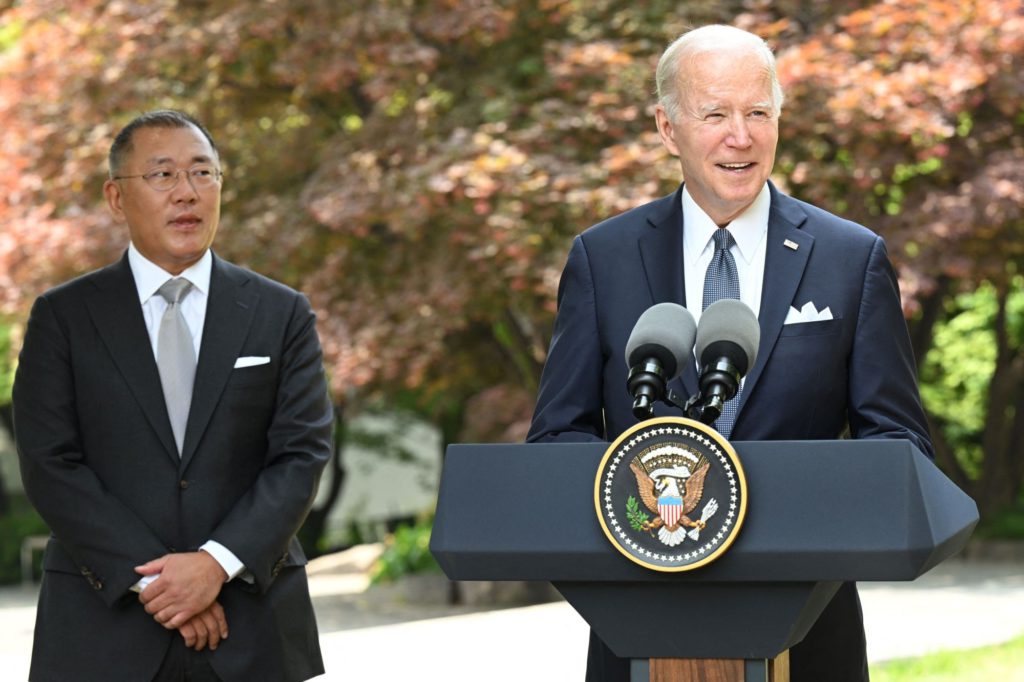
“Hyundai and any company investing in the United States would benefit greatly from entering into partnerships with some of the most highly skilled, dedicated and engaged workers in the world,” Biden said in a joint appearance with Hyundai’s Executive Chairman Euisun Chung. “And that is American union members.”

Hyundai announced Friday it’s investing $5.5 billion to build an EV assembly and battery plant near Savannah, Georgia.

But Georgia is a right-to-work state, meaning workers may not be required to join a union as a condition of their employment. Just 4.8% of Georgia’s workforce were members of unions in 2021, according to the Bureau of Labor Statistics. 

Biden, who has vowed to be the most pro-union president in US history, also heralded the benefit of union jobs in the EV industry during a tour Friday of a Samsung facility outside Seoul.

“Every joint venture that manufactures electric vehicle batteries would be made stronger by collective bargaining relationships with America unions,” Biden said. 

Biden has set a goal of electrifying half of US cars by 2030, and administration officials said earlier this month that the federal government will spend more than $3 billion to support domestic manufacturing of advanced batteries used in electric vehicles and energy storage. 

“Electric vehicles are good for our climate goals, but they’re also good for jobs — and they’re good for business,” Biden said Sunday. 

Chung said Hyundai would invest an additional $5 billion through 2025 to collaborate “with American enterprises in diverse technologies, such as robotics, urban air mobility, autonomous driving and AI.”

Georgia’s Republican Governor Brian Kemp — who faces former Senator David Perdue in Tuesday’s GOP primary — has backed hefty incentives to lure automotive companies. Perdue is backed by former President Donald Trump.

Hyundai Investing $5.5 Billion in Georgia EV, Battery Plants 

Hyundai’s sales in the US have increased since the company transformed its fleet to meet Americans’ demand for SUVs. It set a US retail sales record in the first quarter after increasing deliveries nearly 20% in 2021. 

The company said in April it will spend $300 million to expand its assembly plant in Montgomery, Alabama, to make a hybrid version of the Santa Fe crossover and an EV for its luxury Genesis brand, the GV70, this fall. 

More stories like this are available on bloomberg.com

©2022 Bloomberg L.P.

Record Food Costs Throw Spotlight on How China Will Feed Itself

(Bloomberg) — China has been long obsessed with finding ways to ensure there is enough food for its population, and with good reason. 

With almost a fifth of the world’s people, limited farmland and the increasing challenge of climate change, President Xi Jinping’s government has exhorted farmers to maximize harvests and consumers to minimize waste. It’s built up huge stockpiles to cope with shortages and created new seeds to boost output.

Even so, the country still buys about 60% of all the soybeans that are traded internationally, and ranks as the biggest corn and barley importer. It has also recently emerged as one of the world’s largest wheat buyers. That makes soaring global crop costs and, potentially, a looming world food crisis very much a matter of concern for the government, especially in terms of how local prices perform. Here are some of the food security challenges China faces: 

Soybeans, Edible Oils

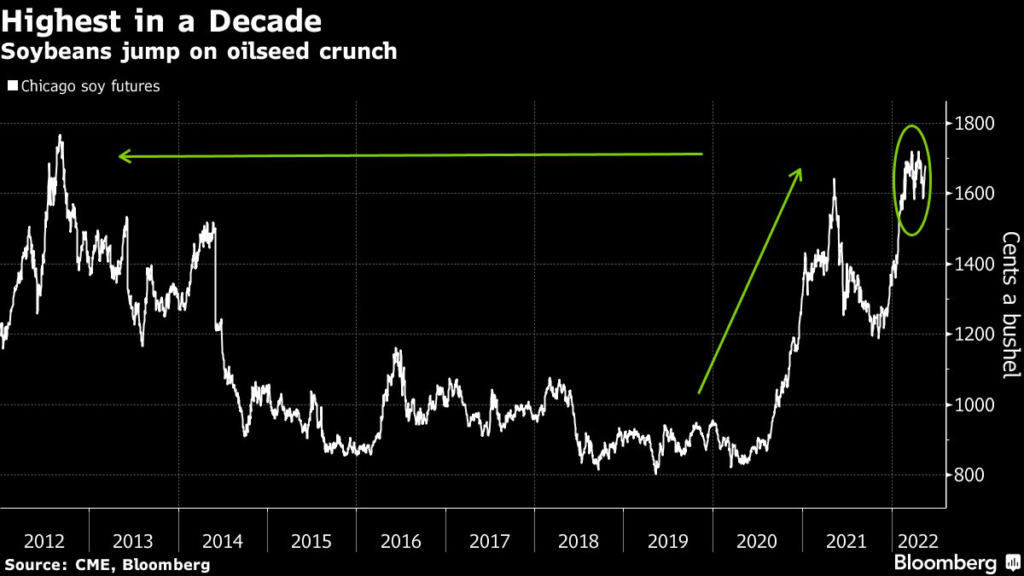
China’s local consumption of soybeans is almost as large as the entire US harvest, and the country has to import about 85% of its needs. The beans are crushed into edible oil for cooking and other food uses, and into feed for its hog population, the world’s largest. Global soybean prices have doubled in the past two years on dry weather in South America and a shortage of oil-bearing seeds. Unless the US has a bumper crop this year, they could go even higher. 

“Soybeans carry the biggest inflationary risk,” said Jim Huang, head of China-America Commodity Data Analytics. Rising prices of crude oil and freight, as well as the weakening yuan, are worsening the situation, he said by email.  

China is also the biggest importer of palm oil after India and a major buyer of sunflower oil. Global cooking oil prices have soared to records on drought, labor shortages and Russia’s war in Ukraine. The latest leg-up came after top exporter Indonesia banned palm oil shipments.

The government is making a big push to boost soybean production, with the crop poised to jump 19% in 2022-23. But with output so low compared with consumption, that isn’t going to make much of an impression on imports. 

Corn

For a long time, China didn’t buy much corn overseas, but in recent years that started to change with the country emerging as the world’s biggest importer, driven by the need to replenish inventories and feed a rapidly expanding hog population. The surge in buying, much of it from the US, its geopolitical rival, spurred China to boost its focus on self-sufficiency as a national security goal. 

Unlike soybeans, however, where the country has been highly dependent on foreign supplies, corn imports only accounted for about 10% of domestic consumption in the 2020-21 year, and that percentage is on track to shrink to about 6% by 2022-23, according to data from the US Department of Agriculture.

China buys quite a bit of corn from Ukraine, with the Black Sea nation supplying about 30% of shipments last year, its second-biggest supplier. But that trade has been throttled by the Russian invasion, and is one of the possible reasons behind an expected decline in imports in the coming year.

Wheat

The world’s supply of wheat is under threat as everything from war to drought, floods and heat waves cut production. Global wheat prices soared to a record in March after Russia invaded Ukraine, and they are 80% more expensive than they were a year earlier, helping push global food costs to the highest ever. 

Like corn, the country’s dependence on imports is low at about 7% of consumption in 2021-22. That still makes it one of the world’s top buyers along with Indonesia, Egypt and Turkey. There has been concern over production in China, and at one point a top official said the country could face the worst crop conditions in history after record-breaking floods last year. Authorities are also investigating if there’s any illegal destruction of the crop after videos showing immature wheat being destroyed or cut down went viral on social media.

What’s Next

China has built up huge stockpiles of wheat, rice and corn, and according to USDA estimates, the country holds at least half, if not more, of global inventories for these commodities. The government will release stockpiles if needed to alleviate any food inflation or shortages, said Iris Pang, chief economist for Greater China at ING Bank. Fertilizer costs are a concern and could push up food inflation, but “not to a worrying situation,” she added.

Over the longer term, Beijing has called for stronger measures to stabilize production, with two priorities: new seeds and protection of arable land. It’s seeking to develop genetically modified seeds to boost yields, and wants to stop farmland being used for construction or turned into golf courses.

More stories like this are available on bloomberg.com

©2022 Bloomberg L.P.

Amazon Aims to Sublet, End Warehouse Leases as Online Sales Cool

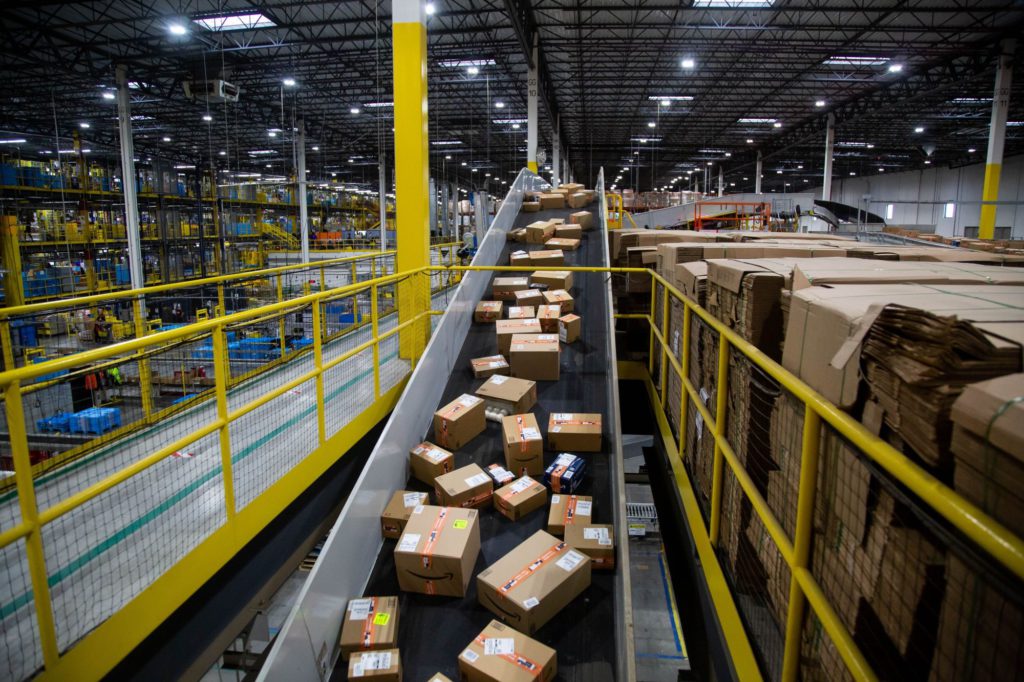
(Bloomberg) — Amazon.com Inc., stuck with too much warehouse capacity now that the surge in pandemic-era shopping has faded, is looking to sublet at least 10 million square feet of space and could vacate even more by ending leases with landlords, according to people familiar with the situation. 

The excess capacity includes warehouses in New York, New Jersey, Southern California and Atlanta, said the people, who requested anonymity because they’re not authorized to speak about the deals. The surfeit of space could far exceed 10 million square feet, two of the people said, with one saying it could be triple that. Another person close to the deliberations said a final estimate on the square footage to be vacated hasn’t been reached and that the figure remains in flux.

Amazon could try to negotiate lease terminations with existing landlords, including Prologis Inc., an industrial real estate developer that counts the e-commerce giant as its biggest tenant, two of the people said.

In a sign that Amazon is being careful not to cut too deeply should demand quickly rebound, the 10 million square feet the company is looking to sublet is roughly equivalent to about 12 of its largest fulfillment centers or about 5% of the square footage added during the pandemic. In another signal that Amazon is hedging its bets, some of the sublet terms would last just one or two years. 

The company declined to say which space it plans to sublet or confirm the amount.

“Subleasing is a very common real estate practice,” spokeswoman Alisa Carroll said. “It allows us to relieve the financial obligations associated with an existing building that no longer meets our needs. Subleasing is something many established corporations do to help manage their real estate portfolio.”

Prologis declined to comment.

Amazon spooked investors last month after reporting slowing growth and a weak profit outlook that it attributed to overbuilding during the pandemic when homebound shoppers stormed online. At the end of 2021, Amazon leased 370 million square feet of industrial space in its home market, twice as much as it had two years earlier. 

In the April earnings report, the company said it expected the excess space to contribute to $10 billion in extra costs in the first half of 2022. The company didn’t divulge how much over-capacity it had, where it was located or what it planned to do with it. Subleasing surplus space is one way for Amazon to trim costs on space it no longer needs.

Amazon tasked the real estate firm KBC Advisors to evaluate the warehouse network and determine where to sublet and where to terminate leases, two of the people said. Both options carry costs. Subletting warehouse space requires Amazon to remove all of its equipment so the new occupant can tailor it to their own needs. Lease terminations typically require the tenant to pay a percentage of the rent that would be due over the full term of the agreement.

It shouldn’t be hard to find tenants. The vacancy rate for industrial space is below 4%, an all-time-low, and rents were up 17.6% at the end of 2021, according to a February report from Prologis.

More stories like this are available on bloomberg.com

©2022 Bloomberg L.P.

Dangerous DIY Baby Formula Recipes Go Viral as Parents Get Desperate

(Bloomberg) — As a nationwide baby formula shortage sends parents into crisis mode, social media posts containing dangerous misinformation about homemade formula recipes have gone viral online, racking up views in the millions. Although major networks like Facebook, TikTok and YouTube have taken steps to label photos, videos and posts with contextual information pointing to the harms of such recipes, and in some cases removed them, they have done so inconsistently, allowing the advice to continue spreading and putting children at risk.

“Platforms still haven’t learned the lesson that their obsession with engagement is leading them to recommend wildly unsafe content,” said Laura Edelson, a computer scientist studying misinformation at New York University. “The fact that they still have not fixed this issue after years of very clear evidence that their algorithms are promoting dangerous content is shocking.”

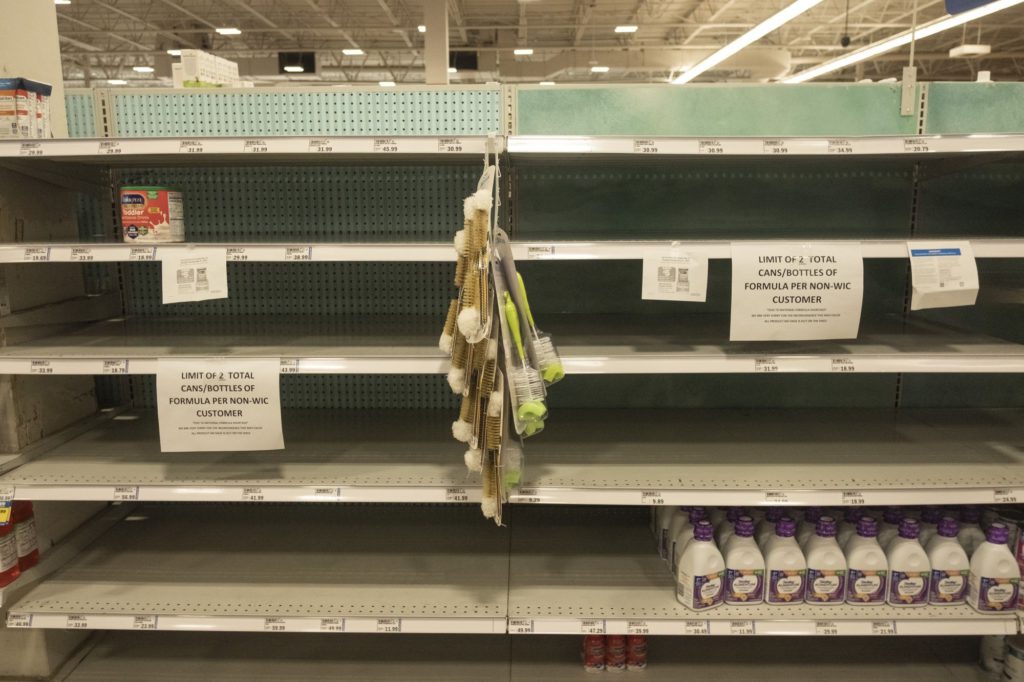
Scant availability of formula has been a problem for months because of supply-chain disruptions that have affected consumers across major industries, from autos to appliances. But after Abbott Laboratories’ nutrition unit recalled some of its products earlier this year, including its top-selling brand Similac, stockpiles were further depleted, leading parents to try anything — driving for hours to stores that might have stock, or bartering in Facebook groups — to get their babies fed. On May 18, US President Joe Biden took urgent action to address the crisis, invoking the Defense Production Act to increase production and instructing Defense Department planes to speed formula shipments into the country from overseas.

Parents are turning to the internet for solutions and alternatives, but medical experts agree that homemade versions of baby formula come with serious health risks. “We’ve all seen over the last couple of years that fear and uncertainty create an ideal environment for misinformation to go viral,” Edelson said.

Both the US Food and Drug Administration and the American Academy of Pediatrics issued warnings stating that parents shouldn’t make their own infant formula because of the dangers associated with a lack of nutrients in them. In its advisory, the FDA added that it had received reports of hospitalized infants suffering from low calcium from the homemade recipes. On May 16, a doctor at Le Bonheur Children’s Hospital in Memphis, Tennessee, said he was treating two young patients—a toddler and a preschooler—because they didn’t have access to the specialty formula they needed.

Both YouTube and TikTok said they removed videos Bloomberg flagged. YouTube said content that “promotes, sells or provides instructions for homemade baby formula” is in violation of its harmful and dangerous content policies. TikTok said it would continue looking for similar problematic content. Twitter, when shown examples by Bloomberg, said they didn’t violate its misinformation policies, which apply to manipulated media, elections, Covid-19 and crises, such as the Buffalo shooting. Twitter said it would re-examine its approach as the public conversation evolves. 

Meta Inc., which owns Facebook and Instagram, said it partners with a network of third-party fact checkers who rated claims about the baby formula shortage. Once posts have been fact checked, they appear with warning labels in Facebook’s feed and fewer people see them, a Meta spokesperson said. The company did not respond to questions about its inconsistent labeling on the homemade baby formula posts.

The platforms did host many communities sharing information about where to find baby formula, including crowdsourced maps about which grocery stores had products in stock. Bringing people together to strategize around the problem and get emotional support comes with the tradeoff of making it easy for bad advice to travel, said Melissa Ryan, chief executive officer of Card Strategies, a consulting firm that researches disinformation.

“Parents are using online forums, particularly local groups, to source formula for their babies, and it’s been an amazing resource,” Ryan said. “But misinformation about the shortage is also everywhere. Everything from fake homemade formula recipes to conspiracies about what caused the shortage.”

Ryan said the tech companies could consider solutions like applying more consistent fact-check labels on formula misinformation, or setting up a resource pointing parents to factual information about the formula shortage, the way they have sought to redirect users from potential Covid-19 misinformation with links to reputable sources.

Steven Abrams, a pediatrician at the University of Texas in Austin, said the lack of absorbable nutrients in homemade formula poses a risk of seizures in infants, and inadequate iron risks anemia and developmental delays. Improper preparation is also a danger, he said. “Contamination either in the foods or from the preparation exposes infants to risks of serious bacteria, including salmonella,” Abrams said.

But the warnings didn’t stop social media users from discussing and sharing the unproven recipes online. In the first week of May, there were just a couple hundred posts discussing homemade baby formula on Twitter, according to an analysis by Bloomberg News. The next week, that number jumped to almost 5,000 tweets—a 2,100% increase. “If you are affected by this, don’t panic,” said one tweet. “Millions of us grew up on homemade formula… your baby will be fed and happy and probably have fewer tummy upsets.” 

On Facebook, posts sharing a photo for a 1960s recipe for homemade baby formula as a workaround to the shortage were by far the most viral on the platform. Posts containing the recipe photo were shared in hundreds of Facebook groups with names like “Country Girl’s Dream Spaces” and “Mommy Talk Madness,” generating 95,899 interactions in the past year, according to an analysis on CrowdTangle, a social media web tool owned by Facebook parent Meta Platforms Inc. Though not everyone in the Facebook groups liked or shared the posts, the DIY recipe may have reached as many as 12.5 million people, the analysis showed.

On some of the posts, Facebook applied a label saying the information listed could mislead people. But on others, including one that collected nearly 1,000 likes and shares, the label wasn’t applied. The company appeared to be labeling posts inconsistently “based on very basic text patterns, such as ‘formula recipe,’” said Edelson, the misinformation researcher.

The recipe was also shared widely on Meta’s Instagram photo-sharing app, generating hundreds of likes and shares. Similar to Facebook, many of the Instagram posts didn’t carry the misleading label.

On Google’s YouTube, dozens of videos sharing DIY baby formula recipes were hosted on the video site and shared across other platforms, including Twitter and Facebook, collecting hundreds of likes and shares. The most popular videos had tens of thousands of views and included ads, appearing after a simple search string—“homemade baby formula”—despite YouTube’s promises that it doesn’t allow or promote content containing health misinformation on search and recommendations on the site. YouTube removed some videos from its site, but only after Bloomberg News reached out.

The same simple search on ByteDance Ltd.’s TikTok app brought up just as many results, but the videos were even more viral on the platform. Half a dozen of the most popular search results containing untested formula concoctions saw at least 1.5 million views on the platform, according to a review by Bloomberg News. After Bloomberg reached out for comment, TikTok removed results for “homemade baby formula” and added a notification for users that some of the posts that would have appeared are in violation of community guidelines.

Many of the instructions shared online were based on a homemade recipe from the Weston Price Foundation, a nonprofit based in Washington, D.C., that has also advanced false claims about vaccines, cholesterol and Covid-19. “A better, healthier homemade baby formula recipe,” tweeted Darla Shine, the wife of former President Donald Trump’s onetime communications director, attaching a link to the group’s recipe. “Please pass around.” Her tweet collected 150 likes and shares.The link was shared hundreds more times on Twitter, a CrowdTangle analysis showed. On Facebook, the same link was shared hundreds of times, generating 23,600 likes and shares on the platform. It collected 2,400 more interactions on Instagram. Shine did not respond to a request for comment.

Abrams, the pediatrician, said he was “very familiar” with the group’s formulations and considered them “risky.” Others had even stronger views.

“Oh man, these are completely dangerous,” said Mark Corkins, a pediatric gastroenterologist who treated the two young patients hospitalized in Memphis, when asked to review several other recipes that went viral on social media, many of them based on Weston Price’s original recipe. “Two of them start with raw milk. That is unpasteurized. Louis Pasteur invented pasteurization because cow’s milk contained infectious agents that were eliminated by the process.”

“These are not going to be complete nutrition and have a very high risk of exposing your infant to infections you don’t want them to have,” he said.

Sally Fallon Morell, the president of the Weston A. Price Foundation, stood by her advice on raw milk formulas in a phone conversation, claiming “it gives the baby immunity for life against any pathogen in the raw milk.” The Centers for Disease Control and Prevention has stated that raw milk can carry harmful bacteria and other germs that can kill people. In about half of states, the sale of raw milk to consumers is illegal.

For parents looking to help feed their babies, the American Academy of Pediatrics recommends checking smaller stores and local pharmacies for baby formula, or looking online for well-recognized distributors for supplies. Pediatricians may also be able to connect low-income families to the U.S. Department of Agriculture’s special supplement nutrition program, which provides federal grants for food, including baby formula, to qualified individuals, the group said. 

The formula shortage underscores the issue tech companies have with short-lived surges in misinformation that their artificial intelligence systems aren’t trained to address. Despite Biden’s action, companies are warning that the shortages could affect consumers for months. Shelves were 45% out of stock the week ending May 15, according to Datasembly.

“This is a public health crisis,” said Ryan, the misinformation researcher. “But the tech companies aren’t treating it like one at all.”

More stories like this are available on bloomberg.com

©2022 Bloomberg L.P.

Crypto’s Bankman-Fried Gave $16 Million to Super PACs in April

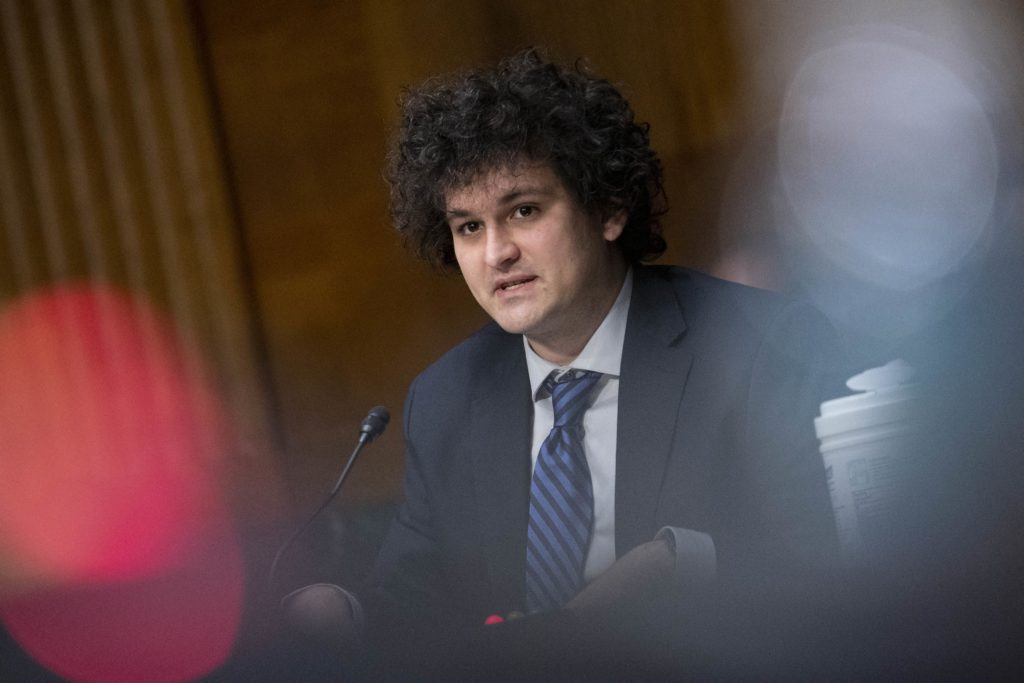
(Bloomberg) — Crypto billionaire Samuel Bankman-Fried poured $16 million into super PACs in April, making him one of the top donors to outside groups as the primaries get into full swing, according to the latest filings with the Federal Election Commission.

Bankman-Fried gave $10 million to Protect Our Future, a super PAC that says it’s supporting candidates who can help prevent the next pandemic. The group has spent $19 million to influence elections so far, all in Democratic House races. Its biggest outlay was $10.5 million to back Carrick Flynn, who ran for an open seat in Oregon’s 6th congressional district. Despite the support, he lost the primary to Andrea Salinas, a state lawmaker who could be Oregon’s first Latino woman elected to Congress should she win the seat in November.

Protect Our Future, which is the third biggest spender among super PACs so far, also backed Representative Lucia McBath, a Democrat of Georgia, spending $1.9 million on her behalf, and six other candidates.

The House Majority PAC, the super political action committee of House Democrats, counted the CEO of crypto exchange FTX as its biggest donor in April. Bankman-Fried gave it $6 million of the $9.8 million it raised. The PAC ended April with $59.8 million in the bank after spending $2.8 million.

The super PAC, which has ties to Speaker Nancy Pelosi, plans to spend more than $100 million in a bid to protect the Democrats’ narrow five-seat House majority. Its Republican counterpart, the Congressional Leadership Fund, which is planning its own $125 million ad blitz ahead of the November elections, files quarterly and won’t report its totals until July 15.

Super PACs can raise money in unlimited amounts but can’t coordinate their spending with candidates or parties.

The donations bring Bank-Fried’s total support for super PACs in the current election cycle to $31.5 million, among the top tier of donors. He’s well behind George Soros, who put $125 million into Democracy PAC II, a committee he uses to distributed funds to other groups. 

Bankman-Fried has moved into second place ahead of Republican donor Richard Uihlein, who gave $1 million to the super PAC arm of the Club for Growth in April, bringing his total donations to just less than $31.5 million, according to OpenSecrets.

In the 2020 election cycle, Bankman-Fried ranked 47th among donors to outside groups, giving $5.6 million to Future Forward, which supported the campaign of Joe Biden.

A plunge in cryptocurrencies slashed the wealth of some of the industry’s biggest players, including Bankman-Fried, whose net worth dropped by about half to $11.3 billion, according to the Bloomberg Billionaires Index.

More stories like this are available on bloomberg.com

©2022 Bloomberg L.P.
A $5 Trillion ‘Wealth Shock’ Is Cracking Americans’ Nest Eggs

(Bloomberg) — The world’s richest nation is waking up to an unpleasant and unfamiliar sensation: It’s getting poorer.

Americans’ collective net worth had been climbing at a dizzying rate for the past two years, even as families and businesses contended with the ravages of Covid-19. Households piled up an extra $38.5 trillion from early 2020 to the end of last year, bringing their collective net worth to a record $142 trillion, the Federal Reserve estimates.

Just as the US is learning to live with the virus and spending shifts back toward pre-pandemic normal, it faces a new scary threat: A plunge in wealth since the start of 2022 that JPMorgan Chase & Co. estimates totals at least $5 trillion — and could reach $9 trillion by year-end.

So far, the richest Americans have borne the brunt, with US billionaire fortunes down almost $800 billion since their peak amid the sharp losses in stocks, crypto and other financial assets. But surging interest rates are also starting to rattle the housing market, where middle- and working-class families have the bulk of their wealth.

It all adds up to the sudden removal of a major prop to confidence: ever-bigger nest eggs. And it’s by design. To stamp out the highest inflation in decades, the Fed needs Americans to curb their spending, even if it requires an economic slowdown to get there.

“It’s painful to get back to normal after really being in a fantasy world last year,” said John Norris, chief economist at Oakworth Capital Bank. “It’s going to feel a lot worse than it actually is.”

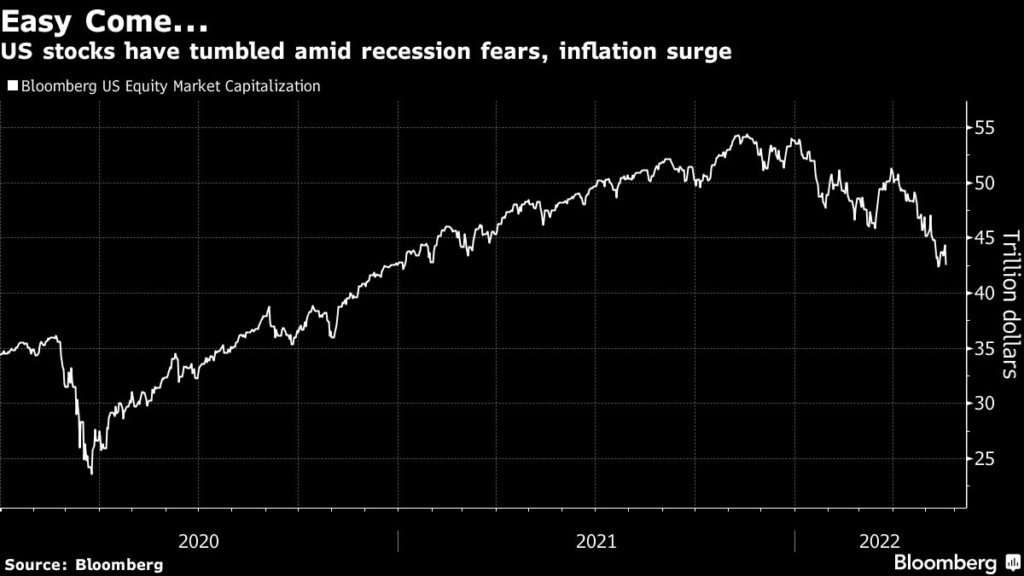
Since the start of the year, the S&P 500 Index is down 18%, the Nasdaq 100 has lost 27% and a Bloomberg index of cryptocurrencies has plunged 48%.

That all amounts to “a wealth shock that is set to drag on growth in the coming year,” JPMorgan economists led by Michael Feroli wrote in a note Friday.

Fed Chair Jerome Powell and his colleagues have repeatedly said they’re actively aiming for such a slowdown, leaving it unlikely policy makers will move to address the Great Wealth Drop of 2022.

Read More: Fed to Plow Ahead on Half-Point Hikes, Undeterred by Stock Slump

Billionaires were the biggest winners of 2020 and 2021. Now they’re losing more than almost everyone else. The Bloomberg Billionaires Index, a daily measure of the wealth of the world’s 500 richest people, has dropped $1.6 trillion since its peak in November.

Leading the way are the Americans on the index, who have lost $797 billion since their peak. Perhaps the most humbled by it all is the world’s richest person, Elon Musk. He’s lost $139.1 billion, or 41% of his wealth, since November, when his net worth briefly surpassed $340 billion. Amazon.com Inc. founder Jeff Bezos, the second-richest person, lost $82.7 billion, or 39% of his peak wealth.

While the wealth losses among the top 0.001% reduce inequality, that won’t be much comfort to most people who worry about the U.S.’s widening disparities. 

“In a relative sense, it’s going to make the inequity a little lower — but in an absolute sense, everyone suffers,” said Reena Aggarwal, director of Georgetown University’s Psaros Center for Financial Markets and Policy. 

Like many, Aggarwal is concerned that falling markets will create problems for the broader economy. “Some correction was needed but this is a pretty huge correction, and it’s not stopping.”

A downturn in housing — made likely by a surge in mortgage rates to the highest since 2009 — threatens wider reverberations. Over the last decade, the robust real estate market added $18 trillion in market value to owner-occupied home valuations.

US spending has been lifted in recent years by owners tapping the enhanced values of their homes for cash. The practice of home equity extraction likely came to a halt this year. More than 40% of refinancings in the final quarter of last year saw homeowners pull cash out of their homes. 

Real estate is far more evenly distributed than financial wealth. The top 1% owns more than half of U.S. holdings of stocks and mutual funds, and the bottom 90% owns less than 12%, according to Federal Reserve estimates. By contrast, in real estate the bottom 90% owns more than half of the total, while the top 1% holds less than 14%.

“Higher home prices and sharply higher mortgage rates have reduced buyer activity,” Lawrence Yun, National Association of Realtors chief economist, said in a statement Thursday. “It looks like more declines are imminent in the upcoming months.”

What Bloomberg’s Economists Say…

While the plunging stock market will dent consumers’ net worth this year, the residual effect of last year’s surge in asset values — and the resilience in home prices so far this year — are major offsetting factors supporting consumption. As a result, personal spending is expected to grow faster this year than before the pandemic, even after the removal of fiscal stimulus.

— Yelena Shulyatyeva, economist

For the full note, click here

It could take a while before Americans realize that their pandemic home-price gains have evaporated. Even the stock market selloff could take a while to translate into spending in a way that could tip the U.S. into recession.

“A general selloff in the equity market may have a dampening effect,” said Chris Gaffney, president of world markets at TIAA Bank, but there’s a lag for investors. “They look at their statements on a quarterly basis and all of a sudden they say, ‘Oh my goodness, my stock-market portfolio is down 20%, maybe I shouldn’t take that vacation,’ or ‘Maybe I shouldn’t buy that larger TV or a new car.’”

More stories like this are available on bloomberg.com

©2022 Bloomberg L.P.
Close Bitnami banner
Bitnami