Bloomberg

Social Media Buzz: Bear Market, Nancy Pelosi, George Carlin

(Bloomberg) — Here’s what’s buzzing on social media:

BUZZING STOCKS

A dramatic late-session rally brought the S&P 500 back from the brink of closing in a bear market on Friday. But the US stock benchmark still sank for a seventh straight week as investors grappled with concerns about an economic slowdown and more monetary tightening.

BUZZING HEADLINES

House Speaker Nancy Pelosi is perpetrating a “great evil” and will be denied communion because of her support for abortion rights, Archbishop Salvatore Cordileone of San Francisco tweeted. Angry reaction on Twitter focused on the Catholic Church’s pedophilia scandals.

Australia’s Labor Party is set to take power for the first time since 2013, as voters booted out Prime Minister Scott Morrison’s conservative government. Morrison conceded defeat on Saturday night and congratulated Anthony Albanese on the victory.

A federal judge in Louisiana blocked the Biden administration from ending Title 42, a border restriction enacted in the early days of the pandemic that allows for the immediate expulsion of asylum-seekers and other migrants. Immigrants’ rights advocates decried the ruling as legally flawed and cruel. Supporters of maintaining the statute argued that its repeal would send the border into chaos, citing already high numbers of migrants this year.

A new documentary on George Carlin debuted Friday on HBO, tracing his arc from clean-cut comedian to political bomb-thrower who said words that couldn’t be repeated on television or here. The documentary was directed by Judd Apatow and Michael Bonfiglio, and traces his influence on a generation of comedians. He died in 2008.

More stories like this are available on bloomberg.com

©2022 Bloomberg L.P.

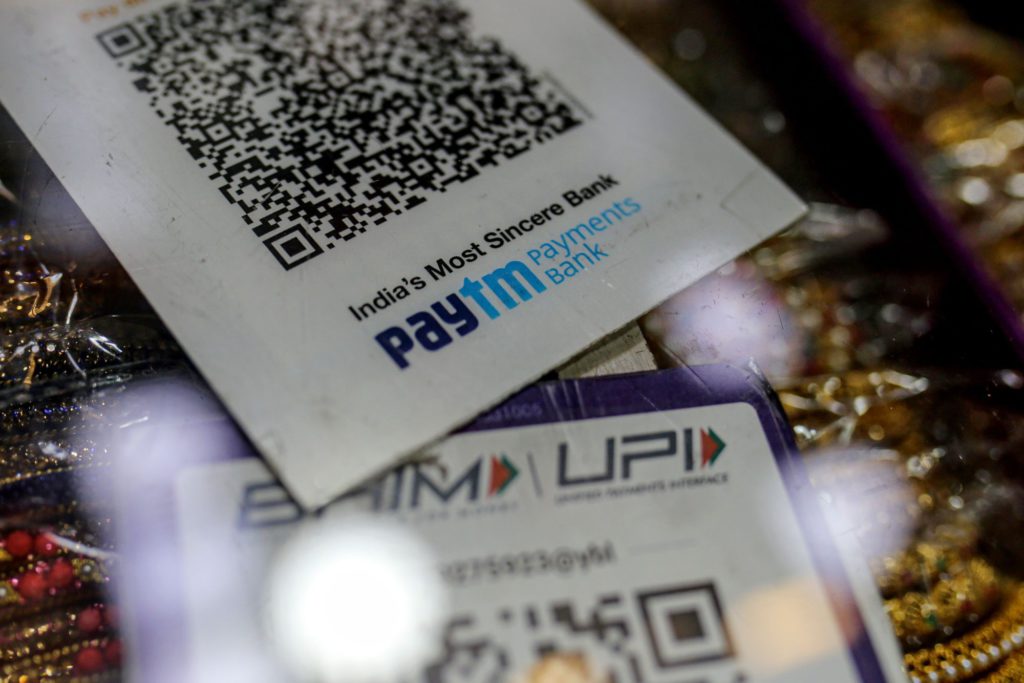
Fintech Pioneer Paytm’s Quarterly Revenue Edges Higher

(Bloomberg) — Paytm reported a 5.8% rise in revenue amid the Indian digital payments pioneer’s struggle with intensifying competition.

Paytm-owner One 97 Communications Ltd. reported a net loss of 7.6 billion rupees ($98 million) for the March quarter, versus a loss of 7.8 billion rupees a quarter earlier. Revenues rose to 15.4 billion rupees from 14.6 billion rupees, it said in a statement.

Paytm is grappling with intensifying competition from Amazon.com Inc., Meta Platforms Inc. and Alphabet Inc. as well as a slowdown in transactions during the pandemic. The company, which counts Warren Buffett’s Berkshire Hathaway Inc. and SoftBank Group Corp. among its backers, pulled off India’s largest-ever initial public offering at the time in November, a landmark moment for the country’s young internet industry. 

But its shares plunged 27% on debut and have dropped more than 70% since the $2.5 billion IPSO. Investors have grown cautious about its longer-term growth prospects and potential regulatory tangles. In March, India’s central bank barred the company’s lending venture from accepting new customers, citing concerns it may have shared local users’ data abroad, including with Chinese-based entities. 

Read more: Buffett-Backed Paytm Aims to Break Even in Under Two Years

Vijay Shekhar Sharma, from the small central Indian town of Aligarh, founded One97 about two decades ago and won acclaim nationwide as a small-town-boy-made-big. But analysts including those at Macquarie Capital Securities (India) Pvt. have questioned his ability to turn Paytm  into a profitable business any time soon.

India’s consumer Internet stocks have taken a beating, mirroring the worldwide tech stock slide, but the stock of the high-profile Paytm continues to hover around about a fourth of its offer price.

The stock swoon has proven painful for early backers of Paytm, as its market cap has dropped. Berkshire Hathaway Inc. invested in One97 when the company was valued at more than $10 billion in 2018, and T. Rowe Price Group Inc. invested at a $16 billion valuation the following year, Bloomberg News has reported.

In a letter to shareholders last month, founder Sharma said the company was targeting operational break-even by September next year. Paytm in April predicted it will become profitable in six quarters on an operating earnings before interest, tax, depreciation and amortization basis. That forecast followed a doubling of its gross merchandise value to 2.59 trillion rupees in the three months ended March.

Paytm disbursed over 15 million loans worth 76.23 billion rupees in the year ended March, the company said in its earnings release. Its merchant base grew to 26.7 million, it said.   

In a separate statement, Paytm said it plans to set up a general insurance company and intends to apply for a new license. It will hold 74% in the new company, which will be set up with an investment of as much as 9.5 billion rupees over 10 years, it said.   

(Updates with details on the company’s general insurance venture in last paragraph)

More stories like this are available on bloomberg.com

©2022 Bloomberg L.P.

When EVs Die in the Wild (And Trust Us They Will)

(Bloomberg) — The range anxiety didn’t start until I pulled up to the charging station.

I had made it to the bank of hoses with about 15 miles to spare, but three of the six units weren’t working and a Nissan Leaf owner at the fourth slot was on the phone with the station’s customer service, looking far from cheerful. With my two small kids in the back, I dipped a credit card and pulled it out sopping wet — no dice. My mind frantically calculated contingencies like a Garmin on the fritz until I updated an app and was able to pay through the iPhone. With the hum of electrons zipping through the chord, my heartbeat returned to steady-state. Crisis averted. 

Even without gas, running out of gas is still a thing — call it driving to zero. With a spike in electric vehicle adoption, as a wave of charging rookies hits the road, it will be increasingly common. Stranded drivers will be a particularly acute problem in North America, with its still insufficient network of often flawed charging hardware. Vast  EV deserts are more the norm than the exception and error-codes — whether in the parking lot of your local Whole Foods or at any of the charger-outfitted rest stops along the east coast’s I-95 — are a given.

The cars, however, are as smart as they look. Near the end, they try desperately to save themselves. Most contemporary EVs do the math and automatically navigate to a nearby charger when range is getting tight. Many also have some form of “limp-home” function, a setting that shuts down all but the bare essential electric processes and adds a few miles of distance. Nissan calls this “turtle mode” — a plodding reptile pops up on the vehicle’s screen.

Even when the battery is all but dry, your car will drag itself along slowly; the accelerator pedal will feel mushy, but not entirely kaput. “You can always go a little bit further once you hit zero,” counsels Tom Moloughney, who regularly runs EVs to empty for his YouTube channel State of Charge. At the very least, the EV will survive long enough to die in a safe place.

Running out of battery is a constant concern for EV owners, particularly those who haven’t been driving electric for long, says Ryan O’Gorman, manager and strategist in Ford Motor’s Energy Services Business. “Generally I ask [people], ‘When was the last time you ran out of gas?,’” he explains, “and typically the answer is something like, ‘When I was in high school.’” O’Gorman’s other strategy to foster peace-of-mind: asking how often they have driven away from home with an entirely full tank of gas.

The issue has been a priority at Ford since it angled for the electric market with the launch of the Mustang Mach-E in December 2020. Those buying the battery-powered compact SUV — or the F-150 Lightning — also get a tow to a charging station if and when they’re stranded as a free service for five years or 65,000 miles.

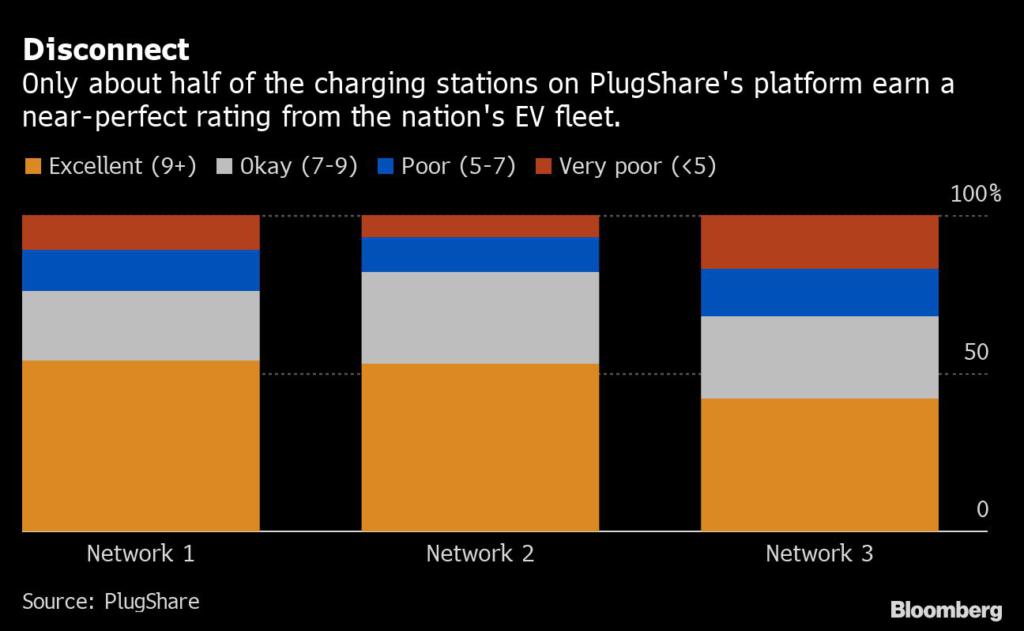
Data on public charger reliability — or “uptime” in industry-speak — is notoriously hard to come by. Perhaps the best measure is a crowdsourced system of ratings on PlugShare, a navigation platform that aims to be for EV drivers what Yelp is for diners. On a scale of 1-10, almost one quarter of PlugShare stations garner a score under 7.

In a recent study of chargers in the Bay Area, almost 23% weren’t functioning for a variety of reasons — from unresponsive screens to broken credit card processors. Another 5% had cords that were too short to be of much use.

Ford also launched a fleet of  “charging angels,” an unspecified number of electric vehicles zipping around the country as quality control. The auditors rotate through the chargers on the company’s “Ford Pass” network, flagging issues and collecting data on output and overall reliability. “We’re going to keep them roaming and testing and retesting until we get to a point where we’re comfortable,” said Ford spokesman Jordan Mammo.

Cold weather is another tripping point. Not only do freezing temperatures severely hamstring an electric vehicle under way, but they sap an idle battery. Ski trips are particularly fraught, according to Gary Baker, managing director at PlugShare. “If they don’t check their car for two or three days, they may find that the car is ‘bricked,’” he wrote in an e-mail. “It then needs to be towed to a heated garage to thaw out.”

EVgo Inc. is aiming for 98% reliability on its 885 U.S. public charging stations and it has an aggressive program to repair or replace much of the older hardware in its network. However the upgrades could take a while. Jonathan Levy, the company’s chief commercial officer, concedes that a tight supply chain for parts has been a challenge.

“We want to make sure that we can get the best experience for our customers,” Levy said. “There are occasional horror stories, but there’s electricity everywhere. … If you’re really getting down to zero, pull over anywhere and plug into a wall. It may take you awhile, but you’ll get juice.”

More stories like this are available on bloomberg.com

©2022 Bloomberg L.P.

Facebook Slammed for Spreading Putin’s Propaganda in NATO’s East

(Bloomberg) —

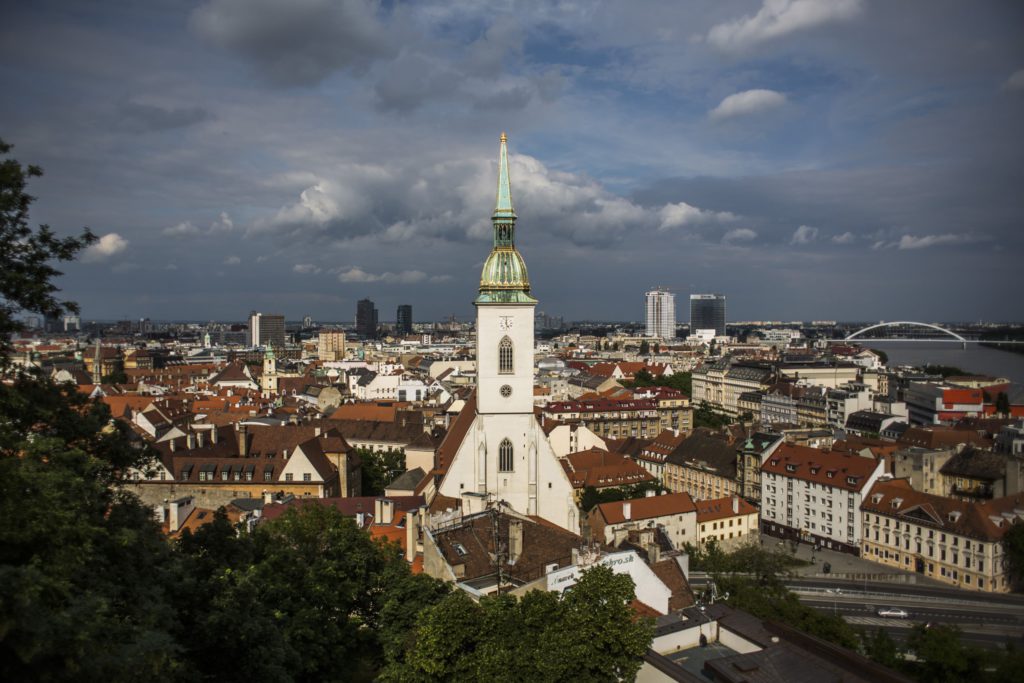
A flood of posts pushing misinformation in Slovakia is putting the spotlight on Facebook for facilitating the spread of pro-Russian theories on the war in neighboring Ukraine, ranging from claims that Kyiv is secretly developing biological weapons to questioning whether President Vladimir Putin’s invasion even happened at all.

While Facebook owner Meta Platforms said it’s taking “extensive steps to fight the spread of misinformation” in the NATO and European Union member, Slovakia’s government, other former Eastern Bloc countries, and even US lawmakers say the company isn’t doing enough.

The dispute took center stage this week when members of the US House Permanent Select Committee on Intelligence called out Meta and its chief executive officer, Mark Zuckerberg, for facilitating the dangerous spread of pro-Russia disinformation in the country of 5.3 million.

According to the GLOBSEC security think tank, the intensity of false messages is worse here than anywhere else in ex-communist central Europe. That has buoyed support for Putin, with more than a quarter of Slovaks saying they back his actions, even as the administration in Bratislava tries to shelter the refugees and send weapons to Kyiv to aid in its defense. 

“The Committee is deeply concerned by the continued presence of harmful disinformation and pro-Russian propaganda on Slovak Facebook,” the US delegation led by Chairman Adam Schiff wrote in a letter to Zuckerberg. They urged Meta “immediately to ensure that all pro-Russian disinformation is quickly evaluated, fact-checked, and labeled, downranked, or removed in accordance with Facebook’s public pledges and stated policies.” 

The committee said that the US and Slovak governments had repeatedly asked Meta to take action against messages that include posts accusing Ukrainians of supporting Fascism, killing their fellow countrymen and demonizing the hundreds of thousands of people who have fled abroad to escape the war.

“Half of the population is prone to believe in some kind of misinformation or conspiracy theories,” said GLOBSEC analyst Dominika Hajdu.

At present, Meta has only one fact-checker dedicated to Slovakia, where about 2.7 million people, or almost half of the population, have Facebook accounts, making it the most widely used social-media platform, according to the US committee members’ letter. They described the staffing level as “wildly inadequate.”

On a web page offered by Meta identifying fact-checking partners in Slovakia, it listed AFP journalist Robert Barca as the person responsible for Slovakia. Meta said it is consulting governments across the region, and its efforts to combat the issue include an array of measures that remove some content and tagging other items with warning labels.  

“We’re removing content that violates our policies, and working with third-party fact checkers in the region to debunk false claims,” Meta spokeswoman Magdalena Szulc said in an email. “When they rate something as false, we move this content lower in Feed so fewer people see it. We’re also giving people more information to decide what to read, trust, and share by adding warning labels on content rated false.”

‘Justifying a Crime’   

Last year, before Putin invaded Ukraine, the Slovak secret service issued a report warning that “the activities of pro-Russian activists were focused on the spread of narratives aimed at the polarization of Slovak society.” 

Earlier this week, police briefly detained former Supreme Court Chairman Stefan Harabin after he posted an item declaring that “Russia must pacify the Nazis who killed 15,000 own citizens from 2014,” echoing the Kremlin narrative that its invasion of its neighbor is an effort to “denazify” Ukraine. Harabin, who stands accused of “justifying a crime,” has denied wrongdoing.

“Never before in history has freedom of speech been abused in favor of murder and destruction on such a mass scale and with such a devastating effect,” Prime Minister Eduard Heger wrote in his own Facebook post.

Slovakia isn’t alone. In February, the prime ministers of Poland and the Baltic trio Estonia, Latvia and Lithuania demanded executives in charge of Facebook, Google, YouTube and Twitter “take a stand” against Russian disinformation. 

The EU, meanwhile, finalized legislation last month giving governments more power to force the companies to take down illegal content such as hate speech, terrorist propaganda or slap them with fines that could reach 6% of their annual revenue.

In the letter to Zuckerberg, the US committee members requested a briefing on what it’s doing to address the Slovak authorities’ concerns, information on any investigations it has led into pro-Russian disinformation, and its plans to address the issue. They said Meta had agreed.

“The Slovak government is rightly troubled by these developments,” the members wrote. “One senior Slovak defense official described Facebook as ‘the main arena for Kremlin propaganda.’ Yet despite Facebook’s awareness of the issue, the pervasive and false content seems to remain on Facebook’s platform.”

More stories like this are available on bloomberg.com

©2022 Bloomberg L.P.

Lagarde Says Crypto Is ‘Worth Nothing’ and Should Be Regulated

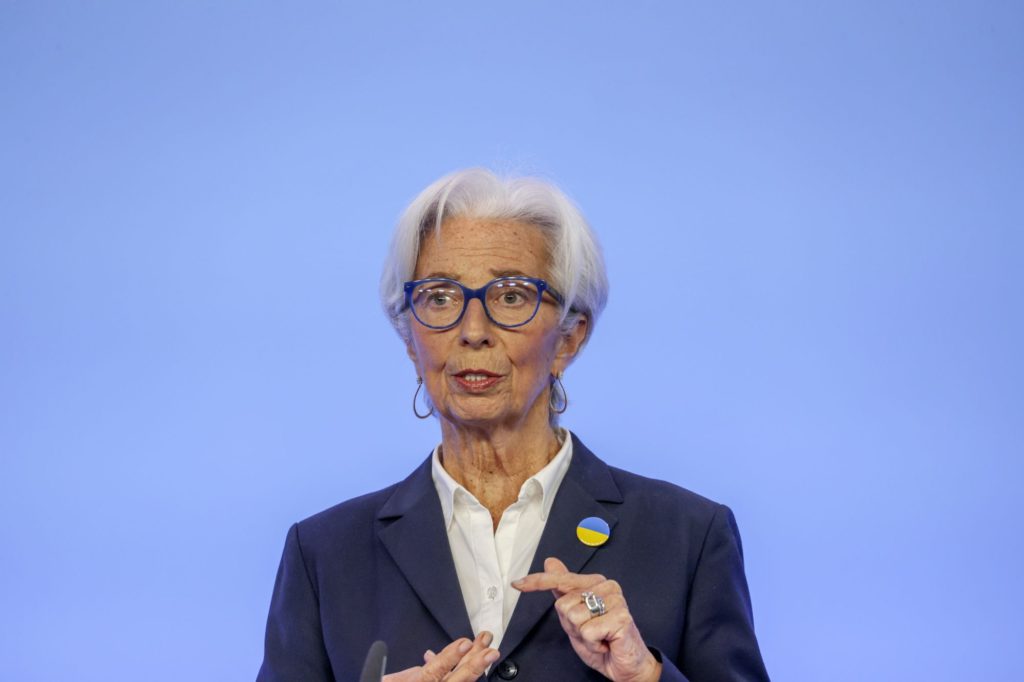
(Bloomberg) — European Central Bank President Christine Lagarde said crypto-currencies are “based on nothing” and should be regulated to steer people away from speculating on them with their life savings.

Lagarde told Dutch television that she’s concerned about people “who have no understanding of the risks, who will lose it all and who will be terribly disappointed, which is why I believe that that should be regulated.”

The comments come amid choppy times for crypto markets, with digital currencies Bitcoin and Ether down 50% from last year’s peak. At the same time, the asset class is facing tougher scrutiny from regulators worried about the dangers it may pose to the broader financial system.

Lagarde said she’s skeptical of crypto’s value, contrasting it with the ECB’s digital euro — a project that may come to fruition in the next four years.

“My very humble assessment is that it is worth nothing, it is based on nothing, there is no underlying asset to act as an anchor of safety,” she said. 

“The day when we have the central bank digital currency out, any digital euro, I will guarantee — so the central bank will behind it and I think it’s vastly different than many of those things,” Lagarde said.

Other ECB officials have already voiced concerns. One is Executive Board member Fabio Panetta, who said in April that crypto-assets “are creating a new Wild West,” and drew parallels with the 2008 subprime mortgage crisis.

Lagarde said she doesn’t hold any crypto assets herself because “I want to practice what I preach.” But she follows them “very carefully” as one of her sons invested — against her advice. “He’s a free man,” she said.

More stories like this are available on bloomberg.com

©2022 Bloomberg L.P.

Shopify’s Founder-Share Proposal Is Opposed by Glass Lewis

(Bloomberg) — Shopify Inc.’s plan to give Chief Executive Officer Tobi Lutke a special “founder share” that will preserve his voting power is being opposed by prominent shareholder advisory firm Glass Lewis & Co.

The plan by the e-commerce company carries “inadequate protection” for the interests of minority shareholders and limits their rights, according to a filing Friday. “Ultimately, while we acknowledge the board’s concerns around the approaching sunset of the CEO’s effective controlling voting stake, we are not persuaded that the proposed arrangement is the correct solution,” Glass Lewis said in a note.

Shareholders will be asked to approve the plan at a meeting scheduled for June 7. Under that arrangement, Lutke, his family and his affiliates would together retain 40% of the votes at the company. Lutke would have to give up his founder share if he’s no longer with the company as an executive, director or consultant, Shopify had said in a statement last month. He wouldn’t be allowed to transfer it to anyone else. 

He would also forfeit the special share if his ownership stake — including family members and affiliates — drops below 30% of the number of class B shares they currently have. Shareholders will also be voting next month on Shopify’s plans for a 10-for-1 stock split for its common stock that it said “will make ownership more accessible to all investors.” 

Representatives for Shopify and Glass Lewis couldn’t be reached outside of regular business hours on Friday evening.

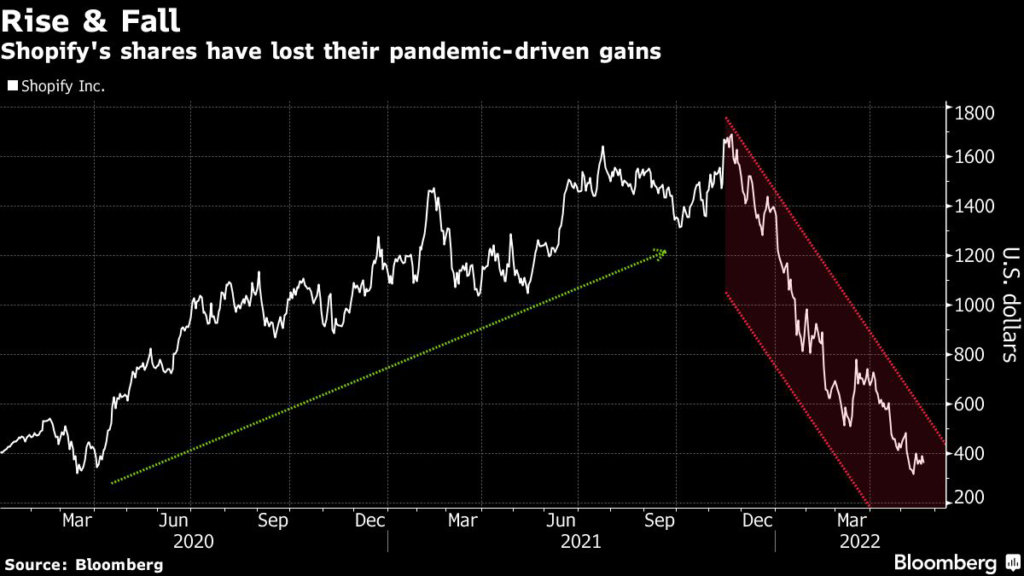
The new structure would shield Lutke and Shopify from shareholder activism amid a nearly 80% stock slump from its November peak. Lutke said last week he had placed an order to purchase $10 million of Shopify’s shares.

Its shares received a huge lift when the pandemic hit in 2020 and consumers turned to online shopping. But they have given back those gains as investors retreated from high-valuation stocks amid rising interest rates and slowing growth outlook. 

Earlier this month, Shopify reported quarterly revenues and profits that fell short of expectations and gave a weaker outlook for adding new business customers in 2022.

(Adds details throughout)

More stories like this are available on bloomberg.com

©2022 Bloomberg L.P.

BitMEX Founder Hayes Avoids Prison on Bank Secrecy Charge

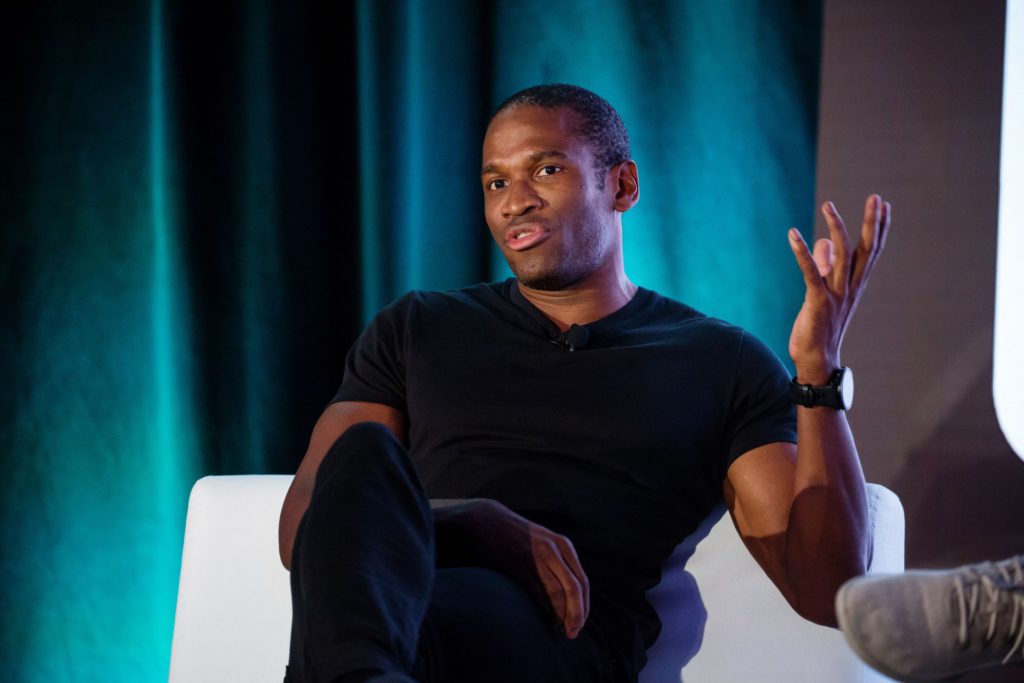
(Bloomberg) — BitMEX co-founder Arthur Hayes was spared from prison despite admitting he failed to guard against money laundering at the pioneering cryptocurrency exchange, which the US blames for hundreds of millions of dollars in shady transactions.

On Friday a federal judge sentenced Hayes to two years’ probation, after Hayes and BitMEX’s other founders were charged in 2020 with violating the Bank Secrecy Act, which requires the establishment of such safeguards, including verifying the identities of an exchange’s customers. 

Hayes, who was ordered to spend the first six months of his sentence in home confinement, avoided time behind bars even though prosecutors argued that the court had to send a signal.

“This is a very serious offense,” Assistant US Attorney Samuel Raymond told US District Judge John Koeltl in Manhattan before Koeltl pronounced the sentence. “There were real consequences. When individuals like Mr. Hayes operate platforms without anti-money-laundering programs or know-your-customer programs, they become a magnet for people to launder money.”

Derivatives Pioneer

BitMEX — among the first to offer cryptocurrency derivatives, such as futures contracts that allow investors to make leveraged bets — carried out at least $209 million in transactions “with known darknet markets or unregistered money services businesses,” the Treasury Department said in August. BitMEX agreed to pay $100 million to settle civil allegations that it allowed illegal trades for years and violated rules requiring anti-money-laundering programs, without admitting to or denying the claims. 

In his plea deal, Hayes agreed to forfeit $10 million. Despite his conviction, he has remained active in the world of crypto and regularly posts essays outlining his thoughts on issues ranging from market prices to the recent Terra stablecoin meltdown.

Read More: BitMEX Founders Charged With Failing to Prevent Laundering 

Allowing Hayes to stay out of prison “would send a message to him that the cost of doing business is merely a fine, and he could continue to violate the law for huge amounts and pay any fine,” Raymond warned. “This case is being closely watched by cryptocurrency exchanges and other companies around the world.”

Prosecutors and regulators are increasing their scrutiny of digital asset exchanges amid a broader focus on cryptocurrency. Securities and Exchange Commission Chairman Gary Gensler said this month that some platforms are shirking rules and may be betting against their own customers. He has asked lawmakers to increase the agency’s budget as he seeks to require exchanges to register with the SEC.

‘Intellectual Powerhouse’

Hayes told the judge that he took “full responsibility” for his role in BitMEX’s failure to implement the measures.

“I know that my best years are ahead of me,” said Hayes, 36. “I will always have to live with the consequences of these actions. I am ready to turn the page and start again.”

Read More: Millennial Traders Flee Boring Banking to Chase Riches in Crypto

His lawyer, James Benjamin, called Hayes an “intellectual powerhouse” and “charismatic leader” and said prosecutors were trying to make the case a “referendum on abstract principles they seek to endorse,” pursuing a “draconian sentence” to vindicate US policy.

Prosecutors had asked Koeltl to send Hayes to prison for significantly more than a year to help deter similar violations. Hayes sought no jail time and the right to live abroad and travel freely, saying the case itself was a landmark that would help the US prosecute financial crimes at exchanges around the world. Probation officials recommended two years of supervised release.

‘Willful Violation’

“Did BitMEX do a perfect and seamless job on its path from startup to a mature fintech company?” Benjamin said in court on Friday. “No, it did not. There were some bumps in the road.”

As he prepared to mete out Hayes’s punishment, Koeltl said the BitMEX founder was “a sophisticated businessman.”

“He knew these procedures were required to avoid having his company used for money laundering and other illegal purposes,” the judge said. “The crime was more than a simple regulatory oversight.” He called it “a willful violation of the Bank Secrecy Act.”

QuickTake: What Are Buttcoin, Dex and WAGMI? A Crypto Glossary

Hayes and co-founder Benjamin Delo pleaded guilty in February, and Samuel Reed in March, each agreeing to forfeit $10 million. Delo is scheduled to be sentenced next month and Reed in July. Another BitMEX employee charged in the scheme, former head of business development Gregory Dwyer, has pleaded not guilty and is set for trial in October. 

Outstripped by Binance

Hayes founded BitMEX in 2014 with Delo, a computer scientist who built high-frequency trading systems for JPMorgan Chase & Co., and Reed, a programmer specializing in fast web applications. While BitMEX was once the largest crypto derivatives platform, Binance now dominates the field. BitMEX recently laid off about a quarter of its workforce of 300 people, not long after its planned acquisition of a German bank fell through. 

The company on Tuesday launched a spot exchange, which will start off with seven trading pairs including Bitcoin, Ether and Polygon versus the Tether stablecoin.

Damian Williams, the top federal prosecutor in Manhattan, said in a statement Friday that Hayes’s failures “allowed BitMEX to operate as a platform in the shadows of the financial markets.” He vowed to “vigorously enforce United States law intended to prevent money laundering through financial institutions, including cryptocurrency platforms.” 

The case is US v. Hayes, 20-cr-500, US District Court, Southern District of New York (Manhattan).

(Adds prosecutors’ argument in first section, Treasury’s claims in second, Hayes’s lawyer’s remarks in third and Manhattan US Attorney’s comments at bottom.)

More stories like this are available on bloomberg.com

©2022 Bloomberg L.P.

Stocks Avert Bear Market, Slide for Seventh Week: Markets Wrap

(Bloomberg) — A dramatic late-session rally brought the S&P 500 back from the brink of a bear market, but the index still sank for a seventh straight week in a stretch of weakness not seen since 2001. 

The benchmark closed the day little changed in the green, after a selloff earlier sent it down more than 2% from a January closing high, meeting the common definition of a bear market. At the end of another volatile week, the monthly expiration of options tied to equities and exchange-traded funds exacerbated price swings. Treasuries gained with the dollar as havens caught bids.

In a week marked by buy-the-dip, sell-the-rally price action, investors grappled with concerns about an economic slowdown and prospects for more monetary tightening, while retailers signaled the mounting impact of high inflation on margins and consumer spending. 

Read more: Retailer Rout Erased $503 Billion, Stirs Worry of More to Come

Read more: Tesla Drags Down S&P 500 as Twitter Waffling, China Hit Stock

The S&P 500’s seventh weekly decline marked the longest losing streak since the dotcom bubble burst more than two decades ago. It’s just its fourth streak of seven or more weekly losses in the post-World War II period, according to Bespoke Investment Group.

“It’s a small sample size, but these types of streaks haven’t occurred during particularly positive periods for the equity market,” wrote the firm’s strategists in a note. “The root causes of the weakness have been the hawkish FOMC and increasing concerns over the potential for a recession.”

More Commentary

  • “The economy is relatively fragile right now, has been weakening, and obviously inflation is causing a lot of consternation among a lot of companies and investors, and we weren’t seeing that being reflected in earnings estimates,” Mike Mullaney, director of global markets research at Boston Partners, said by phone. “We just haven’t seen negative revisions yet, and until you see negative revisions, we still think there’s more downside to the market.”
  • “A lot of the excesses have been wrung out, especially out of the more speculative segments of the market,” Keith Lerner, co-chief investment officer and chief market strategist at Truist Advisory Services, said in a note. “In times like this, volatility and pullbacks are always uncomfortable and come with bad news, but they are also the admission price to being in the market with the potential for higher long-term returns relative to most other asset classes.”
  • “No sign yet of the Fed being unhappy about tighter financial conditions so far, and markets are continuing to fully price in two further 50bp moves from the Fed in June and July,” wrote Deutsche Bank’s Jim Reid. “Nobody said getting inflation back to target from such lofty levels would be easy. So if you’re looking for a Fed put, it may take a while.”

In the latest developments over Russia’s war in Ukraine, the Senate passed a more than $40 billion Ukraine aid package, sending the bill to President Joe Biden for his signature. Meanwhile, finance chiefs from the Group of Seven leading economies pledged to deliver $19.8 billion of budget aid to Ukraine this year as the country struggles to continue functioning amid destruction wrought by Russia’s invasion.

What damage will be done to the US economy and global markets before the Fed changes tack and eases policy again? The “Fed Put” is the theme of this week’s MLIV Pulse survey. Click here to participate anonymously.

Some of the main moves in markets:

Stocks

  • The S&P 500 was little changed as of 4 p.m. New York time
  • The Nasdaq 100 fell 0.3%
  • The Dow Jones Industrial Average was little changed
  • The MSCI World index rose 0.4%

Currencies

  • The Bloomberg Dollar Spot Index rose 0.2%
  • The euro fell 0.3% to $1.0556
  • The British pound rose 0.2% to $1.2489
  • The Japanese yen was little changed at 127.87 per dollar

Bonds

  • The yield on 10-year Treasuries declined five basis points to 2.78%
  • Germany’s 10-year yield was little changed at 0.94%
  • Britain’s 10-year yield advanced three basis points to 1.89%

Commodities

  • West Texas Intermediate crude rose 0.9% to $113.23 a barrel
  • Gold futures were little changed

More stories like this are available on bloomberg.com

©2022 Bloomberg L.P.

Musk Hoists GOP Banner, Tears Into Biden as US Probes His Empire

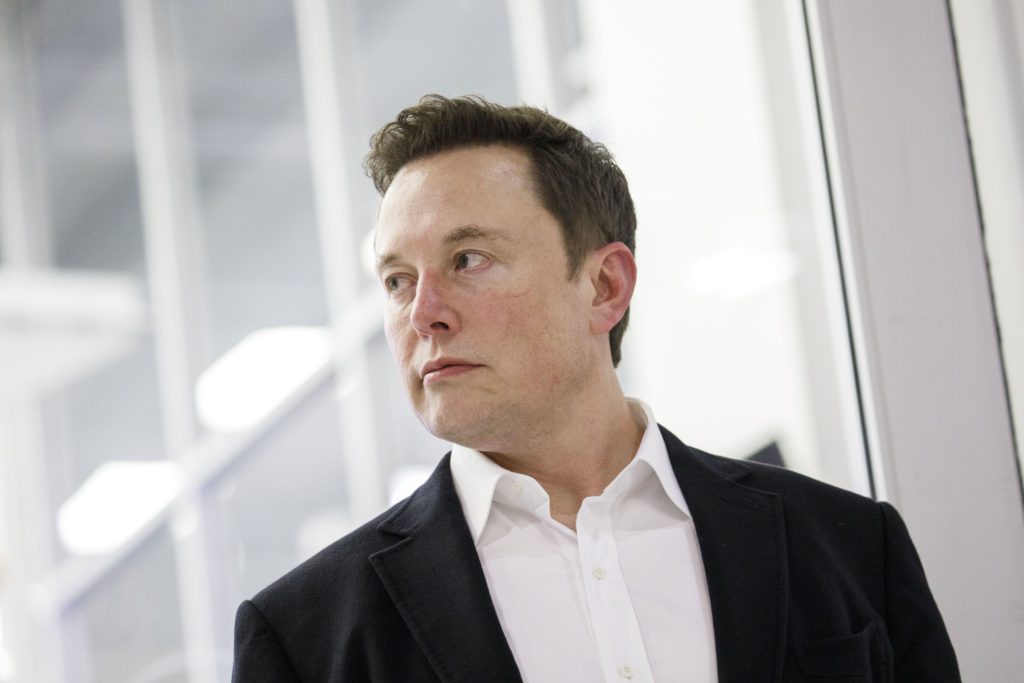
(Bloomberg) — The world’s most famous entrepreneur is ratcheting up a battle with its most powerful government, as Elon Musk sharpens his critiques of President Joe Biden and aligns himself with Republicans in an acrimonious US culture war.

Musk on Friday complained that the White House “has done everything it can to sideline & ignore Tesla.” That’s after saying earlier this week that he would vote Republican, an embrace of a new, more partisan identity for someone who has never fit neatly into Washington’s tribal politics.

Musk, the chief executive officer of both Tesla Inc. and SpaceX, has dialed up his political bombast after lobbing a $44 billion bid to buy Twitter Inc., a deal he has framed as a free-speech crusade. While the move has alarmed many Democrats, Republicans have gleefully seized upon the world’s richest person as a new ally.

If the transaction closes, Musk’s growing empire of electric cars, reusable rockets and space-based satellites would expand to include a social media platform that both parties will treat as a battleground in the upcoming midterm elections.  

As Musk’s businesses have grown, he’s become a symbol of everything from immigrant ingenuity to income inequality. His latest partisan posturing casts him in a new light. Bureaucrats in regulatory agencies may see him more readily decry their investigations as mere political attacks. It will be more difficult for the Biden administration to shrug him off, and puts other lawmakers in the president’s party in a bind.

“Elon’s unconventional behavior has had outsized, positive results for him,” said Gene Munster, a co-founder of Loup Ventures, a research-driven technology investment firm. “The Democrats are in a Catch-22. On the one side, Musk eviscerates them. And on the other side, his products are a part of their agenda. They will probably tread carefully when it comes to doing anything that’s a headwind to Tesla.”

Read More: Why ESG Investing Is Under Republican Attack

No Stranger

While Musk, 50, has little patience for government bureaucracy, he is not exactly a Washington outsider. SpaceX is a major government contractor, flying NASA astronauts to the International Space Station and launching top secret satellites for the US military. Though his companies’ lobbying presence is modest compared with competitors like General Motors Co. and Boeing Co., he has courted politicians on both sides of the aisle for over a decade.

In 2010, Tesla received a $465 million loan from the Department of Energy, a lifeline for what was then a startup automaker. Tesla went public that June and paid back the loan in full in 2013. President Barack Obama visited SpaceX’s launch site in Florida during his first term.

When President Donald Trump was elected in 2016, Musk briefly served on his business councils, where he tried to push on immigration reform. He ultimately left the groups after Trump pulled the US out of the Paris Climate Accords. Still, Musk frequently espouses Trump’s brand of populist conservatism, including by meeting Friday with Brazilian President Jair Bolsonaro.

Mounting Probes

Musk’s sprawling collection of businesses mean he is on the radar of several federal agencies.  

The National Highway Traffic Safety Administration opened two defect investigations that are ongoing into Tesla’s driver-assistance feature known as Autopilot. Earlier this year, National Transportation Safety Board Chairwoman Jennifer Homendy called the company’s decision to test early versions of what it calls “full self-driving” on the roads “a disaster waiting to happen.”

In November, the SEC issued a subpoena to Tesla seeking information on governance processes around compliance with an amended settlement agreement stemming from Musk’s failed effort to take Tesla private in 2018. 

The Federal Aviation Administration is in the throes of an environmental review of SpaceX’s plans to launch its massive new Starship rocket from Boca Chica, Texas. The agency postponed a decision on April 29 after the company made “multiple changes” to its application.

The FTC is scrutinizing Musk’s Twitter bid for antitrust concerns, though most expect the agency will allow the deal to close without an in-depth probe. The FTC is separately investigating why Musk didn’t inform the agency when he amassed a 9% stake in Twitter this March. 

Government Contracts

Though Musk is most widely known as the CEO of Tesla, he’s emerged as a major player in the military industrial complex. He forced his way into the business of military and intelligence satellite launches after campaigning vigorously in Congress and suing the Air Force for the right to compete with a longstanding joint venture of defense giants Boeing Co. and Lockheed Martin Corp.

After settling a lawsuit against the Air Force in 2015, closely held SpaceX was certified to compete for military launches. SpaceX won 17 of the 42 military launches planned for Phase 2 through fiscal 2024, with the rest going to the Boeing-Lockheed venture. 

“There were certainly difficulties and tensions in the DOD/SpaceX relationship,” Cris Chaplain, a former space systems acquisitions director with the Government Accountability Office, said in an email. “But in the long run both parties benefited tremendously.”

SpaceX spent an average of $2.2 million from 2017 to 2021 influencing the federal government. It currently has 37 lobbyists, most at outside firms, working for it. About three-quarters of them previously worked for the government, according to OpenSecrets, which tracks money in politics.

As Ukraine defends itself from Russia’s invasion, SpaceX has played a critical communications role with Starlink, its effort to provide high-speed broadband internet across the globe. The US Agency for International Development (USAID) delivered 5,000 Starlink terminals to the government of Ukraine through what it describes as a “public-private partnership” with SpaceX. 

Political Winds

Musk spent much of his career in reliably Democratic California, making his first fortune in Silicon Valley and then living in Los Angeles for two decades. In 2020, he relocated to conservative bastion Texas, a place with no state income tax where SpaceX is expanding and Tesla has built a new factory.

Read More: Elon’s Texas Empire

For his vast wealth, Musk is a minor political donor. He has contributed just $529,000 to political candidates since 2009, Federal Election Commission records show. About $282,000 of that amount went to Democrats, including a $40,000 donation to Obama’s re-election campaign in 2012. 

Since 2017, he gave Republican candidates and committees $91,700 compared with $67,800 for Democrats. He’s yet to make a donation in the current election cycle, FEC filings show.

Democratic Senator Elizabeth Warren chalks up Musk’s rightward shift to money. “The Republicans are the party of letting the billionaires get away without paying taxes, so it doesn’t particularly surprise me,” Warren said in a hallway interview at the Capitol Thursday.

Republican fans will find Musk isn’t an ally on all of their pet issues. This week he said expanded immigration to the US, including from Mexico, is a “no-brainer.” Tesla will also support employees who need to travel for out-of-state health care, including abortions. Still, House Minority leader Kevin McCarthy called Musk “a good friend of mine” in a floor speech last fall. Committees connected to McCarthy have gotten $129,000 from Musk, more than any other politician. 

Musk has pitched his bid for Twitter as one to protect free speech, and has said he will allow Trump back on the platform. The idea has delighted conservatives, with Senator Ted Cruz calling the deal “the most important development for free speech in decades.”

Owning Twitter would put Musk at the center of a policy fight over legal protections for online tech giants, known as Section 230. Critics have argued that courts construed the 1996 law too broadly, conferring sweeping immunity for tech companies over the content posted on their platforms. The political parties vastly differ on the problem and how to resolve it. Conservatives contend that the platforms censor right-wing voices — a view Musk has echoed — while Democrats say unfettered online discourse fuels hate speech. 

Since agreeing to buy the social media platform, Musk has been on offense against Democrats, this week blasting them as “the party of division & hate” and criticizing Biden’s administration as one that “doesn’t seem to get a lot done.”

Biden has generally tried to steer clear of feuding with Musk, though a White House spokesman said Friday, “count us as unsurprised that an anti-labor billionaire would look for any opportunity to nip at the heels of the most pro-union and pro-worker President in modern history.”

Labor Feud 

In February, California’s Department of Fair Employment and Housing took the rare step of suing Tesla, saying it “found evidence that Tesla operates a racially segregated workplace where Black workers are subjected to racial slurs and discriminated against in job assignments, discipline, pay, and promotion.” The federal Equal Employment Opportunity Commission is also investigating. Those labor issues were part of why Tesla was booted from the ESG version of the S&P 500 Index — a move that Musk blasted as “a clear case of wacktivism.”

Unlike legacy automakers, Tesla’s factories are non-union. Biden is a staunch union advocate, a view that has long cast a pall over his view of Tesla. Musk has balked at Biden’s proposed subsidies for union-made US electric vehicles — the measure, made in a policy proposal that has since collapsed, would have offered subsidies of up to $12,000, but the labor provision would have excluded Tesla.

“In the case of Biden, he’s simply too much captured by the unions, which was not the case with Obama,” Musk said at a conference in Miami on Monday. 

Musk has angrily rebutted a report that SpaceX paid $250,000 to settle a sexual harassment claim in 2016. He said the accusations are “utterly untrue” and called the article a “hit piece” designed to interfere with his Twitter acquisition. 

And though he tweeted in September that “I would prefer to stay out of politics,” he’s now taken a page from Trump’s playbook, portraying himself as a victim of partisan smears. 

More stories like this are available on bloomberg.com

©2022 Bloomberg L.P.

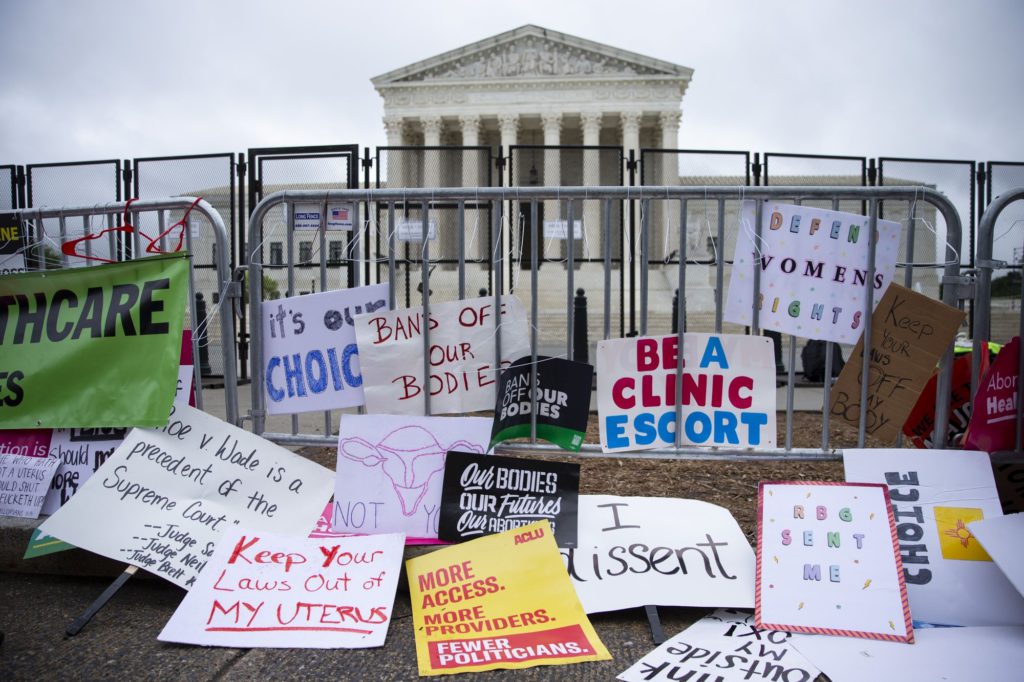
The Knot Worldwide Joins Companies Covering Travel for Abortion

(Bloomberg) — The Knot Worldwide, best known for its wedding-planning website The Knot, will reimburse employees who need to travel to obtain abortion care.

Chief Executive Officer Timothy Chi announced the policy in a LinkedIn post Friday, saying the changes come in light of Roe v. Wade’s precarious standing as a legal precedent. The company is extending its parental leave policy to as many as 20 weeks of paid leave and will begin covering travel costs incurred by employees who need to travel more than a “reasonable distance” to seek reproductive healthcare, including abortion.

Read More: How US Companies Are Supporting Workers on Abortion

The Knot Worldwide employs 1,900 people in 16 countries, a spokesperson for the company said. Its holdings include its namesake wedding marketplace, The Knot, as well as a pregnancy-focused imprint called The Bump. They also operate the Spanish-language site Bodas, which serves parts of Europe as well as Latin America. 

“As a company employing thousands and serving millions of women globally, we pride ourselves on helping people around the world celebrate life’s greatest moments, but that’s only possible when everyone is empowered to make the choices that are right for them,” Chi said in the post. He said the company will also begin petitioning senators in states where they have offices, including Texas, Nebraska and New York, and advocate against bans and restrictions.

He added that the abortion-access battle is “a complex issue that will not be resolved in a few weeks or a couple of months,” and that the company is “in the process of identifying partners that will enable us to have a meaningful impact on the lives of women.”

The change in policy follows the path of Apple Inc., Bumble Inc., Citigroup Inc. and other companies that are covering travel costs for employees who need to travel 100 miles or more, or even to another state to obtain health services.

More stories like this are available on bloomberg.com

©2022 Bloomberg L.P.

Close Bitnami banner
Bitnami