
Bloomberg

S&P 500 Evades Bear Market as Investors Go On Late Buying Spree

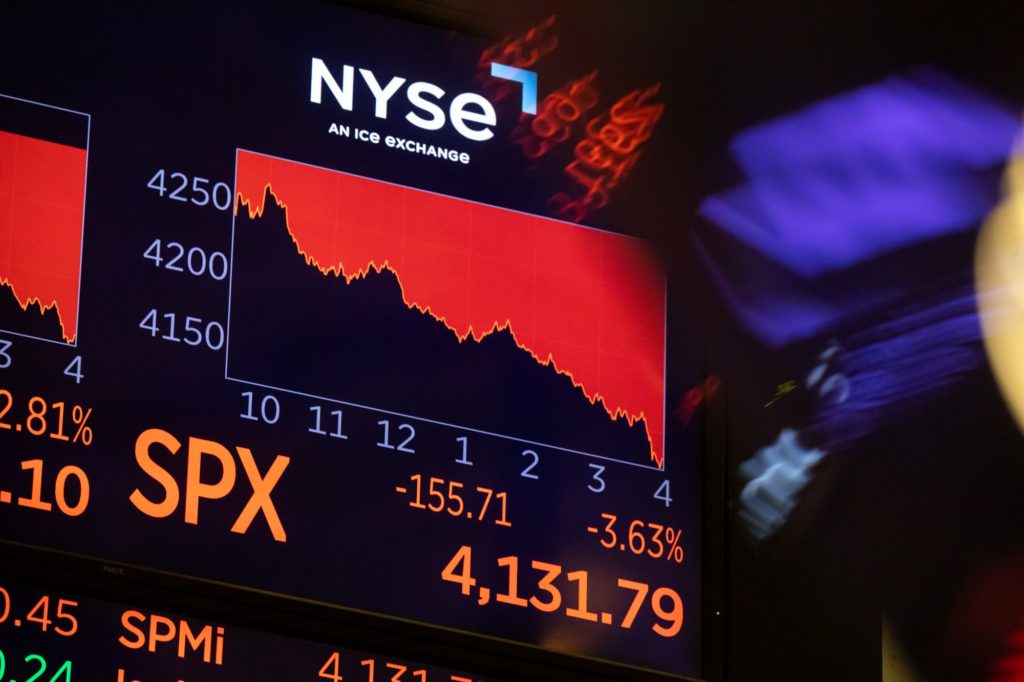
(Bloomberg) — A two-year bull run in stocks that began at the depths of the coronavirus panic came close to crashing into a bear market Friday but avoided that fate in the last hour of trading.

The S&P 500 traded 20% below its record closing high of 4,796.56 for most of the afternoon, but it pared those losses to finish basically where it started the day. The last entered into bear market in February 2020. 

The broad equities benchmark ended down for a seventh straight week, its longest weekly losing streak since March 2001, while the Dow Jones Industrial Average notched its eighth straight week of declines, the longest stretch since 1923. The tech-heavy Nasdaq 100 Index also ended down for a seventh week, its longest streak since 2011.

The key to the index’s rise and fall is the Federal Reserve, whose unprecedented efforts to boost the economy in early 2020 helped the S&P 500 more than double through the end of last year. Now, with central bankers reining in stimulus as inflation surges, shares are selling off at the hands of investors convinced a recession is all but unavoidable.

“All of this has been driven by two major forces that were reiterated this week: one is inflation and how stubbornly high it is. And the second is how aggressive the Federal Reserve will likely be to get it under control,” said Art Hogan, chief market strategist at National Securities.

Tech stocks in particular are dragging the market lower, with Apple Inc. and Amazon.com posting an eighth straight weekly drop, while Tesla Inc. fell for a fourth one. The group has come under widespread pressure this year. According to S3 Partners, tech is the most shorted sector in the US market, “making up almost $1 out of every $5 shorted.” Software is the most shorted industry within the sector.

  • Consumer discretionary sector has been the worst performing group in the S&P 500 since the index’s January high, sinking 34%. The only S&P 500 sector to gain during that stretch is energy, which is up 42%.


Retailers Plunge

Friday’s rollercoaster ride capped a volatile week for the US stock markets, which saw consumer stalwarts that thrived throughout the pandemic-era bull market finally buckle. 

Target Corp. plunged the most since Black Monday in 1987, a day after Walmart Inc. suffered a similar fate, on signs that runaway inflation is hurting the US consumer and eroding profit margins. 

 “The Fed has been a primary driver of these market declines, but the latest news from retailers has added additional concerns to the outlook for the economy,” said Adam Phillips, managing director of portfolio strategy at EP Wealth Advisors. “Now that we’ve breached the 20% level, the big question will be where do we go from here?.”

Since 1929, the S&P 500 has entered a bear market 17 times, including Friday, according to data from CFRA Research. The longest period lasted 998 days from September 1929 to June 1932. The shortest was just 33 days from Feb. 19, 2020, to March 23, 2020, CFRA’s data show. 

On average, bear markets result in a decline of roughly 38%, although since 1946 the average loss is less than 33%, according to CFRA. 

“It was bound to happen because I think the bears wanted to push it there. And a fair amount of people had turned bearish,” said Mike Mullaney, director of global markets research at Boston Partners. “Positioning is catching up with sentiment right now.”

(Adds details on market rebound, updates to close)

More stories like this are available on bloomberg.com

©2022 Bloomberg L.P.

Tesla Weighs on S&P 500 as Twitter Waffling, China Hit Stock

(Bloomberg) — Tesla Inc. is limping to the finish line, as the stock’s 14% decline this week makes it the second-biggest drag on the S&P 500 Index over the past five sessions, behind only Apple Inc. 

The issues facing the electric-vehicle maker’s stock are wide ranging. For starters, Tesla’s difficulties in China have become impossible to ignore, with multiple Wall Street analysts this week warning about the country’s disruptions weighing on Tesla’s results. The shares have also been caught up in the growth-stock selloff as investors shun risky assets amid soaring global inflation. 

“Tesla is mainly down on two things — macroeconomic concerns as people are worried about inflation and recession, and China,” Gary Black, founder and managing partner at the actively-managed ETF Future Fund LLC, said in an interview, discussing the slide in the stock in recent weeks.

The slide in Tesla shares has led to about $110 billion of its market capitalization evaporating just this week. The stock closed down 6.4% at $663.90 on Friday, at the lowest level since Aug. 17.  

Like most automakers, Tesla is facing crippling supply shortages and soaring raw material costs. Though it has been able to navigate the troubles better than most, the latest coronavirus outbreak in China that led to multiple production disruptions at its factory in Shanghai has been damaging to the shares.

Morgan Stanley analyst Adam Jonas warned that the China supply wobble could potentially drive a “substantial” miss on deliveries in the second quarter. Analysts’ average estimate for Tesla’s second-quarter deliveries now stand at around 303,000 units, down 12% from the end of March, according to Bloomberg data. On Thursday, Wedbush analyst Daniel Ives lowered his price target on the stock by 29% to $1000.

Also not helping is the uncertainty surrounding Chief Executive Elon Musk’s high profile bid to takeover Twitter. 

“As long as the Twitter deal is out there, and as long as Tesla’s stock is falling, people worry that Musk will have to sell more stock and would get distracted and not pay as much attention to Tesla as he should,” Black said. 

Beyond the Twitter headlines, Tesla also was removed from the S&P 500 ESG Index, prompting questions about its position as a key sustainable energy investment. In response, Musk called ESG investing “an outrageous scam.” 

Even with the 37% rout in Tesla shares this year, the stock is still among one of the priciest in the NYSE FANG+ Index of megacap technology stocks. It trades at a forward price-to-earnings multiple of 55, compared with the index’s average of 21.

There also are a few things coming that could make Tesla investors optimistic. The company is expected to announce a stock split before its August shareholder meeting, a move that would make its lofty shares more affordable for retail traders and potentially boost its stock price. And earlier this week, Musk said the company’s AI Day event on Aug. 19 will feature a preview of its Optimus robot. A strong response to the technology development could help reverse the negative sentiment.

(Updates stock move in first and 10th paragraphs, adds stock context in fourth, updates chart.)

More stories like this are available on bloomberg.com

©2022 Bloomberg L.P.

Elon Musk Praised by Bolsonaro in Surprise Trip to Brazil

(Bloomberg) — Elon Musk’s efforts to buy Twitter Inc. received the enthusiastic backing of President Jair Bolsonaro during a short and unexpected visit to Brazil, where allegations of fake news spreading through social media are a hot issue ahead of October’s election.

The world’s richest man was invited by the Brazilian government to discuss investment plans, implementation of new technology to monitor Amazon deforestation and a project to take broadband Internet to far-flung regions, including rural schools and indigenous communities, the communications ministry said in a statement on Friday.

But it was the planned purchase of Twitter that was highlighted by Bolsonaro when the two men spoke to a group of business leaders and students gathered at a hotel where the meeting took place, about 70 miles from Sao Paulo. 

“We received your announcement about the purchase of Twitter as a breath of hope,” Bolsonaro told Musk, calling him a protector of freedom. “The whole world is suffering with people who are willing to steal that freedom from us.” 

Read More: Twitter Deal Is Proceeding, Not ‘On Hold,’ Executives Say

Musk has become even more popular among Bolsonaro’s supporters after announcing he wanted to take control of Twitter to defend “freedom of speech.” The right-wing Brazilian president, often compared with Donald Trump, has had several of his own social media posts taken down by Twitter and Facebook after the companies determined he was spreading falsehoods about topics including the Covid-19 pandemic and the safety of Brazil’s electronic voting system. 

Bolsonaro, under investigation in Brazil for allegedly spreading fake news, has been stepping up his rhetoric against the country’s top court and electoral authorities as the October election gets closer. That is raising concerns among political experts that, just like Trump did, he could dispute the result of the vote if he were to lose. 

Musk, answering questions from students before Bolsonaro’s remarks, spoke broadly about his big projects, including efforts to develop self-driving cars, and the positive impact he believes they would have on the economy.

Later, speaking to reporters about the result of the meeting, Bolsonaro didn’t announce any concrete deal with Musk’s companies, but said his government is very interested in partnering with them. He suggested the chief executive of Tesla Inc. take a closer look at niobium, a metal mostly found in southeastern Brazil, to possibly make batteries. Musk didn’t attend the news briefing.

“We’ve just began dating and I’m sure it will end in marriage,” Bolsonaro said, repeating one of his favorite metaphors. 

Musk joined the group of businesspeople for lunch at the hotel and returned to the US shortly after, according to Brazil’s communications ministry.

(Updates with post-meeting comments from Bolsonaro, starting in eighth paragraph.)

More stories like this are available on bloomberg.com

©2022 Bloomberg L.P.
Musk’s Twitter Deal Praised by Bolsonaro in Surprise Brazil Trip

(Bloomberg) — Elon Musk’s efforts to buy Twitter Inc. received the enthusiastic backing of President Jair Bolsonaro during a short and unexpected visit to Brazil, where allegations of fake news spreading through social media are a hot issue ahead of October’s election.

The world’s richest man was invited by the Brazilian government to discuss investment plans, implementation of new technology to monitor Amazon deforestation and a project to take broadband Internet to far-flung regions, including rural schools and indigenous communities, the communications ministry said in a statement on Friday.

But it was the planned purchase of Twitter that was highlighted by Bolsonaro when the two men spoke to a group of business leaders and students gathered at a hotel where the meeting took place, about 70 miles from Sao Paulo. 

“We received your announcement about the purchase of Twitter as a breath of hope,” Bolsonaro told Musk, calling him a protector of freedom. “The whole world is suffering with people who are willing to steal that freedom from us.” 

Read More: Twitter Deal Is Proceeding, Not ‘On Hold,’ Executives Say

Musk has become even more popular among Bolsonaro’s supporters after announcing he wanted to take control of Twitter to defend “freedom of speech.” The right-wing Brazilian president, often compared with Donald Trump, has had several of his own social media posts taken down by Twitter and Facebook after the companies determined he was spreading falsehoods about topics including the Covid-19 pandemic and the safety of Brazil’s electronic voting system. 

Bolsonaro, under investigation in Brazil for allegedly spreading fake news, has been stepping up his rhetoric against the country’s top court and electoral authorities as the October election gets closer. That is raising concerns among political experts that, just like Trump did, he could dispute the result of the vote if he were to lose. 

Musk, answering questions from students before Bolsonaro’s remarks, spoke broadly about his big projects, including efforts to develop self-driving cars, and the positive impact he believes they would have on the economy.

Later, speaking to reporters about the result of the meeting, Bolsonaro didn’t announce any concrete deal with Musk’s companies, but said his government is very interested in partnering with them. He suggested the chief executive of Tesla Inc. take a closer look at niobium, a metal mostly found in southeastern Brazil, to possibly make batteries. Musk didn’t attend the news briefing.

“We’ve just began dating and I’m sure it will end in marriage,” Bolsonaro said, repeating one of his favorite metaphors. 

Musk joined the group of businesspeople for lunch at the hotel and returned to the US shortly after, according to Brazil’s communications ministry.

(Updates with post-meeting comments from Bolsonaro, starting in eighth paragraph.)

More stories like this are available on bloomberg.com

©2022 Bloomberg L.P.
Stocks Pare Losses After Dipping Into Bear Market: Markets Wrap

(Bloomberg) — U.S. stocks pulled back from session lows after the S&P 500 dipped 20% below its Jan. 3 closing record. Treasuries and the dollar gained as havens caught bids.

The benchmark dropped less than 1%, catching bids in the last hour trading. It earlier fell more than 2% earlier, where a close at that level would meet the common definition for a bear market. At the end of another volatile week, price swings are likely to be exacerbated by the monthly expiration of options tied to equities and exchange-traded funds. 

The selloff has sent the S&P 500 deeper into a seventh weekly decline that would make the longest losing streak since the dotcom bubble burst more than two decades ago. It will be just its fourth streak of seven or more weekly losses in the post-World War II period, according to Bespoke Investment Group.

“It’s a small sample size, but these types of streaks haven’t occurred during particularly positive periods for the equity market,” wrote the firm’s strategists in a note. “The root causes of the weakness have been the hawkish FOMC and increasing concerns over the potential for a recession.”

In a week marked by buy-the-dip, sell-the-rally price action, investors grappled with concerns about an economic slowdown and retailers signaled the mounting impact of high inflation on margins and consumer spending. Sentiment got a boost early Friday after Chinese lenders lowered the five-year loan prime rate by a record amount in an effort to boost mortgages and loans amid a property slump and Covid lockdowns. 

Read more: Retailer Rout Erased $503 Billion, Stirs Worry of More to Come

Read more: Tesla Drags Down S&P 500 as Twitter Waffling, China Hit Stock

More Commentary

  • “The economy is relatively fragile right now, has been weakening, and obviously inflation is causing a lot of consternation among a lot of companies and investors, and we weren’t seeing that being reflected in earnings estimates,” Mike Mullaney, director of global markets research at Boston Partners, said by phone. “We just haven’t seen negative revisions yet, and until you see negative revisions, we still think there’s more downside to the market.”
  • “A lot of the excesses have been wrung out, especially out of the more speculative segments of the market,” Keith Lerner, co-chief investment officer and chief market strategist at Truist Advisory Services, said in a note. “In times like this, volatility and pullbacks are always uncomfortable and come with bad news, but they are also the admission price to being in the market with the potential for higher long-term returns relative to most other asset classes.”
  • “No sign yet of the Fed being unhappy about tighter financial conditions so far, and markets are continuing to fully price in two further 50bp moves from the Fed in June and July,” wrote Deutsche Bank’s Jim Reid. “Nobody said getting inflation back to target from such lofty levels would be easy. So if you’re looking for a Fed put, it may take a while.”

In the latest developments over Russia’s war in Ukraine, the Senate passed a more than $40 billion Ukraine aid package, sending the bill to President Joe Biden for his signature. Meanwhile, the Group of Seven industrialized nations will agree on more than 18 billion euros ($19 billion) in aid for Ukraine, according to German Finance Minister Christian Lindner.

What damage will be done to the US economy and global markets before the Fed changes tack and eases policy again? The “Fed Put” is the theme of this week’s MLIV Pulse survey. Click here to participate anonymously.

Some of the main moves in markets:

Stocks

  • The S&P 500 fell 0.7% as of 3:36 p.m. New York time
  • The Nasdaq 100 fell 1.2%
  • The Dow Jones Industrial Average fell 0.5%
  • The MSCI World index was little changed

Currencies

  • The Bloomberg Dollar Spot Index rose 0.2%
  • The euro fell 0.3% to $1.0553
  • The British pound rose 0.1% to $1.2482
  • The Japanese yen was little changed at 127.83 per dollar

Bonds

  • The yield on 10-year Treasuries declined five basis points to 2.78%
  • Germany’s 10-year yield was little changed at 0.94%
  • Britain’s 10-year yield advanced three basis points to 1.89%

Commodities

  • West Texas Intermediate crude rose 0.9% to $113.23 a barrel
  • Gold futures were little changed

More stories like this are available on bloomberg.com

©2022 Bloomberg L.P.

It May Be a Bear Market, But It’s Not a Panic. That’s Worrisome

(Bloomberg) — It’s been hard to watch, impossible to predict and a nightmare to trade. But has the S&P 500’s slide been an unqualified panic to date? By some measures no, and that might bode poorly for equities in the near term. 

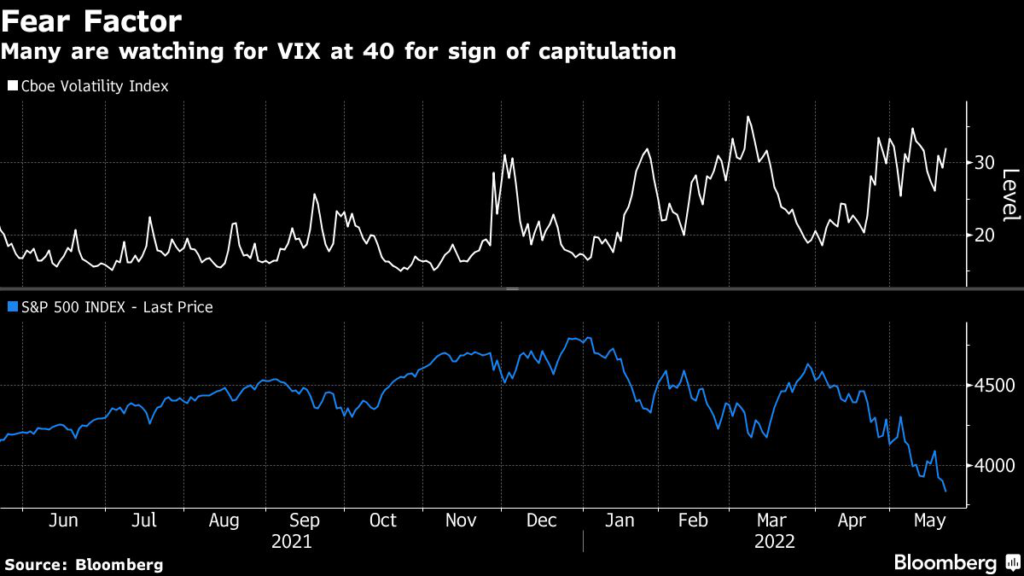
Even with the US stock benchmark plunging 20% from a record for the first time since March 2020, trading volume has been pretty average and the Cboe Volatility Index is below this month’s highs. Meanwhile, the Cboe SKEW Index — implied volatility for bearish S&P 500 put contracts relative to calls — is close to two-year lows. 

The relative lack of anxiety isn’t necessarily a good thing, from contrarian lenses. That the S&P 500’s path has remained relatively orderly without any obvious sings of panic suggests that the bottom isn’t yet in view, according to AlphaTrAI’s Max Gokhman. Layer on a Federal Reserve that’s intent on looking past the turmoil in pursuit of tighter financial conditions, and the outlook is gloomy.

“Investors holding their breath may wind up passing out because there’s more to this drop before the roller-coaster year starts grinding back up,” said Gokhman, the firm’s chief investment officer. “With the Fed as the ride’s operator, we shouldn’t expect a gentle glide back to the station. Only one-third of tightening cycles ended without a recession and they all started when inflation was under 3.3%.”

Not Rushing for the Exits

The drop in stocks hasn’t been accompanied by a surge in trading. Volume on US exchanges hasn’t spiked this week as the S&P 500 fell another 4.8%. It’s remained in line with levels seen throughout the tumultuous year. 

“Volumes are not impressive or overwhelming. I prefer to see a volume surge to feel more confident about a bottom,” said Chris Murphy, co-head of derivatives strategy at Susquehanna International Group. “We typically see more volume at a real low as a sign of capitulation.”

‘Fear Gauge’ Has Yet To Tremble

“We have fear, we have doubt, we have angst, but we don’t have capitulation. We don’t have people dumping stocks yet, and I think that will come,” SentimenTrader’s analyst Jay Kaeppel said in a Bloomberg Television interview Friday. “Wake me when it hits 45, because if you look at history, all the big declines, it spikes to 40 or 45, so 30 isn’t going to do it.”

The VIX is currently around 32.

Julian Emanuel, chief equity and quantitative strategist at Evercore ISI, is watching three things for signs of capitulation: the VIX above 40, the put/call ratio reaching 1.35, and share volume above 20 billion.

“The end of corrections are often accompanied by fear and capitulation — extreme volatility and trading volume,” he wrote in a recent note.

Craig W. Johnson, chief market technician at Piper Sandler, is also looking for the VIX to hit 40, and is utilizing a proprietary technical indicator he’s dubbed the “40-week technique,” which measures how many stocks are above or below their 40-week moving averages. That gauge has dropped to 13% and he’s waiting for a “sub-10% washed-out reading.”

“We have found readings below 10% have historically signaled the broader market is near an inflection point,” he wrote in a note.

Single-Stocks Signals

The Cboe SKEW Index — implied volatility for bearish S&P 500 put contracts relative to calls — is near the lowest since April 2020. Meanwhile, the put-to-call ratio that tracks the volume of options tied to individual companies has jumped to 1.27, still below the threshold Evercore’s Emanuel is watching for. 

“Even if index volatility isn’t cracking, you are seeing it in single stocks,” said Amy Wu Silverman, an equity derivatives strategist at RBC Capital Markets. “If single stocks is cracking, eventually this leads up to the index level.” Wu pointed to reactions in Walmart Inc. and Target Corp. as examples — both earlier this week posted their biggest post-earnings drops in decades.

Keeping a Close Eye on Valuations

Mike Mullaney, director of global markets research at Boston Partners, says there’s potential for further margin contraction. “There’s probably more downside for the market right now than there is upside,” he said by phone. 

He’s going to be looking for analyst revisions to come down and valuations getting lower. 

“The $64,000 question is whether we can achieve a soft landing or are going to get pushed into a recession,” he said. “We’re more in the recession camp than we are in the soft-landing camp if the Fed wants to get to their inflation targets.” A recession could push the S&P 500 earnings multiple to around 13, and that could signal an area where “pretty much everything has been discounted in the market.”

More stories like this are available on bloomberg.com

©2022 Bloomberg L.P.

Amazon Targets Calm, Headspace Audience With a Wellness Podcast

(Bloomberg) — Amazon.com Inc. is continuing to build its wellness podcast offerings with the release of an exclusive, meditation-oriented series called “Become.”

Produced with Salt, the audio company behind comedian Dave Chappelle’s podcast “The Midnight Miracle,” the show will be released three times a week and guide listeners through relaxation techniques like breath work, meditation and intention setting, according to company executives. It’ll be available only through Amazon Music, Alexa-enabled devices and the Wondery+ app.

“Become” adds to a growing body of podcasts and short-form audio from tech companies. They include subjects like fitness and wellness. Each episode of 15 minutes or less takes a Peloton-like approach—the four initial coaches switch out regularly, meaning listeners will probably find one they especially like and stick with them.

Salt Co-founder Jamie Schefman calls the show, which has been in production since November, an “audio vitamin.” The music is custom-made and episodes are mixed in binaural, which makes listeners wearing headphones feel like they’re in the room with their hosts. The episodes are ad free, according to Nick Panama, Salt’s chief executive officer and a co-founder.

“Become” is the latest addition to Amazon’s wellness podcast offerings. Wondery, its podcast network, produced “Meditations for the Day” and “Imagined Sleep” in 2020, and Amazon delivered “Built to Thrive” this year. The latter offers short episodes on wellness topics from British doctor Rangan Chatterjee.

The Salt team wanted to build a show that fits into people’s lifestyles, Panama said, focusing more on the “renewed self” than on winding down. “Become” could grow into a community with live events, workshops and a video content component, he said.

Marshall Lewy, chief content officer at Wondery, said in an email that “people are looking for ways to improve their mental and physical health,” given the stress of recent years, and that audio content can help fill the void. The company’s competitors, like Headspace, have grown quickly during the pandemic. Last year, Headspace said it had 70 million users. Calm was valued at $2 billion after a fundraising round in December 2020.

More stories like this are available on bloomberg.com

©2022 Bloomberg L.P.
S&P 500 Headed for Bear Market as Losses Exceed 20% From High

(Bloomberg) — A two-year run in stocks that began at the depths of the coronavirus panic and became one of most powerful bull markets on record is on the brink of extinction.

The S&P 500 slipped more than 2% on Friday, pushing it 20% below its record closing high of 4,796.56 on Jan. 3. If the losses hold through the close of trading, it will enter its first bear market since the pandemic hit in February 2020. 

The broad equities benchmark is on pace for a seven-week slide, its longest weekly lossing streak since March 2001, while the Dow Jones Industrial Average is heading for its eighth straight week of declines, the longest since 1923. The tech-heavy Nasdaq 100 Index is also down for a seventh week, its longest stretch since 2011.

At both ends of the moves sits the Federal Reserve, whose unprecedented efforts to boost the economy in early 2020 helped the S&P 500 more than double through the end of last year. Now, with central bankers reining in stimulus as inflation surges, shares are selling off at the hands of investors convinced a recession is all but unavoidable.

“All of this has been driven by two major forces that were reiterated this week: one is inflation and how stubbornly high it is. And the second is how aggressive the Federal Reserve will likely be to get it under control,” said Art Hogan, chief market strategist at National Securities.

Tech stocks are dragging the market lower, with the Nasdaq 100 Index sliding as much as 3% on Friday. Apple Inc. and Amazon.com are poised for an eighth straight weekly drop, while Tesla Inc. falls for a fourth one. The group has come under widespread pressure this year. According to S3 Partners, tech is the most shorted sector in the US market, “making up almost $1 out of every $5 shorted.” Software is the most shorted industry within the sector.

Consumer discretionary sector has been the worst performing group in the S&P 500, plunging 35% since the index’s January high. The only S&P 500 sector to gain this year is energy, which is up 41% since the index hit its peak. 

Retailers Plunge

Friday’s selloff caps a volatile week for the US stock markets, which saw consumer stalwarts that thrived throughout the pandemic-era bull market buckle. 

Target Corp. plunged the most since Black Monday in 1987, a day after Walmart Inc. suffered a similar fate, on signs that runaway inflation is hurting the US consumer and eroding profit margins. 

 “The Fed has been a primary driver of these market declines, but the latest news from retailers has added additional concerns to the outlook for the economy,” said Adam Phillips, managing director of portfolio strategy at EP Wealth Advisors. “Now that we’ve breached the 20% level, the big question will be where do we go from here?.”

Since 1929, the S&P 500 has entered a bear market 17 times, including Friday, according to data from CFRA Research. The longest period lasted 998 days from September 1929 to June 1932. The shortest was just 33 days from Feb. 19, 2020, to March 23, 2020, CFRA’s data show. 

On average, bear markets result in a decline of roughly 38%, although since 1946 the average loss is less than 33%, according to CFRA. 

“It was bound to happen because I think the bears wanted to push it there. And a fair amount of people had turned bearish,” said Mike Mullaney, director of global markets research at Boston Partners. “Positioning is catching up with sentiment right now.”

(Adds comments in in fourth and 9th paragraph, adds details throughout)

More stories like this are available on bloomberg.com

©2022 Bloomberg L.P.

Ethereum Co-Founder Buterin Says He’s No Longer a Billionaire

(Bloomberg) — Vitalik Buterin, co-founder of the Ethereum blockchain platform, is the latest casualty in the dramatic collapse of crypto fortunes.

“I’m not a billionaire anymore,” Buterin, 28, wrote Friday in a Twitter post.

Buterin created Ethereum in 2014 and is the owner of a digital wallet that as recently as November contained holdings worth about $1.5 billion. Since then, the price of the Ether token that’s associated with the blockchain has fallen by 55%. 

Buterin has previously suggested he’d welcome lower prices of digital coins, telling Bloomberg News in February: “The people who are deep into crypto, and especially building things, a lot of them welcome a bear market.” 

Crypto holdings have been pummeled by a steep drop in prices of digital currencies and the turmoil engulfing the algorithmic stablecoin TerraUSD and its Luna token. Changpeng Zhao, founder of the crypto exchange Binance, has seen more than $80 billion — or 84% of his wealth — evaporate this year, according to the Bloomberg Billionaires Index. 

Some ultra-wealthy crypto backers have professed humility amid the upheaval. Michael Novogratz, founder of crypto merchant bank Galaxy Inc., acknowledged that TerraUSD was “a big idea that failed.” Others, including the Winklevoss twins, have insisted that their investments are long-term. 

“It’s all about perspective and HODLing for the long game,” Cameron Winklevoss tweeted on May 12, using an acronym for “hold on for dear life.” 

Read more: Winklevoss Twins Have Fortunes Riding on Crypto Startup Comeback

As the pandemic raged through India last year, Buterin donated more than 50 trillion Shiba Inu coins to a Covid-19 relief fund in that country. The coins, which are a meta joke about the dog-themed digital coin Dogecoin, would have been worth more than $1 billion at the time. 

Buterin’s donation represented more than 5% of the total Shiba Inu coins in circulation and sent prices tumbling about 50%. 

In a separate tweet Friday, Buterin talked about the tradeoffs between “open-mindedness” and “passion,” while expressing support for the blockchain he helped create. 

“Note to trolls: no, ethereum was not a mistake,” he wrote.

More stories like this are available on bloomberg.com

©2022 Bloomberg L.P.

Novogratz Warns ‘Picking Bottoms Is Dangerous’ as Bitcoin Slide Resumes

(Bloomberg) — Everyone knows crypto’s been having a tough time of late. Bitcoin’s lost a third of its value this year, and altcoins are faring even worse with prices sliding again Friday. Despite calls within the community — propagated largely over Twitter — to hoard more coins whenever there’s a selloff, market-watchers say to be wary of predictions that call a bottom to the slide. 

Mike Novogratz, the founder of Galaxy Digital Holdings Ltd. who this week issued a mea culpa over Terraform Labs’s imploded stablecoin, noted that some smaller tokens are down 80% from their highs. And should their losses accelerate to the same degree they did in 2018, those coins could lose an additional 70%. 

“My point is picking bottoms is dangerous,” he tweeted. “And if you do scale in slowly.”

Cryptocurrencies have suffered this year, undergoing a dark stretch that’s affected just about every corner of the market. Bitcoin and Ether are down 50% each since November, when many coins peaked, while XRP, Dogecoin and Solana have all lost roughly 70%. Shiba Inu is down 80%. And investors are also souring on NFTs and other crypto-centric offshoots.

Bitcoin, the largest digital-asset by market value, dropped as much as 5% to $28,706 on Friday. The S&P 500 dipped 20% below its January peak on an intra-day basis.

It’s all happening as the Federal Reserve, in its attempt to bring inflation back to 2%, raises interest rates and tightens the loose monetary conditions it had put in place to deal with the pandemic. Stocks and bonds have also sold off this year as investors try to figure out whether the central bank’s actions will induce the economy into a recession. 

“The move so far has been correlated to the broader macro market moves,” Mathew McDermott, global head of digital assets at Goldman Sachs, said of the crypto markets.

That hasn’t kept some from saying that now is a good time to buy digital assets at a discount — Twitter is rife with such posts. Nor have predictions ceased, after more than $1 trillion has been erased in crypto-markets value since the fall, that the bottom is in. 

The plunge in prices on May 12, amid TerraUSD’s breakdown, “signaled clear tendencies of extreme and irrational fears,” according to a research note by BlockFi and Arcane Research. Funding rates reached lows not seen since July as liquidations spiked, all while spot volumes remained elevated. “All these events suggest that the current selloff could be nearing a point of saturation,” the report said, though it added that assessing the crypto market without consideration for what’s going on with broader risk assets is “likely unwise.”

Recession or not, crypto prices could have further to fall, according to Mike Belshe, founder and CEO of BitGo. “Even if the economy avoids a downturn, I’m confident that prices will collapse and the exuberance will subside,” he said in an interview. “This would be more pronounced if we enter into a recession.”

“We haven’t had them go through a real recession and the question I ask myself is, if you take Bitcoin now, what is the greater probability? That it will double in value or that Bitcoin will halve in value?,” Jonathan Macey, professor at Yale Law School who studies corporate finance, said by phone. “And I think the odds are that it’s going to halve in value.”

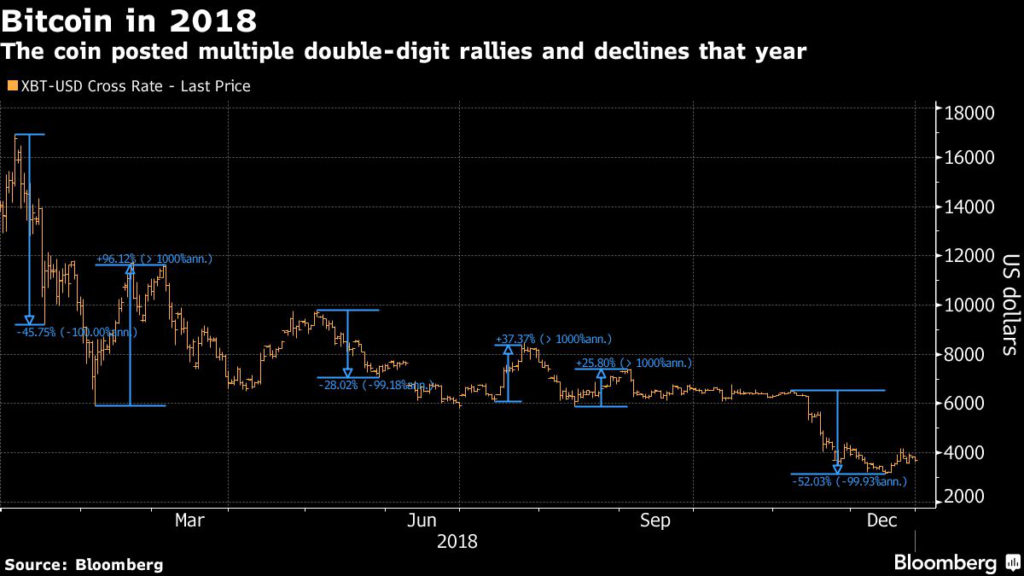
It’s difficult to say what event or news could help Bitcoin and other risky assets start to form a floor. Many are scouring charts and sentiment readings, though some have turned to history. The coin offers many case studies. Bitcoin’s peak-to-trough decline in 2018, for instance, exceeded 80%. That year, the coin posted multiple double-digit rallies and declines. 

“I wouldn’t look for a sustainable rally there until the Fed’s getting ready to lower rates again,” David Donabedian, chief investment officer of CIBC Private Wealth Management, said by phone. “And that’s quite a ways away.”

Meanwhile, BitGo’s Belshe says a recession could help “filter out weaker projects.”

That’s an argument that’s often heard in the crypto space: Exuberance can spawn many new projects, some of which can be sketchy or outright scams — downturns can help wring out excesses. 

“While I don’t see Bitcoin dropping to $20,000, if the price of Bitcoin does continue to decline, it would help filter out weaker projects and allow us to focus more on projects with more long-term viability,” he said. “I don’t welcome a recession — it does have real impact on people’s lives, which is unfortunate. That said, crypto is not responsible for a recession in this case.”   

More stories like this are available on bloomberg.com

©2022 Bloomberg L.P.

Close Bitnami banner
Bitnami