Bloomberg

Deutsche Bank Among Lenders Probed by US Over WhatsApp Use

(Bloomberg) — Deutsche Bank AG is among a number of investment banks included in a sweeping probe by US regulators to find out how much employees rely on private communication channels such as WhatsApp to conduct business.

There’s an “industry-wide” investigation in the US and Deutsche Bank is part of it, legal head Stefan Simon said at the lender’s annual general meeting on Thursday in response to investor questions. The lender is trying out new software to improve its ability to archive messages and has repeatedly warned staff not to delete messages, he said, confirming previous Bloomberg reports. 

Use of private communication tools has come under increased scrutiny since US regulators in December slapped $200 million in fines on JPMorgan Chase & Co. for failing to keep adequate records of staff messages. At least five other global banks have since said they, too, are fielding US inquiries.

Industry rules have long required banks to archive business communications to ensure regulators can check them if necessary at a later stage. But the rapid spread of private messaging tools outside of banks’ controls has undermined that effort. 

Read More: Why Wall Street Is in Hot Water for Using WhatsApp

Deutsche Bank has also received an information request on the matter from the German supervisor BaFin, Bloomberg has reported. The watchdog is following up on indications that senior Deutsche Bank executives have been relying on messaging tools such as WhatsApp and private email accounts to conduct business, people familiar with the matter have said.

The BaFin request explicitly mentions Deutsche Bank’s management board, meaning the messaging behavior of Chief Executive Officer Christian Sewing and the other members of the governance body are within its scope, other people said now. 

Representatives for Deutsche Bank and BaFin declined to comment.

(Updates with details on BaFin information request in last paragraph)

More stories like this are available on bloomberg.com

©2022 Bloomberg L.P.

Crypto Betting Service Polymarket Taps Ex-CFTC Head as Chair After Agency Probe

(Bloomberg) — Just months after settling a probe with a key US regulator, crypto betting platform Polymarket has signed up the former head of that agency as the new chairman of its advisory board.

J. Christopher Giancarlo led the Commodity Futures Trading Commission during the Trump administration and is known for his early embrace of crypto and blockchain. The 63-year-old received the ‘CryptoDad’ moniker after a US congressional appearance and even authored a book with that name about the fight for the future of money.

Read More: CoinFund Taps Ex-Wall Street Regulator CryptoDad as Adviser

“I’ve spent a lifetime at the junction of financial markets, technology, law and regulation,” Giancarlo said. “Polymarket was pursued by the CFTC, they reached the settlement, they paid the price, moved everything offshore, and they’re doing what is required of them. I’m very proud to now help advise them on where to go from here on out.”

Back in January, the online platform that offers wagers on politics, economic indicators and other real-world events, was told to wind down its existing contracts and agreed to pay $1.4 million to resolve allegations it offered illegal trading, according to the CFTC. Polymarket, whose popularity surged during the pandemic, had been running an unregistered platform that let people bet on the outcome of events since around June 2020, the agency said at the time. 

Polymarket didn’t admit or deny wrongdoing in the settlement. The company introduced new contracts weeks after the settlement, but US residents are not able to trade on the site.

The predictions platform is led by 23-year-old founder Shayne Coplan, and lets users trade on the outcome of topics like the expansion of NATO, the Republican winner in the Pennsylvania senate primary, and whether Amber Heard will be held liable for defaming Johnny Depp. Instead of US dollars, customers who want to make trades on Polymarket use USD Coin (USDC), a stablecoin issued by Circle.

Read More: Crypto Masters Washington’s ‘Revolving Door’ as Influence Grows

More stories like this are available on bloomberg.com

©2022 Bloomberg L.P.

US Narrows Scope of Anti-Hacking Law Long Hated by Critics

(Bloomberg) — The US Department of Justice is changing its policy around a controversial anti-hacking law, addressing longstanding complaints from cybersecurity researchers that the law could criminalize good-faith efforts to improve technology.

The Computer Fraud and Abuse Act, or CFAA, is a federal statute outlawing unauthorized access to computers and networks. While prosecutors have used the law to convict thousands of people, critics have long said the statute, enacted in 1986, is overly broad and gives prosecutors the flexibility to charge defendants for innocuous digital activity.

Such concerns are largely theoretical, but legal experts and activists point to numerous instances in which they believe the law was misused, and they maintain it creates a chilling effect that inhibits efforts to improve security.  

In particular, ambiguous language about what constitutes “authorized access” to a “protected computer” has created potential criminal liability for cybersecurity researchers — sometimes called “white hat hackers” — who seek out software flaws and then report them to the developer to encourage them to fix the problem. Under a policy that goes into effect Thursday, the department is advising prosecutors to not use CFAA to pursue criminal penalties for security researchers who are trying to improve technology.

Members of the security research community have so far welcomed the update. 

“This is demonstration from DOJ that the conversation around good-faith security researchers, white hat hackers, has really changed in the past ten years,” said Harley Geiger, a senior director for public policy at the security firm Rapid7. “The US is trying to walk a fine line between allowing good faith security research to benefit society and avoiding giving criminals a loophole to break the law.”

CFAA has been a hotly debated topic since Aaron Swartz, an entrepreneur and internet activist, took his own life in 2013 while facing prison time. Swartz was accused of improperly accessing the internet at the Massachusetts Institute of Technology to download millions of academic papers from the JSTOR subscription service.

His case has frequently been cited by the Electronic Frontier Foundation and others an example of the heavy penalties that are possible when prosecutors broadly apply CFAA to broad kinds of internet activity. 

The new policy would’ve discouraged prosecution of Christian Sandvig, a University of Michigan professor who planned to use fake online accounts to study whether social media services discriminated against users from different backgrounds. The tactic would have violated sites’ terms of service, a potential CFAA violation, resulting in Sandvig and the American Civil Liberties Union suing the Justice Department to challenge the law. 

A district court ruled in Sandvig’s favor in 2020, a decision that factored into the new DOJ policy, Justice Department officials said.

In addition, about a year ago, the US Supreme Court ruled against the DOJ in a case that narrowed the scope of the law. The case, Van Buren v. US, involved a former Georgia police officer who was accused of exceeding “authorized access” under CFAA by looking up license plate data in a police database in exchange for a bribe. In a 6-3 opinion, the court said such an interpretation of the law “would attach criminal penalties to a breathtaking amount of commonplace computer activity.”

Importantly, according to Rapid7’s Geiger, the Justice Department’s update only clarifies federal prosecution. Corporations still can use CFAA to take legal action against researchers who find flaws in corporate software, and state laws still enable local prosecutors to take up cases that federal prosecutors won’t.

“This is a positive step, but it will take an act of Congress to really rebalance the law in the way it needs,” Geiger said.

The DOJ’s change also aims to focus prosecutors’ attention on more pressing threats, such as ransomware, distributed denial-of-service attacks and foreign cybercriminal threats.

It also strengthens a consultation requirement for prosecutors who try to bring charges under CFAA.

US attorneys must consult with CCIPS on how to proceed. If CCIPS recommends against a prosecution, the charging attorney must notify the deputy attorney general to move forward with a case. The deputy attorney general has the power to stop a case from being charged.

“If you’re moving fast and you need to charge a case, and then all of a sudden you need to deal with the deputy attorney general, that sounds a little stressful,” said Kamal Ghali, a former U.S. cybercrime prosecutor who now is a partner at Bondurant Mixon & Elmore LLP.

“These are new factors that will force prosecutors to think about where they’re going to spend their resources.”

More stories like this are available on bloomberg.com

©2022 Bloomberg L.P.

Mercedes-Benz to Trim Entry-Level Car Lines, Focus on High End

(Bloomberg) — After years in a grudge match against rival BMW AG to become the world’s biggest luxury automaker, Mercedes-Benz AG is calling it quits.  

The Stuttgart-based manufacturer will cut some entry-level vehicles from its product line and shave 25% off of its share of entry-level cars in the segment by 2026, CEO Ola Källenius said in a far-reaching interview May 18 in Monaco.

It will also focus on higher priced—higher-margin—vehicles in the coming years, he said. Last year, Mercedes sold 2 million vehicles worldwide, while BMW sold 2.5 million, beating Mercedes for the first time in five years. A spokesperson declined to confirm the sales target for 2022. 

“We are not going to go in and compete with the volume makers—that’s not our place,” said Källenius. “We will still cater to the entry-level luxury segment. But we will trim the portfolio. Today we have seven models in that segment; in the future we will have four.”

He declined to specify which models would be cut. Entry-level vehicles at Mercedes include the A-Class sedan, CLA coupe, and GLA SUV.

Instead, the brand will increase by 60% the sales share of its top-end vehicles by 2026. That group includes sales of the S-Class, Mercedes-AMG, Maybach, and G-Wagen lines.

The strategy is key to maintaining the current strong level of Ebit margins, says Michael Dean, a senior automotive analyst for Bloomberg Intelligence. During the day with investors May 19, the company announced a modest uplift of Ebit margin targets to 14% by 2025, versus 12.7% in 2021. But even with some improvement, it would still be disappointing compared to competitors.

“The decision by Mercedes to drop some low-end models is welcomed,” Dean says. “However it’s a moot point whether they will gain credit by investors for the decision, if BMW or Audi does not follow suit.” 

Prior to its semi-annual investor day also held in Monaco, the brand unveiled examples of its high-end vehicles that would place it closer to competitors like Bentley and Rolls-Royce. A highly bespoke concept called the Mercedes-Maybach Haute Voiture, a play on the term haute couture using the French word for car, and a limited-to-150 edition Mercedes-Maybach S680 S-Class V12 designed by Virgil Abloh were two examples shown of what Mercedes will focus on more in the future. A spokesperson for the brand declined to specify pricing on the vehicles.

“Upper premium luxury has the greatest growth potential,” Källenius said. “It’s not just about China. It’s wealth growth in Europe, there’s wealth growth in North America, there’s wealth growth in all economies. Which means, in our logic, the market is coming towards us.”

The plan to focus more on vehicles with higher profit margins comes at a time when the brand, along with rivals like BMW, had already increased pricing due to substantial market complications. Global semiconductor shortages, the war in Ukraine, and extensive pandemic-related shutdowns in China have caused supply chain issues, production delays, and high pricing at dealerships for virtually every luxury automaker.

The possibility of gas rationing in Germany is another recent challenge the company is evaluating on a daily basis, Källenius said. 

“We are in a perpetual taskforce mode,” he said. “We are not rattled per se, as a system, but of course it has an effect. It further complicates our overall environment.”

The first non-German head of the 120-plus-year-old brand, the Swede said the company had already started to build its new strategy prior to the current headwinds and would continue with the plan after the market normalizes. In the first quarter of this year, Mercedes sold 10% fewer vehicles compared to last year but saw profits surge by 20%.

“At some point, we will come out of this, and we will have restrictions lifted,” he said. “But we are committed to stick with this discipline.”

More stories like this are available on bloomberg.com

©2022 Bloomberg L.P.

Cisco Slips Most Since 2020 as Supply Disruptions Weigh on Sales

(Bloomberg) — Cisco Systems Inc. spooked investors with a warning that Chinese lockdowns and other supply disruptions would wipe out sales growth in the current quarter, renewing broader concerns about tech spending in a shaky economy.

The outlook sent Cisco shares down as much as 13% on Thursday, the biggest drop since March 2020. The decline weighed on stocks of other networking companies, dealing a fresh blow to an already-battered sector. Even before Cisco’s latest plunge, its stock was down 24% this year.

The question for much of Wall Street was whether Cisco’s forecast meant that customers were cutting spending, but the networking-equipment giant said supply woes — and not a pullback in expenditures — was the main problem.

“Even though these top-line numbers don’t look good, there’s a very simple explanation,” Chief Executive Officer Chuck Robbins said on a conference call with analysts. “Customers are not signaling any real shift at this point. There’s no reflection of demand issues in our guidance.”

Robbins acknowledged that Cisco wasn’t prepared for production to be closed down so extensively in China, a move triggered by the country’s Covid Zero policy. 

“We did not have a plan for a country to shut down,” he said. “And so it takes time to go out and create that geographic resilience, but our teams are working on all of those kinds of things right now.”

China’s lockdowns have hurt production from many companies, including Tesla Inc. and Sony Group Corp. Robbins said it’s not yet clear when supplies will return to normal, despite signs that government restrictions are easing in certain areas.

“Shanghai now is saying they’re going to open up June 1 — we don’t know exactly what that means,” he said. When the reopening happens, “there is going to be lots of competition for ports capacity, airport capacity.”


Cisco is the biggest maker of machines that power corporate networks and form the backbone of the internet. Investors look at its outlook as a proxy for corporate spending on infrastructure, which is why the sudden shift was especially jarring.

The company had predicted growth in the current quarter of about 6%. It said Wednesday that sales would actually decline by 1% to 5.5% in the period, which ends in July. Cisco’s earnings forecast also was short of Wall Street predictions.

Cisco shares tumbled as low as $39 in late trading. That followed a 4.4% decline in regular trading Wednesday, bringing the stock to $48.36.

Other networking related-companies saw their stocks fall following Cisco’s report. Juniper Networks Inc., Broadcom Corp. and Ciena Corp. all dropped about 3%.

Broader chip shortages and the war in Ukraine also have created disruptions for Cisco and its peers.

Like many tech companies, Cisco began cutting ties with Russia after that country invaded Ukraine earlier this year. The company said Wednesday that stopping business in Russia and its ally Belarus cost it about $200 million in revenue during the fiscal third quarter. Historically the region, including Russia, Belarus and the Ukraine, has accounted for about 1% of total sales.

On the conference call with Cisco executives, analysts questioned whether the weak guidance indicated that customers are concerned about their own future prospects and have begun to cut their spending.

Robbins insisted that demand remains robust. That said, the company doesn’t expect supply shortages to be resolved in the current quarter.

The inability to get power supplies from China cost Cisco $300 million in revenue in the third quarter, executives said. And even when the lockdowns end in China, the problem won’t be solved right away.

The tone of the report was a stark contrast from three months ago, when Cisco said orders rose more than 30% for a third consecutive quarter. Since then, investors have become more concerned that inflation and fears of slowing economic growth will make customers more cautious. This past quarter, the company said it orders increased 8%. 

While that’s a much slower rate of expansion, it shows strong growth ahead for a company of Cisco’s size, according to David Heger, an analyst at Edward D. Jones & Co.

“I would be more concerned if that order number was flat or down,” Heger said.

Cisco has implemented a no-cancellation policy on its orders within 45 days of the shipping date, according to Chief Financial Officer Scott Herren. Smaller customers, who tend to be the quickest to tighten their spending budgets, increased orders 19%. The growth and the overall low rate of cancellations give the company confidence that there are no underlying demand issues, Herren said in an interview.

Under Robbins, Cisco has been trying to spur growth with updated hardware, as well as new services and software. The hope is to make the longtime king of networking gear less dependent on one-time equipment sales.

The latest outlook marks a setback in that push. Excluding certain items, earnings will be 76 cents to 84 cents a share in the period, Cisco said. That compares with an average estimate of 92 cents.

For the year, revenue will grow 2% to 3%, the company said, compared with a previous prediction of as much as 6.5%. 

Revenue in the three months ended in April, was $12.8 billion, little changed from a year ago. Earnings per share, minus certain items, was 87 cents. Analysts had projected a profit of 86 cents on sales of $13.3 billion on average.

But without signs that orders truly are slowing, Wall Street may be overreacting to Cisco’s numbers, Heger said.

“Short of some big drop-off in demand, it seems as though the market is overcompensating,” he said.

More stories like this are available on bloomberg.com

©2022 Bloomberg L.P.

Cisco Tumbles Most Since 2020 as Supply Upheaval Weighs on Sales

(Bloomberg) — Cisco Systems Inc. spooked investors with a warning that Chinese lockdowns and other supply disruptions would wipe out sales growth in the current quarter, renewing broader concerns about tech spending in a shaky economy.

The outlook sent Cisco shares down as much as 13% on Thursday, the biggest drop since March 2020. The decline weighed on stocks of other networking companies, dealing a fresh blow to an already-battered sector. Even before Cisco’s latest plunge, its stock was down 24% this year.

The question for much of Wall Street was whether Cisco’s forecast meant that customers were cutting spending, but the networking-equipment giant said supply woes — and not a pullback in expenditures — was the main problem.

“Even though these top-line numbers don’t look good, there’s a very simple explanation,” Chief Executive Officer Chuck Robbins said on a conference call with analysts. “Customers are not signaling any real shift at this point. There’s no reflection of demand issues in our guidance.”

Robbins acknowledged that Cisco wasn’t prepared for production to be closed down so extensively in China, a move triggered by the country’s Covid Zero policy. 

“We did not have a plan for a country to shut down,” he said. “And so it takes time to go out and create that geographic resilience, but our teams are working on all of those kinds of things right now.”

China’s lockdowns have hurt production from many companies, including Tesla Inc. and Sony Group Corp. Robbins said it’s not yet clear when supplies will return to normal, despite signs that government restrictions are easing in certain areas.

“Shanghai now is saying they’re going to open up June 1 — we don’t know exactly what that means,” he said. When the reopening happens, “there is going to be lots of competition for ports capacity, airport capacity.”


Cisco is the biggest maker of machines that power corporate networks and form the backbone of the internet. Investors look at its outlook as a proxy for corporate spending on infrastructure, which is why the sudden shift was especially jarring.

The company had predicted growth in the current quarter of about 6%. It said Wednesday that sales would actually decline by 1% to 5.5% in the period, which ends in July. Cisco’s earnings forecast also was short of Wall Street predictions.

Cisco shares tumbled as low as $39 in late trading. That followed a 4.4% decline in regular trading Wednesday, bringing the stock to $48.36.

Other networking related-companies saw their stocks fall following Cisco’s report. Juniper Networks Inc., Broadcom Corp. and Ciena Corp. all dropped about 3%.

Broader chip shortages and the war in Ukraine also have created disruptions for Cisco and its peers.

Like many tech companies, Cisco began cutting ties with Russia after that country invaded Ukraine earlier this year. The company said Wednesday that stopping business in Russia and its ally Belarus cost it about $200 million in revenue during the fiscal third quarter. Historically the region, including Russia, Belarus and the Ukraine, has accounted for about 1% of total sales.

On the conference call with Cisco executives, analysts questioned whether the weak guidance indicated that customers are concerned about their own future prospects and have begun to cut their spending.

Robbins insisted that demand remains robust. That said, the company doesn’t expect supply shortages to be resolved in the current quarter.

The inability to get power supplies from China cost Cisco $300 million in revenue in the third quarter, executives said. And even when the lockdowns end in China, the problem won’t be solved right away.

The tone of the report was a stark contrast from three months ago, when Cisco said orders rose more than 30% for a third consecutive quarter. Since then, investors have become more concerned that inflation and fears of slowing economic growth will make customers more cautious. This past quarter, the company said it orders increased 8%. 

While that’s a much slower rate of expansion, it shows strong growth ahead for a company of Cisco’s size, according to David Heger, an analyst at Edward D. Jones & Co.

“I would be more concerned if that order number was flat or down,” Heger said.

Cisco has implemented a no-cancellation policy on its orders within 45 days of the shipping date, according to Chief Financial Officer Scott Herren. Smaller customers, who tend to be the quickest to tighten their spending budgets, increased orders 19%. The growth and the overall low rate of cancellations give the company confidence that there are no underlying demand issues, Herren said in an interview.

Under Robbins, Cisco has been trying to spur growth with updated hardware, as well as new services and software. The hope is to make the longtime king of networking gear less dependent on one-time equipment sales.

The latest outlook marks a setback in that push. Excluding certain items, earnings will be 76 cents to 84 cents a share in the period, Cisco said. That compares with an average estimate of 92 cents.

For the year, revenue will grow 2% to 3%, the company said, compared with a previous prediction of as much as 6.5%. 

Revenue in the three months ended in April, was $12.8 billion, little changed from a year ago. Earnings per share, minus certain items, was 87 cents. Analysts had projected a profit of 86 cents on sales of $13.3 billion on average.

But without signs that orders truly are slowing, Wall Street may be overreacting to Cisco’s numbers, Heger said.

“Short of some big drop-off in demand, it seems as though the market is overcompensating,” he said.

More stories like this are available on bloomberg.com

©2022 Bloomberg L.P.

US Stocks Turn Lower as Treasuries Catch Bids: Markets Wrap

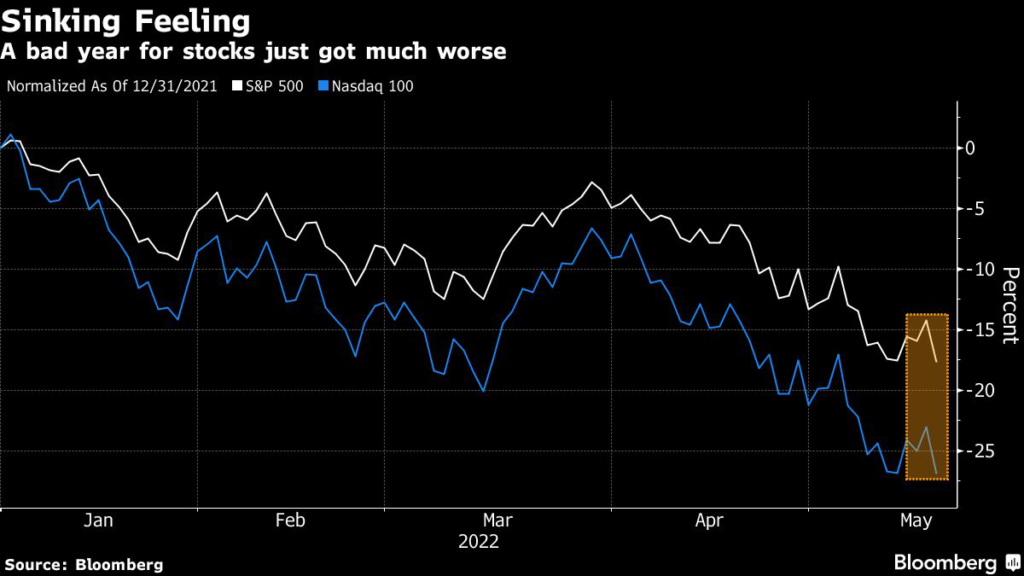
(Bloomberg) — Declines in US stocks resumed in early trading on Thursday, after growing concern that inflation is cutting into corporate performance erased $1.5 trillion from the market value of companies in the S&P 500 in the prior session. Treasuries extended gains.

The benchmark equity index extended losses to 1%, after the biggest single-day drop since June 2020 on Wednesday. The tech-heavy Nasdaq 100 also turned lower. 

Treasury yields retreated about nine basis points as investors sought insurance against further declines in risk assets, with the Federal Reserve set on taming inflation via rate hikes and a shrinking balance sheet beginning in June. 

Bets that robust earnings can help investors weather this year’s turbulence were thrown in doubt after US consumer titans signaled growing impact of high inflation on margins and consumer spending. Meanwhile, Fed officials reaffirmed that tighter monetary policy lies ahead, and investors fretted over stagflation risks.

The Stoxx Europe 600 retreated about more than 2%, with all industry sectors in the red and personal care and food and beverages leading the decline. Stocks of retailers and consumer-discretionary companies posted some of the biggest losses in Asia and Europe after US investors questioned the lofty valuations of companies like Target Corp. against the backdrop of rising interest rates.

“We remain concerned that the inflationary environment will see consumers rein in spending and see further risks in consumer-exposed sectors which aren’t being fully priced in yet,” said James Rutherford, head of European equities at Federated Hermes Ltd. “Inflationary pressure on company margins is also a growing — and underestimated — risk. We therefore remain focused on companies with high revenue visibility and strong pricing power.”

In China, Tencent Holdings Ltd. plunged 6.5% after warning it will take time for Beijing to act on promises to prop up the Chinese tech sector. Cisco Systems Inc. slid in extended US trading on a disappointing revenue outlook.

On the commodities front, crude oil extended declines, while industrial metals were mixed as global growth fears damped the demand outlook. Copper held near a seven-month low.

Elsewhere, the Swiss franc extended its advance versus the dollar after Swiss National Bank President Thomas Jordan said policy makers are ready to act against inflation.

And in emerging markets, Sri Lanka fell into default for the first time in its history as the government struggles to halt an economic meltdown that prompted mass protests and a political crisis. An index of developing-nation stocks slumped more than 2%.

What damage will be done to the US economy and global markets before the Fed changes tack and eases policy again? The “Fed Put” is the theme of this week’s MLIV Pulse survey. Click here to participate anonymously.

Some of the main moves in markets:

Stocks

  • The S&P 500 fell 1% as of 9:48 a.m. New York time
  • The Nasdaq 100 fell 0.9%
  • The Dow Jones Industrial Average fell 1.4%
  • The Stoxx Europe 600 fell 2.1%
  • The MSCI World index fell 1.2%

Currencies

  • The Bloomberg Dollar Spot Index fell 0.8%
  • The euro rose 0.9% to $1.0562
  • The British pound rose 1.1% to $1.2472
  • The Japanese yen rose 0.8% to 127.24 per dollar

Bonds

  • The yield on 10-year Treasuries declined nine basis points to 2.79%
  • Germany’s 10-year yield declined 10 basis points to 0.93%
  • Britain’s 10-year yield declined five basis points to 1.81%

Commodities

  • West Texas Intermediate crude fell 0.9% to $108.59 a barrel
  • Gold futures rose 0.9% to $1,838.20 an ounce

More stories like this are available on bloomberg.com

©2022 Bloomberg L.P.

US Policy in Latin America; Clean Energy: New Economy Update

(Bloomberg) — Can Latin America seize the opportunities in front of it stemming from supply chain disruptions, cheap labor and a growing technology industry in order to revert a decade of tepid growth? 

That’s one of the key issues being discussed at Bloomberg’s inaugural New Economy Gateway Latin America event being held in Panama City. After a day that saw hesitation on the speed of adaptation for cryptocurrencies, warnings of growing populism and the potential to leverage relationships with both the US and China, speakers Thursday will address health, food scarcity, clean energy, cities and biodiversity.

US Special Assistant to President Joe Biden and Senior Director for Western Hemisphere Affairs Juan Gonzalez will kick things off while Ecuador’s President Guillermo Lasso will speak late morning.

You can follow the agenda here and the event will be streamed on the terminal at LIVE GO and on the web.

Cortizo on crypto law, China trade and growth (7:40 p.m.)

In an interview with Bloomberg’s Stephanie Flanders, Panamanian President Laurentino Cortizo said his country is boosting cooperation with the private sector to lure investments and has the pandemic under control which is driving the fastest economic growth in the region.

While both China and the US are key trade partners, the US is most strategic relationship, Cortizo said. After a pause, trade talks with China will resume soon and Panama will push for more of its agricultural products to be included.

A new crypto law approved in Congress will be reviewed by lawyers and they’ll make a recommendation on whether to approve, partially sanction or reject the legislation, Cortizo said. In its current form, it wouldn’t be signed, he said, and any new rules will have to guarantee that the country’s fight against money laundering isn’t weakend.

“It is an innovative law from what I have heard, it’s a good law,” he said. “However, we do have a solid financial system here in Panama and one of the things I’m waiting on is when you have a global regulation of crypto-assets.” 

More stories like this are available on bloomberg.com

©2022 Bloomberg L.P.

Saudi Food Delivery Firm Jahez Seeks to Acquire Rival Chefz

(Bloomberg) — Sign up for our Middle East newsletter and follow us @middleeast for news on the region.

Saudi food delivery firm Jahez signed a non-binding pact to acquire The Chefz, months after Delivery Hero SE’s attempt to buy the firm was thwarted by the local competition watchdog.

Jahez International Co. for Information Systems Technology, as the firm is formally known, plans a full takeover of The Chefz, according to a statement. The consideration for the proposed transaction will be based on a due diligence and will include cash and shares in Jahez.

Saudi Arabia’s General Authority for Competition last year rejected Delivery Hero’s takeover offer for The Chefz, without disclosing any details or the reasons for its decision. 

The Chefz, which started out as an app that specialized in home delivery for fine dining restaurants before expanding its services in the kingdom, competes against Delivery Hero’s Hungerstation and Jahez.

Jahez is the biggest locally owned food delivery group in Saudi Arabia. The firm made its trading debut in January after pricing its initial public offering at the top end of a planned range.

The shares have gained about 24% this year, giving it a market value of about $2.9 billion.

More stories like this are available on bloomberg.com

©2022 Bloomberg L.P.

Grab Revenue Rises, Loss Narrows on Delivery, Ride Demand

(Bloomberg) — Grab Holdings Ltd. said revenue rose 6% in the first quarter after the ride-hailing and delivery company won back consumers as the pandemic receded in Southeast Asia.

Revenue increased to $228 million after the Singapore-based company added sales from Jaya Grocer, a platform it acquired in January. That was more than the $139.2 million analysts were expecting, according to data compiled by Bloomberg. Grab’s net loss narrowed to $435 million, as the company fights to gain profitability following years of heavy spending in pursuit of market share.

The company managed to grow monthly users 10% to 30.9 million after Southeast Asian countries removed pandemic-era restrictions. Per-user spending climbed 19%, it said. Unlike other Internet companies that are grappling with cooling post-Covid online activity, Grab’s car-hailing and delivery businesses benefit as life returned to normal.

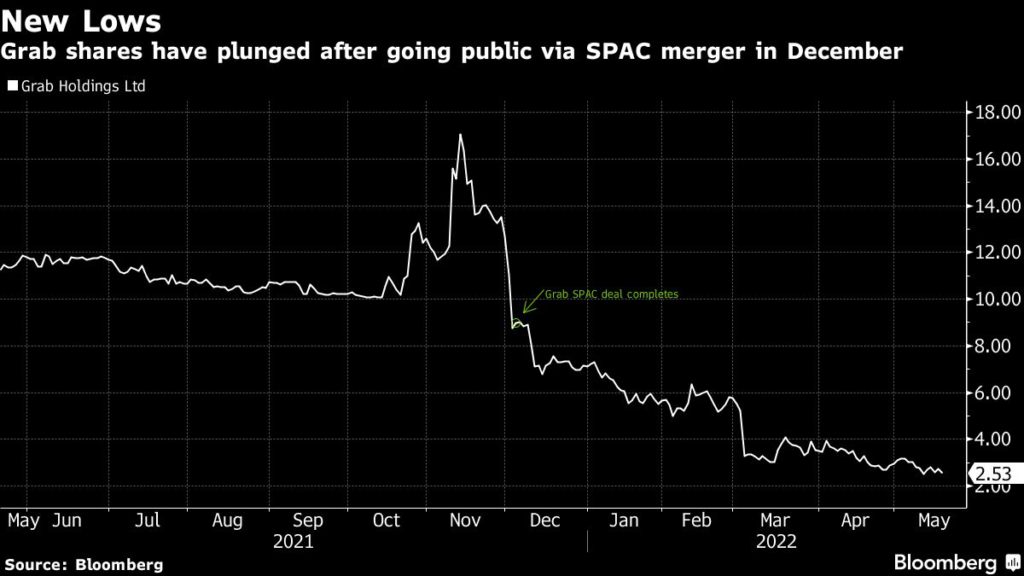
The company had struggled since becoming a publicly listed company in the U.S. through a merger with a blank-check company in December. Mounting losses, coupled with a broad tech selloff, have weighed on its shares, which have lost more than 70% since the startup went public.

Grab’s Deliveries to Offset Mobility Weight on Revenue: Preview

Key Insights 

  • Revenue from delivery business jumped 70% to $91 million
  • Revenue from mobility business declined 22% to $112 million
  • Revenue from financial services rose to $11 million
  • Grab plans to launch a Singapore digital bank, currently in internal pilot, in the second half, CEO Anthony Tan said during a conference call
  • Deliveries GMV was $2.56 billion vs its forecast of $2.4 billion to $2.5 billion
  • Mobility GMV was $834 million vs its forecast of $750 million to $800 million
  • The company said it expects full-year revenue to increase to $1.2 billion to $1.3 billion; sales excluding Jaya Grocer will rise no less than 50% this year, CFO Peter Oey said on the call

Get More

  • Grab’s cash and cash equivalents fell to $3.4 billion at the end of March from about $5 billion at the end of 2021, partly because of cash outflow from operating activities and the acquisition of Jaya Grocer
  • Partner incentives climbed 55% to $216 million, while consumer incentives rose 85% to $344 million
  • Grab expects second-quarter deliveries GMV of $2.55 billion to $2.65 billion
  • Company sees second-quarter mobility GMV of $950 million to $1 billion
  • Grab expects second-quarter financial services total payment volume, before consolidation, to reach $3.5 billion to $3.6 billion
  • Company sees GMV growing 30% to 35% in 2022

Market Reaction 

  • Grab shares rose more than 3.5% in pre-market trading in New York.

(Updates with digital bank plan in fourth bullet point)

More stories like this are available on bloomberg.com

©2022 Bloomberg L.P.
Close Bitnami banner
Bitnami