
Bloomberg

Quebec Plans to Bar Most Immigrants Who Don’t Speak French

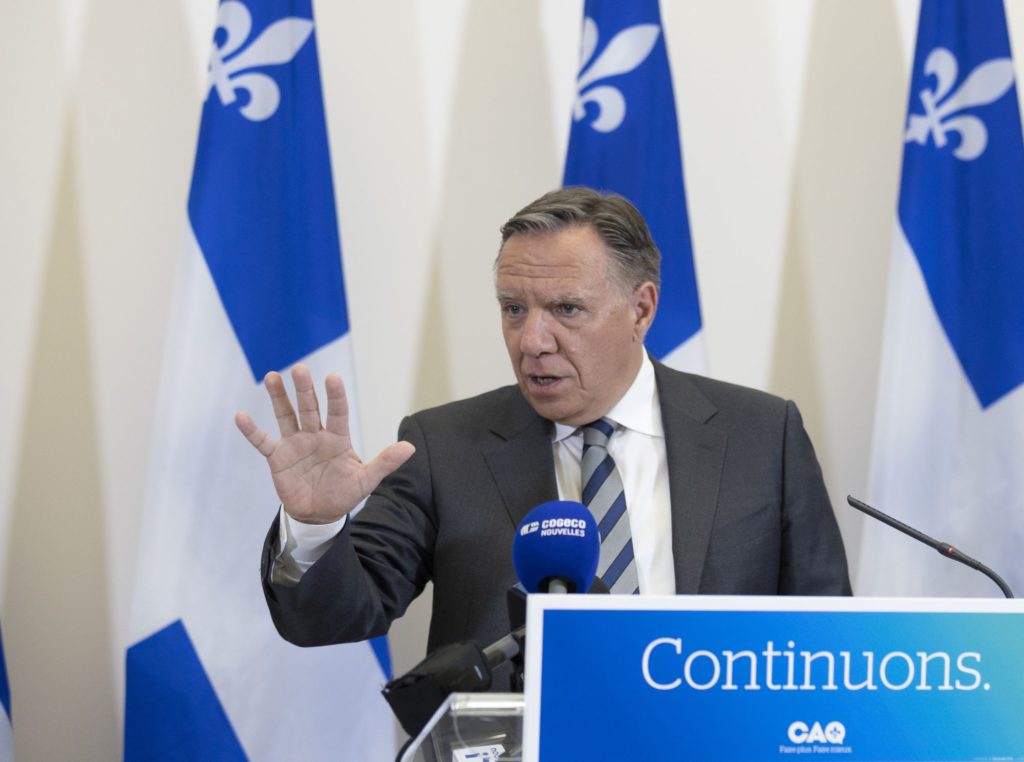
(Bloomberg) — Quebec Premier Francois Legault, concerned about the decline of the French language in the Canadian province, has set a new goal for immigrants: They should all speak French.

Legault’s nationalist Coalition Avenir Quebec party was re-elected with a huge majority in October, partly on a platform of protecting French as the dominant language in the province of 8.7 million people. His speech to the legislature Wednesday laid out his priorities for his second term, including a plan to bar almost all economic immigrants who don’t speak French by 2026.

“The objective is to stop the decline of French, in particular in Montreal, and to reverse the trend,” Legault said. “The French language, it must be an imperative duty.”

The policy would apply only to those seeking permanent residency on economic grounds — not to refugees or people entering Quebec on temporary work visas. Legault said about 50% to 60% of economic immigrants selected by previous governments talked French.

The percentage of Quebeckers declaring French as their first spoken language declined 1.5 percentage points to 82.2% between 2016 and 2021, according to data from Statistics Canada. Within the province, 80% of employees now mainly use French at work, while 14% mainly use English and 5% use both equally. 

But in Montreal, the province’s largest city, French at work drops to 70%.

‘Enormous Damage’

Pierre Fitzgibbon, Quebec’s economy minister, told reporters there should be exceptions, such as workers in the electric-vehicle battery sector. Foreign firms from South Korea and Germany have plans to build plants in the province. “It would be fun to have 100%,” he said. “But you have to be realistic, and balance that with needs.”

The Conseil du Patronat du Quebec, a lobby group that represents some of the province’s biggest companies, said the government should not penalize allophones — people whose first language is neither French nor English — especially in sectors such as information technology and video game programming, where talent is harder to find. 

“We are sensitive to the situation of French in Quebec, but we must not rule out good candidates for immigration on this sole criterion,” said Karl Blackburn, the group’s president.

Legault’s government has been criticized by the business community for adopting a controversial law, known as Bill 96, aimed at protecting the French language. Under it, all companies providing goods and services in Quebec must now serve their clients in French. Another measure allows a provincial agency, the Office Quebecois de la Langue Francaise, to verify the language used in a company’s internal and external communications when investigating a complaint.

Executives at more than 150 companies have signed a letter to Legault warning the premier the law “is threatening to do enormous damage to the province’s economy” because it creates an unpredictable business environment.

(Updates with comments from the Conseil du Patronat du Quebec)

More stories like this are available on bloomberg.com

©2022 Bloomberg L.P.

Russia’s Labor-Starved Economy Pays Price of Putin’s Call-Up

(Bloomberg) — The call-up of men to fight in Ukraine has left labor so scarce in Russia that entire industries are in distress.

Two months after the Kremlin announced the mobilization in late September, a record depletion of workers is fast spreading across a country already hobbled by an aging and shrinking population and with unemployment near the lowest ever. A study by the Gaidar Institute in Moscow in November found that up to a third of Russian industry may face a deficit of personnel because of the draft, the most severe crunch since 1993.

Agrokomplex, a large agricultural company in the south, now struggles to fill openings for tractor drivers and other workers, in addition to the specialists in areas like agronomy who’ve long been hard to find, said Irina Khmelevskaya, head of recruitment. The mobilization is partly to blame, she said.

The mobilization of 300,000 men, combined with an even bigger wave of emigration it triggered, will reduce the male labor pool by 2%. That’s among the main reasons that Bloomberg Economics now puts Russia’s potential economic growth rate at just 0.5% — or half its pre-war level. The threat that labor shortages would eventually bring inflationary pressure has already prompted the Bank of Russia to put interest-rate cuts on hold.

The call-up and the flight it caused cut across society, sweeping up urban white-collar professionals and people in rural areas alike.

In Novosibirsk, Siberia’s most populous city, officials say they can field barely half the staff needed to clear streets of snow with so much of the seasonal workforce from the countryside caught up in the mobilization. More than 200 convicts will be employed at the state-run tank maker Uralvagonzavod.

A third of companies lost some employees to the call-up, with nearly a fifth saying they haven’t yet been able to replace them, a November survey showed. Among infrastructure builders, the vast majority is experiencing an increasing lack of qualified labor and expects shortages to get worse in the coming quarters, according to a report.

The number of vacancies in IT and telecommunications grew 15% in October from the previous month, according to Russian online recruiter Superjob.

In the wake of the call-up, résumés from Russian citizens are flooding nations across much of the post-Soviet region and Turkey, with IT specialists accounting for a fifth of the total, according to HeadHunter Group Plc, Russia’s biggest online job-search platform.

Natalia Danina, chief of HeadHunter’s analytical department, said demand for blue-collar workers is surging. The age group of 20 through 24 currently counts no more than 7 million people, a steep drop from over 12 million a decade ago, she said.

“These are terrifying numbers,” Danina said. “Besides, many may have health problems because of the stress. There are physically not enough people left!”

The elderly, alongside women and teenagers, are also becoming an important source of workers, according to Danina. Migrants account for up to 10% of the local labor market, with Russia growing more reliant on them to expand the pool of low-skill labor.

Migration outflows have meanwhile continued since the start of the year, according to official data published Wednesday, with the number of those leaving Russia in the first nine months more than doubling and rising by more than 323,000.

Labor shortages may become a major vulnerability as Russia heads for a downturn likely to extend well into next year, especially as other parts of the economy come under pressure from sanctions imposed by the US and its allies. Almost half the companies surveyed by the Gaidar Institute said staff shortages will make it impossible for them to increase output even if there’s sufficient demand.

“Fear and uncertainty have caused a very serious outflow of brains and capital from the country, hurting many sectors,” said Evgeny Kogan, a professor at Moscow’s Higher School of Economics. “If this huge potential for development remains outside the country, it will lead to a major future decline in the economy.”

(Updates with migration outflows in third paragraph from the bottom.)

More stories like this are available on bloomberg.com

©2022 Bloomberg L.P.

Kenya Fintech Cellulant Starts Expansion to South Africa

(Bloomberg) — Cellulant Ltd., a Kenyan payment-services provider, is starting a South African business after months of testing the market and is looking to wrap up fundraising for further expansion to the Middle East and UK.

The two-decade old company is looking to tap South Africa’s mature retail ecosystem, Chief Business Officer Sike Bamisebi said in an interview, with the United Arab Emirates and UK set to follow in the next two years.

Cellulant is about to close its latest fundraising round, she said. While the company hasn’t disclosed the likely amount, it has previously indicated it could raise as much as $100 million. 

“We provide a valuable proposition in South Africa. We work with premium merchants and we give them access to these markets,” Bamisebi said at the Africa Tech Summit in London. “These new markets fall in line with our strategy to prioritize the top markets.”

Payment-technology companies have been at the forefront of an unprecedented boom in investment in African startups, which hit a record $5 billion in 2021. Businesses such as Flutterwave Inc. in Nigeria are tapping into rising demand for e-commerce on the continent, fueled by better connectivity and a lack of traditional banks.  

Cellulant’s backers include TPG Growth’s The Rise Fund, which led a $47.5 million round in 2018. The company operates in 18 countries and serves 35 others. 

The company enables businesses to collect payments online and offline from mobile money, cards or banks. Its clients include airlines, banks, fintechs and fast-food chains including Burger King. 

In its latest partnerships, Cellulant partnered with Copia Global, a Kenyan e-commerce platform, to facilitate payment for diaspora and urban customers. 

Cellulant’s fundraising comes amid a cool down in startup investment globally in part due to rising US interest rates. Funds raised by African startups this year are likely to match the previous year’s record $5 billion according to data from Briter Bridges. 

(Updates with details on Copia Global partnership in penultimate paragraph)

More stories like this are available on bloomberg.com

©2022 Bloomberg L.P.
Biden Tempts Battery Makers Balking at Steep German Energy Bills

(Bloomberg) —

Europe’s energy crisis and the allure of US incentives are complicating Germany’s efforts to build up a leading electric-vehicle supply chain.

Northvolt said this week it’s considering postponing plans to build a battery factory in Europe’s biggest economy because of high energy prices. The Swedish company will decide next year between building the Heide facility in northern Germany in time for production to start in late 2025, or expand first in North America, where US President Joe Biden is wooing cell manufacturers with billions of dollars in incentives.

“Given what is happening in North America and what is happening in Europe,” Northvolt will “decide what to prioritize,” said Jesper Wigardt, a company spokesman. A decision in favor of North America might delay the German plant “a bit.”

The potential holdup of the Heide factory — which eventually will produce enough cells for roughly 1 million EVs per year — would be a serious setback for Volkswagen and BMW, both of which have invested in Nothvolt and placed multibillion-dollar orders. It also follows reports that Tesla is delaying battery-making efforts at its plant outside Berlin.

Retooling the German auto industry to preserve manufacturing jobs is among Chancellor Olaf Scholz’s top priorities. But the country’s modernization push has been complicated by the war in Ukraine, which forced Berlin to abandon its reliance on cheap Russian natural gas. Wholesale prices for the fuel and for electricity have soared, and that’s bad news for the energy-intensive battery industry. Producing 1 kilowatt-hour of EV battery capacity requires 41 kilowatt-hours of gas and electricity, according to Berylls Strategy Advisors.

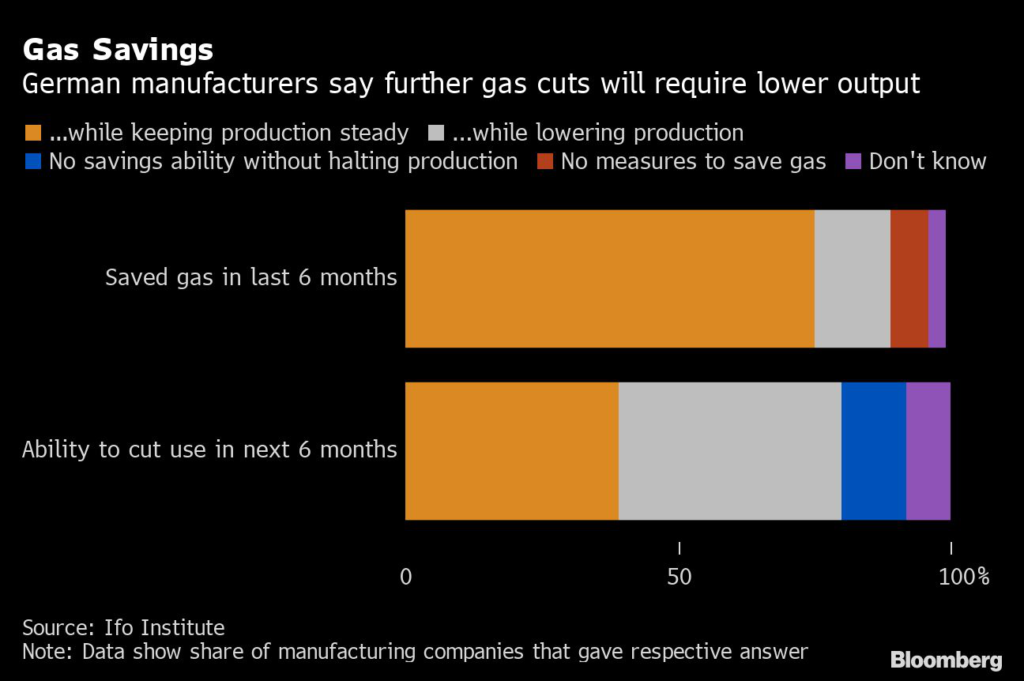
Europe has stocked up on gas during the past few months, but supplies could dwindle in the event of an extended cold spell. Manufacturers in Germany see slim odds of being able to save more gas without slowing or stalling production, according to a survey published last week by the Ifo Institute. While Qatar this week agreed to supply Germany with LNG for at least 15 years, shipments won’t start until 2026.

“Unless we manage to reduce energy prices in Germany and Europe quickly and reliably, investments in energy-intensive production or new battery cell factories in Germany and the EU will be practically unviable,” Thomas Schaefer, chief executive officer of the VW brand, wrote this week on LinkedIn. “The value creation in this area will take place elsewhere.”

By elsewhere, Schaefer likely is referring to the US. The country has seen a surge in investments in response to the Inflation Reduction Act, which aims to boost domestic EV and battery production and reduce reliance on China for components and materials. Tax credits for assembling battery cells and packs in the US are so generous, they may well make America “a global EV battery hub,” UBS analysts said in a note in September. “Cell manufacturing in the US could be more profitable than in any other country.”

Germany is unlikely to completely miss out. China’s CATL, the world’s biggest maker of EV batteries, is on track to start production at its first European cell plant in Erfurt, central Germany, by the end of this year, a spokesperson said this week. The facility is slated to start with 8 gigawatt-hours of annual capacity and expand to 14 gigawatt-hours within a year. Northvolt has said its factory will eventually produce 60 gigawatt-hours of cells annually.

Still, industry officials have been urging German and European politicians to bolster aid or risk stalling the industry’s transformation. Germany’s Varta said last month that it won’t finish building a new battery factory until it secures binding orders, citing issues including rising energy and raw materials costs. China’s Svolt Energy Technology, which is planning to build three cell factories in Germany, said this week it will “monitor economic developments” in the US because of the new incentives there.

“IRA has changed the dynamics for suppliers. The entire value chain is looking at North America instead of at Europe,” Northvolt’s Wigardt said. “European politicians on various levels need to act quickly to ensure that Europe remains attractive to invest in.”

More stories like this are available on bloomberg.com

©2022 Bloomberg L.P.

Xi Urges Calming Crisis in Ukraine During Talks With Michel

(Bloomberg) — Chinese President Xi Jinping urged efforts to resolve the war in Ukraine during talks with European Council President Charles Michel, as Beijing sought to address one of its biggest friction points with Brussels.

“Solving the Ukraine crisis through political means is in the best interest of Europe and the common interest of all countries in Eurasia,” Xi said after the meeting on Thursday in Beijing, according to state broadcaster China Central Television. He added that “it is necessary to avoid escalation and expansion of the crisis.”

Michel told Xi that the European Union counted on China “to contribute to ending Russia’s brutal destruction and occupation,” according to a statement from Michel’s spokesman. Both leaders “stressed that nuclear threats are irresponsible and highly dangerous” during their roughly three hours of discussions, it added.

Speaking alone at a news conference following his meetings, Michel said Xi had also “made very clear” that China isn’t providing weapons to Russia. 

“We all share the responsibility to work for peace and to respect the fundamental principles of the United Nations Charter,” Michel said. “I urged President Xi, as we did at our EU-China summit in April, to use his influence on Russia to respect the UN charter.”

Read: Europe Reasserts Middle Path on China, Pushing Back on Biden

China has refrained from criticizing Russia over the war in Ukraine, blaming the expansion of the North Atlantic Treaty Organization for Moscow’s actions. China signed off on a communique at the Group of 20 summit in Indonesia earlier this month that said “most members strongly condemned the war in Ukraine,” but continues to refrain from calling it a war.

Xi also reinforced his opposition to the use of nuclear weapons in Ukraine during talks with US President Joe Biden at the G-20. Russian President Vladimir Putin had fueled fears he may resort to nuclear weapons, though Russian diplomats later clarified his stance.

The encounter between Xi and Michel came as China’s zero-tolerance approach to the coronavirus faces new stress given the costs to the economy and burdens placed on the public. French companies said last week that the rollout of changes China made to its Covid Zero strategy earlier this month, including pulling back on testing, fell short of expectations. The European nation’s chamber of commerce called on the government to lift “unnecessary and excessive curbs.”

See: Beijing Eases Covid Curbs, Letting Some Patients Isolate at Home

The statement from Michel’s spokesman said he told Xi about “difficulties faced by EU companies and investors, which have been exacerbated by the pandemic.” The statement didn’t mention protests that broke out recently in China against the nation’s strict Covid Zero rules.

At the news conference, Michel said he discussed the protests with Xi as well as the “acceptance by societies of the measures and the reactions by authorities.” He said that both sides had agreed to resume a human rights dialog, adding, “For the EU, the right of assembly is an important fundamental right.”

Also on Thursday, China called for an investment agreement with Europe to be finalized. European lawmakers voted to halt ratification of the Comprehensive Agreement on Investment due to a dispute over human rights issues and both sides levying sanctions.

The deal is “good for China, Europe and the world,” Shu Jueting, spokeswoman of the Ministry of Commerce in Beijing, said at a press briefing. “China and Europe should work together to push for signing and entering the agreement into force so that it can benefit companies and the public on both sides soon.”

Europe has been trying to carve out a middle ground on diplomacy with China, with French President Emmanuel Macron calling for engagement with Beijing and resisting efforts to divide the world into competing blocs.

That move pushes back at the US, which is trying to convince chipmakers around the world to curb high-end exports to China, limiting progress the world’s No. 2 economy can make in areas such as artificial intelligence and military applications.

Still, the US and the European Union aim to work together to counter what they call non-market policies, including in China, according to a draft statement before high-level talks due in Washington this month. Macron, on a state visit to the US, meets with Biden on Thursday. 

–With assistance from James Mayger, Natalia Drozdiak and Katharina Rosskopf.

(Updates with Michel comments following press conference in 4th, 5th and 10th paragraphs)

More stories like this are available on bloomberg.com

©2022 Bloomberg L.P.
Startup’s Headset to Treat Alzheimer’s Will Undergo Wide Trial With Patients

(Bloomberg) — Cognito Therapeutics Inc. became the latest company to secure a large-scale trial to treat Alzheimer’s disease. Unlike most other remedies in development today, this one involves a device rather than medicine.

The late-stage trial, which the company plans to announce Thursday at the Clinical Trials on Alzheimer’s Disease conference in San Francisco, will enroll around 500 US participants. They will wear a headset for an hour a day for a year. The headset will deliver light and sound at a frequency that, according to prior Cognito studies including one in the journal Neurology, delivers improved cognitive ability among people with Alzheimer’s.

Cognito, based in Cambridge, Massachusetts, will also show research about the effects of its device on the deterioration of the brain’s white matter, the intertwining neural connections that link all four lobes of the brain. Abnormalities in white matter, and the insulating layer that surrounds it called myelin, are associated with Alzheimer’s. “We’re quite optimistic,” said Cognito Chief Executive Officer Brent Vaughan.

Alzheimer’s is intractable. About 10 million people are diagnosed each year with the disease or other dementias, according to the World Health Organization. Many potential remedies over the years have initially shown promise and ultimately fallen short of expectations.

One highly anticipated drug, Eisai’s and Biogen’s lecanemab, has sparked excitement because it appears to reduce brain plaque associated with Alzheimer’s and could be approved by the US Food and Drug Administration early in 2023. Shares of both companies rose after they released data about the drug. Still, lecanemab caused brain swelling and bleeding among 20% of those who took it in a trial, compared with 10% of the placebo group.

Cognito’s earlier trials were promising enough for the FDA to give the company breakthrough status, meaning a streamlined process for evaluation. Even if the Cognito headset proves effective in this latest trial, the earliest it could see wide adoption is 2024. It will take several months to enroll participants, then a year to collect the data and submit it for review.

Unlike other emerging therapies, Cognito seeks to preserve white matter in the brain rather than attack plaque buildup. Its device has drawbacks, including that it might be tough for some to devote an hour every day to wearing the headset. Some patients in earlier trials said they experienced ringing or buzzing in their ears when using it.

Some neurological conditions such as epilepsy have been shown to be treatable with devices. Most are invasive, involving implanted electrodes.

Cognito’s is noninvasive and resembles wrap-around sunglasses. It works using neuromodulation, meaning direct alteration of nerve activity by outside stimulus. The headset transmits lights and sounds at a frequency of 40 times per second. The light is more of a flicker than a flash, Vaughan said, and the sound a mild clicking or ticking, audible to the patient but not anyone else nearby. Patients can wear it at home rather than going to a clinic.

The device’s pulsing lights and sounds are aimed at stimulating immune cells called microglia in an effort to clear out proteins that can lead to disease and dementia.

Cognito has raised a total of $73 million from backers including FoundersX Ventures and Morningside Ventures. Its co-founders include Massachusetts Institute of Technology’s Ed Boyden, who has created a new approach to studying the brain through optogenetics, a way of turning key cells on and off with light. If Cognito’s treatment is proven, which is no guarantee, the device could one day have other applications. Mild cognitive impairment, some types of strokes and Parkinson’s disease are all conditions that could see benefits from stimulation, Vaughan said.

More stories like this are available on bloomberg.com

©2022 Bloomberg L.P.
Forever 21 Bets You Want to Dress Like Your Roblox Avatar

(Bloomberg) — There’s no shortage of skepticism about the metaverse, but one legitimate business strategy could be using virtual worlds as a testing ground for physical products.

That’s a hypothesis Forever 21 has been incubating since it set up a shop in Roblox a year ago. In the virtual world, the fast-fashion giant made a splash selling digital goods that users buy to outfit their avatars. A black beanie, a product it didn’t offer in the real world, selling for about 70 cents is on track to be purchased 1.5 million times this year, making it one of the brand’s top-performing items ever.

Forever 21 is now bringing that beanie and other digital-first items to its stores and website in what it has called the first clothing line tested in the metaverse.

“We love the idea of testing products digitally,” said Jacob Hawkins, whose roles at Forever 21 include chief marketing officer. “It costs us so much less to test a product digitally than to test it in stores.”

Brands and retailers spanning Gucci to Walmart have piled into the metaverse this year by creating experiences and selling digital goods, with many attempts tied to NFTs and crypto. But few of those bets have made real-world money, and the recent routs in tech and crypto have soured investors on Web3 — a catchall for the future of the internet.

However, Forever 21’s latest push is a sign that virtual worlds have the potential to be more than glorified brand billboards by offering an inexpensive way to create and test products. A digital good can be produced cheaply and quickly by sidestepping the logistical hurdles that bedevil retailers. Forever 21’s digital beanie cost less than $500 to make, according to Justin Hochberg, chief executive officer of Virtual Brand Group, the company hired to build Forever 21’s metaverse business.

“The work of going out and creating a product, talking to a factory, going through all that process — that’s months and months and months of work,” said Hawkins. “To create a product digitally, we can do that in days.”

The rewards are potentially enormous: Annual global spending in digital worlds like Roblox could reach as much as $5 trillion by 2030, according to a June report from McKinsey & Co. 

That kind of growth could help Forever 21, which exited bankruptcy in 2020 when it was acquired by Authentic Brands Group, Simon Property Group and Brookfield Property Partners. The chain is already planning more items, including a real-life version of a digital-first prom collection that’s slated to be released early next year.

Forever 21 isn’t alone. Vans, a shoe and apparel brand owned VF Corp., has been testing new colors, textures and designs in its Roblox store. However, the company said it doesn’t have immediate plans to turn them into physical products. Nike Inc. has used its virtual Roblox city to test sneaker prototypes and is starting a trading platform for digital goods.

The challenge will be sustaining the business as the metaverse changes and evolves over the next decade — if it ever comes to fruition at all, that is. There’s also often a disconnect between what people do online and in the real world, according to Sucharita Kodali, principal analyst at Forrester Research. “It’s just not correlated to what actually sells.”


More stories like this are available on bloomberg.com

©2022 Bloomberg L.P.
US Stock Futures Waver After Rally, Dollar Weakens: Markets Wrap

(Bloomberg) — The dollar plumbed a three-month low on Thursday, while US stock futures paused after hefty index gains fueled by China’s softer stance on Covid and confirmation of a slower US rate-hiking pace from Federal Reserve Chair Jerome Powell. 

S&P 500 contracts were steady, a day after Powell’s comments helped the underlying benchmark close out November with a second month of gains for the first time in more than a year. Those on the tech-heavy Nasdaq 100, which jumped 4.5% on Wednesday, slipped more, with notable declines in US-listed China stocks that had benefited from reports of China’s economic reopening.

Markets elsewhere continued to ride high, with Europe’s Stoxx 600 benchmark up more than 0.5% and a range of regional indexes on the cusp of bull-market territory, having gained almost 20% from lows hit in September. A gauge of global shares touched a three-month high.

Sentiment got an extra boost after China’s top official in charge of the fight against the coronavirus, Vice Premier Sun Chunlan, said the response was entering a new phase, with the omicron variant weakening and more Chinese getting vaccinated. Beijing also indicated some Covid patients could isolate at home.

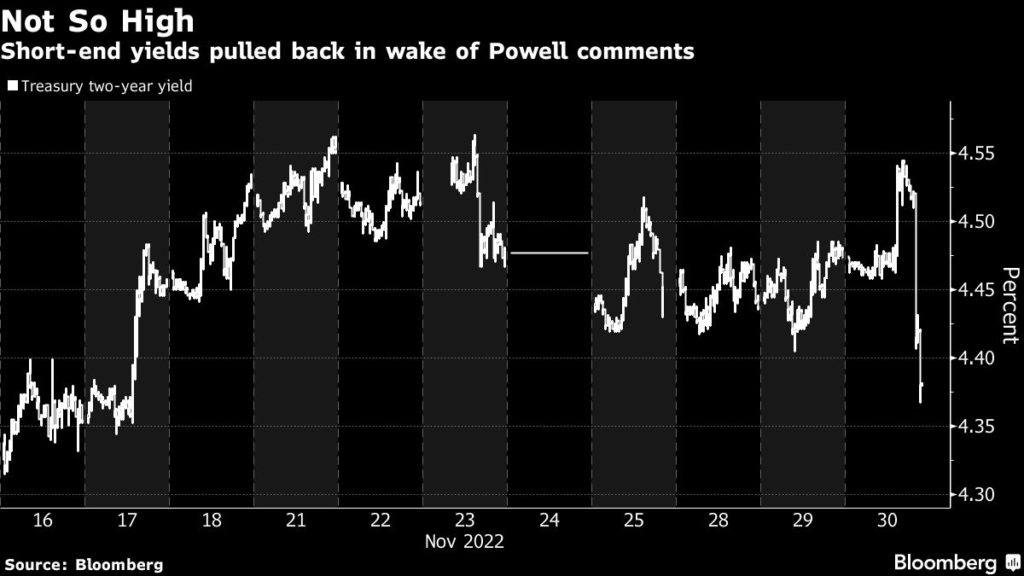
The buoyant mood knocked the dollar lower against its Group-of-10 counterparts for the third straight day, while Treasury 10-year yields stayed just off two-month lows hit in the wake of Powell’s comments. The yen advanced more than 1% and the euro touched a five-month peak.

“There is no one-way bet any more on dollar strength,” said Sarah Hewin, senior economist at Standard Chartered in London. “We had a good signal about a pivot from Powell, so the market has dialed back its expectations on peak rates.” 

Powell’s remarks confirmed expectations the Federal Reserve will raise interest rates 50 basis points this month in a departure from a run of four 75 basis point hikes. Pricing in the swaps market indicates the Fed funds rate will peak below 5% in May. Prior to Powell’s comments, the market anticipated a peak above that level occurring in June.

Focus will likely shift now to how economic growth will fare in coming quarters. US activity gauges have painted a mixed third-quarter picture, with Wednesday’s daa showing job openings down in October, while Friday’s jobs report is currently forecast to show employers added 200,000 workers to payrolls in November.

Later in the day, investors will get to parse the latest US core PCE print — one of the Fed’s favored inflation gauges.

“The market’s wanting to see whether PCE inflation for November aligns with the soft CPI numbers,” analysts at Mizuho wrote, referring to below-forecast inflation data that kicked off the equity rally in November.

There are signs that cooling growth is affecting corporate earnings, especially in the tech sector. Tech shares led losses in US premarket trading, with software maker Salesforce down sharply after an earnings outlook that appeared to reflect a weaker economic environment. 

Elsewhere, oil fluctuated after a three-day rally as investors assessed the latest signals that China may be softening its Covid Zero policy and looked ahead to an OPEC+ meeting that will set supply levels for 2023.

Key events this week:

  • S&P Global PMIs, Thursday
  • US construction spending, consumer income, initial jobless claims, ISM Manufacturing, Thursday
  • BOJ’s Haruhiko Kuroda speaks, Thursday
  • US unemployment, nonfarm payrolls, Friday
  • ECB’s Christine Lagarde speaks, Friday

Some of the main moves in markets:

Stocks

  • Futures on the S&P 500 were little changed as of 6:17 a.m. New York time
  • Futures on the Nasdaq 100 fell 0.3%
  • Futures on the Dow Jones Industrial Average fell 0.2%
  • The Stoxx Europe 600 rose 0.8%
  • The MSCI World index rose 0.6%

Currencies

  • The Bloomberg Dollar Spot Index fell 0.4%
  • The euro rose 0.2% to $1.0427
  • The British pound rose 0.7% to $1.2143
  • The Japanese yen rose 1.2% to 136.41 per dollar

Cryptocurrencies

  • Bitcoin fell 0.1% to $17,085.63
  • Ether fell 1.2% to $1,280.88

Bonds

  • The yield on 10-year Treasuries was little changed at 3.60%
  • Germany’s 10-year yield declined 10 basis points to 1.83%
  • Britain’s 10-year yield declined seven basis points to 3.10%

Commodities

  • West Texas Intermediate crude rose 0.8% to $81.18 a barrel
  • Gold futures rose 1.8% to $1,791 an ounce

This story was produced with the assistance of Bloomberg Automation.


–With assistance from Rita Nazareth and Richard Henderson.

More stories like this are available on bloomberg.com

©2022 Bloomberg L.P.

Crypto Feels the Wrath of FTX’s Demise Through Bankruptcies (Podcast)

(Bloomberg) — Listen to Bloomberg Crypto on the  iHeartRadio App,  Apple Podcasts or  Spotify.

A look into the disorganized bankruptcy filing of FTX’s crypto empire with Bloomberg reporter Jeremy Hill. We review why we don’t know the identity of FTX’s top 50 creditors and whether we’re likely to find out. The discussion also considers what other companies could suffer by their association with former FTX CEO Sam Bankman-Fried and his now bankrupt companies.

Subscribe to the Bloomberg Crypto Newsletter at https://bloom.bg/cryptonewsletter 

This podcast is produced by the Bloomberg Crypto Podcast team: Supervising producer: Vicki Vergolina, Senior Producer: Janet Babin, Producers: Sharon Beriro and Muhammad Farouk, Associate Producers: Mo Andam and Ty Butler. Sound Design/Engineer:  Desta Wondirad.

More stories like this are available on bloomberg.com

©2022 Bloomberg L.P.

Ford Invests £150 Million to Boost EV Parts Output From UK Plant

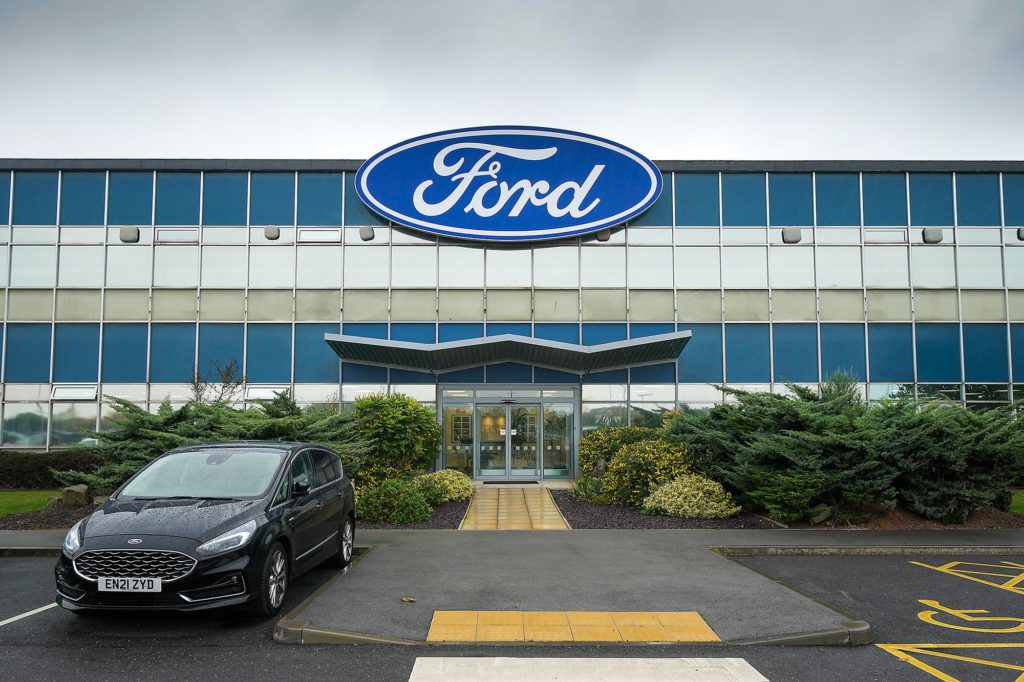
(Bloomberg) — Ford Motor Co. will spend about £150 million ($181 million) on expanding production of electric-vehicle components in England, a rare win for the UK’s struggling auto sector.

The investment will increase capacity at Ford’s Halewood transmission plant by 70% to 420,000 electric vehicle power units a year, the automaker said Thursday. Each unit is comprised of an electric motor and gearbox that replaces the engine and transmission of a conventional combustion vehicle.

Ford first announced over a year ago that it would convert the transmission-making facility near Liverpool to safeguard jobs as it aims to sell 600,000 EVs a year in Europe by 2026. Halewood is expected to supply power units for 70% of those vehicles.

The moves provide a much-needed boost to an industry beset by years of Brexit uncertainty, pandemic disruptions and shortages of components. Britishvolt Ltd., the company thought to be the country’s best hope for a homegrown EV battery maker, is struggling to stay afloat, and BMW AG recently announced it will move production of electric Mini hatchbacks to China.

Read more: The UK Car Industry’s Prospects Are Going From Bad to Worse

Ford’s fresh spending at Halewood adds to the £230 million the company pledged to the site last year. The manufacturer has a target to sell only fully electric cars in Europe by the end of this decade.

“We’re very committed to the UK,” said Kieran Cahill, vice president of Ford’s European industrial operations. “We will continue to look for growth opportunities if Halewood stays competitive.”

More stories like this are available on bloomberg.com

©2022 Bloomberg L.P.

Close Bitnami banner
Bitnami