
Bloomberg

Stocks Buoyed by Powell and China, Dollar Weakens: Markets Wrap

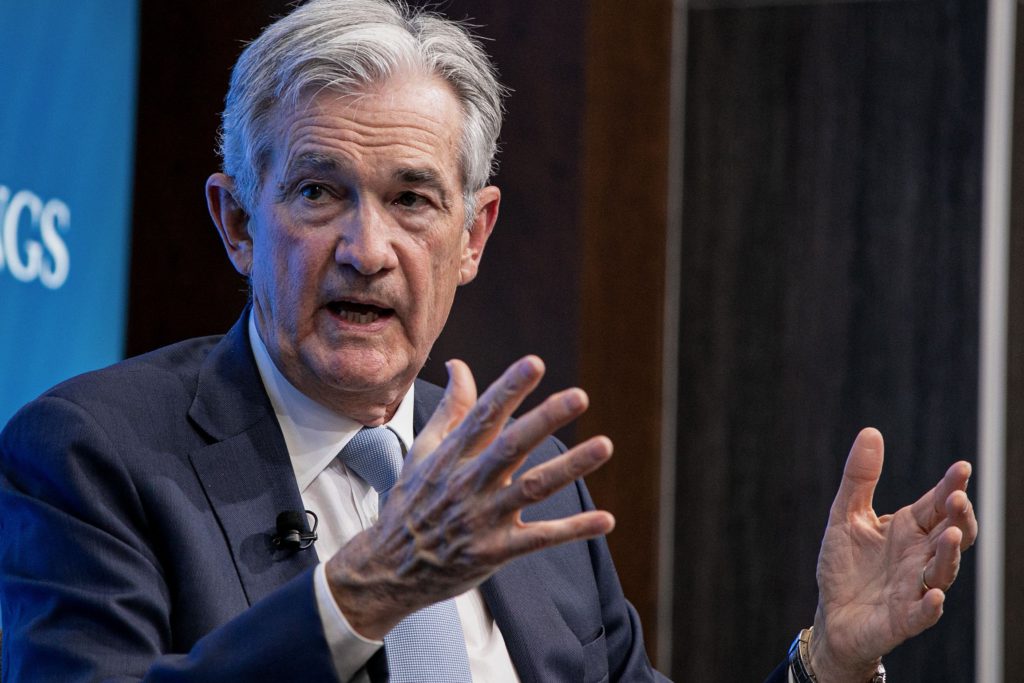
(Bloomberg) — Global stocks climbed and the dollar slipped to a three-month low as fresh signs emerged of a softening in China’s Covid stance and Federal Reserve Chair Jerome Powell confirmed that the pace of interest rate hikes was set to slow. 

Europe’s Stoxx 600 index rose as much as 1.1%, with tech shares gaining as much as 3% and a range of regional indexes on the cusp of bull-market territory, having gained almost 20% from lows hit in September. A gauge of global shares touched a three-month high, although US index futures edged lower, a day after Powell’s comments helped the S&P 500 close out November with a second month of gains for the first time in more than a year.

Sentiment in Asia got an extra boost after China’s top official in charge of the fight against the coronavirus, Vice Premier Sun Chunlan, said the country’s efforts to combat the virus are entering a new phase with the omicron variant weakening and more Chinese getting vaccinated. Beijing also indicated some Covid patients could isolate at home.

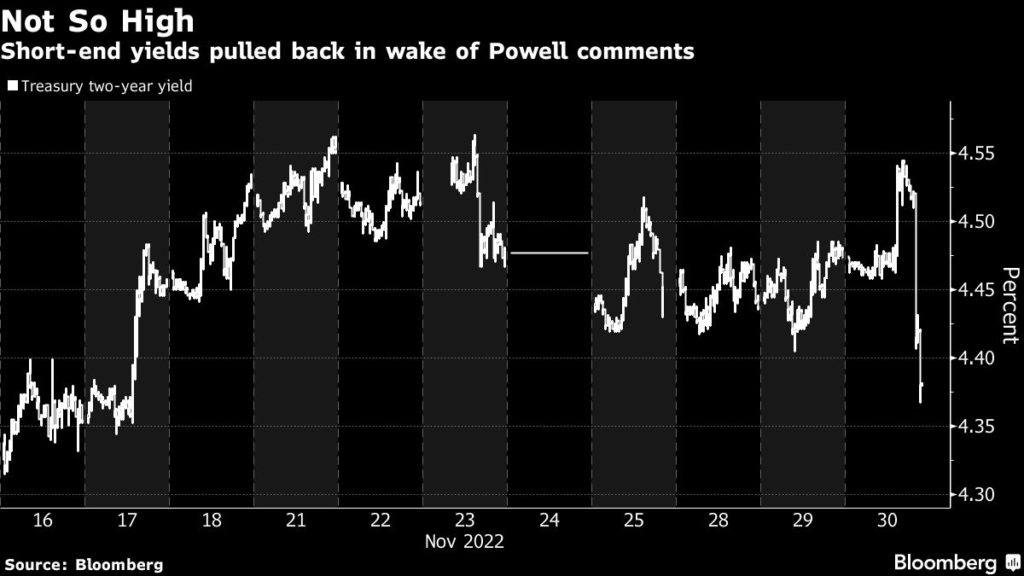
The buoyant mood knocked the dollar lower against its Group-of-10 counterparts for the third straight day, while Treasury 10-year yields stayed just off two-month lows hit in the wake of Powell’s comments. The yen advanced more than 1% and the euro touched a five-month peak.

“There is no one-way bet any more on dollar strength,” said Sarah Hewin, senior economist at Standard Chartered in London. “We had a good signal about a pivot from Powell, so the market has dialed back its expectations on peak rates.” 

Powell’s remarks confirmed expectations the Federal Reserve will raise interest rates 50 basis points this month in a departure from a run of four 75 basis point hikes. Pricing in the swaps market indicates the Fed funds rate will peak below 5% in May. Prior to Powell’s comments, the market anticipated a peak above that level occurring in June.


Investors will likely switch focus to how economic growth will fare in coming quarters. Key gauges of US activity have painted a mixed third-quarter picture. Job openings fell in October — a hopeful sign for the Fed as it seeks to curb demand — while Friday’s jobs report, is currently forecast to show employers added 200,000 workers to payrolls in November. 

There are also signs that cooling growth is affecting corporate earnings, especially in the tech sector. While the rate-sensitive Nasdaq jumped 4.5% on Wednesday, tech shares broadly fell in premarket trading, led by software maker Salesforce, whose earnings outlook appeared to reflect a weaker economic environment. 

Thursday’s PMI numbers from S&P Global showed a slump in Asian and European factory activity and businesses bracing for more cutbacks in spending from customers. 

Elsewhere in markets, oil fluctuated after a three-day rally as investors assessed the latest signals that China may be softening its Covid Zero policy and looked ahead to an OPEC+ meeting that will set supply levels for 2023.


Key events this week:

  • S&P Global PMIs, Thursday
  • US construction spending, consumer income, initial jobless claims, ISM Manufacturing, Thursday
  • BOJ’s Haruhiko Kuroda speaks, Thursday
  • US unemployment, nonfarm payrolls, Friday
  • ECB’s Christine Lagarde speaks, Friday

Some of the main moves in markets:

Stocks

  • The Stoxx Europe 600 rose 0.7% as of 9:56 a.m. London time
  • Futures on the S&P 500 were little changed
  • Futures on the Nasdaq 100 fell 0.2%
  • Futures on the Dow Jones Industrial Average fell 0.2%
  • The MSCI Asia Pacific Index rose 1.7%
  • The MSCI Emerging Markets Index rose 0.8%

Currencies

  • The Bloomberg Dollar Spot Index fell 0.4%
  • The euro rose 0.3% to $1.0439
  • The Japanese yen rose 1.3% to 136.31 per dollar
  • The offshore yuan fell 0.6% to 7.0899 per dollar
  • The British pound rose 0.7% to $1.2148

Cryptocurrencies

  • Bitcoin was little changed at $17,111.26
  • Ether fell 1.1% to $1,282.69

Bonds

  • The yield on 10-year Treasuries advanced two basis points to 3.62%
  • Germany’s 10-year yield declined nine basis points to 1.84%
  • Britain’s 10-year yield declined five basis points to 3.11%

Commodities

  • Brent crude was little changed
  • Spot gold rose 0.5% to $1,778.16 an ounce

This story was produced with the assistance of Bloomberg Automation.

–With assistance from Rita Nazareth and Richard Henderson.

More stories like this are available on bloomberg.com

©2022 Bloomberg L.P.

Jiang Death Injects Uncertainty for Xi at Fraught Time in China

(Bloomberg) — The death of former Chinese leader Jiang Zemin poses yet another challenge for Xi Jinping, providing a potential rallying point for people disillusioned by stringent Covid Zero measures and a flagging economy. 

Jiang’s death at the age of 96, which was announced by state media Wednesday, comes days after people took to the streets to challenge virus curbs in China’s most widespread protests in decades. While the demonstrations have since subsided, efforts to mourn the fallen leader who took steps to open the Asian nation to the world could provide a fresh impetus for gatherings that turn into a platform to criticize Xi. 

“After the death of such a big figure in Chinese politics, some people may write articles, people may have gatherings, and this would be totally legal and allowed,” said Chen Gang, an assistant director and senior research fellow at National University of Singapore’s East Asian Institute. “If such activities continue, people can make the contrast between the previous leader and the current situation. That may have a kind of backlash effect upon the current administration.”

A similar episode in April 1989 — the death of ousted Communist Party official Hu Yaobang — prompted an outpouring of public grief that morphed into extended pro-democracy protests in Tiananmen Square and loosely related demonstrations around the country. By June, China’s paramount leader Deng Xiaoping had decided to send the military into the square to quash the movement. 

Deng anointed Jiang as leader in the immediate aftermath of the crackdown, as the wider world suspended ties with Beijing as punishment for the incident. Despite his association with the turmoil, Jiang went on to lead China’s return to the world stage, overseeing a period of rapid development and relative openness. 

Nostalgia for that time could strike a chord with those dissatisfied with Xi’s more inward-looking era of slower growth and greater focus on security. Protesters staged dozens of gatherings across China last weekend, with some openly calling for Xi to step down, a rare display of defiance against single-party rule. 

“The Communist Party is now facing a crisis because there’s so much negative news and morale is low,” said Alfred Wu, associate professor at the National University of Singapore’s Lee Kuan Yew School of Public Policy. “Jiang Zemin now appears very beloved by many people compared to the current regime.”

Jiang also enjoyed a degree of popularity among people, in part because his charisma translated well even in the digital era, garnering fans among China’s younger generation in recent years. Memes of so-called toad worship, in which internet users used photos of the amphibian to celebrate Jiang’s appearance, often reinforced longing for the period he oversaw.

Still, support for Jiang doesn’t compare with the grief people felt about Hu’s death, said Wang Dan, former student leader of the Tiananmen Democracy Movement and founder of Dialogue China think tank. 

“Today’s younger generation, I don’t think they really love Jiang Zemin, because they know nothing about him,” Wang told the Foreign Correspondents’ Club of Japan on Thursday. “It’s not enough to push them to the street.”

China has signaled a willingness to clamp down on any attempt to repeat last weekend’s protests. The country’s top law enforcement body vowed Monday not to tolerate “illegal and criminal acts that disrupt social order.” Those arriving at rumored protests sites this week have found large groups of police waiting for them.  

Neil Thomas, a China analyst at Eurasia Group, a political risk advisory and consulting firm said the party will go into “overdrive” to control the message of public mourning for Jiang and to secure the streets during any official commemorations. “Beijing is not unprepared for Jiang’s death,” he said. 

China is expected to hold a state memorial meeting for Jiang in the coming week. It wasn’t immediately clear if there will be a public element for the official mourning.

When Deng died in 1997, tens of thousands of Chinese people gathered along the capital city’s main Chang’an Avenue to bid farewell on the day he was cremated, with some holding banners and photos.

Many Chinese social media users on Thursday paid tributes to Jiang, often tinged with nostalgia. Online photos show residents laying flowers to commemorate Jiang at his former residence in Yangzhou, in eastern China’s Jiangsu province, at a food factory he worked in Shanghai, as well as on the campus of his alma mater, Shanghai Jiaotong University.

A Weibo post with a video showing flowers placed in front of Jiang’s old house in Yangzhou had almost 300,000 likes.

Richard McGregor, senior fellow for East Asia at the Lowy Institute in Sydney, said China’s law-enforcement agencies will help avoid a repeat of past events.

“In many respects, the security apparatus we have in China today is a product of the disastrous way that 1989 was handled,” he said. “But still that doesn’t mean that it won’t be a huge cost if the protests continue or if they’re accentuated by Jiang Zemin’s death.”

–With assistance from Bruce Einhorn, Zibang Xiao and Isabel Reynolds.

More stories like this are available on bloomberg.com

©2022 Bloomberg L.P.
Kenya Fintech Cellulant Starts Expansion Push to South Africa

(Bloomberg) — Cellulant Ltd., a Kenyan payment-services provider, is starting a South African business after months of testing the market and is looking to wrap up fundraising for further expansion to the Middle East and UK.

The two-decade old company is looking to tap into South Africa’s mature retail ecosystem, Chief Business Officer Sike Bamisebi said in an interview, with the United Arab Emirates and UK set to follow in the next two years.

Cellulant is about to close its latest fundraising round, she said. While the company hasn’t disclosed the likely amount, it has previously indicated it could raise as much as $100 million. 

“We provide a valuable proposition in South Africa. We work with premium merchants and we give them access to these markets,” Bamisebi said at the Africa Tech Summit in London. “These new markets fall in line with our strategy to prioritize the top markets.”

Payment-technology companies have been at the forefront of an unprecedented boom in investment in African startups, which hit a record $5 billion in 2021. Businesses such as Flutterwave Inc. in Nigeria are tapping into rising demand for e-commerce on the continent, fuelled by better connectivity and a lack of traditional banks.  

Cellulant’s backers include TPG Growth’s The Rise Fund, which led a $47.5 million round in 2018. The company operates in 18 countries and serves 35 others. 

The company enables businesses to collect payments online and offline from mobile money, cards or banks. Its clients include airlines, banks, fintechs and fast-food chains including Burger King. 

Investment into the startup space has cooled down globally, including in Africa after a record $5 billion of investment in 2021. Data from deal aggregation, Briter Bridges, shows the total amount of money raised this year is likely to match the previous year. 

More stories like this are available on bloomberg.com

©2022 Bloomberg L.P.
Tesla to Fix Rear Lighting Issue on Over 435,000 China-Made Cars

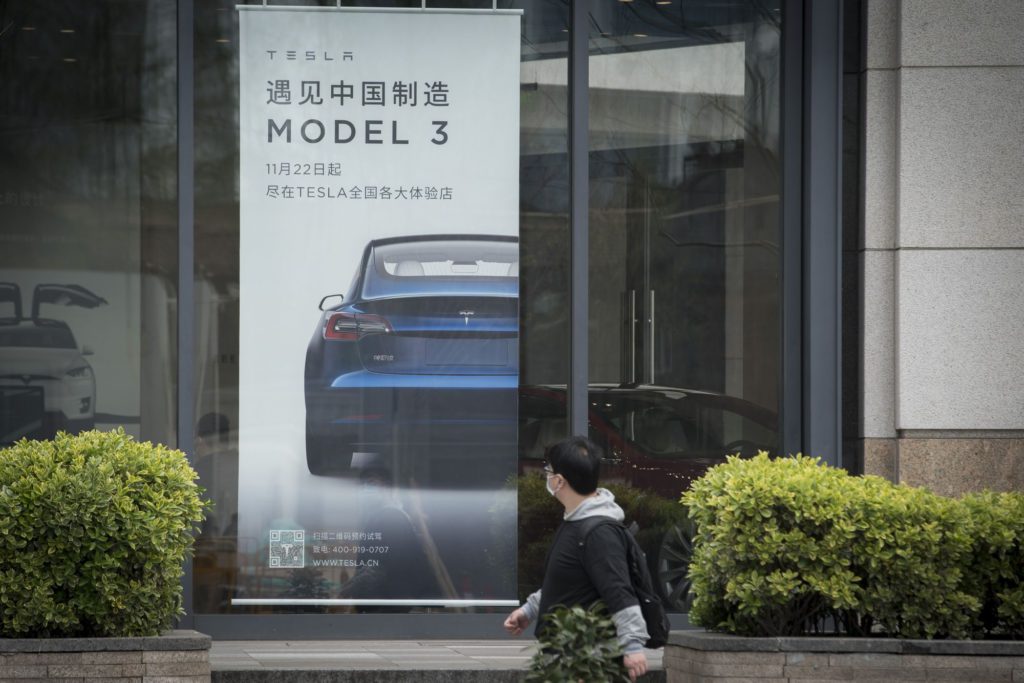
(Bloomberg) — Tesla Inc. will conduct an over-the-air software update on more than 435,000 electric vehicles made at its factory in China due to a rear-lighting defect.

China’s State Administration for Market Regulation said 142,277 Model 3 sedans and 292,855 Model Y sports utility vehicles could be affected by the issue, which in extreme cases raises the risk of crashes. The recall follows a similar move in the US last month, when Tesla had to update software on more than 321,000 EVs because their tail lights might fail to illuminate. 

Tesla rolled out another software fix last week on about 80,000 Model 3, S and X EVs in China, imported and locally-made, due to defects related to battery systems and seat belts. It also asked some customers to return their cars to be fixed. 

Tesla delivered about 320,000 locally-made EVs in China last year and 340,000 in the first 10 months of 2022.

Elon Musk’s company is a major player in China, the world’s biggest EV market. With competition intensifying, Tesla recently revamped its marketing strategy and cut prices to attract customers. A representative for the automaker referred queries on the latest issue to the Chinese regulator’s statement. 

Less than a month ago, video of a fatal crash involving a Tesla Model Y in China was widely circulated on social media along with claims that faulty brakes caused the accident. The company said it would assist a police investigation and suggested it wasn’t due to a malfunction.  

More stories like this are available on bloomberg.com

©2022 Bloomberg L.P.
Crypto Investment-Product Assets Sink to Two-Year Low  Amid FTX Collapse

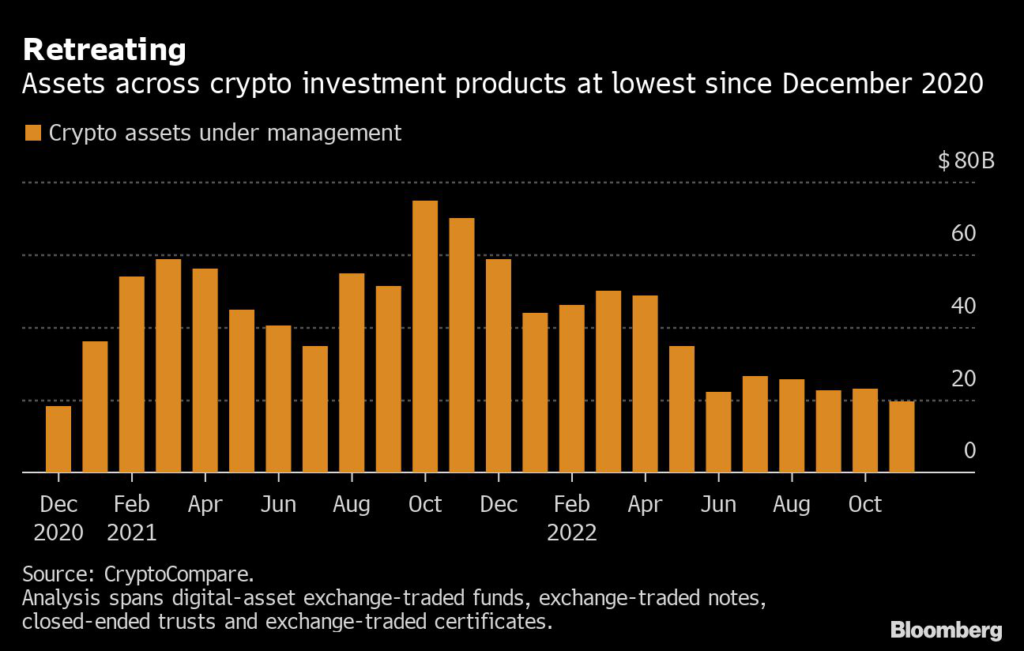
(Bloomberg) — Sliding token prices and a flight from the digital-asset sector amid FTX’s collapse have sent crypto investment-product assets under management to the lowest level since December 2020. The figure dropped almost 15% to $19.6 billion in November from a month earlier, according to data from CryptoCompare. The analysis covers crypto exchange-traded funds, exchange-traded notes, closed-ended trusts and exchange-traded certificates.

More stories like this are available on bloomberg.com

©2022 Bloomberg L.P.

Stocks Extend Rally as China, Powell Fuel Optimism: Markets Wrap

(Bloomberg) — European and US stock futures rose with Asian equities on Thursday after China appeared to soften its Covid stance and Federal Reserve Chair Jerome Powell signaled a slowdown in the pace of interest-rate hikes.

The dollar fell against its Group-of-10 counterparts, with the yen speeding to a three-month high. Treasury yields stabilized after large declines following Powell’s comments.

Euro Stoxx 50 contracts climbed more than 1%, as did benchmark share indexes for Hong Kong and mainland China. A gauge of Asian stocks advanced further after its best month in 24 years. The S&P 500 soared on Wednesday to end the month at the highest level since mid-September, led by a rally led by tech stocks. 

Sentiment in Asia got an extra China’s top official in charge of the fight against the coronavirus. Vice Premier Sun Chunlan said the country’s efforts to combat the virus are entering a new phase with the omicron variant weakening and more Chinese getting vaccinated. Beijing also indicated some Covid patients could isolate at home.

Powell’s remarks affirmed expectations the Federal Reserve will raise interest rates 50 basis points this month in a departure from a run of four 75 basis point hikes. Pricing in the swaps market indicates the Fed funds rate will peak below 5% in May. Prior to Powell’s comments, the market anticipated a peak above that level occurring in June.

“The markets were leaning towards another hawkish Powell speech and that was proven wrong,” said Christy Tan, Asia-Pacific investment strategist for Franklin Templeton Institute, in an interview with Bloomberg Television. The rally, however, may be premature, she added. “The market is second-guessing the Fed while the Fed is looking at data.”

Krishna Guha, head of central bank strategy for Evercore ISI, noted a broadening in Powell’s rhetoric beyond tackling inflation to supporting the economy. “Powell’s remarks embraced the return of some two-sided risk management,” he said. “That is a big deal for equities.”

Others were more skeptical about the driver behind the market moves and pointed to the possibility month-end portfolio positioning had amplified the price action.

Traders also scoured several economic reports, with key gauges of US activity painting a mixed third-quarter picture. Job openings fell in October — a hopeful sign for the Fed as it seeks to curb demand.

The figures precede Friday’s jobs report, which is currently forecast to show employers added 200,000 workers to payrolls in November. Economists are expecting the unemployment rate to hold at 3.7%, and for average hourly earnings to moderate.

Elsewhere in markets, oil fluctuated after three days of gains on China’s Covid developments and data showing a steep drop in US inventories.

Gold advanced in Asia following a 1.1% advance on Wednesday.

Key events this week:

  • S&P Global PMIs, Thursday
  • US construction spending, consumer income, initial jobless claims, ISM Manufacturing, Thursday
  • BOJ’s Haruhiko Kuroda speaks, Thursday
  • US unemployment, nonfarm payrolls, Friday
  • ECB’s Christine Lagarde speaks, Friday

Some of the main moves in markets:

Stocks

  • Futures on the S&P 500 rose 0.2% as of 6:49 a.m. London time. The S&P 500 gained 3.1%
  • Nasdaq 100 futures rose 0.1%. The Nasdaq 100 rose 4.6%
  • Japan’s Topix benchmark rose less than 0.1%
  • The Hang Seng Index rose 1.4%
  • The Shanghai Composite Index rose 0.5%
  • Euro Stoxx 50 futures rose 1.2%

Currencies

  • The Bloomberg Dollar Spot Index fell 0.5%
  • The euro rose 0.5% to $1.0454
  • The Japanese yen rose 1.2% to 136.35 per dollar
  • The offshore yuan fell 0.2% to 7.0589 per dollar
  • The British pound rose 0.4% to $1.2110

Cryptocurrencies

  • Bitcoin rose 0.1% to $17,129.22
  • Ether fell 0.9% to $1,285.18

Bonds

  • The yield on 10-year Treasuries advanced one basis point to 3.61%
  • Japan’s 10-year yield was little changed at 0.25%
  • Australia’s 10-year yield declined five basis points to 3.48%

Commodities

  • West Texas Intermediate crude fell 0.5% to $80.15 a barrel
  • Spot gold rose 0.8% to $1,783.21 an ounce

This story was produced with the assistance of Bloomberg Automation.

–With assistance from Rita Nazareth.

More stories like this are available on bloomberg.com

©2022 Bloomberg L.P.

US Military Chiefs Say Australia Key to Space Rivalry With China

(Bloomberg) — Australia is a critical asset for the US in the growing strategic competition with China over space, with top US military leaders warning Beijing’s technology is advancing “very, very quickly” to close the capability gap.

US Space Force’s Lt. General Nina M. Armagno said Australia’s geographical position and research capabilities represented a “pot of a gold at the end of the rainbow” for the two countries’ strategic interests in space defense.

Armagno, the Director of Staff for US Space Force, said Australia’s location in the southern hemisphere was vital to the US for “space domain awareness,” the ability to track and monitor all objects, satellites and debris in close orbit to the Earth.

“This is prime country for space domain awareness,” she said at an interview in Canberra on Thursday.

Speaking at the Australian Strategic Policy Institute, US Space Command Deputy Commander Lt. General John E. Shaw said the primary difficulty for his command was “understanding what is happening in our domain,” saying it took a “concerted effort” to regularly monitor the space around Earth.

The two generals were in Australia for meetings with their local counterparts and defense officials.

Australia and the US have strengthened their security relationship in recent years amid growing strategic competition with the Chinese government in the Asia Pacific. In September 2021, the US, UK and Australia announced a three-way security partnership which included a plan to work together to build Canberra a fleet of nuclear submarines by 2040.

At the same time, India and Japan have joined Australia and the US to reform the Quad partnership, a group designed to help regional democracies collaborate on China’s rise.

Shaw said while the Chinese government had fielded very few satellites even a few decades ago, Beijing’s space capabilities were rapidly becoming more sophisticated. “They’ve advanced very, very quickly,” he said. In January, China’s moon lander became the first to detect the presence of water on the orbiting body.

The deputy commander said Australia’s advanced research capabilities were particularly important to US space defenses. “Australia is a leader in quantum computing, we’re going to be using those kinds of technologies in the future,” he said.

Armangno said she believed the close alliance between the US and Australia, among other Western powers, was the “secret sauce” which the Chinese government lacked. 

More stories like this are available on bloomberg.com

©2022 Bloomberg L.P.

Xi Urges Calming Ukraine Crisis in Talks With Europe’s Michel

(Bloomberg) — Chinese President Xi Jinping called for efforts to bring calm to the war in Ukraine in talks with European Council President Charles Michel, a sign that Beijing may be trying to address one of its biggest points of friction with Europe.

“Solving the Ukraine crisis through political means is in the best interest of Europe and the common interest of all countries in Eurasia,” Xi said after the meeting on Thursday in Beijing, according to state broadcaster China Central Television. He added that “it is necessary to avoid escalation and expansion of the crisis,” while also promoting peace talks.

Michel told Xi that the EU counted on China “to contribute to ending Russia’s brutal destruction and occupation,” according to a statement from Michel’s spokesman. Both leaders “stressed that nuclear threats are irresponsible and highly dangerous,” it added.

China has refrained from criticizing Russia over the war in Ukraine, blaming the expansion of the North Atlantic Treaty Organization for Moscow’s actions. Still, Russian President Vladimir Putin said after meeting Xi in September that he understood Beijing’s “questions and concerns” about his invasion.

Putin had fueled fears of escalation involving nuclear weapons with warnings that Russia would use all means available to defend the parts of Ukraine it had illegally annexed, though Russian diplomats later clarified their use would only occur if the existence of the country was at stake.  

The encounter between Xi and Michel came as China’s zero-tolerance approach to the coronavirus faces new stress given the costs to the economy and burdens placed on the public. French companies said last week that changes China made to its Covid Zero strategy earlier this month, including pulling back on testing, fell short of expectations. The European nation’s chamber of commerce called on the  government to lift “unnecessary and excessive curbs.”

The statement from Michel’s spokesman said he told Xi about “difficulties faced by EU companies and investors, which have been exacerbated by the pandemic.” The statement didn’t mention protests that broke out recently against the nation’s strict Covid Zero rules.

Europe has been trying to carve out a middle ground on diplomacy with China, with French President Emmanuel Macron calling for engagement with Beijing and resisting efforts to divide the world into competing blocs.

That move pushes back at the US, which is trying to convince chipmakers around the world to curb high-end exports to China, limiting progress the world’s No. 2 economy can make in areas such as artificial intelligence and military applications.

Still, the US and the European Union aim to work together to counter what they call non-market policies, including in China, according to a draft statement before high-level talks due in Washington this month. Macron, on a state visit to the US, meets with President Joe Biden on Thursday. 

Last year, the US and other Western nations placed sanctions on China over allegations of human rights abuses on the Uyghur minority group in Xinjiang, prompting a tit-for-tat from Beijing. European lawmakers then froze a landmark investment deal with China.

The agreement has long faced opposition from China’s critics in the European Parliament, with opponents demanding greater protections against forced labor.

More stories like this are available on bloomberg.com

©2022 Bloomberg L.P.

Ajinomoto Hastens Chipmaking Film Expansion, Mulls Bigger Outlay

(Bloomberg) — Ajinomoto Co. will accelerate production expansion of its signature high-tech chipmaking film and may invest more than the planned 17 billion yen ($122 million) to sate surging demand, Chief Executive Officer Taro Fujie said.

“It’s possible that we add a little more investment,” Fujie said in an interview. “We’ll decide as we watch the market trend.” 

The Tokyo-based company produces Ajinomoto Build-Up Film, commonly known as ABF, which is an essential insulating material used in the fabrication of high-performance semiconductors. ABF has been one of the key chipmaking ingredients that have proven scarce since the start of the pandemic, hampering chipmakers’ ability to fulfill increased orders from automakers, graphics card designers and data center operators.

Ajinomoto, better known for its wide-ranging food business, forecasts ABF shipments will grow 18% every year through March 2026, Fujie said. That growth will remain in double digits through 2030, he added. The global market for ABF will likely grow to $6.5 billion by 2028, according to July estimates by researchers at Absolute Reports.

Read more: Obscure Firm’s 1,219% Rise Shows Profit, Pain of Chip Crunch

Shares of Ajinomoto jumped as much as 3.9% Thursday in their biggest intraday jump in three months and setting a new high.

Roughly 70% of Ajinomoto’s ABF output goes into data center servers, and the expansion in 5G wireless adoption will help further drive demand, Fujie said. Sales in the company’s functional materials unit, which includes ABF, grew 30% to 37.2 billion yen for the six months ended September, Ajinomoto said earlier this month.

The stock has risen more than 20% this year, pushed up by sales from the film business, while the Topix benchmark has been down most of the year. The share price has more than doubled since the start of 2020.

In contrast to the strong sales of electronic materials, Ajinomoto’s frozen food operation, which accounts for about 20% of revenue, reported a loss of 300 million yen for the six months ended September.

Some shareholders have said the company should sell off the frozen food business and concentrate on growth areas like its electronic materials. Ajinomoto has no intention to sell, Fujie said.

Instead, the company plans to shift focus to profitable items such as gyoza and raise prices in North America, he said. Fujie expects overseas gyoza sales to exceed those at home in Japan and sees the product as a near-future growth driver. Ajinomoto bought US frozen food maker Windsor Foods for $800 million in 2014. 

Ajinomoto’s CEO, who took over the role in April, brought in two outsiders to join its top management meetings to help better communicate with stakeholders and investors.

“Society and consumers’ way of thinking evolves,” said Fujie. “The feedback can be tough to accept. But we need to understand each other if we want to do better.”

–With assistance from Nao Sano.

(Updates share price in fifth paragraph)

More stories like this are available on bloomberg.com

©2022 Bloomberg L.P.

TSMC Plans to Make More Advanced Chips in US at Urging of Apple

(Bloomberg) — Taiwan Semiconductor Manufacturing Co. will offer advanced 4-nanometer chips when its new $12 billion plant in Arizona opens in 2024, an upgrade from its previous public statements, after US customers such as Apple Inc. pushed the company to do so, according to people familiar with the matter.

TSMC is expected to announce the new plan when President Joe Biden and Commerce Secretary Gina Raimondo visit Phoenix for a ceremony next Tuesday, said the people, who asked not to be identified because the matter is private.

The TSMC factory had been slated to make 5-nanometer semiconductors, a standard that will be far from the cutting edge by 2024. The Taiwanese company also will commit to adding a second nearby plant, which will make even more advanced, 3-nanometer chips, they said.

TSMC previously said it would make 20,000 wafers per month at the Arizona facility, although production may increase from those original plans, the people said. Apple will use about a third of the output as production gets underway.

Apple and other major tech companies rely on TSMC for their chipmaking needs, and the change means they’ll be able to get more of their processors from the US. Apple Chief Executive Officer Tim Cook has previously told employees that his company plans to source chips from the Arizona plant. He’s scheduled to attend the event next week, the people said.

A representative for TSMC declined to comment. Apple didn’t immediately respond to a request for comment.

Read more: Apple prepares to get made-in-US chips in pivot from Asia

Supply-chain disruptions and trade tensions with China have fueled efforts to bring more manufacturing to the US and Europe. US lawmakers also passed the Chips and Science Act this year, offering $50 billion in incentives for companies looking to create semiconductors in the country. TSMC is likely to receive billions in subsidies. 

The possibility of China taking over Taiwan also has sparked concerns about relying on that region for so much of the semiconductor industry’s current supply. TSMC, headquartered on the island, is the world’s go-to supplier for chips powering everything from smartphones to electric vehicles. Most of its production is still centralized in Taiwan. 

In addition to Apple, TSMC customers like Advanced Micro Devices Inc. and Nvidia Corp. have asked the Taiwanese company to make more sophisticated chips at the Arizona plant, according to people familiar with the discussions. 

AMD CEO Lisa Su and Nvidia head Jensen Huang are expected to attend the event. Representatives for AMD and Nvidia declined to comment.

TSMC’s customers have asked the company to roll out its latest technologies simultaneously in the US and Taiwan, the people said, which would help fulfill a Biden administration goal of having the most cutting-edge chips in the world produced on US soil. But TSMC has not committed to that approach, and Taiwanese and company officials have said that they intend to keep the latest technology at home.

–With assistance from Jenny Leonard.

More stories like this are available on bloomberg.com

©2022 Bloomberg L.P.

Close Bitnami banner
Bitnami