Bloomberg

Panama President Will Refuse to Sign Crypto Law in Current Form

(Bloomberg) — Panama’s President Laurentino Cortizo said he’ll refuse to sign a law regulating the use of cryptocurrency until it contains tougher anti-money laundering controls. 

The nation’s legislative assembly passed the bill last month, which would make it easier for cryptocurrency exchanges to obtain licenses to operate in the country, and regulates transactions in digital currencies. 

But the bill requires the president’s signature to become law, and Cortizo said he needs guarantees that it complies with global anti-money laundering standards.


Read more: Panama Plans Talks With China for Trade Deal: New Economy Update

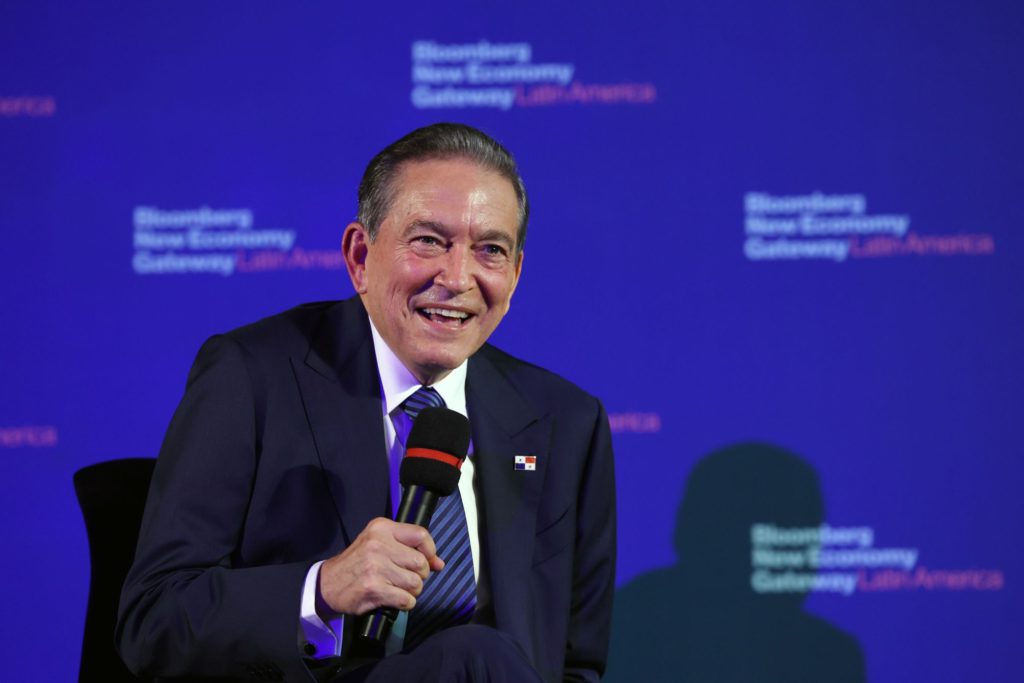
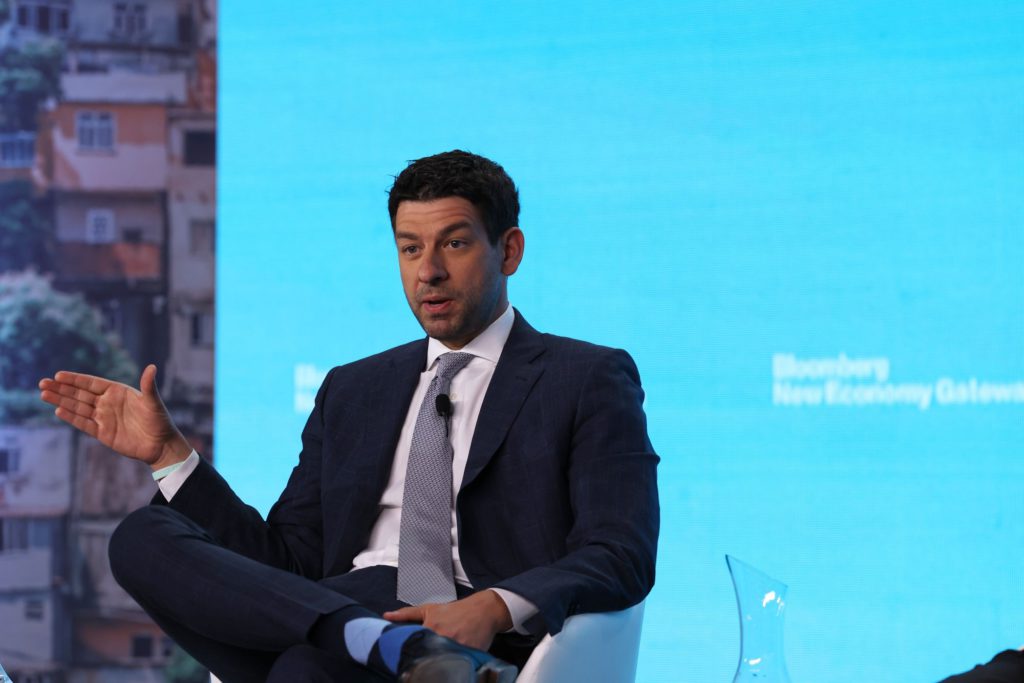
“If I’m going to answer you right now with the information that I have, which is not enough, I will not sign that law,” Cortizo said, speaking at the Bloomberg New Economy Gateway Latin America conference in Panama City. “I have to be very careful if the law has clauses related to money laundering activities. Anti-money laundering activities are very important to us.” 

The global money laundering and terrorist financing watchdog called the Financial Action Task Force has Panama on its list of “jurisdictions with strategic deficiencies” in combating money laundering. Cortizo’s administration has pledged to implement the task force’s recommendations and toughen controls on dirty money. 

The nation’s dollarized economy and well-developed financial services sector makes it a tempting target for drug trafficking organizations in neighboring countries such as Colombia and Mexico seeking to launder their profits. 

Blockchain Technology

The bill would also allow the government to migrate public records to blockchain technology. Proponents have said the bill will help turn Panama into a digital hub in Latin America and attract investments from financial technology companies. 

The bill has been sent to the executive branch and Cortizo must decide whether to sign it or veto it partially or entirely. 

Cortizo said he could sanction some parts of the law while vetoing others. His lawyers are reviewing the bill and will make a recommendation to him on what to do. 

“It is an innovative law from what I have heard, it’s a good law,” he said. “However, we do have a solid financial system here in Panama and one of the things I’m waiting on is when you have a global regulation of crypto-assets.” 

More stories like this are available on bloomberg.com

©2022 Bloomberg L.P.

Tencent Plunges After Warning Tech Crackdown Won’t End Quickly

(Bloomberg) — Tencent Holdings Ltd. slid more than 8% after top executives warned it will take time for Beijing to act on promises to prop up the Chinese tech sector, suggesting the embattled industry may struggle to grow in the short term.

The comments from executives came after Tencent reported revenue growth all but evaporated in the first quarter, walloped by sweeping government restrictions as well as lockdowns across the country. The quarantining of much of Shanghai — the nation’s finance and media hub — obliterated commercial payments and may undercut advertising spending in the current quarter, they said, depressing big drivers of the social media giant’s business.

The disappointing numbers and downbeat assessment bode ill for an industry already struggling to come to grips with a new era of cautious expansion, after Beijing’s year-long clampdown campaign chilled every internet sphere from e-commerce to gaming and fintech. Tencent slid as much as 8.4% in early Hong Kong trading, while Baidu Inc. dropped 4% and Alibaba Group Holding Ltd. lost 6%.

“We can clearly see that from the most senior level, there’s a pretty clear signal of support released. But for this to translate into real impact on our business, there is going to be a time lag,” Tencent President Martin Lau told analysts on a conference call. “It would take the specific regulators and ministries to translate this direction into real action.”

Sentiment toward China’s internet industry has swung wildly in recent weeks. This week, investors initially seized on a pledge from economic czar Liu He to support the digital economy as a signal the crackdown is easing, or perhaps even coming to a conclusion. But Lau said it will take time for various regulators to formulate and enact policies in response to that sweeping endorsement. Shares in Prosus NV, Tencent’s largest shareholder, slid more than 4% in Europe.

Bernstein analyst Robin Zhu called Tencent’s results “The one where almost nothing went right” in a post-earnings report. “Given the lack of new game launches and headwinds in advertising, and the impacts of various regulatory changes over the past year, Tencent’s Q1 earnings were widely expected to look weak,” he noted. “That said, a quarter where almost every line fell below consensus and our estimates still felt like a kick in the shins.”

Meanwhile, Tencent and its peers must continue to grapple with a range of headwinds that’s pushing growth to historic lows.

Tencent on Wednesday posted its slowest revenue gain since going public in 2004. Sales rose 0.1% to 135.5 billion yuan ($20.1 billion) for the three months ended March, missing the average forecast. Net income slid 51% to 23.4 billion yuan, lagging estimates despite a big gain from the sale of stock in Singapore’s Sea Ltd. 

Tencent has so far largely escaped direct scrutiny from Beijing, but not fallout from the broader clampdown and economic malaise. It’s shed roughly $500 billion of market value since its 2021 peak, even as the company studiously endorses Beijing’s efforts to curb excesses in its once free-wheeling internet sector.

Click here for a liveblog on the earnings.

Online advertising sales slid a worse-than-expected 18% after contracting for the first time in the December quarter. The business has been battered by China’s weakening economy and competition against TikTok-owner ByteDance Ltd., while big marketers of past years including online tutors and insurers tightened budgets after falling victim to separate regulatory crackdowns.

Tencent’s bread-and-butter gaming division — the world’s largest — also barely expanded revenue. It’s still on the waitlist for new monetization licenses, after regulators last month approved the first batch of domestic releases since July. The company, expecting fewer gaming approvals in coming years, has already re-calibrated its pipeline to focus on quality over quantity, strategy chief James Mitchell said.

Given the new realities, executives said in March that international games, cloud software, and WeChat’s video accounts will be their major strategic foci. But overseas gaming sales expanded just 8% in constant currency terms, trailing the double-digit growth of previous periods, in part because of a tough comparison from a year earlier when the world was largely locked down.

“Like other companies operating outside of China, the post-Covid reopening dampener on games is real,” said Vey-Sern Ling, a senior analyst with Union Bancaire Privée. “Main takeaway is growth may be weaker for longer, at least until 2Q22, and then in the second half there is a chance for yoy comps to start looking better.”

Tencent’s fintech and cloud division has become its No. 1 revenue driver. But its 10% growth was also worse than expected after Covid lockdowns in cities like Shanghai and Shenzhen. Cloud revenue suffered a mild decline after the company cut loss-making contracts and ventured into services beyond infrastructure.

For now, the WeChat messaging app is still the payment and smartphone backbone of Tencent’s sprawling online empire, and it’s only going to shoulder a bigger role for money-making to try and offset struggling businesses like streaming and domestic games. In April, Tencent shut its game streaming platform and hiked fees for its Netflix-style service for the second time in about a year, as short-video rivals keep luring away users and marketers.

Just like Mark Zuckerberg’s Meta Platforms Inc., Tencent is taking a leap into the virtual realm of the metaverse in the longer term. The Chinese company has revamped its aging social app QQ with customizable 3D avatars and Unreal Engine graphics, and is hiring developers to make open-world titles. But such endeavors, along with a steady pace of investment in overseas game studios, could pressure margins before they come to fruition.

More stories like this are available on bloomberg.com

©2022 Bloomberg L.P.

China’s Premier Li Urges ‘Decisive’ Action on Growth Policies

(Bloomberg) — Chinese Premier Li Keqiang told local governments to “act decisively” on measures to support growth in the coming weeks in an effort to bring the economy back on track as soon as possible. 

Everyone should “add a sense of urgency” to their actions to counter “further intensified new downward pressure” on the economy, Li said Wednesday during a trip to Yunnan province in southwestern China, according to a report in the official Xinhua News Agency. 

He encouraged local authorities to roll out new measures this month if possible, adding that policies outlined in this year’s government work report or in prior economic meetings should be enacted by the end of June. 

Li’s focus on moving quickly in the next couple of months implies that policy makers “might want to leave room for additional fiscal policy support in the second half of the year,” according to Goldman Sachs Group Inc. economists including Maggie Wei. They wrote in a report that the government could consider the issuance of central government special bonds, a form of extra stimulus that Beijing has rarely resorted to unless for specific purposes, such as the fight against the pandemic in 2020.

The Chinese premier also reiterated support for digital platform companies and their public listings, echoing comments made by Vice Premier Liu He earlier this week that provided another sign Beijing may be ready to let up on a yearlong clampdown on technology firms.

Li’s comments are the latest from senior government officials urging more action to shore up economic growth this year after Covid outbreaks and lockdowns walloped economic activity in March and April. Data this week showed China’s industrial output and consumer spending last month slid to the worst levels since the pandemic began, while the jobless rate climbed to 6.1%. Youth unemployment hit a record. 

Read More: China’s Economic Activity Collapses Under Xi’s Covid Zero Policy

Those challenges are making Beijing’s full-year economic growth target of about 5.5% seem further out of reach, and analysts have been skeptical that the government can achieve that goal while also sticking to Covid Zero. Goldman economists just cut their growth forecast for the year to 4% from 4.5%, citing the zero-tolerance policy. 

Achieving growth and stabilizing employment might still be challenging to policy makers in the third quarter, especially ahead of the 20th Party Congress later this year, the Goldman economists wrote late Wednesday. That’s when President Xi Jinping is widely expected to seek a historic third term in office. 

Even so, Li said China still has enough policy room to deal with the growing headwinds facing the economy, citing stable consumer prices and a measured approach from China toward easing. The People’s Bank of China hasn’t been aggressive with its approach to monetary policy this year, having only cut its policy interest rates once in January and reducing the reserve requirement ratio, the amount of money banks have to hold in reserve, a single time. 

Li also said at the Yunnan meeting that steps would be taken to stabilize land and property prices to ensure the healthy development of the property market. Reasonable housing demand would be supported, he said, according to Xinhua. The central bank cut mortgage rates for first-time homebuyers on Sunday. 

(Updates throughout with additional details and comments from Goldman Sachs economists.)

More stories like this are available on bloomberg.com

©2022 Bloomberg L.P.

Panama Plans Talks With China for Trade Deal: New Economy Update

(Bloomberg) — After being battered by the pandemic like few regions in the world, Latin America finally has some tailwinds at its back.

Soaring commodity prices are bolstering exports for many countries while the push by multinationals to shorten and fortify their supply chains is prompting many of them to consider building new factories in the region. There are plenty of risks still: unemployment remains high, poverty has surged, populations are demanding political change across the region and the Federal Reserve is draining cash from the global economy.

At Bloomberg’s inaugural New Economy Gateway Latin America event in Panama City, just a short ride from the century-old canal that transformed global trade, speakers are debating the post-pandemic growth outlook as well as the preparation work needed to confront the next public health crisis, the transition to green energy and the case for cryptocurrencies in the region, among other topics.

You can follow the agenda here and the event will be streamed on the terminal at LIVE GO and on the web.

Panama Eyes China Trade Deal (8:07 p.m.)

Panama is planning to restart negotiations with China to reach a trade agreement, President Laurentino Cortizo said. The government’s main focus has been on the pandemic and economic recovery, but Cortizo said his administration is seeking a deal for Panama’s agricultural products to gain more access to China’s market.

“That’s one matter in which we are pushing very hard in the negotiation,” Cortizo said.

Panama has important relationships with both the US and China, with the US being the main user of the Panama Canal and China taking the number two spot, Cortizo said. Those relationships stretch beyond just the countries involved as they have a global impact.

Cortizo said that he wouldn’t sign into law a bill to regulate the use of cryptocurrencies, which was passed by the general assembly. He would want modifications to the bill to prevent money laundering, he said.

Covid and populism (5:20 p.m.) 

The economic fallout prompted by Covid-19 has exacerbated a populism trend in Latin America that has recently driven leftist leaders to power in both Peru and Chile, according to Mexico’s former Deputy Finance Minister, Vanessa Rubio Marquez.

Panama’s Commerce and Industry Minister, Ramon Martínez de la Guardia, also sees coronavirus-related hardships fueling populist views in the region and highlights the importance of engaging citizens and the private sector in decision-making processes. 

Read More: All Roads Lead to Recession for Biggest Latin American Economies

“Governments come and go but if you keep private sectors and citizens involved you have less risk of falling into traps,” he said. 

For Jorge Guajardo, a former Mexican ambassador to China, the only way to address populism is through social media regulation. 

“Everybody who studies populism says we have to address social media and by social media I mean algorithms,” he said. “We’re doomed to a populist future unless we address social media.”  

Supply chain, carbon neutral (4:45 p.m.)

The supply chain remains at the top of the conversation, though it’s gotten better in some ways because it’s no longer a shock, said Sandra Campos, Shoulder Up Technology Acquisition Corp. CEO

The Panama Canal is moving to be carbon neutral by end of decade, creating the opportunity to price services based on carbon emissions, which hasn’t happened in the past, said Ricaurte Vasquez Morales, Panama Canal Authority Administrator.

CBDCs shield nations from $2 trillion crypto meltdown (4 p.m.) 

Crypto’s plunge over the last few months has eroded about $2 trillion in value from markets, according to Alexandre Tombini, Chief Representative of the BIS Office for the Americas and former Brazil central bank chief. 

Read More: Let’s Talk About the Luna Losers in Terra’s Implosion

At the same time, central bank digital currencies, known as CBDCs, are having a moment – part of the appeal being how different they are from crypto currencies. While people interested in crypto are cross border traders, CBDCs are kept within their own borders. So while they bring much of the benefits of crypto, helping digitize the economy, they also keep nations shielded from volatility. 

“We stay far away from crypto currencies,” Jamaica central bank governor Richard Byles said. “I’m not a fan, neither personally nor as a central banker.”

Panama canal traffic jam to last (3:30 p.m.)

The Panama canal’s current conditions are likely to remain the same for the next half year, Ricaurte Vásquez Morales, the Panama Canal Authority Administrator, said in an interview.

The canal is seeing delayed impacts from China’s Covid-19 lockdowns, according to Vásquez Morales. There was a 18% vessel increase in April versus last year, though numbers are down in May from 2021, he said.

Panama expects to grow 8% in 2022, fastest in the region (1:40 p.m.)

Panama is forecasting it will continue posting the fastest growth in the region, with 8% expected for 2022 after 15% growth in 2021, said Foreign Affairs Minister Erika Mouynes in an interview with Bloomberg TV’s Caroline Hyde. That’s even as the war in Ukraine leads to higher food and fertilizer prices, two key issues for countries in Central America, which are net importers of both of these.

“We need to talk more about the local consequences about what’s happening in the conflict,” said Mouynes. Panama recently convened a regional summit to discuss the issue. “We’re concerned about how we deal with this on a regional basis.”

Read More: Migration Through Panama Plunges 94% From Peak, Minister Says

Mouynes also noted that while Panama continues to be singled out as a tax haven, that’s a “misplaced” view given that a recent report had several G-7 countries at the top of a ranking, with Panama falling below the top 15 globally.  

Marriott bullish on LatAm travel, plans for more hotels (12:10 p.m.)

The president for Marriott International, Craig Smith, said the company aims to double the number of its hotels in Latin America within three to four years. With 300 hotels already in the region, Smith said plans are underway for at least another 100.

“We’re really bullish on the region,” Smith said.

He added that demand for travel in Latin America hasn’t been impacted by the surge in inflation rocking the global economy.

It’s “affecting us more on building costs,” Smith said. “It hasn’t affected people traveling.”

Marcelo Claure on opportunities in Latin America (11:50 a.m.)

Marcelo Claure, the influential venture capital investor best known for turning around Sprint and preparing WeWork for its public listing during his time as chief operating officer for SoftBank International Corp, said he’s a “huge believer” in Latin America.

Claure said he looks beyond “temporary” company valuations as the current risk environment leads to a tighter funding environment for startups, and that startups will have to focus on faster, more profitable growth. He expects investor attention to remain in the region, even as funding slows in the next two years.

“The next 5 to 10 years will be some of the most exciting,” he said in an interview. “We won’t go back to the “dark ages” before 2018 where investment in LatAm was $1 billion, compared to $10 billion for India. We’ll be at least the same as India or as Southeast Asia.”

Claure, who took the helm at his family office Grupo Claure since leaving SoftBank in late January, said he’s closely following companies involved in the “three revolutions” of our time: artificial intelligence, electric vehicles and blockchain.

Panama canal traffic, new container port (11:30 a.m.)

The global shipping bottlenecks rattling industries and consumers in the pandemic era were plain to see for the politicians, economists and investors gathering for the event in Panama.

Separately, Notarc Management Group, a Latin America-focused investment firm, announced on the sidelines of the event that it’s partnering with a unit of Mediterranean Shipping Company to take over construction of the $1.4 billion Panama Canal Container Port.

Opportunities still abound in technology (11:25 a.m.)

Current down cycle and tighter liquidity in startup space in Latin America is temporary, Sumita Pandit, chief operating officer of dLocal said. 

“Cycles are good, it helps you go through these ups and downs to actually strengthen your business model,” Pandit said. “There will be some companies that will not survive the capital constraint that will probably come in the next few quarters but I’m absolutely certain that the cycle will turn and we will again see the abundant availability of capital.”

Latin America technology industry is still missing more female-led companies and founders, according to Mate Pencz, founder and co-CEO of Loft. 

Bachelet discusses Chile, human rights (10:50 a.m.)

UN High Commissioner for Human Rights Michelle Bachelet, speaking in an interview with Bloomberg’s Stephanie Flanders, threw her support behind Chile’s draft constitution, saying she would like to see it approved in September’s national referendum even as polls show growing rejection of the document among her fellow nationals.

“It’s offering a new social contract,” the former Chilean president said.

More broadly, she voiced concern about the short-term outlook for Latin America as policymakers battle the global wave of inflation sparked by the post-pandemic recovery and Russia’s invasion of Ukraine.

On defining Latin America’s alliances (10:25 a.m.)

A panel discussed where Latin America’s geopolitical allegiances should lie and whether nearshoring is really happening amid supply chain disruptions.

“Latin America should be as promiscuous as it can be to play every side for whatever it can,” Marko Papic, partner at Clocktower Group said. “Multipolarity is a great opportunity.”

Inter-American Development Bank head Mauricio Claver-Carone said the US remains the most reliable partner as the biggest foreign direct investor and the realignment of supply chains at the moment represents the biggest opportunity of a lifetime.

“The US has very few free trade agreements but the ones we have are in Latin America,” Shannon O’Neil, Vice President of the Council on Foreign Relations, said. “So companies here have preferred access to the largest economy in the world.”

Michael Bloomberg on role Latin America plays (9:38 a.m.)

Michael Bloomberg, founder of Bloomberg LP, said in a video message to kick off the event that Latin America has a “critical role” in helping confront some of the world’s biggest problems.

Latin America is an economic engine, fertile ground for entrepreneurship, is a global tradeway and is a critical part of our natural defense against climate change given its biodiversity.

More stories like this are available on bloomberg.com

©2022 Bloomberg L.P.

Carousell, L Catterton SPAC Merger Talks End Amid Rout

(Bloomberg) — Carousell Pte, a Singapore-based online classifieds marketplace operator, has recently ended talks to go public through a merger with blank-check company L Catterton Asia Acquisition Corp. amid market volatility, according to people familiar with the matter.

The special purpose acquisition company, which has been conducting due diligence on Carousell over the past few months, has not been able to reach a merger agreement with the Southeast Asian business, the people said, asking not to be identified because the matter is private.

The stock market rout has made it difficult to arrange a private investment in public equity, or PIPE, the people said, where typically other investors chip in funds alongside those contributed by the SPAC itself to the merged entity. Macroeconomic uncertainty and valuation concerns are also among the factors weighing on a potential deal, they added.

A representative for Carousell declined to comment, while a representative for L Catterton Asia Acquisition didn’t immediately respond to requests for comment.

Shares of L Catterton Asia Acquisition touched their lowest level in more than five weeks in New York after the Bloomberg News report. The stock was down 0.2% at Wednesday close.

The companies were in exclusive talks to merge in a transaction that could have valued the combined entity at as much as $1.5 billion, Bloomberg News reported in January. The deal was meant to include a PIPE worth a few hundred million dollars, people familiar with the matter said at the time.

Enthusiasm for SPACs has waned amid heightened market volatility with a growing number of prominent deals fizzling out. The changing regulations from the U.S. Securities and Exchange Commission have also hurt the sentiment in the once-heated sector.

Asia’s SPAC Promise Hits a Roadblock as Market Shuts: ECM Watch

The US-listed SPAC is backed by L Catterton, the $30 billion buyout firm minority-owned by Paris-based luxury goods company LVMH and billionaire Bernard Arnault’s investment firm. Led by managing partners Chinta Bhagat and Scott Chen, the SPAC raised $250 million last year to target a combination with companies in the high-growth, consumer technology sectors across Asia. It is sponsored by L Catterton Asia’s $1.45 billion third fund.

The platform Carousell was founded in 2012 and counts Telenor Group, Rakuten Ventures, Naver, and Sequoia Capital India among its backers. The firm has since expanded to eight markets across Southeast Asia, Taiwan and Hong Kong, allowing users to buy and sell a diverse range of products from cars to gadgets and fashion accessories. It runs several online marketplaces including Carousell, Chotot.com in Vietnam, Mudah in Malaysia and OneKyat in Myanmar, according to its website. 

(Adds share price in fifth paragraph.)

More stories like this are available on bloomberg.com

©2022 Bloomberg L.P.
Untitled Basquiat Painting Sells for $85 Million at Auction

(Bloomberg) — A 16 foot-wide, 1982 painting by Jean-Michel Basquiat sold for $85 million on Wednesday night at Phillips in New York, yielding a 48% return for its seller, the Japanese e-commerce billionaire Yusaku Maezawa​.

Maezawa had purchased Untitled at Christie’s New York in 2016 for $57.3 million, making it, at the time, the most expensive work by Basquiat to ever sell at auction. A year later Maezawa broke his own record, purchasing a black skull by Basquiat for $110.5 million at Sotheby’s New York in 2017.

A subsequent sale, this time of a 1983 painting of a red skull titled In This Case for $93.1 million in May, 2021, pushed Untitled to third place.

With Wednesday night’s sale at Phillips, Untitled, which carried an unofficial $70 million estimate, is still third in the pantheon of Basquiat records at auction, just at a much higher number than before. Additionally, works by Basquiat are known to have sold privately for even larger sums. In 2020, for instance, Citadel founder Ken Griffin reportedly paid more than $100 million for Basquiat’s 1982 painting Boy and Dog in a Johnnypump.

The work, which Phillips said was purchased by an Asian client, was part of the auction house’s 20th Century & Contemporary Art Evening sale, which was expected to yield as much as $210 million.

More stories like this are available on bloomberg.com

©2022 Bloomberg L.P.
Cerebral Directors Vote to Oust CEO as US Probes Prescription Practices

(Bloomberg) — Cerebral Inc. directors voted to oust the mental telehealth giant’s founder and chief executive officer, Kyle Robertson, on Wednesday, as the booming industry draws scrutiny from federal law enforcement and patient advocates.

Robertson had built Cerebral into a $4.8 billion behemoth in online mental health, but alarmed his own clinicians with what they described as an emphasis on attracting customers that medical experts said threatened patient safety. The board appointed David Mou, Cerebral’s president and chief medical officer, as the new CEO.

The company announced Robertson’s departure in a politely worded news release — but a statement that Robertson read during Wednesday’s board meeting, a transcript of which was reviewed by Bloomberg News, made clear that he doesn’t plan to go quietly.

Robertson had informed Cerebral employees on Monday that the firm would stop writing prescriptions for controlled substances, which are regulated by the government due to their potential for abuse and addiction. He said in his statement that he had been required to get the board’s approval before announcing that change publicly.  “It seems the board must be dead set on ensuring that we continue to prescribe controlled medications,” the statement said.

Cerebral is facing a federal investigation into its prescribing practices — yet Robertson’s statement suggested that board members want to continue dealing with controlled substances for business reasons. “This would make sense given that the Board has repeatedly stated to me that we are underperforming our business goals and pressured me to find ways to increase revenues,” he said in the statement.

In response, a Cerebral spokesman pointed to an internal memo that Mou sent on Tuesday, which laid out the company’s plan to end almost all prescriptions for controlled substances. “The board of directors is focused on ensuring exceptional clinical outcomes for our patients and ensuring services are delivered in a safe and effective way that’s in line with the established clinical guidelines for care,” the company said an emailed statement.

In his statement, Robertson also questioned the validity of the board’s efforts to remove him. “If you do push me out, illegally, I plan to pursue all avenues, legal and otherwise, to defend myself and highlight the nefarious actions that the Board of Directors will take today and I expect will take in the future.”

In a news release, Mou thanked Robertson for his service, saying “his vision resulted in what Cerebral is today: a leading provider of urgently needed mental health services to people who were unable or unlikely to obtain treatment,” Mou said.

Major investors with board seats led the effort to replace Robertson with Mou, who attended Harvard business school and medical school. He co-founded Valera Health, another mental health-focused digital startup in 2015, according to his LinkedIn profile. The company also announced that Jessica Muse, Cerebral’s chief operating officer, would also take on the role of company president.

Mou has previously set aggressive targets for Cerebral clinicians to write prescriptions, according to two people familiar with his remarks and a lawsuit filed against the company.

Speaking with managers, Mou had said 95% of people who see a Cerebral nurse should receive a prescription, according to two people familiar with his remarks. (A spokesman for the company said previously that the 95% prescribing rate “refers only to the subset of patients who have received a clinical mental health diagnosis that warrants a prescription as first line treatment.”)

In an April lawsuit, former Cerebral vice president Matthew Truebe said Mou told employees that he aimed to prescribe stimulants to all of Cerebral’s patients seeking treatment for hyper activity/attention deficit disorder. ““We plan to vigorously defend ourselves against these false and unfounded allegations,” a spokesperson for the company said in response to Truebe’s allegations.

In his statement to the board, Robertson said Wednesday that he had messages from Mou “discussing how we need to prescribe more and what we need to do vis-a-vis underprescribers.”

Robertson cofounded Cerebral in 2019 and transformed it into one of the world’s fastest growing startups. One early TV ad featured Robertson, who has no formal medical training, sitting on a couch with his psychiatrist father and psychotherapist mother. When the company launched a partnership with Olympic gymnast Simone Biles, Robertson appeared alongside her on NBC’s Today Show, and in photos posted to Twitter and LinkedIn. A representative for Biles didn’t reply to a request for comment.

Under Robertson’s leadership, Cerebral drew key investments, including from SoftBank Vision Fund 2, Len Blavatnik’s Access Industries and WestCap Group. All three investors have seats on Cerebral’s board; their representatives didn’t respond to requests for comment.

SoftBank has a track record of pushing out founders, including WeWork’s Adam Neumann and Brandless’s Tina Sharkey. 

In the case of Robertson, his style also alienated some employees, who said the startup’s drive for growth had imperiled patient care.

Read more: ADHD Drugs Are Convenient To Get Online. Maybe Too Convenient 

Cerebral came in for heightened scrutiny after Bloomberg Businessweek reported in March that many of the nurse practitioners it employed said they feared the company was over-prescribing the addictive amphetamines used to treat attention deficit/hyperactivity disorder. Others raised concerns about the company’s aggressive advertising on social-media platforms, including TikTok. After that report appeared, the federal Drug Enforcement Administration interviewed at least two employees, according to people familiar with the conversations.

Earlier this month, Cerebral received a grand jury subpoena from the US Attorney’s office for the Eastern District of New York. A company spokeswoman said at the time that a federal investigation was focused on possible violations of the Controlled Substances Act and that the company intended to cooperate fully with the probe. “To be clear, at this time, no regulatory or law enforcement authority has accused Cerebral of violating any law,” the spokeswoman said. 

Cerebral and Robertson, who launched a publication focusing on startups while attending the University of Pennsylvania’s Wharton School of business, got into the business of prescribing controlled medications after federal officials relaxed previous rules requiring in-person examinations for such prescriptions.

That change, which came at the beginning of the Covid-19 pandemic, was designed to make it easier for people to access mental health care. And some Cerebral patients have said the company’s approach – using coordinators to handle patients’ incoming calls, allowing nurse practitioners to often prescribe drugs after just one 30-minute evaluation and distributing medications by mail – improved their lives greatly.

At the same time, some of Cerebral’s own nurses questioned whether the company was making ADHD medicines, such as Adderall, too easy to obtain. Experts say such medication can be subject to abuse by those who don’t have the disorder.

After criticism surfaced in Businessweek and other media outlets, Truepill, an online pharmacy favored by Cerebral, stopped filling prescriptions for Adderall and other controlled substances. 

Earlier this month, Cerebral said it would stop writing new prescriptions for Adderall and other ADHD drugs. Days later, the company said it had received the grand jury subpoena. US Attorney Breon Peace’s office has declined to comment.

Then, on Monday, Robertson announced to Cerebral employees that it would stop writing prescriptions for most controlled substances. He wrote in an email that they’ll be discontinued for new patients beginning on May 20 and for existing patients on Oct. 15. He said Cerebral will continue, when appropriate, to prescribe Suboxone and Narcan, which treat opioid addiction and overdoses.

In his own memo to clinicians, Mou wrote that the company was making the change to prepare for the prospect that federal policymakers may end the pandemic-inspired waiver that allows for prescribing controlled substances online.

Robertson has said Cerebral’s launch was rooted in his own struggle with anxiety and depression as a gay man. “Finding the right care was nearly impossible,” he said in the commercial he appeared in. As CEO, he has displayed a leadership style that employees described as abrasive.

Medical staff said they felt Robertson ignored their expertise and recruiters said he micromanaged them as they attempted to staff the company. Robertson told Businessweek in March that he’d begun working with an executive coach to resolve issues.

In an email sent to employees on Monday afternoon, Robertson said the company’s decision to stop prescribing most controlled substances was the result of “the evolving landscape around the accessibility of mental health care, and the ability for patients to return to an in-person or hybrid care model.”

Telehealth Tips

Bloomberg News is examining the costs and benefits of an evolving field. Share your story at telehealth@bloomberg.net

(Updates with additional details beginning in fourth paragraph)

More stories like this are available on bloomberg.com

©2022 Bloomberg L.P.
Apple Is Union-Busting In NYC, Labor Group Alleges

(Bloomberg) — Apple Inc. violated federal labor law by interrogating staff, restricting the posting of union fliers and requiring employees to attend mandatory anti-union speeches, the Communications Workers of America alleged in a Wednesday filing with the National Labor Relations Board.

The alleged conduct took place at Apple’s World Trade Center store in New York City, a CWA representative said.

Asked about the filing, an Apple spokesperson reiterated a previous comment saying the company deeply values the contributions of its retail employees. “We are pleased to offer very strong compensation and benefits for full time and part time employees, including health care, tuition reimbursement, new parental leave, paid family leave, annual stock grants and many other benefits,” Apple said in the statement.

Apple Store employees working with several different national unions have recently announced unionization efforts, extending a wave of retail and tech organizing that has included surprising victories at a Staten Island Amazon.com Inc. warehouse and dozens of Starbucks Corp. cafes. Apple staff in Atlanta are slated to vote June 2 on joining the CWA. Employees in Maryland have petitioned for a vote to be represented by the International Association of Machinists, while employees at New York City’s Grand Central station have been working with the Service Employees International Union, according to their campaign website.

CWA’s deputy organizing director, Tim Dubnau, declined to say whether the union is seeking to represent the workers at Apple’s World Trade Center store, but said they are among many who have recently contacted the group. “When we learn about Apple violating the law, we try our best to defend workers’ rights,” he said. “It’s time for them to just back off and allow workers to choose for themselves whether or not they want a union.”

While the NLRB has previously held that companies can require employees to attend anti-union meetings, the agency’s current general counsel Jennifer Abruzzo views such “captive audience” sessions as inherently coercive and illegal, and her office is pursuing cases that could change that precedent. “I understand that the argument is that, ‘We’ve been doing this for a long time,’” Abruzzo, appointed by President Joe Biden, said in an interview last week. “But that doesn’t mean it’s right. It doesn’t mean it’s lawful.”

(Updates with Apple comment in third paragraph)

More stories like this are available on bloomberg.com

©2022 Bloomberg L.P.
Grubhub Customers Learn There’s No Such Thing as a Free Lunch After All

(Bloomberg) — Grubhub’s attempts to drum up buzz for its food-delivery service by offering “free” lunch in New York didn’t exactly generate the kind of publicity the company was hoping for.  

On Tuesday, the company offered New Yorkers a “free” lunch, excluding tips and fees, up to the value of $15 between 11 a.m. and 2 p.m. The promotion was shared on social media platforms like Instagram and TikTok and should have been a boon for the city’s restaurants, customers, and couriers. 

Instead, a surge in orders resulted in delayed — or absent — deliveries as the rapid swell in demand left eateries overwhelmed and delivery workers in short supply. At the lunchtime peak, Grubhub was averaging 6,000 orders a minute, spokesman David Tovar said. By 11:25 a.m. there were more than 1,000 reports of issues with its app, according to Downdetector. 


“Hangry” customers took to Twitter to complain of orders that arrived late or not at all. 

Grubhub, however, called the event “a resounding success.” Tovar said restaurants were given advanced notice of the expected increase in order volume but acknowledged that Grubhub’s projections were still far lower than anticipated. “It wasn’t without its challenges,” he said, adding that more orders were placed on Grubhub’s platform in New York City on Tuesday than at any other time in its history. 

The company said fewer than 10% of orders during the promotion’s order window were canceled and that most orders that were actually delivered made it to customers’ doorsteps in about an hour.

The free lunch snafu in one of Grubhub’s largest markets is the latest setback for the company, which has ramped up efforts to fend of competition from food-delivery rivals DoorDash Inc. and Uber Technologies Inc. In March, a partnership with the now-defunct rapid delivery startup Buyk fell through due to Buyk’s inability to secure funding. The deal would have given Grubhub a stake in the competitive quick commerce space and more access to the grocery category. 

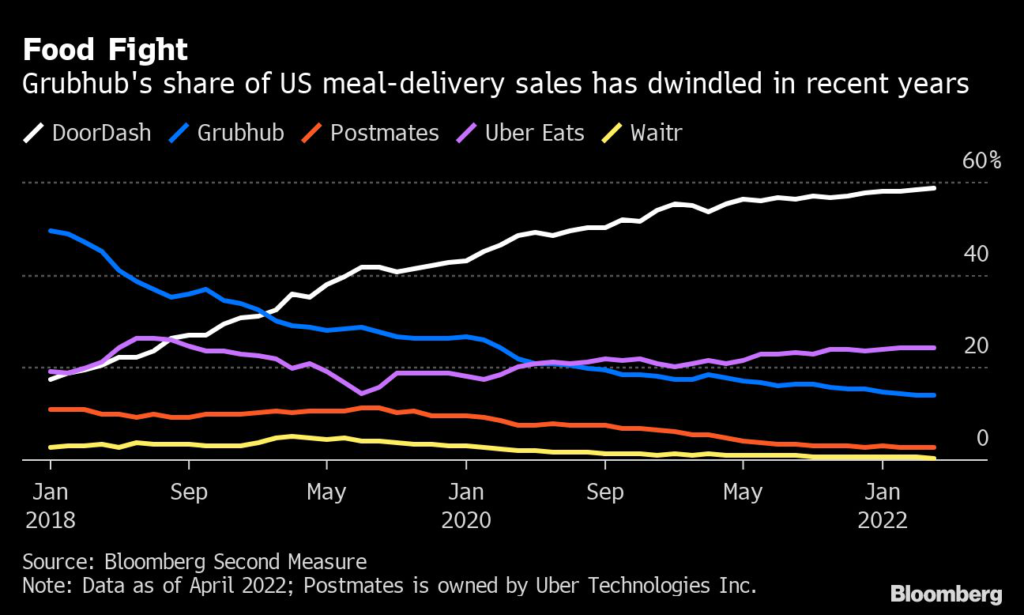
Grubhub, which is owned by Amsterdam-based JustEatTakeaway.com NV, and its subsidiaries, which include Seamless and Eat24, comprised 14% of US meal delivery consumer spending in April, according to Bloomberg Second Measure.

Grubhub has made a concerted effort to maintain its foothold in New York, such as by increasing the number of advertisements on the subway. The city is one of the remaining strongholds for the company, which has a dwindling national presence compared with Uber and DoorDash. Grubhub’s New York market share in April was about 42%, down from 72% in February 2020, according to Matthew Goodman, senior analyst at research and analytics firm M Science.

Just Eat purchased Grubhub for $7.3 billion in 2020 but the company is already considering a partial or full sale as the American unit struggles to compete with rivals, Chief Executive Officer Jitse Groen told analysts on its latest earnings call.

Despite the operational snafu, Tovar said Grubhub acquired new diners and reactivated existing customers who had been ordering less frequently at a “very low” marketing cost. “It’s a huge win. Today we’re the talk of the town.”

(Updates with company data on deliveries in fifth paragraph.)

More stories like this are available on bloomberg.com

©2022 Bloomberg L.P.

Musk Loses $12 Billion in a Day as He Tweets Politics, Slams ESG

(Bloomberg) — Elon Musk spent Wednesday on Twitter Inc., announcing his political switch from Democrat to Republican, trashing ESG and replying to several users of the social-media website he’s agreed to buy.

Tesla Inc., meanwhile, sank to the lowest level this year, wiping $12.3 billion from his wealth, while Twitter further extended its slide. All told, Musk has lost $49 billion since launching his bid for Twitter last month, partly as the wider market tumbled and as some investors in Tesla grew concerned over how he’d fund his offer for the social-media giant.

Musk, 50, remains the world’s richest person, with a fortune of $209.9 billion, according to the Bloomberg Billionaires Index. He’s shaved $60.4 billion off his wealth this year, trailing only Binance’s Changpeng Zhao, who’s down $81 billion, and Jeff Bezos’s $62 billion drop.

Musk has grown increasingly vocal since launching his $44 billion offer for Twitter. Wednesday was no exception. 

He tweeted that ESG was “a scam” after Tesla lost its spot on an S&P Global index that tracks companies on their environmental, social and governance standards. He also predicted that “political attacks” on him would “escalate dramatically in coming months.”

In a separate tweet, Musk said he’d supported Democrats in the past because “they were (mostly) the kindness party,” but has now changed his mind.

“They have become the party of division & hate, so I can no longer support them and will vote Republican,” he said.

More stories like this are available on bloomberg.com

©2022 Bloomberg L.P.

Close Bitnami banner
Bitnami