
Bloomberg

US Stocks Extend Declines as Risk Sentiment Sours: Markets Wrap

(Bloomberg) — US stocks extended declines in early trading as traders weighed the outlook for growth and monetary tightening, following the latest comments from Federal Reserve. The dollar snapped a three-day losing streak.

Both the S&P 500 and Nasdaq 100 fell following Tuesday’s risk rebound. The latest retail earnings reports underlined the impact of higher prices: Target Corp. tumbled more than 20% in early trading after trimming its profit forecast due to a surge in costs. Shares of retailers from Wallmart Inc. to Macy’s Inc. were also down.

Treasuries were mixed, with the 10-year Treasury yield lower after Tuesday’s selloff. In some of his most hawkish remarks to date, Fed Chair Jerome Powell said Tuesday that the US central bank will raise interest rates until there is “clear and convincing” evidence that inflation is in retreat.

The benchmark S&P 500 is emerging from the longest weekly slump since 2011, but rebounds in risk sentiment are proving fragile amid tightening monetary settings, Russia’s war in Ukraine and China’s Covid lockdowns. 

“We’ll have this kind of volatility as people jump in and look at opportunities to buy as markets decline,” Shana Sissel, director of investments at Cope Corrales, said on Bloomberg Television, referring to the Wall Street bounce. The Fed is going to struggle to achieve a soft economic landing, she added.

The latest data from Europe didn’t offer any reassurance. New-vehicle sales shrank for a 10th month in a row as the industry remains mired in supply-chain crises, while euro-area inflation plateaued at a record high. Yields on most European bonds ticked higher as traders upped bets on European Central Bank tightening.

Meanwhile, UK inflation rose to its highest level since Margaret Thatcher was prime minister 40 years ago, adding to pressure for action from the government and central bank. The pound weakened as traders speculated that the Bank of England will struggle to rein in prices and avoid a recession.

Elsewhere, the Biden administration is poised to fully block Russia’s ability to pay US bondholders after a deadline expires next week, a move that could bring Moscow closer to a default. Sri Lanka, meantime, is on the brink of reneging on $12.6 billion of overseas bonds, a warning sign to investors in other developing nations that surging inflation is set to take a painful toll

What damage will be done to the US economy and global markets before the Fed changes tack and eases policy again? The “Fed Put” is the theme of this week’s MLIV Pulse survey. Click here to participate anonymously.

What to watch this week:

  • G-7 finance ministers and central bankers meeting Wednesday
  • Eurozone, UK CPI Wednesday
  • Philadelphia Fed President Patrick Harker speaks Wednesday
  • China loan prime rates Friday

Some of the main moves in markets:

Stocks

  • The S&P 500 fell 1.5% as of 9:45 a.m. New York time
  • The Nasdaq 100 fell 1.9%
  • The Dow Jones Industrial Average fell 1.2%
  • The Stoxx Europe 600 fell 0.9%
  • The MSCI World index fell 1%

Currencies

  • The Bloomberg Dollar Spot Index was little changed
  • The euro fell 0.2% to $1.0531
  • The British pound fell 0.6% to $1.2416
  • The Japanese yen rose 0.7% to 128.52 per dollar

Bonds

  • The yield on 10-year Treasuries declined three basis points to 2.96%
  • Germany’s 10-year yield advanced one basis point to 1.06%
  • Britain’s 10-year yield was little changed at 1.88%

Commodities

  • West Texas Intermediate crude rose 0.4% to $112.83 a barrel
  • Gold futures fell 0.4% to $1,811.80 an ounce

More stories like this are available on bloomberg.com

©2022 Bloomberg L.P.
Stablecoin Giant Tether Loses Ground to Rival Circle on Redemptions

(Bloomberg) — Circle’s USD Coin is reaping the benefits as circulation of Tether, the world’s largest stablecoin and its closest rival, continues to decline in a wave of redemptions.

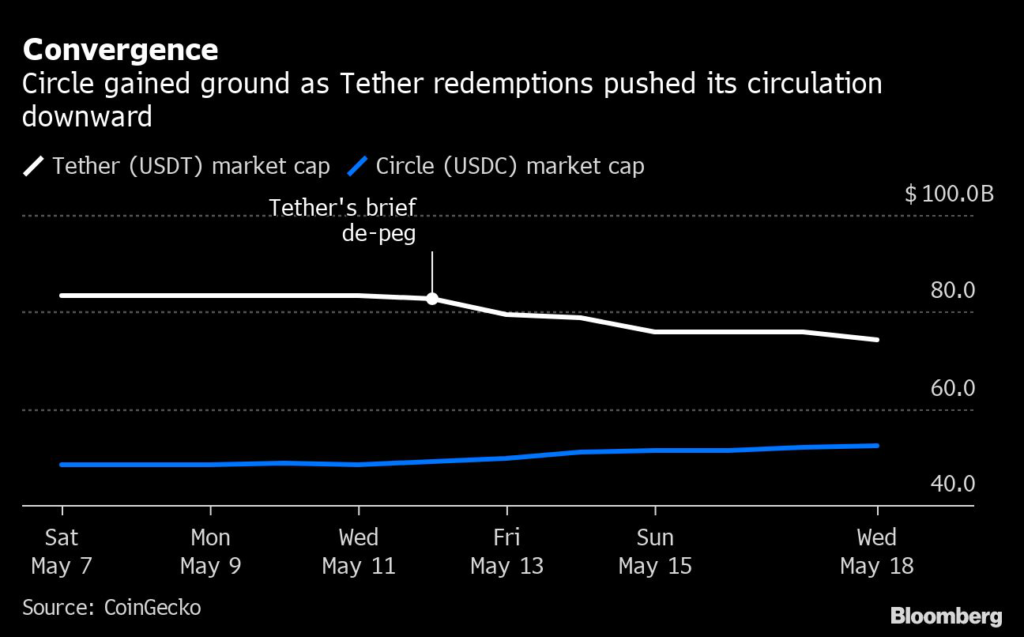
Earlier this month, the collapse of algorithmic stablecoin TerraUSD pushed investors to seek sanctuary in other cryptoassets that aim to maintain a one-to-one peg with the US dollar. While the subsequent market contagion caused cryptocurrencies and stablecoins alike to wobble, Tether’s USDT briefly lost its dollar peg and fell to 95 cents on May 12 — a knock that’s been followed by $8.5 billion in redemptions to date, according to data from CoinGecko.

As time presses on, the total market capitalizations of Tether and Circle appear to be converging as investors trade from one and into the other, with Circle’s circulation rising by nearly $3.4 billion over the same period. Other stablecoins are also benefiting, with Binance USD’s value up by $1.2 billion.

TerraUSD, or UST, used an algorithmic design to adjust its supply through trades with its sister token Luna, intended to help it keep a steady value of $1. Collateralized stablecoins like Tether and USD Coin, however, rely on a reserve of dollar and dollar-equivalent assets to support their supply. Questions have previously been raised about the quality of Tether’s stockpile, though it remains the dominant quote pair on many crypto exchanges.

The fallout from Tether’s brief dip from its peg has reversed a downward trend for Circle’s USDC, the supply of which had been slowly contracting since late February, data from Glassnode show. 

“Given the dominant growth of USDC over the last two years, this may be an indicator of changing market preference away from USDT and towards USDC as the preferred stablecoin,” a Glassnode on-chain analyst known by the moniker Checkmate said in a report Monday.

Read more: Circle CEO Sees Algo Stablecoins Ruled as Synthetic Derivatives

Jeremy Allaire, chief executive of Circle, told Bloomberg on Tuesday the company had seen a flood of additional demand after Terra’s collapse. 

“There were multiple scenarios where we could see it being triggered into a death spiral, and that’s exactly what happened,” Allaire told Bloomberg TV. “We’ve seen since then a real flight to quality.”

More stories like this are available on bloomberg.com

©2022 Bloomberg L.P.
China Has Enough Policy Room for Economic Challenges, Li Says

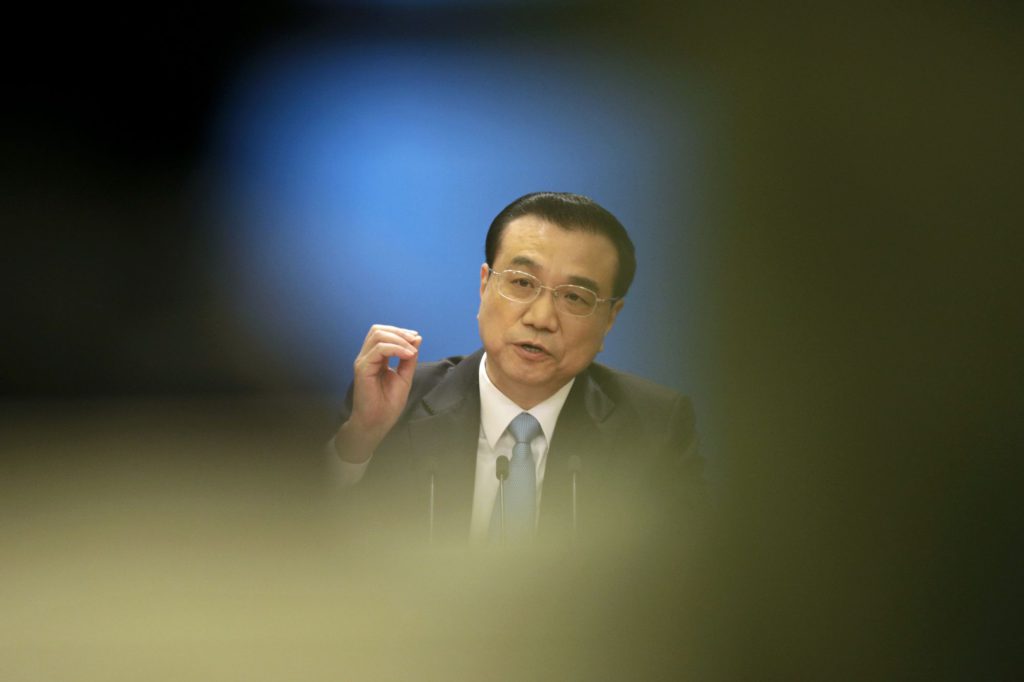
(Bloomberg) — Premier Li Keqiang said China has enough policy room to deal with the growing challenges facing the economy, which indicators show has been weakening since March, state broadcaster CCTV reported Wednesday. 

At a meeting on stabilizing markets and jobs, Li said China would strengthen macro-policy adjustments and called on government agencies to act with a greater sense of urgency and implement policies faster, according to CCTV. 

New measures should be adopted as soon as this month to ensure the economy is in a “reasonable range” for the first half and the rest of the year, the report cited Li as saying, without elaborating. 

Data this week showed China’s industrial output and consumer spending sliding to the worst levels since the pandemic began as the government battles Covid outbreaks with strict lockdowns that are having a major impact on activity. Unemployment climbed to 6.1% in April and the youth jobless rate hit a record high. Analysts have warned of no quick recovery. 

China’s Economic Activity Collapses Under Xi’s Covid Zero Policy

China has set a full-year economic growth target of 5.5%. Goldman Sachs Group Inc. just cut its forecast for this year to 4% from 4.5%.

At Wednesday’s meeting with officials in Yunnan province, Li said steps would be taken to stabilize land and property prices to ensure the healthy development of the property market. Housing demand will be supported, he said, according to CCTV. The central bank cut mortgage rates for first-time homebuyers on Sunday. 

The Chinese premier also reiterated support for digital-economy companies and their public listings, echoing comments made by Vice Premier Liu He after a symposium with the heads of some of the nation’s largest private companies.

More stories like this are available on bloomberg.com

©2022 Bloomberg L.P.

Twitter Suspended His Account. Then He Launched a Competing Network

(Bloomberg) — Last month, after Elon Musk said he would acquire Twitter Inc., a Finnish cryptocurrency developer named Stani Kulechov tweeted a joke saying he was selected as Twitter’s interim chief executive officer. Then Twitter briefly suspended his account.

On Wednesday, Kulechov will deliver his response: He built a rival social network based on blockchain technology, which will become available for anyone to access for the first time. The network, Lens Protocol, allows people to post and follow but differs from Twitter in a major way: Each piece of content is associated with nonfungible token, giving the creator ownership over their posts, said Kulechov, the founder and CEO of the London-based startup Aave.

Musk and the Twitter co-founder Jack Dorsey have expressed interest in creating a more decentralized Twitter and open-sourcing its algorithm. Musk has also raised doubts about whether he will even go through with the acquisition, citing concerns about bots on the network.

Lens Protocol is suited to handling many of the issues that Musk has said he’s worried about, Kulechov said. Blockchain-based tools can help verify identities, prevent spam and present an open system, he said. “Open sourcing comes by default with public blockchains,” Kulechov said.

His own experiences with Twitter, including the temporary ban, helped inform the work on Lens Protocol, Kulechov said: “As a user, you’re very much at the mercy of the platforms.”

Converting enough people to a different social network is a big challenge, whether for blockchain-based networks or more ideological ones, like Gab or former US President Donald Trump’s Truth Social. Then there’s the flight from crypto incited by the recent crash of the TerraUSD stablecoin.

Kulechov is undeterred. His team sees potential for social gaming and music sharing to be added to Lens Protocol and will continue developing on the platform. “We’ve been building during bear markets and bull markets,” Kulechov said. “And we just don’t care.”

More stories like this are available on bloomberg.com

©2022 Bloomberg L.P.
MicroStrategy’s Bitcoin Timing Shows a Spotty Scorecard

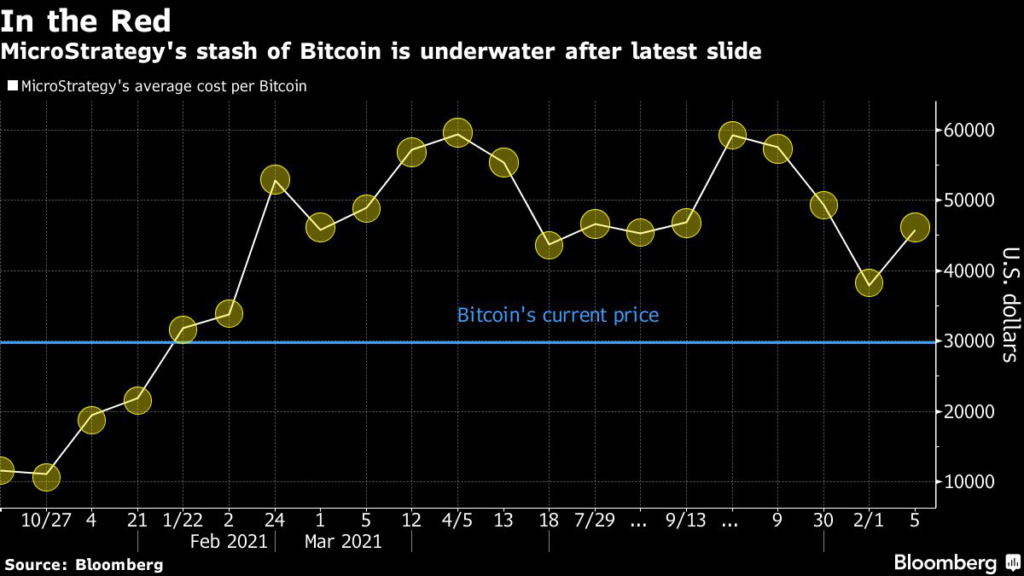
(Bloomberg) — Bitcoin’s slide below $30,000 has dragged MicroStrategy Inc.’s stash of the cryptocurrency underwater, muddying founder Michael Saylor’s strategy of betting on the token. The software maker has disclosed new Bitcoin additions nearly two dozen times, with the first back in August 2020. However, all but four of those times they paid more on average than the current price of around $30,000. The first four purchases in late 2020 — amassing just over 70,000 coins for just $1.13 billion — have nearly doubled in value.

More stories like this are available on bloomberg.com

©2022 Bloomberg L.P.

Tesla Bets It Can Bring Down Insurance Costs, Make Driving Safer

(Bloomberg) —

For more than six weeks now, the tech and finance industry has been riveted by Elon Musk’s pursuit of Twitter.

The topic has sucked up tons of oxygen and contributed to Tesla shares sagging amid a broader market rout and Shanghai’s shutdown to contain the spread of Covid-19.

The deal dominated the friendly conversation Musk had Monday with his buddies behind the All-In Podcast, who asked Tesla’s chief executive officer to elaborate on a tweet last month describing the company as a collection of many startups doing things he says other car companies aren’t. One of the products Musk touched on was Tesla Insurance.

The insurance offering — a passion project for CFO Zachary Kirkhorn — is currently available in just eight states, including California, Illinois and Texas. During the last earnings call, Kirkhorn said Tesla had become the second-largest insurer of its cars in the Lone Star State. Eventually, coverage will be available to 80% of the US, and then the company plans to go international.

Tesla has long tried to draw customers to an ecosystem of products that complement one another: an electric car, a Solar Roof, a home battery known as a Powerwall. It wants to offer consumers an Apple-like suite of goods and services, and insurance is another piece of this strategy.

“The car insurance industry is incredibly inefficient,” Musk told attendees of the All-In Summit in Miami, which he joined virtually for almost 90 minutes. “You’ve got so many middle entities, from insurance agents all the way to the final reinsurer, there’s like a half-dozen companies each taking a cut.”

Tesla charges premiums based on real-time driving data used to compile a monthly safety score. We heard about these scores when the company expanded its controversial Full Self-Driving beta program to more drivers, but there’s an insurance element to it, as well.

Five factors impact a safety score: forward collision warnings per 1,000 miles, hard braking, aggressive turning, unsafe following and forced Autopilot disengagement. This differs from traditional determinants such as credit score or age.

“We assume a Safety Score of 90 when you first sign up,” Tesla says on its website. “Your premium can adjust monthly based on your Safety Score. The higher your score is, the lower your premium can be. Tesla will always notify you in advance of your new monthly premium.”

I don’t drive very much, because I live in a city and prefer to ride my bicycle and take public transit to work. My family has one car, an old Subaru. We have excellent insurance through USAA, thanks to my father’s service in the US Air Force. But our premiums are pretty static — they renew every six months and don’t change all that much. There’s no real-time driving data on our old beater.

It’s hard to argue with a product that incentivizes safer driving with lower cost to consumers. That said, it’s worth noting that Tesla markets its products with mixed messages from a safety perspective, often putting heavy emphasis on zero-to-60 acceleration times. There have been plenty of crashes — some of them fatal — involving Tesla drivers traveling at high speeds. Just this month, one careened into an Ohio convention center at about 70 miles per hour. Thankfully, no one was seriously injured or killed.

Do you have Tesla Insurance? I’d love to know what your premiums are, and how you’ve found the dynamic pricing so far. Give me a shout at dhull12@bloomberg.net.

Like getting this newsletter? Subscribe to Bloomberg.com for unlimited access to trusted, data-driven journalism and subscriber-only insights.

More stories like this are available on bloomberg.com

©2022 Bloomberg L.P.

Hong Kong Telco HKBN Said to Draw Interest From Stonepeak, PAG

(Bloomberg) — Stonepeak and PAG are among suitors considering bids for Hong Kong telecommunications provider HKBN Ltd., according to people familiar with the matter.

The private equity firms have been working with advisers to conduct due diligence on HKBN, the people said, asking not to be identified because the matter is private. Shares of HKBN are little changed in Hong Kong trading this year, giving the business a market capitalization of about $1.6 billion. 

HKBN offers broadband internet services to residential and corporate customers in the city. It also provides other enterprise telecom solutions, runs data centers and offers Wifi connectivity. The company’s major shareholders include buyout firms TPG and MBK Partners. 

The potential deal comes amid booming demand for infrastructure assets globally. Deliberations are at an early stage, and there’s no certainty the funds will proceed with formal bids, the people said. 

Challenging financing markets and stock market volatility could still weigh on a potential deal, the people said. A representative for PAG declined to comment, while spokespeople for HKBN and Stonepeak didn’t immediately respond to requests for comment.

In 2018, HKBN announced an all-stock merger with WTT, the enterprise-focused fixed telecoms provider then owned by TPG and MBK. It was completed the following year. 

More stories like this are available on bloomberg.com

©2022 Bloomberg L.P.
Microsoft Begins Cloud Concessions After Rivals Complain

(Bloomberg) — Microsoft Corp. is bowing to pressure to make it easier for European cloud providers to host the company’s software.

The US company is launching a new initiative that will make it easier for European cloud companies to host Microsoft products like Windows and Office 365 apps. The company will also provide greater licensing flexibility for customers in Europe.

“We have a responsibility to do more,” said Microsoft president Brad Smith at an event in Brussels on Wednesday.

Microsoft is facing a formal inquiry from the European Commission into the company’s alleged antitrust practices. The commission is curerntly seeking questions from rival services after a complaint last year from France’s OVHcloud, claiming Microsoft’s software licensing terms put them at a disadvantage for running Microsoft products, and make it easier or cheaper to pair Windows, Office and Windows Server with Microsoft’s own Azure cloud.

“We don’t think all of these claims are valid but some of them are,” said Smith. “So we’re making changes.”

Cloud providers based in Europe should “run Microsoft software pretty much the same way Microsoft can,” Smith said. Microsoft could make additional changes in the future.

Read More: Microsoft Customers Decry Cloud Contracts That Sideline Rivals

Microsoft — the maker of market-leading Office and Windows software — is also the No. 2 global seller of cloud infrastructure, renting computing power and storage delivered over the internet to customers. Amazon.com Inc. is the largest vendor of such services, and Alphabet Inc.’s Google is trying to catch Microsoft.

“We were thinking so much about our biggest competitors,” Smith said, “we were forgetting to think about the impact of what we were doing on smaller participants in the market.”

European cloud companies will soon be able to offer a wider range of products to customers at a fixed price. Microsoft also agreed to make its licensing deals easier to read and to launch a new support team to assist European cloud providers.

The changes will only apply to European cloud companies and customers, however – explicitly excluding Microsoft’s two biggest competitors: Amazon and Google.

“We’re looking at the part of the market that has been raising these concerns, and when we look at the data, we said, we understand why when we look at the change in the market share,” Smith said. “We’re saying that we’ll treat you as our partners and put you in a position to then, in effect, offer these services instead of Azure, and instead of Microsoft itself.”

European cloud companies were cautiously optimistic about the announcement. Francisco Mingorance, secretary general of the Cloud Infrastructure Services Providers in Europe, said he wants “firm, concrete and specific” commitments from Microsoft to adapt their licensing agreements and make them auditable by a third party.

“At the end of the day, the industry and users of cloud services and software cannot rely on the goodwill or charity of any gatekeeper,” he said.

(Updates with additional context.)

More stories like this are available on bloomberg.com

©2022 Bloomberg L.P.
Crypto ETP-Provider 21Shares Marks US Debut With Two Launches

(Bloomberg) — Crypto exchange-traded products issuer 21Shares, which has made waves in Europe with its offerings since 2018, is marking its US entrance with the launch of two new funds.

The Zug, Switzerland-based company is debuting two index funds, the 21Shares Crypto Basket 10 Index Fund, which tracks the largest coins, and the 21Shares Crypto Mid-Cap Index Fund, which also measures the performance of the biggest tokens, but excludes Bitcoin and Ether. The funds will be rebalanced and reconstituted quarterly.

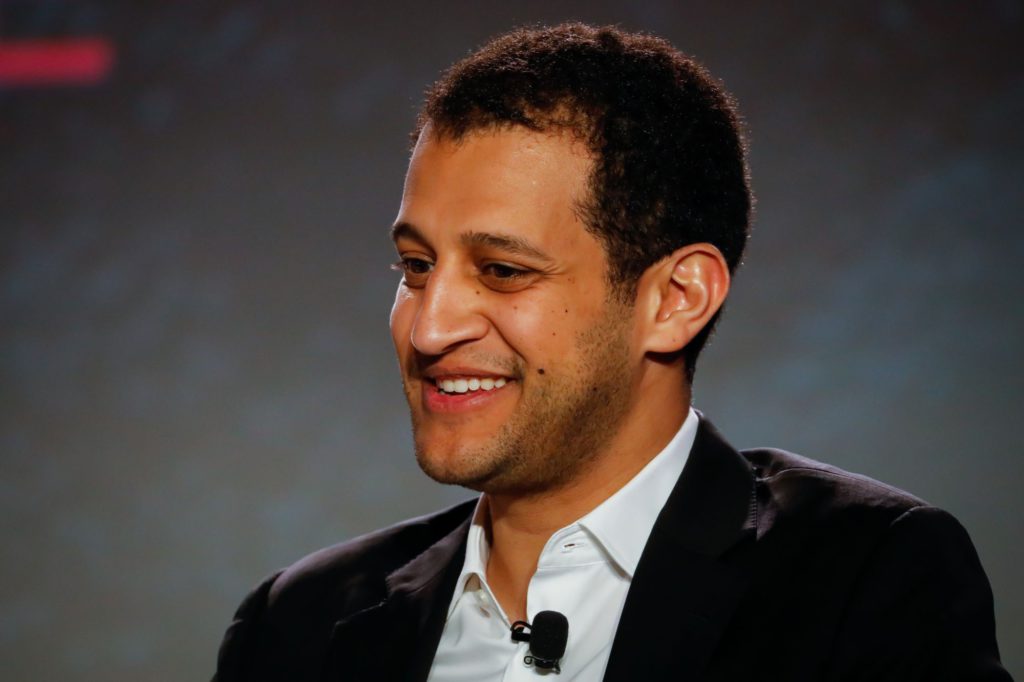
“We’ve been working on products in the US since we first started, so we couldn’t be more excited to finally bring them,” Hany Rashwan, chief executive officer and co-founder of 21Shares, said in an interview. 

The company, which manages $2.1 billion, has Cathie Wood, the founder of Ark Investment Management, on its board. It also has backing from some Silicon Valley VCs, Rashwan said.

21Shares already has ETPs trading in Europe, where regulators have been more open toward crypto-centric funds. It also recently debuted a Bitcoin fund in Australia, though the launch coincided with the TerraUSD stablecoin implosion that rocked markets and which also led the company to suspend creations and redemptions on its Terra ETP. 

It’s been a turbulent year for the crypto market, with prices on some of the largest tokens dropping as the Federal Reserve and other central banks tighten monetary policy to help cool inflation. Bitcoin, the biggest digital coin, has lost 50% since reaching a peak in November, and the overall market has shed more than $1.5 trillion in value during that stretch, according to data from CoinGecko.com.

Rashwan, who co-founded 21Shares with Ophelia Snyder in 2018, says the downturn isn’t too concerning. The company launched its first physically-backed crypto ETP during the 2018 crypto slump, and that fund now has assets of around $119 million. 

Read more: A Rising Crypto Star Has the SEC and Volatile Markets In Her Way

“Bear markets are wonderful times to consolidate, to build and to innovate, and we see this as a long-term investment,” he said. “Nothing changes in the long term. There’s always going to be ups and downs. But we remain just as committed to both this asset class, as well as all the geographies we are in or are considering to be in.”

The company is looking to also launch exchange-traded funds in the States, he said. But, “in the meantime, until that happens, we’re very excited to bring some of our index and basket strategies to America through private funds that are geared toward the more qualified institutional investors.”

More stories like this are available on bloomberg.com

©2022 Bloomberg L.P.

Binance Seeks German License to Expand European Operations

(Bloomberg) —

Binance is courting Germany’s financial regulator over a license to operate in the country, a little over a year after it was admonished for offering stock-like tokens without publishing an investor prospectus.

Changpeng ‘CZ’ Zhao, the chief executive of the crypto exchange, said Binance is in discussions with BaFin as part of plans to grow its presence in Germany. BaFin requires any business wishing to offer custody of cryptoassets to acquire a license. 

“Our team definitely is talking with regulators here and in all of Europe,” Zhao said in an interview at the Finance Forward fintech conference in Hamburg on Wednesday. “I have not talked to them myself directly, but based on my secondary feedback from our team, things are going well.”

Zhao declined to provide further details because the conversations are confidential. He added that Binance is “hiring a lot more people” in Germany, particularly on its compliance team.

“We’re doing a much better job communicating with regulators here. We still hope to get a license in Germany, and we want to grow our market here,” he said.

Binance’s announcement follows a warning from BaFin in April last year over the exchange’s offering of crypto-like tokens tied to the performance of popular US stocks like Tesla Inc., MicroStrategy Inc. and Coinbase Global Inc. The tokens were intended to act like synthetic shares backed by actual stock, Binance said at the time, allowing investors to benefit from a company’s stock performance and dividends, but without shareholder rights like voting privileges.

Tesla Tokens From Crypto Exchange Binance Draw BaFin Scrutiny

BaFin said in a statement at the time that Binance may have violated security rules. A spokesperson for the regulator said on Wednesday that it does not comment on individual cases.

The Germany discussions come after Binance secured regulatory approval from the French government earlier this month, providing the exchange with digital-asset service provider registration to make Paris its European hub. 

Zhao had previously confirmed Binance would make a 100 million-euro ($105 million) investment into France’s blockchain ecosystem and hire up to 250 people to work on infrastructure development.

(Adds BaFin declined to comment.)

More stories like this are available on bloomberg.com

©2022 Bloomberg L.P.

Close Bitnami banner
Bitnami
