
Bloomberg

US Pries Into Over 100 Trader and Banker Phones in Texting Probe

(Bloomberg) — The US is forcing Wall Street banks to embark on a systematic search through more than 100 personal mobile phones carried by top traders and dealmakers in the largest-ever probe into clandestine messaging on platforms such as WhatsApp.

The Securities and Exchange Commission has been sending firms lists of key positions — in some cases pointing to around 30 people including heads of certain investment banking teams or trading desks — that are subject to the review, according to people with direct knowledge of the requests. Personnel in those roles are being ordered to hand over phones so devices can be examined by lawyers.

The aim is to gauge how pervasively Wall Street professionals use unauthorized messaging platforms to chat with each other or clients as regulators decide which firms to punish, and how hard, for failing to preserve business-related messages sent via unapproved platforms. Banks including Goldman Sachs Group Inc., Morgan Stanley, Citigroup Inc., HSBC Holdings Plc and Credit Suisse Group AG have said they’re in the midst of fielding US inquiries into messaging apps, though it’s not clear whether all are now accessing phones.

The requests to access devices are so sensitive — potentially rooting through years of office banter and even personal texts — that banks are arranging for outside attorneys to help conduct the reviews, acting as intermediaries and preserving some semblance of privacy, the people said. The lawyers are being asked to look for business-related messages, with a definition that may offer the industry’s denizens a bit of comfort: Venting to a coworker about a terrible boss probably won’t be deemed business-related. And the boss won’t find out. Plus, regulators generally aren’t seeking message content at this stage, but rather information on who used illicit messaging channels and how often.

Still, the notion that the government and securities firms might embark on a broad, methodical look at phones has been sending shivers through the industry since word emerged about a year ago that JPMorgan Chase & Co. was examining some employees’ use of external apps. That review culminated with ousters and $200 million in regulatory fines as JPMorgan admitted failing to monitor business-related messages on external channels. The SEC expressed particular frustration with the use of apps by supervisors who were supposed to prevent such activity, and it vowed to keep investigating.

“Unfortunately, in the past we’ve seen violations in the financial markets that were committed using unofficial communications channels,” SEC Chair Gary Gensler said at the time.

Since JPMorgan’s punishment, other banks have disclosed inquires or taken steps to rein in app use. Though Bank of America Corp. hasn’t mentioned the issue, it’s also included in the regulatory examination of the industry, according to people with knowledge of the matter.

Earlier this year, Deutsche Bank AG warned staff not to delete communications on WhatsApp. The Frankfurt-based firm hasn’t disclosed a US probe, but it has received information requests from German financial watchdog BaFin, people with knowledge of the requests said this week.

Spokespeople for the banks and the SEC declined to comment.


Under industry rules, securities firms are required to set up surveillance systems and archive written communications. Yet workers across the industry embraced messaging apps in their personal lives, and many began using them to chat with each other, potentially splicing jokes, gripes, gossip and tales of weekend adventures with messages about trades and deals. The texting became all the more common when the pandemic forced legions to work from home, out of bosses’ sight.

The danger for Wall Streeters is that efforts to tally business-related messages could still single out people who were especially prolific on apps. Aside from the potential for big penalties, it’s unclear what might happen if the reviews uncover evidence of blatant misconduct.

JPMorgan’s settlement with the SEC in December didn’t allege that anything fraudulent or untoward was found in recovered texts. But the bank did admit, among other things, that one manager texted with more than 100 colleagues and dozens of outsiders including clients, racking up more than 2,400 messages over the course of a year. Another set up a WhatsApp group chat and invited 19 other members of the desk to join, where they discussed markets, business and client meetings.

The bank ended up ousting a few employees and disciplining more behind the scenes, in some cases lowering bonuses, people with knowledge of the matter have said. Such moves can help demonstrate to regulators that banks are serious about clamping down.

US officials are trying to stamp out clandestine messaging while simultaneously ramping up a series of other inquiries into suspected market abuses. Pushing banks to do a better job of preserving messages could ultimately help those inquiries. Authorities are scrutinizing, for example, whether bankers tipped off market participants to large stock transactions, known as block trades. They also opened inquiries into short sellers and signs of insider trading ahead of deals announced by blank-check companies.

Amid those complex cases, the SEC’s approach to the texting probe conserves resources by relying on banks to do much of the work, which is where the look at so many mobile phones comes into play. The agency is essentially asking banks to gather and summarize a representative sample of texting. From that the agency may infer how severe lapses were at different firms.

A number of firms are angling to pay less than what JPMorgan, the nation’s largest lender, ended up forking over to the SEC and Commodity Futures Trading Commission, people with knowledge of the initial talks said. JPMorgan had hoped to pay less, too. 

As Bloomberg reported earlier this month, the bank’s negotiators were caught by surprise when they entered talks armed with a list of past precedents, pointing out that the heftiest penalty ever levied was less than $20 million. The SEC made it pay more than six times that.

More stories like this are available on bloomberg.com

©2022 Bloomberg L.P.
Macquarie Alum’s GreenPoint Eyes $1 Billion for Real Estate Bets

(Bloomberg) — GreenPoint Partners, a firm founded by Macquarie Group Ltd.’s former global real estate investment banking head Chris Green, is seeking about $1 billion for a new fund dedicated to property wagers, according to people with knowledge of the matter.

The New York-based firm has begun discussing the vehicle with prospective investors, said the people, who asked not to be named because the matter is private. A GreenPoint spokesman declined to comment on fundraising efforts.

Any new vehicle would follow a separate $134 million technology fund through which GreenPoint invests in companies focused on the digital transformation of real assets, defined as real estate, infrastructure, energy and agriculture. Its backers include Canada’s Public Sector Pension Investment Board, Ivanhoe Cambridge, Goodman Group, Lendlease Corp., Greystar and Charter Hall Group, the firm said.

“The increasing pervasiveness of technology and ESG trends is pressuring real asset digitization and technology adoption to catch up to other industries,” Green said in a statement. “Combining real estate private equity and technology investing allows us to surface unique insights into the rapidly changing industry.” 

GreenPoint’s technology fund counts Ryan Shmeizer as a general partner and JLL alums Eric Boothe, Rick Michaux and John Forrest as operating partners. It has backed companies including Built Technologies, OpenSpace, Fetch Package, GetHenry, Relay Payments and Snapdocs. One of its portfolio companies, Envizi, was acquired by International Business Machines Corp. in January. 

Read more: Construction Fintech Startup Built Nabs $1.5 Billion Valuation

“We are focused on the consequences of technology change for our portfolio and investment strategy,” said Stephane Jalbert, a managing director overseeing real estate investments in the Asia Pacific and Europe for PSP Investments. 

GreenPoint has made its first real estate wager on U.K.-based Infinium Logistics, a platform that manages over 30 last-mile logistics sites in Europe and is seeking to amass a portfolio of assets valued at 500 million British pounds ($624 million). GreenPoint’s real estate investment strategy counts Alexander Cakir as a general partner. 

More stories like this are available on bloomberg.com

©2022 Bloomberg L.P.
Software Stocks Pummeled Even Harder Than Rest of Tech Market

(Bloomberg) — Software companies that delivered fantastic returns in recent years have lost more than half of their value since hitting peaks last fall.

Lockdown darlings Zoom Video Communications Inc., DocuSign Inc., Snowflake Inc. and Asana Inc. each experienced double-digit gains during the pandemic then crashed this year.

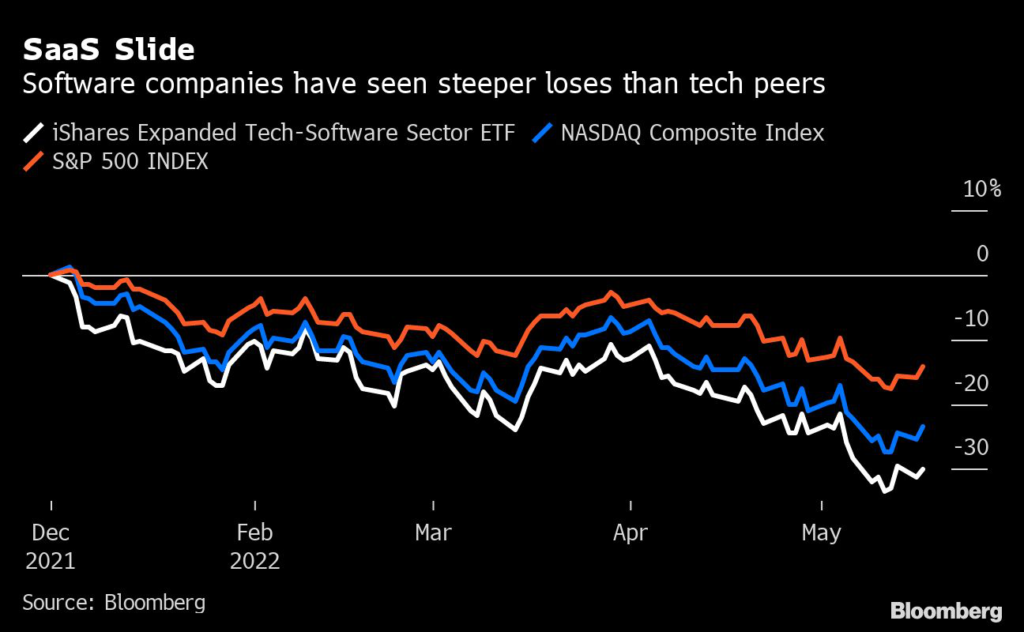
While most of the market has been in decline in recent weeks, makers of computer applications and data-storage solutions have seen even steeper losses. The iShares Expanded Tech-Software Sector ETF is on track for its longest streak of weekly drops since 2001, and is down 38% from a November peak, compared with a 24% fall for the Nasdaq 100 Index, which includes a broad swath of the technology industry. 

Software firm valuations are being hurt by rising interest rates and a reversal of Covid-related trends that boosted tech, said Rishi Jaluria, an analyst at RBC Capital Markets. High-multiple or unprofitable companies like Asana were particularly susceptible to these changing economic circumstances, he said.

These software makers became investor favorites throughout the pandemic, when US growth was limited to a handful of sectors. Though sales continue to rapidly increase at many of these companies, profitability is more important when interests rates are rising, Jaluria said. “Growth at all costs is not OK anymore.”

Read more: High-Flying Startups Feel the Pain of a Long-Predicted Downturn

It’s not just new high-growth firms that are suffering. Enterprise giants have plunged as well. Adobe Inc. shares declined 28% this year through Tuesday’s close. Salesforce Inc. dropped 36%, Microsoft Corp. fell 21% and Oracle Corp. slid 18%. Investors have fled even after Salesforce and Oracle delivered bullish revenue forecasts during their most recent earnings reports.

Despite broad economic pressure, software companies’ pain may be near an end, according to Morgan Stanley’s Keith Weiss. As prices have fallen, investors now view these companies as fairly valued and some short-sellers are no longer betting the prices will go much lower, he wrote in a research note Monday. 

Not everyone agrees. BMO’s Keith Bachman wrote in a note Tuesday that share prices of software providers could fall further, even if valuations have come back to long-run averages.

“We continue to have concerns about valuations given the backdrop of continued rising rates and very real threat of Europe, if not broader global economy, entering a recession,” Bachman wrote.

More stories like this are available on bloomberg.com

©2022 Bloomberg L.P.

Twitter Board Says It Plans to Enforce Musk Merger Agreement

(Bloomberg) — Twitter Inc.’s board said it plans to enforce its $44 billion agreement to be bought by Elon Musk, saying the transaction is in the best interest of all shareholders.

“We intend to close the transaction and enforce the merger agreement,” the board said Tuesday in a statement to Bloomberg News. Directors voted earlier to unanimously recommended that shareholders approve Musk’s $54.20-a-share offer.

The proposed takeover includes a $1 billion breakup fee for each party, which Musk will have to pay if the deal falls apart due to financing issues. But Musk can’t just walk away by paying the charge.

The merger agreement includes a specific performance provision that allows Twitter to force Musk to consummate the deal, according to the filing. That could mean that, should the deal end up in court, Twitter might secure an order obligating Musk to complete the merger rather than winning monetary compensation for any violations of it.

The board’s statement comes as Musk appears to be maneuvering to ditch or renegotiate his offer.

Musk said last week that the deal was “on hold” until he gets more information, specifically proof from Twitter that so-called spam bots make up less than 5% of its users.

On Monday Musk stoked speculation that he could seek to renegotiate the takeover, saying at a tech conference in Miami that a viable deal at a lower price wouldn’t be “out of the question.”

Twitter has said it’s committed to completing the sale. The shares, which had dropped for seven straight trading days, closed Tuesday up 2.5% to $38.32, still well below the offer price.

QuickTake: Why Elon Musk and Twitter CEO Are Sparring Over Bots

(Adds detail on breakup fee provision from third paragraph.)

More stories like this are available on bloomberg.com

©2022 Bloomberg L.P.
Turkish Bike-Riding App Marti to List in New York Via SPAC

(Bloomberg) — Sign up for our Middle East newsletter and follow us @middleeast for news on the region.

Turkey’s electric scooter and bike-sharing app Marti is preparing to go public in New York through a merger with a blank-check company, according to people with knowledge of the matter.

Marti Ileri Teknoloji AS will merge with a special purpose acquisition company — Galata Acquisition Corp. — that raised $125 million in a listing on the New York Stock Exchange last year, said the people who asked not to be named because the plan is confidential. The deal is expected to finalize this year, the people said.

A spokesperson for Marti didn’t respond to calls and emailed questions.

Cash shells, like Galata, raise money through initial public offerings to buy a business that will be identified later on. SPACs boomed at the onset of the pandemic, but the market has since cooled as investors turn their backs on speculative investments and as scrutiny from the U.S. Securities and Exchange Commission intensifies.

This year, 66 SPACs have raised $11.5 billion on US exchanges, compared with 317 that had amassed $102 billion through mid-May of 2021, according to data compiled by Bloomberg.

Galata has $147 million in cash and a market value of $178 million, according to data compiled by Bloomberg. It’s backed by Callaway Capital Management LLC, a Washington-based asset manager founded by Daniel Freifeld, who’s also the SPAC’s chief investment officer.  

The European Bank for Reconstruction and Development and Turkish private equity firm Actera are among investors that made a $30 million investment in Marti’s Series B round in 2021. 

Marti, which means seagull in Turkish, was founded by entrepreneur Oguz Alper Oktem. Its bikes and electric scooters are used by more than 5 million clients in several cities in Turkey, including Istanbul and Ankara.

(Updates with information about Galata in the sixth paragraph.)

More stories like this are available on bloomberg.com

©2022 Bloomberg L.P.
Futures Slip, Stocks Stall as Powell Turns on Heat: Markets Wrap

(Bloomberg) — U.S. equity futures slipped, signaling Wall Street’s recovery may stall as traders assess hawkish comments from Federal Reserve Chair Jerome Powell. Treasury yields ticked lower and the dollar snapped a three-day losing streak.

Contracts all major US benchmarks were down after the S&P 500 added 2% in a risk rebound Tuesday. Powell said the Fed “won’t hesitate” to tighten policy beyond neutral to curb high inflation, fueling fears that higher rates and surging inflation may drive the economy into a recession.

The Stoxx Europe 600 index stalled after a three-day rally, with corporate news in focus. ABN Amro slumped almost 10% after the Dutch lender reported first-quarter results burdened by rising costs. The energy sector outperformed as Siemens Gamesa Renewable Energy SA surged after Siemens Energy AG said it may offer to buy the shares it doesn’t own in its Spanish unit. Oil rose toward $114 a barrel and Bitcoin slipped below $30,000. 


Rebounds in risk sentiment are proving fragile amid tightening monetary settings, Russia’s war in Ukraine and China’s Covid lockdowns. In what’s seen as his most hawkish remarks to date, Powell said that the US central bank will raise interest rates until there is “clear and convincing” evidence that inflation is in retreat.

“We’ll have this kind of volatility as people jump in and look at opportunities to buy as markets decline,” Shana Sissel, director of investments at Cope Corrales, said on Bloomberg Television, referring to the Wall Street bounce. The Fed is going to struggle to achieve a soft economic landing, she added.

The latest data from Europe didn’t offer any reassurance. New-vehicle sales shrank for a 10th month in a row as the industry remains mired in supply-chain crises, while euro-area inflation plateaued at a record high. Yields on most European bonds ticked higher as traders upped bets on European Central Bank tightening.

Meanwhile, UK inflation rose to its highest level since Margaret Thatcher was prime minister 40 years ago, adding to pressure for action from the government and central bank. The pound weakened and gilt yields fell as traders speculated that the Bank of England will struggle to rein in inflation and avoid a recession.

‘Challenging Markets’

“This is one of the most challenging markets I have been in in my career,” Henry Peabody, fixed income portfolio manager at MFS Investment Management, said on Bloomberg Television. “I suspect at a certain point of time we’re going to have the liquidity of the markets challenged. They really haven’t been thus far.”

Elsewhere, the Biden administration is poised to fully block Russia’s ability to pay US bondholders after a deadline expires next week, a move that could bring Moscow closer to a default. Sri Lanka, meantime, is on the brink of reneging on $12.6 billion of overseas bonds, a warning sign to investors in other developing nations that surging inflation is set to take a painful toll.

What damage will be done to the US economy and global markets before the Fed changes tack and eases policy again? The “Fed Put” is the theme of this week’s MLIV Pulse survey. Click here to participate anonymously.

What to watch this week:

  • G-7 finance ministers and central bankers meeting Wednesday
  • Eurozone, UK CPI Wednesday
  • Philadelphia Fed President Patrick Harker speaks Wednesday
  • China loan prime rates Friday

Some of the main moves in markets:

Stocks

  • Futures on the S&P 500 fell 0.2% as of 6:20 a.m. New York time
  • Futures on the Nasdaq 100 fell 0.4%
  • Futures on the Dow Jones Industrial Average were little changed
  • The Stoxx Europe 600 was little changed
  • The MSCI World index rose 0.2%

Currencies

  • The Bloomberg Dollar Spot Index was little changed
  • The euro fell 0.2% to $1.0528
  • The British pound fell 0.6% to $1.2420
  • The Japanese yen rose 0.2% to 129.11 per dollar

Bonds

  • The yield on 10-year Treasuries declined two basis points to 2.97%
  • Germany’s 10-year yield advanced one basis point to 1.06%
  • Britain’s 10-year yield declined four basis points to 1.84%

Commodities

  • West Texas Intermediate crude rose 1.4% to $113.94 a barrel
  • Gold futures were little changed

More stories like this are available on bloomberg.com

©2022 Bloomberg L.P.

Food Shocks Will Also Destabilize the ESG World

(Bloomberg) —

The risk of a global food shortage presents a grave threat to millions of people across the developing world. Much less critical but also important are the longer term environmental obstacles such a calamity may pose for sustainability.

For analysts at Bank of America Corp., the record surge in food prices vividly illustrates the risks at the intersection of environmental and societal crises. And the impact is huge, ranging across agriculture and food retailers to wholesalers, hospitality and gaming companies and even telecommunications providers.

Not only are rising food prices adding to concerns about poverty, hunger and political instability, they’re shining a light on the climate crisis as more than one-third of greenhouse gas emissions are tied to the production, distribution and consumption of food. Feeding the world while moving toward sustainable practices was already hard enough. The Kremlin’s aggression has suddenly made a bad situation much worse.

For investors, the risks are pervasive, said Kay Hope, London-based head of ESG for global fixed-income research at Bank of America. In the short term, Russia’s war on Ukraine caused food prices to climb more than 36% year-on-year in March. While that increase may take a few months to filter through to the consumer, it’s likely to weigh on the broader financial markets, she said.

Read more: The Worst Way to Respond to a Global Food Crisis 

Russia and Ukraine are responsible for about 25% of the world’s wheat exports, 65% of sunflower oil, 20% of barley and 18% of corn. Wheat prices are hovering at record highs this week, rising further Monday after India decided to restrict exports, which further exposed just how tight global supplies are because of Vladimir Putin’s war.

And there are concerns about the fertilizer market, too, Hope said. Sanctions against Russia and its ally Belarus, plus fallout from the destruction inside Ukraine, will almost certainly reduce the availability of fertilizer, as those nations account for a large chunk of global supplies.

Put this all together and it’s not hard to see how grain market disruptions might ultimately lead to worldwide food shortages. 

“In the UK, we’re already limited in how much vegetable oil we can buy at the supermarket,” Hope said. “That’s an alarming prospect for what may lie ahead for nations everywhere.”

Separately, US Treasury Secretary Janet Yellen and Bank of England Governor Andrew Bailey talked about the food crisis Monday. Yellen said Russia’s latest invasion of Ukraine has created a global crisis by exacerbating food security issues, while Bailey warned that a surge in food costs could have “apocalyptic” consequences for the poorest people in society and the global economy.

“That is a major worry, not just for this country, but for the developing world,” Bailey said.

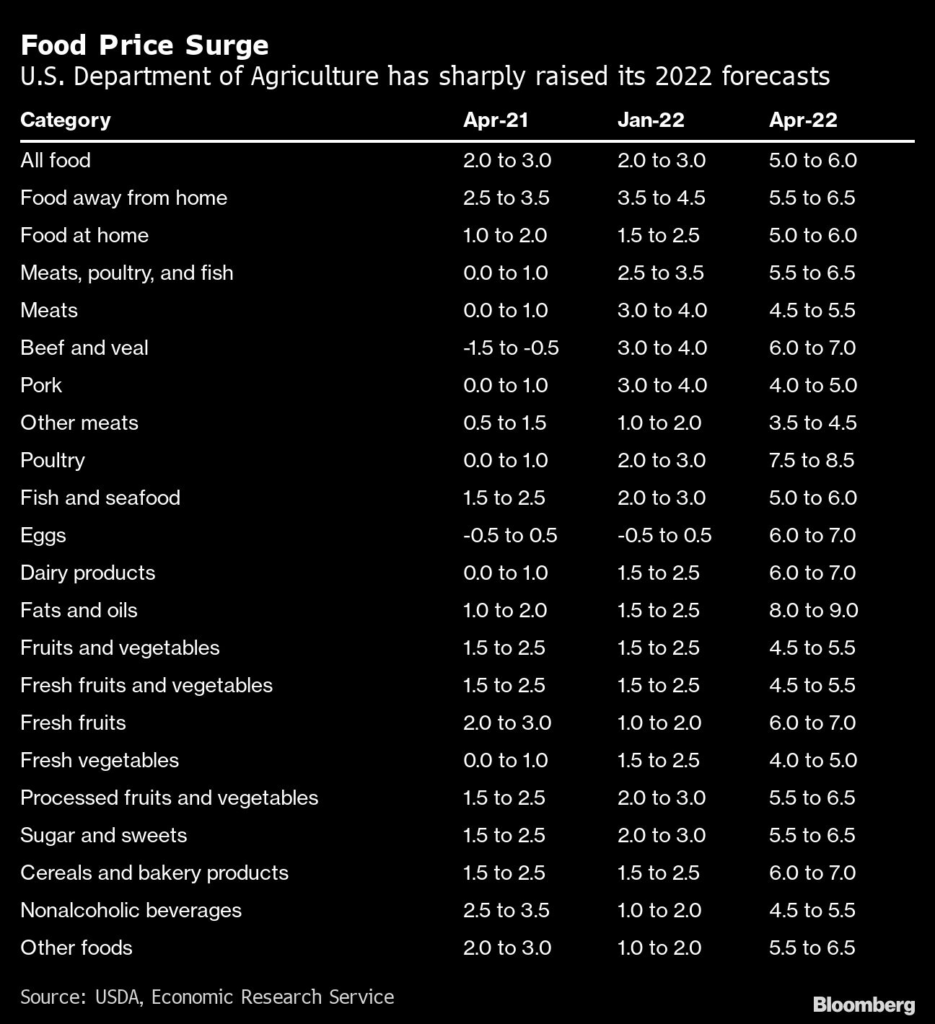
In the US, the Department of Agriculture estimated as recently as last month that food prices may rise 5% to 6% this year—at least double the earlier forecast of about 2.5%.

Over the longer term, climate change and its impact on food supplies is a huge worry, not only for the emerging markets but for developed markets as well. As the world gets warmer, it will become more difficult to grow enough food and ensure that it gets to enough places to feed a growing global population, Hope said.

The potential social consequences are enormous, as the world will have to feed as many as 10 billion people by 2050, up from 7.7 billion as recently as 2020. And fixing food security means addressing climate change, and that’s an enormous undertaking.

In a report entitled “Food Security: Environmental Meets Social,” Bank of America analysts said climate change will alter what can be grown and where, while also increasing extreme weather patterns and affecting the spread of pests and disease. 

They added that about one-third of food produced annually is lost or wasted, and that discarded food accounts for about 8% to 10% of greenhouse gas emissions. Equally alarming is the fact that about one quarter of that wasted food could feed almost 900 million hungry people.

Citing data from Global Food Security UK, the the analysts concluded that this sorry state of affairs “could lead to food production shocks, food price spikes, food security crises and potential civil unrest.”

Bloomberg Green publishes Good Business every week, providing unique insights on ESG and climate-conscious investing.

More stories like this are available on bloomberg.com

©2022 Bloomberg L.P.
Velocity Global Nabs Multibillion Value With $400 Million Raise

(Bloomberg) — Velocity Global, a startup aiming to ease the process of hiring remote and international workers, has raised $400 million in a Series B round.

The financing was led by investment firms Norwest Venture Partners and Eldridge Industries LLC, according to a statement provided to Bloomberg News. The round has boosted the company’s valuation seven-fold since the same time last year, Velocity Global said.

Chief Executive Officer Ben Wright said the company has now amassed a multibillion-dollar valuation but declined to comment further on the amount. “What’s most important for us is the capital raise and what we do with it, especially knowing that we’ve been profitable every single year” since inception, Wright said in an interview. 

Founded in 2014, Velocity Global operates as a software platform for corporate clients to handle human resources. The company offers talent onboarding, global payroll and employment legal services. Funds from the raise will be used to accelerate investments in technology, sales, marketing and also potential tuck-in acquisitions.

According to Wright, the Denver-based company generated $125 million in revenue last year and is projected to do more than $200 million in 2022.

When asked about the potential for an initial public offering, Wright said “certainly an IPO is a possibility.”

“We already have the hallmarks of being a public company,” he said. “We look public ready from kind of a financial perspective, but I think we’ve got a little bit of time to sort of start putting our pieces into place.”

Norwest is a venture capital and growth equity investment firm that invests in early to late-stage businesses spanning the consumer, enterprise and health-care sectors. The Palo Alto, California-based firm has more than $12.5 billion in assets under management. 

“Velocity Global has a rare mix of scale, growth, and profitability that attracted us to be part of the next phase,” said Parker Barrile, a partner at Norwest and the former vice president of product at LinkedIn. He will join Velocity Global’s board of directors as part of the deal.

Led by billionaire Todd Boehly, Eldridge Industries is an investment firm with a build and growth strategy for companies spanning sectors such as insurance, sports, media and gaming, music, technology, real estate and more. The firm is headquartered in Greenwich, Connecticut with offices in New York, London and Beverly Hills, California.

More stories like this are available on bloomberg.com

©2022 Bloomberg L.P.
Global Rolex Shortage Spreads to Cartier and Tudor

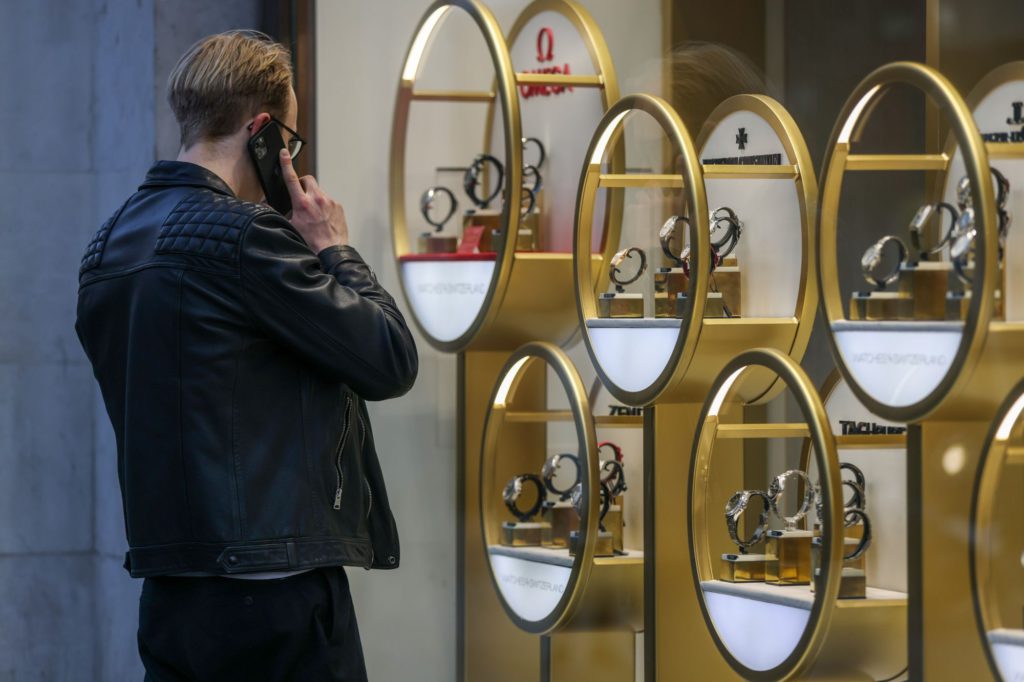
(Bloomberg) — The boom in demand for Rolex watches and a lack of sufficient supply is driving interest in other luxury timepieces, the head of retailer Watches of Switzerland Group Plc said.

Sales of Swiss luxury brands Rolex, Patek Philippe and Audemars Piguet showed only “modest” increases in the retailer’s 2022 fiscal year, largely because of a scarcity of the most sought-after watches, Chief Executive Officer Hugh Brian Duffy said in an interview. That drove interest in other high-end brands. 

“We more than doubled our increases with them,” Duffy said, citing Richemont’s Cartier, Swatch Group’s Omega, LVMH’s Tag Heuer, Rolex sister brand Tudor and independent Breitling.

The retailer, with 171 stores in the UK and US, said demand for certain Cartier and Tudor models is now causing new supply issues.

“We can’t get enough Santos,” Duffy said of the Cartier aviator watch. “We can’t get enough Tudor,” particularly the brand’s chronograph models, he added. 

Those supply concerns may have contributed to a decline early Wednesday in the company’s shares, which traded 1% lower at 10:49 a.m. in London after slumping as much as 4.1%. The stock has fallen by almost a third in 2022, after more than tripling over the previous two years.

Sales of luxury watches jumped during the pandemic as cash-rich consumers directed funds usually spent on travel and entertainment toward high-end timepieces. Retailers benefited with soaring sales online and in stores once they reopened. 

Watches of Switzerland’s full-year revenue rose 40% to 1.24 billion British pounds ($1.54 billion) at constant currencies, the company said Wednesday. It forecast revenue of 1.45 billion pounds to 1.5 billion pounds for 2023. 

Prices for Rolexes and some other luxury Swiss brands are starting to plateau or decline slightly on the second-hand market after a feverish rise. Despite that effect, and the hit from plunging stocks and cryptocurrencies, Duffy said retail demand for Rolex, Patek Philippe and Audemars Piguet watches continues to outstrip supply.

“Demand is just off the scale for those brands. We would love to have more of them,” he said. 

(Updates share price in paragraph five)

More stories like this are available on bloomberg.com

©2022 Bloomberg L.P.

UK Inflation Hits 40-Year High: Where Will Wallets Be Stretched?

(Bloomberg) —

Britain’s inflation rate has surged to its highest level since 1982, piling pressure on consumer budgets as the nation’s cost-of-living crisis intensifies.

The increase is more than double the rate of basic wage growth, squeezing consumer spending power at the fastest pace on record. Almost 2 percentage points of the rise came from a jump in energy prices, while petrol and diesel costs also contributed. 

The FTSE 100 Index barely moved during morning trading, a sign that surging prices have become a baked-in fixture of living standards. The pound retreated after staging its biggest rally in 17 months on Tuesday as investors flocked to the beaten-down currency.

The bad news for consumers is that price increases are set to intensify, with the Bank of England predicting double-digit inflation by October. Here’s a look at the areas where Brits will see their pockets stretched the most.

Housing costs 

Residents of housing association properties could see a rise in costs, as rents and service charges are typically tied to inflation. 

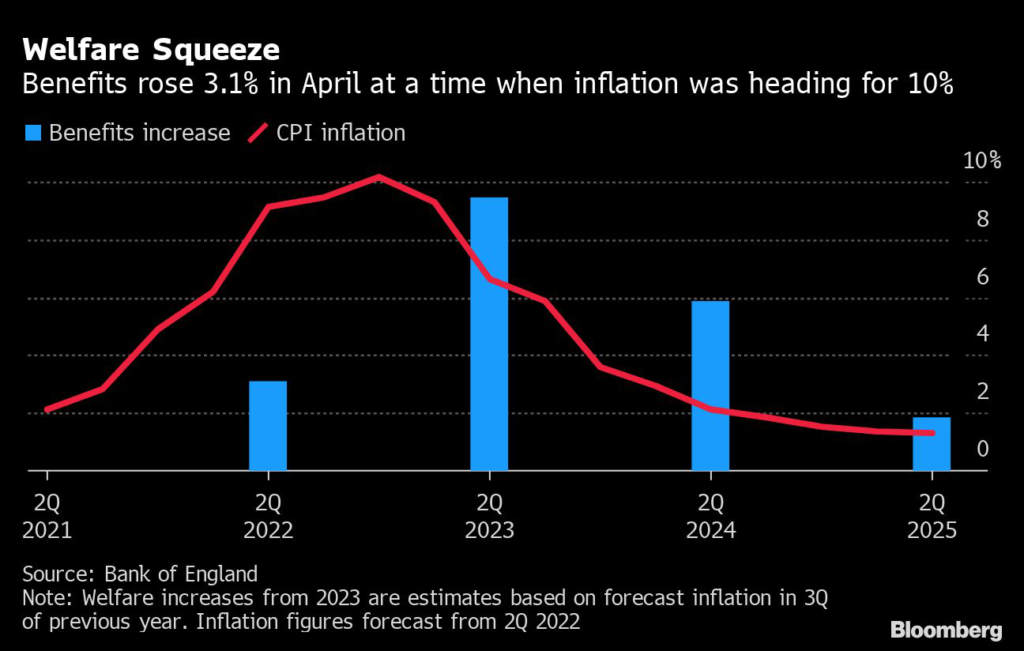
Price increases also determine how much benefits for Britain’s poorest households will rise by next April, which means welfare may experience a record bump at a time when inflation may have cooled. That’s prompted calls to bring forward some of that uprating to this year to smooth the impact.

Mobile phones

Phone and broadband bills have jumped faster than inflation. Three of the UK’s mobile operators raised tariffs by 3.9% earlier this year. 

As wallets have been squeezed, regulator Ofcom and senior politicians have pushed telecom companies to promote so-called cheaper “social tariffs” available to people on certain government benefits. In February, Ofcom said only 1.2% of those eligible had opted for them.

Train fares

Rail fares in the UK usually rise in January, and are typically increased by the retail price index plus 1%. In 2022, the government delayed the price hike to March and said that it would cap it at 3.8%, still the steepest since 2013.

Fares are likely to continue rising in 2023 based on the current formula.

Used cars

A global automobile production crisis, largely driven by a semiconductor shortage, has driven up used-car sales and prices through the pandemic. Surging inflation has also increased demand as consumers hold off splurging on new cars. 

Used car prices have been more than 30% higher year on year since December, and were 32.2% higher in April, according to data from Autotrader.co.uk’s retail price index.

Beer

Budweiser owner Anheuser-Busch InBev NV and rival beermakers Heineken NV and Carlsberg A/S all delivered sales growth ahead of analyst estimates this quarter, largely driven by price increases. So far, drinkers returning to bars after lockdowns have been undeterred by having to pay more, with costs of brewers’ raw materials such as aluminum and barley soaring.

“Inflation continues to move very fast and is moving above or faster than what the expectation was,” AB InBev Chief Executive Officer Michel Doukeris has said. It’s “a little too early” to gauge how resilient demand for beer will be, given most of the brewer’s price increases were implemented late last year, he said.

More stories like this are available on bloomberg.com

©2022 Bloomberg L.P.

Close Bitnami banner
Bitnami