Bloomberg

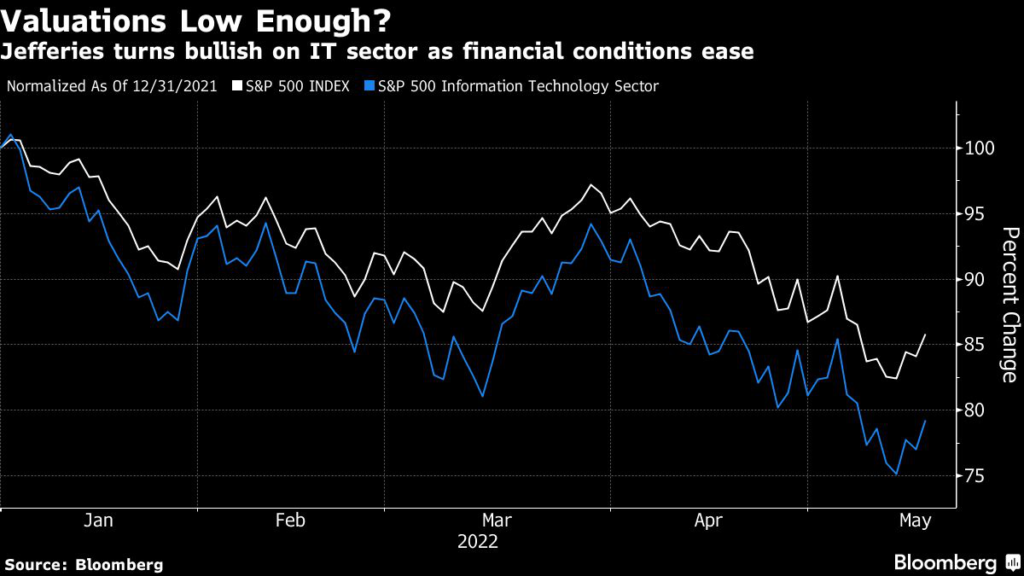
Time to Buy Information Tech Stocks After Drop, Jefferies Says

(Bloomberg) — After this year’s steep declines for US information technology stocks, Jefferies Group LLC strategists have turned bullish on the likes of IBM, Cisco Systems Inc. and Microchip Technology Inc.

The strategists raised their view on the S&P 500 IT Index to bullish in a note on Wednesday, writing that IT stocks are in “a tradeable rally.”

Their more positive view reflects an easing in the strength of the dollar and credit spreads, and, at least temporarily, in financial conditions. Adding to their conviction, they noted recent improvements in both new orders and the backlog for IT firms.


With growth stocks caught in the cross hairs of rising bond yields and fears of an economic slowdown, the S&P 500 Information Technology sector has slumped 21% this year. Price-earnings ratios have fallen to levels last seen in the early days of the pandemic.

A “dash for cash” as investors discounted some extreme interest-rate scenarios “has been more than reflected in the compression of market multiples,” wrote the Jefferies strategists led by Sean Darby.

More stories like this are available on bloomberg.com

©2022 Bloomberg L.P.

African Money Transfer Startup Inspired by Grandma Seeks Capital

(Bloomberg) — A pan-African money transfer business inspired by its co-founder’s grandmother plans to raise additional capital in coming weeks after growing transaction volumes 46-fold last year to $232 million.

Eversend, set up by Uganda’s Stone Atwine and Ronald Kasendwa in 2019, will seek to secure between $15 million and $25 million by tapping venture capitalists and through crowd funding, Atwine said in an interview. It’s only other capital raise was for $1 million, with almost all of that coming from crowd funding. 

The jump in transaction volumes is a result of the company switching its focus from Africans remitting money home to cross-border businesses and cryptocurrency traders, said Atwine, its chief executive officer. Eversend this year started working with Binance Holdings Ltd., the world’s biggest cryptocurrency exchange, and is targeting total transactions of $1 billion. 

“We stopped focusing on migrants sending their money back to grandma and started focusing on people who are actually doing higher volumes,” Atwine said. “We grew big time last year.”

Business Focus

A migrant worker might send home $200 or $300 a month, while businesses will transfer as much as $100,000 at a time and cryptocurrency traders $1,000 two or three times a day, he said. 

The company offers cross-border payments, virtual credit cards, currency exchange and cryptocurrency transfers.

There is ample room for Eversend and competitors to expand, said Lexi Novitske, a general partner with Norrsken22, an Africa-focused tech fund that was set up by Swedish startup founders and CEOs.

“Today’s small African business is no longer single-country by nature. Traders buy and sell across the continent, tech companies have to move capital cross-border seamlessly from one currency to another,” she said by text message. “Even as mobile money and payment infrastructure have been game-changers for financial inclusion, existing payment solutions are country-specific and lack real-time interoperability or conversion.”

Read: Swedish Fund Norrsken22 Poised for Second Africa Startup Foray

While banks charge between 5% and 7% in commission, Eversend charges 0.5% to 1.5%, with the money available immediately or within a few hours, Atwine said. 

“Intra-Africa trade volumes are north of $90 billion per year, add on top of that the need for consumer and other continental remittance channels that are efficient and affordable and you understand the market size that companies like Eversend are looking to tackle,” Novitske said.

Eversend operates in Kenya, Uganda, Ghana, Nigeria and Rwanda. Its investors include TechStars Central LLC, Atomico UK Partners LLP, Metsola Ventures Oy and Fast Track Capital, Atwine said.

Atwine, 39, who used to work for a software payroll company, said he came up with the idea of a money transfer business while living in Kenya. To get money to his grandmother in Uganda he had to draw cash from a bank and then have a transfer agent send it to her. His grandmother then needed to travel on a bus for 50 minutes to get the notes from another agent.

Read: Mobile Money Revolution in Africa Bypasses Most-Populous Nation

“I started asking myself, I think it was in 2013, how do I solve this problem,” said Atwine, who now divides his time between Paris and Africa. “My grandma has MTN Mobile Money in Uganda, I have M-Pesa and I have a visa card. Surely we must be able to make these systems talk to each other.”

MTN Group Ltd., based in Johannesburg, is Africa’s biggest mobile phone company while M-Pesa is a mobile money service operated by Kenya’s Safaricom Plc.

More stories like this are available on bloomberg.com

©2022 Bloomberg L.P.

KKR Buys Alchemer in First Deal From $5 Billion Mid-Market Fund

(Bloomberg) — Buyout firm KKR & Co. has acquired a majority stake in Alchemer, a provider of customer experience and consumer data collection services, with money from its recently launched Ascendant fund focused on midsize companies.

Capital from the investment will be used to scale the business through mergers and acquisitions, marketing, partnerships and product innovation, the companies said in a statement reviewed by Bloomberg News. Financial terms of the agreement weren’t disclosed.

Alchemer Chief Executive Officer David Roberts said “this transaction will benefit our customers and employees by accelerating our investment in experience management.” As part of the deal, staff at Alchemer will also become owners of the company alongside KKR, which said the employee ownership initiative is a boost for scaling stronger companies.

Founded in 2006, Alchemer develops workplace technology for corporate clients aiming to improve engagement with their workforce and customers. The Louisville, Colorado-based company provides the underpinnings of consumer feedback and retention programs, enterprise risk assessment, and return to office planning among its list of services.

KKR’s purchase of Alchemer is the first deal from the Ascendant fund, a more dedicated effort to back middle-market businesses across North America. The fund sits within the New York-based firm’s Americas private equity platform with an identical focus on sectors such as tech, media and telecom, industrials, health care and more.

Plans for the Ascendant fund were first reported by Bloomberg News in March. A representative for KKR declined to comment on fundraising matters.

“Alchemer is exactly the type of company that we want to invest in,” Pete Stavros and Nate Taylor, co-heads of KKR Americas Private Equity, said in the statement. “We see a significant and growing opportunity to use our leading platform and resources to help high-quality middle-market businesses grow, scale and create value for their customers and employees.” 

William Blair & Co. represented Alchemer on the transaction, while Perkins Coie LLP acted as legal counsel. KKR was advised by Jefferies LLC while Simpson Thacher & Bartlett LLP served as legal adviser.

More stories like this are available on bloomberg.com

©2022 Bloomberg L.P.

Tencent Disappoints After Lockdowns, Crackdown Wipe Out Growth

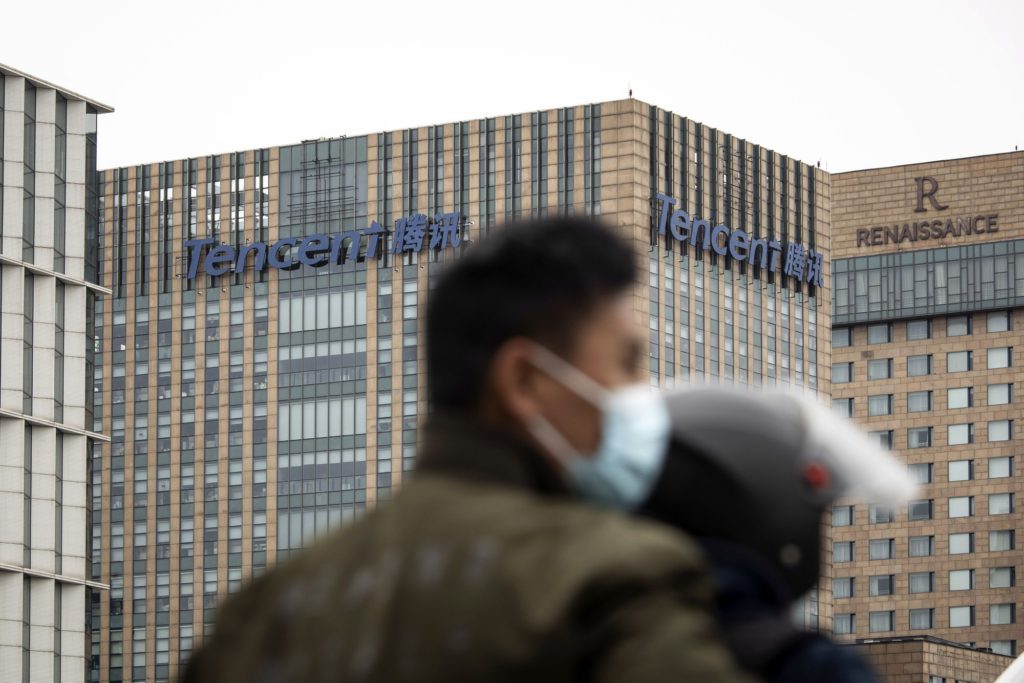
(Bloomberg) — Tencent Holdings Ltd. posted its slowest revenue gain on record, after a sweeping government crackdown and Chinese economic malaise obliterated growth at the internet behemoth.

Sales barely rose to 135.5 billion yuan ($20.1 billion) for the three months ended March, missing the average forecast, after online ad revenue plummeted 18%. Overall growth decelerated for a seventh straight quarter, to the slowest pace since the Shenzhen company went public in 2004. 

China’s largest tech corporations from Tencent to Alibaba Group Holding Ltd. are resigning themselves to a new era of cautious expansion, more than a year after the start of Beijing’s campaign that eventually engulfed every internet sphere from e-commerce to gaming and fintech. 

Net income slid 51% to 23.4 billion yuan, lagging estimates despite a big gain from the sale of stock in Singapore’s Sea Ltd. Shares in Prosus NV, Tencent’s largest shareholder, slid more than 3% in Europe. 

Sentiment toward the industry has swung wildly in recent weeks, as investors debate whether the crackdown has run its course, or is at least switching to a more sustainable pace.

Click here for a liveblog on the earnings.

What Bloomberg Intelligence Says

2022 could mark Tencent’s second straight year of low single-digit EPS gains, putting its status as a China growth stock into question. Yet, 2H and 2023 may yet draw flames from Tencent’s glowing growth embers, particularly if consumer demand stabilizes, regulatory tightening eases, and gaming approvals resume.

– Marvin Chen and Sufianti Sufianti, analysts

Click here for the research.

Read more: Tencent, Alibaba Look Like Utilities After $1 Trillion Drubbing

Tencent has so far largely escaped direct scrutiny from Beijing, but not fallout from the broader clampdown and economic malaise. It’s shed roughly $500 billion of market value since its 2021 peak, even as the company studiously endorses Beijing’s efforts to curb excesses in its once free-wheeling internet sector.

On Tuesday, Chinese economy czar Liu He vowed support for digital platform companies and their public listings, after a symposium attended by firms including Baidu Inc. and NetEase Inc.

“On the one hand, our revenue and profit growth has slowed down; on the other hand, we can use it as a chance to shift gear toward higher-quality development,” founder Pony Ma wrote in Tencent’s social value report published this week, calling it the “difficult but right thing” to do.

Online advertising sales slid a worse-than-expected 18% after contracting for the first time in the December quarter. The business has been battered by China’s weakening economy and competition against TikTok-owner ByteDance Ltd., while big marketers of past years including online tutors and insurers tightened budgets after falling victim to separate regulatory crackdowns.

Tencent’s bread-and-butter gaming division — the world’s largest — also barely expanded revenue. It’s still on the waitlist for new monetization licenses, after regulators last month approved the first batch of domestic releases since July.

Given the new realities, executives said in March that international games, cloud software, and WeChat’s video accounts will be their major strategic foci. But overseas gaming sales expanded just 8% in constant currency terms, trailing the double-digit growth of previous periods, in part because of a tough comparison from a year earlier when the world was largely locked down.

“Like other companies operating outside of China, the post-Covid reopening dampener on games is real,” said Vey-Sern Ling, a senior analyst with Union Bancaire Privée. “Main takeaway is growth may be weaker for longer, at least until 2Q22, and then in the second half there is a chance for yoy comps to start looking better.”

Tencent’s fintech and cloud division has become its No. 1 revenue driver. But its 10% growth was also worse than expected after Covid lockdowns in cities like Shanghai and Shenzhen delayed cloud projects and cooled transactions.

For now, the WeChat messaging app is still the payment and smartphone backbone of Tencent’s sprawling online empire, and it’s only going to shoulder a bigger role for money-making to try and offset struggling businesses like streaming and domestic games. In April, Tencent shut its game streaming platform and hiked fees for its Netflix-style service for the second time in about a year, as short-video rivals keep luring away users and marketers.

Just like Mark Zuckerberg’s Meta Platforms Inc., Tencent is taking a leap into the virtual realm of the metaverse in the longer term. The Chinese company has revamped its aging social app QQ with customizable 3D avatars and Unreal Engine graphics, and is hiring developers to make open-world titles. But such endeavors, along with a steady pace of investment in overseas game studios, could pressure margins before they come to fruition.

“We expect Tencent’s earnings weakness to continue well into 1H2022E due to slowdown in online games and online advertising businesses,” Shifara Samsudeen, an analyst with LightStream Research, wrote in a note on Smartkarma before the results. “At this point, we don’t see many catalysts to drive a strong rally in Tencent’s share price.”

More stories like this are available on bloomberg.com

©2022 Bloomberg L.P.

India’s Biggest IPO Comes to Market at the Wrong Time, KPMG Says

(Bloomberg) — The initial public offering of Life Insurance Corporation of India came at a time when market volatility is high and the country’s largest insurer’s business will continue to outperform with its dominant market share, according to KPMG.

“It continues to remain a very strong company in the insurance sector and has more than 70% market share in India,” Srinivas Balasubramanian, senior partner and head of corporate finance at KPMG India, said in a Bloomberg Television interview on Wednesday. “Unfortunately it came to the market at the wrong point of time.”

India’s state-run insurer plunged 7.8% in its Mumbai trading debut on Tuesday after raising $2.7 billion in the nation’s largest IPO. The share sale, which was priced at the top end of its range, was well-received by local investors and LIC policyholders. LIC shares were up 0.4% as of 2:35 p.m. local time on Wednesday.

Read more: The Stunning Scale of India’s Biggest IPO Ever: QuickTake

Balasubramanian, who was involved in the $18 billion merger between Larsen & Toubro Infotech Ltd. and Mindtree Ltd., expects more acquisitions activity in India’s technology services sector despite the risk-off sentiment. India offers a high-quality talent pool for the sector and companies need scale to capture more business, he said.

“A lot of larger companies are seeing this as an opportunity to use their larger balance sheets, use their stock as currencies to acquire smaller companies, whether it be adding adjacencies to their existing portfolio or even getting into new sectors,” Balasubramanian said. “In my opinion, this will continue to thrive through this year.”

More stories like this are available on bloomberg.com

©2022 Bloomberg L.P.
New China Covid Flareups Raise Risk of More Disruptive Curbs

(Bloomberg) — Fresh outbreaks around key Chinese cities and the ongoing Covid-19 spread in Beijing are raising the specter of more disruptive pandemic curbs, even as Shanghai slowly emerges from its six-week lockdown.

The capital reported 69 new cases for Tuesday, up from 52 on Monday. The Fengtai district has locked down some areas for seven days after new clusters flared, with authorities racing to isolate people exposed at a fresh produce market to try and prevent community spread. Three rounds of mass testing across four districts, including Fengtai, will start Thursday.

Tianjin, close to the capital and where an outbreak in January disrupted global automakers Toyota Motor Corp. and Volkswagen AG, saw cases rise to 55 on Tuesday from 28 on Monday. The port city in China’s north has closed 36 subway stations, and commuters heading to Beijing are required to get a negative Covid test within 48 hours of travel.

A cluster is also ballooning in Sichuan province, which reported 201 cases, raising concerns about potential spread to Chongqing, an important manufacturing hub and home to about 32 million residents. Nationwide, the case count rose for the first time in five days.

The flareups underscore the challenges China faces in pursing Covid Zero, as well as the ever-present risk of disruptions that have already taken an enormous economic and social toll. The zero-tolerance approach is straining in the face of the highly transmissible omicron variant, with authorities turning to deploying harsh measures more extensively and frequently, including the unprecedented shutdown of Shanghai.

Read more: Thousands Shown Being Herded Into Covid Quarantine in China

The financial hub, the epicenter of China’s worst outbreak since the early days of the pandemic, is finally starting to emerge from its grueling lockdown. While cases rose slightly to 855 on Tuesday from 823 on Monday, no infections were found outside of government quarantine for a fourth day. A day earlier, the city hit the crucial milestone of three consecutive days of zero cases in the community, the metric authorities had said would allow them to unwind the strict curbs that hampered economic activity and curtailed almost every aspect of daily life for residents. 

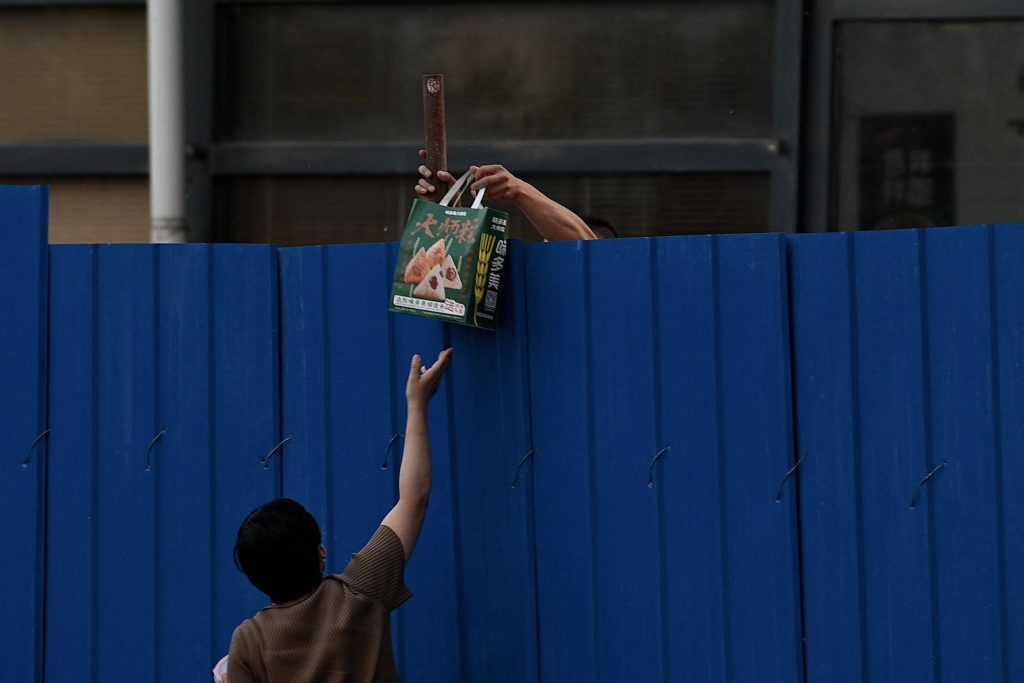
However, many restrictions remain in place and swaths of the city’s population are still largely stuck inside their compounds. Residents must produce a pass to exit their compounds and can only leave by bike or on foot. The passes are distributed to each apartment by residential committees, allowing one person per family to leave during appointed hours for grocery errands. According to passes seen by Bloomberg News, many compounds will allow residents to leave twice in the next four days, for a maximum of four hours at a time. 

Read more: My First Day Out of Shanghai’s Lockdown Was Far From Freedom

About 790,000 people in quarantined areas of Shanghai are still under the toughest restrictions that bans them from leaving their apartments due to Covid cases, Zhao Dandan, deputy head of the city’s health commission, said at a press conference Wednesday.

There are also few signs of any widespread re-opening for businesses. Many firms in Shanghai are still enforcing the closed-loop systems, where staff work and live on-site and undergo regular testing, that allowed them to operate during the lockdown.

The largest chipmakers in Shanghai, including Semiconductor Manufacturing International Corp., still have thousands of workers in Covid-free bubbles for production. Non-essential staff are advised not to go back until further notice, according to people familiar with the matter, who asked not to be identified because the work practices are confidential.

SMIC’s plant in Zhangjiang has about 5,000 workers in closed loop, said one of the people.

Unisoc, the country’s largest mobile chip manufacturer, didn’t comment on closed-loop policy, but said in a text statement that the company is working in accordance of local authority’s rules to resume production.

(Updates to add details on Beijing, Tianjin in second and third paragraphs.)

More stories like this are available on bloomberg.com

©2022 Bloomberg L.P.

China’s New Covid Flareups Raise Risk of More Disruptive Curbs

(Bloomberg) — Fresh outbreaks around key Chinese cities and the ongoing Covid-19 spread in Beijing are raising the specter of more disruptive pandemic curbs, even as Shanghai slowly emerges from its six-week lockdown.

The capital reported 69 new cases for Tuesday, up from 52 on Monday. The Fengtai district has locked down some areas for seven days after new clusters flared, with authorities racing to isolate people exposed at a fresh produce market to try and prevent community spread. Three rounds of mass testing across four districts, including Fengtai, will start Thursday.

Tianjin, close to the capital and where an outbreak in January disrupted global automakers Toyota Motor Corp. and Volkswagen AG, saw cases rise to 55 on Tuesday from 28 on Monday. The port city in China’s north has closed 36 subway stations, and commuters heading to Beijing are required to get a negative Covid test within 48 hours of travel.

A cluster is also ballooning in Sichuan province, which reported 201 cases, raising concerns about potential spread to Chongqing, an important manufacturing hub and home to about 32 million residents. Nationwide, the case count rose for the first time in five days.

The flareups underscore the challenges China faces in pursing Covid Zero, as well as the ever-present risk of disruptions that have already taken an enormous economic and social toll. The zero-tolerance approach is straining in the face of the highly transmissible omicron variant, with authorities turning to deploying harsh measures more extensively and frequently, including the unprecedented shutdown of Shanghai.

Read more: Thousands Shown Being Herded Into Covid Quarantine in China

The financial hub, the epicenter of China’s worst outbreak since the early days of the pandemic, is finally starting to emerge from its grueling lockdown. While cases rose slightly to 855 on Tuesday from 823 on Monday, no infections were found outside of government quarantine for a fourth day. A day earlier, the city hit the crucial milestone of three consecutive days of zero cases in the community, the metric authorities had said would allow them to unwind the strict curbs that hampered economic activity and curtailed almost every aspect of daily life for residents. 

However, many restrictions remain in place and swaths of the city’s population are still largely stuck inside their compounds. Residents must produce a pass to exit their compounds and can only leave by bike or on foot. The passes are distributed to each apartment by residential committees, allowing one person per family to leave during appointed hours for grocery errands. According to passes seen by Bloomberg News, many compounds will allow residents to leave twice in the next four days, for a maximum of four hours at a time. 

Read more: My First Day Out of Shanghai’s Lockdown Was Far From Freedom

About 790,000 people in quarantined areas of Shanghai are still under the toughest restrictions that bans them from leaving their apartments due to Covid cases, Zhao Dandan, deputy head of the city’s health commission, said at a press conference Wednesday.

There are also few signs of any widespread re-opening for businesses. Many firms in Shanghai are still enforcing the closed-loop systems, where staff work and live on-site and undergo regular testing, that allowed them to operate during the lockdown.

The largest chipmakers in Shanghai, including Semiconductor Manufacturing International Corp., still have thousands of workers in Covid-free bubbles for production. Non-essential staff are advised not to go back until further notice, according to people familiar with the matter, who asked not to be identified because the work practices are confidential.

SMIC’s plant in Zhangjiang has about 5,000 workers in closed loop, said one of the people.

Unisoc, the country’s largest mobile chip manufacturer, didn’t comment on closed-loop policy, but said in a text statement that the company is working in accordance of local authority’s rules to resume production.

(Updates to add details on Beijing, Tianjin in second and third paragraphs.)

More stories like this are available on bloomberg.com

©2022 Bloomberg L.P.

Blockchain Gaming Studio Raises $46 Million Ahead of Game Launches

(Bloomberg) — Blockchain gaming startup N3twork Studios Inc. has raised $46 million in funding, the company plans to announce Wednesday. The cash influx comes as the startup prepares to launch two new games, and as controversy lingers over the use of cryptocurrencies in gaming.

Venture capital firm Griffin Gaming Partners led the Series A funding round, which also saw participation from Kleiner Perkins, Galaxy Interactive and other investors.

N3twork Studios launched as an independent company in January following the acquisition of the N3twork gaming technology platform by blockchain company Forte. The startup plans to release a new game, Legendary: Heroes Unchained, which will involve raising armies and conquering lands, in a soft launch later this year. The company is also developing Triumph, a fantasy world where players can go on quests and fight monsters.

The new games are part of a growing movement in blockchain gaming where offerings are free-to-play, or don’t make earning money the main purpose of the game, according to N3twork Studios President Matt Ricchetti. In these games, players may have the opportunity to earn money as a fun bonus.

“That mindset has gotten more popular just over the last few months and this year,” Ricchetti said in an interview. 

This new trend stands in contrast to the “play-to-earn” model used by blockchain games like Axie Infinity, where players breed and battle monsters represented by nonfungible tokens. In these offerings, which Ricchetti called “gamified financial experiences,” players focus on winning crypto tokens and often have to spend money to join in the first place.

The use of blockchain technology in gaming has drawn backlash, with critics arguing that the addition of NFTs or crypto tokens doesn’t actually improve players’ experiences. But Ricchetti said these digital assets allow people to actually own the items they play with, since characters, weapons and virtual land can be represented by NFTs. 

“We’re going to have to demonstrate that we can build real authentic games with sustainable economies,” he said.

More stories like this are available on bloomberg.com

©2022 Bloomberg L.P.
Chinese Stocks Edge Lower as Traders Weigh Liu He’s Support Vow

(Bloomberg) — Chinese stocks closed lower after rallying in the previous session as traders assessed fresh support pledges from Vice Premier Liu He for the battered tech sector. 

The Hang Seng Tech Index pared earlier declines to end 0.3% lower in Hong Kong. The benchmark Hang Seng Index eked out gains, while China’s CSI 300 Index trimmed losses to 0.4%. Automakers were among the biggest gainers on the two gauges following a report that Chinese government departments are in talks with firms about extending subsidies for electric vehicles.

The fluctuations show markets are yet to set a direction following Tuesday’s much-anticipated meeting between Liu, China’s top economic official, and some of the nation’s tech giants. Liu said the government will support the development of digital economy companies and their listing overseas. While that sparked a more than 5% rally in a gauge of Chinese stocks trading in the US, the excitement waned in the Asia session.  

Concerns related to Covid-19 also remained in focus as cases rose in Tianjin and a cluster was ballooning in Sichuan province.

“It is difficult to assess if Chinese equities have bottomed, especially with more economic pain to come as authorities persist on the Zero Covid path, but we believe long term value has emerged,” for some sectors, said Eli Lee, head of investment strategy at Bank of Singapore. “Markets are also forward-looking and a lot of negativity has been priced into Chinese tech at this point.” 

READ: China Economy Czar Vows Support for Tech Firms After Crackdown

More than a year into Beijing’s sweeping regulatory crackdown on private enterprise, investors remain wary about getting back into the sector. Even as authorities have repeatedly promised to soften their stance on internet companies — including Liu’s remarks in mid-March — stock market rallies have rarely lasted more than a few days as new uncertainties related to regulation or Covid-19 outbreaks would resurface.    

“Although investors are aware that there won’t be many punitive measures for tech from now, Covid concerns will continue to depress valuations across the board,” said Hou Anyang, fund manager at Frontsea Asset Management. The meeting wasn’t enough to ease worries, he added. 

Still, in a sign of emerging optimism, JPMorgan Chase & Co. analysts upgraded a number of tech firms including Alibaba Group Holding Ltd. and Tencent Holdings Ltd. to overweight earlier this week, just two months after deeming the sector “uninvestable.”   

READ: China Markets Signal Pessimism Is Peaking After Brutal Selloff

Separately, data showed home prices fell for an eighth month in April amid strict coronavirus lockdowns. The deepening slump is another blow to China’s embattled property sector, which the authorities have sought to support as part of efforts to halt a slowdown in the world’s second-largest economy.  

Where China’s stock market goes from here will hinge on whether policy makers follow through on their promises, and the nation’s Covid-19 situation.

Chinese equities may set “lower lows into the year-end” as the US raises interest rates and scuppers global risk appetite, said Ilya Spivak, head of Greater Asia at DailyFX. “Rising interest rates mean people are resistant to taking risk, which means they are that much more responsive to things like regulatory disruptions or Covid lockdowns.”

More stories like this are available on bloomberg.com

©2022 Bloomberg L.P.
Microsoft Begins Cloud Concessions After Rivals Complain to EU

(Bloomberg) — Microsoft Corp. is bowing to pressure to make it easier for European cloud providers to host the company’s software.

The US company is launching a new initiative that will make it easier for European cloud companies to host Microsoft products like Windows and Office 365 apps. The company will also provide greater licensing flexibility for customers.

“We have a responsibility to do more,” said Microsoft president Brad Smith at an event in Brussels on Wednesday.

Microsoft is facing a formal inquiry from the European Commission into the company’s alleged antitrust practices. The commission sent questions to rival cloud services after an antitrust complaint last year from France’s OVH claiming Microsoft’s software licensing terms put them at a disadvantage for running Microsoft products and make it easier or cheaper to pair things like Windows, Office and Windows Server with Microsoft’s own Azure cloud.

“We don’t think all of these claims are valid but some of them are,” said Smith. “We want to act fast.”

Read More: Microsoft Customers Decry Cloud Contracts That Sideline Rivals

Microsoft — the maker of market-leading Office and Windows software — is also the No. 2 global seller of cloud infrastructure, renting computing power and storage delivered over the internet to customers. Amazon.com Inc. is the largest vendor of such services, and Alphabet Inc.’s Google is trying to catch Microsoft.

“We were thinking so much about the big competitors,” Smith said, “we were forgetting” to think about the smaller players on the European market.

More stories like this are available on bloomberg.com

©2022 Bloomberg L.P.
Close Bitnami banner
Bitnami