Bloomberg

Flipkart Billionaire Fails to Secure India Bank Permit

(Bloomberg) — The Reserve Bank of India on Tuesday rejected all four applications seeking new universal banks, including that by billionaire Sachin Bansal, co-founder and former chief executive officer of e-commerce platform Flipkart.

Bansal’s Chaitanya India Fin Credit Pvt., the micro finance arm of his fintech platform Navi Technologies, didn’t make the cut for running full-fledged banks in India, the RBI said in a statement on its website.

The other three “not found suitable” for a universal bank license were UAE Exchange and Financial Services Ltd., The Repatriates Cooperative Finance and Development Bank Ltd. and a proposal by former Citigroup Inc. banker Pankaj Vaish with others.

The banking regulator has been conservative in issuing full-fledged banking licenses, even as it has allowed a number of smaller banks, including digital ones in the country. The RBI awarded two full-fledged licenses last in 2014, while shying away from granting licenses to industrial houses.     

Alongside rejecting the universal bank applicants, the RBI also rejected small finance banks aspirants — VSoft Technologies Pvt. and Calicut City Service Co-operative Bank Ltd. 

Applications including from Dvara Kshetriya Gramin Financial Services Pvt. and Akhil Kumar Gupta for small finance banks remain “under examination,” the central bank said.

Overall, the RBI had received 11 applications for floating banks, the latest one being in December last year. The applications are reviewed by an external advisory committee, formed in March last year, with former deputy governor Shyamala Gopinath as the chairperson.  

  • NOTE: In April 2021, Flipkart Co-Founder, Former Citi Official Seek India Bank Permit

Story Link: RBI: Chaitanya, UAE Exchange Not Found Suitable for Bank Permit

More stories like this are available on bloomberg.com

©2022 Bloomberg L.P.

Moving App Updater Nabs $215 Million in Vista Equity Backing

(Bloomberg) — Updater Inc., an app and technology developer for residential relocation services, has received $215 million in financing from the credit investment arm of Vista Equity Partners.

The funds from Vista Credit Partners, a subsidiary of the Austin, Texas-based private equity firm, will be used as growth capital, according to a statement provided to Bloomberg News. Updater plans to accelerate its investments in research and development, workforce talent, new products and user features, and also to expand into more industry verticals, the company said. 

“Raising debt is a way of betting on ourselves and I’d rather defer the dilutionary hit to a future period of time when our valuation should be materially greater,” David Greenberg, founder and chief executive officer at Updater, told Bloomberg News. “We’re very confident in our company’s ability to execute and I’m bullish on our growth prospects.”

In a potential equity raise today, Greenberg estimates Updater to draw a valuation between $1.5 billion and $2 billion, he added.

Headquartered in New York, Updater helps customers with relocation services throughout the moving process. Inspired by the complexities of his own moves between New York City apartments, Greenberg founded the company in 2010. Today the mobile app serves as a one-stop platform for packing supplies, labor assistance, transfer of utility services, internet and television connectivity, home insurance and more.

Updater generates money from commissions from service providers when customers book them using the app’s platform. According to Greenberg, the business generated more than $100 million in revenue in 2021.

Vista Credit Partners President David Flannery said the firm “looks to partner with founders of companies that have a strong market position and a mission-critical product suite, both of which we found in Updater, by providing non-dilutive capital solutions.”

Goodwin Procter LLP served as legal counsel to Updater on the transaction.

(Adds company valuation in fourth paragraph and legal counsel in final graph)

More stories like this are available on bloomberg.com

©2022 Bloomberg L.P.

Twitter’s Board Recommends Shareholders Vote to Approve Musk Deal

(Bloomberg) — Twitter Inc.’s board unanimously recommended that shareholders approve Elon Musk’s bid to take the social media company private in a $44 billion deal, eight days before they are scheduled to vote and as the billionaire entrepreneur seems to be seeking to back out or renegotiate his offer.  

On Monday, Musk has floated the idea of trying to lower his initial offer of $54.20 a share, saying a deal at a lower price wouldn’t be “out of the question.” The billionaire entrepreneur is raising doubts about Twitter’s publicly disclosed data on the percentage of spam and fake accounts on its social-media service, claiming they make up more than 20% of all users. On Tuesday, Musk said he would only go ahead with his offer if Twitter can prove the number is less than the 5% the social media company has reported.  

In its proxy statement, Twitter said it’s “committed to completing the transaction on the agreed price and terms as promptly as practicable.”

The board disclosed all relevant details related to Musk’s offer, including how he intends to finance the purchase, the behind the scenes events between the billionaire entrepreneur and Twitter’s executive leadership that led to the offer, and what will happen to shares held by Twitter’s employees and executives if the offer is finalized.

The board cited a host of factors that influenced its decision to recommend that shareholders approve the deal, including an improvement in Twitter’s competitive positioning and prospects if it were to become an independent company, and the board’s belief that the deal has a high level of closing certainty. The board also listed several risks associated with Twitter’s business model if it were to remain a public company such as the challenge of “making investments, operational changes and improvements (including meaningful cost reductions) to achieve long-term growth and profitability” and “the historical challenges to Twitter’s ability to grow its advertising revenue.” The filing went on to say that none of the possible strategic alternatives to the merger was likely to present better opportunities for Twitter to create greater value for its stockholders. 

The US Securities and Exchange Commission will review the deal — although the regulatory agency generally lacks the power to stop corporate mergers or take-private transactions — and shareholders will vote on approval at Twitter’s annual shareholder meeting on May 25. The proxy statement is critical to persuading Twitter’s shareholders to vote yes as it provides significantly more information than was previously available. 

US antitrust regulators are also expected to probe Musk’s purchase of Twitter, but they are unlikely to sue to block it because Musk, who is chief executive officer of Tesla Inc. and Space Exploration Technologies Corp., is a nascent entrant into the social media sector.

Twitter told its employees on April 25 that the deal is slated to close in another three to six months.

But Musk created an air of uncertainty last Friday with an early morning tweet that said the deal to take Twitter private was “temporarily on hold” until he receives more information about the proportion of fake accounts on the social media site, linking to a May 2 Reuters report on Twitter’s most recent disclosure about the number of bots on the platform.

Despite his public comments, the deal’s contract doesn’t seem to give Musk much room to walk away. The merger agreement stipulates that he would owe Twitter a $1 billion breakup fee if he were to cancel the deal. The contract also gives Twitter the right to force Musk to close the deal as long as his debt financing is available. Twitter also has the right to go to court to force Musk to try to obtain that debt financing.

Twitter’s stock has been dropping on speculation that the deal falls apart. The stock now sits 31% below the price Musk has contractually agreed to pay, closing Monday at its lowest level since March 17. 

More stories like this are available on bloomberg.com

©2022 Bloomberg L.P.

Energy Investors Back Startup That Halves Electric-Motor Size, Weight

(Bloomberg) — Infinitum Electric, an electric motor maker based in Texas, has attracted $80 million in investment from several major energy-focused firms, enabling it to boost production.

Electric motors are the ubiquitous workhorses of modern life that the International Energy Agency in 2016 estimated consume 53% of the world’s electricity generation. They drive everything from computer and refrigerator fans to irrigation pumps, washing machines, golf carts and heavy-duty trucks. Motors may propel 30% of industrial electricity demand growth by 2040, Deloitte analysts wrote in 2020.

Infinitum Electric’s motors are being targeted for use in heating, cooling and ventilation, portable power generation and cars, among other applications. They’re half the weight and size of conventional designs, and much quieter, said Ben Schuler, CEO and founder. By swapping out conventional components, such as iron and copper wiring, for a printed circuit board that has copper conductors etched into it, the design is more durable and recyclable, eliminating wear and tear common to iron and copper motors which expand under heat and cool at different rates. The company said it has secured customer agreements worth more than $900 million in potential orders.

The recent Series D funding round brings Infinitum’s total venture capital raised to $135 million. Investors include Riverstone Holdings LLC, Applied Ventures LLC (an investment arm of Applied Materials Inc.), Cottonwood Technology Fund, Chevron Technology Ventures, Aventurine Partners LLC, Energy Innovation Capital Management LLC and Ajax Strategies LLC. Rockwell Automation, Inc. and Caterpillar Venture Capital also are shareholders. The company expects the investment will enable production of up to 50,000 motors a year, starting next year, a five-time increase over 2022. The new investment will enable the company to finish developing a motor for electric vehicles.

Engineers and investors commonly point out that the architecture of the electric motor has remained stable since Nikola Tesla invented it in the late 1880s. Making them more efficient has become an industry-wide challenge—“table stakes” for new products, Schuler said. 

Infinitum Electric motors also have so-called variable frequency drives (more than just on and off), which offer more flexibility and possibility for energy savings—up to 65% of the typical energy consumed by regular motors, Schuler said.

“If you want to make a dent in in energy demand, motors are a great place to start,” said John Staudinger, managing director of Riverstone, a firm that has invested more than $6 billion in renewables and decarbonization over the past 13 years.

Schuler, who started Infinitum in 2016 with money from his retirement accounts and his kids’ 529 college savings accounts, traces the motivation back to work he did in his 20s in Taiwan and Japan, designing equipment that incrementally sped up the manufacture of smartphone glass.

“What I took with me from that experience is, finding something that makes incremental impact or incremental change can provide massive value,” he said. “I took that and related it to the whole green energy thing.”

More stories like this are available on bloomberg.com

©2022 Bloomberg L.P.

US Stocks Catch Risk-On Wave; Dollar, Bonds Fall: Markets Wrap

(Bloomberg) — US stocks jumped as risk appetite returned to markets roiled in recent weeks by concerns about global economic growth, surging prices and policy tightening. Treasuries fell with the dollar. 

Both the S&P 500 and Nasdaq 100 bounced higher after a late-day tech-led drop Monday. Citigroup Inc. rose after report showed Warren Buffett’s Berkshire Hathaway took a stake in the lender. Walmart Inc. tumbled after cutting its profit outlook due to inflationary pressures, while Home Depot Inc. climbed after boosting its full-year forecast.

Sentiment was buoyed by data showing U.S. retail sales grew at a solid pace last month, the latest evidence that consumers remained resilient in the face of inflation. The value of overall purchases increased 0.9%, after an upwardly revised 1.4% gain in March. Another report showed factory production rose at a solid pace for a third month in April.

Treasuries fell, sending yields to session highs after the retail sales data. The dollar weakened against all of its Group-of-10 counterparts except the yen.  

The risk mood in Europe got a lift from data showing the economy in the euro area expanded more than initially estimated at the start of the year, defying headwinds from the early days of the war in Ukraine. 

“Stock markets are in positive territory once more as investors continue to see value after a substantial sell-off in recent weeks,” said Craig Erlam, a senior market analyst at Oanda. “There’s plenty of economic data and central-bank speak to come this week that could easily make investors nervous once again but for now, there may be a belief that a lot of bad news is priced in.”

St. Louis Fed President James Bullard, a hawk and FOMC voter, stressed Tuesday that inflation is the most pressing issue facing the Fed right now. Five more Fed officials are slated to speak throughout the day, including Chair Jerome Powell.

Meanwhile, Shanghai reported three days of zero community transmission, a milestone that could lead officials to start unwinding a punishing lockdown. Flareups elsewhere in China showed how hard it is to tackle the omicron strain.

Cryptocurrencies weathered the latest stablecoin turbulence, with Bitcoin rising above the $30,000 mark. 

What damage will be done to the US economy and global markets before the Fed changes tack and eases policy again? The “Fed Put” is the theme of this week’s MLIV Pulse survey. Click here to participate anonymously.

What to watch this week:

  • Fed Chair Jerome Powell among slate of Fed speakers Tuesday
  • Reserve Bank of Australia releases minutes of its May policy meeting Tuesday
  • G-7 finance ministers and central bankers meeting Wednesday
  • Eurozone, UK CPI Wednesday
  • Philadelphia Fed President Patrick Harker speaks Wednesday
  • China loan prime rates Friday

Some of the main moves in markets:

Stocks

  • The S&P 500 rose 1.4% as of 9:47 a.m. New York time
  • The Nasdaq 100 rose 2.1%
  • The Dow Jones Industrial Average rose 1%
  • The Stoxx Europe 600 rose 1.3%
  • The MSCI World index rose 1.6%

Currencies

  • The Bloomberg Dollar Spot Index fell 0.5%
  • The euro rose 0.9% to $1.0530
  • The British pound rose 1.1% to $1.2454
  • The Japanese yen fell 0.4% to 129.66 per dollar

Bonds

  • The yield on 10-year Treasuries advanced eight basis points to 2.97%
  • Germany’s 10-year yield advanced 12 basis points to 1.05%
  • Britain’s 10-year yield advanced 14 basis points to 1.87%

Commodities

  • West Texas Intermediate crude rose 0.6% to $114.91 a barrel
  • Gold futures rose 0.6% to $1,824.60 an ounce

More stories like this are available on bloomberg.com

©2022 Bloomberg L.P.

Elon Musk Tweet Storm Bodes Ill for Twitter Shareholders

(Bloomberg) — There’s no edit button on Twitter. But Elon Musk may be trying to put one on his $44 billion takeover bid, which means there’s not likely to be much upside for shareholders any time soon.

Musk on Monday roiled the social media service’s stock yet again, saying he could lower his $54.20-a-share offer. He followed that Tuesday by saying the deal will go ahead only if Twitter Inc. can prove that fewer than 5% its users are bots. Twitter said it’s committed to closing the deal on the original terms.

The stock now sits 31% below the price Musk has contractually agreed to pay, closing at its lowest level since March 17. For shareholders, it’s been chaos since Musk disclosed a 9% stake in the company last month, which he followed with an April 14 buyout offer.

Musk’s proposal, which Twitter’s board accepted April 25, initially looked like a golden ticket for investors, since it landed amid a renewed slide in technology stocks that pushed the Nasdaq 100 Index into a bear market. But now confusion reigns. If Musk tries to cut the price, what will Twitter’s board do? Will the deal fall apart? 

“It’s hard to calibrate the deal risk given the lack of precedents on so many levels of this deal, right down to turning around a few weeks after the ink is dry,” said Cabot Henderson, who has a focus on merger arbitrage and special situations as market strategist at JonesTrading. “Since we are in uncharted territory and given Musk’s mercurial nature, investors should expect anything can and will happen.”

Here’s a look at some of the most likely scenarios to come out of this deal and what they could mean for Twitter’s shareholders:

1. Musk Offers a Lower Price

Musk stoked speculation that could seek to renegotiate his takeover of Twitter, saying a viable deal at a lower price wouldn’t be “out of the question.” Tech-stock valuations in general have fallen since the offer was announced, with the Nasdaq 100 down 14%.

For Jean-Francois Comte, managing partner at merger arbitrage firm Lutetia Capital, he might have a “fairly strong hand” if no rival bidders come through. 

While the deal — in which the world’s richest man agrees to take a company private with anything-but-standard financing and then hints at a renegotiation — has no real precedent, there have been some where the buyers closed the transaction with reduced offers. 

Take LVMH’s deal with Tiffany & Co., where it purchased the jewelry retailer at a reduced price of $131.50 share, down from the original $135. LVMH had said it couldn’t go through with the deal, citing a request from the French government amid a trade dispute with the US. Also, Advent International Corp. came back to the table to buy Forescout Technologies Inc. at a discount to the original $1.9 billion price, blaming the pandemic.

2. Musk Walks Away From a Deal

If Musk abandons his bid, Twitter would have to be evaluated on the basis of its fundamentals, a prospect that could lead to weakness over the near term, analysts said. 

Truist Securities estimate Twitter shares would trade in the high $20s or low $30s without a deal, based on where it was trading prior to the offer, or a drop of about 20% from $37.39 at Monday’s close.

CFRA sees an even steeper potential decline. “Should a deal not transpire at all, we see significant downside risk as we value the company at about $26 on a standalone basis,” analyst Angelo Zino wrote in a note Monday. That represents a 30% decline from Monday. 

Twitter’s board could sue to try to force Musk to close the deal as agreed, but that would be a long and costly fight.

3. Deal Goes Through as Agreed

This could be the best-case scenario for shareholders. Anyone who bought at the close Monday would reap a 45% return should the deal go through.

The very fact that such a return is on offer, though, is a sign of market skepticism. The $17.35 gap between Musk’s buyout price and the market value on Tuesday was the widest since the deal was announced.

Where it all goes from here is anyone’s guess. Only eight out of the 37 analysts covering the stock have moved their share price targets to Musk’s bid of $54.20, signaling that most are still unsure if the deal will go through.

“Twitter is not trading completely like a broken deal, but awfully close to one,” said Steve Sosnick, chief strategist at Interactive Brokers.

Tech Chart of the Day

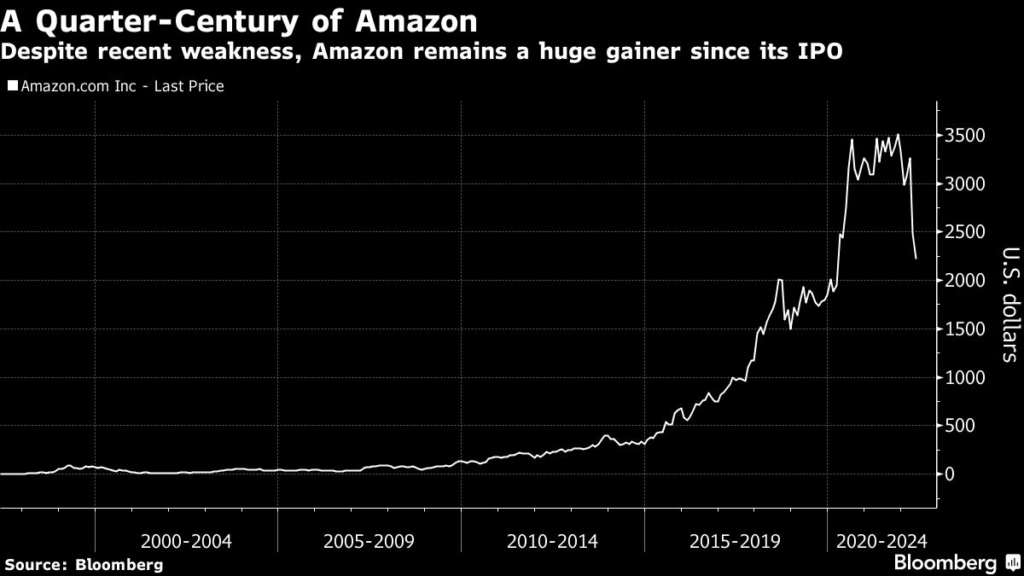
Investors are marking Amazon.com Inc.’s 25th anniversary as a publicly traded company by punishing the stock with its longest weekly losing streak since 2008. Still, Jeff Bezos’s e-commerce behemoth remains an extraordinary stock performer. Amazon shares have soared almost 150,000% since its IPO, while the S&P 500 Index has returned about 662% including dividends over the same period.

Top Tech Stories

  • Chinese tech stocks jumped as traders bet a key meeting Tuesday between the nation’s top regulators and corporate giants would result in Beijing dialing back its yearlong clampdown of the industry
  • SpaceX employees are offering to sell shares via a private placement that would value Musk’s launch and satellite company at around $125 billion, according to people familiar with the matter
  • Tesla’s Shanghai factory output has reached 45% of capacity, according to city officials, after production was suspended during the city’s Covid lockdown
  • Vodafone Group is exploring the creation of a fiber joint venture to connect millions of homes in Germany as it faces issues in its biggest market
  • Nasdaq futures extended their advance on Tuesday, setting up technology stocks for solid gains as investors were lured by cheaper valuations following a six-week rout

(Updates deal spread in paragraph 16)

More stories like this are available on bloomberg.com

©2022 Bloomberg L.P.

Walmart Slides After Cutting Profit Forecast on Rising Costs

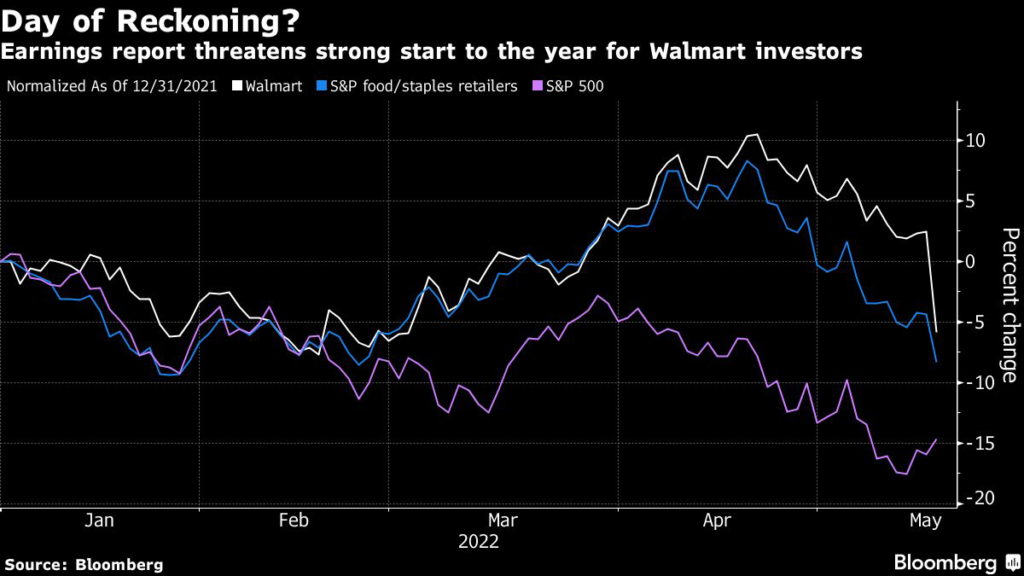
(Bloomberg) — Walmart Inc. fell the most in two years after cutting its profit outlook due to inflationary pressures, especially in food and fuel.

The retail giant now sees earnings per share falling by about 1% this year, compared with a prior view of mid-single-digit gains, Walmart said in a statement Tuesday. Adjusted profit fell to $1.30 a share during the first quarter ended in late April. That trailed the $1.48 average of analyst estimates compiled by Bloomberg. 

The Bentonville, Arkansas-based company, which for decades has championed “everyday low prices,” is vying for more customers as inflation pushes shoppers to look harder for bargains. But higher costs for merchandise, transportation and labor pose a growing threat to profitability. That’s raising the stakes as Walmart must decide how much of those costs they will pass along to consumers.

“US inflation levels, particularly in food and fuel, created more pressure on margin mix and operating costs than we expected,” Walmart Chief Executive Officer Doug McMillon said in the statement. “We’re adjusting and will balance the needs of our customers for value with the need to deliver profit growth for our future.”

The shares sank 8.5% in early trading at 9:31 a.m. New York time, their biggest drop since March 2020. Walmart had gained 2.4% so far this year through Monday, bucking a selloff of US stocks.

Fuel costs accelerated faster last quarter than Walmart was able to pass along to consumers through higher prices, McMillon said on a conference call with analysts. He also called out labor challenges and temporary overstaffing due to Covid, higher costs for containers and storage, excess inventory, and a shift in spending away from general merchandise, which typically has higher profit margins than groceries.

For the current quarter, Walmart said it now expects earnings to be “flat to up slightly” compared with a prior view of a low- to mid-single-digit increase.

The disappointing performance underscores the pressure on US consumers as soaring prices send sentiment to the lowest in a decade. Walmart and other retailers are also contending with the lack of government stimulus payments after benefiting in early 2021 from an injection of federal spending to help households weather the coronavirus pandemic.

Unique Perspective

Walmart’s size gives it a unique perspective on the US economy, and analysts pressed the company for insight on whether shoppers are pulling back their spending as they get squeezed by the highest inflation in four decades. The retailer said it’s seeing some consumers switch to cheaper private-label brands in the grocery, but at the same time, there’s growing demand for some high-end items like video-game consoles.

McMillon said Walmart will raise prices while seeking to stay below its competitors. The company will try to limit price hikes on entry-level food items, the CEO said.

“Price leadership is especially important right now,” he told analysts.

Same-store sales at US Walmart stores rose 3% in the quarter, excluding fuel, topping analyst estimates for 2% growth. Revenue climbed 2.4% to $141.6 billion, while Wall Street had expected $139.1 billion.

Walmart’s revenue gains are consistent with new government data released Tuesday showing that US retail sales grew at a solid pace in April despite rising prices.

For the full year, Walmart raised its forecast for same-store sales growth at US Walmart stores to about 3.5%, up from a prior view of “slightly above 3%.”

The retailer is also trying to develop businesses in digital advertising, financial services and health care, and it’s investing heavily in online sales. E-commerce grew 1% in the quarter. The online business got a substantial boost during pandemic lockdowns, but demand has been slowing as shoppers venture back into stores.

(Updates shares in first and fifth paragraphs.)

More stories like this are available on bloomberg.com

©2022 Bloomberg L.P.

Carvana Pits Tiger Cubs Against Jim Chanos After 90% Plunge

(Bloomberg) —

An up-and-comer trying to become the Amazon of auto retailing is learning the hard way that, for all their digital shortcomings, American car dealers are formidable foes.

Carvana pitched itself as a leading e-commerce platform for used cars when it went public five years ago. Like Amazon, Netflix, Zoom and Peloton, its stock made for a popular pick during the pandemic. What better time to bet on a highly online business competing with brick-and-mortar stores that were either closed completely or unable to operate normally?

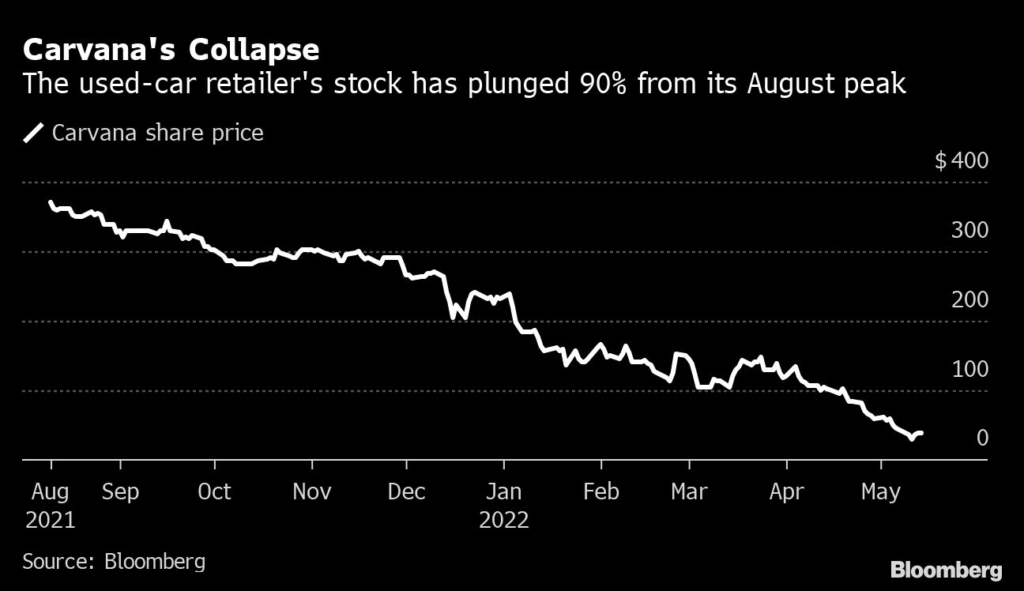
By August of last year, Carvana shares had soared above $370, valuing the company at more than $60 billion, almost three times greater than the market capitalization of top used-car retailer CarMax and eight times what AutoNation, the leading US auto-dealership chain, was worth. In the last nine months, the stock has come crashing down.

Investors overlooked the fact that, while selling or buying a car through Carvana can be done mostly online, there are serious limitations to digitizing the dirty work of inspecting and bidding for used vehicles, transporting them to be reconditioned, and oftentimes moving them again to where they’re resold. All of this is expensive and competitive work. Growing significantly faster than the retail chains and mom-and-pop dealers you’re competing with every day at auction sites, or for trade-ins from consumers shopping around online for the best offer, is no simple task.

Carvana pursued a grow-at-all-costs strategy to gobble up as much inventory as it could at a time when every player in the industry was feeling supply pressures and paying top dollar for used vehicles at auction. Automotive News noted early last year that, in roughly the same time it takes to brush one’s teeth, Carvana was buying or selling another car.

The reckoning came in February, when Carvana succumbed to the shortages sweeping the industry and reported its first-ever sequential decline in quarterly retail sales.

Carvana also announced a highly controversial acquisition for a company that prides itself on being extremely online, telling investors it would pay $2.2 billion for Adesa, one of America’s largest physical car-auction businesses. The seller, KAR Auction, said it was offloading 56 vehicle logistics centers across the US to focus on its digital offerings.

Meanwhile, Carvana’s consistently negative free cash flow has taken a turn for the worse: the company has burned through almost $4 billion since the beginning of last year. It’s assured shareholders that the Adesa acquisition should meaningfully reduce capital expenditures. Late last week, Carvana released a 53-page updated operating plan to rein in expenses and prioritize profitability and positive free cash flow.

Some of the biggest names on Wall Street are placing bets on whether Carvana can turn itself around. Last month, Apollo swooped in to salvage the junk-bond sale used to finance the Adesa acquisition. High-profile hedge fund Tiger Global Management was crushed early this year by the car retailer’s poor performance. On Monday, however, the firm disclosed having added to its stake.

Stanley Druckenmiller’s Duquesne Family Office, on the other hand, sold out of the stock. Famed short seller Jim Chanos told the Wall Street Journal that his firm Kynikos Associates, has been betting the shares will fall.

Analysts at JPMorgan — who cut their price target on the shares to just $35 on Monday, tied for the lowest among those compiled by Bloomberg — wrote that while Carvana has put to rest liquidity concerns for the time being, the stock is now a show-me story.

“We do not necessarily see the company’s business model as highly superior or disruptive to the market,” JPMorgan’s Rajat Gupta wrote, “with well-capitalized brick-and-mortar dealers finding ways to grow and generate solid returns in an increasingly competitive environment.”

Like getting this newsletter? Subscribe to Bloomberg.com for unlimited access to trusted, data-driven journalism and subscriber-only insights.

More stories like this are available on bloomberg.com

©2022 Bloomberg L.P.

Sea Game Sales Top Estimates, Offsetting E-Commerce Slowdown

(Bloomberg) — Sea Ltd.’s core gaming revenue grew faster than expected in the first quarter, offsetting a slowdown across the rest of the Southeast Asian internet giant’s business as online activity retreats from pandemic-era heights.

Sea’s gaming arm, its most profitable division, posted sales of $1.14 billion, versus projections for less than $930 million. Its shares climbed more than 10% in trading before US exchanges opened.

The Singaporean company’s large e-commerce business however underperformed. Consumers emerging from prolonged lockdowns are cutting back on online purchases, especially with the war in Ukraine and rising interest rates clouding the global economic outlook.

Sea revised its full-year outlook for e-commerce sales, its main source of revenue, to $8.5 billion to $9.1 billion from its previous guidance of $8.9 billion to $9.1 billion. The company also posted a wider loss for the first three months as expenses soared.

Read more: Sea Founder Loses $17 Billion in One of Tech’s Biggest Wipeouts

Key Insights

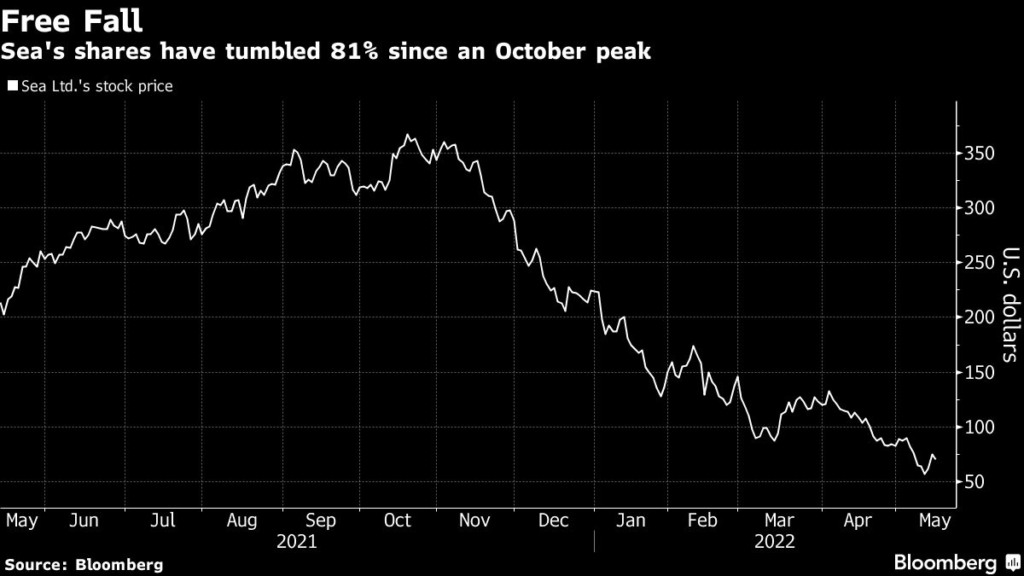
  • The pandemic triggered a rally in online shopping and gaming shares as consumers spent more time and money online, helping Sea become Southeast Asia’s most valuable company. But the broader tech selloff, the shutdown of its e-commerce operation in India and disappointing earnings have wiped 81% off its value since a peak in October.
  • First-quarter revenue from Shopee, Sea’s e-commerce unit, rose 64% to $1.5 billion, versus estimates of $1.7 billion.
  • Revenue from gaming arm Garena gained 45%. The company said in March it expects Garena to post $2.9 billion to $3.1 billion in bookings in 2022, set to be its first decline ever.
  • Sea plans to diversify its portfolio across game genres, Chief Executive Officer Forrest Li said during a conference call. Moonlight Blade, a third-party massive multiplayer online role-playing game, is set to be introduced on mobile and PC in Thailand in the coming months after launching in Taiwan last year, he said. The company is also exploring publishing partnerships and making early investments in game studios.
  • Revenue from SeaMoney, Sea’s digital financial services unit, more than quadrupled to $236 million.

Get More

  • Net loss in the first three months widened to $579.8 million from $422.7 million a year earlier. Total revenue climbed 64% to $2.9 billion, the slowest pace of growth in more than four years.
  • Research and development expenses increased 141% to $340.4 million, mainly because of higher staff cost from increased headcount and investment in technologies.
  • Sales and marketing expenses jumped 48% to $1 billion.
  • Shopee’s gross merchandise value, the sum of transactions flowing through its platform, grew 39% to $17.4 billion.
  • Total payment volume for Sea’s mobile wallet rose 49% to $5.1 billion.
  • Sea Ltd Widens FY E-Commerce Revenue Forecast

Market Reaction

  • Shares of Sea jumped more than 10% in early trading. They had lost 69% this year through Monday.

(Updates with comment from CEO in fourth bullet point)

More stories like this are available on bloomberg.com

©2022 Bloomberg L.P.
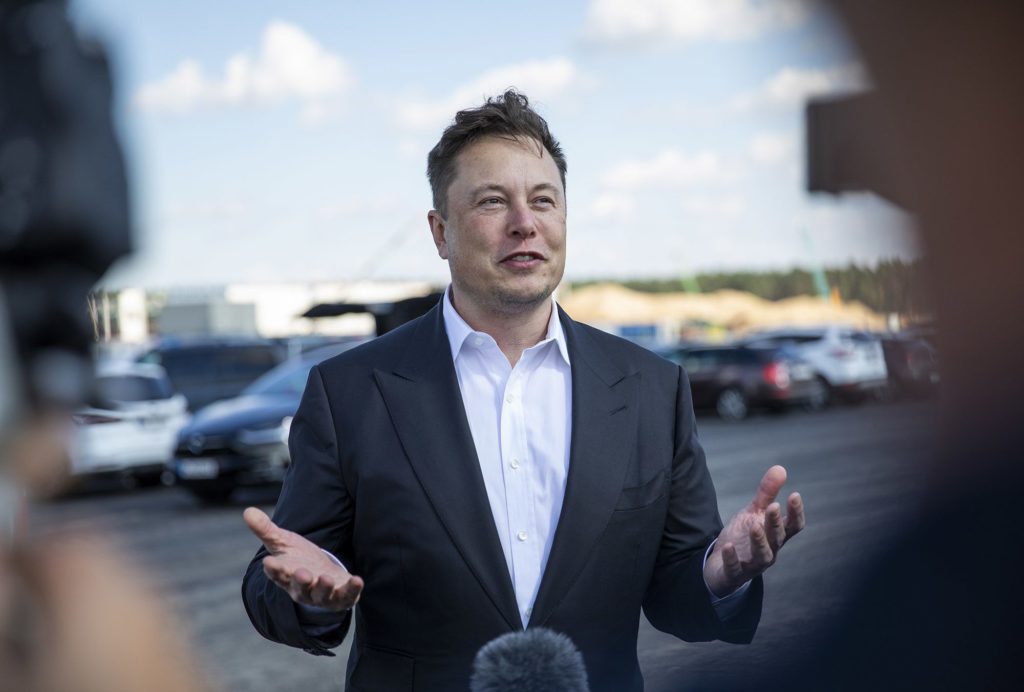
Musk’s Talks With Twitter All Started With Dorsey, Durban

(Bloomberg) — While it’s anyone’s guess how Elon Musk’s $44 billion takeover attempt of Twitter will end, there is some clarity over how it started. 

The key relationships in the run-up to Musk’s takeover offer revolve around calls with Twitter co-founder Jack Dorsey and board member Egon Durban, managing partner at private equity firm Silver Lake who helped Musk on his ill-fated 2018 attempt to take Tesla Inc. private, according to a US securities filing on Tuesday.

During the course of March 26, Musk chatted to Dorsey and Durban about his plans for the social media platform, including that he had taken a “significant stake” of more than 5% stake in the company. 

Durban soon informed Bret Taylor, the board chairman, Martha Lane Fox, one of Twitter’s directors, and Chief Executive Officer Parag Agrawal, of Musk’s interest in joining the board and set up a meeting between Musk and the Twitter executives.

Many of the following twists in the Twitter takeover have been highly publicized by Musk, on Twitter — his financing, his concerns over bots, even poop emojis to Agrawal. However, the latest details highlight how the troubled takeover has appeared to be been driven by the billionaire’s whims rather than deep financial analysis. 

In early April, after the initial conversations with Musk, it seemed Twitter’s board and its legal team had successfully sated his appetite to change the company. Musk agreed to take a board seat, limit his stake in Twitter to 14.9%, and spent three days chatting about new products with Agrawal — presumably including adding an edit button.

By now Dorsey had informed the Twitter board of the somewhat obvious fact that “that he and Mr. Musk were friends,’ according to the filing. The pair, two of the tech industry’s most high-profile entrepreneurs, have regularly chatted about cryptocurrencies and making Twitter’s software and content moderation decisions more transparent. 

Durban also told the board that he had worked on “unrelated matters with Mr. Musk in the past.” These matters involved advice given by Silver Lake — along with other investors — in 2018 over taking Tesla private. The US Securities and Exchange Commission sued Musk for securities fraud, after he falsely claimed — via Twitter — he had funding to take Tesla private.

On April 4, Musk publicly disclosed his 9.2% stake in Twitter and board members outlined their offer for him to have a seat at the table, subject to him agreeing to not acquire more than 14.9% of the company. Meanwhile, Musk continued to discuss Twitter’s strategy with Dorsey and Agrawal. Dorsey shared his own view that Twitter would do better as a private company, and that he would not stay on as a board member with Musk. 

Musk’s conversation with Dorsey clearly outweighed any potential product launch with Agrawal. On April 9, Musk decided he wanted to buy Twitter instead. He made his formal offer of $54.20 a share on April 14, setting off a scramble to finance the deal.

Since then, Musk’s takeover attempt of Twitter has been one of general chaos, most recently culminating in Musk declaring Tuesday morning that he won’t proceed unless the social media giant can prove bots make up fewer than 5% of its users. 

Wall Street has always been skeptical of the deal. The spread between Musk’s offer and Twitter’s last trading price is currently about 40%, suggesting investors think there is little chance the deal will get done without a discount — if at all. 

There is unlikely to be a white knight to push the price back up. In mid-April a number of financial sponsors and institutional investors got in touch with Twitter’s advisers that they might be interested in either buying or funding a deal for Twitter. However, “None of these parties (or any other party) made a proposal to acquire Twitter,” according to the filing. 

More stories like this are available on bloomberg.com

©2022 Bloomberg L.P.
Close Bitnami banner
Bitnami