Bloomberg

Mastercard Begins Facial-Recognition Rollout With Retailers

(Bloomberg) — Mastercard Inc. has begun to trial a biometric payment system for brick-and-mortar stores, using facial recognition rather than contactless cards, smartphones or memorable PINs.

The company said its Biometric Checkout Program would let a shopper scan their face using a retailer’s smartphone app and assign their likeness to a bank card stored on file. The technology is comparable to how Apple Inc.’s iPhone uses FaceID to approve payments or unlock a device.

“When the pandemic happened, we saw that everybody went digital and consumers embraced new technologies,” Mastercard Cyber & Intelligence President Ajay Bhalla said in an interview. “Consumers actually all over the world asked us for that for shopping, for their retail experiences.”

A pilot program began this week inside five St Marche supermarkets in Sao Paulo, Brazil, Mastercard said in a statement. The stores will use an app developed by Brazilian startup Payface, one of the small businesses Mastercard promotes as part of its Start Path engagement program.  

On the hardware side, Mastercard is working with companies including NEC Corp. and Fujitsu General Ltd., with plans to roll out internationally soon.


“We’ve got the Middle East and Africa lined up, Asia and Latin America,” Nili Klenoff, a senior vice president of product innovation at Mastercard, said in an interview. “We’re really looking forward to bringing this solution everywhere.”

She said more features that can use this technology are in the works. Age verification for purchasing restricted store items “is one actually that we’re beginning to explore and one that we’re really excited about,” she said.

Facial recognition is just one of many technologies being trialed by retailers, banks and payments firms to eliminate cash and reduce fraud. 

Amazon.com Inc. has a system that uses in-store cameras to track what shoppers put in a basket and charges them on exiting its physical stores in the US and UK. It won interest from Britain’s J Sainsbury Plc, which installed it at a trial store, and Starbucks Corp. has a cafe in New York using it, too.

More stories like this are available on bloomberg.com

©2022 Bloomberg L.P.

China Economy Czar Vows Support for Tech Firms After Crackdown

(Bloomberg) — China’s top economic official gave an unusual public show of support for digital platform companies Tuesday, suggesting Beijing may be ready to let up on a year-long clampdown on technology giants as it battles a slowing economy.

The government will support the development of digital economy companies and their public listings, Vice Premier Liu He, who is President Xi Jinping’s most senior economic aide, said after a symposium with the heads of some of the nation’s largest private firms. Baidu Inc. founder Robin Li, Qihoo 360 Technology Co.’s Zhou Hongyu and NetEase Inc. chief William Ding were among the tech luminaries spotted at the forum, according to a video posted online.

Liu’s remarks reported by state media were short on detail but signal further easing of the regulatory risk for China’s technology behemoths including Baidu and Tencent Holdings Ltd., as investors await clues on whether a rout in their shares is near an end. The Hang Seng Tech Index rallied as much as 6% Tuesday on optimism the meeting would affirm Beijing’s intention to dial back some of its restrictions.

The meeting between Liu and tech company representatives was facilitated by the Chinese People’s Political Consultative Conference, an advisory body that includes some executives among its members. The relationship between government and markets “should be handled well,” Liu was reported as saying.

Beijing has made stability its core priority in a year plagued by geopolitical uncertainty and the heavy economic impact of coronavirus outbreaks — particularly as its top officials prepare for a key leadership transition toward the end of 2022 where Xi is expected to ensure a third term as party chief.

Beijing is enlisting the technology industry — the biggest growth driver of the past decade — to revitalize an economy struggling with rolling urban lockdowns hitting consumption and causing supply-chain bottlenecks. China’s economic activity collapsed last month, with industrial output and consumer spending sliding to the worst levels since the pandemic began and economists warning that recovery is not in sight.

The latest comments may inject much-needed confidence in the capital markets, where more than $1 trillion of the combined value of Tencent and Alibaba Group Holding Ltd. was at one point wiped out after Beijing began a broad regulatory campaign aimed at the sector in late 2020. Investor sentiment has swung wildly in recent weeks amid debates over the possible easing of the crackdown. 

Liu vowed in March to stabilize battered financial markets, promising to ease a regulatory onslaught that started with the dramatic cancellation of Ant Group Co.’s record IPO before snowballing into an assault on every corner of China’s technosphere.

Investors remain wary as they weigh a mixed bag of developments, which have included a restart of gaming approvals and also the deepening of a campaign to rein in the little-understood algorithms that internet companies employ to serve content and gather data. The Hang Seng Tech Index has rallied 23% from a three-year low hit in mid-March.

Signs of a turnaround in the tech sector may be already underway. On Monday, JPMorgan Chase & Co. analysts upgraded a number of tech firms including Alibaba and Tencent to overweight from underweight just two months after deeming the sector “uninvestable”. 

(Updates with more details on meeting.)

More stories like this are available on bloomberg.com

©2022 Bloomberg L.P.

Bank of America Clients Hoard Cash at Highest Level in Two Decades

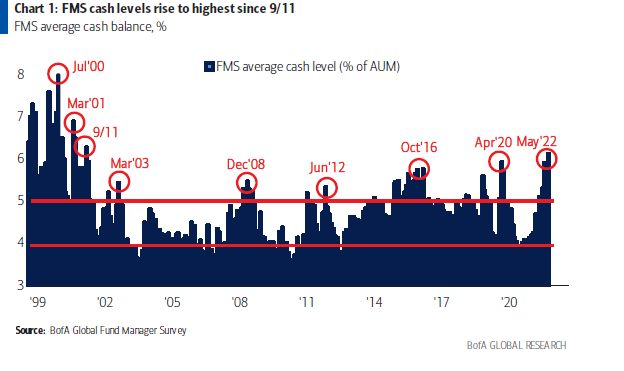
(Bloomberg) — Investors are piling into cash as the outlook for global growth plunges to an all-time low and stagflation worries mount, according to a Bank of America Corp. fund manager survey that points to continued stock market declines.

Cash levels among investors hit the highest level since September 2001, the report showed, with BofA describing the results as “extremely bearish.” This month’s survey of investors with $872 billion under management also showed that hawkish central banks are seen as the biggest risk, followed by a global recession, while stagflation fears have risen to the highest since 2008.

The results make for grim reading for global equities, which have already suffered the longest weekly losing streak since the global financial crisis as central banks turn off the monetary taps at a time of stubbornly high inflation. While equities have seen a small rebound since Friday as valuations get more attractive, strategists including Michael Wilson at Morgan Stanley say more losses lie ahead.

In the BofA report, strategist Michael Hartnett said investors believe stocks are prone to an imminent bear market rally, but ultimate lows have not yet been reached. With more rate hikes expected from the Federal Reserve, the market isn’t yet at “full capitulation,” Harnett wrote in the note.

Fears of a recession trumped the tail risks from inflation and the war in Ukraine, the survey showed. The bearishness has been extreme enough to trigger BofA’s own buy signal, a contrarian indicator for detecting entry points into equities. Strategists such as Kate Moore at BlackRock Inc. and Marko Kolanovic at JPMorgan Chase & Co. have also suggested that concerns of an imminent recession are overblown.

The BofA survey also showed that technology stocks are in the biggest “short” since 2006. Frothy tech shares have been particularly punished in the latest selloff amid concerns about future earnings as rates rise. On Tuesday, Nasdaq futures jumped as much as 2.4% before paring to 1.7% by 8:50 a.m. in New York, setting up tech shares for a rebound. 

Overall, investors are very long cash, commodities, healthcare and consumer staples, and very short technology, equities, Europe and emerging markets. 

Other findings in the May survey:

  • Investors now expect 7.9 Fed rate hikes in this tightening cycle compared with 7.4 in April
  • Fund managers are most underweight equities since May 2020; net 13% versus 6% overweight last month
  • Investor positioning turned the most defensive since May 2020, with combined net 43% overweight in utilities, staples, healthcare
  • Monetary risk is seen as the biggest potential risk to financial market stability, overtaking geopolitical risk
  • The Fed ‘put’ is seen at 3,529 for the S&P 500, which is about 12% below the current level
  • Most crowded trades: long oil/commodities (28%), short US Treasuries (25%), long tech stocks (14%), long Bitcoin (8%), long ESG (7%), short China stocks (7%) and long cash (4%)

(Updates US futures in the sixth paragraph)

More stories like this are available on bloomberg.com

©2022 Bloomberg L.P.

Tiger Cubs Ditched Tech Losers, Buying Others That Did Worse

(Bloomberg) — Tiger Global Management was already off to a “very disappointing” first quarter, when it cut some of the biggest tech losers of 2022 from its portfolio and added others.

But things went from bad to worse for Chase Coleman’s firm. It added to its stake in beleaguered online used-vehicle dealer Carvana Co., which has lost more than two-thirds of its value since the end of the quarter. It exited 83 stocks, including Netflix Inc. and Adobe Inc., while paring its holding of pandemic darling DoorDash Inc., according to a filing Monday. Meanwhile, it added just two new positions. One of them, digital banking-services provider Dave Inc., has plunged 64% since March 31.

That helped fuel a 15% April decline for Tiger Global’s flagship hedge fund, extending its loss for the year to 44%. 

Coleman, 46, is among several so-called Tiger Cubs — named for money managers who previously worked at Julian Robertson’s Tiger Management — that have struggled this year as surging inflation, rising interest rates and war in Europe have crushed equity markets. The tech-heavy Nasdaq 100 tumbled 13% in April, its biggest monthly decline since 2008, while the broader S&P 500 fell 8.8%, the most in more than half a century.

Read more: Tiger Global Loss This Year Hits $16 Billion After April Tumble

Steve Mandel’s Lone Pine Capital also reduced its stake in DoorDash, which tumbled 20% in the first quarter, and trimmed Shopify Inc., another erstwhile favorite of the Covid-19 era that lost more than half of its value in the period. And while Tiger Global unloaded a chunk of its stake in DocuSign Inc., fellow cub Philippe Laffont at Coatue Management started a new stake, snapping up 1.5 million shares. The stock has plunged 30% so far this quarter.

Rounding out the group are Lee Ainslie’s Maverick Capital, which also added to its position in Carvana, and Andreas Halvorsen’s Viking Global Investors, which threw in the towel on Peloton Inc., the exercise-equipment maker that dropped 26% in the first quarter and an additional 41% since.

Monday was the deadline for the Tiger Cubs and thousands of other institutional investors, including pension funds and endowments, to report certain US equity holdings to the Securities and Exchange Commission through quarterly 13F filings.

For TOPLive blog coverage of 13F disclosures, click here

Other highlights:

  • Stanley Druckenmiller’s Duquesne Family Office added to its already substantial position in Chevron Corp., while exiting Carvana and Google parent Alphabet Inc.
  • Dan Sundheim’s D1 Capital, whose firm is typically lumped together with the Tiger Cubs because it was spun off from one, also sold out of Carvana, Shopify and JD.com, along with 18 other stocks it liquidated during the first quarter
  • Gabe Plotkin’s Melvin Capital Management, which was down 23% through the first four months of the year, ditched 16 holdings, including DoorDash and Facebook parent Meta Platforms Inc., while adding to its stakes in Microsoft Corp. and Amazon.com Inc. It took new positions in Spotify, Visa Inc. and MGM Resorts International
  • Warren Buffett’s Berkshire Hathaway Inc. added a few new stakes, including $2.9 billion worth of Citigroup Inc., while liquidating the rest of its shares of Wells Fargo & Co.
  • Viking took a new stake in Mastercard Inc., snapping up 1.79 million shares valued at $641 million as of March 31. The stock was little changed in the first quarter and is down 7.7% since.

(Updates with Viking’s new Mastercard position in final bullet point)

More stories like this are available on bloomberg.com

©2022 Bloomberg L.P.

Bill Hwang Seeks Probe of Morgan Stanley in Costly Short Squeeze

(Bloomberg) — Before Bill Hwang sent a slate of stocks on a manic climb last year, he had already started bleeding billions of dollars on a bearish bet after seeking Morgan Stanley’s help.

It’s an untold chapter that played out just before Hwang’s famously bullish trades came tumbling down in early 2021, wiping out his Archegos Capital Management and leading to criminal charges. Months before all of that, Archegos was trying to exit a wager against a Chinese online broker and sought help from Pawan Passi, the Morgan Stanley banker placed on leave as the US probes whether Wall Street is too loose-lipped when handling big trades.

Hwang had placed a massive short bet on Futu Holdings Ltd. using swaps, and wanted to close out his position around the end of 2020. He told Morgan Stanley he needed to buy a large block of shares to unwind the position, according to people with knowledge of the episode. But before Hwang managed to defuse the bet, Futu’s price skyrocketed, gaining more than 400% in the two months after that Christmas. That jump took an almost $4 billion bite out of Hwang’s portfolio.

Archegos alerted US authorities to that costly episode after the emergence of the block-trading probe this year, one of the people said. The firm has sought a review of whether someone at the bank might have tipped off outsiders to its plan to buy Futu stock in bulk.

Indeed, it remains unclear who squeezed Hwang’s short bet and whether they even knew they were targeting him. Futu’s price surge coincided with last year’s so-called meme stock frenzy, in which an army of retail traders organized themselves on message boards and set out to identify and lift shares targeted by short sellers.

Still, the review sought by Archegos is yet another way that big US probes of Wall Street keep intersecting. The government’s examination of whether financial firms are handling blocks discreetly was underway for a while before it ramped up in the wake of Archegos’s collapse and liquidation, people with knowledge of the matter have said. Now, Hwang is looking to make another link, turning the scrutiny back toward banks.

Shorting Angst

The US investigation of block trades does focus on whether Wall Street bankers have tipped off hedge funds to any pending deals. But Morgan Stanley, which has said it’s cooperating, hasn’t had any discussions with the government about a potential Futu transaction with Archegos as part of that inquiry, a person with knowledge of the matter said. 

Neither Passi nor the bank has been accused of wrongdoing. Representatives for Morgan Stanley, Archegos and the Justice Department all declined to comment. Passi didn’t return a request for comment.

Ironically, within weeks of getting burned on Futu, Hwang became the scourge of other short sellers by driving up the price of Chinese online-education company then known as GSX Techedu Inc., which some of the world’s most famous short sellers were betting against. When Hwang was eventually outed as their antagonist, they cursed his name and publicly called for probes into that, too.

Passi canvassed the market through parts of January 2021. In the end, Morgan Stanley didn’t manage to acquire a large enough block of Futu’s stock to help Archegos unwind its ill-fated bets, the people said. The hit to Archegos’s portfolio was soon dwarfed by its highly leveraged gains on almost every other part of its portfolio, which in relatively short order soared, sputtered and crashed.

The Archegos and block-trading probes do have a common theme — seeking to head off fraud and manipulation, US Securities and Exchange Commission Chair Gary Gensler noted in an interview last week. “It’s about protecting markets,” he said.

For a time after Archegos’ collapse, some in the market suspected Hwang was the one who had driven up Futu so spectacularly at the start of 2021. After all, that move traced the arc of his bullish bets. But in this case, the Justice Department’s investigation found he was on the losing side of the surge.

A brief nod to that trade is buried in the indictment prosecutors unveiled against Hwang in April — charges that he is fighting. A single line notes he shorted Futu, betting the Hong Kong-based brokerage platform would lose value, and identifying it as one of the top positions in his portfolio. Hwang’s bet against a single stock was a rarity. His long-short strategy generally placed highly concentrated bets on stocks he was convinced could rise, which he then hedged by shorting exchange-traded funds tied to indexes.

Futu got its listing on the US market with a stock offering in 2019. The company, seen as the Chinese take on Robinhood, soon benefited from a retail investing mania that took hold during early Covid-19 lockdowns.

By the start of November 2020, the price had more than doubled from the IPO to around $30. But in just over three more months it jumped to $191. It even raised $1.24 billion in April 2021 after selling shares at $130 apiece. Since then, the stock has crumbled.

Hwang had initially sought out another Morgan Stanley executive who referred him to Passi, according to people with knowledge of the conversations. Passi remained in close contact with Archegos head trader William Tomita about the status of his efforts. Tomita is one of the Archegos executives who is cooperating with the DOJ in its Archegos case.

It’s not clear when Archegos began setting up its bet against Futu or how it structured the trade. The firm often favored the use of swaps. But its $4 billion hit from the trade is startling — a figure that almost equaled Futu’s total market capitalization in late 2020.

That speaks to the dangers of short-selling. An investor who buys a stock is limited in how much they might lose: the value of that stake. But an investor who shorts a stock — especially with leverage — can lose multiples of what they paid to set up the trade, if the price climbs dramatically.

Prosecutors described Archegos’s final weeks in their indictment. By last March, the firm’s attempts to artificially prop up a highly leveraged and unusually concentrated portfolio of bullish bets lost steam, according to the government. As prices started slipping, Hwang and colleagues allegedly stepped up efforts to manipulate prices and avoid margin calls, and then misled banks about the brewing crisis at the firm until everything came crashing down.

Banks that had helped Archegos place bullish bets ended up racing to unwind those positions and were saddled with hefty losses. Credit Suisse Group AG suffered a $5.5 billion hit, Nomura Holdings Inc. $2.9 billion and Morgan Stanley $911 million.

More stories like this are available on bloomberg.com

©2022 Bloomberg L.P.

Crypto Tax Startup Gets Backing From Haun Ventures

(Bloomberg) — TaxBit Inc., a provider of cryptocurrency tax and accounting software, plans to announce Tuesday that Haun Ventures is a strategic investor in the startup—an announcement that comes as digital currencies face increasing regulatory pressure. 

TaxBit joins a wave of early investments by Haun Ventures, a venture capital firm launched in March by former federal prosecutor Katie Haun. Haun founded the firm after leaving Andreessen Horowitz as a general partner and raising $1.5 billion for the new project. Haun Ventures has already backed nonfungible token platform Autograph, NFT marketplace OpenSea, blockchain startup Aptos and crypto lender Moonwell.   

Founded in 2018, Salt Lake City-based TaxBit raised $130 million at a more than $1.3 billion valuation in August. Venture firms IVP, Insight Partners, Tiger Global Management, Paradigm and 9Yards participated in the Series B round. 

TaxBit offers software that makes it easier for users to report capital gains and losses on their crypto investments to the Internal Revenue Service. The company also works with crypto businesses to make crypto tax reporting easier for their customers, and provides data analysis to government agencies.

Chief Executive Officer Austin Woodward said in an interview that Haun’s experience in working with the government would be valuable for the startup. TaxBit, which works with both public and private sector clients as well as individual customers, announced the opening of a new office in Washington in February. 

“Katie and her team have really leaned in there as well,” Woodward said. “They have a big D.C. public sector presence.”

The CEO called 2022 “the year of regulation” for the crypto industry. The stunning crash of the TerraUSD stablecoin has spurred lawmakers to call for more crypto guardrails. The meltdown has also helped tank crypto prices — Bitcoin dipped below $30,000 on Monday and was down about 25% over the past 30 days. 

Woodward said that crypto has seen bear markets before and that he isn’t worried about TaxBit. “We have a lot of cash, even to weather any economic downturns that we currently may be in,” he said. 

More stories like this are available on bloomberg.com

©2022 Bloomberg L.P.

China Makes a Comeback in Bitcoin Mining Despite Government Ban

(Bloomberg) —

While the US extended its leading position as the dominant location for Bitcoin mining, China has reemerged as the second-largest locale despite a government ban on the activity last year. 

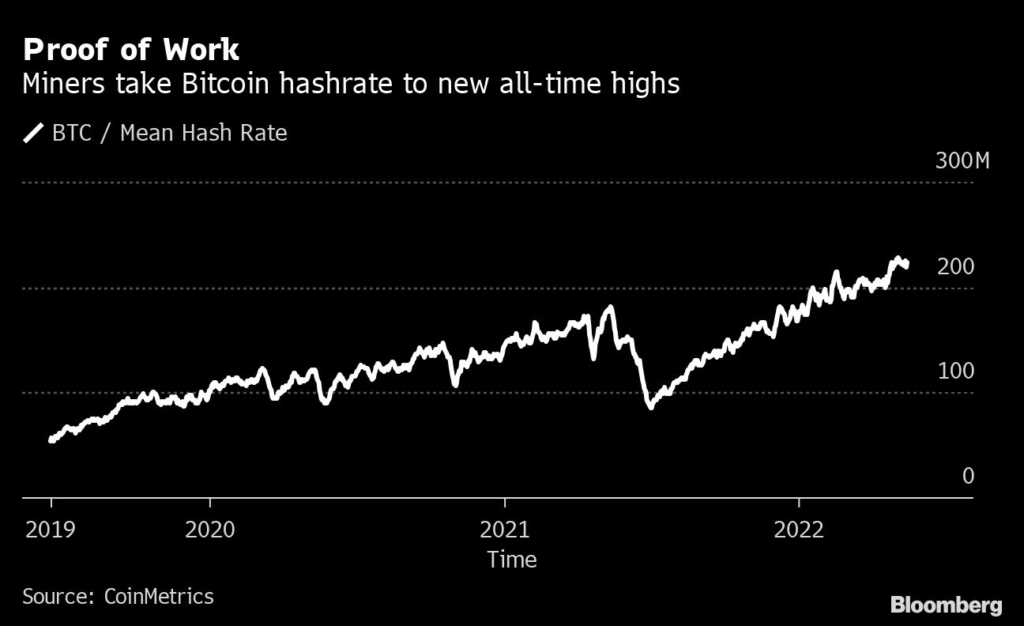
The US accounted for 37.84% of global hashrate, a measure of computing power used to extract the digital currency, between September 2021 to January, according to the Cambridge Centre for Alternative Finance, in a report released on Tuesday. The hashrate, also responsible for securing the Bitcoin network, has made a strong comeback to new highs after falling last year. 

Following the mining ban in China last year, the country has seen a sudden surge in activity through “covert mining operations” and has “re-emerged as a major mining hub” grabbing 21.11% of global hashrate, according to the CCAF.

“This strongly suggests that significant underground mining activity has formed in the country, which empirically confirms what industry insiders have long been assuming,” CCAF wrote in the report. In May (2021), Beijing intensified its efforts to curb the cryptocurrency market. It seems covert mining is still happening in China through routed through virtual private networks that make it appear the computers are operating in another country. 

While covert mining operations may be a cause of this resurgence, CCAF’s methodology, which is based on aggregating geolocation data given by partner mining pools, is prone to errors as many miners miners might hide their identity using proxy services like VPNs. 

Kazakhstan was third at 13.22%, followed by Canada taking 6.48% of global hashrate.  Russia accounted for 4.66%, and has seen cryptocurrency mining operations relegated elsewhere, said the report.     

More stories like this are available on bloomberg.com

©2022 Bloomberg L.P.

Hong Kong Considers Blocking Telegram, Local Paper Says

(Bloomberg) — Hong Kong authorities are deliberating whether to curtail public access to the messaging service Telegram, the Sing Tao Daily reported, potentially reviving fears the former British colony is moving closer toward Beijing-style internet controls.

The Privacy Commissioner for Personal Data is considering invoking regulations for the first time to restrict access to a platform it found to be rampant with doxxing, the local newspaper reported Tuesday. The widespread doxxing — or online exposure of sensitive and personal data — was aimed at government officials as well as citizens, the newspaper said, citing unidentified people.

If taken, such an action is likely to stoke fears that national security legislation enacted in 2020 will further encroach on civil liberties, as part of a continuing effort by Beijing to exert its influence over the city. The report comes days after the appointment of a new leader who’s a vocal supporter of the China-imposed national security law. A representative for the Hong Kong government didn’t immediately respond to requests for comment.

Read more: China’s Great Firewall Looms Over Hong Kong As Surveillance Grows

An overhaul of Hong Kong’s political institutions in past years has already crushed the city’s pro-democracy movement and fueled warnings of an end to the city’s status as a free-wheeling commercial hub. But the authorities have so far avoided curbs on the internet akin to China, where a plethora of foreign services from Facebook to Google and Twitter are banned under what’s known as the Great Firewall.

Telegram supports free speech and the right of users to protest peacefully, a representative for the company said. “However, content that discloses personal information without consent (doxxing) is not allowed and routinely removed,” the spokesperson said in a messaged statement.

It’s unclear how the privacy watchdog intends to carry out such an action. Blocking internet sites or apps often requires the cooperation of local service providers, such as in 2021 when Hong Kong police invoked the national security law to block access to HKChronicles. The authorities may choose to fully block public access, or eradicate the app from the city’s stores, the paper added, citing the unidentified people.

The privacy watchdog declined to comment on Sing Tao’s report but said it’s empowered to block public access to messages on platforms it considers doxxing. “The PCPD will take appropriate enforcement actions to combat unlawful doxxing behaviour in order to minimise the harms done to the victims,” it said in a statement.

If Hong Kong goes ahead, it would be the latest in a series of measures by authorities to crack down on doxxing, after details of police officers and other public officials were released by 2019 protesters. In September, Hong Kong strengthened data privacy laws to prevent doxxing, a move that spooked big tech giants.

Officials will consider public views before taking a decision, the paper said. Telegram channels are still widely used to help residents stay up-to-date on court cases involving pro-democracy activists, a means for 2019 anti-government protest supporters to stay connected amid a crackdown on dissent by the authorities.

(Updates with Telegram’s comment in the 7th paragraph)

More stories like this are available on bloomberg.com

©2022 Bloomberg L.P.
Harvard Grad Seeks Investor to Help Togo Slash Internet Costs

(Bloomberg) — Cina Lawson, Togo’s minister of digital economy and transformation, is seeking an investor to help build internet services in the West African nation and help slash costs.

The Harvard University graduate expects the project, which will use Togo’s power-line infrastructure to lay fiber cable, to cost about 350 million euros ($431 million). The government will borrow about 250 million euros from multilateral institutions such as the World Bank, while the investor would provide the balance, the minister said. 

Togo is working on a law to lure startups, and expects cheaper and wider internet access to improve the path to education and pull millions out of poverty. The nation of about 8.5 million people is poised to get high internet speeds by 2025 after the Equiano subsea internet cable, part of Google’s $1 billion program to build digital capacity in Africa, landed on its shores. 

“We want to make sure that we continue to invest in fiber in the country so that the capacity goes everywhere,” Lawson said at the Bloomberg Invest: Focus on Africa conference in London. “We’re looking for financing. We want to put two-thirds of the money and have the private sector put one third.”

“It’s about making sure that the risk in investing in Togo is low enough to attract the right kind of investor,” she said.

The project will expand connectivity in a country that has among the highest mobile-data costs on the continent at $8.64 per gigabyte, according to the Alliance for Affordable Internet, a global coalition of governments, companies and civil society that advocates for better internet access. 

Togo may this year issue a tender seeking investors to build the internet network. Once ready, it will help cut digital costs by as much as 75%, said Lawson, who grew up in Paris and was invited to join the government in 2009. 

Lawson recorded an early success leading the creation of a digital system for delivering monthly payments to about a quarter of Togo’s adult population during the Covid-19 pandemic. The whole system, which used artificial intelligence algorithms to determine beneficiaries, was created within two weeks to rush the payment to people where average income is below $2 a day. 

“We want to be able to share this with other African countries because a lot of them reached out to us saying they want to be able to do the same thing,” she said. “Some of our countries don’t have biometric ID and you want to make sure that when you pay people, you’re paying real individuals.”

Togo is close to finalizing a program modeled on India’s biometric database known as Aadhar, she said. People who are assigned an ID would also be given SIM cards and a mobile-money account so every national with an ID would also be financially included.

“Africa needs the best of technology in order to grow,” Lawson said. “We are willing to be the test bed for new approaches.” 

More stories like this are available on bloomberg.com

©2022 Bloomberg L.P.

NatWest Explores a Separate Online Lender for Small Businesses

(Bloomberg) —

NatWest Group Plc is considering launching a separate digital lender for small businesses in the UK to find a new avenue of growth for the bank.

The plan would bring NatWest together with Brussels-based Aion through a new joint venture, according to people familiar with the matter, who asked not to be named because the negotiations are private.

Aion has a banking license and already operates in several countries including Belgium and Poland. A deal would also involve its technology provider, Vodeno, whose data capabilities could help NatWest attract smaller business customers that traditional banks would normally consider uneconomic. Both are owned by US private equity firm Warburg Pincus. 

The UK lender could also explore using the pair’s technology to offer financing to customers shopping at retailers, via what is known as “banking as a service.”

NatWest’s venture would add to its already dominant presence in UK business banking, where it has about one million customers, or one in four companies. 

The plan has won tentative backing from senior individuals within NatWest but is still at an early stage of development, according to the people. If it goes ahead, both NatWest and Warburg Pincus could inject capital into the joint venture to fund Aion’s expansion into the UK. 

Growth Plans

NatWest is hunting for growth opportunities after more than a decade under the control of the UK government, which cut its stake to 48% in March. Alison Rose, NatWest’s chief executive officer, bought a book of mortgages from Metro Bank in a £3.1 billion deal in 2020 and last year added RoosterMoney, an app aimed at helping children manage their cash. 

The Edinburgh-based bank has also held talks with the private equity owners of consumer credit business NewDay, whose initial public offering was postponed during market volatility earlier this year, according to one person familiar with the matter, who asked not to be named discussing non-public information. 

NatWest declined to comment on Aion or any other potential transaction. Spokespeople for Warburg Pincus and Aion also did not comment. 

Executives believe that while small, Aion offers a technology platform that could make it cheaper to reach new customers and to offer more services such as accounting, according to one person familiar with the matter. Any lessons could be brought back into NatWest’s main SME operation. 

Fintech Experiments

NatWest has already made several attempts to harness fintech, the catch-all term for banking services underpinned by online platforms instead of brick-and-mortar branches. It launched Bo, a digital retail lender, in 2019 but closed it six months later and folded the business into Mettle, which was established to serve SMEs. Mettle’s chief executive, Marieke Flament, departed in December. She has been replaced by Andrew Ellis, who is also NatWest’s head of digital assets. 

Big banks are spending billions on both system upgrades and dealmaking in the search for technological advantages. Lloyds Banking Group Plc and JPMorgan Chase & Co. considered buying UK digital lender Starling Bank Ltd. in 2020, the Times reported at the time. JPMorgan went on to buy wealth manager Nutmeg, and launched a British retail bank under the Chase brand last year. Others such as Spain’s Banco Bilbao Vizcaya Argentaria SA are competing with fintechs to develop banking as a service offerings.

NatWest has already struck technology collaboration deals in other areas, including with fintech Pollinate to offer merchant acquiring payments services to small business customers on a platform called Tyl. 

Aion Bank was created following Warburg Pincus’s acquisition of the Belgian subsidiary of Italian banking group Monte dei Paschi di Siena in 2019. 

More stories like this are available on bloomberg.com

©2022 Bloomberg L.P.

Close Bitnami banner
Bitnami