
Bloomberg

Insight Bet Values Banking Software Startup Unit at $1.2 Billion

(Bloomberg) — Insight Partners led a $100 million equity funding round that values financial-technology startup Unit at $1.2 billion, almost quintuple the $255 million it last commanded.

New York-based Unit, which makes software that allows companies to offer banking products such as payments, lending and credit cards, is at the “epicenter” of disruption, co-founder and Chief Executive Officer Itai Damti said in an interview.

“What used to take companies 18 months to build now takes weeks,” he said. “We’re entering the most transformational phase in the history of financial services.”

The valuation represents a multiple of 67 times Unit’s projected 2022 revenue of $18 million, a metric that Insight managing director Nikhil Sachdev said isn’t uncommon for early infrastructure software companies.

“Unit has executed really well, especially through the rapid acceleration of its customer adds,” Sachdev said, referencing Unit’s more than 140 clients since its 2019 launch. Unit’s bank partners include Piermont Bank, Blue Ridge Bank and Choice Bank, Damti said. 

Unit’s software powers banking offerings by companies like AngelList, Roofstock, Invoice2Go, Forage and Mos, Damti said. With Unit’s help, Forage enables online grocers to accept payment from government food-assistance programs while Mos — which counts U.S. college students as its main customers — expanded into debit cards and fee-free checking and savings accounts, he said.

In the six months through April 30, Unit’s deposit volume grew roughly tenfold to more than $100 million, and its end-customers more than tripled to about 330,000, Damti said. Annualized transaction volumes are $2.6 billion. 

Including the new funding, Unit’s balance sheet should sustain its growth through 2032, Damti said. “We’re conservative in how we spend money, especially in this climate,” he added.

Accel, Better Tomorrow Ventures, Flourish Ventures, Moving Capital and Stepstone also participated in the funding round. Proceeds will be used in part to hire staff and accelerate product development. Unit has plans to launch business credit cards and other products such as cash advance, early wage access and invoice factoring.

More stories like this are available on bloomberg.com

©2022 Bloomberg L.P.
JD.com Revenue Jumps, Defying China Lockdown Hit to Spending

(Bloomberg) — JD.com Inc. logged better-than-expected 18% revenue growth, after China’s second-largest e-commerce operator grew market share to cushion the blow from Covid lockdowns across the country’s biggest cities.

Sales climbed to 239.7 billion yuan ($35.6 billion) in January-March, beating the 236.7 billion yuan average of analyst forecasts. It reported a net loss of 3 billion yuan. JD’s stock surged more than 8% in pre-market trading in New York.

JD and larger rival Alibaba Group Holding Ltd. are grappling with the economic fallout from the coronavirus-related lockdowns that have snarled logistics to cities such as Shanghai. Heavily reliant on domestic sales, JD has been expanding brand offerings to tempt shoppers. Alibaba is expected to post its slowest quarterly growth in revenue since its 2014 listing.

Read more: Tencent, Alibaba Look Like Utilities After $1 Trillion Drubbing

Billionaire Richard Liu’s online shopping empire has largely avoided a direct hit from Beijing’s crackdown on China’s biggest tech companies. Fines on Alibaba by Chinese antitrust watchdogs even helped the company gain access to brands like Starbucks and Estee Lauder, which had been previously exclusively tied to Alibaba in China. 

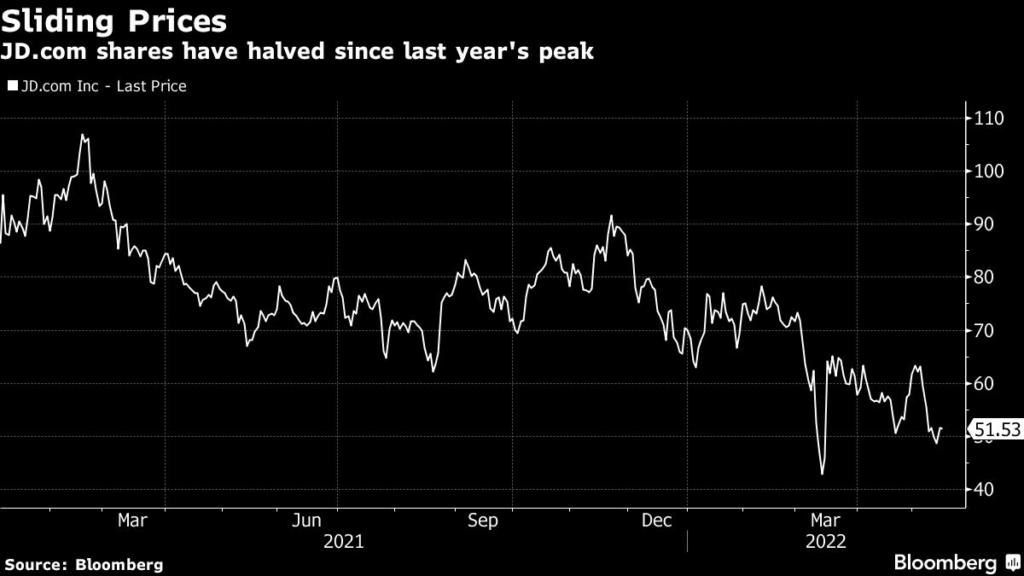
But ongoing concern about China’s priorities, the fallout from the country’s Covid lockdowns, along with US regulators’ plans to possibly force JD and some of China’s biggest companies to delist, are weighing on the stock. JD’s market valuation has shrunk by about 50% from a high last year.

Read more: China’s Economic Activity Collapses Under Xi’s Covid Zero Policy 


(Updates with share spike from the second paragraph)

More stories like this are available on bloomberg.com

©2022 Bloomberg L.P.

Elon Musk Says Twitter Must Prove Bot Claims for $44 Billion Deal to Proceed

(Bloomberg) — Elon Musk declared he won’t proceed with his $44 billion takeover of Twitter Inc. unless the social media giant can prove bots make up fewer than 5% of its users, casting yet more uncertainty over the deal.

The billionaire tweeted “this deal cannot move forward” unless Twitter provides proof of its claims, reiterating his own view that the ratio is far higher.

Musk’s latest online pronouncement complicates an already chaotic takeover, potentially one of the largest acquisitions the internet industry has ever seen. He recently butted heads online with Twitter chief Parag Agrawal over the way the social media giant accounts for bots, stoking speculation Musk may try to lower the price or even walk away.

Twitter’s shares fell another 3.2% in pre-market trading in New York, after sliding more than 8% the previous day. The spread between Musk’s offer price of $54.20 and its last trading price is currently about 40%, suggesting investors think there is little chance the deal will get done without a discount — if at all. 

Twitter said it is “committed to completing the transaction on the agreed price and terms as promptly as practicable,” in a statement on Tuesday. 

“If a revised deal does get done by Musk and Twitter,” said Dan Ives, analyst at Wedbush, “it will likely will be at a much lower price once negotiations take over and the diligence happens around Twitter DAU and algorithms hot button issues.

EXPLAINER: Why Elon Musk and Twitter CEO Are Sparring Over Bots

The battle over bots has become a sticking point for Musk, who told a tech conference in Miami on Monday that fake users make up at least 20% of all Twitter accounts, possibly as high as 90%. Twitter regularly states in its quarterly results that the average of false or spam accounts “represented fewer than 5% of our monthly daily active users during the quarter,” adding that it applied “significant judgment” to its estimate, and the true number could be higher.

Musk encouraged Twitter users to run their own tests for bots, crowd-sourcing the effort to calculate whether they made up less than 5% of the service. Responding to Musk’s assertions, Agrawal posted a long thread laying out his company’s methodology. Musk replied by first asking why Twitter doesn’t just call users to verify their identity — and then by posting a poop emoji.

The proposed takeover includes a $1 billion breakup fee for each party, which Musk will have to pay if he ends the deal or fails to deliver the acquisition funding as promised. It is unclear whether an update by Twitter on the number of fake accounts — if materially larger than 5% — would trigger a so-called material adverse effect clause, releasing Musk from the breakup fee. 

The latest barrage of tweets from the world’s richest person is yet another twist in Musk’s attempted takeover of the micro-blogging site. A prolific user with over 90 million followers, he revealed a stake of more than 9% in the company last month, then launched an unsolicited takeover offer — without detailed financing plans — all within a matter of weeks.

Musk caused the potential cracks in the deal to widen last week when he tweeted that his offer to buy Twitter was “temporarily on hold” until he gets more information about the proportion of fake accounts. Roughly two hours later, Musk claimed in another tweet that he was “still committed” to the deal.

(Update with additional context, response from Twitter, analyst comment. Earlier version corrected deal price.)

More stories like this are available on bloomberg.com

©2022 Bloomberg L.P.
Berkshire Tweaks Bank Play With $2.9 Billion Bet on Citi

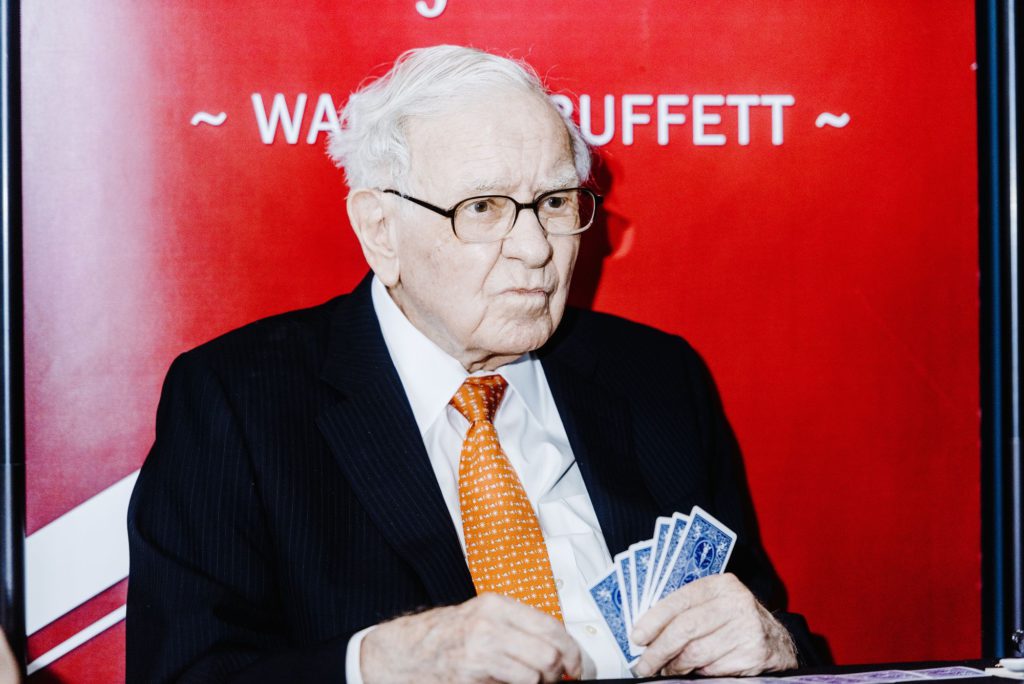
(Bloomberg) — Warren Buffett’s Berkshire Hathaway Inc., which cut many bank holdings as the pandemic bore down on the US, is back with a roughly $2.9 billion bet on Jane Fraser’s Citigroup Inc. even as it said goodbye to a long-time stake in Wells Fargo & Co.

The company also added a $2.61 billion bet on Paramount and a nearly $390 million stake in Ally Financial Inc., according to a regulatory filing Monday. Buffett’s firm also disclosed new stakes in McKesson Corp., Markel Corp. and Celanese Corp.

Berkshire has spent recent years revamping its bank bets. It pulled back from big-name investments including stakes in JPMorgan Chase & Co. and Goldman Sachs Group Inc., while sticking with Bank of America Corp. and US Bancorp. Wells Fargo, an investment made more than three decades ago by Berkshire, has been whittled down and finally disappeared from the quarterly filing this time around.

Berkshire’s now betting on Citigroup as new management takes over. Citigroup’s shares have been languishing even as new CEO Fraser seeks to refocus on higher-returning businesses like wealth management and treasury offerings. The shares have traded below book value — a sign that investors believe executives are actively destroying shareholder value — since 2018. A Citi spokeswoman declined to comment.

Citigroup shares rose as much as 5.4% in premarket trading.

Buffett, Berkshire’s chief executive officer and chairman, and his investing deputies have been on one of Berkshire’s biggest buying sprees, with about $41 billion of net purchases during the first quarter. That’s the most in data going back to 2008.

Buffett’s company had disclosed some ramped-up bets ahead of the filing. It expanded wagers tied to oil, with purchases of Occidental Petroleum Corp. stock and a bigger investment in Chevron Corp. that vaulted that holding among Berkshire’s top-four stock bets. The company also built out an investment in Activision Blizzard Inc. as part of a merger arbitrage play to wager that the deal with Microsoft Corp. will close. And it moved further into the technology realm with a wager on HP Inc. disclosed in April.

The filing Monday reveals that the buying spree went even deeper. Berkshire now owns a $1.13 billion stake in chemical maker Celanese, as well as an $895 million holding in McKesson. The company also boosted stakes in General Motors Co. and furniture company RH. 

Berkshire pulled back on certain bets. The Verizon Communications Inc. stake was down 99% in the first three months of the year. The company’s filing no longer showed stakes in AbbVie Inc. and Bristol-Myers Squibb Co.

(Adds premarket trading in fifth paragraph.)

More stories like this are available on bloomberg.com

©2022 Bloomberg L.P.
Startup Funding Set to Slow in Canada as Volatility Hits Home

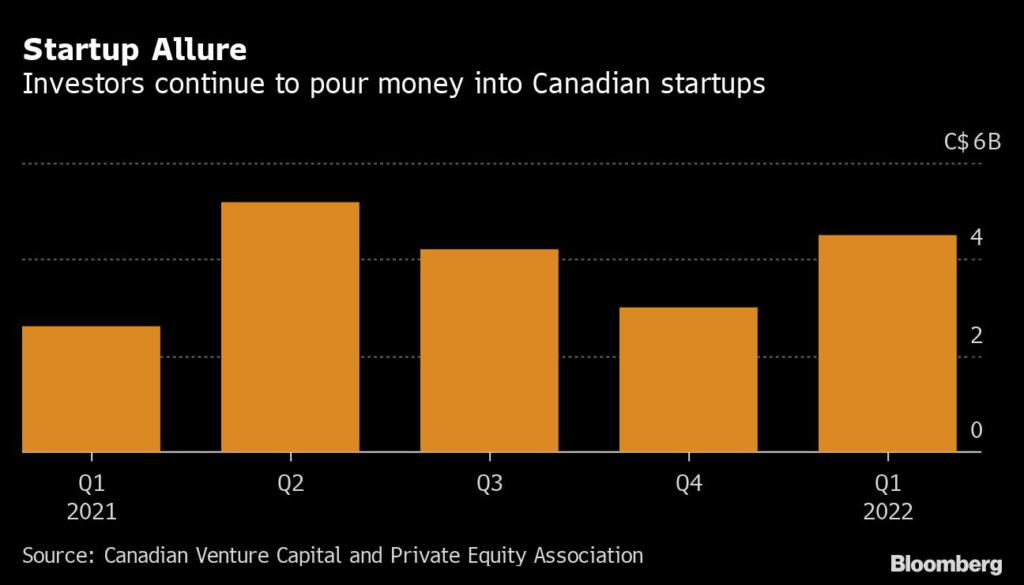
(Bloomberg) — Investments in Canadian startups reached C$4.5 billion ($3.5 billion) in the first quarter, the second-highest level on record, but the pace is slowing as the stock market correction makes deals less appealing, according to an industry group. 

“Venture capital activity in 2022 will likely see a delayed reaction to the slowdown experienced on public markets,” according to the Canadian Venture Capital and Private Equity Association. 

About 70% of the venture investments went into the information, communications and technology sector, the CVCA said. “I think a lot of that activity was residual from the fourth quarter of last year,” Kim Furlong, the association’s chief executive officer, said in an interview. “We’re seeing some slowdown on that front.” 

Divestments dropped significantly during the quarter, with only 12 exits and no initial public offerings. In the report, Furlong described the slowdown as “as a period of waiting for both investors and companies in a choppy public market.”  

The stock market decline has weighed on valuations, making IPOs less appealing to investors who are factoring in higher inflation, rising interest rates and geopolitical risks. The S&P 500 has dropped 15.9% this year and some traders don’t see the market bottoming out yet. 

In a separate report, the CVCA said there were a record 42 private equity exits in the first quarter — none by IPO. Private equity firms closed 212 Canadian deals with a combined value of C$1.4 billion, with most deals happening among small- and medium-sized enterprises

“We are seeing some signs in clouds on the horizon,” Furlong said, adding that she expects venture capital activity to “normalize” in the second quarter and private equity to remain stable. 

More stories like this are available on bloomberg.com

©2022 Bloomberg L.P.
Getty to Sell NFTs in Multiyear Deal With Fanatics-Owned Candy

(Bloomberg) — Getty Images Inc. has signed a multiyear deal with Candy Digital, the digital collectibles firm owned by Fanatics Inc., as the provider of news and stock photos breaks into the nonfungible-token business ahead of its plans to go public.

As part of the agreement, the pair will develop a range of NFT products from Getty’s sizable library and archive, made up of nearly 500 million images. They’re preparing to release digital formats of rare analog works as well as modern images across culture, art and world events. Financial terms weren’t disclosed.

“It’s very analogous to our physical-print business, as we sell prints across entertainment and sports and celebrity,” Getty Chief Executive Officer Craig Peters said in an interview. “We’re bringing a similar capacity to the NFT space.”

Digital collectibles became a popular alternative asset last year as investors looked for new places to put their money. The market has since cooled off after a rough start to the year, with transaction activity down, but cryptocurrency wallets still sent more than $37 billion to NFT marketplaces in the first four months of 2022, according to data from crypto research firm Chainalysis.

Peters said he isn’t worried about the ups and downs of the market as Getty is in it for the long term. He said a storied brand like Getty can help build confidence over time in a sector that’s saddled with trust issues between consumers and sellers due to fakes and fraud. Still, brands from sports franchises to fashion houses have gotten involved in the market, creating a busy competitive landscape. Rival photo service the Associated Press began selling its own NFTs on a new marketplace in January.

Digital Collections

Getty hasn’t yet set sales projections for its new business line as it prepares to go public in the first half of the year through a merger with a special purpose acquisition company backed by investment firms CC Capital and Neuberger Berman. The deal, currently pending approval from the US Securities and Exchange Commission, values the company at $4.8 billion.

Candy Digital, meanwhile, is making its first move outside sports as Fanatics looks to broaden its scope, adding to ongoing agreements with Major League Baseball, World Wrestling Entertainment Inc. and the Race Team Alliance. Executives have said they’re seeking more deals with leagues, teams and individual athletes.

For owner Fanatics, Candy is a key piece of CEO Michael Rubin’s aspirations as he expands beyond the company’s roots in sports merchandise into sectors such as trading cards and sports betting. In October, a funding round led by private equity firm Insight Partners and SoftBank Vision Fund 2 valued Candy at $1.5 billion.

“It’s about creating what I hope will look a lot like our other partnerships which are decades long, like the NBA or BBC,” said Peters.

More stories like this are available on bloomberg.com

©2022 Bloomberg L.P.
Stocks, Futures Jump Amid Risk-On Mood; Bonds Fall: Markets Wrap

(Bloomberg) — Stocks in Europe rose Tuesday along with US equity futures as risk appetite returned to markets roiled in recent weeks by concerns about global economic growth, surging prices and policy tightening. Treasury yields rose and the dollar retreated. 

Technology stocks led a broad-based advance of the Stoxx Europe 600 following a rally in Chinese tech shares on optimism Beijing may ease up on a yearlong clampdown. Equities were also buoyed by data showing the euro-area economy expanded more than initially estimated at the start of the year as the region moved past a wave of Covid-19 infections and defied headwinds from the early days of the war in Ukraine. 

Contracts on the S&P 500 bounced back after a Wall Street drop, while futures on the tech-heavy Nasdaq 100 jumped more than 2%. Citigroup Inc. rose 4.5% in premarket trading Warren Buffett’s Berkshire Hathaway took a stake in the lender. Tech names including Advanced Micro Devices Inc. Tesla Inc. and Qualcomm Inc. were among the biggest pre-market gainers.

A challenging global economic outlook amid elevated food and fuel costs and tightening monetary settings continues to shape sentiment, although one bond-market measure — the five-year breakeven rate — is signaling inflation may have peaked. Oil has jumped to about $114 a barrel and an index of agricultural prices is at a record high.

“All-in-all, the price action is suggestive of a market that can’t decide what it wants to do,” said Jeffrey Halley, a market analyst at Oanda. “Concerns around recessions make me feel that a decent correction lower from the dollar and US yields is increasingly likely. I’m still not sure it provides markets with a reason to turn long once again on equities.”

Bond yields across Europe rose, with the 10-year U.K. rate climbing as much as 10 basis points as traders added tightening bets after strong jobs data. The pound strengthened more than 1% to a two-week high against the dollar.

An Asian share index rose for a third day — its longest winning streak since mid-March — amid a jump in some technology firms and as investors assessed China’s efforts to stamp out Covid. A meeting Tuesday between the nation’s top regulators and corporate giants raised hopes the battered tech sector is near a turning point.

Meanwhile, Shanghai reported three days of zero community transmission, a milestone that could lead officials to start unwinding a punishing lockdown. Flareups elsewhere in China showed how hard it is to tackle the omicron strain.

Cryptocurrencies weathered the latest stablecoin turbulence, with Bitcoin rising above the $30,000 mark.

New York Fed President John Williams on Monday downplayed deteriorating liquidity conditions in financial markets, saying it was to be expected as investors grapple with uncertainty over global events and shifting U.S. monetary policy. Fed speakers including Chair Jerome Powell are due to speak later Tuesday. 

What damage will be done to the US economy and global markets before the Fed changes tack and eases policy again? The “Fed Put” is the theme of this week’s MLIV Pulse survey. Click here to participate anonymously.

What to watch this week:

  • Fed Chair Jerome Powell among slate of Fed speakers Tuesday
  • Reserve Bank of Australia releases minutes of its May policy meeting Tuesday
  • G-7 finance ministers and central bankers meeting Wednesday
  • Eurozone, UK CPI Wednesday
  • Philadelphia Fed President Patrick Harker speaks Wednesday
  • China loan prime rates Friday

Some of the main moves in markets:

Stocks

  • The Stoxx Europe 600 rose 1.7% as of 10:52 a.m. London time
  • Futures on the S&P 500 rose 1.7%
  • Futures on the Nasdaq 100 rose 2.2%
  • Futures on the Dow Jones Industrial Average rose 1.2%
  • The MSCI Asia Pacific Index rose 1.5%
  • The MSCI Emerging Markets Index rose 2%

Currencies

  • The Bloomberg Dollar Spot Index fell 0.3%
  • The euro rose 0.3% to $1.0470
  • The Japanese yen fell 0.2% to 129.36 per dollar
  • The offshore yuan rose 0.5% to 6.7648 per dollar
  • The British pound rose 1% to $1.2445

Bonds

  • The yield on 10-year Treasuries advanced three basis points to 2.91%
  • Germany’s 10-year yield advanced five basis points to 0.99%
  • Britain’s 10-year yield advanced seven basis points to 1.80%

Commodities

  • Brent crude rose 0.6% to $114.96 a barrel
  • Spot gold rose 0.2% to $1,827.09 an ounce

More stories like this are available on bloomberg.com

©2022 Bloomberg L.P.

US, European Firms Rethink China Investment After Lockdowns

(Bloomberg) — US and European businesses are reconsidering their investments in China after the lockdown in Shanghai and restrictions in other cities caused major disruption to their operations.

The American and European Union chambers of commerce in separate briefings said their members are rethinking their supply chains and whether to expand investment in the face of China’s zero tolerance approach to combating Covid-19.

“The Covid lockdowns this year and the restrictions over the past two years are going to mean that three, four, five years from now, we will most likely see investment decline,” Michael Hart, president of the American Chamber of Commerce in China, said Tuesday in Beijing. 

While this doesn’t mean an immediate shift outside of China, Hart said that many firms that source from China are asking where else they can get supplies, and whether they should be building or sourcing from somewhere else.

The outlook is shared by European companies. Many members of the European Union Chamber of Commerce in China are putting investment plans on pause and starting to consider whether to leave the country, the business group’s representatives said at a briefing Monday. Uncertainties about a potential next wave of outbreaks are taking a heavy toll on business confidence, they said.

“Uncertainty is really the keyword, because there’s no view, no outlook about how long this could last, and what will be next after Shanghai,” said Massimo Bagnasco, vice president of the European chamber.

Read More: China Vows to Ease Supply Chain Woes in Foreign Chamber Meeting

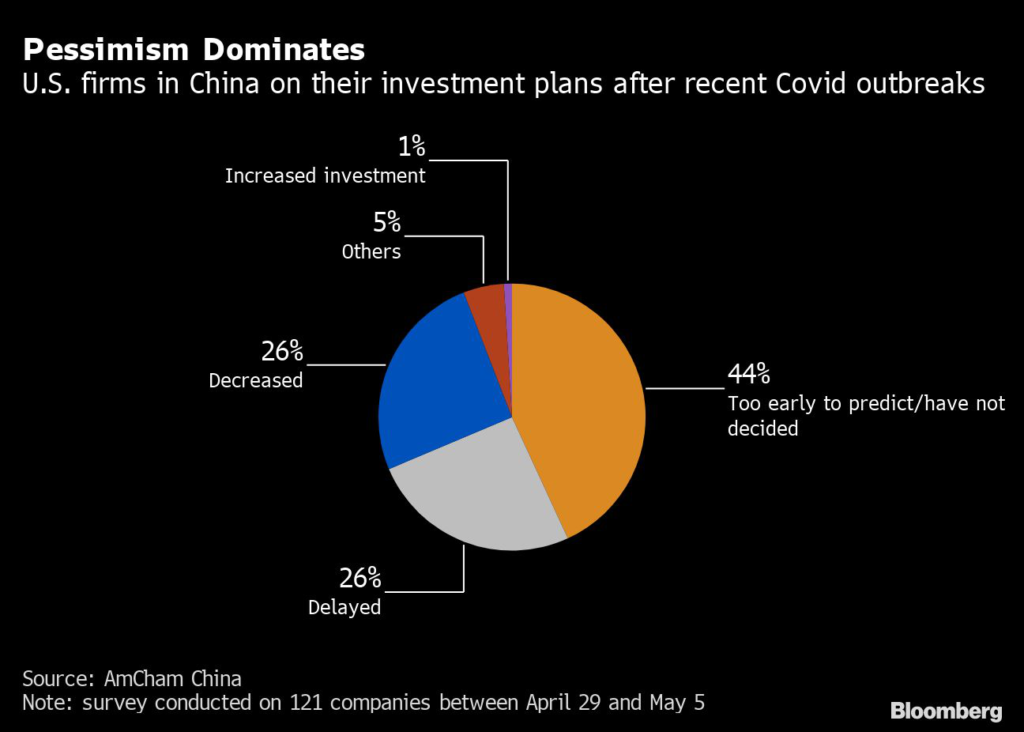
Profits of foreign firms in China are falling, and companies have become increasingly vocal about the impact on their businesses from Covid lockdowns and restrictions. Earlier this month, more than half of US firms said they were reducing or delaying investment plans and expected lower revenue due to the economic fallout from extended lockdowns, which have clogged the world’s biggest port, closed highways and shuttered factories and businesses. 

And last week, respondents to a survey by the German Chamber of Commerce in China reported that nearly 30% of their foreign employees had plans to leave China because of Covid. The chamber surveyed 460 companies.

The restrictions that began in March in Shanghai and elsewhere come on top of existing travel controls, which have made it hard for employees of foreign firms to travel to China or visit headquarters overseas.

The travel restrictions have left AmCham “very concerned” about US and other foreign investment into China, Hart said at a press conference to launch the chamber’s 2022 White Paper. 

China usually ranks among the top three destinations for investment among AmCham’s member companies, but “it is falling in preference,” Hart said, adding that if people can’t travel to the country, it will “decline as an investment destination.”

Political pressure is also building on US companies to reduce their reliance on China. US Treasury Secretary Janet Yellen on Tuesday called on the US and Europe to coordinate their approach toward China, saying that they have a “common interest in incentivizing China to refrain from economic practices that have disadvantaged us all.”

“We have become too vulnerable to countries using their market positions in raw materials, technologies, or products to exercise geopolitical leverage or disrupt markets for their own gain,” she said during a speech in Brussels.

European businesses continue to face challenges including lost production days, labor shortages and supply chain and logistics disruptions due to lockdown measures. The pressure to leave China will rise significantly if the obstacles don’t improve by the end of the year, said Joerg Wuttke, president of the chamber.

The economy is also unlikely to rebound this time around as sharply as it did in 2020 because of ongoing headwinds from the crackdown on the technology sector, a persistent property market slump, and capital flowing out of China as the China-US interest rate differential diminishes, according to Wuttke.

Read more: China’s Covid Exit Hinges on Seniors Who Don’t Want Vaccines

Wuttke urged China to accelerate its vaccination efforts, as the vaccine uptake among those older than 65 has slowed in recent months. 

“You cannot hold an economy hostage by 150-to-160 million people that are insufficiently vaccinated,” he said. “This has to change, it can’t go on forever.”

(Updates with details about Janet Yellen’s Brussels speech from paragraph 12.)

More stories like this are available on bloomberg.com

©2022 Bloomberg L.P.
Moving App Updater Secures $215 Million in Vista Equity Backing

(Bloomberg) — Updater Inc., an app and technology developer for residential relocation services, has received $215 million in financing from the credit investment arm of Vista Equity Partners.

The funds from Vista Credit Partners, a subsidiary of the Austin, Texas-based private equity firm, will be used as growth capital, according to a statement provided to Bloomberg News. Updater plans to accelerate its investments in research and development, workforce talent, new products and user features, and also to expand into more industry verticals, the company said. 

“Raising debt is a way of betting on ourselves and I’d rather defer the dilutionary hit to a future period of time when our valuation should be materially greater,” David Greenberg, founder and chief executive officer at Updater, told Bloomberg News. “We’re very confident in our company’s ability to execute and I’m bullish on our growth prospects.”

Headquartered in New York, Updater helps customers with relocation services throughout the moving process. Inspired by the complexities of his own moves between New York City apartments, Greenberg founded the company in 2010. Today the mobile app serves as a one-stop platform for packing supplies, labor assistance, transfer of utility services, internet and television connectivity, home insurance and more.

Updater generates money from commissions from service providers when customers book them using the app’s platform. According to Greenberg, the business generated more than $100 million in revenue in 2021.

Vista Credit Partners President David Flannery said the firm “looks to partner with founders of companies that have a strong market position and a mission-critical product suite, both of which we found in Updater, by providing non-dilutive capital solutions.”

More stories like this are available on bloomberg.com

©2022 Bloomberg L.P.

China Tech Stocks Surge on Bets Crackdown to Ease, JPM’s Shift

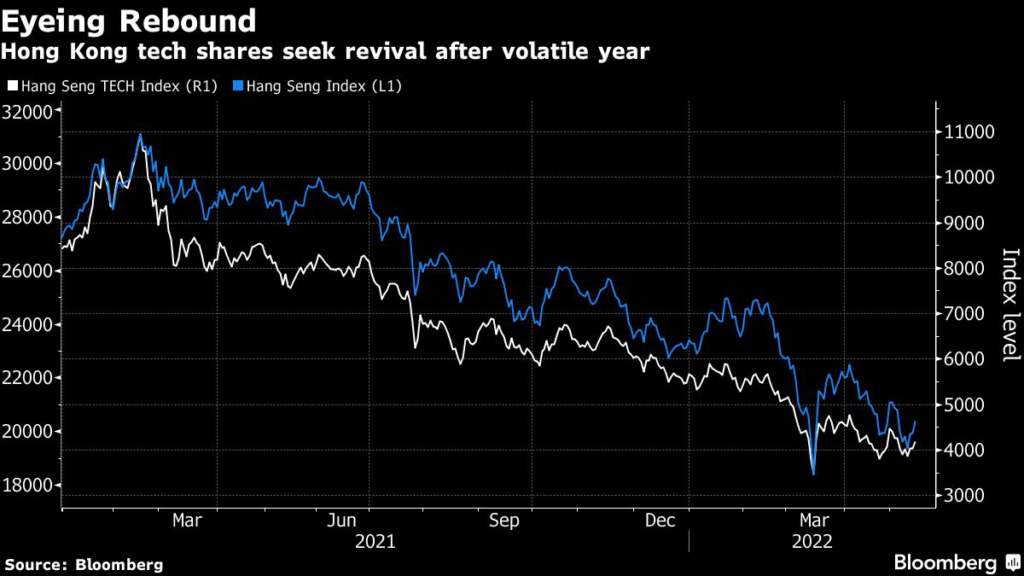
(Bloomberg) — Chinese tech stocks jumped as traders bet a key meeting Tuesday between the nation’s top regulators and corporate giants would result in Beijing dialing back its yearlong clampdown of the industry. 

The Hang Seng Tech Index rallied 5.8%, the most this month, with Sunny Optical Technology Group and Li Auto Inc. the top performers. JD.com Inc. also traded higher ahead of its earnings later in the day.

China’s top political advisory body is hosting a symposium related to the digital economy, according to state media. While the outcome wasn’t released within trading hours, a Reuters report showed Chinese Vice Premier Liu He is scheduled to speak at the meeting also attended by private-sector executives like Baidu Inc. founder Robin Li. Investors closely watched for clues to whether the rout in technology stocks could near an end. 

Signs of a turnaround in the tech sector may be already underway. On Monday, JPMorgan Chase & Co. analysts upgraded a number of tech firms including Alibaba Group Holding Ltd. and Tencent Holdings Ltd. to overweight from underweight just two months after deeming the sector “uninvestable”. 

“Market may trade ahead of it, then wait to see the outcome to adjust the view,” said Willer Chen, analyst at Forsyth Barr Asia Ltd., referring to the tech meeting. 

Following the yearlong crackdown on private enterprise, a number of top officials have vowed to stabilize markets in recent months. That’s given rise to bets that the worst days of tech regulations may be over.

Expectations that Shanghai may soon ease its strict lockdown measures are also adding to hopes after the city reported no community cases for a third day. 

Still, it’s not clear whether the rules will be relaxed significantly enough to give markets a sustainable boost. China’s dogged adherence to zero tolerance for Covid has hit industrial output and consumer spending. 

On the mainland, the CSI 300 Index gained 1.3%. The Hang Seng Index rose 3.3%.

More stories like this are available on bloomberg.com

©2022 Bloomberg L.P.

Close Bitnami banner
Bitnami