Bloomberg

SpaceX Employees Offer to Sell Shares at $125 Billion Valuation

(Bloomberg) — SpaceX employees are offering to sell shares via a private placement that would value Elon Musk’s launch and satellite company at around $125 billion, according to people familiar with the matter.

The shares are being offered in a so-called employee tender at $70 each, the people said, asking not to be identified because the details are private. That compares with a split-adjusted $56-a-share during a sale in October at a valuation of about $100 billion.

It’s unclear whether Musk is selling stock as part of the employee tender, the people said. The size of the offering couldn’t immediately be determined.

Read more: Musk Seeks to Scrap Tesla Margin Loan With New Twitter Funding

SpaceX didn’t respond to a request for comment outside regular business hours. The New York Post reported the share placement plan earlier.

Musk has been seeking a variety of funding sources to complete his agreement to purchase Twitter Inc. On Monday he suggested the deal for the social media platform might be completed at a lower price, days after he questioned Twitter’s ability to estimate how many accounts are spam or fake.

More stories like this are available on bloomberg.com

©2022 Bloomberg L.P.

India’s Byju’s Eyes Chegg or 2U as It Weighs US Acquisition

(Bloomberg) — Byju’s, an India online education startup, is in discussions to acquire a US target and likely to bid for either Chegg Inc. or 2U Inc., according to people familiar with the matter. 

The Bangalore-based company has held talks with both Santa Clara, California-based Chegg and Lanham, Maryland-based 2U and the total value of a deal could be about $2 billion, said the people, who asked not to be named because of the sensitive nature of the negotiations. Chegg’s market value was $2.3 billion as of Friday’s close, while 2U had a market value of $756 million and more than $1 billion in debt and other liabilities.

Byju’s and its bankers are evaluating the financials of the two companies and aim to make an offer in the coming weeks, said one of the people. They have yet to agree on any final price and it’s possible no deal will ultimately materialize, the people said.

Byju’s declined to comment, while Chegg and 2U didn’t respond to requests for comment.

Chegg closed 2.9% higher Monday after rising as much as 12%, while 2U finished up 6.8% after climbing as much as 24%.

Byju’s, one of the world’s most valuable startups with backing from Tiger Global Management and Mark Zuckerberg’s Chan Zuckerberg Initiative, is seeking to capitalize on a worldwide market rout and build its business through acquisitions, one of the people said. Both Chegg and 2U have seen their shares tumble more than 75% from July through Friday’s market close.

The Indian education pioneer is the country’s most valuable startup, with a valuation of $22 billion, according to the market researcher CB Insights. Its backers also include Silver Lake Management, Naspers Ltd., and Mary Meeker’s Bond Capital. 

Byju’s, whose parent company is and formally known as Think & Learn Pvt, has already lined up conditional debt commitments of more than $1 billion to finance the acquisition from banks including Morgan Stanley and JPMorgan Chase & Co. and Goldman Sachs Group Inc. said the people. Representatives for the banks declined to comment.

Bloomberg News reported last week that the company was in talks with lenders to raise more than $1 billion in acquisition financing. 

Byju’s, founded by former teacher Byju Raveendran in 2015, has already been leading a consolidation wave in online education. In the past year, it bought the US reading platform Epic for $500 million, the Singaporean service Great Learning for $600 million, the US coding site Tynker for $200 million and Austria’s mathematics operator GeoGebra for about $100 million. 

“We are seizing an opportunity to create a very large edtech company for the world,” Raveendran told Bloomberg News last year.

A deal for Chegg or 2U would further turbocharge Byju’s growth by giving it access to tens of millions of students in the lucrative higher education segment. 

Founded by a group of Iowa State University students in 2005, Chegg started out as a low-price textbook rental service for college students. It then raised $187 million in an initial public offering in 2013 and pivoted to online coursework and tutoring.

Chegg was among a crop of pandemic-era darlings from Peloton Interactive Inc. to Zoom Video Communications Inc. that surged in 2020 after investors bet on fundamental changes to consumer behavior. But the edtech firm, which competes with Coursera Inc., cratered in 2021 after enrollments shrank and US economic growth sputtered, prompting Chegg to cut its revenue forecast and warn about an uncertain growth outlook.

2U, founded in 2008, is the parent of online learning platform edX. The company supplies universities around the world with tools to design and provide e-learning curricula. 

Byju’s has also been plotting its own route to the public markets. The Indian edtech startup has been in conversation with multiple special purpose acquisition companies, or SPACs, about a possible U.S. listing, which is still under consideration, the people said. 

(Updates with share moves in fifth paragraph)

More stories like this are available on bloomberg.com

©2022 Bloomberg L.P.

Ether Could Sink Another 80%, Chart Watcher 22V Says

(Bloomberg) — Ether, the second-biggest cryptocurrency by market cap, has fallen about 60% from its November record. It could be due to drop another 80% or so, according to technical analyst John Roque of 22V Research. His downside target is around $420, compared with its current level about $2,000,  Ether is “oversold daily and oversold weekly and cannot rally,” Roque said in a note Monday.

More stories like this are available on bloomberg.com

©2022 Bloomberg L.P.

Tiger Cubs Ditched Tech Losers, Buying Others That Fared Worse

(Bloomberg) — Tiger Global Management was already off to a “very disappointing” first quarter, when it cut some of the biggest tech losers of 2022 from its portfolio and added others.

But things went from bad to worse for Chase Coleman’s firm. It added to its stake in beleaguered online used-vehicle dealer Carvana Co., which has lost more than two-thirds of its value since the end of the quarter. It exited 83 stocks, including Netflix Inc. and Adobe Inc., while paring its holding of pandemic darling DoorDash Inc., according to a filing Monday. Meanwhile, it added just two new positions. One of them, digital banking-services provider Dave Inc., has plunged 64% since March 31.

That helped fuel a 15% April decline for Tiger Global’s flagship hedge fund, extending its loss for the year to 44%. 

Coleman, 46, is among several so-called Tiger Cubs — named for money managers who previously worked at Julian Robertson’s Tiger Management — that have struggled this year as surging inflation, rising interest rates and war in Europe have crushed equity markets. The tech-heavy Nasdaq 100 tumbled 13% in April, its biggest monthly decline since 2008, while the broader S&P 500 fell 8.8%, the most in more than half a century.

Read more: Tiger Global Loss This Year Hits $16 Billion After April Tumble

Steve Mandel’s Lone Pine Capital also reduced its stake in DoorDash, which tumbled 20% in the first quarter, and trimmed Shopify Inc., another erstwhile favorite of the Covid-19 era that lost more than half of its value in the period. And while Tiger Global unloaded a chunk of its stake in DocuSign Inc., fellow cub Philippe Laffont at Coatue Management started a new stake, snapping up 1.5 million shares. The stock has plunged 30% so far this quarter.

Rounding out the group are Lee Ainslie’s Maverick Capital, which also added to its position in Carvana, and Andreas Halvorsen’s Viking Global Investors, which threw in the towel on Peloton Inc., the exercise-equipment maker that dropped 26% in the first quarter and an additional 41% since.

Monday was the deadline for the Tiger Cubs and thousands of other institutional investors, including pension funds and endowments, to report certain US equity holdings to the Securities and Exchange Commission through quarterly 13F filings.

For TOPLive blog coverage of 13F disclosures, click here

Other highlights:

  • Stanley Druckenmiller’s Duquesne Family Office added to its already substantial position in Chevron Corp., while exiting Carvana and Google parent Alphabet Inc.
  • Dan Sundheim’s D1 Capital, whose firm is typically lumped together with the Tiger Cubs because it was spun off from one, also sold out of Carvana, Shopify and JD.com, along with 18 other stocks it liquidated during the first quarter
  • Gabe Plotkin’s Melvin Capital Management, which was down 23% through the first four months of the year, ditched 16 holdings, including DoorDash and Facebook parent Meta Platforms Inc., while adding to its stakes in Microsoft Corp. and Amazon.com Inc. It took new positions in Spotify, Visa Inc. and MGM Resorts International
  • Warren Buffett’s Berkshire Hathaway Inc. added a few new stakes, including $2.9 billion worth of Citigroup Inc., while liquidating the rest of its shares of Wells Fargo & Co.

More stories like this are available on bloomberg.com

©2022 Bloomberg L.P.

Hacker Shows Off a Way to Unlock Tesla Models, Start Cars

(Bloomberg) — Tesla Inc. customers might love the carmakers’ nifty keyless entry system, but one cybersecurity researcher has demonstrated how the same technology could allow thieves to drive off with certain models of the electric vehicles.

A hack effective on the Tesla Model 3 and Y cars would allow a thief to unlock a vehicle, start it and speed away, according to Sultan Qasim Khan, principal security consultant at the Manchester, UK-based security firm NCC Group. By redirecting communications between a car owner’s mobile phone, or key fob, and the car, outsiders can fool the entry system into thinking the owner is located physically near the vehicle. 

The hack, Khan said, isn’t specific to Tesla, though he demonstrated the technique to Bloomberg News on one of its car models. Rather, it’s the result of his tinkering with Tesla’s keyless entry system, which relies on what’s known as a Bluetooth Low Energy (BLE) protocol. 

There’s no evidence that thieves have used the hack to improperly access Tesla vehicles. The carmaker didn’t respond to a request for comment. NCC provided details of its findings to its clients in a note on Sunday, an official there said.

Khan said he had disclosed the potential for attack to Tesla and that company officials didn’t deem the issue a significant risk. To fix it, the carmaker would need to alter its hardware and change its keyless entry system, Khan said. The revelation comes after another security researcher, David Colombo, revealed a way of hijacking some functions on Tesla vehicles, such as opening and closing doors and controlling music volume. 

BLE protocol was designed to conveniently link devices together over the internet, though it’s also emerged as method that hackers exploit to unlock smart technologies including house locks, cars, phones and laptops, Khan said. NCC Group said it was able to conduct the attack on several other carmakers and technology companies’ devices.

Kwikset Corp. Kevo smart locks that use keyless systems with iPhone or Android phones are impacted by the same issue, Khan said. Kwikset said that customers who use an iPhone to access the lock can switch on two-factor authentication in lock app. A spokesperson also added that the iPhone-operated locks have a 30-second timeout, helping protect against intrusion.

Kwikset will be updating its Android app in “summer,” the company said.

“The security of Kwikset’s products is of utmost importance and we partner with well-known security companies to evaluate our products and continue to work with them to ensure we are delivering the highest security possible for our consumers,” a spokesperson said. 

A representative at Bluetooth SIG, the collective of companies that manages the technology said: “The Bluetooth Special Interest Group (SIG) prioritizes security and the specifications include a collection of features that provide product developers the tools they need to secure communications between Bluetooth devices. 

“The SIG also provides educational resources to the developer community to help them implement the appropriate level of security within their Bluetooth products, as well as a vulnerability response program that works with the security research community to address vulnerabilities identified within Bluetooth specifications in a responsible manner.”

Khan has identified numerous vulnerabilities in NCC Group client products and is also the creator of Sniffle, the first open-source Bluetooth 5 sniffer. Sniffers can be used to track Bluetooth signals, helping identify devices. They are often used by government agencies that manage roadways to anonymously monitor drivers passing through urban areas.  

A 2019 study by a British consumer group, Which, found that more than 200 car models were susceptible to keyless theft, using similar but slightly different attack methods such as spoofing wireless or radio signals. 

In a demonstration to Bloomberg News, Khan conducted a so-called relay attack, in which a hacker uses two small hardware devices that forward communications. To unlock the car, Khan placed one relay device within roughly 15 yards of the Tesla owner’s smartphone or key fob and a second, plugged into his laptop, near to the car. The technology utilized custom computer code that Khan had designed for Bluetooth development kits, which are sold online for less than $50.

The hardware needed, in addition to Khan’s custom software, costs roughly $100 altogether and can be easily bought online. Once the relays are set up, the hack takes just “ten seconds,” Khan said. 

“An attacker could walk up to any home at night – if the owner’s phone is at home – with a Bluetooth passive entry car parked outside and use this attack to unlock and start the car,” he said. 

“Once the device is in place near the fob or phone, the attacker can send commands from anywhere in the world,” Khan added. 

(Updated to clarify reference to the affected Tesla models, remove mention of engines.)

More stories like this are available on bloomberg.com

©2022 Bloomberg L.P.

Microsoft Will Boost Pay and Stock Compensation to Retain Employees 

(Bloomberg) — Microsoft Corp. plans to “nearly double” its budget for employee salary increases and boost the range of stock compensation it gives some workers by at least 25%, an effort to retain staff and help people cope with inflation.

The move will mainly affect “early to mid-career employees,” the software giant said in a statement Monday.

“As we approach our annual total rewards process, we are making a significant additional investment this year to compensate our employees globally,” the Redmond, Washington-based company said. “While we have factored in the impact of inflation and rising cost of living, these changes also recognize our appreciation to our world-class talent who support our mission, culture and customers, and partners.”

In addition to contending with cost-of-living increases and a tight Seattle housing market, Microsoft is locked in a fierce battle for talent with companies like Amazon.com Inc., Google and Facebook owner Meta Platforms Inc., as well as startups. Fields like cybersecurity, artificial intelligence, the metaverse and cloud computing have been especially competitive. Moreover, the pandemic has led many workers to relocate and reconsider employment options.

“Time and time again, we see that our talent is in high demand because of the amazing work that you do,” Chief Executive Officer Satya Nadella said in a memo that was obtained by Bloomberg. 

Microsoft’s salary package is composed of base salary, bonus and stock. The changes will apply to a substantial part of the company’s workforce, which stood at 181,000 as of June 30, 2021.

The stock increase will apply to employees at Level 67 in the company’s internal scale, or below, Nadella said. Level 67 is the last tier before an employee is made a company partner, putting them in a higher pay scale. The salary budget increases will vary by country and “the most meaningful increases will be focused where the market demands.”

The company didn’t discuss pay figures, so it’s hard to tell what the new compensation levels will translate to in dollar figures. But the Glassdoor website estimates that a new graduate working as a software engineer at Microsoft makes about $163,000.

Cross-town rival Amazon.com Inc. in February said it would more than doubling the maximum base salary it pays employees to $350,000 from $160,000 to cope with a competitive labor market.

Microsoft announced the changes as it nears the end of the fiscal year ending June 30. For the current fiscal year, the company had already put in place higher budgets for promotions and a special stock award meant to “recognize exceptional impact and support retention of our most competitive talent pools,” Nadella wrote. 

Insider reported the company was considering the increases last week.

(Adds CEO comment in 10th paragraph.)

More stories like this are available on bloomberg.com

©2022 Bloomberg L.P.

Buffalo Massacre Suspect Mapped Plans on Discord App for Months

(Bloomberg) — The accused gunman behind 10 deaths and 3 injuries in Buffalo, New York, over the weekend had spoken explicitly about his plans to commit a terrorist act on the popular chat app Discord since at least last December, according to logs of his posts reviewed by Bloomberg. 

The record of his conversations indicate that the alleged shooter, identified by authorities as Payton S. Gendron, 18, had typed out plans to commit a rampage fueled by his White supremacist beliefs for months over a private Discord server. On Dec. 2 he wrote, “I will carry out an attack against the replacers, and will even livestream the attack via discord and twitch,” referring to a popular White supremacist belief that the white race is on the verge of extinction by non-Whites who are controlled and manipulated by Jewish people. 

The suspect wrote on Dec. 5 that he initially planned the attack for March 15,  three years after the shooting at two mosques in Christchurch, New Zealand, which left dozens dead. He then delayed his attack, carried out at a Tops grocery store, until May 14.

The alleged shooter shared these logs with several public Discord groups as part of an effort to draw attention to his Twitch stream, where he broadcast the attack live. In December alone, he referenced his plans to commit the attack at least 17 times, according to the logs. Between November and May, 14 the shooter references the Christchurch terrorist’s name 31 times, the word “gun” 200 times, the word “shoot” 119 times, and the word “attack” over 200 times. He also abundantly used racist and anti-Semitic language, including extremist phrases identified by multiple anti-hate research centers.The numerous references to guns and attacks, and specifically mentioning Discord and Twitch, highlight the challenges social media companies face in rooting out violence and hate speech before events unfold when in hindsight it appears to be plainly evident for anyone to see.

Discord hosts more than 150 million monthly users and is enormously popular among young gamers who use the chat rooms to communicate via voice, video and text, while playing video games. As its popularity as grown, the site has expanded to encompass everything from study groups to art communities. 

Since its 2015 launch Discord has become “the de facto place for social interactions online,” said Alex Newhouse, the deputy director of Middlebury Institute’s Center on Terrorism, Extremism and Counterterrorism. “We also know extremists have recognized that Discord has issues with large-scale content monitoring and enforcement.” Perpetrators of both the 2017 Unite the Right Rally, in Charlottesville, Virginia, and the 2020 Capitol Riots mobilized in part over Discord. 

The shooter followed patterns widely visible across similar online white-supremacist communities, including in his use of Discord, according to Newhouse. “Discord has become a haven for these particular types of small-cel, individual-focused mobilization pathways,” he said. 

In a statement, Discord said, “We extend our deepest sympathies to the victims and their families. Hate and violence have no place on Discord.” The company said it’s cooperating with law enforcement on the investigation.Discord, a San Francisco-based startup that was recently valued at $15 billion, is not as experienced as some of its larger tech rivals in policing its online content. Social media giants like Meta Platforms Inc.’s Facebook and Alphabet Inc.’s YouTube have hired tens of thousands of moderators and invested billions of dollars in trying to spot violent content and remove it before it leads to a deadly act or proliferates, and even they have had mixed results.To amass an audience on Twitch, the shooter sent invitations to an unknown number of individuals linking to his Twitch livestream and Discord logs. The logs don’t contain his full Discord use, and primarily provide information about his White supremacist views and attack plan.Experts have applauded Twitch for its speed in taking down the live stream less than 2 minutes after the violence began. While the attacker was live for a total of 25 minutes, most of that footage was of him driving, according to StreamsCharts. Gendron chose to livestream his attack on Twitch because it was free and easy for anybody to watch, he states in his manifesto. A 2019 shooting at Germany’s Halle Synagogue was also livestreamed on the platform. Facebook Live was less appealing because it’s more challenging for people to watch without their own account, Gendron said. ByteDance Ltd.’s TikTok and YouTube both have follower or subscriber requirements before permitting users to livestream.

Twitch, owned by Amazon.com Inc., said in a statement to Bloomberg that it uses both proactive detection of content that violates its terms of service as well as user reports. A spokesperson said it has doubled the size of its safety operations team in recent years. Twitch and Discord both work with law enforcement agencies and the Global Internet Forum to Counter Terrorism, a nonprofit coalition of social media sites formed in 2017 by Facebook, Microsoft Corp., Twitter Inc. and YouTube, to monitor and moderate harmful content

“Twitch has issues, but overall has taken a stricter route in general toward content moderation,” said Middlebury’s Newhouse.

While the attack appears to have been planned at least in part on Discord and broadcast on Twitch, videos of the livestream and the attacker’s manifesto proliferated widely across the internet. Facebook, Twitter Inc. and YouTube said they designated the Buffalo shooting as a so-called violating terrorist attack, meaning copies of the shooter’s video as well as all copies of his manifesto and links to the video of his attack would be banned from the platforms. Video and other posts praising the shooter would also be removed, the companies said. 

The major tech platforms said they were also working with GIFCT, the nonprofit coalition of social media sites, to prevent the spread of the video. Social media services often use a hash — or a digital footprint of video or image — as a signal to mark inappropriate content for automatic takedown by the companies’ algorithms.

But that system still didn’t effectively curb the spread of the shooter’s manifesto and the video of his attack. In the first 24 hours after the shooting occurred on Saturday, a Google Drive link to the manifesto was shared more than 1,100 times on Twitter, according to an analysis by the social media threat intelligence firm Memetica. Facebook posts that linked to a video copy of the attack on Streamable, a video-sharing site, collected 43,500 likes, comments and shares on the platform, according to an analysis on the social media web tool Buzzsumo. The Streamable link was also shared hundreds of times on Twitter and Reddit, the analysis showed.

On YouTube, portions of the video attack that didn’t show the explicit violence were uploaded to the site, raising questions about loopholes in the companies’ moderation policies.

And on far right message boards such as Patriots.win and GreatAwakening.win, a forum affiliated with the QAnon conspiracy movement, copies of both the manifesto and video of the shooter’s attack also continued to spread online. Other copies were widely shared on platforms with little to no content moderation such as 4chan, Telegram, Gab and KiwiFarms, according to Memetica.

Discord has been more actively moderating content since the Charlottesville event in 2017. But it still has a long way to go. The company removed more than 24,000 accounts and 2,000 servers associated with violent extremism in the second half of last year, according to its latest transparency report, 10% more than its previous reporting period. Fewer than half of those servers were removed as a result of the company’s proactive moderation efforts.

A Discord spokesperson said Gendron’s was a private server so only members had access to the content. “As soon as we became aware of it we took action against it and removed the server in accordance with our policies against violent extremism,” the spokesperson said. Discord has a dedicated counter-extremism sub-team that tracks hateful networks and removes servers where users organize around hateful ideologies.

Last year, New York State Police investigated a 17-year-old suspect after he made threatening statements involving his high school. Law enforcement subsequently investigated the suspect, resulting in a short hospital stay. In Gendron’s Discord logs, he refers to a hospital stay and said it “only helped to prove my belief that people, even certified doctors are not concerned about helping you.” 

Months later, Gendron openly discussed White supremacist views, purchasing guns, choosing an attack location, and attack strategy over Discord. A channel titled “to-do-list,” with messages as far back as March 5, contained a detailed explanation of his plans. On at least six separate days, the suspect referenced on Discord his plans to livestream the attack on Twitch. Gendron was arrested moments after the shooting and was charged with first-degree murder. He has pled not-guilty to the attack.

More stories like this are available on bloomberg.com

©2022 Bloomberg L.P.

Druckenmiller Exits Google, Carvana as Family Offices Place Bets

(Bloomberg) — The investment firms of some of the world’s wealthiest investors made some large shifts in their assets last quarter as US stocks slumped by the most since the onset of the Covid-19 pandemic.

Stanley Druckenmiller’s Duquesne Family Office sold about $274 million of Alphabet Inc. shares and $121 million of Carvana Co., ditching both stocks entirely as of March 31, according to the firm’s 13F filing Monday. It also exited Airbnb Inc. and Starbucks Corp., while placing new bets on companies including Teck Resources Ltd. and Coterra Energy Inc.

Duquesne also added to its already large position in Chevron Corp., which touched a record high on Monday.

The S&P 500 Index fell about 5% in the first quarter, while the tech-heavy Nasdaq 100 plunged 9%, as investors weighed how US companies and the world’s largest economy would fare as the Federal Reserve lifts interest rates to combat the highest inflation in decades. Energy companies have done better as Russia’s invasion of Ukraine keeps oil prices near recent highs.

George Soros’s family office, Soros Fund Management, saw its US equity positions fall by almost $2 billion in the first quarter to $5.2 billion, due in large part to a decline in the value of its stake in electric-vehicle maker Rivian Automotive Inc. It ditched holdings in IHS Markit Ltd. and Activision Blizzard Inc., while adding $122 million of Zynga Inc. shares. 

Wildcat Capital Management, the family office of TPG Inc. co-founder David Bonderman, added new positions in companies including Frontier Communications Parent Inc. and Marqeta Inc., while selling out of Procore Technologies Inc. and Virgin Galactic Holdings Inc. It didn’t touch its largest holding, Skillz Inc., a mobile gaming platform that tumbled 60% in the first three months of the year.

An investment firm for the Walton family, which mostly buys and sells low-cost exchange-traded funds, added to its position in US municipal debt and took a big stake in Japanese equities, while also betting on small-cap stocks and Coinbase Global Inc. It held about $5.1 billion in US stocks and ETFs at the end of last quarter.

Hong Kong-based Blue Pool Capital, which manages part of the fortunes of Alibaba Group Holding Ltd. co-founders Joe Tsai and Jack Ma, exited three stocks: Adobe Inc., Meta Platforms Inc. and XPeng Inc. Its $628.5 million is now almost entirely invested in Blue Owl Capital Inc.

US Securities and Exchange Commission rules require investors managing more than $100 million in US equities to disclose their holdings, though family offices can appeal to keep these documents confidential. 

More stories like this are available on bloomberg.com

©2022 Bloomberg L.P.

Tencent, Alibaba Look Like Utilities After $1 Trillion Drubbing

(Bloomberg) — For years they were two of the fastest-growing companies worldwide — stock-market darlings worth a combined $1.7 trillion at their peak.

Now Tencent Holdings Ltd. and Alibaba Group Holding Ltd. are struggling to keep up with even the most staid utilities as China’s crackdown on internet giants takes its toll.

Tencent results on Wednesday are expected to show revenue rose by a mere 4.3% in the March quarter, while growth at Alibaba is projected at 7.1%. Both would be record lows and lagging the 8.6% average growth reported by the 10 largest utilities including Duke Energy Corp. and The Southern Co. last year.

It’s a remarkable turn of events for two corporate stars that once embodied China’s modern economic miracle, before Xi Jinping’s sweeping tech-sector crackdown forced the internet industry to cut staff, freeze investments into new arenas — even give away billions to social causes. The creator of WeChat, which has shed about $520 billion of value since its 2021 peak — could be hardest-hit after embracing what second-in-command Martin Lau calls a “new industry paradigm.”

China’s tech giants have made peace with a new era of caution and stricter government oversight. Venture capitalists are hitting the brakes on some of the country’s hottest internet trends like community buying, sounding the death knell for high-profile startups and squeezing valuations of others. TikTok-owner ByteDance Ltd. and online exporter Shein could postpone their stock-market debuts. All that has disillusioned investors who can no longer count on China Tech Inc. to drive their portfolios.

“There has been a fundamental shift in growth story for China tech in that the sector will focus on quality and sustainable growth, unlike the unconstrained growth in years past,” said Bloomberg Intelligence analyst Marvin Chen. “This may result in a downshift in revenue and user growth as companies become more conscious about how they go about user acquisition, M&A, and opening up their platforms to competition.”

See how China’s Big Tech crackdown unfolded over a year

Tencent’s latest quarterly print will offer clues on how the once free-wheeling sector is holding up as Covid lockdowns traumatize the world’s No. 2 economy. The market will also strain for hints on whether there will be a let-up in the pace of Beijing’s campaign.

Sentiment toward China’s internet industry has swung wildly in recent weeks, with companies including Tencent and Alibaba surging April 29 after China’s top leaders pledged to boost economic stimulus. The country’s top political advisory body plans to host a forum this week with private-sector firms including Baidu Inc. to discuss developing the digital economy, Bloomberg News has reported, as the ruling Communist Party makes stability a key priority ahead of its leadership reshuffle later this year. 

Tencent has so far largely escaped direct scrutiny from Beijing — but not fallout from the broader clampdown.

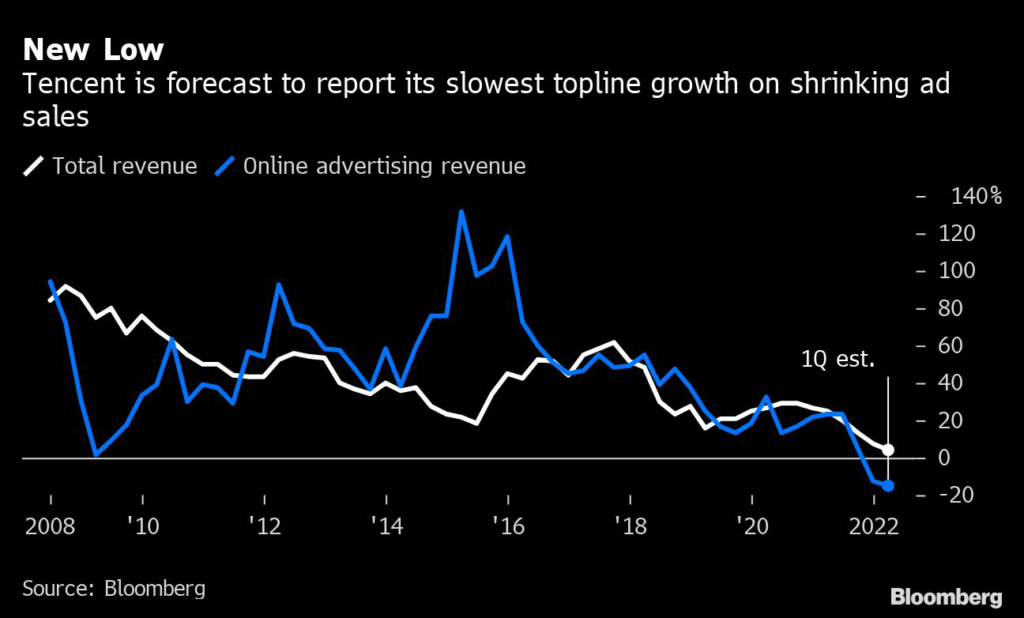
Online advertising sales are forecast to decline about 15% after contracting for the first time in the December quarter — a hit that management signaled will persist for most of this year. Big marketers of past years including online tutors, insurers and game developers have all fallen victim to separate regulatory actions, while stricter user privacy rules took a toll.

The WeChat operator in the meantime is struggling to keep ByteDance at bay, whose hit app Douyin increasingly draws advertisers from Tencent. In April, Tencent shut down its game streaming platform and hiked fees for its Netflix-style service for the second time in about a year, to try and offset the hit. Regulators also banned minors from tipping on livestream platforms, echoing similar policies on online gaming.

As for its bread-and-butter games division — still the world’s biggest publisher — Tencent will need to wait a bit more for a resurgence.

Online gaming revenue is expected to grow just 4.9% — slowest in three years. Last month, China approved the first batch of new games since July, ending a months-long hiatus that put the $44 billion market on edge. Tencent and closest rival NetEase Inc. were not on the list.

Industry watchers expect them to be included in subsequent rounds, likely in the second quarter. Before that, Tencent will have to lean on aging titles like Honor of Kings and Peacekeeper Elite while accelerating bets on overseas markets, which now contribute about a quarter of gaming sales.

Bocom International analysts led by Connie Gu estimated domestic gaming sales contracted 2.3% for the first quarter, versus a 24% rise internationally.

Read more: China’s Other Gaming Giant Is Quietly Snapping Up Global Talent

Then there’s the fintech and business arm, now Tencent’s No. 1 revenue driver. That division – which includes cloud services – is expected to expand 18%, down a tad from the prior quarter but still the only unit expected to post double-digit growth. A Covid resurgence in China, coupled with punishing lockdowns in cities like Shanghai and Shenzhen, could have delayed cloud projects and cooled transactions. 

Regulators are now considering requiring Tencent to fold its WeChat Pay service into a newly established financial holding company, Bloomberg News reported in March, part of an overhaul of the fintech arm that could undermine its entire social media business. Tencent executives have stressed they are talking with regulators and will comply with requirements.

“The key share-price driver for the sector remains more on the policy side rather than company fundamentals,” Daiwa analyst John Choi wrote in a May 13 note. “As the market is increasingly focused on profitability, we believe companies are prioritizing efficiency gains over scale expansion, hence investors should be aware of slowing growth across the sector” in 2022 and 2023.

More stories like this are available on bloomberg.com

©2022 Bloomberg L.P.
Verizon Joins AT&T in Raising Wireless Prices as Inflation Bites

(Bloomberg) — Verizon Communications Inc. will raise prices on its wireless bills for the first time in two years as the largest US wireless carrier grapples with higher costs.

Millions of consumers will see a $1.35 increase in administrative charges for each voice line starting in their June phone bill. And business customers will see a new “economic adjustment charge” beginning June 16, with mobile phone data plans increasing by $2.20 a month and basic service plans going up by 98 cents, according to Verizon representatives.

New York City-based Verizon started notifying customers Monday and has been contacting some of its larger corporate clients in recent days to tell them of the coming increases.

The move rallied Verizon’s shares, vaulting them ahead of the broader market to their highest close in three weeks. At 4 p.m. in New York, Verizon rose 1.8% to end the regular session at $49.04, while the S&P 500 declined 0.4%. 

Like many businesses, Verizon has been weighing options on how to adjust to inflation pressure. Rival AT&T Inc. earlier this month raised its rates on older consumer plans by $6 on single lines and $12 for families in order to catch up with rising costs and higher wages.

Labor Department data last week signaled that elevated consumer inflation could persist for longer than expected.

“We’re all feeling the pressure and we’ve been in the process of deciding how much of that pressure we can share with our clients,” Tami Erwin, head of Verizon Business, said in an interview last week. 

Verizon is trying to balance higher prices with better service, like switching customers from outdated plans to new 5G offers, Erwin said. 

Since there are no fixed-rate plans for businesses like there are for consumers, each new corporate contract is a fresh chance at raising charges. Verizon will be able to negotiate higher prices into new service plans when the previous ones expire, Erwin said.

Industry watchdogs had warned that once T-Mobile US Inc. acquired Sprint Corp. two years ago, there would be fewer wireless competitors, making it easier to raise prices. Implementing higher charges under the cover of surging inflation represents a ripe time to capitalize on the situation.

It’s a “raise-your-prices-while-you-can” moment, said Harold Feld, senior vice president of the Washington-based policy group Public Knowledge, before the Verizon news.

(Updates with Verizon closing share price in fourth paragraph)

More stories like this are available on bloomberg.com

©2022 Bloomberg L.P.

Close Bitnami banner
Bitnami