Bloomberg

Lithium Sector Needs $42 Billion as Pivot From China Adds Costs

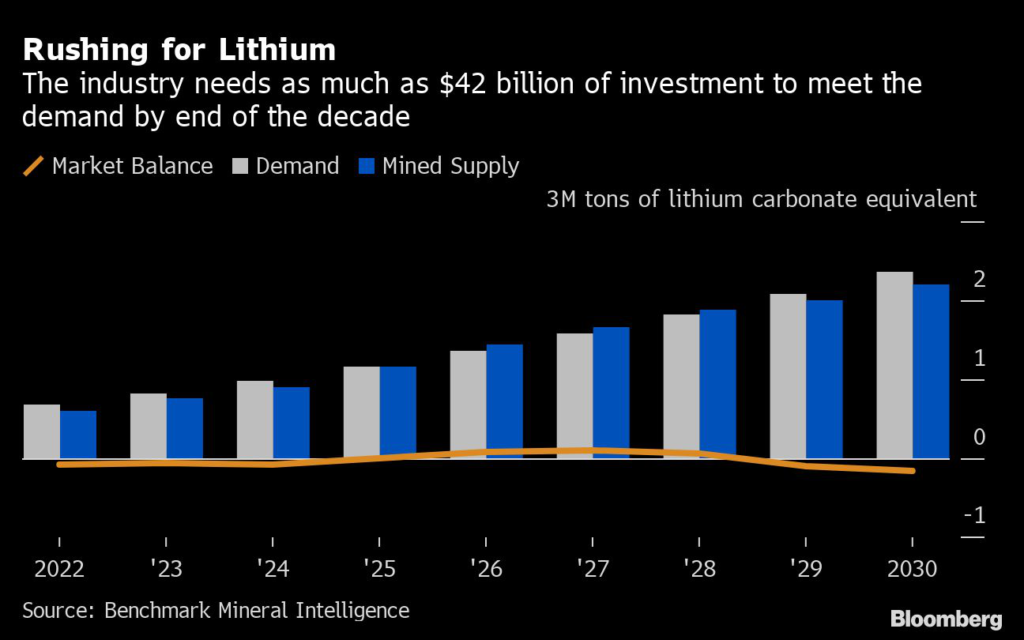
(Bloomberg) — The global lithium industry needs as much as $42 billion of investment by the end of the decade in order to meet demand for the crucial battery-making material, with attempts to build supply chains outside of China subject to much higher costs, according to a data and market-intelligence provider.

The sector will require $7 billion of investment each year from now until 2028, Benchmark Mineral Intelligence said in a report. That would help it meet forecast demand of 2.4 million tons a year by 2030, which is four times higher than the 600,000 tons that’s estimated to be produced in 2022.

The forecast comes as Europe and North America look to reduce their dependency on Chinese imports and develop their own lithium production. That strategy that could require around twice as much capital than relying on getting the refined product from the Asian powerhouse, Benchmark said.

China has enjoyed a stranglehold over the lithium supply chain, bolstered by economic clustering, a high level of expertise, and lower labor and energy costs. 

“If you want lithium with as little ESG impact as possible, the solution may cost more outside China,” analyst Cameron Perks said in the report. 

In the U.S., the Biden administration has been pushing to accelerate production of key battery metals, with more than $3 billion in grants to help process elements including lithium. Meanwhile, Canada has also earmarked up to C$3.8 billion ($2.9 billion) in this year’s budget to build a domestic critical metals supply chain. 

Lithium, which is central to the clean-energy transition, has surged more than 400% in China over the past year, as supply struggles to keep pace with the electric-vehicle boom. Tesla Inc. Chief Executive Officer Elon Musk has made a public appeal for more investment in lithium mining, and said that the car giant might consider mining or refining it directly after prices rose to “insane levels”.

The shortfall of raw materials to produce batteries is limiting the production of EVs, meaning their makers may have to get involved in mining if they want to make the cars at scale, Benchmark’s chief executive officer, Simon Moores, said in the report. While lithium’s major producers have large investments planned, those alone will not be sufficient and new mines are needed, the note added. 

Automakers could step in and “they have more than one reason to do so,” according to Perks. “Unlike investors, they are not just looking for a return from profits generated by lithium. They are looking to secure supply for their batteries.”

More stories like this are available on bloomberg.com

©2022 Bloomberg L.P.

Stocks, Futures Retreat After Big China Data Miss: Markets Wrap

(Bloomberg) — Stocks in Europe fell along with US equity futures as poor Chinese economic data fueled concerns about the global outlook, pouring cold water on last week’s brief revival of risk sentiment.

The Stoxx Europe 600 index dropped about 0.6% at the open, led lower by travel and personal-care stocks. Telecoms advanced as Vodafone Group Plc climbed after Emirates state-backed firm e& bought a 9.8% stake, becoming the group’s largest shareholder. Contracts on the S&P 500 and Nasdaq 100 declined.

An Asia-Pacific share index came off sessions highs, the dollar firmed and oil slid, pointing to a fresh bout of investor caution after Chinese data showed that industrial output and consumer spending hit the worst levels since the pandemic began, hurt by Covid lockdowns.

In the bond market, the 10-year US yield dropped to around 2.89%. A key question is whether economic worries will help stem this year’s Treasury selloff, which has been driven by inflation and tightening US monetary settings. 

Cryptocurrencies dipped as the mood in stocks weakened. That took Bitcoin back below the $30,000 level.

The risk of an economic downturn amid price pressures and rising borrowing costs remains the major worry for markets. Goldman Sachs Group Inc. Senior Chairman Lloyd Blankfein urged companies and consumers to gird for a US recession, saying it’s a “very, very high risk.” Many traders remain wary of calling a bottom for equities despite a 17% drop in global shares this year.

Volatility that saw the S&P 500 dip to a 13-month low last week before rebounding “is a reminder that for most investors, trying to time the market is likely to prove time-consuming and loss-making,” said Mark Haefele, chief investment officer at UBS Global Wealth Management. “Investor sentiment is fickle, and markets are likely to remain choppy until we get greater clarity on the three Rs: rates, recession, and risk.”

Food and fuel prices are feeding into rising costs. Wheat jumped by the exchange limit on India’s move to curb exports. 

Oil was dented by the Chinese figures but remains in sight of $110 a barrel. Shanghai is close to the necessary threshold for loosening its six-week lockdown, a development that could spur bets on rising energy demand. Officials are taking measured steps to help the economy: China effectively cut the interest rate for new mortgages over the weekend to bolster an ailing housing market, but the one-year policy loan rate was left unchanged Monday.

Traders are also waiting to see how European markets react to efforts by Finland and Sweden to join the North Atlantic Treaty Organization in the wake of Russia’s invasion of Ukraine. 

The shift in Europe’s security alliance could exacerbate tensions with Russia. European equity futures edged lower.

What to watch this week:

  • New York Fed President John Williams speaks Monday
  • Fed Chair Jerome Powell among slate of Fed speakers. Tuesday
  • Reserve Bank of Australia releases minutes of its May policy meeting. Tuesday
  • G-7 finance ministers and central bankers meeting. Wednesday
  • Eurozone, UK CPI. Wednesday
  • Philadelphia Fed President Patrick Harker speaks. Wednesday
  • China loan prime rates. Friday

Some of the main moves in markets:

Stocks

  • The Stoxx Europe 600 fell 0.6% as of 8:15 a.m. London time
  • Futures on the S&P 500 fell 0.8%
  • Futures on the Nasdaq 100 fell 1%
  • Futures on the Dow Jones Industrial Average fell 0.6%
  • The MSCI Asia Pacific Index rose 0.1%
  • The MSCI Emerging Markets Index rose 0.1%

Currencies

  • The Bloomberg Dollar Spot Index was little changed
  • The euro was little changed at $1.0408
  • The Japanese yen rose 0.2% to 128.96 per dollar
  • The offshore yuan fell 0.3% to 6.8176 per dollar
  • The British pound fell 0.3% to $1.2225

Bonds

  • The yield on 10-year Treasuries declined three basis points to 2.89%
  • Germany’s 10-year yield was little changed at 0.94%
  • Britain’s 10-year yield declined one basis point to 1.73%

Commodities

  • Brent crude fell 1.4% to $110.02 a barrel
  • Spot gold fell 0.1% to $1,809.20 an ounce

More stories like this are available on bloomberg.com

©2022 Bloomberg L.P.

Vodafone CEO Gains Potential Ally With e&’s $4.4 Billion Stake

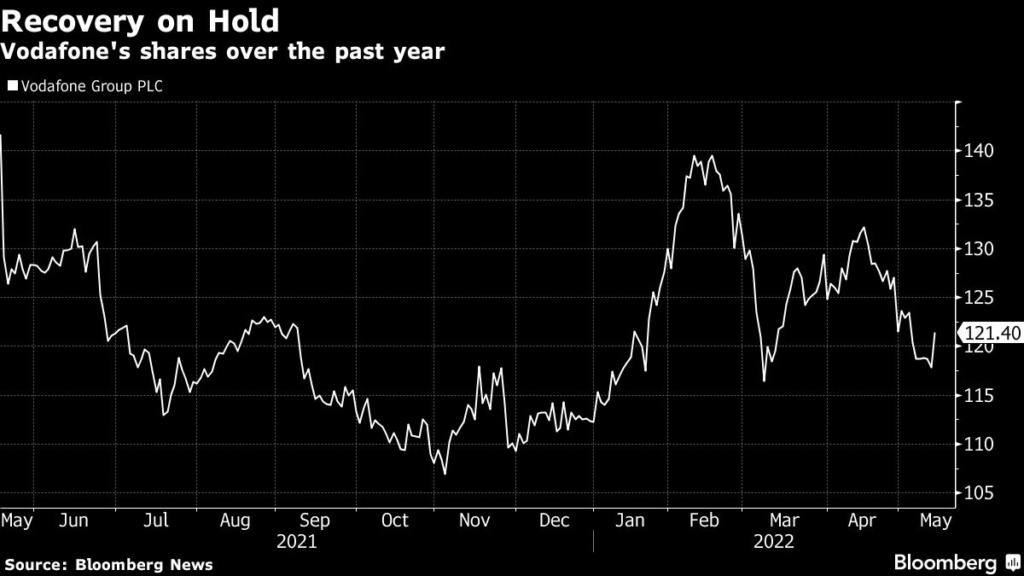
(Bloomberg) — Vodafone Group Plc shares halted their monthlong slide after Emirates state-backed telecom firm e& bought a surprise 9.8% stake on Saturday, becoming the group’s largest shareholder.

The sudden arrival of Emirates Telecommunications Group Company PJSC — now known as e& — could tilt the scales in a growing debate about the phone group’s strategy. Vodafone Chief Executive Officer Nick Read is trying to consolidate in key markets while facing pressure from shareholders including Europe’s largest activist fund, Cevian Capital AB. 

A wealthy, supportive shareholder could give Read cover to reset expectations around investment and profits by supporting the share price, Jefferies analyst Jerry Dellis said. That could give him greater cover to spend upgrading its network — such as Vodafone’s cable footprint in Germany to fiber. 

“We expect e& to counteract activist pressure, not add to it,” said Dellis in a note to clients. He noted e&’s CEO Hatem Dowidar previously worked at Vodafone for 17 years, including with Read. 

Vodafone shares rose as much as 4.2% in early trading in London on Monday, while shares in e& rose as much as 9.3%. On Saturday e& announced it had taken a $4.4 billion stake — offering about 130 pence ($1.59) a share, according to Bloomberg calculations. The price represents a premium of about 10% to Friday’s closing price for Vodafone shares, which have been trading at only about half of their 2018 high. Vodafone reports full-year results Tuesday. 

Read publicly said he is pursuing deals in the UK, Spain, Italy and Portugal. Since then, rival Orange SA clinched the biggest likely deal in Spain, Read turned down an offer for Vodafone Italy from Iliad SA, and previous talks with CK Hutchison Holdings Ltd. for a deal in Britain have yet to yield results.

Abu Dhabi-based e& said it is supportive of Read’s team and approach, isn’t seeking board seats, and it committed not to launch a takeover bid for the next six months. The Vodafone stake marks a change in e&’s strategy after it set out a plan earlier this year to diversify its investments across regions and currencies. 

Supportive or not, e&’s arrival may trigger new takeover concerns for Vodafone’s board, which recently added three directors with telecom, technology and regulator experience. 

After e&’s standstill expires, its controlling shareholder, the UAE state, could easily find a way to fund a full acquisition, said New Street Research Analyst James Ratzer in a weekend note to clients. That would face political investigation by the UK, which has tightened takeover rules. 

Read’s biggest move since becoming CEO in October 2018 was to carve out and separately list Vodafone’s tens of thousands of mobile masts in the company Vantage Towers AG. That company now faces its own widespread expectations to consolidate with rivals like the mobile operator-owned tower rivals from Deutsche Telekom AG, Orange, or a pure specialist tower company like Cellnex Telecom SA. 

Vantage is still 82% owned by Vodafone and reported results largely in line with expectations earlier on Monday, setting out expectations for 3%-5% sales growth. 

More stories like this are available on bloomberg.com

©2022 Bloomberg L.P.

Vodacom Weighs Bond Issue, Changes Dividend Policy to Fund Growth

(Bloomberg) — Vodacom Group Ltd. is mulling a bond issue and will pay a smaller proportion of its earnings in dividends as South Africa’s market-leading wireless carrier looks to finance new growth plans.

Funds are needed to complete the acquisition of a majority stake in Vodafone Egypt — a $2.7 billion deal agreed with U.K. parent Vodafone Group Plc last year — and to pay for newly auctioned high-speed internet spectrum in its home market, Chief Financial Officer Raisibe Morathi said in an interview on Monday.

The Johannesburg-based company will revert to an outlay of at least 75% of headline earnings to shareholders, down from 90%, the group said earlier in its annual earnings statement.

The moves are about transforming Vodacom from a straight telecom provider to a technology firm, according to Morathi. 

“We are arranging debt, and we needed a bit more fire power to support the servicing of that debt,” the CFO said. “Investors will now get 75% of a much faster-growing business.”

African carriers in particular are investing heavily in financial-technology services as more customers conduct banking and other business online. Vodacom benefits from the fast growth of M-Pesa, the Kenyan mobile-money services operated by partner Safaricom Ltd., among other products.  

Vodacom’s earnings per share gained 3.6% in the year through March and sales rose 4.5% to 103 billion rand ($ 6 billion). The stock gained as much as 1.6% in early trade in Johannesburg.

More stories like this are available on bloomberg.com

©2022 Bloomberg L.P.

Ryanair Trims Fares to Encourage Sales: The London Rush

(Bloomberg) — Here’s the key business news from London-listed companies this morning.

Ryanair Holdings Plc: The Irish airline tentatively said it would return to profit this year, while also citing Covid-19 and Russia’s war in Ukraine as possible threats to growth. 

  • The carrier said it is “cautiously optimistic” that peak-season fares will be somewhat ahead of 2019 levels, although it still had to use price cuts to stimulate the market this quarter

Made.com: The furniture brand cut its full year profit guidance amid more challenging trading than it expected at the start of this year. 

  • Supply chain disruption will take £5 million off the company’s adjusted earnings before interest, taxes, depreciation, and amortization this year, which it now expects to be between a loss of £35 million and £15 million, compared to a profit expectation in March

Greggs Plc: The bakery chain says sales in office and larger cities locations are lagging the rest of its estate.

  • The company, known for its cheap pasties and sausage rolls, said its cost pressures are increasing while customer incomes are also under pressure

RWS Holdings Plc:  Baring Private Equity Asia Fund VIII said does not intend to make an offer for the patent translation company, after previously exploring a possible takeover.

Outside The City

The UK is fast becoming the epicenter of the global stagflation crisis, and it’s about to get even worse, according to a clear majority of market participants in the latest MLIV Pulse survey. More than two thirds of 191 respondents see the currency tumbling to $1.15, a 6% decline from current levels to lows unseen even in the post-Brexit chaos. Meanwhile a similar proportion expect 10-year gilt yields to climb to 3%.

 The UK plans to increase the frequency it adjusts its energy price cap to every three months instead of every six, meaning customers can take advantage of falling wholesale prices more frequently — although it would also mean higher prices would hit consumers quicker.

In Case You Missed It

Over the weekend a new investor in Vodafone Group Plc was revealed.   Emirates Telecommunications Group Company PJSC bought a 9.8% stake in the company for $4.4 billion. The UAE-based provider said it doesn’t plan to make an offer for Vodafone and that it supports its strategy. 

Looking Ahead

Vodafone will report full year results tomorrow amid reports that it is in talks to merge its British operations with Three UK. The telecommunications giant had expressed interest in acquiring its smaller rival late last year, Bloomberg reported in January. 

Also on Tuesday, economic data on the UK labor market will be released, ahead of crucial inflation figures later in the week. 

More stories like this are available on bloomberg.com

©2022 Bloomberg L.P.

Bitcoin Falls With US Futures as China Data Hurt Risk Sentiment

(Bloomberg) — A selloff in cryptocurrencies accelerated Monday, with Bitcoin dropping back below $30,000 after weak Chinese economic data dented appetite for riskier assets.

The largest cryptocurrency fell as much as 5.3% and was trading at $29,450 as of 7:30 a.m. in London. Other tokens including Ether and Avalanche were on the back foot too. S&P 500 futures were in the red after the Chinese figures pointed to economic contraction.

Overall, however, digital-asset markets were calmer compared with the worst of last week’s turmoil over a collapsed stablecoin.

Bitcoin dipped to a low of $25,425 on Thursday after the TerraUSD algorithmic stablecoin unraveled, throwing the entire ecoystem that supports it into disarray. At its height, the market panic engulfed the $76 billion stablecoin Tether, a key cog in cryptoassets that briefly dipped from its dollar peg. 

“We have witnessed the rapid decline of a major project, which sent ripples across the industry, but also a new found resiliency in the market that did not exist during the last market downswing,” Changpeng Zhao, chief executive officer of crypto exchange Binance Holdings Ltd., tweeted on Sunday. 

One difference between the current environment and other prolonged downturns such as the “crypto winter” in 2018 is the amount of institutions now involved in the market, which may be a source of support, said Paul Veradittakit, an partner at digital asset manager Pantera Capital.

“Compared to 2018, there are more institutional investors with exposure to crypto and most see this as a buying opportunity,” said Veradittakit.

Ebbing Rally

Monday’s price action saw Bitcoin give back some of a Sunday rally. The total market value of cryptocurrencies has dropped by about $326 billion in the past seven days to roughly $1.33 trillion, according to data from CoinGecko. Bitcoin is some 57% off its November all-time high. 

While crypto markets may have digested the worst of the TerraUSD fallout, the asset class faces other challenges — most notably, rising global interest rates and tighter liquidity conditions.

Bitcoin’s current lower support is at $27,000, “which can likely stabilize price action in the coming days,” said Edul Patel, chief executive officer of Mudrex, an algorithm-based crypto investment platform. 

More stories like this are available on bloomberg.com

©2022 Bloomberg L.P.

US Deepens China Solar Tariff Probe With Scrutiny of 8 Firms

(Bloomberg) — The US Commerce Department is deepening its probe into whether solar power companies are circumventing import tariffs, singling out some of the industry’s giants for increased scrutiny.

The agency identified eight manufacturers, including industry leaders Longi Green Energy Technology Co., Trina Solar Co. and Jinko Solar Co., for mandatory questionnaires to plumb for more information on whether they are skirting US tariffs on China-made solar products by assembling them in Southeast Asia. 

The probe has already roiled the US solar industry and thrown a wrench into decarbonization plans, with companies halting projects and canceling shipments in the face of potentially hefty extra tariffs. The world’s largest solar manufacturers, mostly based in China, are diverting their focus and products to the rising European market amid the US disruptions. 

Shares of major Chinese solar companies fell on Monday, with Jinko stumbling as much as 5.3%, Trina dropping 4.1% and Longi 2.5% in Shanghai. 

The eight companies, located in Cambodia, Malaysia, Thailand and Vietnam, were asked to submit information by May 27, including their ownership structure and source of materials for production processes, according to letters that Commerce posted on its website. The Department has until Aug. 29 to issue preliminary findings in the circumvention case, with the extended deadline for a final determination in April 2023.

The Commerce probe also includes units of Canadian Solar Inc., Hanwha Q CELLS Co. and BYD Co., as well as New East Solar Energy Co. and Boviet Solar Technology Co. Longi, the world’s largest solar company by market capitalization, is being targeted through its Vietnamese unit Vina Solar Technology Co.

(Update share prices in fourth paragraph)

More stories like this are available on bloomberg.com

©2022 Bloomberg L.P.

US Futures, Oil Retreat After Big China Data Miss: Markets Wrap

(Bloomberg) — US equity futures fell and stocks wavered Monday as poor Chinese economic data fueled concerns about the global outlook.

An Asia-Pacific share index came off sessions highs, the dollar firmed, Treasuries rose and oil slid, pointing to a fresh bout of investor caution.

The Chinese figures showed that industrial output and consumer spending slid to the worst levels since the pandemic began, hurt by Covid lockdowns.

Officials are taking measured steps to help the economy: China effectively cut the interest rate for new mortgages over the weekend to bolster an ailing housing market, but the one-year policy loan rate was left unchanged Monday.

In the bond market, the 10-year US yield dropped below 2.90%. A key question now is whether economic worries will help stem this year’s Treasury selloff, which has been driven by inflation and tightening US monetary settings. 

Cryptocurrencies dipped as the mood in stocks weakened. That took Bitcoin back toward the $30,000 level.

The risk of an economic downturn amid price pressures and rising borrowing costs remains the major worry for markets. Many traders remain wary of calling a bottom for equities despite a 17% drop in global shares this year.

“The markets are being defined as volatile, fragile and to some extent unstable,” with bonds again looking like a haven asset adding to an “interesting mix,” Mahjabeen Zaman, Citigroup senior investment specialist, said on Bloomberg Television.

Goldman Sachs Group Inc. Senior Chairman Lloyd Blankfein urged companies and consumers to gird for a US recession, saying it’s a “very, very high risk.”

US Growth

The firm’s economists cut their forecasts for US growth this year and next — they now expect the economy to expand 2.4% this year and 1.6% in 2023, down from 2.6% and 2.2% previously.

Food and fuel prices are feeding into rising costs. Wheat jumped by the exchange limit on India’s move to curb exports. 

Oil was dented by the Chinese figures but remains in sight of $110 a barrel. Shanghai is close to the necessary threshold for loosening its six-week lockdown, a development that could spur bets on rising energy demand.

Traders are also waiting to see how European markets react to efforts by Finland and Sweden to join the North Atlantic Treaty Organization in the wake of Russia’s invasion of Ukraine. The shift in Europe’s security alliance could exacerbate tensions with Russia.

What to watch this week:

  • New York Fed President John Williams speaks Monday
  • Fed Chair Jerome Powell among slate of Fed speakers. Tuesday
  • Reserve Bank of Australia releases minutes of its May policy meeting. Tuesday
  • G-7 finance ministers and central bankers meeting. Wednesday
  • Eurozone, UK CPI. Wednesday
  • Philadelphia Fed President Patrick Harker speaks. Wednesday
  • China loan prime rates. Friday

Some of the main moves in markets:

Stocks

  • S&P 500 futures fell 0.7% as of 1:02 p.m. in Tokyo. The S&P 500 rose 2.4% Friday
  • Nasdaq 100 futures fell 0.7%. The Nasdaq 100 rose 3.7% Friday
  • Japan’s Topix index rose 0.1%
  • Australia’s S&P/ASX 200 index rose 0.2%
  • South Korea’s Kospi index fell 0.3%
  • Hong Kong’s Hang Seng index shed 0.4%
  • China’s Shanghai Composite index declined 0.5%

Currencies

  • The Bloomberg Dollar Spot Index rose 0.1%
  • The euro was at $1.0395, down 0.2%
  • The Japanese yen was at 128.87 per dollar, up 0.3%
  • The offshore yuan was at 6.8117 per dollar, down 0.2%

Bonds

  • The yield on 10-year Treasuries fell two basis points to 2.89%
  • Australia’s 10-year bond yield fell five basis points to 3.36%

Commodities

  • West Texas Intermediate crude fell 1.4% to $108.94 a barrel
  • Gold was at $1,810.12 an ounce, falling 0.1%

More stories like this are available on bloomberg.com

©2022 Bloomberg L.P.

Female Startups Fight ‘Tomato Seller’ Cliche for Funds in Africa

(Bloomberg) — Africa’s female entrepreneurs, like their U.S. and European counterparts, are underrepresented when it comes to raising funds. Their start-up journeys are also often a lot more arduous, say investors like Polo Leteka, co-founder of Alitheia IDF, the continent’s largest gender-led fund.

The issues are “probably more pronounced here because we have more underlying problems,” said Leteka, pointing to her own experience with tapping investors for funds. “There was this mentality that African women are just supposed to sell tomatoes on the side of the road.”  

While surmounting such stereotypes is getting easier, huge barriers remain. For every $1 invested in women, $25 goes to men in the African startup space, according to the World Bank.  

Companies founded or co-founded by African women — many with international alliances, networks and operations —  drew 16% of the total $5.2 billion raised on the continent last year by startups, according to data from Partech. That compares with 14.7% of the pie in the U.S. and 13.6% in Europe, Pitchbook data show.

The numbers, however, don’t capture the challenges of purely home-grown companies started by African women and the cultural barriers they face, entrepreneurs and fund managers say. One research showed that when startups make pitches, men get asked to speak about the opportunity of their business while women are asked about the risks and their plans to have children. The men usually get the funding. 

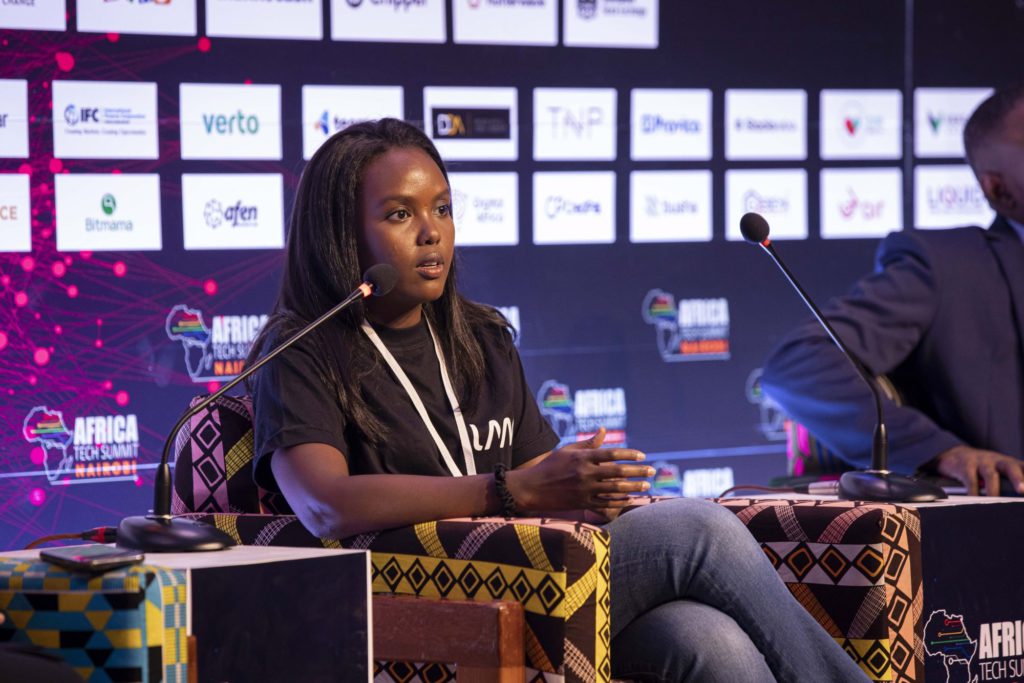
Take Jihan Abass, the founder and chief executive officer of Lami Insurance Technology, a digital platform for financial services in Kenya and parts of sub-Saharan Africa. Abass, 28, grew up in Mombasa and worked as a commodities trader in London for Toyota before starting her firm. 

“I had to show a lot more compared to what I heard my male counterparts were expected to show,” she said in an interview. “During the fund-raising process, you see other people who have less revenue, fewer partners or whatever metric it is, but they raise more money at a higher valuation; of course it is offensive.”

Lami, which announced a year ago that it had raised $1.8 million, is doing a new round of funding — relying primarily on women investors.

“The lead investor who found us and invested in us last year was a woman and the person working with her on the deal was also a woman,” Abass said. “The same thing this time. The more women you have, the more likelihood of them finding other women to invest in.”

The push to groom more women entrepreneurs has spawned a new breed of gender-focused funds in Africa. When Leteka started out in 2007, she was the first and only women-owned private equity firm in South Africa, and was partly able to raise money because of the government’s drive to include more women in the economy. Since then other such funds have sprouted across Africa.

“I recognized it was really difficult for women to access capital,” said Lisa Thomas, who is raising $35 million for a gender-lensed African fund called Samata Capital. She and other female fund managers have come together to create a pan-African network of over 70 women to seek out deals and support entrepreneurs. 

“If women or half of the founders are being left out, then that is an arbitrage opportunity for me because we will find those diamonds in the rough, we will support them and they will outperform everybody else,” Thomas says. 

Governments are trying to do their bit, with countries like South Africa, Tanzania and Kenya prioritizing women suppliers in some of their public procurements. But broader hurdles to funding projects often drive women away, especially if they are just starting out.

“There are fewer women coming through the ecosystem,” said Natalie Kolbe, Managing Partner of Norrsken22, an Africa-focused fund started by a Swedish tech startup, which expects to raise $200 million or more this year. “There is capital available but the ecosystem is not producing women entrepreneurs.” 

Consider Anna Njoroge in Nairobi, founder of an African skin and hair products startup called Ythera Beauty, who says “accessing long-term financing is a struggle” for entrepreneurs like her.

“A lot of private equity want to fund deals starting maybe from about $3 million,” she said. “You have a lot of small businesses that may need $15,000 or $100,000, half a million dollars until they get to the next level.” Njoroge, who expanded into the US in December, is having to self fund her business.

One issue hurting women founders is the investor focus on the tech space, which is where a majority of African Unicorns are emerging, says Jessica Espinoza, CEO of the 2X Collaborative, an industry body for gender-focused investing.

“This isn’t necessarily the sector where female founders are,” she said. “As an investor, if you want to fund women-led startups, you might need to look to other sectors such as healthcare and reproductive care.”

Still, when they are in a tech-related sector, women entrepreneurs thrive. Last year, Gro Intelligence, a Nairobi and New York-based provider of artificial-intelligence driven real-time agriculture and climate updates raised $85 million. Its founder is Sara Menker, an Ethiopian who was a former Wall Street commodities trader. 

“The primary driver and why we decided to invest was the founder,” said Eghosa Omoigui, managing general partner of EchoVC Partners. “Sara is a force of nature. She came into our office 5 1/2 years ago to pitch us her vision on Gro. A scheduled one-hour long meeting turned into 2 1/2 hours. Later we met in New York. That meeting crystallized what founders want to back and what I call WOW  — With or Without — that is founders who will succeed with or without you as an investor.”

But stories like Menker’s are rare. For most women entrepreneurs, drawing the attention of the wider pools of funds remains a challenge. 

“Women are judged by what they’ve done in the past solely while men are being judged by what they say they’ll do in the future,” said Tokunboh Ishmael at Alitheia Capital, who launched a $100 million gender-investment fund. “Even in cases where I’ve trained male colleagues in this industry, I would be judged as less capable than those same colleagues.”

Marie Stavelot, a Belgium-born Congolese luxury resale aggregator based in Dubai, tells a similar tale.  Stavelot, who founded her company, Reluxable, in December 2020 and launched her platform this year, is looking for about $1 million for the next 16 months to expand her business. The luxury second-hand market is growing, and her sales have been rising.  After self-funding operations through her savings and help from her mother, she reached out to more than 200 venture capitalists globally — with no success.

“There are always suggestions saying you want to try an accelerator program, mentorship and things like that, but why? I am an entrepreneur like any other male entrepreneur,” said the London-educated former bank credit analyst.

More stories like this are available on bloomberg.com

©2022 Bloomberg L.P.

New Zealand to Speed Electric Car Adoption to Cut Emissions

(Bloomberg) —

New Zealand will accelerate its adoption of electric vehicles and investigate hydrogen as an alternative energy source as it seeks to phase out fossil fuels and play its role in mitigating global warming.

Announcing its first emissions reduction plan Monday in Wellington, the government said it will initially allocate NZ$2.9 billion ($1.8 billion) over four years to fund a range of measures, from electric car incentives to phasing out coal boilers and helping farmers reduce methane emissions from livestock.

“This is a landmark day in our transition to a low emissions future,” Prime Minister Jacinda Ardern said in a statement. “We’ve all seen recent reports on sea-level rise and its impact right here in New Zealand. We cannot leave the issue of climate change until it’s too late to fix.”

Despite contributing only a tiny fraction to global greenhouse gas emissions, the government says New Zealand needs to play its part in limiting world temperature rise to 1.5 degrees Celsius above pre-industrial levels. The measures announced today also aim to protect the nation’s environment and maintain the clean, green reputation it trades on.

“In New Zealand our environment really is our economy,” Finance Minister Grant Robertson said. “Our clean, green brand has never been more important.”

The government will step up efforts to decarbonize transport, aiming to have at least 30% of the country’s light vehicle fleet electric by 2035.

It will continue to provide a clean vehicle discount to encourage the purchase of low-emission cars, invest in electric vehicle charging infrastructure and help low and medium-income households to buy an electric car if they scrap their old gas guzzler. It will also trial an EV leasing scheme.

It aims to decarbonize the entire public transport fleet by 2035.

There will be efforts to reduce the waste going to landfills, with most households having access to kerbside food waste collection by 2030. The government will also ban new low and medium-temperature coal boilers and phase out existing ones by 2037.

Methane Emissions

New Zealand’s economy relies on agriculture, particularly cows and sheep whose methane emissions are a major contributor to global warming. The country, which is the world’s biggest dairy exporter, has more than 10 million cows and beef cattle and almost 27 million sheep. That compares with just over five million people. 

Of the NZ$2.9 billion in allocated spending, NZ$710 million is earmarked for lowering emissions from farms, expanding forestry to reduce carbon and producing alternative “green” fuels. 

The government, which plans to start pricing agricultural emissions from 2025, said today it will establish a Center for Climate Action on Agricultural Emissions to accelerate the research and development of products that help reduce on-farm greenhouse gases. 

Read More: Feeding Cows Seaweed Could Curb Methane Emissions

Greenpeace slammed the initiative as “ridiculous,” saying it fails to properly deal with “the dirty great cow in the room.”

“Intensive dairying is the number one cause of climate pollution in Aotearoa, so it’s absolutely staggering to see that the Emissions Reduction Plan fails to include policy that would reduce cow numbers or phase out the synthetic nitrogen fertilizer that drives emissions,” said Greenpeace agriculture campaigner Christine Rose. The government is instead relying on “unproven techno-fixes to agricultural emissions,” she said.

The government said it will invest in planting more trees to boost carbon sequestration, and work with major heat energy users to help them transition to renewable sources.

Hydrogen Roadmap

Funds will be allocated to develop a comprehensive energy strategy, including a hydrogen roadmap and the creation of a regulatory framework for offshore wind energy.

“Hydrogen as a fuel could enable the decarbonization of hard to electrify sectors such as heavy freight and steel,” the government said. “The roadmap will provide the nascent green hydrogen sector with further clarity on how the government will support a pathway to an economically sustainable market for hydrogen.”

The initiatives will be paid for from a NZ$4.5 billion Climate Emergency Response Fund, which is backed by proceeds from the nation’s emissions trading scheme. The government last week set targets for greenhouse gas reductions over the next 14 years as part of its aim to achieve net zero emissions by 2050.

Three emissions budgets will act as stepping stones toward the 2050 goal.

Ardern said addressing climate change can bring down the cost of living – a key political theme as the country grapples with the fastest inflation in more than 30 years.

“Reducing our reliance on fossil fuels will shield households from the volatility of international price hikes while reducing transport and energy bills,” she said. “Households are already seeing the impact of escalating petrol prices and this plan sets out practical ways to cut power, transport and other costs by taking climate friendly actions.”

(Updates with Greenpeace comment in 13th paragraph)

More stories like this are available on bloomberg.com

©2022 Bloomberg L.P.
Close Bitnami banner
Bitnami