
Bloomberg

Britain’s Crypto List: Here Are the People to Watch

(Bloomberg) —

Britain’s relationship with the crypto industry has been at times a rocky one, with entrepreneurs often complaining about what they regard as overly strict regulations — and in some cases going so far as to move their startups abroad.

But things might be changing. In April, the government announced its intention to brand the UK a “crypto hub” on par with the sector’s favorite destinations, from Dubai to Switzerland. In Britain’s favor, it was already home to a host of fast-growing startups, from crypto custodian Copper to Ripple, the issuer of the world’s sixth-biggest digital coin.

Bloomberg Crypto spoke with some of the UK crypto industry’s key players, from immigrant entrepreneurs to a senior government official. Here are the stories of six of them, in part one of a two-part series.

John Glen

Age: 48Job: Economic Secretary to the Treasury, City Minister and MP for SalisburyLocation: London and Salisbury

As the UK’s de facto digital assets czar and self-described deputy to Chancellor Rishi Sunak, MP John Glen keeps one ear tuned to the debates in Parliament and the other to rumblings in the cryptosphere. Having spent the last 18 months on something of a global listening exercise, he’s now spearheading the government’s new crypto strategy.

“In this area, there isn’t one single pathway,” Glen said, referring to observations from trips to cities like San Francisco, Washington, Madrid and Berlin in recent months. “There isn’t one mechanism to unlock all of this. There are different jurisdictions vying for supremacy.”

Last month, Glen surprised entrepreneurs by announcing the UK government’s desire to be “a global crypto hub,” revealing plans to provide regulators with more powers to handle crypto assets and explore bringing blockchain technology into financial markets. He said the initiative was in part prompted by the prodding of an entrepreneur friend who’d been nagging him for months to listen to more crypto podcasts. 

“My colleagues will always say, ‘we’ve got to deregulate, deregulate, deregulate.’ I say we’ve got to find responsible regulation that enables innovation, but also takes account of consumer risks,” he said. “When we invest in financial products, we take risks.”

Glen is the government’s longest-serving minister to the City since 1947, having served as an adviser across the business, housing and finance departments since 2010. Before becoming an MP, he spent 13 years working for accountancy firm Accenture in roles ranging from analysis to relationship management with the World Economic Forum. 

Crypto, however, is a fairly new realm. And though Glen hasn’t personally invested in digital assets, he said he’s ready to oversee the Treasury’s next move.

“I see the excitement that exists now,” Glen said. “But we’ve got to innovate in our regulatory thinking as well.”

Lex Sokolin

Age: 38Job: Head Economist, Global Fintech Co-Head at ConsenSysLocation: London

Lex Sokolin was 10 years old when his family moved from Moscow to New York in 1994. Growing up, he wanted to be an architect, an interest that would later evolve into a career focused on building decentralized finance tools and crypto-economic design.

After graduating from Amherst College in 2006 — armed with a double major in economics and law, jurisprudence and social thought — Sokolin joined then-investment powerhouse Lehman Brothers as an analyst. The firm collapsed during the 2008 financial crisis, and Sokolin returned to academia some time after, earning an MBA and JD from Columbia University.

Around this time, Sokolin also launched a robo-investment advisory business, NestEgg Wealth, which was acquired a few years later. In 2016, he joined London-based equity research firm Autonomous as a partner, where he kept a lookout for the next big thing. 

“It had felt to me like the fintech movement of the early 2010s was missing the point,” he said in an interview.

Sokolin ended up covering blockchain during the 2017 boom in initial coin offerings, through which startups issued crypto tokens to raise money. “The crypto spark started getting louder and louder and louder to me,” he said. 

When Autonomous was bought by AllianceBernstein in 2019, Sokolin immersed himself in the crypto space full-time. He joined Ethereum infrastructure builder ConsenSys, where he co-led the fintech product group. The team was tasked with creating software for integrating decentralized finance tools into MetaMask, the popular crypto wallet. 

The following year, Sokolin was named chief marketing officer, and in 2021 was appointed as head economist, overseeing everything from coin economic design to spinning out decentralized autonomous organizations, or DAOs.

Having lived in London for the last few years, Sokolin said the UK has “a more coherent regulatory stance than in the US, but still a lot of room to grow.” 

“Over the next year, I would expect to see continued progress on the regulatory front, as more companies get licenses and clarity deepens,” he said. “I would also expect to see continued institutional engagement — in capital markets, asset management as well as fintech bridging their user base.”

Sendi Young

Age: UndisclosedJob: Managing Director of Europe for RippleLocation: London

Young was tapped last year to run the European operations of Ripple, which uses the XRP digital token in its products. She joined from Mastercard, where she was in charge of developing banking and fintech partnerships. Young, who spent her childhood in Istanbul, has also worked in senior roles at HSBC and AlixPartners. She holds an MBA from Harvard Business School and a BA in economics from Brown University.

At Ripple, she’s helping oversee the expansion of RippleNet, the decentralized global network of payment providers and banks that currently includes companies like Modulr and Azimo. 

Ripple has no shortage of experience in dealing with regulators: The company has been locked in a bitter court battle with the US Securities and Exchange Commission, which sued it for issuing an unregistered security. In November, Stuart Alderoty, Ripple’s general counsel, proposed limiting the SEC’s role in policing cryptocurrencies. XRP, which at one point was the third-biggest token before the SEC suit, now ranks sixth by market value.  

“Compared to the US, I think that we’re still in a much better space,” Young said in an interview. “The UK has a very good opportunity to keep that leading role and become a crypto hub.”

But she also sounded a note of caution, adding that UK regulators have been sending sending “contradictory messages” regarding how to govern the mushrooming crypto sector. As an example, she cited UK Economic Secretary to the Treasury John Glen making comments in support of the industry and Bank of England Governor Andrew Bailey warning about digital assets being used in criminal scams — on the same day.  

“More recently, we were hearing more mixed messages. I think it is really dangerous right now because this is the kind of mixed messaging that can hamper innovation and endanger the UK’s position to be the leading crypto hub,” she said.

Ophelia Brown

Age: 36Job: Founder of Blossom CapitalLocation: London

Brown launched the London-based venture capital firm Blossom Capital in 2018. She’s invested in startups such as MoonPay, which provides infrastructure for buying and selling digital assets, and the cryptocurrency and computing platform Tezos.

Other investments include business forecasting platform Pigment and cybersecurity automation startup Tines. Blossom has also invested in non-crypto firms such as online payments company Checkout.com, whose $40 billion valuation in a funding round in January made it one of Europe’s most valuable startups. 

Brown studied at the University of Oxford and has an MBA from French business school Insead.

She caught the crypto bug early — Brown recalls going to her first meeting with other cryptocurrency fans in London in 2013, adding it’s an industry she has been interested in for a long time. 

“Back in 2014 was when I bought my first Bitcoin through a site called localbitcoins.com, which involved actually meeting someone in a Starbucks in Mayfair,” she said in an interview. Bitcoin ended that year at around $300. It peaked at close to $69,000 in November last year.  

In January, Blossom Capital launched a fund with plans to invest a third of its capital in crypto firms in Europe; it now stands at £387 million ($475 million). She isn’t fazed by the recent meltdown in cryptocurrency markets: Blossom Capital is “very bullish long term investors, we don’t pay too much attention to the intra-day or the weekly volatility” are more focused on “the evolution of crypto from a niche financial tool to a mainstream asset class,” she said. 

Brown said Blossom Capital also owns nonfungible tokens, the digital certificates of authenticity that exploded in popularity last year. “We have a Crypto Punk and we have Bored Apes and through that we hold some ApeCoin.”

Dmitry Tokarev

Age: 32Job: Founder and chief executive of CopperLocation: London

Since founding crypto custodian Copper in 2018, Siberian-born Tokarev has been on a mission to convince the UK’s institutional investor crowd that digital assets belong in a diversified portfolio. 

A talent for mathematics propelled Tokarev into Siberian Federal University at age 15, where he got a degree in software engineering. Wanting a Western education, he Googled the world’s top universities and settled on the UK. There, he picked up English while working at a Pizza Hut for nine months. He eventually studied risk management and financial engineering at Imperial College London, then built trading bots for small hedge funds and discovered how to arbitrage discrepancies in the price of Bitcoin across different exchanges. 

Like most executives in the crypto sector, his assessment of the world’s current financial rails is scathing: “It’s very much shocking how the financial services industry works on a tech level, underneath the smokescreen of sending £20 to a friend with an emoji,” Tokarev said in an interview. “But that’s definitely not how the financial services infrastructure is going to look in 15 to 20 years’ time.”

With backers like billionaire hedge fund manager Alan Howard and clients including FTX and State Street, Copper is now one of the UK’s most prominent crypto companies. Asked about a regulatory regime that’s at times been outright hostile to cryptocurrencies, Tokarev said he’s optimistic that things are changing — while pointing out that there’s some way to go. 

“There are certain political discrepancies in the narrative, where I don’t think there is a 100% understanding of what’s going on in crypto,” he said. Tokarev warned of “Chinese walls” forming between regulators and the politicians that oversee them, where neither side is fully sure of how to engage with the industry.

For now, Tokarev thinks the UK should start looking beyond the parts of crypto and blockchain technology that easily integrate into existing financial services. “There’s much more to look at in the crypto space, like decentralized finance, that’s already 50,000 steps ahead. You can continue catching up, but at least lay the perimeter within which you can innovate.”

Stani Kulechov

Age: 31Job: Founder and chief executive of AaveLocation: London

After founding crypto lending platform Aave in 2017, Kulechov been promoting what proponents refer to as web3, a blockchain-based version of the internet controlled by end users rather than big tech companies like Facebook. In addition to developing decentralized finance tools like Aave, Kulechov said he’s been working closely with U.K. regulators to spur greater adoption of web3.

Born in Finland, Kulechov learned how to play video games and program from his older brother. The two would build gaming servers together, even building one into an old vacuum cleaner. He studied law at the University of Helsinki and wrote his thesis on using tech to make commercial agreements more efficient — and so stumbled across the use of so-called smart contracts on Ethereum, the most-used blockchain for DeFi applications.

While studying for law exams, he began building the precursor to the Aave protocol, which was then called “ETHLend,” or shorthand for Ethereum Lending. Kulechov posted about the platform on Reddit, and word started spreading. When ETHLend raised $16.2 million in an initial coin offering in 2017, Kulechov was still living in a dorm room.

ETHLend rebranded to Aave in 2018, and is now one of the most widely used crypto lending platforms.

Kulechov’s version of the internet is all about ownership. In Aave’s case, the protocol is owned and governed by users who hold the platform’s eponymous token. He said Aave’s name (it means ghost in Finnish) and matching logo take inspiration from the idea that companies like Aave should develop protocols, then fade into the background as the platforms become managed by users.

He said he’s optimistic about the crypto landscape in the U.K. and is in constant discussions with regulators and the central bank. Regulators understand the benefits of blockchain technology, “but getting that information to the wider public is the next challenge,” Kulechov said.

Kulechov isn’t afraid of courting controversy to promote his ideas: In April, he was briefly suspended by Twitter Inc. after falsely claiming to have been named the social media giant’s interim CEO. In an interview just before suspension, he said posting about taking the job was a “question about free speech.”


(Updates value of Blossom Capital fund.)

More stories like this are available on bloomberg.com

©2022 Bloomberg L.P.
Terra Hasn’t Killed Crypto, But It Was a Narrow Escape

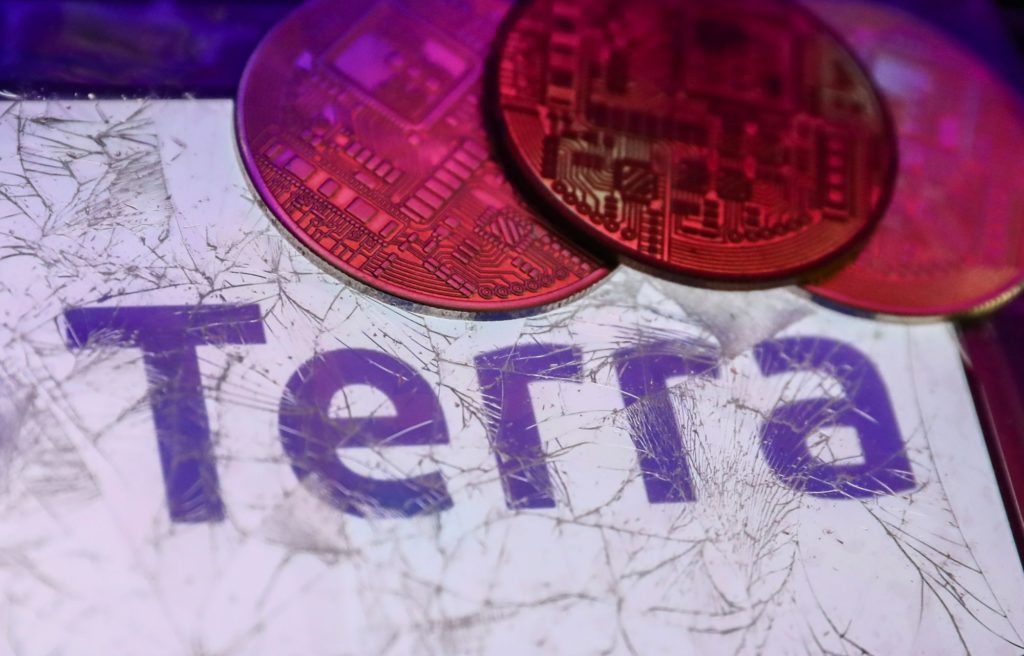
(Bloomberg) — Speculation that the collapse of one of the biggest experiments in decentralized finance could bring about the death of crypto appears to have been overblown. If Terra’s implosion had happened after a few more months of growth, the resultant market impact might have created a DeFi version of 2008 — instead, high-profile algorithmic stablecoins may end up being the main casualty.

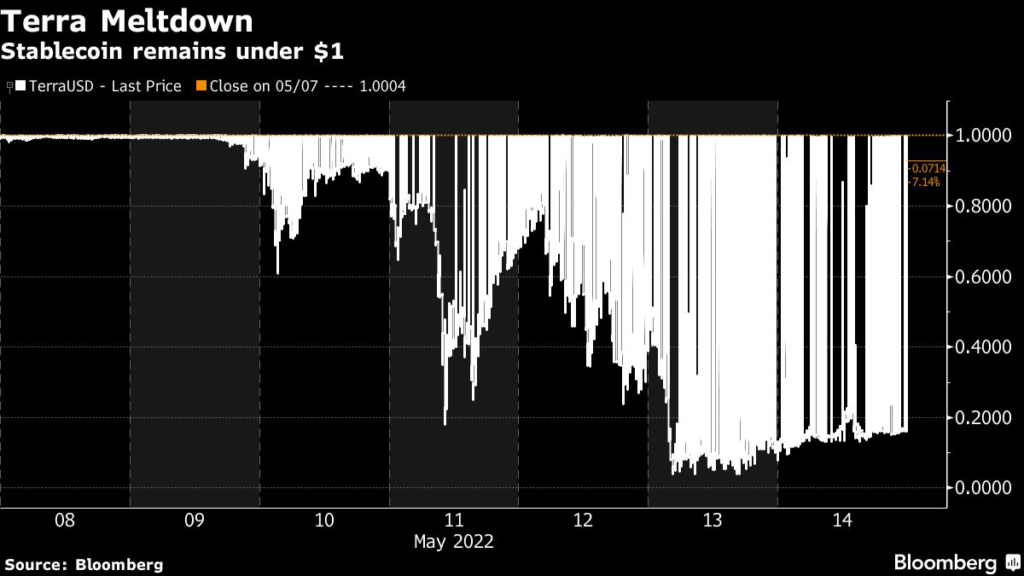
In a tumble starting on May 9, Terraform Labs’ TerraUSD — a token that primarily uses algorithms, rather than collateral, to adjust its supply and maintain a 1-to-1 peg with the US dollar — and its digital coin counterpart Luna lost almost all their value, while activity on the underlying Terra blockchain was twice suspended. A month after reaching a record of $119, the price of Luna now trades at near zero, while UST is stuck around 20 cents.

The meltdown sparked crypto price declines across the board; they later stabilized and recovered somewhat, but not without knocking some $300 billion or so off of the sector’s trillion-dollar total market value. Most significantly, it caused wobbles in even the largest collateralized stablecoins, which back their peg with dollar and dollar-equivalent assets — though they too returned to business as usual by the end of the week.

Stablecoins are a vital part of crypto because they are used by traders as a means of retaining value without leaving the digital asset ecosystem. Investors turn to them as a safe haven during periods of volatility, or even simply as a means of digital payment. Now, questions remain on whether the unique mechanism behind TerraUSD might be entering retirement, at least for use by projects that get too big to fail.

Meet the Hedge-Fund Manager Who Warned of Terra’s $60 Billion Implosion

“I wouldn’t be surprised if this is the end of algorithmic stablecoins,” said Hilary Allen, professor of law at American University. “DeFi can’t work without stablecoins, really. A lack of trust in stablecoins would be catastrophic for the DeFi ecosystem.”

Prior to losing its peg on May 8, TerraUSD had a total market value of around $18.6 billion — dwarfed in size by its collateralized rivals Tether and USDC, at $83.2 billion and $48.7 billion, respectively, according to data from CoinMarketCap. That kept its collapse from causing lasting widespread contagion, but any later, and it might have been a different story.

Price of Failure

As the Terra ecosystem grew in popularity, its co-founder Do Kwon said he wanted to build a reserve that might shore up UST in times of extreme stress. He established the Luna Foundation Guard, an organization aimed at keeping UST stable, which would look after a pile of Bitcoin he was slowly accumulating to act as collateral for UST. Meanwhile, developers continued to build apps on its blockchain, investors bet on its future and some crypto luminaries irrevocably tied themselves to the project.

Read more: Bitcoin’s Most-Watched Whale is King of the ‘Lunatics’

Between January and March, the LFG bought $3.5 billion of Bitcoin, according to blockchain forensics firm Elliptic. In media interviews in March, Kwon said he planned to increase the pile to $10 billion by the third quarter of this year. The theory was that if TerraUSD unwound, the firm could deploy its existing Bitcoin supply to try and stabilize the selloff — though it may have required much more capital to save it. 

Read more: Whereabouts of Bitcoin Reserves a Mystery After Transfer

Had the LFG’s hoard already reached that $10 billion figure, the de-peg might have not been so brutal to markets — but that amount of Bitcoin hitting exchanges in quick succession would have triggered shockwaves throughout the sector. In calmer periods, such as the few days before Terra broke its peg, Bitcoin recorded an average of around $30 billion in daily trading volume — making Kwon’s stockpile about a third of the entire market if dumped in one go.

“The reason why I want to get to $10 billion is that besides Satoshi, we will be the largest single holder of Bitcoin in the world,” Kwon said in an interview with crypto YouTube channel Fungible Times in March, referring to the wealth of Bitcoin’s pseudonymous creator which has never been moved or traded. A video of the interview, seen by Bloomberg, was later removed on Friday following Terra’s collapse.

“Then in that case, within the crypto industry, the failure of UST is equivalent to the failure of crypto itself,” Kwon added.

(Un)Stable

Even with some reserves added in as a backstop, the algorithmic model that governs UST is dependent on a combination of software programs, trader incentives and swaps with Luna to maintain its value. That’s in comparison to collateralized stablecoins such as Tether, USDC and Binance’s Binance USD, which rely on being able to redeem tokens from a reserve of fiat currency. In the case of Tether, the quality of those assets has previously been called into question — but during the instability caused by Terra, helped the token to avoid the same fate.

Read more: ‘Everything Broke’: Terra Goes From DeFi Darling to Death Spiral

“Really we shouldn’t use the same word for all of these things,” said Sam Bankman-Fried, chief executive of crypto exchange FTX, in a tweet on Thursday. “What we call ‘algorithmic stablecoins’ aren’t really stable in the same way that fiat backed stablecoins are. They’re more like structured products, and they need upside if they want to justify the risk.”

As the dust settles, broader consequences of Terra’s downfall include heightened scrutiny of the entire stablecoin sector by regulators, who had already viewed tokens like Tether’s as a potential systemic risk. Treasury Secretary Janet Yellen said on Thursday that the incident shows the dangers of private stablecoins, which while unregulated, can present the same kind of risks as bank runs. 

“A stablecoin should be able to live up to its name,” said Denelle Dixon, chief executive of the Stellar Development Foundation, which supports the Stellar crypto network and USDC. “What we’ve seen this week has proved why it’s essential to distinguish and define what is genuinely a stablecoin from what is not.”

Reeve Collins, co-founder and former CEO of Tether which operates its own asset-backed stablecoin, said Terra’s collapse was part of crypto’s natural order, using market corrections to wipe away the froth.

“The beauty of the bull market is it attracts the crazies, it attracts all the money and attracts the smart people into the market,” said Collins. who now acts as co-founder of NFT platform BlockV, in an interview. “Without the bull market, we wouldn’t get the attention and the brains into the space. And without the bear market, we wouldn’t really, you know, clean out the crowd.”

More stories like this are available on bloomberg.com

©2022 Bloomberg L.P.
Bitcoin Trades Below $30,000 as Markets Digest TerraUSD Fallout

(Bloomberg) — Bitcoin staged a modest recovery to trade just below $30,000, extending a period of relative market calm after the collapse of a closely watched stablecoin roiled digital assets in the past week.  

The largest cryptocurrency advanced 1.1% to $29,670 at 10:40 a.m. in London. Ether, the second-biggest token, rose 1.9% while coins like Avalanche and Cardano posted larger gains. 

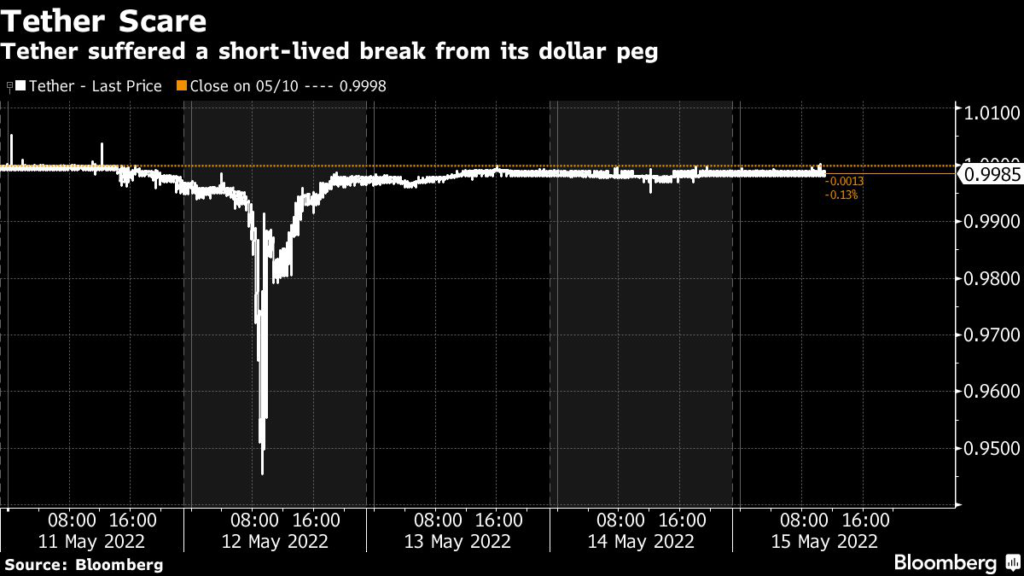
Bitcoin dipped to a low of $25,425 on Thursday after the TerraUSD algorithmic stablecoin unraveled, throwing the entire ecoystem that supports it into disarray. At its height, the market panic engulfed the $76 billion stablecoin Tether, a key cog in cryptoassets that briefly dipped from its dollar peg. 

“We have witnessed the rapid decline of a major project, which sent ripples across the industry, but also a new found resiliency in the market that did not exist during the last market downswing,” Changpeng Zhao, chief executive officer of crypto exchange Binance Holdings Ltd., tweeted on Sunday.  

Even after Sunday’s recovery, the total market value of cryptocurrencies has dropped by about $350 billion in the past week to roughly $1.35 trillion, according to data from CoinGecko. Bitcoin is almost 60% off its November all-time high. 

While crypto markets may have digested the worst of the TerraUSD fallout, the asset class faces other challenges — most notably, rising global interest rates and tighter liquidity conditions. Federal Reserve Chair Jerome Powell this week reaffirmed that the central bank will likely raise interest rates by a half-point at its next two meetings. 

“I remain long term bullish, especially on Bitcoin,” said Vasja Zupan, president of cryptocurrency exchange Matrix. “But I do foresee high volatility for some time followed by a period of much lower volumes at lower prices before we can expect trending to new all-time highs.”


More stories like this are available on bloomberg.com

©2022 Bloomberg L.P.
World Takes Cover From Stock Chaos in Oil, Utilities and China

(Bloomberg) — Optimism may be in short supply for equity investors caught in the downdraft of volatile global markets, but pockets of shelter are emerging. 

From banks benefiting from interest-rate hikes to stocks offering high dividend yields and cheap valuations, portfolio managers and strategists are finding areas of resilience. Those willing to stomach high volatility are betting on China’s eventual reopening.

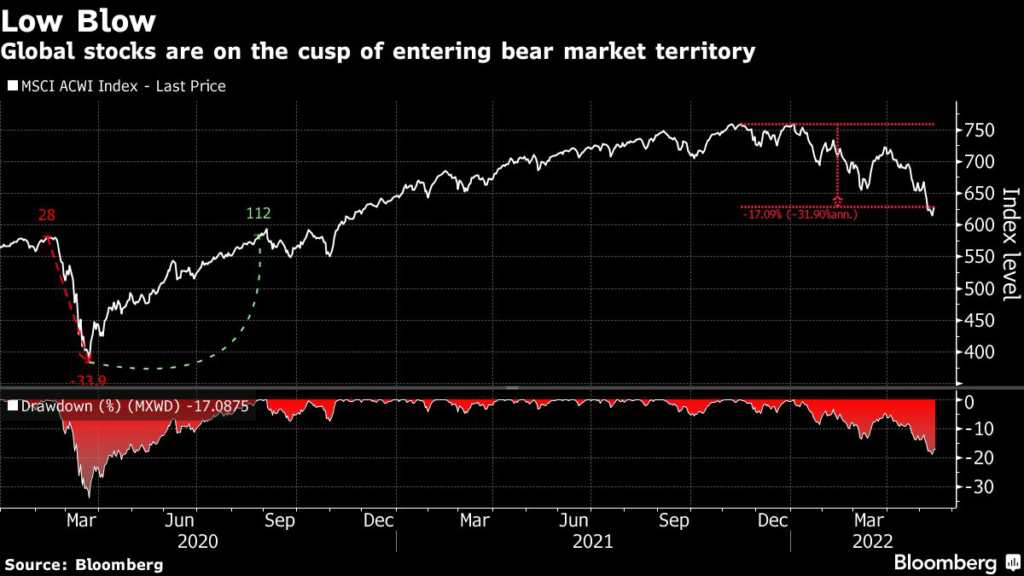
The search for relative havens comes as riskier assets have been roiled by worries over surging interest rates, inflation and slowing economic growth. The speculative fervor that drove meme stocks, blank-check companies and cryptocurrencies has waned. Down 17% from a record high hit six months ago, the MSCI All Country World Index is nearing a bear market.

“Investors are caught between fears that earnings and valuations will be under pressure in the short term from these headwinds, but also realize that the equity valuations have declined to levels that have become attractive for long term investors,” said David Sekera, chief US market strategist at Morningstar.

Dividend Champions

As companies navigate a world of rising borrowing costs and input prices, stocks offering investors income via higher dividend yields are being rewarded by the market. The MSCI World High Dividend Yield gauge, which is estimated to offer a yield of 3.8% over the next 12 months, has outperformed its broader peer by more than 10 percentage points this year.

“The short duration nature of the high-yielding stocks should also provide protection against higher interest rates,” Goldman Sachs Group Inc. strategists led by Timothy Moe wrote in an Asia-focused note on Wednesday.

Value Names

While value shares have outshone growth peers amid the tech rout, sectors such as commodities and financials still offer room for upside as earnings are set to improve in the high-inflation, rising-rates environment, strategists say. Earnings forecasts for the S&P Pure Value Index have risen at a time when outlooks for growth peers are worsening rapidly, according to Bloomberg Intelligence.

Oil and gas stocks offer a natural hedge against inflation — particularly energy inflation — and have outperformed broader indexes by a wide margin through 2021 and so far in 2022. The S&P 500 Energy Index is up 45% so far this year, outperforming the broader S&P 500, which is down 16%.  

Energy has also dominated the list of top-performing global stocks on the MSCI World Index this year. Texas-focused Occidental Petroleum Corp. sits at the top after rising 121% so far this year.

Even after that run, Wells Fargo analysts Nitin Kumar and Joseph McKay wrote “the outlook for the sector remains strong” and the “global market remains structurally under-supplied” for oil and gas due in part to Russia’s invasion of Ukraine creating a tightness in commodities supplies.

“Energy, while a consensus long, still makes sense” as an overweight investment class, JP Morgan analysts wrote in a research note after U.S. inflation data showed a greater than expected increase in consumer prices on Wednesday at 8.3%. 

For energy stocks, “the fact that oil prices have stopped going up makes the sector not as attractive as before, but it remains a sector that can extract quite a big chunk of margins over the others,” said Andrea Cicione, head of research at TS Lombard.

Allocating to companies with stable earnings growth and ample pricing power “makes sense given support for commodity prices,” said Marcella Chow, global market strategist at JPMorgan Asset Management. 

China, Southeast Asia

China might currently seem like a contrarian bet, but Credit Suisse Group AG and Invesco Ltd. are among those that point to an impending rebound once lockdowns ease in major cities such as Shanghai and Beijing.

While mired in a bear market, China’s benchmark CSI 300 Index gained 2% last week, led by industrial stocks, posting its biggest weekly outperformance versus global peers since 2020.

READ: China Stocks Set For Recovery Post Lockdowns, Credit Suisse Says

Elsewhere in Asia, reopening Southeast Asian economies are also seen offering some opportunities including in energy and financial shares, with the latter holding a nearly 40% weight in the region’s benchmark MSCI index.

“High quality Asean banks with strong deposit franchises look relatively well placed,” such as Indonesia’s Bank Central Asia Tbk, said Ross Cameron, a Tokyo-based fund manager of Northcape Capital Ltd.

READ: Chinese Stocks Stand Out as Rare Winners in Global Equity Rout

Utilities, Japan

Defensive stocks — whose earnings are less dependent on economic cycles — are also seen offering some solace. In Europe the Stoxx 600 Optimised Defensives Index is nearly flat for the year, compared to a 15.3% drop in the equivalent cyclicals index.

Investors should stay “relatively constructive” on sectors such as US health care and European utilities and telecom, Morgan Stanley strategists led by Mike Wilson wrote in a mid-year outlook report.

Overall, Morgan Stanley prefers Japanese equities over US shares due to the differing monetary-policy backdrops, cheaper valuations and light investor positioning.

More stories like this are available on bloomberg.com

©2022 Bloomberg L.P.
A Former Steakhouse Chef Wants to Beat Beyond Meat at Plant-Based Food

(Bloomberg) —

The founder of a London steakhouse is an unlikely entrepreneur in plant-based foods. But Neil Rankin, co-founder of acclaimed BBQ restaurant Temper in London’s Soho, says the meat alternatives out there simply aren’t good enough.

His list of complaints begins with meatless protein maker Beyond Meat, which he says, is good at capturing the “texture and look” of meat, but ultimately the company makes food that’s so far unprofitable to make and sell. Quorn, the original meat substitute, is “clever and sustainable,” but “tasteless,” he says. 

In 2020 the outspoken chef, now 45,  thought he could do better and and started plant-based food company Symplicity Foods. His aim is to make plant-based food so delicious that even die-hard meat eaters will want to choose his burgers over beef. With the help of fermentation, a unique recipe and the pandemic lockdown, he thinks he’s pulled it off. He says his food is “like a McDonalds health food. But better.”

The start of Rankin’s meat-to-plant conversion began with experiments in fermentation, a 12,000-year-old preservation technique, using vegetables in a glass jar at home, which he then pressed and minced into burger patties. Six months spent perfecting the recipe led to a pop-up plant-based burger spot in Brick Lane, which proved the concept.

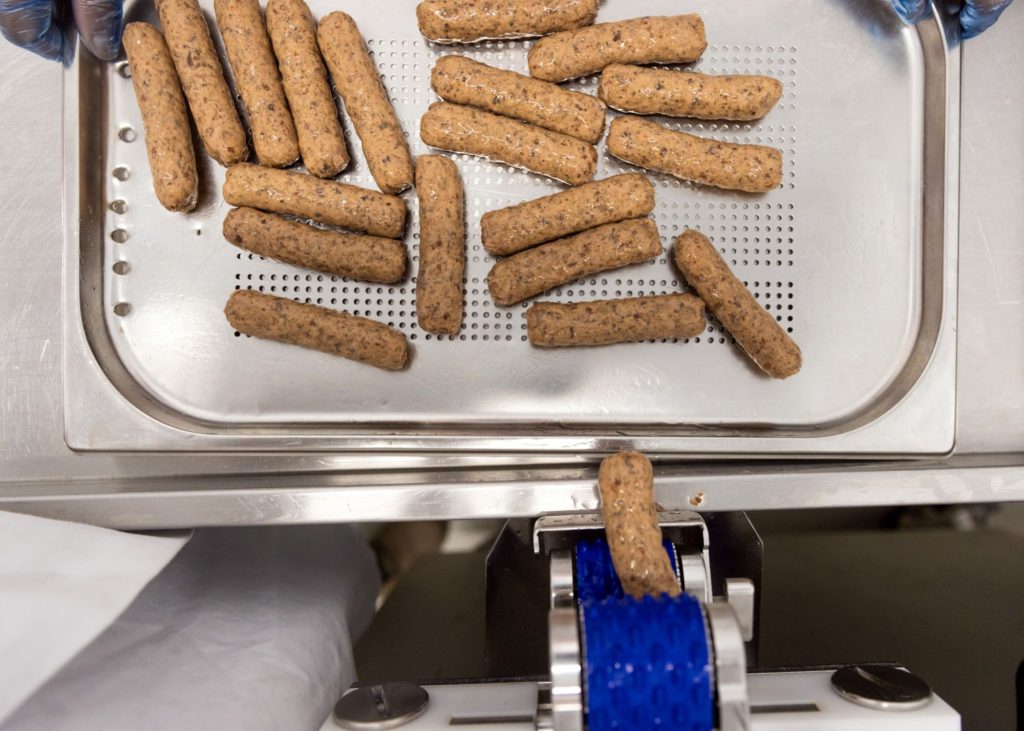
Today Symplicity Foods’ home is a factory in Harlesden, West London, but the recipe today is the same as the one made in his kitchen. The “meat” is made from mushrooms grown in caves in the UK, Poland and France that are mixed with onions, beetroot and a barley miso, which are then cooked and fermented for 10 days. Next it’s pressed, minced, mixed with spices, formed into sausages, burger patties or schnitzels, steamed, frozen and packed off to London restaurants.  The leftover juice from the fermentation is turned into gravy or a flavor enhancer which can be sold on.  

The pandemic and lockdown accelerated the idea last year. He teamed up with Mark Wogan, co-founder of Homeslice Pizza, who offered a shuttered restaurant for Rankin to develop the idea further and expand production. Before long he’d signed up Bleecker Burger and Dishoom as customers, with make-at-home kits using his plant-based sausages getting rave reviews on Twitter.  The next big customer is Soho House, which wanted a vegan schnitzel. Rankin and his partners are bidding for contracts worth hundreds of millions of pounds, and he has huge airline food contracts in his sights.

But is it any good? 

We tried the Soho House schnitzel, Dishoom sausage naan and Bleecker burger, which Rankin fried up on an electric grill with a bit of oil and salt in a tasting room above the factory. The burger patty has the texture of a high quality fried beef burger, but with a salty, savory kick reminiscent of marmite, which mostly comes from the barley miso.

Most miso is made in Japan by fermenting soybeans, but Rankin has already found a supplier who will make it in the UK with barley, reducing the carbon impact of shipping. Eventually, Rankin hopes to combine the cost- and carbon-saving benefits of using UK miso with food waste from supermarkets. “You can make miso with bread,” which UK supermarkets happen to have plenty of, often unsold and unsellable at the end of the day.

If he can pull it off, Rankin wants Symplicity Foods’ supply chain to be as clean as his factory’s worktops, where he can “look down the line and see that it’s sustainable from start to finish. I want to know where my mushrooms come from, I want to know where my tomatoes come from.” Then, one day in the future, maybe customers won’t mind knowing how the sausage is made.

More stories like this are available on bloomberg.com

©2022 Bloomberg L.P.
Ukraine Latest: Finland Confident NATO Bid Won’t Be Derailed

(Bloomberg) —

Finland’s leader phoned Russia’s Vladimir Putin on Saturday, telling him that the invasion of Ukraine had “altered the security environment” for the Nordic country. Putin told Sauli Niinisto joining NATO would be a mistake. Finland has scheduled a press conference for Sunday that’s likely to focus on NATO, and its foreign minister was confident that Turkey’s objections won’t derail the bid.

NATO foreign affairs ministers will meet in Berlin on Sunday from 9 a.m. local time, while the NATO Secretary General and Germany’s foreign affairs minister will hold a press conference at 2:30 p.m.

The European Union is offering gas importers updated guidance on how to buy fuel from Russia without breaching EU sanctions. G-7 foreign ministers called on China “not to justify” Russian actions in Ukraine.

President Volodymyr Zelenskiy said he met Minority Leader Mitch McConnell and several other Republican senators in Kyiv. India prohibited most wheat exports in the latest bout of global food protectionism. 


(See RSAN on the Bloomberg Terminal for the Russian Sanctions Dashboard.)

Key Developments

  • Russia’s Backyard Weighs Opportunities, Threats From Putin’s War
  • EU Drafts Plan for Buying Russian Gas Without Breaking Sanctions
  • ‘Straw Owner’ Hides $1 Billion Worth of Russian Yachts, US Says
  • EU Draft Cuts Euro-Area GDP Forecast, Sees 6.1% Inflation 
  • NATO Expansion Could Finally Shore Up Alliance’s Weakest Flank
  • Germany Girds for Day of Reckoning in Gas Showdown With Russia
  • A Visual Guide to the Russian Invasion of Ukraine

All times CET:

Russia’s Backyard Weighs Opportunities, Threats From Putin’s War (7 a.m.)

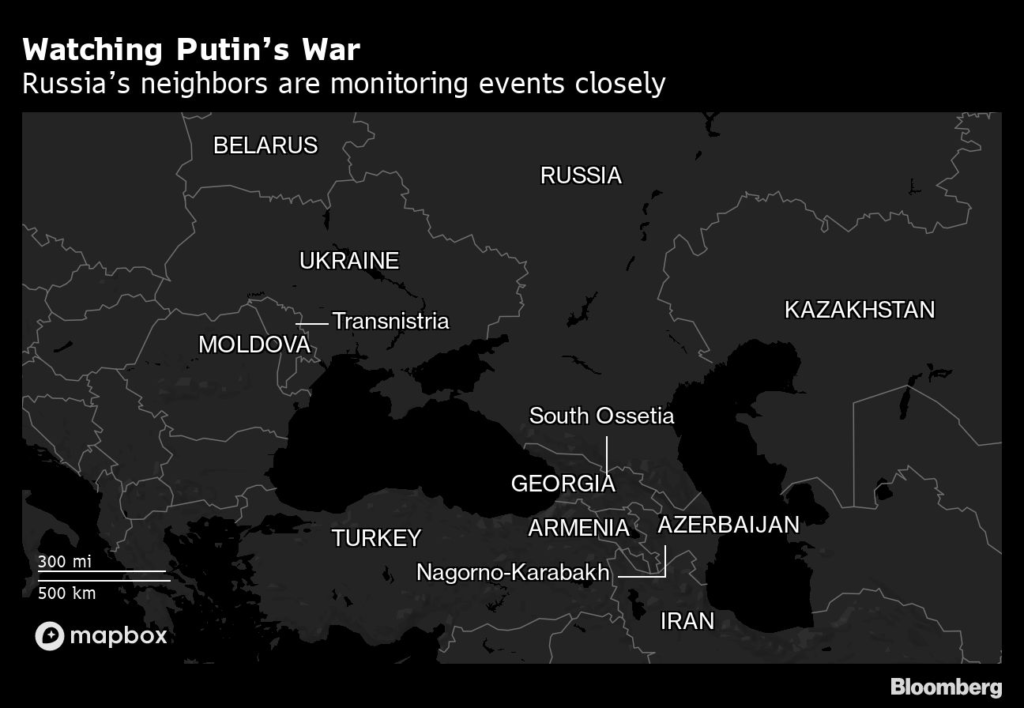
With Putin’s invasion of Ukraine stalling, other former Soviet states are weighing prospects for pulling away from Moscow’s orbit even as they fear risks of potential border conflict. 

The war is sending tremors along an arc of instability stretching from Ukraine’s neighbor Moldova through the Caucasus and into Kazakhstan in central Asia. Putin’s intentions have become an urgent national security question in countries with so-called “frozen conflicts” or that have large pro-Russian minorities. 

UniCredit, Citigroup Explore Asset Swaps to Exit Russia: FT (6 a.m.)

UniCredit SpA and Citigroup Inc. are considering swapping assets with Russian financial institutions as they try to exit the country while avoiding large writedowns on their operations there, the Financial Times reported. 

The banks have explored deals to swap their Russian businesses for the local buyer’s foreign units, people with knowledge of the plans told the newspaper. UniCredit is also working on deals with non-sanctioned banks to swap its Russian loan books for their foreign credit portfolios, according to the report.

Ukrainian Band Kalush Orchestra Wins Eurovision (1:20 a.m.)

The Ukrainian band Kalush Orchestra won the Eurovision Song Contest in a show of support for the war-torn nation, the Associated Press reported. The public vote from home was decisive in securing the band’s victory, according to the report.

Front man Oleh Psiuk made a plea to the live crowd and television audience of millions for the remaining Ukrainian fighters trapped in the Azovstal steel plant to be freed, AP said. Ukrainian President Volodymyr Zelenskiy celebrated the victory in a Telegram post, saying that Ukraine will host the contest next year and hopes to “one day” host participants and guests in Mariupol.

‘Straw Owner’ Hides $1 Billion Worth of Russian Yachts, US Says (11:15 p.m)

US authorities are alleging that a Russian tycoon acted as the “straw owner” of two yachts worth more than $1 billion, including the $700 million Scheherazade, a superyacht linked to Putin.

Court filings in the South Pacific island of Fiji, where the US is trying to seize the $325 million yacht Amadea, reveal what US officials allege is a nest of offshore shell companies that were set up with the help of a yacht broker to conceal the true owners of both vessels — an allegation that lawyers for the listed owner and the broker dispute. A hearing is scheduled for Wednesday in Fiji on the fate of the Amadea.

The layers of companies and trusts, stretching from the Marshall Islands to Switzerland, indicate the beneficial owner of both yachts is the former president of state-controlled Rosneft OJSC, Eduard Khudainatov, according to the documents. Khudainatov doesn’t appear on any sanctions lists.


EU Drafts Sanctions-Compliant Russia Gas Buying Plan (9:30 p.m.)

The European Union is set to offer gas importers a solution to avoid a breach of sanctions when buying fuel from Russia and still effectively satisfy President Vladimir Putin’s demands for payment in rubles.

In new guidance on gas payments, the European Commission plans to say that companies should make a clear statement that they consider their obligations fulfilled once they pay in euros or dollars, in line with existing contracts, according to people familiar with the matter. The EU’s executive arm told the governments that the guidance will allow them to purchase gas without breaching EU sanctions.

The clock is ticking because many firms have payment deadlines this month. If they don’t pay, gas flows could be cut off.

Turkish Foreign Minister Criticizes PKK Support (7:50 p.m.)

Turkish Foreign Minister Mevlut Cavusoglu criticized Sweden and Finland for supporting the Kurdistan Workers’ Party, or PKK, ahead of a meeting with his NATO counterparts. “If a country is going to be a NATO member, it should not support terror organizations,” he said.

“These countries are supporting terrorists and that is why a majority of Turkish people are against their membership,” Cavusoglu said. 

Asked about the comments, Luxembourg Foreign Minister Jean Asselborn said “none of the 30 allies should be allowed to resist” membership for Sweden and Finland if they want to join. “It’s a game that would place NATO in a bad light, so I hope it won’t be the case,” he told reporters.

Finland Says It’s Confident NATO Bid on Track (6:51 p.m.) 

Finnish Foreign Minister Pekka Haavisto said he’s confident his country and Sweden will become NATO members “in the end.” He spoke with reporters in Berlin on Saturday before a meeting with foreign ministers of the alliance. 

Asked about potential Turkish opposition, Haavisto said that “every member country of NATO, of course, has the possibility of prolonging the process.” Turkish President Recep Tayyip Erdogan on Friday expressed his government’s concern about Finland and Sweden joining NATO.

Haavisto stressed Helsinki’s intention to maintain a peaceful border with Russia and to keep the line of communication open. “We don’t ask for permission, but we communicate,” he said. Finland’s president earlier spoke with Vladimir Putin to inform the Russian leader of the rationale behind the country’s interest in NATO. 

Zelenskiy Says He Met US Republican Senators (3:15 p.m.)

Minority Leader Mitch McConnell led a delegation of US Republican senators to Kyiv, where they met with Ukrainian President Volodymyr Zelenskiy on Saturday.

Senators Susan Collins of Maine, John Barrasso of Wyoming and John Cornyn of Texas were with McConnell, according to a photograph released by Zelenskiy’s office. 

Finnish President Phones Putin Over NATO Plan (1:09 p.m.)

Finland’s President Sauli Niinisto phoned Russia’s Vladimir Putin to inform him that the Nordic country will decide in the next few days whether to seek NATO membership, the president’s office in Helsinki said.

“The conversation was direct and straight-forward and it was conducted without aggravations,” Niinisto said in a tweet. 

Putin told his Finnish counterpart that Helsinki’s plan to join NATO would be a “mistake because there are no threats to Finland’s security” and could harm relations between their countries, according to a statement from the Kremlin. The two leaders had a “frank exchange of opinions,” the Kremlin said.  


Mariupol Defenders’ Relatives Turn to Xi for Help (12:53 p.m.) 

Relatives of Ukrainian soldiers in the Azovstal steel plant in Mariupol have asked Chinese President Xi Jinping to act as an intermediary in talks with Russia to help evacuate the defenders and provide safe passage to a third country. 

“There is only one person in the world” left to turn to, Natalka Zarytska, wife of one of the defenders, said in a televised briefing. Citing the close ties between Moscow and Beijing, she said it would “be difficult for Putin to refuse” a request from China’s leader. 

Zarytska said that among the hundreds of wounded at Azovstal are men “without limbs and without pain relief.” The government in Kyiv has spoken to humanitarian groups and world leaders including the presidents of France and Turkey and Pope Francis about an evacuation. The defenders this week turned to billionaire Elon Musk for help.  

Seizing Russian Assets Serves Justice, Germany Says (12:30 p.m.)

Russia is responsible for the devastation in Ukraine and it’s “a matter of justice” that it should be held accountable via the seizing of frozen assets, said German Foreign Minister Annalena Baerbock. 

Speaking after talks with G-7 counterparts in Germany, Baerbock called seizing assets “anything but easy” in legal terms, and noted there are few precedents. If EU countries were to do so, it would have to be legally watertight and stand up at the European Court of Justice, she said, adding that her Canadian counterpart had indicated it’s legally possible there. 

“As Europeans we have a different legal framework, so that we always need more time for such a step,” Baerbock told reporters. “But there are indeed some good reasons why we too might choose this path.” 

G-7 Urges China Not To Justify Russia’s War (12 p.m.) 

Group of Seven foreign ministers issued a long list of demands on Beijing’s stance toward Ukraine after talks in Germany, including a request “not to justify Russian action” there. 

The G-7 officials called on China to “resolutely urge Russia to stop its military aggression against Ukraine,” according to a joint statement. They also called on Beijing not to assist Russia, not to undermine sanctions, and “to desist from engaging in information manipulation, disinformation and other means to legitimize Russia’s war of aggression.” 

The G-7 is committed to “both short-and-long term-support” for Ukraine, according to the statement. “We are determined to accelerate a coordinated multilateral response to preserve global food security and stand by our most vulnerable partners in this respect,” it added.

Scholz Doesn’t See Change in Putin Stance (11:30 a.m.)

Germany Chancellor Olaf Scholz said he detected no change of attitude in Vladimir Putin when he spoke by telephone with the Russian president for more than an hour on Friday. 

“One thing is clear here: Russia has not achieved any of the war aims set out at the start,” Scholz said in an interview with the T-Online news portal. “Ukraine has not been conquered, but is defending itself with great skill, courage and self-sacrifice.” 

“It should gradually be becoming clear to Putin that the only way out of this situation is to reach an agreement with Ukraine,” said Scholz. In a tweet, Scholz referred to Putin’s “insane idea” of expanding the Russian empire. 

Finland Counts on US Support to Win Over Turkey (11:29 a.m.)

Finnish President Sauli Niinisto pushed back against suggestions Turkey would prevent his country and neighboring Sweden from joining NATO, given that the US supports the move.

President Recep Tayyip Erdogan said on Friday Turkey doesn’t favor Sweden and Finland becoming members of the defense alliance, citing concerns over Kurdish “terrorists.” NATO welcomes new members unanimously, and a decision to apply for entry is expected on Sunday from the two Nordic countries that are reacting to Russia’s war in Ukraine.

Read more: Finland Counts on US Support to Win Over Turkey in NATO Bid

Ukraine Says It Destroyed Russian Pontoon Bridges (9:21 a.m.)

Ukraine’s army said it blew up pontoon bridges Russian forces were building near the village of Bilohorivka on the Siverskyi Donetsk River in the Luhansk region, although some Russian soldiers managed to cross. 

Russians troops were pushed back after two days of heavy fighting, the Ukrainian paratrooper brigade that took part in the fight said late Friday, adding that the US and UK anti-tank weapons helped them to repel the attack. 

Regional governor Serhiy Haiday said almost 90 Russian heavy weapons, including a helicopter, was destroyed in the hostilities and that Ukraine’s army is completing the liberation of the other bank of the river.

NATO Expansion Could Shore Up Alliance’s Weak Flank (6 a.m.) 

While much of the focus of deteriorating east-west relations has been on Germany’s new military plans, the expected accession of Finland and Sweden to the 30-member transatlantic alliance is part of the biggest shift in European foreign policy to emerge since Russia’s invasion of Ukraine. 

After waging war in part to stop NATO’s expansion, Putin is now confronted with the opposite.   

Zelenskiy Says Ukraine Pushing Russia From Kharkiv Region (8:15 a.m.)  

Ukraine has retaken a total of over 1,015 villages and towns, including six in the previous 24 hours, as its army is gradually pushes Russian soldiers out of the Kharkiv region, President Volodymyr Zelenskiy said Friday in his night video address. He urged businesses to re-open in safe territories to add jobs. 

Talks on the evacuation of wounded Ukrainian wounded soldiers from Mariupol’s Azovstal steel plant are “very complex,” Zelenskiy said, adding that Kyiv has involved all possible influential intermediaries in the effort. 

Azovstal’s holdouts have criticized the government in Kyiv for failing to defend southern Ukraine, where Russia made much faster progress, and said it had abandoned Mariupol’s garrison. Russia continues airstrikes in the area.

Read more: Mariupol Steel Plant’s ‘Dead Men’ Defenders Call for Rescue Plan

Ukraine Appears to Have Won Battle for Kharkiv, U.S. Group Says (6 a.m.)  

Ukraine “appears to have won the Battle of Kharkiv,” according to the Institute for the Study of War.

Russia has likely decided to withdraw fully from its positions around Kharkiv in the face of Ukrainian counteroffensives and the limited availability of reinforcements, the Washington-based group said in a daily bulletin. 

There’s evidence that “Moscow is focused on conducting an orderly withdrawal and prioritizing getting Russians back home before allowing proxy forces to enter Russia, rather than trying to hold its positions near the city,” ISW said. 

India Stops Most Wheat Exports (5 a.m.)

India prohibited most wheat exports that the world was counting on to alleviate supply constraints sparked by the war in Ukraine, which has largely halted Kyiv’s ability to ship. 

Bloomberg News reported earlier this month that a record-shattering heat wave has damaged wheat yields across the South Asian nation, prompting the government to consider export restrictions.

Exports will still be allowed to countries that require wheat for food security needs and will be based on the requests of their governments, India said. 

More stories like this are available on bloomberg.com

©2022 Bloomberg L.P.
Whereabouts of Terra’s Bitcoin Reserve a Mystery After Transfers

(Bloomberg) — The $3.5 billion in Bitcoin purchased as a reserve by the foundation set up by the creators of the failed Terra blockchain became untraceable after it was moved to two cryptocurrency platforms, according to blockchain forensics firm Elliptic. 

What happened to the cryptocurrency held in reserve may become a key question if investors seek to recoup losses suffered in the wake of the collapse of the blockchain. 

Between January and March, the Luna Foundation Guard, or LFG, bought $3.5 billion of Bitcoin, Elliptic said, according to its blockchain analytics tracking tools. 

When the value of Terraform Lab’s TerraUSD, or UST, stablecoin began to fall on May 9, the foundation said it would use Bitcoin from the reserve to purchase UST in order to maintain its one-to-one peg with the dollar. Over the next day, the crypto wallets used to hold the reserves were emptied, Elliptic said.           

About $1.7 billion was sent on May 9 from LFG wallets to a new address through two transactions after Terra co-founder Do Kwon said the funds would be used to support the peg. Within hours, the entire amount was moved to a single account on the Gemini crypto exchange through several transactions and it was not possible to trace the assets from that point, Elliptic wrote. 

The remain Bitcoin reserves were moved on May 10 in a single transaction to an account on the Binance exchange, Elliptic said. The blockchain analytics firm isn’t able to identify whether the assets were sold or moved to other wallets at that point. 

More stories like this are available on bloomberg.com

©2022 Bloomberg L.P.

Baseball’s Streaming Push Leaves Fans Scrambling to Find Games

(Bloomberg) — The dawn of the streaming era once promised a brighter future for sports fans, a blissful world of à la carte consumption in which everyone could break free of their overstuffed, overpriced cable subscriptions and pay only for what they really wanted to see.

The reality, as baseball diehards are discovering this season, is much less idyllic. 

To watch all the games they want, many fans will have to pay not only for cable but also for multiple streaming services. And once they’ve figured out which app or channel is showing their favorite team, they will be left hoping that the live stream doesn’t crash at a crucial moment. Last month, in the third and fourth innings of Apple Inc.’s first baseball broadcast, some viewers found themselves gazing unhappily at a dreaded error message. 

The current fragmented landscape can be traced back, in part, to last year when ESPN decided to scale back the number of games it would broadcast as part of a new contract. Afterward, Major League Baseball sold a large portion of those games to Apple and to Comcast Corp.’s Peacock. This season, New York Yankees fans will also need a third streaming service because Amazon.com Inc., which owns a stake in the team’s cable channel, started streaming a package of 21 games that will air exclusively on Prime Video.

Subscriptions to Prime Video start at $9 a month. Peacock’s Sunday slate will be behind a $5-a-month paywall. The games on Apple are free.

Jack Carroll, 65, never misses a Yankees game. But to watch his favorite team this season, he’s had to enlist his son, John, to moonlight in filial tech support.

Recently, John spent 20 minutes on a video chat explaining to his father in New Jersey how to sign up for Apple TV+. Afterward, John tweeted: “Please have sympathy for me and the thousands of other children of boomer Yankee fans going through the same thing tonight.”

“He finds it all very confusing and bewildering,” John, 36, said later in an interview. “It makes me wonder what older fans are doing if they don’t have younger children who know this stuff.”

The current arrangement has intensified the debate over how sports leagues and broadcasters should best strike a balance between reaching a younger generation, weaned on streaming, while continuing to serve an older demographic, still tethered to their traditional TV packages. The median age of baseball fans is 57, the oldest among the major sports, according to a study last year by the advertising buyer Magna.

Chris “Mad Dog” Russo, a popular, 62-year-old sports radio host in the New York area, has described baseball’s deal with Apple TV+ as “dangerous.”

“The old-time Met fan living out in Plainview, he’s gonna be raising hell a week from Friday,” Russo said on his SiriusXM radio show before Apple’s first broadcast between the New York Mets and Washington Nationals. “And then baseball wonders why everyone’s so upset.”

From the start, baseball was one of the earliest adopters of streaming. The league has been making its games available online since 2002—five years before Netflix began offering an online option.

Noah Garden, chief revenue officer for Major League Baseball, said in an interview that the league decided to push deeper into streaming this season, in part, to be less vulnerable in the years ahead to cable-TV blackouts. In some cases, disputes between cable-TV companies and local sports channels have left fans unable to see their teams for long stretches. 

“We’re very focused on reaching a wide variety of fans and streaming gives us the ability to do that,” Garden said.

Garden said Apple’s broadcasts, in particular, are meant to reach a new, younger audience. On screen, the games show probability odds. They also feature a booth with announcers aiming to be “less technical and less hardcore,” he said. So far, the newcomers have gotten mixed reviews from fans.

The current annoyances faced by baseball fans are similar to issues cropping up in other sports as well.  Three years ago, Bethany Ball, a tennis fan who lives in Nyack, New York,  canceled her cable subscription and signed up for Tennis Channel Plus. Launched in 2014, the streaming service, which is owned by Sinclair Broadcast Group Inc., costs $110 a year and promises subscribers that they can see thousands of matches each year from around the planet. But Ball soon realized that although she could watch early rounds of tournaments on the app, the finals often required a cable subscription. Seeing the majors required adding even more services. Eventually, she signed up for Peacock to watch the French Open and ESPN+ to see the U.S. Open and Wimbledon.

“I’m still frustrated that I can’t see all the matches that I want to,” Ball said. 

For now, media and league executives are preaching patience. On a recent call with reporters, Rick Cordella, executive vice president of Peacock, said sports has splintered across multiple streaming apps just like other forms of entertainment, such as scripted series and movies. It will get easier for fans, he suggested, once these newer services reach mass audiences.

“There’s a litany of other content that’s spread across four or five of the biggest streamers, and sports really is no different,” he said. “We hope at some point that Peacock is as ubiquitous as the pay TV ecosystem and this is a moment in time.”

Garden, of Major League Baseball, predicts that the complaints will eventually die down once the entertainment industry starts bundling multiple streaming services together, making it easier for sports fans to find more games in a single place. It’s a vision of streaming’s future that is starting to sound remarkably like cable’s recent past. 

“Disruption is hard,” Garden said. “I think the bundle is going to re-create itself, and the friction that consumers and fans are feeling is going to work itself out.”

More stories like this are available on bloomberg.com

©2022 Bloomberg L.P.
Cathie Wood Just Keeps Buying Coinbase and Getting More Inflows

(Bloomberg) — After one of the most dramatic weeks yet for ARK Investment Management, Wall Street can no longer have any doubts: Cathie Wood is sticking with her strategy — and investors are sticking with her.

The chances of both have been questioned this year as a selloff in speculative tech stocks laid waste to her future-focused exchange-traded funds. Wednesday was a particular low point, with the flagship ARK Innovation ETF (ticker ARKK) slumping 10% in its third-worst drop on record.

One of the biggest drags that day was Coinbase Global Inc., the largest US cryptocurrency exchange, which tumbled 26% after disappointing results and amid a rout of digital assets. But while the rest of Wall Street was ditching the stock, Wood and her team stuck to their playbook and used the drop to increase holdings, adding about 860,000 shares in the week through Thursday.

In many eyes, it’s a system that risks loading up on losers. Hitched to a concentrated portfolio of often highly speculative bets, it leaves Wood and her firm with plenty of critics. But the clarity of the goal — chasing companies that can win big from major technological shifts — and ARK’s commitment to it has won some remarkably loyal fans.

“Cathie Wood has not wavered at all in her conviction in her strategy, and in fact has doubled down on her strategy,” said Nate Geraci, president of The ETF Store, an advisory firm. “That’s attractive to a certain segment of investors.”

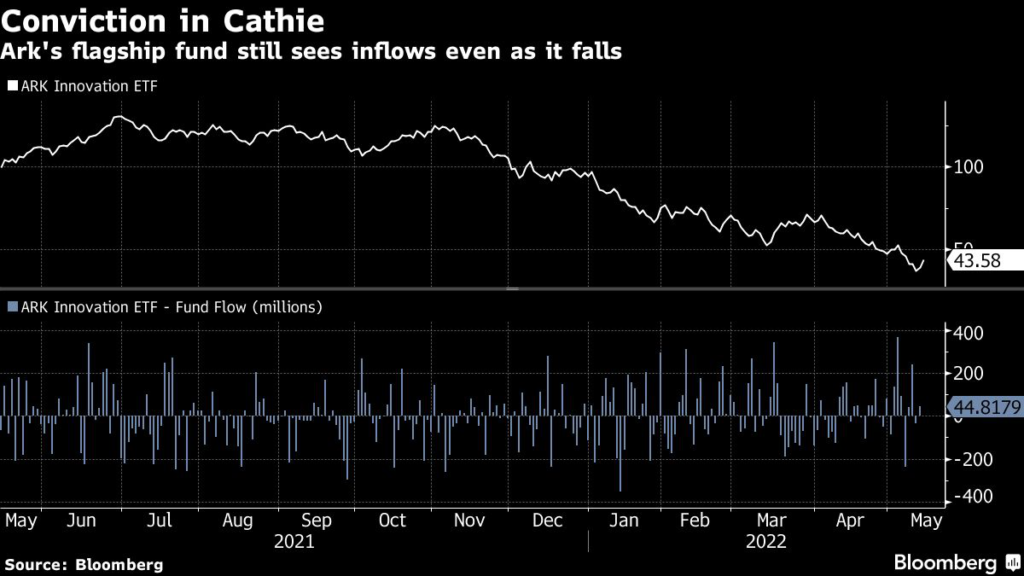
As it plunged on Wednesday, ARKK actually posted inflows. It was a relatively small amount for the $7.8 billion ETF — about $45 million — but net inflows in 2022 are more than $1.5 billion. That’s for a vehicle that has plunged as much as 61% this year.

“Investors that are in this strategy have stayed loyal to this strategy, have a long-term time horizon and view selloffs as opportunities to deploy some additional capital,” said Todd Rosenbluth, head of research at ETF Trends.

Of course, there’s also no shortage of investors ready to bet against ARK. Short interest in the main fund is a relatively elevated 14.8% of shares outstanding, according to data from IHS Markit Ltd. 

Meanwhile, by the close on Wednesday the price of the Tuttle Capital Short Innovation ETF, which aims to deliver the reverse performance of the innovation fund on a daily basis, was more than double that of the ARK ETF. In other words, betting against Wood’s flagship strategy for a day cost twice as much as buying the fund itself to hold.

But things were looking more positive for ARK by the end of the week as tech stocks managed a rebound. The innovation fund jumped 12% Friday after climbing 5.6% a day earlier. One of Wood’s high profile picks, Robinhood Markets Inc., was surging after cryptocurrency billionaire Sam Bankman-Fried revealed a major stake.

It’s a long way from undoing recent damage to Wood’s main ETF — the fund would have to jump about 260% from here to reclaim its all-time high. But at least it provides some respite for the faithful.

Ultimately, investors continue to lean on Ark ETFs as vehicles to get in and out of disruptive technology. In a turbulent week for the flagship fund, trading volume surged to a record 316 million shares.

As Ark sticks to its strategy, investors “know exactly what they’re going to get” and can rely on its funds to make pure-play trades on innovation, Geraci said. “The benefit of Cathie Wood not wavering from her strategy during this brutal downturn is that I think it will help the longer-term viability of Ark.”

More stories like this are available on bloomberg.com

©2022 Bloomberg L.P.
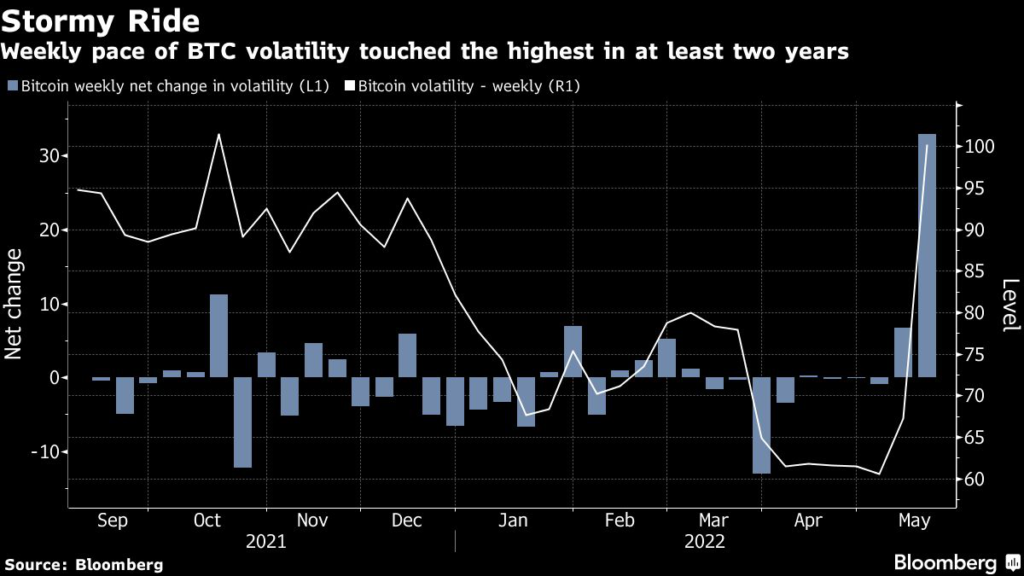
Crypto Prices Slip After Record Week For Bitcoin Volatility

(Bloomberg) — Cryptocurrencies trended lower Saturday in the wake of the collapse of TerraUSD and the most volatile week for Bitcoin trading in at least two years.

The price of Bitcoin, the world’s largest cryptocurrency, had fallen 3% to below $29,000 just after noon in New York, according to pricing compiled by Bloomberg. Ether held steadily below the $2,000 threshold at around $1967.

The wipeout of algorithmic stablecoin TerraUSD and its sister token Luna knocked more than $270 billion off the crypto sector’s total trillion-dollar value. The weekly net change in Bitcoin volatility was the highest in the two years since Bloomberg first began recording data.

Altcoins did not escape the declines on Saturday, with Solana and Polkadot down more than 5% and Avalanche down nearly than 8%.

“Multiple headwinds have given market players almost nowhere to hide in any asset class this week,” said Coinbase Institutional’s Brian Cubellis and David Duong in a report Friday, adding that volumes on its exchange were the highest since January’s crypto sell-off. 

“Interestingly, despite larger volatility than during the sell-offs in January or December, volumes are still somewhat lower in comparison, which suggests lighter positioning as well as potentially decreased interest from retail due to a difficult market environment,” they wrote in the note.

The analysts said Bitcoin’s $30,000 threshold will become “a major resistance” if prices continue to consolidate below that mark over the next few days. “If things were to deteriorate further the next line of support would come at around $20,000 which was the all-time high in the previous 2017/2018 cycle,” they added.

More stories like this are available on bloomberg.com

©2022 Bloomberg L.P.

Close Bitnami banner
Bitnami
