
Bloomberg

In-Flight Wi-Fi Nears End of Stigma as Glitchy Service

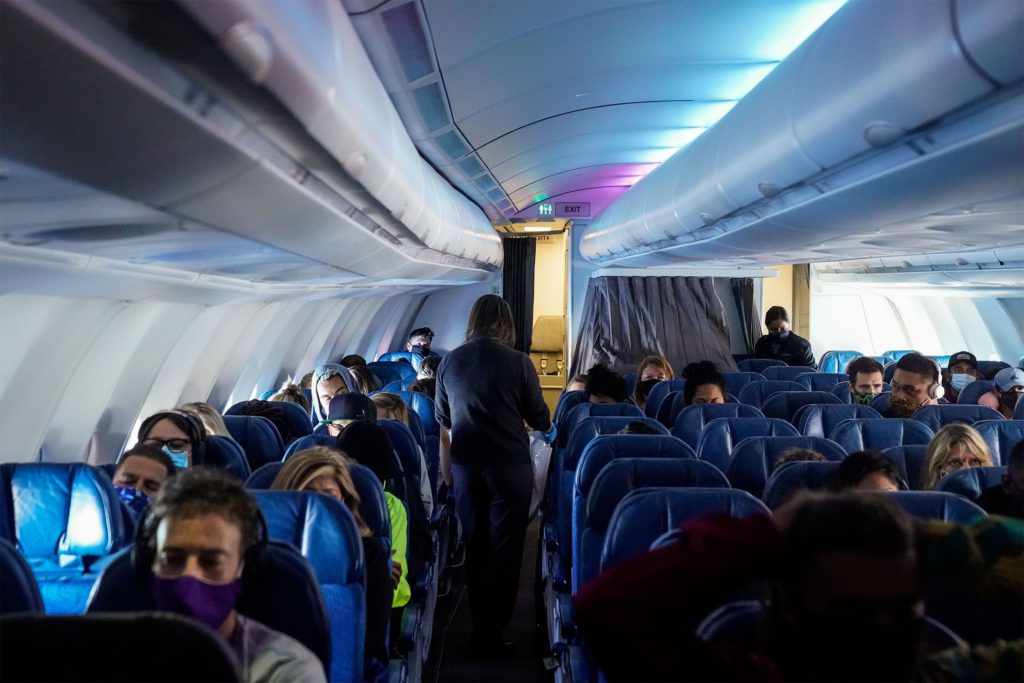
(Bloomberg) — Fast, reliable Wi-Fi on a plane is as unlikely as sitting in a row with an empty seat. But the era of lost connectivity while airborne may be ending.

A spate of new in-flight connection deals in recent weeks, including the first aircraft contracts signed by SpaceX’s Starlink satellite unit, aim to make high-speed Wi-Fi less glitch-free over the next three years on most domestic flights operated by major US carriers. The latest in-flight deal came Wednesday when Southwest Airlines Co. said it would add a second Wi-Fi provider, Viasat Inc., for faster speeds on more than 400 new Boeing Co. 737 Max aircraft.

Airlines are racing to offer improved connection speeds and reliability as post-pandemic competition for travelers has stepped up, particularly for high-revenue premium passengers. With expanded satellite bandwidth, the airlines’ goal is to replicate the same internet experience in-flight that people have come to expect on the ground.

It’s no longer an amenity just for corporate road warriors, Don Buchman, vice president of commercial mobility at California-based Viasat, said in an interview. “You need to have it — it’s kind of like serving water and coffee,” he said.

Elon Musk’s Starlink became the first of several planned low-Earth orbit satellite systems to enter the aviation market last month. Hawaiian Holdings Inc. and Dallas-based JSX Inc. said they’ll offer SpaceX’s Wi-Fi product to passengers for free, though neither carrier has a definitive date for availability. Hawaiian Holdings Inc. said April 25 it plans to equip three aircraft types with Starlink, with the first planned in 2023.

Other satellite-based Wi-Fi providers in the rapidly evolving space include Anuvu Inc., which provides service from its own and other satellites; Intelsat SA, which acquired Gogo Inc.’s commercial airline business two years ago; and OneWeb Ltd., a startup partially owned by the UK government that’s working on a service for aircraft.

Studying SpaceX

Space Exploration Technologies Corp. has pitched its Starlink Wi-Fi internet product to four of the largest US airlines, without success to date. It faces questions about reliability and price competitiveness, according to people familiar with the issue.

Delta Air Lines Inc. said it has tested the new SpaceX service, according to a spokesman, but hasn’t publicly commented on any plans to offer it. American Airlines Group Inc. and Southwest also have had discussions with Musk’s company, according to people familiar with the process at each carrier. 

American declined to comment, while Southwest said it’s “keeping an eye on” new technology, including systems like Starlink. A SpaceX spokesman and a Starlink sales executive did not respond to messages seeking comment.

The first jets likely to be fitted with Starlink’s service will be Hawaiian’s Airbus A321neos flying to the US West Coast, said Avi Maniss, a senior vice president at the airline who helped to evaluate various options before the company chose Starlink. Hawaiian avoided Wi-Fi in its fleet for many years because satellite coverage in the Pacific had been spotty, but has high hopes for the new service offered by SpaceX.

“We are at one of those junctures in the industry where there’s new technology where it’s worth carriers looking at,” Maniss said.  

Crowded Skies

Airlines are weighing the costs and benefits of newer and smaller satellite constellations such as those operated by OneWeb and Starlink versus traditional and larger satellites in higher geostationary orbits like those of ViaSat, Intelsat and Eutelsat SA. 

Alaska Airlines has talked with SpaceX about Starlink but last month opted for Intelsat service for more than 100 new Boeing 737 Max aircraft, adding to the Intelsat/Gogo 2Ku system currently available on more than 150 jets.

“For a new entrant into this market, there are certain table stakes that are required for support,” said David Scotland, product manager for inflight entertainment and connectivity at Seattle-based Alaska. “Everything that they’re doing is very impressive, there’s no denying that, and the speed at which they work is very impressive,” he said of Starlink, noting that Alaska is continuing to exchange information with SpaceX officials.

Viasat is by far the largest provider, with an estimated 3,300 aircraft under contract, according to William Blair. The satellite telecommunications giant has service contracts for broadband capacity with Delta, American, United Airlines Holdings Inc., Southwest and JetBlue Airways Corp.

“ViaSat is now the main Wi-Fi provider for all the ‘Big Four’ airlines in the United States,” Louie DiPalma, a William Blair analyst, said in a note Wednesday. “While we expect that SpaceX will win new contracts, ViaSat has now locked up the most valuable global fleets.”

Wi-Fi Holy Grail

A planned trio of new Viasat-3 satellites, with the first launching in late summer, will provide global coverage and lead to more widebody jet deals, according to Buchman. That could unlock the Holy Grail of Wi-Fi for the jet set: Fast, reliable and affordable service globally.

Delta plans to have 530 of its mainline aircraft with the Viasat system by year’s end. Viasat has also won new business from startup Breeze Airways, established by JetBlue founder David Neeleman, which will install that company’s service on its new Airbus A220 aircraft. 

Southwest’s new Viasat deal complements existing internet service across its 737 fleet, priced at $8 per day, which Anuvu has provided since early 2010. 

Formerly known as Global Eagle Entertainment before emerging from bankruptcy in 2021, Denver-based Anuvu plans to transition from its current patchwork of geostationary satellites to a new $5 billion low-Earth orbit constellation from Canadian satellite operator Telesat Corp., called Telesat Lightspeed, with worldwide coverage. That network of 188 satellites is expected to begin commercial service in 2026, three years later than planned.

(Corrects Southwest’s current in-flight wi-fi price to $8 per day in penultimate paragraph.)

More stories like this are available on bloomberg.com

©2022 Bloomberg L.P.
Terra’s $45 Billion Face Plant Creates a Crowd of Crypto Losers

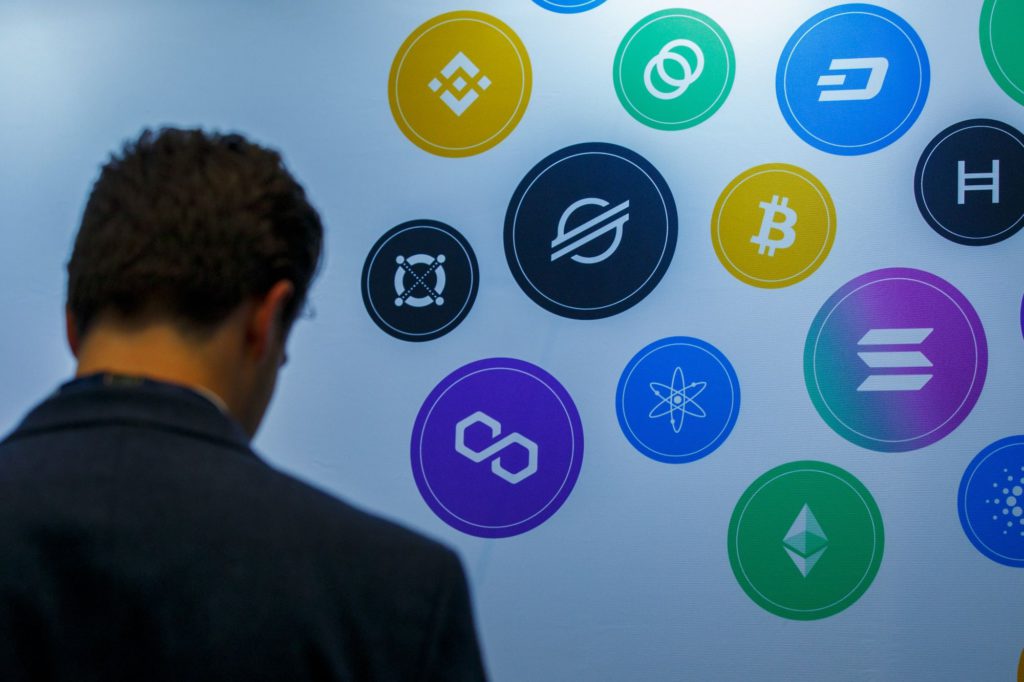
(Bloomberg) — This week’s undoing of the TerraUSD algorithmic stablecoin and its sister token Luna has ramifications for all of crypto. First, there’s the immediate impact: The rapid collapse of a once-popular pair of cryptocurrencies sent a ripple effect across the industry, contributing to plummeting coin prices that wiped hundreds of billions of market value from the digital-asset market and stoked worries over the potential fragility of digital-asset ventures.

Then there are the knock-on effects. In addition to delivering punishing losses to individual users and investment firms, the spectacular failure of a market darling like Terra threatens to have a cooling effect on the fundraisings that have jacked up crypto startups’ valuations in recent years. Venture capitalists who have long been some of the industry’s biggest cheerleaders may not have quite the same risk tolerance now — especially those directly caught in the crossfire.

“It’s something the scale of which crypto has really never seen in terms of a top-five project just absolutely imploding,” said Matt Walsh, founding partner of Castle Island Ventures, a blockchain-focused VC firm. Almost $45 billion evaporated from the market caps of TerraUSD (known as UST) and Luna over the course of a week, according to CoinGecko.

There were some winners in this scenario — like the investment firms including F9 Research that shorted TerraUSD (known as UST). Stablecoins backed by reserves rather than algorithms also came off looking like better options. But it’s the losses from these bruising past few days that will resonate.

Read more: ‘Everything Broke’: Terra Goes From DeFi Darling to Death Spiral

Individual holders of UST and Luna, the token that’s part of the peg mechanism for the algorithmic stablecoin, are now deeply in the red. 

“The biggest losers from all of this will be retail [investors] that didn’t understand the risks they were taking,” said Kyle Samani, co-founder and managing partner at crypto VC firm Multicoin Capital.

Other losers include the venture capitalists and investment firms that have backed Terraform Labs, the startup behind UST, and Luna Foundation Guard, the nonprofit managing the Luna token. Galaxy Digital Holdings Ltd., Pantera Capital and Lightspeed Venture Partners invested in Terraform’s last $150 million fundraise in July, while Jump Crypto and Three Arrows Capital participated in a $1 billion sale of Luna tokens in February.

These backers, who once hoped that their investments would deliver massive returns, instead found themselves being solicited to prop up UST and Luna in a $1.5 billion backstop. In essence, they were asked to “put their money where their mouth is,” a test of whether these institutions actually believe in what they’re investing, said Billy Dishman, investment and research analyst at crypto VC firm CoinFund. So far, they haven’t shown much interest. 

Terraform Labs is working on another contingency plan in which ownership of the blockchain network would be distributed to investors, according to a blog entry posted Friday that was attributed to co-founder Do Kwon.

Investors and startups with no direct connection to UST are also finding themselves on unsteady ground. Chris McCann and Edith Yeung, general partners at Race Capital — a VC firm that focuses on early-stage crypto startups — have heard of deals falling apart or being repriced and said that founders are getting “ghosted” by potential investors. They’re urging their portfolio companies to take caution and ensure that the funds they’ve raised so far are in fiat, not crypto. 

“If you’re in the middle of a fundraise period, close it,” McCann added. “If you’re not, don’t do it now. Now’s not the time.”

Yeung said she also has a playbook in case a portfolio company finds itself in crisis. She said part of Race’s strategy is to find a better way for founders to communicate – lengthy Twitter threads have the potential to spur rumors and spread discord.

“I have a blog post template ready to go,” she said. “It’s kind of silly, but it’s happened now so many times now.”

‘Downstream Impact’

Castle Island Ventures’ Walsh said that later-stage companies are more likely to see valuation hits as they raise more funds because of their proximity to public markets, where stocks like Coinbase Global Inc. have plummeted. Coinbase stock slumped 35% this week and ended the week with a market value of $15 billion.

“Coinbase trading at $17 to $18 billion market cap, that’s going to have a downstream impact on the venture community in the crypto space,” Walsh said in an interview. 

This will eventually trickle down to the seed stage, where newer crypto startups could take valuation cuts, Walsh added. He said that there also could be a shift in the types of firms investing in crypto, noting that a lot of of traditional funds have gotten more interested in the industry in the last year.

“There’s a question of are some of those funds just tourists that in the bear market back away,” Walsh said.

Traditional Take

Dana Stalder, a general partner at tech VC firm Matrix Partners, said it’s important to note that it’s not just cryptocurrencies caught in a downturn: Tech stocks are struggling as well.

“There’s a flight to safety out of the equity asset class,” Stalder said in an interview.

The firm is still excited about its investment in crypto startup Lightspark, which it announced Thursday. The company was founded by David Marcus, who left Meta Platforms Inc. last year after overseeing its crypto efforts. Lightspark is building infrastructure to help support payments for Bitcoin, which traded at less $30,000 as of Friday evening in New York and is down more than 25% over the past 30 days.

“I don’t think this cycle will have any impact on what the Lightspark team is building — it is a very long play,” he said.

Peter Fenton, a general partner at Benchmark, said that there will likely be a slowdown in crypto investing as many VC firms were likely “playing out of their winnings” and using returns from previous crypto investments to fund new ones in the space.

However, his firm, which has already backed crypto startups Chainalysis and Sorare, is still committed. Fenton said Benchmark plans to pursue three to five crypto investments a year because it still has confidence in the industry and its startups.

“People forget that Google’s best financings were done in really the worst venture years,” he said.

More stories like this are available on bloomberg.com

©2022 Bloomberg L.P.
From Sneakers to Teslas, China Lockdowns Upend Global Supply Chains

(Bloomberg) — The economic consequences from China’s Covid-19 lockdowns are starting to be felt by companies and consumers across the globe, and expectations are that the reverberations will only get stronger. 

Supplies of Adidas sneakers and Bang & Olufsen speakers have been hit. Automakers from Toyota to Tesla are facing “unprecedented” costs and production hurdles. Sony is struggling to make enough PlayStations. 

While “supply-chain disruption” is emerging once more as the most repeated phrase of corporate earnings season, the impact goes beyond multinationals’ profits. Hospitals from the US to Australia are wrestling with a shortage of chemicals used in X-rays, while real-estate projects are held up by delayed materials. 

Jake Phipps, whose US firm supplies luxury bathroom fixtures and kitchen countertops to skyscraper projects, is seeing months of delays for the shipment of faucets from Shanghai. “All the construction projects here are backed up waiting on raw materials,” he said. “The supply chain has been a mess already, and this is making it worse.”

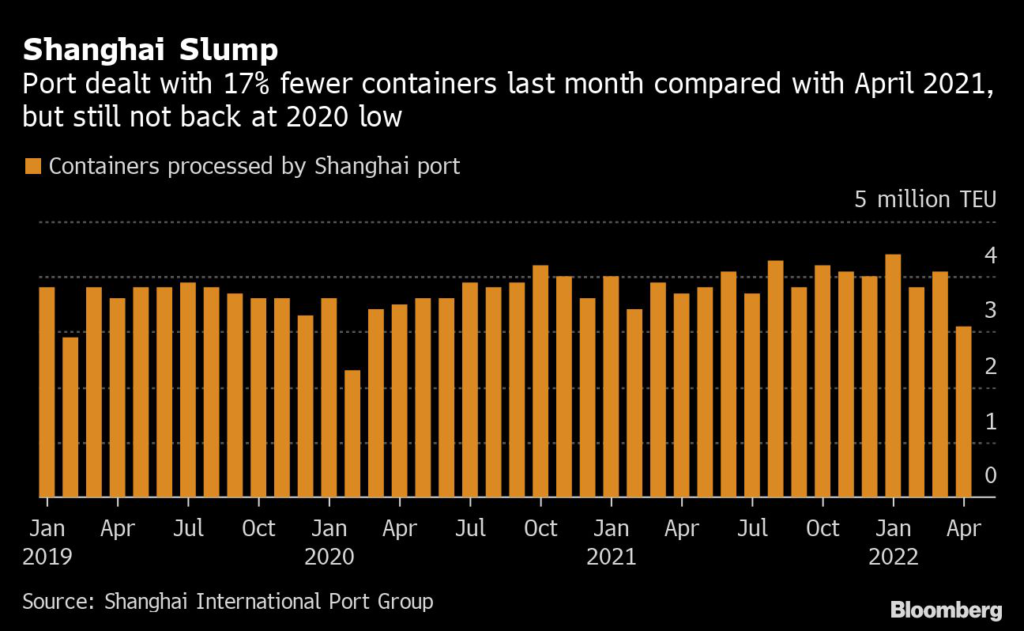
Beijing’s zero-tolerance approach to Covid has idled factories and warehouses, slowed truck deliveries and worsened container logjams. As the country accounts for about 12% of global trade, it was only a matter of time before the upheaval began to trickle across economies, threatening to further stoke rising inflation.

Global Supply Chain Crisis Flares Up Again Where It All Began

While the impact so far doesn’t appear severe, this is likely only the beginning. The full significance of China’s Covid restrictions has yet to be seen as lockdowns continue in Shanghai and other cities shut to contain smaller outbreaks, adding to supply-chain congestion that’s already reeling from the war in Ukraine. 

“Once Shanghai opens up again and everything is back into rotation, and you see all the vessels heading towards the US, that can pose additional challenges with additional congestion,” said Jonathan Gold, vice president of supply chain and customs policy for the National Retail Federation in Washington. 

Here’s how the situation in China is intensifying global supply-chain chaos:

Construction Projects

Phipps, founder of Phipps International, is growing more frustrated as his shipments of faucets have been delayed by two to three months, with no certainty of when they can leave Shanghai. Suppliers repeatedly told him “five more days,” and that has now stretched to 40 days.

One factory making the moulds to cast the faucets managed to start up last week after more than a month of inactivity. But the faucets, once made, still need to be moved to other factories to get chrome-plated and polished, and some of those plants are still shut. Then there’s the dearth of truckers.

“That’s one of the biggest issues – truckers aren’t moving goods because the government doesn’t want them spreading Covid from city to city,” Phipps said in an interview from Miami.

The wait for bathroom taps and other furniture to arrive from China will further delay construction projects in the US, some of which are already a year behind schedule, Phipps said. He is shifting some production from China to Vietnam and is buying marble, quartz and granite from Italy, Brazil and Turkey instead of China.

Sneakers & Apparel

Clothing and shoe factories in Vietnam are struggling to meet orders as supplies of Chinese material used to make everything from sneakers to pants are drying up. 

The Southeast Asian nation is the second-largest supplier of clothes and shoes to the U.S., according to the American Apparel & Footwear Association, which represents more than 1,000 brands. 

China’s Covid Zero strategy is “dramatically” reducing key material at shoe factories, which derive about 60% of supplies from China, said Phan Thi Thanh Xuan, vice chairwoman of the Vietnam Leather Footwear and Handbag Association. Adidas SE this month cut its profit targets, saying supply bottlenecks in Vietnam have reduced the availability of products, eroding sales. 

Technology & Games

The eastern Chinese region around Shanghai is a key center for tech production, and component shortages are hitting companies across the board.

Giants from Microsoft Corp. to Texas Instruments Inc. have said the lockdowns will crimp sales and make it harder to produce products like the Xbox. Apple Inc. said last month that the restrictions will take a toll on its June results, with supply constraints costing $4 billion to $8 billion in revenue. 

Major iPhone supplier Pegatron Corp. this week cut its second-quarter outlook for notebook shipments. Semiconductor Manufacturing International Corp., China’s biggest chipmaker, said the lockdowns could erase about 5% of its output in the latest quarter.

Top China Chipmaker, Apple Suppliers Succumb to Covid Lockdowns

Sony Group Corp., meanwhile, lowered its sales target for the flagship PlayStation 5, citing supply-chain complications because of the Covid-19 pandemic, including the lockdowns in China. Nintendo Co. also said there had been some impact on sales because of the situation in Shanghai.

Medical Supplies

Shanghai’s Covid-19 curbs are even having an impact on health care, as lockdowns have sparked a global shortage of chemicals used in imaging tests.

Health-care facilities have seen shortages of an iodinated contrast medium known as Omnipaque that’s produced at a GE Healthcare factory in Shanghai, the Greater New York Hospital Association said earlier this month. The chemical agent is widely used in X-rays, radiography and CT scans. The hospital body warned that supplies may be curtailed by as much as 80% for the next two months, even though the factory has now resumed production.

A spokeswoman for the Australian Society of Medical Imaging and Radiation Therapy said the shortage of the contrast dye could continue for weeks, and it may be late June until orders get into the country. The society has told its 9,000 members, who include radiographers, to prioritize urgent scans and try to find other suppliers.

A representative for GE Healthcare said the firm was “working around the clock to expand capacity” of the imaging chemical.

Luxury Stereos

Bang & Olufsen, the maker of luxury stereos and TV sets, this week cut its financial outlook due to the developments in China. The Danish company, which sells speakers costing as much as $110,000 a pair, said the lockdowns aren’t just hurting local sales, but are also spilling into markets outside of China as restricted access to warehouses causes a string of logistical problems.

“The lockdowns have been more extensive than we anticipated, and it is not just affecting sales in China, but also the global availability of products,” Chief Executive Officer Kristian Tear said.

Automakers

A slew of carmakers from Volkswagen AG to Toyota Motor Corp. have started to resume production at factories in Shanghai and the industrial province of Jilin, though logistics issues continue.

Tesla Inc.’s plant in Shanghai has been plagued by disruptions, closing down for three weeks last month. It started up again in late April under a so-called closed loop system in which workers live on site and are tested regularly. But with Shanghai largely remaining in lockdown, there are still challenges for the delivery of supplies and materials.

The factory, which typically shipped around 60,000 cars a month, delivered only 1,512 vehicles out of Shanghai last month.

Toyota, meanwhile, is wrestling with an “unprecedented” rise in costs for logistics and raw materials, causing it to forecast a 20% decline in operating profit for the current fiscal year. 

Carmakers on the other side of the world are also struggling to keep up with production as parts produced in China don’t arrive. In Brazil, semiconductor shortages led factories to reduce output by at least 100,000 vehicles so far this year, according to the National Association of Automotive Vehicle Manufacturers.

In March, IHS Markit downgraded its forecast for global auto production in 2022 to factor in the impact from Russia’s invasion of Ukraine, then lowered it further last month in response to the fallout from lockdowns in China, along with other mounting risks. 

More stories like this are available on bloomberg.com

©2022 Bloomberg L.P.
Venezuelan Telecom Rallies on Maduro Plan to List State Assets

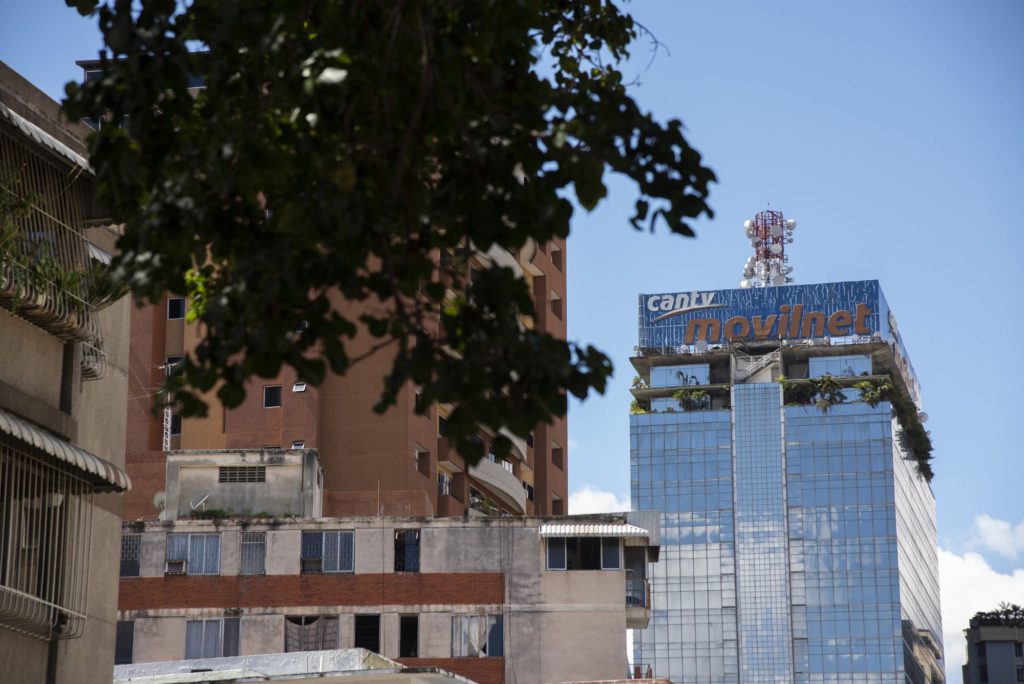
(Bloomberg) — Shares in Venezuela’s state-owned telecommunications company soared this week in Caracas as the government announced plans to offer stakes in public companies, boosting expectations for a revival in the local market.

Cia. Anonima Nacional Telefonos de Venezuela SA, or CANTV, surged 41% in two days, according to Caracas Stock Exchange data, after President Nicolas Maduro said his government was going to list 5% to 10% of the shares of public companies for national and international investment. 

Maduro made comments in a televised evening address Wednesday, mentioning CANTV, a state-owned petrochemical company, and oil and gas joint ventures as examples of companies that could soon start to raise capital. Offerings would start as soon as Monday, Maduro said, without adding further details. 

“These shares are rallying on the expectation that the government is going to start privatizing state-owned companies and that it’s going to do so in a more transparent, institutional way through the stock exchange,” said Jose Miguel Farias, an independent local investment adviser and broker. “Despite the lack of information, for many investors with an appetite for risk, it’s worth accumulating positions in these state companies hoping that, in the long run, that leads to them discovering their real value.”

The announcement could mean a historic shift in Venezuela’s socialist economic policy, where years of currency and price controls, expropriations and corruption led the country to one of the longest bouts of hyperinflation in history and a seven-year recession. As the crises deepened, Maduro has been forced to ease restrictions and allow an unofficial dollarization, which has helped breathe new life into a dormant market.

On Friday at a meeting with the foreign press, Caracas Stock Exchange President Gustavo Pulido said the bourse hadn’t been informed of any new authorization for public listings. Even if they receive notice by Monday, it would take them at least 48 hours to prepare an offering, Pulido said.

CANTV said there was no significant event to notify the market that explained the increase in the stock price. “We presume that the stock movement in the price of CANTV’s shares is a product of the president’s announcement,” CANTV’s corporate affairs manager, Helen Hernandez, said in a letter to the exchange published Friday.

The plan may be in its early stages, and attracting foreign investors remains tricky as economic sanctions imposed by the US continue to block dealings with government-controlled firms. But local investors embraced prospects for development of the capital market.

For CANTV, there are positive expectations about potential investments it could receive through the exchange, said Juan Domingo Cordero Osorio, president of local brokerage Rendivalores Casa de Bolsa. 

More broadly, “a company that is listed in the stock exchange is regulated and supervised,” he said. “Investors see this as positive, as it gives them greater security in their investments.”

More stories like this are available on bloomberg.com

©2022 Bloomberg L.P.
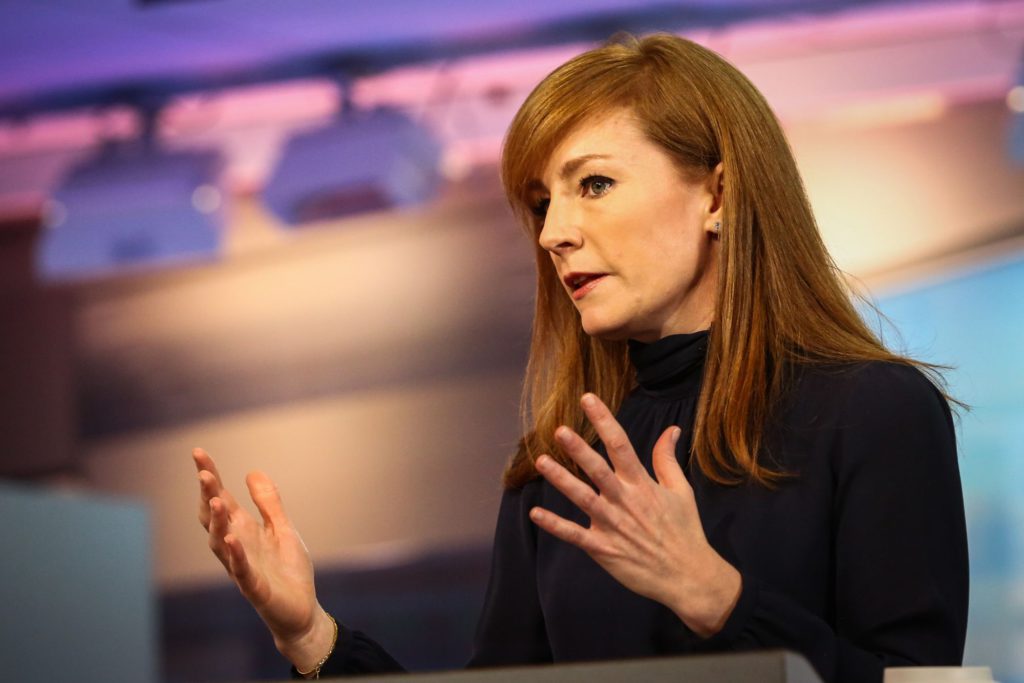
BlackRock’s Moore Says Stock Investors Can Win During Inflation

(Bloomberg) — Stock investors can profit, even when inflation is causing broader markets to tumble, by carefully choosing companies to buy, according to Kate Moore of BlackRock Inc.

“There’s actually really interesting investment themes around higher inflation,” Moore, managing director overseeing thematic strategy at BlackRock, the $9.6 trillion asset manager, said Friday during an interview on Bloomberg Television. 

Companies with less dependence on labor, efficient technology, long-term contracts with suppliers and other factors that reduce input costs are likely to outperform when inflation is rising, Moore told David Westin on Bloomberg Television’s “Wall Street Week.” Cloud-computing firms are likely to do well, she said, without naming specific companies.

U.S. prices increased 8.3% in the year through April, one of the highest paces in four decades, the Bureau of Labor Statistics reported this week. A chaotic week in financial markets ended Friday with the S&P 500 closing up for the day but still posting a sixth consecutive weekly drop, the longest losing streak since 2011. 

Portfolio diversifiers such as commodities, real estate and inflation-protected securities are healthy holdings during inflationary periods when stocks and bonds are falling, according to David Bianco, chief investment officer of the Americas for DWS Group GmbH & Co., another “Wall Street Week” guest. 

“Cash is not trash at a time of uncertainty like this,” Bianco said.

More stories like this are available on bloomberg.com

©2022 Bloomberg L.P.

World’s Richest Family Bet on Munis, Japanese Stocks, Coinbase

(Bloomberg) — An investment firm for the Walton family ramped up its position in a U.S. municipal bond fund and added a sizable stake in Japanese equities, while also betting on small-cap stocks and Coinbase Global Inc. before tumultuous declines. 

WIT LLC, an acronym for the Walton Investment Team, invests mostly in low-cost exchange-traded funds. It held about $5.1 billion in U.S. stocks and ETFs at the end of last quarter, a filing with the US Securities and Exchange Commission showed Friday. 

The firm, which oversees money for the world’s wealthiest family, added 3.9 million shares of the iShares MSCI Japan ETF worth about $239.3 million, its biggest new stake and its fifth-largest overall. WIT also bought about $150 million in small-cap stocks through new positions in Vanguard and iShares index funds. The largest holding is the Vanguard FTSE Emerging Markets ETF, which was worth $1.6 billion at the end of the quarter even after it was whittled down.

Its next two largest stakes are in debt funds: the Vanguard Short-Term Treasury ETF and the iShares Short-Term National Muni Bond ETF. WIT added to both positions in the first quarter as front-end yields surged on expectations of accelerated Federal Reserve interest-rate increases. 

While the vast majority of the positions are in index funds, WIT also acquired $15 million of Coinbase, the cryptocurrency exchange whose shares have tumbled 73% this year, and 64% since March 31.

The Walton family’s fortune is estimated to be in excess of $200 billion, according to the Bloomberg Billionaires Index. About half of that is tied to Walmart Inc., the company founded by Sam Walton in 1950. 

SEC rules require investors managing more than $100 million in U.S. equities to disclose their holdings, though family offices can appeal to keep these documents confidential. 

More stories like this are available on bloomberg.com

©2022 Bloomberg L.P.
Apple Bounce Can’t Shake Off Chilling Signal for Stock Market

(Bloomberg) — The week is ending on a higher note for Big Tech on hopes a relentless selloff may be nearing exhaustion. But Friday’s rally can’t completely wipe out a sobering signal from Apple Inc. shares. 

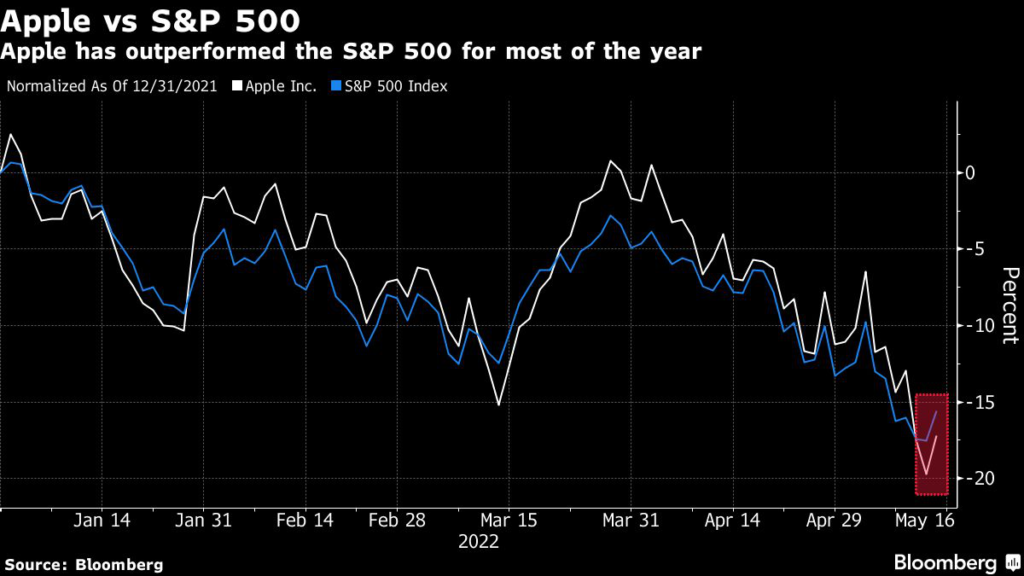
After acting as a ballast for the broader market for most of the year, the stock broke down this week, with losses through Thursday exceeding 9%. Even after Friday’s rebound, Apple is now underperforming the S&P 500 for the year. And this, analysts say, is worrisome. 

“It is a troubling sign when investors sour on best of breed names in an already difficult tape,” said Nicholas Colas, co-founder of DataTrek Research. Apple’s slide “is part of a larger trend of investor risk aversion.”

It would be difficult to overstate the importance of Apple for the rest of the market. With more than $2 trillion in value, the company has the biggest weighting in the S&P 500, helping sway the benchmark in either direction. Further losses for the stock next week could help send the index down again. 

“It’s mathematically impossible for the S&P 500 to rise when the largest stocks keep falling,” said Kim Forrest, chief investment officer and founder of Bokeh Capital Partners. Seeing Apple drop so rapidly is “chilling,” she said.

Apple rose 3.2% on Friday, ending the week down more than 6% and erasing about $165 billion in market value. The losses were punctuated on Wednesday when Aramco, the Saudi Arabian oil giant that is benefiting from higher energy costs, overtook the company as the world’s most valuable.  

Apple’s immense profits have made it a popular destination for investors seeking safe haven assets amid market turmoil. But it’s now being swept up in the selling that started with more speculative growth stocks, which are valued more for their promise of future profits, making them more susceptible to higher interest rates and inflation.

Silver Lining

Of course, the selling could be a sign that investors are finally capitulating and stocks are poised for an extended rebound, said Forrest at Bokeh Capital Partners. 

One positive sign is that retail investors have continued pouring money into stocks this year in spite of the selloff and are still buying Apple. The stock was the second-most purchased by retail traders in the five days preceding May 11, according to data from Vanda Research.

Jason Benowitz, a senior portfolio manager at Roosevelt Investment Group, says he’ll be watching news out of China to gauge the direction of Apple’s shares. Covid-19 lockdowns in the country have disrupted the economy and threaten to exacerbate supply chain snarls that have cost the company billions of dollars in lost sales in recent quarters.

“There’s concern right now about the ability to operate in China,” he said. “Risk is going to be present for some time.”

More stories like this are available on bloomberg.com

©2022 Bloomberg L.P.
Stocks Roar Back at End of Nerve-Racking Week: Markets Wrap

(Bloomberg) — Stocks rallied at the end of a chaotic week in financial markets, with a little help from Federal Reserve Chair Jerome Powell’s reassurance that bigger rate hikes would be off the table for now even after the hot inflation readings of the past few days.

For a market plagued by fears that more aggressive monetary tightening could tip the economy into a recession, Powell’s remarks ended up soothing frayed nerves and sparking a rebound in beaten-down risk assets. Despite the strong gains on Friday, many traders aren’t yet convinced that equities have reached a bottom after a selloff that shaved $10 trillion from US stock values in 18 weeks. Instead, they say investors should still brace for volatility as the Fed’s ability to fight price pressures without causing a hard landing may depend on factors outside the central bank’s control.

After sinking almost 20% from a record and flirting with a bear market, the S&P 500 saw a broad-based rally Friday. It still posted a sixth straight week of declines — the longest losing streak since June 2011. The Nasdaq 100 outperformed amid a rally in giants like Apple Inc., Microsoft Corp. and Amazon.com Inc. Meanwhile, Elon Musk caused chaos over his takeover offer for Twitter Inc., first claiming his bid was “temporarily on hold” and then maintaining he’s “still committed” to the deal — sending the social-media giant into a tailspin. Tesla Inc. jumped. Treasuries fell with the dollar.

Over the course of another tumultuous week for financial markets, some prominent voices on Wall Street pondered on the outlook for stocks after a powerful selloff. Peter Oppenheimer at Goldman Sachs Group Inc. said on Tuesday that the rout had created buying opportunities, with headwinds such as inflation and hawkish central banks already priced in. Meantime, Morgan Stanley strategist Michael Wilson noted that equities were still “not priced for this slowdown in growth from current levels.”

There are five telltale indicators that are used to call a bottom in stocks, including spikes in the Cboe Volatility Index, puts substantially outnumbering calls and a dismal market sentiment, according to Lindsey Bell, chief markets and money strategist at Ally. While the VIX has stayed near 30, past bear markets featured moves above 45. “A volatility climax is a signature of market bottoms,” she said.

Comments:

  • “Much speculative froth has already been removed from the market,” wrote Mark Haefele, chief investment officer at UBS Global Wealth Management. “So, we advise against a hasty exit. Our central scenario is also that a recession will be avoided over the next 12 months. However, investors should continue to brace for high levels of volatility.”
  • “We’ve certainly revalued the stock market in a big way,” Jim Paulsen, chief investment strategist at Leuthold Group, told Bloomberg Television and Radio. “Really great fear on Main Street, on Wall Street, combined with, I think, ongoing good fundamentals — including strong balance-sheets in the household sector, the corporate sector and the banking industry — I think that’s a ‘dynamite’ combination you have to buy on.”
  • “Investor sentiment is at extreme levels and technical indicators are universally negative,” said Mark Hackett, chief of investment research at Nationwide. “This reflects the degree of pessimism embedded in the market, setting the stage for a bounce from oversold levels, which could be expected in the coming weeks.”
  • “There was a sense of calm in the markets, but again without any fundamental news to suggest this is perhaps the bottom,” wrote Fawad Razaqzada, an analyst at City Index and FOREX.com. “Stocks have struggled to sustain any recovery attempts as traders have been quick to take profit on rebounds amid a bearish macro backdrop.”

Expectations of a technical bounce in the S&P 500 are building after the gauge’s relentless slide of the past several weeks. One possible zone of support comes from a cluster of Fibonacci levels — which captures retracements of rallies in the American equity benchmark from 2020 Covid crash lows.

Equities, bonds, cash and gold all saw outflows in the week ended May 11, Bank of America Corp. strategists led by Michael Hartnett wrote in a note, citing EPFR Global data. At $1.1 billion, technology stocks suffered their biggest withdrawals so far this year, second only to financials, which lost $2.6 billion.

“The definition of true capitulation is investors selling what they love,” Hartnett said, citing assets like big tech, for example. “Fear and loathing suggest stocks are prone to an imminent bear-market rally, but we do not think ultimate lows have been reached.”

Some of the main moves in markets:

Stocks

  • The S&P 500 rose 2.4% as of 4 p.m. New York time
  • The Nasdaq 100 rose 3.7%
  • The Dow Jones Industrial Average rose 1.5%
  • The MSCI World index rose 2.3%

Currencies

  • The Bloomberg Dollar Spot Index fell 0.3%
  • The euro rose 0.2% to $1.0401
  • The British pound rose 0.3% to $1.2241
  • The Japanese yen fell 0.8% to 129.32 per dollar

Bonds

  • The yield on 10-year Treasuries advanced nine basis points to 2.93%
  • Germany’s 10-year yield advanced 11 basis points to 0.95%
  • Britain’s 10-year yield advanced eight basis points to 1.74%

Commodities

  • West Texas Intermediate crude rose 4% to $110.36 a barrel
  • Gold futures fell 0.9% to $1,808.40 an ounce

More stories like this are available on bloomberg.com

©2022 Bloomberg L.P.

Terraform’s Kwon Floats Blockchain Restart Plan, Post Says

(Bloomberg) — Terraform Labs is working on ways to keep its Terra blockchain and ecosystem going despite the collapse of its cryptocurrency stablecoin, according to a blog post attributed to co-founder Do Kwon.

The proposal includes the redistribution of ownership of the blockchain network to investors who saw the value of their TerraUSD stablecoin and Luna tokens get wiped out this week. The proposition, titled “Terra Ecosystem Revival Plan,” would distribute 1 billion new Luna tokens to UST and Luna holders.

Kwon didn’t immediately respond to requests for comment made over Twitter and Telegram. 

Whether the proposal would save the blockchain remains in question. The network had relied heavily on investors’ confidence to make its algorithmic stablecoin work before the meltdown. 

“Even if the peg were to eventually restore after the last marginal buyers and sellers have capitulated, the holders of Luna have so severely been liquidated and diluted that we will lack the ecosystem to build back up from the ashes,” Kwon is cited as saying in the commentary. 

If passed, the proposal also raises other questions such as how centralized exchanges that allow trading of Luna and UST would be able to distribute the new tokens to their users.  

(Adds details from the proposal starting in the second paragraph.)

More stories like this are available on bloomberg.com

©2022 Bloomberg L.P.
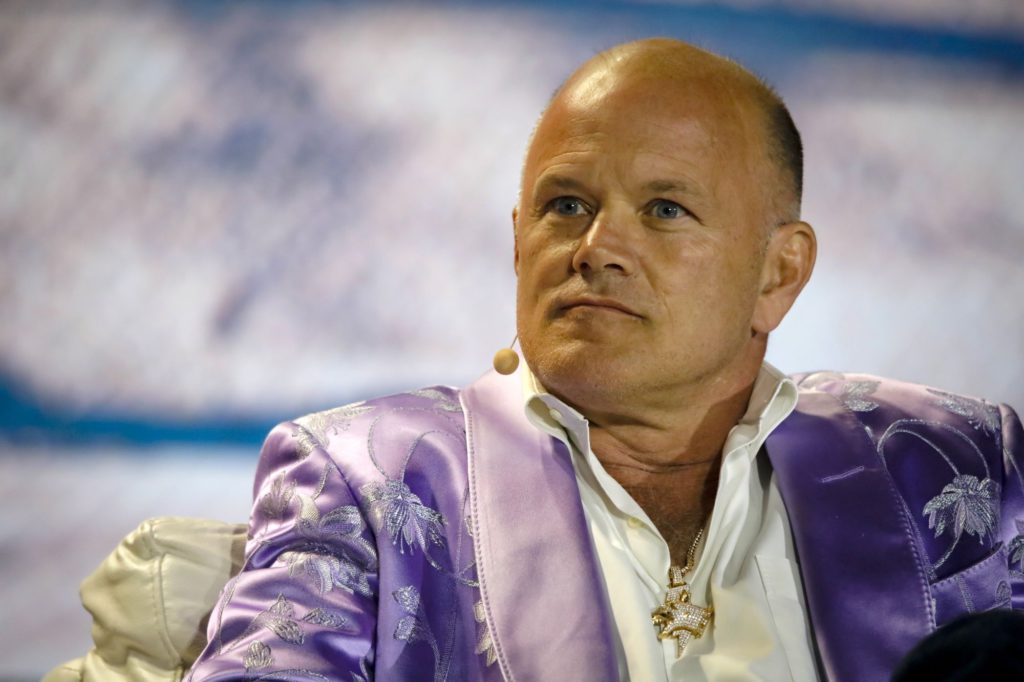
Novogratz’s Galaxy Digital  Braces for $300 Million Hit This Quarter

(Bloomberg) — Galaxy Digital Holdings Ltd. is anticipating a loss of $300 million in net comprehensive income this quarter, as uncertainty swirls across the broader cryptosphere.    

The crypto merchant bank revealed the potential hit in a preliminary update released Friday “in light of recent market conditions.” Comprehensive income typically combines both a company’s net income as well as any yet-to-be realized financial gains or losses. 

The $300 million dampener would bring “partners’ capital” — or total equity — to $2.2 billion, a decline of 12% versus March 31, 2022, according to the statement. New York-based Galaxy Digital declined a request for comment. 

The news comes in the midst of a crypto market crash, fueled by the unraveling of algorithmic stablecoin TerraUSD and its sister coin, Luna. The recent depegging of TerraUSD from the dollar accelerated a sell-off of Bitcoin and other cryptocurrencies, wiping out about $270 billion of cryptoasset market value.  

However, Galaxy Digital said that its treasury “does not utilize algorithmic stablecoins” in its May 13 update, adding that it remains “in a strong capital and liquidity position.” The company’s liquidity stands at about $1.6 billion, including $800 million in cash and over $800 million in net digital assets.  

Meanwhile, Galaxy Digital’s CEO Michael Novogratz, who has championed TerraUSD, saw his fortune nosedive to $2.5 billion, from $8.5 billion in early November. 

“Any concerns that GLXY would be subject to a sizeable loss due to exposure to LUNA tokens are clearly unwarranted,” BTIG analysts Mark Palmer and Andrew Harte wrote in a note Friday, citing a disclosure from Galaxy that it sold significant amounts of LUNA in the first quarter, as well as average collateralization levels “well over 100%” at Galaxy Digital Trading, and smooth operation and execution of the platform amid recent market volatility.

The BTIG analysts also said that their estimates for Galaxy, which they rated Buy with a price target of C$37 ($28.50), are under review. 

The company logged a net loss of about $112 million in the first quarter against a backdrop of large digital asset price declines. Partners’ capital stood at $2.5 billion by the end of March, split between $850 million in cash, $440 million in stablecoins and $400 million in liquid net digital assets, according to Alex Ioffe, the company’s CFO, on a May 9 earnings call. 

The stock was up 15% on Friday afternoon to C$8.90.

More stories like this are available on bloomberg.com

©2022 Bloomberg L.P.

Close Bitnami banner
Bitnami
