
Bloomberg

Novogratz’s Galaxy Digital Braces for $300 Million Hit This Quarter

(Bloomberg) — Galaxy Digital Holdings Ltd. is anticipating a loss of $300 million in net comprehensive income this quarter, as uncertainty swirls across the broader cryptosphere.    

The crypto merchant bank revealed the potential hit in a preliminary update released Friday “in light of recent market conditions.” Comprehensive income typically combines both a company’s net income as well as any yet-to-be realized financial gains or losses. 

The $300 million dampener would bring “partners’ capital” — or total equity — to $2.2 billion, a decline of 12% versus March 31, 2022, according to the statement. New York-based Galaxy Digital declined a request for comment. 

The news comes in the midst of a crypto market crash, fueled by the unraveling of algorithmic stablecoin TerraUSD and its sister coin, Luna. The recent depegging of TerraUSD from the dollar accelerated a sell-off of Bitcoin and other cryptocurrencies, wiping out about $270 billion of cryptoasset market value.  

However, Galaxy Digital said that its treasury “does not utilize algorithmic stablecoins” in its May 13 update, adding that it remains “in a strong capital and liquidity position.” The company’s liquidity stands at about $1.6 billion, including $800 million in cash and over $800 million in net digital assets.  

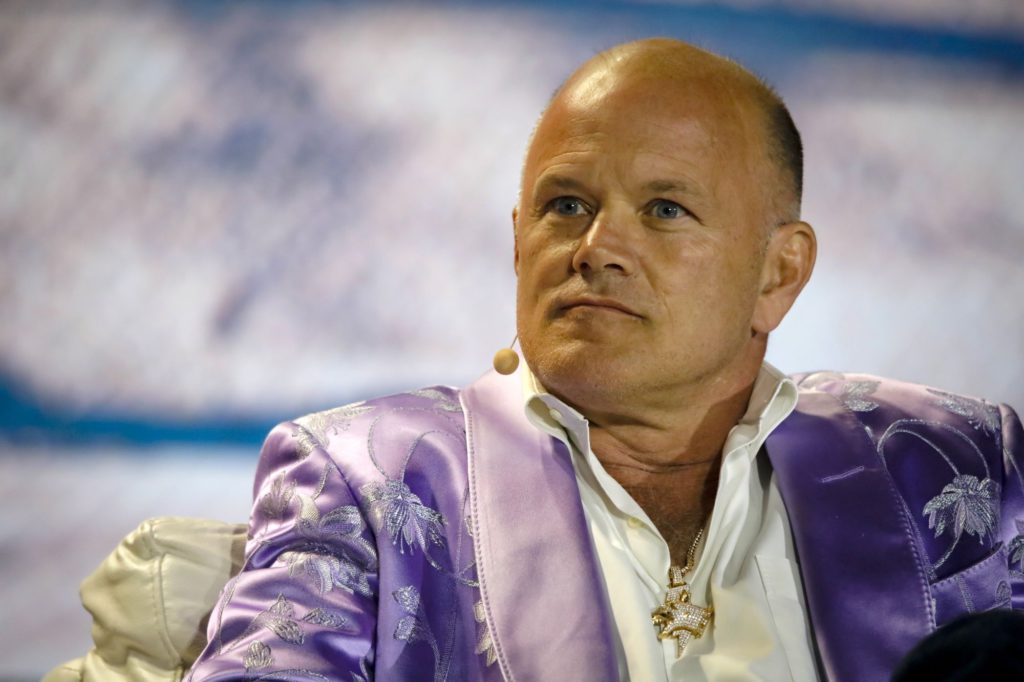
Meanwhile, Galaxy Digital’s CEO Michael Novogratz, who has championed TerraUSD, saw his fortune nosedive to $2.5 billion, from $8.5 billion in early November. 

“Any concerns that GLXY would be subject to a sizeable loss due to exposure to LUNA tokens are clearly unwarranted,” BTIG analysts Mark Palmer and Andrew Harte wrote in a note Friday, citing a disclosure from Galaxy that it sold significant amounts of LUNA in the first quarter, as well as average collateralization levels “well over 100%” at Galaxy Digital Trading, and smooth operation and execution of the platform amid recent market volatility.

The BTIG analysts also said that their estimates for Galaxy, which they rated Buy with a price target of C$37 ($28.50), are under review. 

The company logged a net loss of about $112 million in the first quarter against a backdrop of large digital asset price declines. Partners’ capital stood at $2.5 billion by the end of March, split between $850 million in cash, $440 million in stablecoins and $400 million in liquid net digital assets, according to Alex Ioffe, the company’s CFO, on a May 9 earnings call. 

The stock was up 15% on Friday afternoon to C$8.90.

More stories like this are available on bloomberg.com

©2022 Bloomberg L.P.
Crypto ETP Returns Are Abysmal, But Investors Are Still Buying

(Bloomberg) — A staggering year of losses for investors of exchange-traded products tracking digital assets has done little to shake their confidence in the market, despite recent turbulence. 

ETPs globally tracking everything from Bitcoin to Polkadot are still drawing in cash this year through Thursday, even as their average return over the same period hit minus 45%, according to data compiled by Bloomberg.

Investors continued to pile into such funds over the past week, adding about $106 million even as crypto assets lost some $270 billion of their market value.

Some flow data is delayed because of settlement schedules, so it’s possible that an exodus in the past day or two don’t show up yet. But given the durability and timing of the flows, it’s more likely that investors are trying to position themselves for the next bounce, according to Bloomberg Intelligence.

“This is bottom-calling. People have probably been waiting for a time to get into Bitcoin, and why not while it’s under $30,000?” said James Seyffart, a Bloomberg Intelligence ETF analyst. “There were a bunch of outflows in April for crypto funds around the world. But that started to change so far in May, with money coming in.”

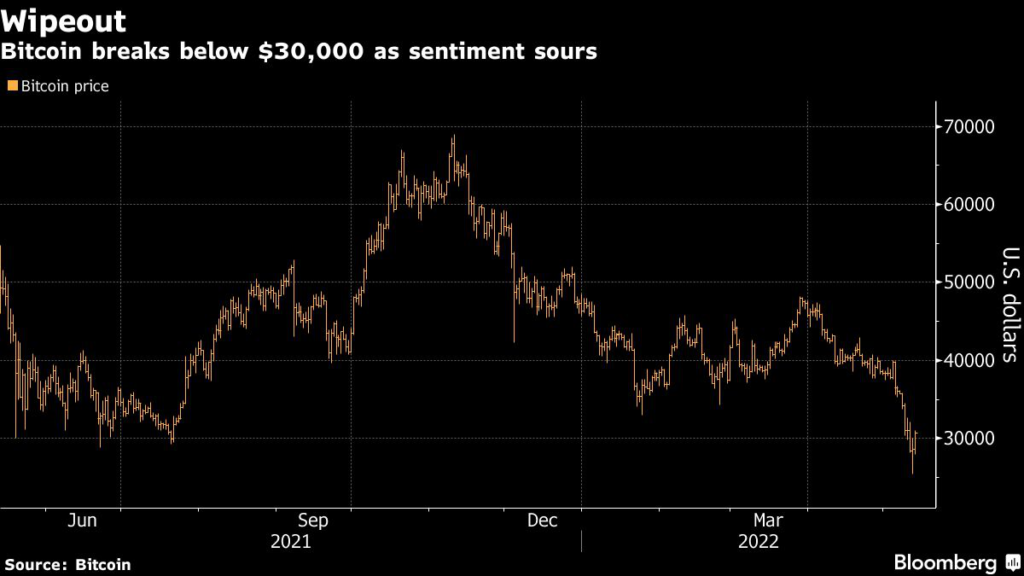
Bitcoin, the world’s largest cryptocurrency, has plummeted more than 35% so far in 2022 as the Federal Reserve tightens monetary policy, zapping the speculative fervor that defined markets over the past two years. It briefly plunged below $26,000 this week — a far cry from November’s record high of nearly $69,000. The implosion of the algorithmic stablecoin TerraUSD further dragged down sentiment this week, prompting the likes of Treasury Secretary Janet Yellen to renew calls for regulation.

But amid the drawdown, memories of crypto’s explosive gains still linger. Bitcoin had surged over 300% in 2020, followed by last year’s nearly 60%. Ether, the second largest cryptocurrency, was up far more. Against that backdrop, the current wipeout looks like a lucrative opportunity to some investors.

“People are always opportunistically adding to their exposure,” Meltem Demirors, chief strategy officer at crypto fund provider CoinShares, said in a Bloomberg Quicktake interview this week. “I think there’s many investors who haven’t put on a position in the past or had a smaller position who are looking to scale into a larger position.”

(Updates prices in 6th paragraph.)

More stories like this are available on bloomberg.com

©2022 Bloomberg L.P.
Two Terra ETPs Suspend Operations After Crypto-Market Meltdown

(Bloomberg) — The creation and redemption of shares in two Terra exchange-traded products issued by VanEck and 21Shares were suspended on Friday as the week’s meltdown in the digital-asset space continued to take its toll.

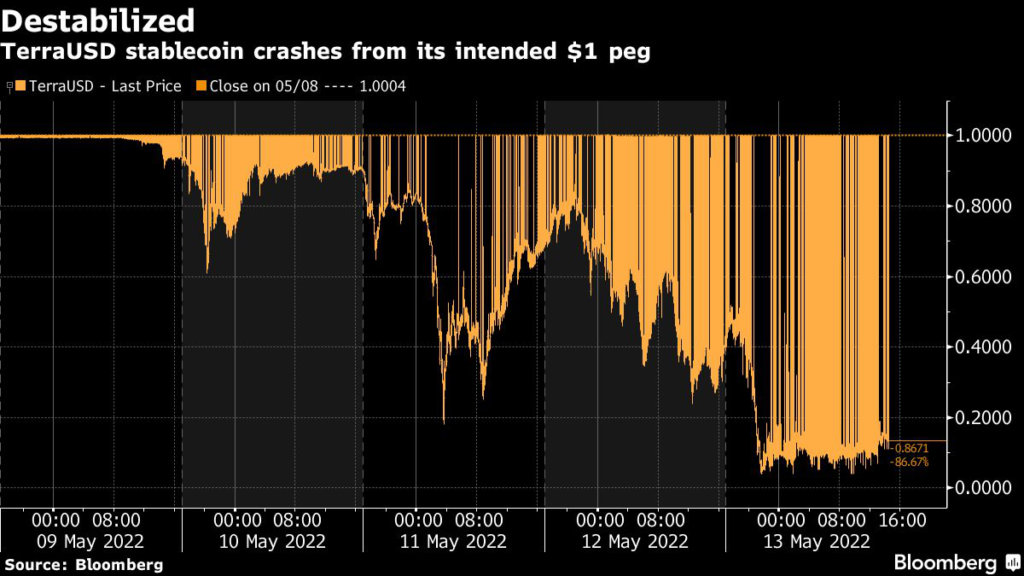
Issuers of the 21Shares Terra ETP (ticker LUNA SW) and the VanEck Terra ETN (VLNA GR) both said the process has been halted for now amid the turmoil facing the TerraUSD stablecoin, which crashed from its US dollar peg on May 9. Luna, the token that was supposed to help TerraUSD hold the peg, has lost almost all of its value as of Friday, according to CoinGecko. 

“We will continue to closely monitor this fast-evolving situation on the underlying,” Hany Rashwan, chief executive officer and co-founder of 21Shares, a crypto ETP provider, said in a statement. “The Luna network is currently operating intermittently and inconsistently producing blocks and cannot operate normally. Therefore transactions can still be performed but in a disrupted environment.”

Meanwhile, VanEck in a statement said it will do the same. The company didn’t immediately respond to an emailed request for comment. 

“The low value of Luna caused issues and risks for the Terra network which trigger the decision by Terra validators to halt the network,” the issuer said on Friday. “At this point it is unclear when (and if) the network will be restarted.”

LUNA SW, a crypto ETP domiciled in Switzerland, tracks the investment results of Luna. It tumbled 99% on Thursday, approaching zero, having closed at 22.29 Swiss francs on May 6, before the Terra meltdown. VLNA GR, an ETP incorporated in Liechtenstein that seeks to replicate the price and yield performance of a digital-asset portfolio that invests in Luna, dropped by a similar magnitude. 

“It makes sense to me. I don’t know what else they’re supposed to do,” said James Seyffart, a Bloomberg Intelligence ETF analyst. “The underlying market is a mess itself. UST and Luna are worthless or at least nearly worthless. The ETPs are obviously going to have a hard time operating.”

The disruption to the two funds came as an uneasy calm returned to the crypto market, which saw $270 billion of value erased in this week’s meltdown.

More stories like this are available on bloomberg.com

©2022 Bloomberg L.P.
Bitcoin’s First African Adopter Faces Backlash From Central Bank

(Bloomberg) — A regional central bank is clamping down on Bitcoin transactions after the Central African Republic adopted the cryptocurrency as legal tender without consulting its monetary authority.

The Bank of Central African States, which already doesn’t recognize cryptocurrencies, is now preventing all lenders from partnering with payment platforms that transact in digital currencies or from recognizing them as an asset. 

Lenders must also monitor any indirect attempt by their customers to make cryptocurrency transactions so authorities can take action, according to a May 6 note to banks sent to journalists on Friday.

“It is necessary to take preventive measures to ensure financial stability and protect client deposits within the region,” Central Bank Governor Abbas Mahamat Tolli said in the note.

The regulator is toughening its stance after accusing the Central African Republic of breaking a decades-old agreement to share a common currency with five of its neighbors when it adopted Bitcoin last month. Cameroon, Chad, Equatorial Guinea, Gabon, the Republic of Congo and the Central African Republic all use one of two variations of the CFA Franc. 

Read: Central Bank Caught Unaware as African Nation Endorses Bitcoin

The $2.3 billion economy became the second to adopt Bitcoin as legal tender after El Salvador, which lost about $40 million on its Bitcoin holdings since September as of Thursday. 

While the African government said Bitcoin would spur economic growth and help to stabilize the war-torn country, the central bank has condemned the measure, adding to criticism from the International Monetary Fund, which said the decision raised major legal and transparency concerns. 

More stories like this are available on bloomberg.com

©2022 Bloomberg L.P.
Tiger Cubs Crushed by Stocks That Made Hedge Funds Billions

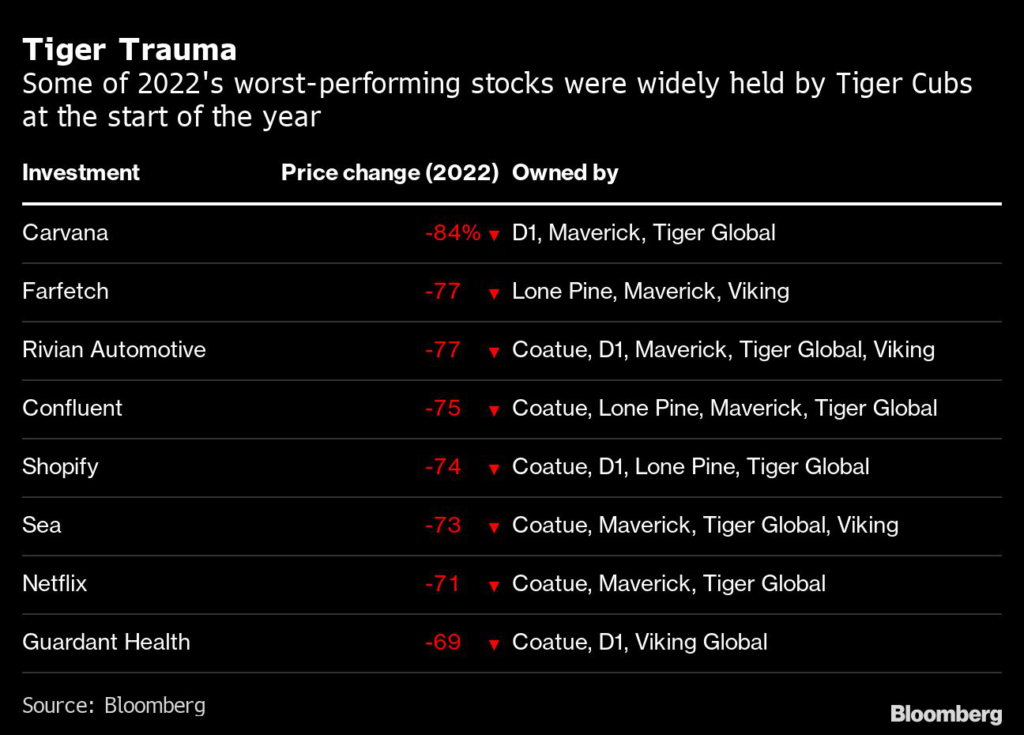
(Bloomberg) — Chase Coleman and other so-called Tiger Cubs made billions crowding into the same collection of high-flying technology stocks including Netflix Inc., Carvana Co. and Shopify Inc. 

Now those shares are in free-fall, along with the hedge funds that piled into them. Clients are angry that these well-known traders, who take pride in making money during good times and bad, failed to foresee this year’s collapse and profit from it. Coleman’s Tiger Global Management lost 44% through April, incinerating $16 billion of investor capital. Dan Sundheim’s D1 Capital Partners — whose firm is included in the group because it was spun out from a Tiger Cub — lost 19% in his most popular portfolio.

Rubberneckers seeking clues about how the losses unfolded may get some answers by Monday, the deadline for asset managers to disclose the US shares they owned at the end of March. One looming question: Did any of the six biggest Tiger Cubs — the hedge funds whose founders cut their teeth at Tiger Management under legendary trader Julian Robertson — bail out of their tech holdings during the first quarter? If so, that would help explain the avalanche of selling that sent shares tumbling by as much as 84% this year. 

These managers, which also include Andreas Halvorsen’s Viking Global Investors, Steve Mandel’s Lone Pine Capital, Lee Ainslie’s Maverick Capital and Philippe Laffont’s Coatue Management, held many of this year’s worst performers in their portfolios at the end of the fourth quarter, earlier filings show. Prominent among them were companies that thrived when consumers were stuck at home during the darkest days of the pandemic.

At least three Tiger Cubs had used-car dealer Carvana in their portfolios, accounting for 11% of the outstanding shares. Farfetch Ltd., an online apparel retailer, was owned by three of the firms that collectively held more than 9% of the stock.   

Electric-vehicle startup Rivian Automative Inc. was also a popular bet, with five of the six hedge funds owning a combined 6.2% of the stock, according to the quarterly 13F filings, which don’t show short positions, stakes in closely held companies or shares traded outside the US. 

Some stocks widely held by the Tiger Cubs — such as Amazon.com Inc. and Microsoft Corp. — were popular among hedge funds in general. But in others, Tiger Cubs made up an especially large share of hedge funds’ overall exposure, including more than 50% of Rivian, Farfetch and Doordash Inc.

The Tiger Cubs’ recent losses are especially stunning because they’ve been among the most successful equity hedge funds in the industry, amassing tens of billions of dollars and posting double-digit returns. In 2020, Coatue and Tiger Global gained 62% and 47%, respectively.

Of the 42 stocks owned by at least half of the Tiger Cubs at the end of December, all but two are down for the year, and almost 90% of of them underperformed the 27% loss for the Nasdaq 100 this year.

Lone Pine had the most overlap with its peers. The firm owned 80% of the 42 aforementioned stocks.

Even so, Lone Pine’s hedge fund lost 22% in the first quarter, about 12 percentage points less than Tiger Global. That adds to intrigue over how the firms each managed the market rout. 

Coleman’s firm likely held on to many of the positions — at least through the first quarter — given its outsize loss this year. In an investor letter last month, Tiger Global wrote that it was “reassessing and refining our models.”

Viking and Coatue posted declines of 9% and 15%, respectively, in the first four months of 2022. A PivotalPath index of hedge funds that specialize in technology, media and telecommunications fell 14.2% over the same period, the second-worst among 45 strategies tracked by the firm.

Here’s a list of US stocks owned by at least three Tiger Cubs at year-end:

(Updates with hedge fund index returns in second-to-last paragraph.)

More stories like this are available on bloomberg.com

©2022 Bloomberg L.P.

Dye & Durham CEO Defends $2.5 Billion Australia Deal After Swoon in Tech Stocks

(Bloomberg) — The head of Canadian software firm Dye & Durham Ltd. said he still believes the company will complete a C$3.2 billion ($2.5 billion) deal for Australia’s Link Administration Holdings Ltd. despite market volatility and the meltdown in technology stocks. 

Dye Chief Executive Officer Matthew Proud said Friday that although there remains a risk that the deal will be rejected by regulators, “nothing in our view has changed” since the two companies announced the all-cash agreement in December. They expect to close in August. 

“We signed a contract with them, we have the money,” Proud said in a phone interview. “But for some regulator stopping the deal, which we don’t think is going to happen, we have to close.” 

Link, a back-office technology provider to pension funds, banks and other companies, has sagged well below the A$5.50 ($3.80) takeover price. Trading in Australia was briefly paused this week after market regulators queried a sudden drop in the share price. Link said it couldn’t explain the trading activity; it ended the week nearly 20% below Dye & Durham’s bid. 

Proud says there’s no risk to the deal financing, which includes as much as C$841 million in preferred equity from Ares Capital Corp. The preferred shares are convertible into common stock at a price of C$53 a share. 

Toronto-based Dye & Durham is now trading far below that level. It dropped as low as C$12.94 this week and has plunged 62% this year amid a selloff in software stocks and concerns about the Link deal — though it’s had a strong bounce the past two days. The shares were up 12.2% to C$16.87 at 2:15 p.m. in Toronto on Friday.    

Ares can’t get out of its commitment and it won’t be repriced, Proud said. An Ares spokesperson declined to comment. 

Goldman Sachs Group Inc., JPMorgan Chase & Co., Bank of Montreal, Bank of Nova Scotia and Ares are the joint lead arrangers of a term loan of A$3.5 billion to fund the deal and refinance existing debt. 

‘Hindsight’s Always 20-20’

Asked if he had any regrets about the price Dye & Durham paid for Link, Proud said: “Look, it’s hard to speculate what would have happened. Hindsight’s always 20-20. But this is a really good opportunity for us, and it continues to be.”

The company’s belief that the deal will close and its economics are sound should help ease investor worries, Raymond James analyst Stephen Boland wrote in a note to clients. “The market is indicating this is a broken deal so management’s comments should reduce this concern though we doubt they will fully alleviate them,” Boland said. The stock would probably fall if the deal were to fail, he said. 

Dye’s debt-to-Ebitda ratio is expected to rise to 4 with the Link deal, according to Boland. That’s one reason investors have been nervous about the company’s financial outlook. Dye & Durham said this week its Ebitda guidance for fiscal 2023 hasn’t changed. 

Proud and his management group made an offer last year to take the company private for C$50.50 a share. But a number of shareholders opposed it and board decided not to pursue it. 

(Updates share price, adds no-comment from Ares, information on buyout attempt of 2021)

More stories like this are available on bloomberg.com

©2022 Bloomberg L.P.

Europe and US Set for Scorching, Dry Summer, Scientists Say

(Bloomberg) — Europe and parts of the US are set for a sweltering and dry summer this year, posing risks for crops and boosting demand for energy for cooling at a time when prices of commodities are already running high. 

Scientists at the Copernicus Climate Change Service, who published their seasonal outlook on Friday, said hotter and drier weather is highly likely across key agricultural regions in the European Union. It could bring drought conditions for farmers that are already battling the impacts of climate change. 

Abnormally high temperatures could also fuel natural gas demand for air conditioning. Russia’s war on Ukraine has already driven gas prices in Europe higher, contributing to a cost of living crisis across the region.  

The scientists said there’s a 70% to 100% probability that temperatures across the northeastern US, Spain, France and Italy will be well above average from June to August. At the same time, the chance of below-normal rainfall across swathes of central Europe, France, Spain and the US northwest was more than 50%, the Copernicus team said. 

Their model brings together data from scientists in the UK, France, Germany, Italy and the US. The EU program uses billions of measurements from satellites, ships, aircraft and weather stations around the world for its monthly and seasonal forecasts.

Persistent drought has threatened to stress production of crops like wheat and corn, just as Russia’s war in Ukraine threatens to curtail shipments.. The models developed by Copernicus are intended to help businesses and governments plan for and potentially mitigate weather-related damages.

More stories like this are available on bloomberg.com

©2022 Bloomberg L.P.
Crypto’s $270 Billion Meltdown Gives Way to an Uneasy Calm

(Bloomberg) —

Even by the white-knuckle standards of the cryptocurrency universe, it was a standout week. 

An algorithmic stablecoin called TerraUSD crashed from its dollar peg when the complex mechanism designed to ensure the link suddenly turned against it, sucking even the biggest digital assets into a vortex of panicked selling. Terms like “death spiral” entered the vernacular. 

By mid-week, the turmoil briefly dragged down the $80 billion Tether stablecoin — a giant of the market and a key cog in many transactions — prompting its issuer to reassure investors that all is well. Exchange-traded products linked to crypto also got hammered, with one tracking the troubled Luna token dropping 99% in a single day. 

On Friday, a semblance of calm had returned to crypto markets. But the tally was still steep, with some $270 billion of cryptoasset market value lost, according to CoinMarketCap, in the most volatile week for Bitcoin since October. Add to that the broader question: What other corners of the crypto universe might soon unravel and cause a market meltdown like this one?

“The ramifications for the space and what we’ve learned post-mortem are significant and vital lessons as we go forward,” Mati Greenspan, founder of crypto research firm Quantum Economics, wrote in a newsletter published late Thursday.

Despite jumping as much as 8.5% on Friday, Bitcoin is still down 13% over the past five days, while the second-biggest token Ether has lost 20%. Smaller so-called altcoins have taken even bigger hits. Luna, the token that was supposed to help TerraUSD maintain its peg, has lost almost all of its value.

Still, despite the rough week, many cryptos posted big jumps at the end of the week, rallying alongside a 2.6% advance in the S&P 500 and a nearly 4% gain in the Nasdaq 100. Solana, Cardano and Avalanche each added at least 17% on Friday, Bloomberg data show.

As the chaos surrounding TerraUSD (UST) deepened, the Terra blockchain that underpins it stopped processing transactions for the second time in less than a day. Terraform Labs said in a tweet from their verified account that validators, the entities responsible for verifying transactions on the blockchain, took the step to “come up with a plan to reconstitute” the Terra network. 

“We were shocked to see that a platform as huge as Terra was shut down. This is unprecedented,” said Mihir Gandhi, a partner at PwC and leader of its payments transformation business in India. “The world of stablecoins looks worrying.” 

Stablecoin Oversight

More traditional stablecoins like Tether, USDC and Binance USD — which hold dollar equivalents and other reserves in support of their pegs — were trading on par with the greenback on Friday, suggesting UST’s collapse has yet to erode confidence in such tokens. Yet regulators have taken note of the episode and are vowing to step up oversight. 

Read more: Yellen Says Terra Meltdown Shows Crypto-Stablecoin Dangers (1)

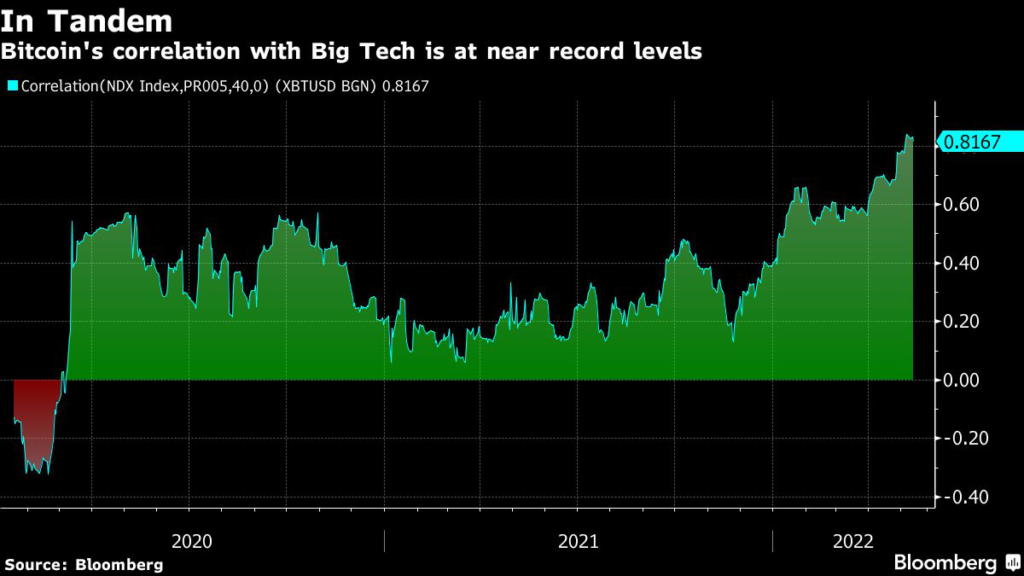
There are other challenges facing cryptocurrencies, not least their tendency to trade more and more like technology stocks. Bitcoin’s 40-day correlation with the Nasdaq 100 index currently stands at 0.82, close to a record, data compiled by Bloomberg show. A correlation of 1 indicates that two assets trade in perfect unison; a reading of -1 means they trade in opposite ways. 

The tighter link with equities has undermined the argument that cryptoassets are a good diversifier in times of stress. Instead, they are getting dumped along with other asset classes in an environment of tightening monetary policy. 

Federal Reserve Chair Jerome Powell on Thursday reaffirmed that the central bank will probably raise interest rates by half a percentage point at each of its next two meetings, and that it could possibly go further. Powell, who is trying to tame the fastest inflation in four decades, acknowledged in an interview with the Marketplace public radio program that the Fed should have moved earlier. 

Edward Moya, senior market analyst at Oanda, said in an email late Thursday that Bitcoin’s drop below $30,000 had created a “key entry point for many institutional investors.”

“Confidence has been waning in the cryptoverse but it seems we are getting close to the end of the market selloff,” he added. “Bitcoin has rebounded from $25,424, but this won’t last if risk appetite does not stabilize soon.”

(Updates prices.)

More stories like this are available on bloomberg.com

©2022 Bloomberg L.P.
MicroStrategy Bitcoin Binge Hasn’t Blown Up, But Pressure Rises

(Bloomberg) — MicroStrategy Inc.’s stock rallied Friday, recovering a bit from its recent routs. Neither the ups nor the downs are much of a surprise. The company is simply tracking the rises and falls of Bitcoin, which Chief Executive Officer Michael Saylor has tied his software maker to inexorably.

MicroStrategy has been on a two-year, debt-fueled Bitcoin buying spree, accumulating billions of dollars worth of them — shifting its corporate focus from developing software to becoming a proxy for the price of Bitcoin.

With borrowing, there are rules. Loans often require collateral, and you have to pay back sometimes-giant principal balances when debt matures. MicroStrategy faces both of those obligations. Bitcoin this week crumbled below $26,000, putting within reach price levels that boost the pressure on MicroStrategy.

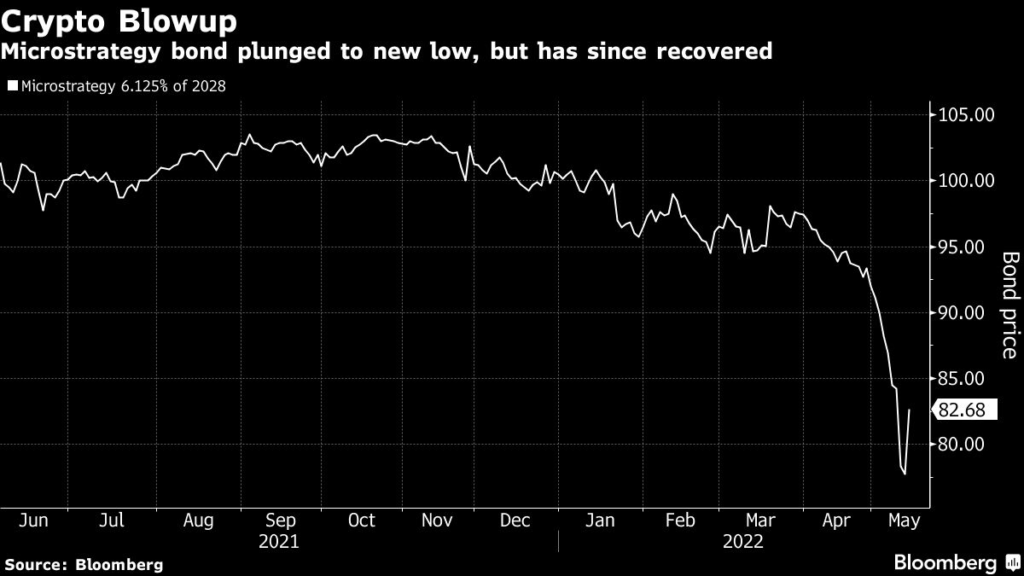
The company’s shares have lost more than half their value in the past few weeks amid a Bitcoin rout. Its junk bonds have fallen, too, sinking at one point Thursday below 72 cents on the dollar — nearing distressed levels. Both have rebounded Friday, with the stock up as much as 29% and the junk bonds back above 82 cents.

MicroStrategy borrowed $205 million through a three-year term loan in March, which the company then used to buy more of the cryptocurrency. Thousands of Bitcoin are pledged as collateral, which must be valued at no less than $410 million. If Bitcoin drops to about $21,000, the company would need to pledge more collateral, according to an earnings conference call early this month.

On Tuesday, Saylor took to Twitter to assure investors, saying that MicroStrategy has an additional 115,109 Bitcoin the company can pledge to the loan. If Bitcoin fell below $3,562, the company could post other collateral, he wrote.

And then there’s the bonds. That includes $2.2 billion of debt from two convertible bonds and a junk bond. The debt matures between 2025 and 2028. At the end of March, MicroStrategy owned 129,218 Bitcoin. Those tokens would need to be trading above roughly $18,600 each to be able to fully pay off the principal in a firesale scenario — which, to be clear, is not necessarily what looms ahead for MicroStrategy.

The notes have no immediate triggers tied to the price of Bitcoin, allowing the company to ride out ups and downs. The first maturity hits in March 2025 for the $205 million loan. Then comes the $650 million convertible notes maturing in December 2025, which will need to be repaid if the stock price doesn’t recover. If those are still outstanding, the $500 million high-yield bond “springs” ahead to September 2025 — giving MicroStrategy a large pile of debt to pay back all at once. 

MicroStrategy is essentially a levered Bitcoin play — its original software-development business doesn’t generate enough earnings to repay all the debt. The company has to rely on Bitcoin increasing in value to make its strategy work. 

Notably, that junk bond offers significant downside protection for investors — it’s secured by the company’s positive cash flow and software intellectual property plus the Bitcoin that it helped purchase, which made risk-averse debt investors more comfortable with buying the debt.

But even that business is seeing a hiccup. Revenue declined 2.9% to $119.3 million in the first quarter of 2022, the lowest quarterly revenue since MicroStrategy started its Bitcoin investment strategy in August 2020. It had posted modest revenue gains for four consecutive quarters in 2021.

More stories like this are available on bloomberg.com

©2022 Bloomberg L.P.

BitMEX Co-Founder Deserves More Than a Year in Jail, US Says

(Bloomberg) — BitMEX co-founder Arthur Hayes should spend significantly more than a year in federal prison for failing to implement an anti-money-laundering program at the pioneering cryptocurrency exchange, US prosecutors said.

Hayes, 36, of Miami, a former Citigroup Inc. equities trader who co-founded BitMEX in 2014, pleaded guilty in February. He is scheduled to be sentenced May 20, and federal prosecutors on Thursday submitted their recommendation to US District Judge John Koeltl in Manhattan.

As part of Hayes’s plea deal, prosecutors had agreed that, under federal sentencing guidelines, his offense called for a prison term of six to 12 months. He also agreed to pay a $10 million fine. If convicted at trial, Hayes had faced as much as five years on each count of his October 2020 indictment.

But prosecutors argued late Thursday that a year in prison wasn’t enough, saying a more severe punishment is needed to make cryptocurrency platforms comply with the law.

“There is no question that this case has been extremely closely watched in the cryptocurrency industry,” prosecutors said in the filing. “Compliance by cryptocurrency platforms will be unattainable if their operators believe there are no meaningful repercussions for failing to comply with the law.”

The Hayes sentencing will come as regulators are increasing their scrutiny of digital-asset exchanges. US Securities and Exchange Chairman Gary Gensler said earlier this week that some platforms are shirking rules and may be betting against their own customers.

In their own sentencing recommendation, lawyers for Hayes asked Koeltl to impose no jail time and allow him to live abroad and travel freely, saying the case is a landmark that will help the US government prosecute financial crimes at cryptocurrency exchanges throughout the world. The Probation Office recommended that Hayes be sentenced to two years’ probation.

Prosecutors said Hayes’ sentencing request shows a prison sentence is needed to stop him from committing further crimes, because he has made it clear he continues to work in the cryptocurrency industry. 

‘Real Cost’ to Crime

“Given his lengthy history of anti-regulatory and anti-law enforcement rhetoric and conduct in relation to cryptocurrency trading, there is an acute risk that he will return to criminal conduct if he does not perceive that there is a real cost to such criminal behavior,” the government said. “The defendant has paid a significant financial penalty, but it is only a small portion of the money he has made from operating BitMEX, and could easily be viewed as just a ‘cost of doing business’ outside the law.”

BitMEX initially denied the allegations, but a group of companies that operated the exchange in August agreed to pay $100 million to settle allegations they allowed illegal trades for years and violated rules requiring them to implement anti-money-laundering programs. BitMEX said in a statement that it has improved its compliance program in recent years and is pleased to put the investigations behind the company.

Hayes founded BitMEX with Benjamin Delo, a computer scientist who built high-frequency trading systems for JPMorgan Chase & Co., and Samuel Reed, a programmer specializing in fast web applications. The exchange was among the first to offer cryptocurrency derivatives, such as futures contracts that allow investors to make leveraged bets on the prices of different cryptocurrencies.

Delo and Reed also pleaded guilty earlier this year and agreed to pay $10 million each. Delo will be sentenced on June 15, Reed on July 13. Gregory Dwyer, the exchange’s first employee and former head of business development, is still fighting charges and is scheduled to go to trial in October.

The case is US v Hayes, 20-cr-500, US District Court, Southern District of New York.

(Updates with further excerpts from sentencing memo.)

More stories like this are available on bloomberg.com

©2022 Bloomberg L.P.

Close Bitnami banner
Bitnami
