Bloomberg

Zilingo Appoints Financial Adviser as Creditors Recall Loan

(Bloomberg) — Creditors of Zilingo Pte have decided to recall all of their loan, prompting the company’s board to appoint an independent financial adviser for options for the troubled Singapore-based fashion tech startup.

“Due to Zilingo’s failure to fulfill prior obligations under the loan agreement, the company’s lenders have made the decision to accelerate the repayment of the entire loan,” Zilingo’s board said in a statement on Friday. “Further, the board has appointed an independent financial adviser to explore options for the company.” 

The development underscores a deepening crisis at Zilingo after Chief Executive Officer Ankiti Bose, 30, was suspended from her duties on March 31 while the firm’s board investigates the startup’s accounting practices. Kroll Inc. has been appointed to carry out the probe. 

Bose, who denies any wrongdoing, said in a statement to Bloomberg News that no debt repayments were missed when she was still the CEO. 

“The first event of default notification was after my suspension,” she said, adding that the creditors recalled debt on May 11. “There were several means of curing the event of default. However, it seems that the interim leadership possibly did not act on them.” 

The investigation into allegations against Bose is close to being completed, according to the board’s statement.

More stories like this are available on bloomberg.com

©2022 Bloomberg L.P.

Crypto Exchanges Are Delisting Terra Tokens After Meltdown

(Bloomberg) — Some of the largest cryptocurrency exchanges are suspending or starting to delist the tokens associated with the collapsing Terra blockchain, even those that were investors in the troubled network.

OKX, one of the largest crypto exchanges, is terminating all trading of UST, LUNA, as well as two other tokens on the blockchain, Anchor and Mirror. FTX is delisting LUNA perpetual swaps. Before resuming earlier Friday, Binance, the world’s largest exchange by trading volume, said that it suspended spot trading for LUNA, the native token of Terra blockchain and TerraUSD, or UST, the dollar stablecoin that lost its peg, against Binance’s stablecoin Binance USD. Huobi took similar measures. Crypto.com announced that it has suspended trading of LUNA, Anchor and Mirror. Coinbase, Global Inc. will suspend trading May 27. 

Some of the exchanges were among Terra’s best-known investors. The venture arms of Binance, Huobi, OKX and Coinbase all had invested in Terra previously. 

Changpeng Zhao, chief executive of Binance, said in a tweet that the decision was made after Terra blockchain halted its network the second time. The halt of the network resulted in “no deposits or withdrawals possible to or from any exchange,” he tweeted.

The Terra blockchain stopped processing new transactions for a second time late Thursday, after Terraform Labs, the main developer firm of the blockchain, said in a Twitter announcement that entities responsible of verifying transactions on Terra, had taken the step to “come up with a plan to reconstitute” the Terra blockchain. The blockchain resumed activities about nine hours later, according to the latest tweet by Terraform Labs.

UST was trading at $0.103, down 83.7% in the past 24 hours, according to CoinGecko. LUNA at the same time, was down to virtually zero. It had climbed to about $120 in mid-April before the collapse. 

“I am very disappointed with how this UST/LUNA incident was handled (or not handled) by the Terra team,” Binance’s Zhao wrote. “We requested their team to restore the network, burn the extra minted LUNA, and recover the UST peg. So far, we have not gotten any positive response, or much response at all.”

Before everything went down last weekend, UST was one of the largest stablecoins in the world by market value. Its sister token LUNA that’s used to keep UST’s 1-1 peg to the dollar was also one of the biggest cryptocurrencies. The unraveling of the collapse of UST and LUNA sent shock waves through crypto, as Terra, once a crypto darling, grew so big and was connected to the rest of the crypto world.     

According to Lily Zhang, chief financial officer of Huobi, the exchange resumed the trading “in order to protect the trading rights of” their users.

(Updates with FTX delisting in the second paragraph.)

More stories like this are available on bloomberg.com

©2022 Bloomberg L.P.

A Luxembourg Prince Is Emptying His Private Wine Cellar for Charity

(Bloomberg) — On Saturday, May 21, an extraordinary personal cellar of old and newer vintages is going on sale at Sotheby’s in New York. The more than 4,200 bottles come from Prince Robert of Luxembourg, owner of Bordeaux first growth Château Haut-Brion, his family, and his friends.

Just perusing the catalogue will stimulate the fantasies of wine collectors. The sale includes some of the most unique, priceless vino on the planet, all with perfect provenance—and you can feel virtuous no matter how many bucks you drop on any of the 818 lots. It’s being called one of the biggest charity auctions of its kind ever staged.

Prince Robert is not just funneling all proceeds to medical research through the newly established non-profit PolG Foundation, but also trying to put a spotlight on a devastating, little-known degenerative disease to spur the development of treatments, and hopefully, a cure.

His reasons are very personal and heartbreaking. Five years ago, his and his wife Princess Julie’s youngest son, Frederik, then age 14, was diagnosed with a rare PolG-related mitochondrial disease they had never heard of. (Nor, probably, have most people.) The genetic disorder robs the body’s cells of energy, which in turn eventually causes organ failure. As the couple struggled to help their son, they learned that one in 5,000 people may suffer from mitochondrial conditions, which are related to more well-known diseases such as Parkinson’s and Alzheimer’s.

For five years, their lives were turned upside down as they tracked down top medical specialists and researchers throughout the world, attended conferences, and visited laboratories. “We were in a cocoon, trying to survive,” Prince Robert says in a phone call. “When we began thinking how we could also help others and motivate serious research in a public way, I came back to what I know, wine, and ways I could use my position as a pulpit.”

As chairman and CEO of the family wine company Domaine Clarence Dillon SAS, he heads a business that began with his great-grandfather, American investment banker Clarence Dillon, who purchased Château Haut-Brion in 1935 for a modest 2,300,000 francs (the equivalent of $153,000 back then). One of the chateau’s historic owners was Talleyrand; Thomas Jefferson visited in May 1787.

The family’s next big buy, in 1983, was famous neighboring property Château La Mission Haut-Brion, just down the road. Prince Robert has expanded the empire by adding another chateau in Bordeaux, a negociant business, and even branched out with a Michelin-starred restaurant in Paris, Le Clarence.

“For the sale, I’m pretty much emptying out my cellar,” he says. “Including all the old vintages.”

He’s talking about more than 900 bottles of Haut-Brion from 1908, 1918, 1919, the decades of the ’20s, 30s, 40s, and even a jeroboam (4.5-liter bottle) of the legendary 1926 (estimated $7,500 to $12,000). There are also three lots of my favorite more recent vintage, the dense, complex 1989 (est. $20,000 to 28,000 a case).

I can personally attest to the staying power of the chateau’s old vintages. One of the greatest—and most fun—tastings I ever attended was a weekend in Texas where 49 vintages, including the 1926, and back to 1899, were poured at a black-tie event in a barn. Trust me, they go brilliantly with a cowboy stew of longhorn beef, which we dined on by candlelight while sipping Haut-Brion and sitting on hay bales.

As you can imagine, Prince Robert’s cool, dark cellar below Château Haut-Brion also includes stellar vintages of La Mission Haut-Brion and other first growths, such as the silky-textured 1928 Château Latour (est. $3,000 to $4,000), and equivalent wines like a 3-liter bottle of 1982 Petrus (est. 13,000 to $18,000). None has left Bordeaux before now.

The Board of Domaine Clarence Dillon, without Prince Robert’s participation, jumped in with unique experiences and 12-liter bottles of Haut-Brion from the great 2009 vintage.

But there’s another part of the sale story that’s about the power of solidarity and generosity.

Domaine Clarence Dillon is part of an elite group called Primum Familiae di Vini, otherwise known by its nickname, PFV. The 12 members are some of the world’s most illustrious family-owned wine estates, such as Château Mouton Rothschild, Sassicaia, Antinori, Vega Sicilia, and the Symington family’s many Port houses. They leapt in to donate, too. The Haute Couture Case and Passport, lot 776, includes one bottle from each estate from a top vintage and a special private tasting and lunch or dinner at each one (est. $75,000 to $150,000).

Over the years, Prince Robert has raised millions for many charities, and as word about the proposed sale spread to others in the wine industry, they, too, called to offer rare bottles direct from their own cellars. Château Petrus sent Imperials (6-liter bottles) from five vintages (est. $14,000 to $35,000).

Despite physical challenges, Frederik, now 20, is in on the action to raise money, designing the Mito logo for the foundation and a line of “cool, fun, comfortable” very un-Savile Row Mito clothing for sale on the foundation website.

Prince Robert is encouraged by “the mind-blowing pace at which medical research is moving because of the development of artificial intelligence and genetic discoveries.” The foundation, which already has three projects headed by well-known scientists underway, aims to foster a sense of urgency and collaboration, and will also focus on venture philanthropy, investing in companies in the bio-tech space.

Meanwhile, money is needed, and great wine is what he—and his friends—have to offer on the 21st. Every dollar goes to an important cause. You could drink to that.

More stories like this are available on bloomberg.com

©2022 Bloomberg L.P.

Grayscale’s Bitcoin Fund Hits Record Discount After SEC Meeting

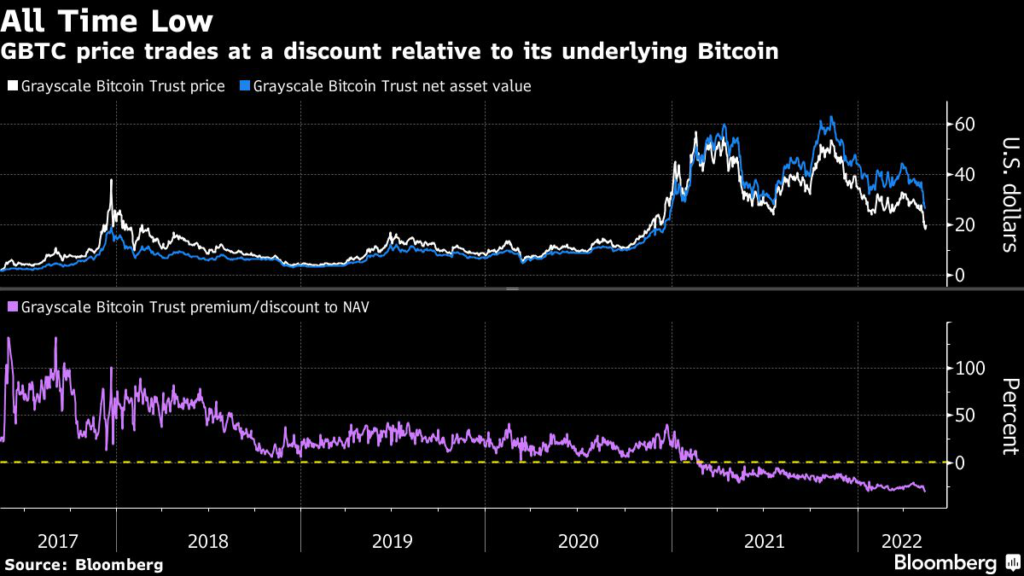
(Bloomberg) — The world’s biggest crypto fund is trading at its biggest discount to Bitcoin ever as Grayscale Investment LLC pushes to convert it into an exchange-traded fund. 

The $18.3 billion Grayscale Bitcoin Trust (ticker GBTC) has plunged over 41% so far this year, outpacing the cryptocurrency’s 34% decline. As a result, GBTC’s price closed almost 31% below the below of the Bitcoin it holds on Tuesday, a record discount, according to Bloomberg data. 

That dynamic is one of the reasons why Grayscale is pushing the Securities and Exchange Commission to approve its application to convert GBTC into a physically backed ETF — a structure that U.S. regulators have yet to approve. Because the trust doesn’t allow for redemptions like an ETF, GBTC shares can’t be created and destroyed to keep pace with shifting demand. That’s effectively turned GBTC into a closed-end fund, which are also prone to such dislocations.

The crypto firm met with U.S. regulators last week to discuss the application ahead of a July 6 deadline, arguing that conversion would unlock as much as $8 billion in value for investors should the discount be repaired. Should the SEC reject the filing, Grayscale Chief Executive Officer Michael Sonnenshein has said the company wouldn’t rule out a lawsuit challenging the decision.

More stories like this are available on bloomberg.com

©2022 Bloomberg L.P.
Apple Testing iPhones That Ditch Lightning Ports in Favor of USB-C

(Bloomberg) — Apple Inc. is testing future iPhone models that replace the current Lightning charging port with the more prevalent USB-C connector, according to people with knowledge of the situation, a move that could help the company conform with looming European regulations.

In addition to testing models with a USB-C port in recent months, Apple is working on an adapter that would let future iPhones work with accessories designed for the current Lightning connector, said the people, who asked not to be identified because the matter is private.

If the company proceeds with the change, it wouldn’t occur until 2023 at the earliest. Apple is planning to retain the Lightning connector for this year’s new models. 

By moving to USB-C, Apple would streamline the collection of chargers used by its various devices. Most of the company’s iPads and Macs already rely on USB-C rather than Lightning. That means that Apple customers can’t use a single charger for their iPhone, iPads and Macs — an odd setup given Apple’s penchant for simplicity. Wireless chargers for both the iPhone and Apple Watch also use a USB-C connector for their power bricks.

Apple, based in Cupertino, California, declined to comment on the change.

The move, which analyst Ming-Chi Kuo has also predicted, would come with trade-offs — and potentially create confusion for customers. USB-C chargers are slightly larger than the Lightning connector, but can offer quicker charging speeds and data transfers. The new connectors also would be compatible with many existing chargers for non-Apple devices, like Android phones and tablets.

But the majority of Apple accessories — including AirPods, the Apple TV remote, the MagSafe battery pack and the MagSafe Duo charger — still use Lightning. The USB-C adapter in development could mitigate that issue, but it’s unclear if Apple would include that in the box or make customers pay extra for it. 

There’s also a wide range of third-party accessories, such as chargers, car adapters and external microphones, that use the existing connector. A switch would force third-party providers to redesign their products.

Read more: Apple’s confusing strategy for its chargers 

And the shift would lessen Apple’s control over the iPhone accessories marketplace. Apple forces accessory makers to pay it to use the Lightning connector and partake in a stringent approval process. USB-C is a standard used by many consumer device makers, including most Android phone manufacturers, making it less likely that Apple will be able to exert its usual level of control.

In recent years, Apple also has worked on iPhones without any charging port, seeking to promote the MagSafe wireless charging system introduced in 2020. But a wireless connection is often slower at charging a phone’s battery and doesn’t sync data with other devices as quickly. It’s also not practical in all situations, such as the setup in some cars.

A key reason for making the change is the European Union’s decision to force phone and other device makers to adopt USB-C. In April, legislation for such a requirement was approved by a majority vote.

“Mobile phones, tablets, digital cameras, headphones and headsets, handheld video-game consoles and portable speakers, rechargeable via a wired cable, would have to be equipped with a USB Type-C port, regardless of the manufacturer,” according to the legislation. 

Apple has said the European law would hurt its ability to innovate. “We are concerned that regulation mandating just one type of connector for all devices on the market will harm European consumers by slowing down the introduction of beneficial innovations in charging standards, including those related to safety and energy efficiency,” the company said last year. 

Apple could conceivably release a version of the iPhone for Europe that is compliant while keeping Lightning elsewhere. But having multiple versions of the same iPhone with different connectors would probably bring even more confusion, as well as supply-chain headaches.

It’s unclear if Apple might ultimately abandon the USB-C switch if the European law fails to materialize. Many consumers have been calling for the change regardless, for the sake of simplicity.

A move to USB-C would be the second port change in the iPhone’s history. Starting with the original iPhone in 2007 through the iPhone 4s in 2011, Apple used the 30-pin iPod connector popularized years earlier. With the iPhone 5, Apple switched to the smaller Lightning port, touting its more durable design that could be inserted into the iPhone in either direction.

That switch drew some complaints, but customers embraced the change fairly quickly. At the time, Apple sold a separate adapter for old accessories. It cost $29.

More stories like this are available on bloomberg.com

©2022 Bloomberg L.P.
Money Markets Are Insulated, for Now, From the Stablecoin Mess

(Bloomberg) — US money markets have so far proven resilient amid growing turmoil in so-called stablecoins, although investors remain alert to the risk of problems spilling over into key parts of the world’s financial plumbing.

Some stablecoins are backed by assets like Treasury bills and short-term corporate IOUs — key elements of the dollar funding markets — and the concern is that if redemptions are big enough they could spark problems in the markets for these underlying assets.

Yet for now signs of disturbance appear minimal even as Tether — the largest stablecoin used in cryptocurrency markets to facilitate trading, saw its market value drop below the par level it’s meant to be pegged at. This so-called breaking of the buck followed sharply on the heels of an implosion in TerraUSD — another stablecoin — and a rout in cryptocurrency assets. 

There has been some apparent dislocation in the pricing of some very short-term bills that may be related, putting yields on some securities out of line with broader curve moves, but no indication of any general contagion beyond the general impact of recent crypto-asset ructions on global risk markets.

Barclays Plc strategist Joseph Abate reckons redemptions in Tether, for example, are only likely to cause notable strains in traditional money markets if they climb beyond half of the stablecoin’s total holdings. 

One reason for that is that Treasury bills are likely to constitute most of the initial liquidation and there is already a supply-demand balance within these markets that means any extra assets should be mopped up relatively easily. It’s only if the redemptions start affecting Tether’s commercial paper holdings and certificates of deposit that they’re likely to really roil things, in his view.

“In a run, Tether might be forced to fire-sell its holdings in order to meet redemptions,” Abate wrote in a note to clients Thursday. “Money market investors are nervous that if Tether is pushed to sell its CP and CD holdings, these normally illiquid markets could lock up, as they did in March 2020.”

Yet while Tether has broken the buck, Abate reckons these kind of concerns about money-market assets “may be somewhat premature.”

“There is plenty of appetite for Tether’s bills should it need to sell them,” Abate wrote in a note to clients Thursday. “Strains in traditional money markets might emerge only if Tether’s redemptions exceed 50%, and these might be limited to the small market for lower-tier CP.”

Bank of America Corp. strategists said in a note Friday that they believe that Tether’s CP holdings have likely been acquired through issuance on the blockchain rather than more in more standard markets, so “any CP sales would likely have limited direct impact on the traditional CP.” That said, the market “may not be completely insulated: CP spreads could widen modestly with reduced risk sentiment, growth concerns, or broader financial stability risks,” wrote strategists Mark Cabana and Katie Craig.

Treasury Secretary Janet Yellen, speaking on Thursday to a committee of lawmakers in the wake of the recent turmoil involving TerraUSD, said that stablecoin risks are not yet big enough to present a “real threat to financial stability, but they’re growing very rapidly and they present the same kind of risks that we have known for centuries in connection with bank runs.”

JPMorgan Chase & Co. analysts including Teresa Ho said they doubted there would be a lot of follow-on impact for traditional funding markets due to the stability of other stablecoins and money-market funds as well as continued demand for both rates and credit products. The bigger impact, in their view, is likely to be how the “seemingly idiosyncratic” episode around TerraUSD might affect stablecoin regulations going forward.

The price of Tether, the largest of the stablecoins used in cryptocurrency markets to facilitate trading, slipped as low as 94.55 cents from its intended one-to-one peg to the dollar on Thursday before recovering to par, Bloomberg-compiled data show. Officials said in a statement they had honored more than $300 million redemptions and processing more than $2 billion “without issue.” 

Yields on the very shortest US Treasury bills — in particular those coming due in the next week or so — shot up over the last couple of days, out of proportion with changes in the broader T-bill curve, a move that could have been related to the recent turmoil around stablecoins. 

Yet Tether — which disclosed that it was holding about $35 billion of bills as of end-2021 — would be unlikely to cause “much of a ripple” in the market even if it had to dump the lot very quickly, because daily trading averages of about $150 billion and weekly auction sizes are both larger, according to Abate.

Still, there are still a few unknowns for funding-market participants. For starters, Tether updates its portfolio holdings quarterly, which for a portfolio of short-maturity assets reduces the amount of insight investors have about its liquidity risk, according to Abate. It is as yet unclear whether this bout of unease represents a flight from stablecoins, or within stablecoins, and that too could affect how the movements play out in more traditional funding markets.

(Updates with JPMorgan comments.)

More stories like this are available on bloomberg.com

©2022 Bloomberg L.P.

Coinbase Customers Sue Over Stablecoin That’s ‘Anything But’

(Bloomberg) — Coinbase Global Inc. was sued over its role in the promotion and trading of a stablecoin that allegedly was “anything but.”

The digital asset trading platform and the issuer of the GYEN token were accused of misleading investors about its stability, leading to millions of dollars in losses, according to a proposed class-action complaint filed Thursday in federal court in northern California.

“Investors placed orders believing the coin’s value was, as advertised, equal to the yen, but the tokens they were purchasing were worth up to seven times more than the yen,” according to the complaint. “Just as suddenly, the GYEN’s value plunged back to the peg — falling 80 percent in one day.”

Coinbase then froze trading of the coin, which “compounded the harm by restricting many customers’ ability to sell the asset,” the investors alleged. As a result, purchasers of GYEN “collectively lost untold millions in a matter of hours,” they claimed.

‘Stress and Outrage’

The lawsuit came a day after Coinbase shares and bonds plunged to new lows, signaling investor skepticism about the prospects of the crypto exchange in a worsening bear market. Coinbase shares were rebounding Friday, up 17% to $68.48 at 10:28 a.m. in New York, as the crypto market calmed somewhat in morning trading.

Unlike with Bitcoin, stablecoin issuers say their tokens are backed by hard assets. GYEN, which was issued by Tokyo-based GMO-Z.com Trust Co., purportedly had its value pegged to Japan’s yen.

Read More: Coinbase Tumbles to Record Lows as Crypto Meltdown Deepens

But in November, when Coinbase started trading GYEN, “the asset immediately came untethered from the yen,” according to the lawsuit.

Due to “the omission of the fact that GYEN was not designed to hold a value pegged to the yen, and Coinbase’s restriction prohibiting investors from liquidating their GYEN as it plummeted, several hundred purchasers lost vast sums, some losing hundreds of thousands of dollars in just hours, causing them grief, anxiety, stress, and outrage,” according to the investors, who are seeking to represent a class of GYEN purchasers and asking for unspecified damages. 

Coinbase and GMO-Z didn’t immediately respond to requests for comment on the suit.

QuickTake: What Are Stablecoins? Why Did TerraUSD Go So Wobbly?

Stablecoins are designed to be only as volatile as conventional currencies, whose values typically go up and down much less than those of Bitcoin, for example. The tokens — and in particular the leader in the field, Tether — have drawn increasing scrutiny for the risk they could pose not only to cryptocurrency users but also to the global financial system, with U.S. financial agencies calling for strict regulation. The crash of TerraUSD intensified the worries. 

The case is Donovan v. Coinbase Global Inc., 22-cv-02826, U.S. District Court, Northern District of California (San Francisco).

(Updates with details of alleged investor losses and context on stablecoins in second section.)

More stories like this are available on bloomberg.com

©2022 Bloomberg L.P.
GM’s Cruise and BrightDrop Explore Self-Driving Electric Vans

(Bloomberg) — Cruise LLC, the self-driving startup controlled by General Motors Co., is working with the automaker’s BrightDrop electric van business on a plan to develop autonomous delivery vehicles, people familiar with the matter said.

Cruise and BrightDrop have started early-stage work that could eventually put a self-driving system into the electric vans, potentially creating a driverless package-delivery service, said the people, who asked not to be identified discussing the collaboration. The nascent project could be a logical next step for GM, whose Cruise unit has mostly been focused on getting its robotaxi business running and generating revenue.

Despite the preliminary work, the people cautioned that Cruise is still dedicating most of its resources to the robotaxi effort, and said that other self-driving vehicle programs will get additional attention once that business is established. The company has been offering free rides in San Francisco without a safety driver and is hoping for state approvals to start charging fares next month.

Representatives of Cruise and GM declined to comment. BrightDrop spokesman Daniel Roberts said via email that “there are no collaborations to announce with Cruise at this time, but we are always exploring new ways to create innovative and efficient delivery solutions for BrightDrop customers.”

Cruise’s other current priorities are development of its Origin autonomous vehicle and a delivery initiative with Walmart Inc. to bring goods from stores to customers. The Origin is a four- to six-passenger shuttle that’s purpose-built for a ride-sharing services.

Other major players in autonomous driving are experimenting with delivery services. Alphabet Inc.’s Waymo has been working to put its autonomous system in freight trucks. Argo.ai, which is owned by Ford Motor Co. and Volkswagen AG, last year announced a pilot program to deliver packages to Walmart customers in select cities.

GM has high hopes for Cruise and BrightDrop. Chief Executive Officer Mary Barra said in October that the automaker is embarking on a plan to double revenue to $280 billion by 2030. Of the projected revenue gains, Cruise is targeted for about $50 billion while BrightDrop’s electric vans would account for about $10 billion.

‘Zero Crashes’

Putting the technologies together aligns with Barra’s vision for GM built around the slogan “zero crashes, zero emissions, zero congestion.”

Collaboration between GM and Cruise has been getting closer and is likely getting tighter after former Cruise CEO Dan Ammann was ousted in December. GM bought back shares that were owned by Japanese investor SoftBank Vision Fund, giving the automaker 80% ownership. Barra has also dismissed the notion of spinning out Cruise in the near term, ensuring the two companies will remain tightly aligned.

Cruise has been expanding routes in Phoenix for a pilot program with Walmart, which is also an investor in Cruise. In January, the retailer signed an agreement to reserve 5,000 of BrightDrop’s Zevo 600 and smaller Zevo 410 electric delivery vans to support its last-mile delivery network.

BrightDrop also has an agreement with FedEx Corp., which has reserved priority production for 2,000 electric vans over the next several years. The agreement adds to FedEx’s initial reservation of 500 BrightDrop EVs announced last year. In addition, FedEx is working on a plan to add as many as 20,000 more in the years to follow. 

Travis Katz, BrightDrop’s CEO, told trade publication Freightwaves in September that his unit and Cruise could collaborate on self-driving technology with BrightDrop’s vans. No work had been done at that point, the people said.

More stories like this are available on bloomberg.com

©2022 Bloomberg L.P.

Tax Investigators Identify Potential $1 Billion Crypto Ponzi Scheme

(Bloomberg) — International tax officials have identified more than 50 leads to potential crypto tax crimes that may lead to official investigations in the coming weeks, including one case that could be a $1 billion Ponzi scheme.

Top criminal tax and financial crimes officials from the UK, US, Canada, Australia and the Netherlands, a group known as the J5, met in London this week to share intelligence and data to identify sources of cross-border illegal crypto activity. The officials specifically focused on emerging trends with decentralized finance and nonfungible tokens, or NFTs.

“Some of these leads I’m talking about, they involve individuals with significant NFT transactions revolving around potential tax or other financial crimes throughout our jurisdictions,” Jim Lee, the Internal Revenue Service’s chief of criminal investigations, told reporters Friday. One lead “appears to be a $1 billion Ponzi Scheme. That’s billion with a B and this lead also touches every single J5 country.”

The initiative highlights increasing scrutiny of risks, fraud and malfeasance in the burgeoning crypto industry. US Treasury Secretary Janet Yellen told lawmakers Thursday that the meltdown of the TerraUSD stablecoin highlighted the need for new regulations.

‘Significant Targets’

The J5 tax officials have also identified leads involving decentralized exchanges and financial-technology companies, Lee said. There could be announcements on “significant targets” as soon as this month, he added. The officials declined to give any more specifics about the leads, which have not yet become active investigations or involve any official charges.

The identification of potential crimes marks more bad news in what’s been a tumultuous week for crypto markets. Large price fluctuations roiled crypto markets and depressed total crypto asset valuations by about $270 billion, according to some estimates.

The ease at which crypto transactions can easily cross international borders has necessitated closer collaboration between countries that have struggled to keep pace with rapid shifts in technology in recent years. The IRS has pivoted to making crypto one of the agency’s top enforcement priorities, both domestically and internatially.

“NFTs are one of the new modern digital ways of trade-based money laundering,” Niels Obbink, of the Dutch Fiscal Information and Investigation Service, told reporters. “And since there is — comparing with more well-known classic sectors — less control and less supervision and a limited regulation that makes it vulnerable for fraud, it must have our attention.”

More stories like this are available on bloomberg.com

©2022 Bloomberg L.P.
Raging Nasdaq Selloff Nears $1 Trillion Weekly Loss

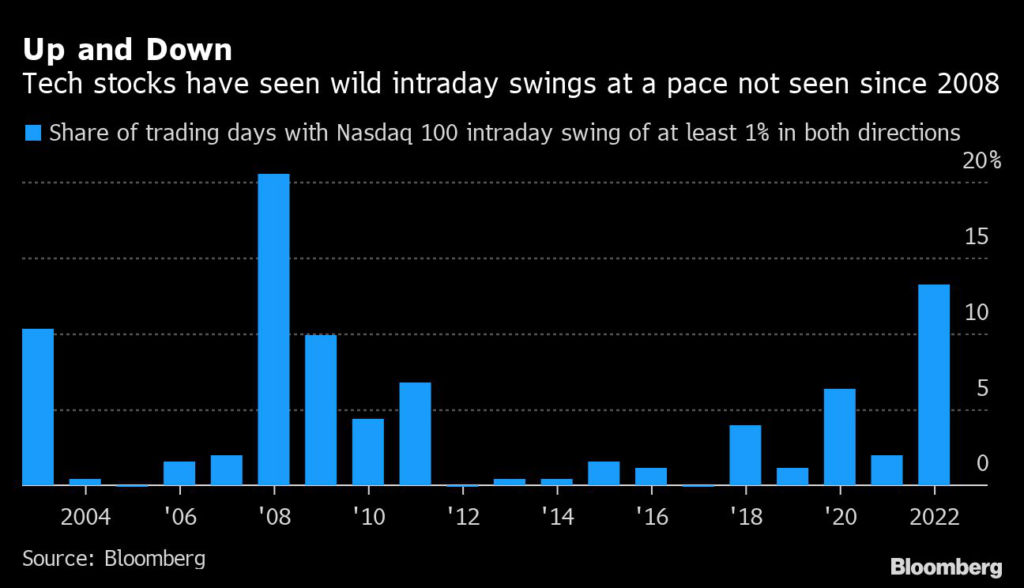
(Bloomberg) — Milestones have followed one after another for technology stocks in this week’s market meltdown: Apple Inc. is no longer the world’s most valuable company, Amazon.com Inc. is on its longest losing streak in 14 years and the Nasdaq 100 Index is on pace for its biggest weekly slump since January.

Blame the Federal Reserve, as policy makers rush to aggressively raise interest rates in their fight against inflation. And supply-chain concerns that are hurting earnings forecasts. Frothy valuations are another reason that investors have fled growth stocks, while chaos in the crypto market has also added to the growing wall of worry. 

In the latest example of volatility in both directions, stocks staged a solid rebound on Friday, with the Nasdaq 100 Index gaining 2%, though it remains solidly lower for the week.

“My outlook for tech is positive, but accommodative Fed policy had become mother’s milk, and this will be a painful weaning process,” said Kristina Hooper, chief global market strategist at Invesco Ltd., who sees the more hawkish Fed as the primary catalyst behind the selling. Investors will watch how corporate profits hold up in the face of rising interest rates and the prospect of a recession, she said.

Here are some notable developments of the week:

1. $982 Billion Wipeout

The week’s rout has erased almost $982 billion from the Nasdaq 100’s market valuation, as of its Thursday close, with Big Tech making up a large chunk of that hole. Microsoft Corp. erased about $120 billion in value, a decline that pushed its capitalization below $2 trillion. Amazon’s $48 billion drop was nearly enough to kick it out of the $1 trillion club altogether. 

Perhaps most notably, the $200 billion wipeout at Apple was sizable enough for it to lose its title as the world’s most valuable company, dropping below Saudi Aramco for the first time since 2020.

2. Losing Streaks

The sector’s brutal selloff was only the latest example of investors rotating out of information tech and internet stocks. Amazon has dropped 4.1% this week, its seventh negative week in a row and longest losing streak since March 2008. Apple, which has tumbled 8.2%, is also on pace for a seventh straight weekly drop.

The iShares Expanded Tech-Software ETF is on track for a sixth straight negative week, the most since 2014. The Nasdaq 100 also is poised for its longest run of weekly drops in almost a decade.

3. Pandemic Busts

Investors have soured on one-time pandemic winners, and some disappointing earnings results were only the latest excuse to further beat those stocks down. 

Peloton Interactive Inc. collapsed 7% as analysts reduced their share price targets after the exercise-bike maker reported a deeper loss than predicted and cut its revenue guidance. Its shares have plunged from their peak in 2021. Coinbase Global Inc.’s weaker-than-expected first-quarter earnings report fueled a wider selloff with the crypto exchange down more than 70% this year, trading far below its first-day closing price of $328.28 from April 2021.

Upstart Holdings Inc., the cloud-based artificial intelligence lending platform that more than tripled over the course of 2021, slashed its forecast, sending shares down 60% for the week.

4. Crypto Meltdown

The selloff in crypto stocks deepened as Bitcoin fell near its lowest levels since December 2020. The digital currency is down about 11% this week, its sixth consecutive slump and longest streak since October 2014. Crypto companies have been pummeled over the last six months as Bitcoin’s price was cut in half amid a broader rout in global risk assets. A basket of 25 US-listed cryptocurrency-related stocks — which houses Block Inc., Coinbase Global and Robinhood Markets Inc. — has seen roughly $200 billion in market value erased.

5. Bright Spots

Amid this rollercoaster ride, there were some bright spots in the Nasdaq 100. Electronic Arts Inc. was the best performer, gaining 4.9% after analysts were upbeat on the video-game retailer’s fourth-quarter results, which showed that earnings topped expectations. Comcast Corp. and Charter Communications Inc., which announced a streaming TV joint venture last month, are also on track for positive weeks.

Tech Chart of the Day

Even if stocks do rally for the day Friday, the prolonged selloff may have longer to run. The Cboe NDX Volatility Index, which tracks a market estimate of future volatility, has jumped to the highest level since October 2020. 

Top Tech Stories

  • Twitter Inc. shares plunged as much as 11% after Elon Musk said his acquisition of the social-media company is “temporarily on hold” while he seeks confirmation that fake accounts represent less than 5% of Twitter users
  • China’s biggest chipmaker and a major iPhone supplier cut their outlooks for the second quarter, joining a growing list of manufacturers warning about the fallout from lockdowns aimed at containing the country’s worst Covid outbreak in two years
  • Samsung Electronics Co. is talking with foundry clients about charging as much as 20% more for making semiconductors this year, joining an industry-wide push to hike prices to cover rising costs of materials and logistics
  • Apple Inc., confronting unionization efforts at several of its stores, has begun holding meetings with employees and posting notices that extol the company’s benefits
  • The blockchain behind the collapsed TerraUSD stablecoin and the affiliated Luna token stopped processing new transactions for the second time in less than a day
  • Masayoshi Son had investors bracing for such a bad earnings report that even a $20 billion loss in SoftBank Group Corp.‘s Vision Fund business was enough to send shares surging


(Updates to market open.)

More stories like this are available on bloomberg.com

©2022 Bloomberg L.P.

Close Bitnami banner
Bitnami