Bloomberg

NSA Says ‘No Backdoor’ for Spies in New US Encryption Scheme

(Bloomberg) — The US is readying new encryption standards that will be so ironclad that even the nation’s top code-cracking agency says it won’t be able to bypass them.

The National Security Agency has been involved in parts of the process but insists it has no way of bypassing the new standards. 

“There are no backdoors,” said Rob Joyce, the NSA’s director of cybersecurity at the National Security Agency, in an interview. A backdoor enables someone to exploit a deliberate, hidden flaw to break encryption. An encryption algorithm developed by the NSA was dropped as a federal standard in 2014 amid concerns that it contained a backdoor.

The new standards are intended to withstand quantum computing, a developing technology that is expected to be able to solve math problems that today’s computers can’t. But it’s also one that the White House fears could allow the encrypted data that girds the U.S. economy – and national security secrets – to be hacked. 

Scientists estimate viable quantum computing could arrive anywhere from five to 50 years from now, if ever.

The contest by the National Institute of Standards and Technology, or NIST, is intended to update the algorithms that underpin widespread public-key cryptography that secures emails, online banking, medical records, access to control systems, some national security work and more. That system, developed in the 1970s, allows for the private exchange of information by relying on publicly accessible algorithms. Announcement of the winners is imminent, officials said.

The Biden administration last week unveiled a plan to switch the entire US economy to quantum-resistant cryptography, which will rely on new NIST algorithms, as much “as is feasible by 2035.” 

Joyce, of the NSA, said it was a question of “when, not if.” He is among those who worry U.S. adversaries are stealing and stockpiling encrypted data intended to remain secret for decades or more in anticipation of being able to unlock it when viable quantum computing arrives. China, for one, is pouring billions of dollars of investment into developing quantum computing, according to US researchers.

NIST, which started the post-quantum contest in 2016, has taken pains to stress independence in overseeing the public competition, which is now down to seven finalists from 69 initial viable submissions “from all over the world.” While the NSA has helped design and edit NIST standards in the past, this time the institute has made all decisions about the new algorithms internally, relying on the expertise of its post-quantum cryptography team, a NIST spokesperson told Bloomberg.

The NSA already has classified quantum-resistant algorithms of its own that it developed over many years, said Joyce. But it didn’t enter any of its own in the contest. The agency’s mathematicians, however, worked with NIST to support the process, trying to crack the algorithms in order to test their merit.

“Those candidate algorithms that NIST is running the competitions on all appear strong, secure, and what we need for quantum resistance,” Joyce said. “We’ve worked against all of them to make sure they are solid.”

The purpose of the open, public international scrutiny of the separate NIST algorithms is “to build trust and confidence,” he said.

Leaked documents from former NSA contractor Edward Snowden in 2013 revealed some of the NSA’s techniques for penetrating encryption and lent credence to allegations that the algorithm it created included a backdoor. Afterward, NIST revoked its support for the algorithm.

Choosing the algorithm is only a first step. NIST will then oversee an effort to turn the winning algorithms into public standards. The plan is to make them available in 2024 so that government and industry can adopt them.

The NIST spokesperson said the final standard will also be open to scrutiny for any weakness or flaws.

“The reason they take so long to standardize is our confidence in them is a function of how many hours really smart people are taking to try to break them,” said Charles Tahan, director of the national quantum coordination office at the White House, in an interview.


(Updates with new lead and timing of winner announcement in sixth paragraph.)

More stories like this are available on bloomberg.com

©2022 Bloomberg L.P.

Billionaire Bankman-Fried Triggers Surge in Robinhood Stock

(Bloomberg) — Robinhood Markets Inc. has for months tried and failed to find ways to win investor approval. Turns out all it needed was a crypto billionaire’s vote of confidence.

Sam Bankman-Fried, the 30-year-old chief executive officer of crypto trading platform FTX, revealed late Thursday that he’d bought a 7.6% stake in the struggling online brokerage, which has lost 77% since its July public debut.

The shares surged 22% to $10.42 at 9:43 a.m. Friday in New York. They touched $11.70 in after-market trading Thursday. 

Bankman-Fried has said he intends to hold the stock as an investment and not to influence the company. But the disclosure comes at a critical time for Robinhood. Its plunge in value since its hotly anticipated initial public offering reflects rising concern that the retail trading phenomenon is losing steam.

That’s troublesome for Menlo Park, California-based Robinhood. It exploded in popularity during the pandemic, becoming synonymous with the retail boom as new investors stuck at home downloaded its app to trade through wild market swings, including run-ups in meme stocks and crypto. It amassed a stunning 22.7 million users by the end of 2021. 

But trading activity, which makes up the bulk of its revenue, is starting to wane, and nothing it has tried so far has reversed the decline. Last month it said it would cut 9% of staff, roughly 340 employees.

Robinhood, founded by Vlad Tenev and Baiju Bhatt, has indicated that crypto is one of its top areas of focus for growth. Crypto revenue contributed to 18% of total net revenue in the first quarter, an increase from 13% in final three months of 2021.

In April, it added four new coins — Compound, Polygon, Solana, and Shiba Inu — after requests from customers, and agreed to buy U.K.-based crypto platform Ziglu Ltd. The company said it expects to add more coins over time. 

Bankman-Fried acquired about 56.3 million shares in Robinhood through his Emergent Fidelity Technologies paying about $648.3 million, a regulatory filing showed. He started building the position in March, at times paying more than $13 a share and increased his purchases in May as the shares fell. His position is worth about $482 million based on Thursday’s closing price. 

The crypto executive has a net worth of about $11.3 billion, according to the Bloomberg Billionaires Index. He has said he plans to give all his money away to charity.

Read more: A 30-Year-Old Crypto Billionaire Wants to Give His Fortune Away

Tenev and Bhatt became billionaires after the IPO, but their fortunes have since slipped below that threshold. Still, they own shares with special voting rights that give them control of the company’s board.

(Updates share price in third paragraph.)

More stories like this are available on bloomberg.com

©2022 Bloomberg L.P.

The Jaguar E-Type Has a History as Rich as the Car Is Beautiful

(Bloomberg) — Last year marked the 60th anniversary of the Jaguar E-Type, the iconic coupe that Enzo Ferrari himself famously declared was the most beautiful car he’d ever seen. 

As part of the celebration, TeNeues publishers has released The Jaguar Book ($125), a 272-page hardback compendium that chronicles Jaguar history from before its founding as SS Cars Co. in 1933 to the Jaguar XK8 release of 2005. With 175 images photographed by René Staud and accompanying words by Jürgen Lewandowski, the book explains how the genesis of Jaguar’s most famous car, the E-Type (also called the Jaguar XKE for the North American market) can be traced to well before its glittering debut in 1961 to the birth of the company itself.

In 1922, William Lyons teamed up with William Walmsley to found the Swallow Sidecar Co., which produced motorcycle sidecars.

Four years later they changed the name to the Swallow Sidecar & Coachbuilding Co. and started building a two-seater car based on a similar version called the Austin Swallow. Then they joined forces with the Standard Motor Co., where Lyons produced more models that quickly became known by the designation SS—short for Standard Swallow. In 1933 he officially founded SS Cars Co., resulting in the elegant SS 1, the sporty SS 90, and the SS 100, which was widely considered the first great Lyons classic.

By 1945, after the Nazi horrors of World War II made the “SS” moniker highly toxic, Lyons had changed the name of his SS Cars Co. to Jaguar Cars Ltd. And he started making the Jaguar XK 120. The swoopy roadster was powered by a straight six-cylinder engine and quickly sold out of its first round of 200 units made. In 1950, Lyons continued making the XK 120 with a new steel body, followed by a closed-top coupe in 1951 and a convertible in 1953. The car was considered a smash success. In the end, more than 12,000 of them were made. 

By 1950, fresh off a respectable 12th-place finish with the XK 120 at the 24 Hours of Le Mans, Jaguar wanted to quickly develop something else to capitalize on the success. So it made the XK 120 Type “C” (for “Competition”), which won at Le Mans in 1951 and 1953. Even better, the wins enabled Jaguar to sell 43 similar cars to private buyers—the start of a robust business bolstered by a racing pedigree. In 1954, Jaguar began developing a successor to the Type C, which, logically, it called the D-Type.

The D-Type came with what was then considered supremely advanced engineering. Its lightweight metal body had a bolted-on rear section and a front metal tubing subframe that carried the engine and wheel suspensions. Its 3.5-liter six-cylinder engine and four-speed transmission got up to 300 horsepower—and won multiple victories at Le Mans in the 1950s. Private customer D-Type cars also won other notable races during the era the world over.

In the meantime, Jaguar had also been making the Mark VII in 1950 and was considering compact, sportier cars to appeal to a younger clientele. Its successor, the Mark IX, was built until 1961 with around 210 horsepower, large windows, chrome door frames, a widened rear track, and a new interior. Those sportier cars aimed at younger drivers and the race-developed aerodynamics of the D-Type set the tone for the car that would translate it for the masses, the E-Type.

By 1960, car designer Malcolm Sayer had already started designing the E-Type to be the most aerodynamic car possible. Helped by a 3.8-liter engine (and later a 4.2-liter) six-cylinder engine and four-speed transmission, it was fast enough to boast a 0-60 sprint time of around 7 seconds and a 150 mph top speed—at the time, among the fastest cars in the world. 

The glass-covered headlights, long hood, short rear, and dramatic curves of the E-Type also happened to look great. When it was introduced at the Geneva Motor Show in 1961, it caused a critical and public sensation. Americans in particular loved the E-Type, which sold a total of 38,389 units in its Series 1 versions.

Subsequent versions boasted open headlights, rather than glass-covered headlights, and the larger turn signal and tail lights now set under the bumpers. In the three years that the Series 2 was offered, Jaguar sold 8,641 roadsters, 4,878 coupes, and 5,329 2+2 coupes, according to Lewandowski. The majority were shipped to the US. 

The E-Type is still beloved today, with values for enthusiasts rising accordingly. Prices have gone up over the past decade as collectors flock to the model for its beauty, heritage, and the easy and relatively affordable availability of replacement parts and components. Car insurance company Hagerty reports that prices for the 1967 E-Type 2+2 are on average $71,300 for one in good condition and $153,000 for one in pristine concours condition. Prices on the more desirable Series 1 hover around $164,000 for one in good condition. In general, Hagerty reports, E-Type values have risen 25% more than standard cars.

In 2018, Jaguar said it would make an electric version of its fan-favorite model that Prince Harry and Meghan Markle drove after their wedding that year. (That plan has since been postponed.) The unique 1968 E-Type electric conversion they drove is valued at approximately €475,000 ($493,000). 

The best-selling E-Type was followed by another hit, the XJ saloon, which sold more than 413,000 units worldwide. It also marked the end of an era. By 1966, Jaguar Cars Ltd. and the British Motor Corp. (BMC) joined together and then in 1968, after years of infighting, were bought by the British Leyland Motor Corp. Lyons, who had received a knighthood in 1956, remained chairman of the board until his retirement in 1972, when he became honorary president. He died on Feb. 8, 1985.

But his legacy continued. 

The 1980s were the years of the flashy supercars. Porsche had started building the 959, and Ferrari built the F40. Jaguar wanted one of its own.

So chief engineer Jim Randle decided he would build a machine that could reach 220 mph. He paired a 6.3-liter V12 engine with all-wheel drive and reached an impressive 542 horsepower, which was considerable at the time. He called it the XJ 220, though it never did reach the speed goal. 

Once the company showed the car and received hundreds of orders for ones, however, it had to make it with a V6 engine and lose the all-wheel drive so it could meet the demand. The decision killed the hype, because each car cost an astounding £450,000 ($549,000). Ultimately only 275 XJ 220s were made—making them exceedingly rare and special for collectors today as the supercar descendant of Lyons’s original dream.


More stories like this are available on bloomberg.com

©2022 Bloomberg L.P.

Electric-Vehicle Startups Run Low on Cash After SPAC Deals

(Bloomberg) —

Several electric-vehicle startups that went public by merging with special purpose acquisition companies, or SPACs, the last two years made some nervy disclosures this week.

Canoo, the buzzy electric-van outfit that drew interest from Apple’s car team back in 2020, issued a going concern warning that there’s substantial doubt as to whether it has enough cash to keep operating for another year.

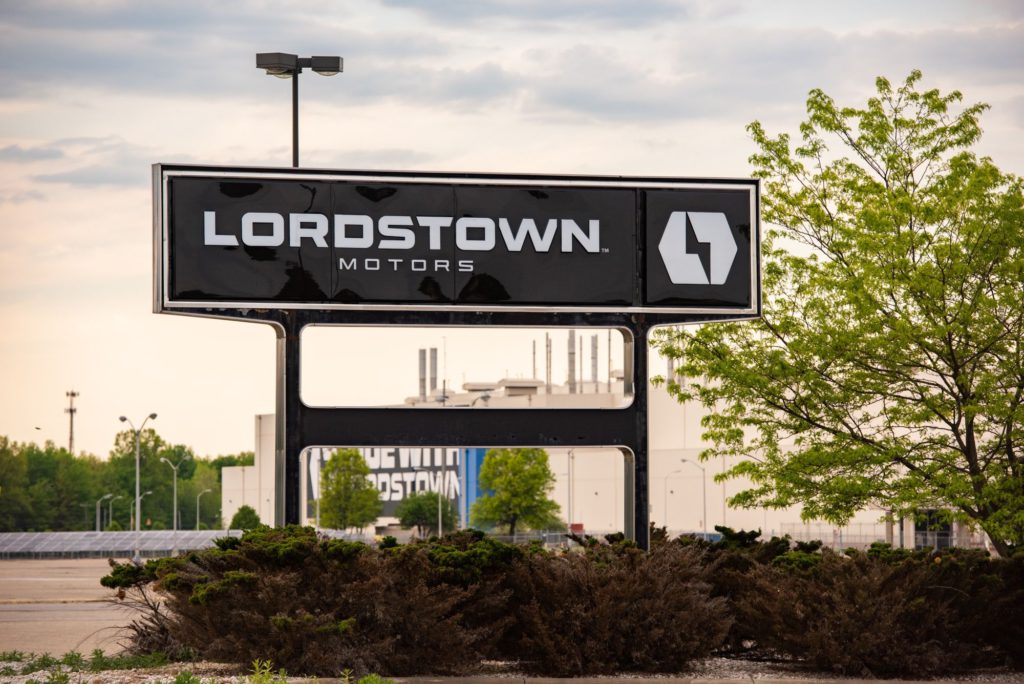
Lordstown Motors completed the sale of its electric pickup plant to Foxconn only after multiple delays and an admission it didn’t have enough money to refund the iPhone assembler if the deal fell through.

And Fisker, which is six months away from delivering its debut electric sport utility vehicle, reiterated belief that it has sufficient cash for at least the next year with the caveat that it may need more due to changed business conditions.

All of this has understandably given investors pause in an equity market where the tide is clearly going out. The tech-heavy S&P 500 Index is down 18% this year, and some post-SPAC EV stocks have fallen much further. The rout doesn’t bode well for the near-term ability for companies with little or no revenue to raise more money and get their vehicles to market.

An environment of rising interest rates and less-friendly capital markets is particularly problematic for EV companies because of how much money they were always going to need to make it in the long run. Consider this comparison, courtesy of Jefferies: Tesla has raised $23.5 billion — and generated almost that much in gross earnings — to get where it is today. Excluding outlier Lucid, the 11 EV companies that went public via SPAC since 2020 combined have raised roughly $7.5 billion.

Tesla is, of course, not the only well-resourced competition that awaits these companies. Rivian raised almost $12 billion from its initial public offering in November and has brought in almost $25 billion in total capital. General Motors and Ford are pumping out high-margin pickups and SUVs to fund the flotilla of EVs they’ll have hitting the road in the coming years.

Lucid has raised $8 billion and has a flush backer in Saudi Arabia’s sovereign wealth fund. That’s a good thing, because Bloomberg Intelligence estimates the carmaker will burn through almost $8 billion this year and next, and may need to raise at least another $2.5 billion for additional wiggle room. BI’s forecasts suggest Fisker, Lordstown, Canoo and Nikola risk exhausting their respective cash balances by the end of next year, and that they too could use more capital.

Several of these startups are trying out an asset-light business model to minimize investment. Fisker and Lordstown are both relying on Foxconn to do assembly. Mega-supplier Magna’s contract-manufacturing subsidiary also will build vehicles for Fisker. Nikola’s first trucks are being built with partner Iveco, the commercial-vehicle unit of CNH Industrial. These approaches will reduce costs, but won’t erase them.

Fisker, Lordstown, Canoo and Nikola currently have a total of $1.4 billion cash on hand. Raising more will be difficult because they don’t own much to secure asset-backed loans. Convertible debt is currently pricey. Equity is the way out, but again, their shares have been getting hammered. If they can get deals done to sell more stock, it will be dilutive to existing shareholders.

And for each of these companies, we’re talking about money to produce and support the first vehicles they’re trying to get out of factory doors. To make it big over the long term, they need Tesla money. This isn’t the kind of market from which they’re going to get it.

Like getting this newsletter? Subscribe to Bloomberg.com for unlimited access to trusted, data-driven journalism and subscriber-only insights.

More stories like this are available on bloomberg.com

©2022 Bloomberg L.P.

Tiger Cubs Crushed by Same Stocks That Made Hedge Funds Billions

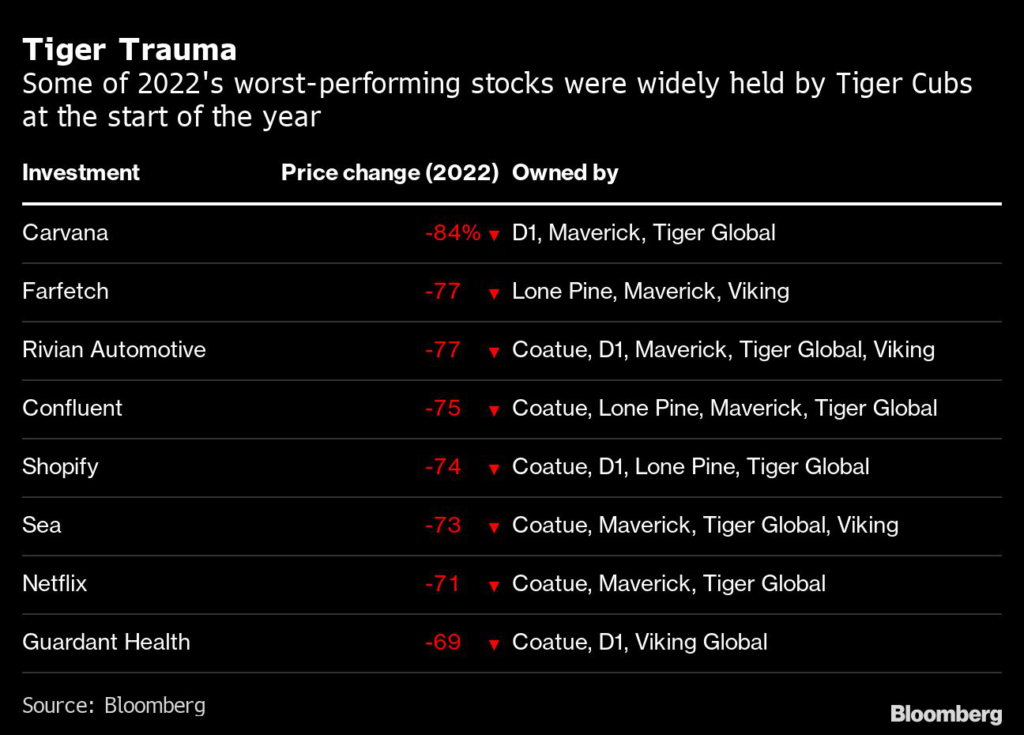
(Bloomberg) — Chase Coleman and other so-called Tiger Cubs made billions crowding into the same collection of high-flying technology stocks including Netflix Inc., Carvana Co. and Shopify Inc. 

Now those shares are in free-fall, along with the hedge funds that piled into them. Clients are angry that these well-known traders, who take pride in making money during good times and bad, failed to foresee this year’s collapse and profit from it. Coleman’s Tiger Global Management lost 44% through April, incinerating $16 billion of investor capital. Dan Sundheim’s D1 Capital Partners — whose firm is included in the group because it was spun out from a Tiger Cub — lost 19% in his most popular portfolio.

Rubberneckers seeking clues about how the losses unfolded may get some answers by Monday, the deadline for asset managers to disclose the US shares they owned at the end of March. One looming question: Did any of the six biggest Tiger Cubs — the hedge funds whose founders cut their teeth at Tiger Management under legendary trader Julian Robertson — bail out of their tech holdings during the first quarter? If so, that would help explain the avalanche of selling that sent shares tumbling by as much as 84% this year. 

These managers, which also include Andreas Halvorsen’s Viking Global Investors, Steve Mandel’s Lone Pine Capital, Lee Ainslie’s Maverick Capital and Philippe Laffont’s Coatue Management, held many of this year’s worst performers in their portfolios at the end of the fourth quarter, earlier filings show. Prominent among them were companies that thrived when consumers were stuck at home during the darkest days of the pandemic.

At least three Tiger Cubs had used-car dealer Carvana in their portfolios, accounting for 11% of the outstanding shares. Farfetch Ltd., an online apparel retailer, was owned by three of the firms that collectively held more than 9% of the stock.   

Electric-vehicle startup Rivian Automative Inc. was also a popular bet, with five of the six hedge funds owning a combined 6.2% of the stock, according to the quarterly 13F filings, which don’t show short positions, stakes in closely held companies or shares traded outside the US. 

Some stocks widely held by the Tiger Cubs — such as Amazon.com Inc. and Microsoft Corp. — were popular among hedge funds in general. But in others, Tiger Cubs made up an especially large share of hedge funds’ overall exposure, including more than 50% of Rivian, Farfetch and Doordash Inc.

The Tiger Cubs’ recent losses are especially stunning because they’ve been among the most successful equity hedge funds in the industry, amassing tens of billions of dollars and posting double-digit returns. In 2020, Coatue and Tiger Global gained 62% and 47%, respectively.

Of the 42 stocks owned by at least half of the Tiger Cubs at the end of December, all but two are down for the year, and almost 90% of of them underperformed the 27% loss for the Nasdaq 100 this year.

Lone Pine had the most overlap with its peers. The firm owned 80% of the 42 aforementioned stocks.

Even so, Lone Pine’s hedge fund lost 22% in the first quarter, about 12 percentage points less than Tiger Global. That adds to intrigue over how the firms each managed the market rout. 

Coleman’s firm likely held on to many of the positions — at least through the first quarter — given its outsize loss this year. In an investor letter last month, Tiger Global wrote that it was “reassessing and refining our models.”

Viking and Coatue posted declines of 9% and 15%, respectively, in the same span. 

Here’s a list of US stocks owned by at least three Tiger Cubs at year-end:

More stories like this are available on bloomberg.com

©2022 Bloomberg L.P.

Abortion Misinformation Surges on Facebook, Twitter After Leak

(Bloomberg) — Conspiracy theorists have latched on to the debate over US abortion rights on Facebook, Twitter, YouTube and TikTok, leading to a spike in misinformation around what is already one of the most politically-charged topics online — and signaling the complex decision-making that lies ahead for social media companies if the procedure becomes illegal in some states.

For years, social networks have been criticized for hosting user posts and advertisements that seek to confuse people about their right to access abortion or about the safety of the procedure. Since May 2, when Politico published a draft Supreme Court decision that would overturn Roe v. Wade if finalized, researchers have seen a surge in posts connecting the leak itself to already-problematic conspiratorial storylines. 

Nearly 200 far right Facebook groups with names like “Nashville Tea Party” and “Southern Conservatives United” lit up with posts spreading the baseless idea that the Antifa movement — a loose collective of antifascist activists — had helped coordinate the leak as part of a broad leftist campaign of intimidation and violence against the Supreme Court justices. On Twitter, hundreds of tweets questioned the timing of the draft ruling’s leak, asserting that it distracted from news favorable to Donald Trump. And on Telegram, dozens of chats dedicated to the QAnon conspiracy, which falsely posits that a group of global liberal elites run a child sex ring that Trump would stop, discussed how abortion is a form of human sacrifice. 

These false storylines surged to the thousands or tens of thousands mentions in the last week, according to Zignal Labs, which tracks topics on social media and in the news. According to Zignal, content from less reliable sources referencing abortion has more than doubled since Politico’s publication of the leaked draft, compared to the volume of conversation on abortion the month before the leak occurred, which was already heightened due to changing laws in some states.

The abortion topic is “salient to communities where misinformation has readily flowed in recent years, such as motherhood groups, conservative religious groups and anti-science communities,” said Rachel E. Moran, a researcher at the University of Washington who studies online conspiracy theories.

Misinformation about abortion has long circulated in right-wing communities. In 2019, Media Matters for America, a liberal watchdog group, found that of the top-engaged U.S. abortion-related stories on Facebook, 63% of links with the most Facebook interactions came from right-leaning websites that pushed anti-abortion falsehoods, including that Democrats support infanticide or that abortion is never needed to save a mother’s life. In February, Representative Jerrold Nadler, the Judiciary Committee chairman, sent a letter to Facebook asking the company to explain why it promoted ads about “abortion reversal” treatments, in spite of the known dangers of the unproven medical procedure. Meta Platforms Inc., the owner of Facebook, responded to the letter stating that ads that discuss abortion services are permitted under its policies with a required disclaimer. It added that the company restricts ads promoting reproductive health products to people 18 years and older, and that it prohibits ads with misinformation when the claims have been debunked by its third-party fact checkers.

The new spike in abortion misinformation is “another battle in a long war, one that anti-choicers have been waging since long before social media,” said Melissa Ryan, chief executive of Card Strategies, a consulting firm that researches disinformation. “It will only get worse once Roe is gone,” she added. “And since the tech companies know this is coming, they should prepare. Like Covid and climate change, reproductive health shouldn’t be political.”

For issues like the pandemic, which has prompted a surge in anti-vaccination conspiracies, and the 2020 election results, which led to false theories that it was stolen from Trump, social media companies have broadly labeled posts redirecting users to information from authorities. But for abortion, a politically-charged medical issue, they are unlikely to come up with a specific labeling campaign, and instead let the posts be moderated under a broader rule, that content can be taken down if it will lead to “imminent harm.”

Part of the problem is that falsehoods about abortion are so commonplace that they are easily overlooked. Misconceptions about the medical procedure are “so baked into our culture that it can be invisible in a lot of ways,” according to Ellie Langford, the author of “The Lie That Binds,” a book covering the evolution of abortion politics in America. She disputed the idea that abortion misinformation doesn’t constitute an imminent, real-world threat to health and safety, pointing to abortion clinic bombings since the late 70s, as well as the harassment of providers and patients who have publicly said they had undergone the procedure. “Of course there’s the risk of imminent harm with anti-choice disinformation when it comes to healthcare and an individual’s safety.”

Companies have also historically adjusted their policies to fit geographically-specific legal requirements. If Roe is overturned, abortion would become illegal in thirteen states — some with laws that punish citizens for assisting others in obtaining one. Companies may hesitate to direct users to accurate information that may support an abortion decision, for fear of running afoul of the law.

Meta spokesperson Kevin McAlister said several of the pages shared by Bloomberg had repeatedly shared content that has been fact-checked, and that it had downranked them in Facebook’s news feed. McAlister added that Facebook’s community standards would apply to posts about abortion, such as policies against bullying and harassment, violent and graphic content, and privacy violations.

Twitter Inc. said its misinformation policies currently apply to Covid-19, civic integrity and manipulated media, but for abortion or other charged topics, it tries to counter misleading claims by elevating credible information through, for example, Twitter Moments. Google’s YouTube said it was committed to enforcing its community guidelines, regardless of the topic. ByteDance Ltd.’s TikTok said it routinely labels videos to inform viewers when the content in them is unsubstantiated. Telegram didn’t respond to a request for comment.

On May 3, one day after the publication of the Supreme Court’s draft ruling, Josh Barnett, a Republican candidate for Congress in Arizona, tweeted, “They leaked Roe v Wade to hide 2000 Mules info,” referencing a new film that falsely suggests ballot “mules” aligned with the Democratic Party were paid to illegally collect and drop off ballots in swing states. Barnett’s post collected 27,100 likes and shares on Twitter. It was one among nearly 600 other posts in the past week questioning the timing of the leak as it related to the release of the film, peaking at 15 tweets an hour on the evening of May 3, according to an analysis of Twitter on Dataminr, a social media monitoring service. Barnett didn’t respond to a request for comment.

On Facebook, posts connecting the leak of the draft ruling to Antifa-led “rioting” collected 12,600 likes and shares on the platform, according to data from CrowdTangle, a Facebook-owned social media analytics tool. Meta said that number is minuscule compared to the content shared on its apps and that it was not likely every person in the groups engaged with the posts given their metrics. But according to the CrowdTangle data, as many as 12.7 million people may have seen the posts, even if they did not like or share them. In one of the groups, a Facebook page called the Stanford College Republicans with nearly 10,000 followers went further, pushing an unproven conspiracy that the leak was “a coordinated leftist campaign to intimidate Supreme Court justices, and even use force against them.”

The baseless idea was amplified on YouTube, where the right-wing influencer Tim Pool posted a video on May 4 proclaiming “RIOTING Erupts Over SCOTUS Abortion Leak, Liberals Call For Violence And Revolution Over Roe v. Wade.” The video collected more than 271,000 views, with the comments awash in conspiracies. “What’s interesting, how fast these activists could stage a rally when the leak only came yesterday,” said one, whose comment collected 230 upvotes. “Almost like they knew before the leak?” Pool and the College Republicans didn’t respond to a request for comment.On TikTok, several accounts posted videos, without evidence, that a particular Supreme Court clerk was behind the leaked draft ruling, collecting over 41,000 views on the platform. The company said it made those videos ineligible for recommendation into For You feeds and applied a label to warn users that its contents were unproven after Bloomberg News reached out.

And on Telegram, dozens of channels dedicated to the QAnon movement fired off new conspiracies about the Supreme Court’s draft ruling, such as one falsely asserting that “they” leaked it to generate fetuses for “cannibalistic lifestyles, satanic rituals & sacrifices, ” as well as “godless scientific needs.”

Alex Stamos, the director of the Stanford Internet Observatory and a former head of security at Facebook, said that after the 2020 presidential election, tech companies favored “moving away from content-based policies towards actor and behavior based policies.” 

Content-based policies, such as Facebook’s third-party fact-checkers individually scanning and researching stories to label them as false if necessary, can be unevenly applied, leading to criticism from the public. Behavior-based policies, such as blocking coordinated efforts by multiple accounts to spread a falsehood or scam, are perceived as fairer. But designating certain actors as “dangerous” and banning them wholesale from a platform — like most of the social media services did with QAnon in late 2020 — is an extreme step that companies tend to shy away from because of how politicized the move can appear. 

Amid the noise, and in absence of broad action from the social media platforms, health advocates and others worked to spread accurate information: Roe has not yet been overtuned and abortion, for now, is federally protected. “If you have an appointment tomorrow, next week, soon, you are still fine,” said a post from a Facebook page called Feminist News. “Don’t let people scare you out of getting care. Nothing is in effect until the decision actually comes.”

More stories like this are available on bloomberg.com

©2022 Bloomberg L.P.

Wall Street Has Jitters Over ICE-Black Knight Antitrust Concerns

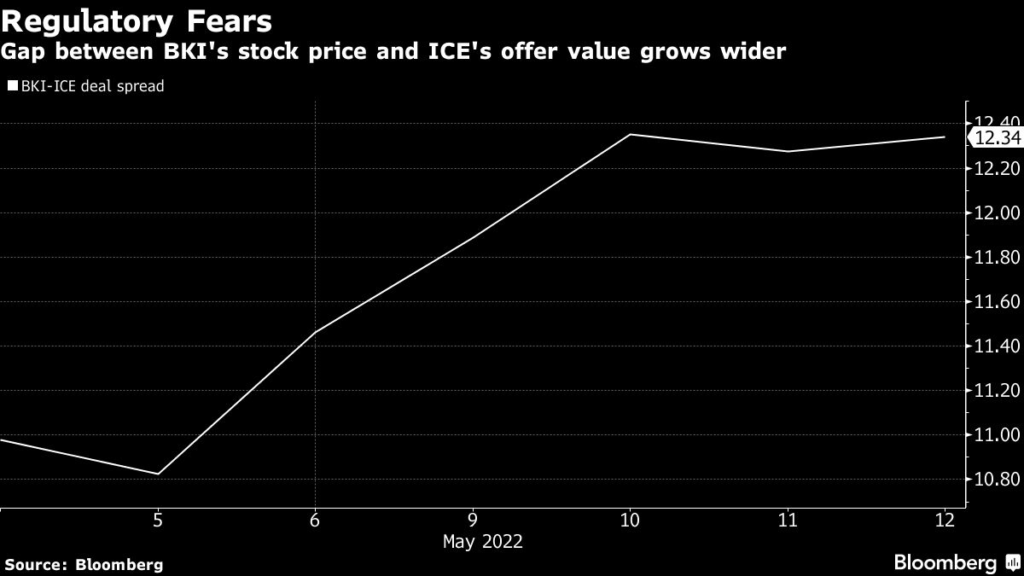
(Bloomberg) — Investors are worried that Intercontinental Exchange Inc.’s $13.1 billion deal to buy mortgage software rival Black Knight Inc. could run into antitrust obstacles at the Justice Department.

The gap between Black Knight’s stock price and the value of ICE’s cash and stock offer is more than $12 per share, making it one of the largest merger arbitrage spreads among all U.S. transactions. 

The wide spread reflects fear about the potential antitrust issues raised by combining the top two players in the market for mortgage origination software, and that the buyer could easily walk away if challenged, merger arbitrage analysts said. The deal, which was announced last week, is still in early stages and the spread could narrow as the review advances, they said. 

Under the terms of the agreement, ICE isn’t required to offer divestitures, agree to conduct remedies or litigate if there are antitrust issues with the merger, Elevation LLC’s merger arbitrage specialist Betty Chan wrote in a note. 

And Anna Pavlik, senior counsel at specialized brokerage firm United First Partners, said “These provisions put ICE squarely in control of the regulatory outcome, since ICE can decide to simply walk away without offering any remedy or having to litigate, while BKI’s only recourse is to receive a breakup fee.”  

Exchange operator ICE already owns mortgage software company Ellie Mae Inc., whose Encompass platform is the most widely used for loan origination. Black Knight’s Empower is the second-biggest player in that market. 

The companies said the deal would create a platform to help lenders throughout all stages of a mortgage from a customer’s initial home search through loan servicing and potential default. They have sought to downplay any overlap, telling investors that ICE and Black Knight offer “complementary businesses that service different parts of the mortgage ecosystem.”

ICE President Benjamin Jackson said during an investor call last week “the customers that they cater to are fundamentally very different and have a completely different mindset to the customers that we service today at ICE.”

In a presentation on the deal, ICE described Ellie Mae’s Encompass as the “standard” software used for processing and underwriting while Black Knight’s Empower offers a “custom solution.” Yet in securities filings and investor presentations, Black Knight has consistently referred to Ellie Mae as its biggest competitor.

“In origination, I’d say Ellie Mae is our most significant competitor,” Black Knight Chief Financial Officer Kirk Larsen said at an investor conference in December 2020. “They have 40-plus percent market share; we have low double digit.”

Justice Department antitrust attorneys are likely to look closely at that overlap, said Jennifer Rie, an analyst for Bloomberg Intelligence. 

“It’s going to come down to whether they can show there’s a difference here,” Rie said. “The companies that license this software, do they view them as complements or not? We have a very aggressive DOJ, particularly in areas like financial markets.”

Divesting Black Knight’s Empower business — which contributed 11% of the company’s $1.48 billion in revenue last year — could also be tricky, Rie said. Antitrust officials would likely oppose a sale to a large bank or major lender because of the sensitive nature of the data held by the platforms, leaving only non-lenders or private equity as possible buyers, she said.

ICE and Black Knight declined to comment on potential antitrust hurdles facing the deal. The Justice Department did not immediately respond to a request for comment on Thursday night.

Regulators also may be interested in how the combined company would use customer data, given Black Knight’s leading position in mortgage servicing and ICE’s strength in mortgage origination, said United First Partners’ Pavlik. 

Antitrust enforcers are likely to look at whether a combined ICE-Black Knight would have the ability to leverage its dominance in one area, like loan origination, into other areas where its software is less popular, said Amanda Wait, an antitrust lawyer at Norton Rose Fulbright LLP. 

The Justice Department would likely be concerned if the merged company sought to bundle all of its services, shutting out rivals who only offer software for one part of the mortgage workflow, she said. 

The company told investors it expects to close in the first half of of next year, though it can extend through November 2023 if needed to gain regulatory approval. 

More stories like this are available on bloomberg.com

©2022 Bloomberg L.P.
Private Credit Is Not an Easy Option for Banks on Citrix $15 Billion Buyout Debt

(Bloomberg) — A group of lenders led by Bank of America Corp., Credit Suisse Group AG and Goldman Sachs Group Inc.. faces a narrow path to avoid losses on one of the biggest buyout financings of the past decade. Private credit firms awash with cash can only do so much to help.

The blowout of high-yield spreads in recent months is making it increasingly difficult for underwriters to offload the debt for the take-private of Citrix Systems Inc. to investors at levels close to what they’d committed to when the deal was announced in January. That’s especially true for the riskiest piece of the $15 billion financing, a $4 billion loan that’s expected to be replaced by unsecured bonds. 

While private-capital providers such as Ares Management Corp. have taken advantage of the sell-off by snapping up junk-rated debt that public markets have little appetite for, the timing of the Citrix acquisition means that a private credit solution could be trickier to slot into place than for other leveraged buyouts.  

The Citrix financing, which supports Vista Equity Partners and Elliott Investment Management’s purchase of the workspace software maker and its combination with Vista portfolio company Tibco Software Inc., was underwritten at the end of January, when the riskiest CCC rated junk bonds were yielding less than 8%.

The banks agreed to a cap of 9% on the nearly $4 billion unsecured bridge loan, according to people with knowledge of the matter. Last month, a group of private lenders led by Apollo Global Management Inc. made an offer to buy a large chunk of the financing at around the cap, though discussions had mostly focused on the secured piece of the financing, which includes a $7.05 billion term loan and a $4 billion bridge to secured bonds.

But the 9% cap for the unsecured piece is now well below the latest average yield for CCC rated bonds, which on Thursday stood at 11.81%. This means the banks risk having to sell the debt at a steep discount in order to hold the interest of private credit firms — a move that could eat into underwriting fees and even result in outright losses.

In contrast, lenders on the recent $11.2 billion financing for Elliott and Brookfield Asset Management Inc.’s buyout of TV ratings provider Nielsen Holdings Plc had guaranteed a maximum coupon of about 11% on the unsecured portion of that deal, according to the people, who asked not to be identified because the terms are private. An Ares-led consortium swooped in and replaced this roughly $2 billion unsecured bridge facility with a second-lien loan, for an all-in yield of between 9-10%, they said. 

This left the two sponsors with a lower cost of capital compared to their worst-case scenario. It also allowed the underwriters to sell the riskiest piece of the financing without any major losses, though they missed out on some fees as is typical when broad syndications are swapped out for privately placed loans.

Representatives for Bank of America, Credit Suisse, Goldman Sachs, Vista, Elliott and Brookfield declined to comment.

In a separate deal, Goldman Sachs’ private credit arm also recently stepped in with an $865 million second-lien loan to help fund Brookfield’s purchase of auto-dealership software business CDK Global Inc. The loan replaced a planned unsecured bond of the same size that was part of a larger $5.9 billion debt financing. 

Vista, Elliott and their bankers are still discussing options for the Citrix financing and have so far opted to wait until closer to the deal’s expected closing in June to make a decision.

With only a few weeks to go, the clock is ticking.

More stories like this are available on bloomberg.com

©2022 Bloomberg L.P.
Internet Service on US Airlines Is About to Get a Lot Better

(Bloomberg) — Fast, reliable Wi-Fi on a plane is as unlikely as sitting in a row with an empty seat. But the era of lost connectivity while airborne may be ending.

A spate of new in-flight connection deals in recent weeks, including the first aircraft contracts signed by SpaceX’s Starlink satellite unit, aim to make high-speed Wi-Fi less glitch-free over the next three years on most domestic flights operated by major US carriers. The latest in-flight deal came Wednesday when Southwest Airlines Co. said it would add a second Wi-Fi provider, Viasat Inc., for faster speeds on more than 400 new Boeing Co. 737 Max aircraft.

Airlines are racing to offer improved connection speeds and reliability as post-pandemic competition for travelers has stepped up, particularly for high-revenue premium passengers. With expanded satellite bandwidth, the airlines’ goal is to replicate the same internet experience in-flight that people have come to expect on the ground.

It’s no longer an amenity just for corporate road warriors, Don Buchman, vice president of commercial mobility at California-based Viasat, said in an interview. “You need to have it — it’s kind of like serving water and coffee,” he said.

Elon Musk’s Starlink became the first of several planned low-Earth orbit satellite systems to enter the aviation market last month. Hawaiian Holdings Inc. and Dallas-based JSX Inc. said they’ll offer SpaceX’s Wi-Fi product to passengers for free, though neither carrier has a definitive date for availability. Hawaiian Holdings Inc. said April 25 it plans to equip three aircraft types with Starlink, with the first planned in 2023.

Other satellite-based Wi-Fi providers in the rapidly evolving space include Anuvu Inc., which provides service from its own and other satellites; Intelsat SA, which acquired Gogo Inc.’s commercial airline business two years ago; and OneWeb Ltd., a startup partially owned by the UK government that’s working on a service for aircraft.

Studying SpaceX

Space Exploration Technologies Corp. has pitched its Starlink Wi-Fi internet product to four of the largest US airlines, without success to date. It faces questions about reliability and price competitiveness, according to people familiar with the issue.

Delta Air Lines Inc. said it has tested the new SpaceX service, according to a spokesman, but hasn’t publicly commented on any plans to offer it. American Airlines Group Inc. and Southwest also have had discussions with Musk’s company, according to people familiar with the process at each carrier. 

American declined to comment, while Southwest said it’s “keeping an eye on” new technology, including systems like Starlink. A SpaceX spokesman and a Starlink sales executive did not respond to messages seeking comment.

The first jets likely to be fitted with Starlink’s service will be Hawaiian’s Airbus A321neos flying to the US West Coast, said Avi Maniss, a senior vice president at the airline who helped to evaluate various options before the company chose Starlink. Hawaiian avoided Wi-Fi in its fleet for many years because satellite coverage in the Pacific had been spotty, but has high hopes for the new service offered by SpaceX.

“We are at one of those junctures in the industry where there’s new technology where it’s worth carriers looking at,” Maniss said.  

Crowded Skies

Airlines are weighing the costs and benefits of newer and smaller satellite constellations such as those operated by OneWeb and Starlink versus traditional and larger satellites in higher geostationary orbits like those of ViaSat, Intelsat and Eutelsat SA. 

Alaska Airlines has talked with SpaceX about Starlink but last month opted for Intelsat service for more than 100 new Boeing 737 Max aircraft, adding to the Intelsat/Gogo 2Ku system currently available on more than 150 jets.

“For a new entrant into this market, there are certain table stakes that are required for support,” said David Scotland, product manager for inflight entertainment and connectivity at Seattle-based Alaska. “Everything that they’re doing is very impressive, there’s no denying that, and the speed at which they work is very impressive,” he said of Starlink, noting that Alaska is continuing to exchange information with SpaceX officials.

Viasat is by far the largest provider, with an estimated 3,300 aircraft under contract, according to William Blair. The satellite telecommunications giant has service contracts for broadband capacity with Delta, American, United Airlines Holdings Inc., Southwest and JetBlue Airways Corp.

“ViaSat is now the main Wi-Fi provider for all the ‘Big Four’ airlines in the United States,” Louie DiPalma, a William Blair analyst, said in a note Wednesday. “While we expect that SpaceX will win new contracts, ViaSat has now locked up the most valuable global fleets.”

Wi-Fi Holy Grail

A planned trio of new Viasat-3 satellites, with the first launching in late summer, will provide global coverage and lead to more widebody jet deals, according to Buchman. That could unlock the Holy Grail of Wi-Fi for the jet set: Fast, reliable and affordable service globally.

Delta plans to have 530 of its mainline aircraft with the Viasat system by year’s end. Viasat has also won new business from startup Breeze Airways, established by JetBlue founder David Neeleman, which will install that company’s service on its new Airbus A220 aircraft. 

Southwest’s new Viasat deal complements existing internet service across its 737 fleet, priced at $8 per flight, which Anuvu has provided since early 2010. 

Formerly known as Global Eagle Entertainment before emerging from bankruptcy in 2021, Denver-based Anuvu plans to transition from its current patchwork of geostationary satellites to a new $5 billion low-Earth orbit constellation from Canadian satellite operator Telesat Corp., called Telesat Lightspeed, with worldwide coverage. That network of 188 satellites is expected to begin commercial service in 2026, three years later than planned.

More stories like this are available on bloomberg.com

©2022 Bloomberg L.P.

In-Flight Wi-Fi Nears End of Stigma as a Service US Flyers Hate

(Bloomberg) — Fast, reliable Wi-Fi on a plane is as unlikely as sitting in a row with an empty seat. But the era of lost connectivity while airborne may be ending.

A spate of new in-flight connection deals in recent weeks, including the first aircraft contracts signed by SpaceX’s Starlink satellite unit, aim to make high-speed Wi-Fi less glitch-free over the next three years on most domestic flights operated by major US carriers. The latest in-flight deal came Wednesday when Southwest Airlines Co. said it would add a second Wi-Fi provider, Viasat Inc., for faster speeds on more than 400 new Boeing Co. 737 Max aircraft.

Airlines are racing to offer improved connection speeds and reliability as post-pandemic competition for travelers has stepped up, particularly for high-revenue premium passengers. With expanded satellite bandwidth, the airlines’ goal is to replicate the same internet experience in-flight that people have come to expect on the ground.

It’s no longer an amenity just for corporate road warriors, Don Buchman, vice president of commercial mobility at California-based Viasat, said in an interview. “You need to have it — it’s kind of like serving water and coffee,” he said.

Elon Musk’s Starlink became the first of several planned low-Earth orbit satellite systems to enter the aviation market last month. Hawaiian Holdings Inc. and Dallas-based JSX Inc. said they’ll offer SpaceX’s Wi-Fi product to passengers for free, though neither carrier has a definitive date for availability. Hawaiian Holdings Inc. said April 25 it plans to equip three aircraft types with Starlink, with the first planned in 2023.

Other satellite-based Wi-Fi providers in the rapidly evolving space include Anuvu Inc., which provides service from its own and other satellites; Intelsat SA, which acquired Gogo Inc.’s commercial airline business two years ago; and OneWeb Ltd., a startup partially owned by the UK government that’s working on a service for aircraft.

Studying SpaceX

Space Exploration Technologies Corp. has pitched its Starlink Wi-Fi internet product to four of the largest US airlines, without success to date. It faces questions about reliability and price competitiveness, according to people familiar with the issue.

Delta Air Lines Inc. said it has tested the new SpaceX service, according to a spokesman, but hasn’t publicly commented on any plans to offer it. American Airlines Group Inc. and Southwest also have had discussions with Musk’s company, according to people familiar with the process at each carrier. 

American declined to comment, while Southwest said it’s “keeping an eye on” new technology, including systems like Starlink. A SpaceX spokesman and a Starlink sales executive did not respond to messages seeking comment.

The first jets likely to be fitted with Starlink’s service will be Hawaiian’s Airbus A321neos flying to the US West Coast, said Avi Maniss, a senior vice president at the airline who helped to evaluate various options before the company chose Starlink. Hawaiian avoided Wi-Fi in its fleet for many years because satellite coverage in the Pacific had been spotty, but has high hopes for the new service offered by SpaceX.

“We are at one of those junctures in the industry where there’s new technology where it’s worth carriers looking at,” Maniss said.  

Crowded Skies

Airlines are weighing the costs and benefits of newer and smaller satellite constellations such as those operated by OneWeb and Starlink versus traditional and larger satellites in higher geostationary orbits like those of ViaSat, Intelsat and Eutelsat SA. 

Alaska Airlines has talked with SpaceX about Starlink but last month opted for Intelsat service for more than 100 new Boeing 737 Max aircraft, adding to the Intelsat/Gogo 2Ku system currently available on more than 150 jets.

“For a new entrant into this market, there are certain table stakes that are required for support,” said David Scotland, product manager for inflight entertainment and connectivity at Seattle-based Alaska. “Everything that they’re doing is very impressive, there’s no denying that, and the speed at which they work is very impressive,” he said of Starlink, noting that Alaska is continuing to exchange information with SpaceX officials.

Viasat is by far the largest provider, with an estimated 3,300 aircraft under contract, according to William Blair. The satellite telecommunications giant has service contracts for broadband capacity with Delta, American, United Airlines Holdings Inc., Southwest and JetBlue Airways Corp.

“ViaSat is now the main Wi-Fi provider for all the ‘Big Four’ airlines in the United States,” Louie DiPalma, a William Blair analyst, said in a note Wednesday. “While we expect that SpaceX will win new contracts, ViaSat has now locked up the most valuable global fleets.”

Wi-Fi Holy Grail

A planned trio of new Viasat-3 satellites, with the first launching in late summer, will provide global coverage and lead to more widebody jet deals, according to Buchman. That could unlock the Holy Grail of Wi-Fi for the jet set: Fast, reliable and affordable service globally.

Delta plans to have 530 of its mainline aircraft with the Viasat system by year’s end. Viasat has also won new business from startup Breeze Airways, established by JetBlue founder David Neeleman, which will install that company’s service on its new Airbus A220 aircraft. 

Southwest’s new Viasat deal complements existing internet service across its 737 fleet, priced at $8 per flight, which Anuvu has provided since early 2010. 

Formerly known as Global Eagle Entertainment before emerging from bankruptcy in 2021, Denver-based Anuvu plans to transition from its current patchwork of geostationary satellites to a new $5 billion low-Earth orbit constellation from Canadian satellite operator Telesat Corp., called Telesat Lightspeed, with worldwide coverage. That network of 188 satellites is expected to begin commercial service in 2026, three years later than planned.

More stories like this are available on bloomberg.com

©2022 Bloomberg L.P.
Close Bitnami banner
Bitnami