Bloomberg

Apple Extols Its Benefits to Retail Staff as It Faces Union Push

(Bloomberg) — Apple Inc., confronting unionization efforts at several of its stores, has begun holding meetings with employees and posting notices that extol the company’s benefits. 

On Thursday, Apple began publishing laminated copies of a letter in store backrooms. The two-page note outlines benefits such as vacation time, a 401(k) plan, product discount programs and health insurance. The same memo has been posted in different US retail outlets, but each version is signed by the location’s individual managers. 

“At Apple, we care deeply about our team members and our relationship with you is paramount. Over the years we’ve built a foundation together grounded in care, connection, respect and support,” the letter states. “By listening and working as a team, we’re continuously evolving our special culture.”

Like Starbucks Corp. and Amazon.com Inc., Apple is facing a surge in labor campaigning. So far, no Apple store has become officially recognized as a union, but multiple locations — including in Washington State, Florida, Maryland, Georgia and New York — are working with labor groups.

Apple stores at the Cumberland Mall in Atlanta and in Towson, Maryland, are perhaps the closest to unionizing. Both have filed to hold union elections.

Though Apple’s letter doesn’t mention labor unions, the outlining of benefits could be an attempt to show employees they’re better off without a change. The company also has begun to hold one-on-one meetings between managers and retail employees to discuss worker gripes.

In the letter, the company said it is “committed” to a workplace where employees can thrive and nurture their careers.

“We hope that seeing this information in one place is helpful,” Apple said. “There is more we can offer, and if you have any questions, please come talk with us.”

More stories like this are available on bloomberg.com

©2022 Bloomberg L.P.

DOJ Loses Bid to Sanction Google for Withholding Documents

(Bloomberg) — Alphabet Inc.’s Google dodged court sanctions after it was called out by the Justice Department for hiding documents from government lawyers.

U.S. District Judge Amit Mehta in Washington said during a hearing Thursday that he wouldn’t punish the company over its practice of having employees copy company lawyers on emails when discussing competition issues. The US government claims Google uses “silent attorney” emails as a ploy to avoid disclosing records in litigation.

But Mehta ordered Google to ensure that all of the “silent-attorney” emails are reviewed anew to make sure the company has complied with disclosure obligations.

Google maintained that it acted in good faith throughout the information-sharing process, though the company’s lawyer said at a recent hearing there could have been “mistakes” made by the legal team that reviewed emails.

The company declined to comment on the judge’s order.

Read More: Google Poised to Dodge Sanctions in Records-Hiding Row With U.S.


More stories like this are available on bloomberg.com

©2022 Bloomberg L.P.

SoftBank CEO Pays Price for Tech Bets With $20 Billion Loss

(Bloomberg) — Masayoshi Son is paying a steep price for his outsized wagers on money-losing technology companies. 

Son’s SoftBank Group Corp. reported a record annual loss at its Vision Fund unit as a selloff in tech shares pummeled the value of its portfolio companies, including public holdings like Coupang Inc., Uber Technologies Inc. and Didi Global Inc. The Vision Fund swung to a loss of 2.64 trillion yen ($20.5 billion) for the year ended Mar. 31, compared with a 4.03 trillion yen profit in the previous year. 

The world’s largest tech fund has been grappling with pandemic-driven writedowns and a market rout that hammered the valuations of public and private tech companies. SoftBank’s own stock had dropped 17% this year through Thursday’s close.

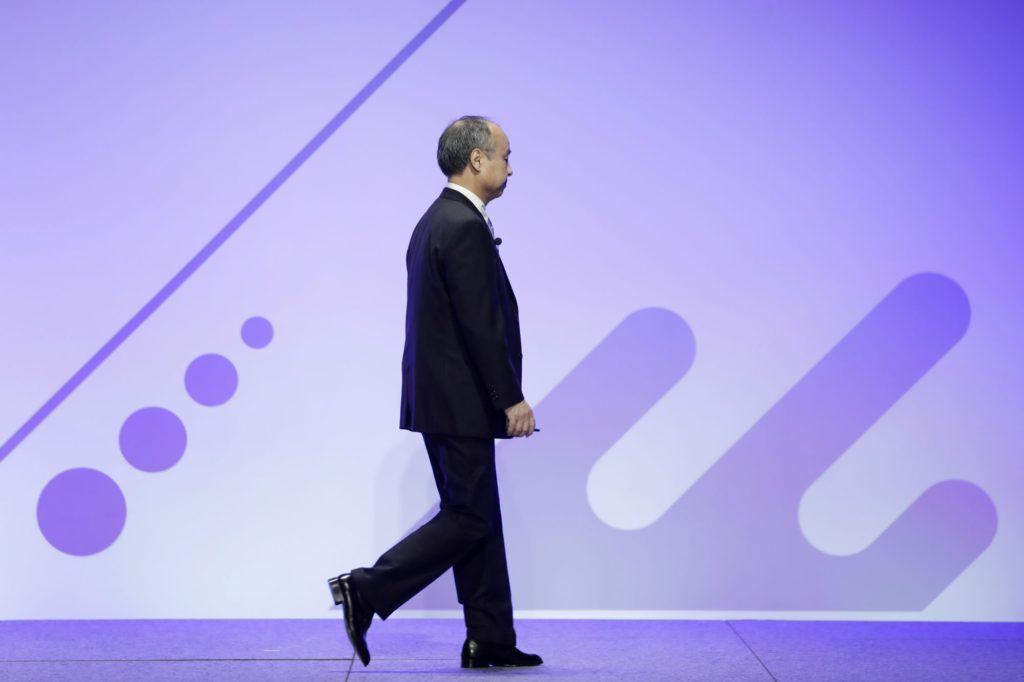
While Son has a reputation for making aggressive and unpredictable strategic moves, he spent most of a 90-minute press conference reassuring investors that he knows how to weather difficult times. He began with slide entitled “Concerns about SoftBank?” and then addressed questions about his debt load, the decline in his equity holdings and his cash position.

“In terms of personality, I do like to play offense,” said Son. But with the “pandemonium” of Covid-19 and war in Ukraine, he understands now is the time to play defense. “When it rains, you open an umbrella,” he said.

SoftBank shares rose about 4% on Friday, after an 8% drop on Thursday.

Analysts noted the somber tone, which came after several quarters in which the CEO said SoftBank was making its way through a technology “winter.”

“Son’s comments were even bleaker than those made at the 3Q results stage,” Citigroup Inc. analysts including Mitsunobu Tsuruo wrote in a research note.

Son said SoftBank’s “safe driving” in recent months has solidified its financial position. He explained in a slide that the company has allocated 2.9 trillion yen of cash, or roughly twice the 1.3 trillion yen due for bond redemptions in fiscal 2022 and 2023.

The Vision Fund unit has also dramatically scaled back its investments, doling out just $2.5 billion in the January-to-March quarter. That’s down from $10.4 billion a quarter earlier and far below the peak of $33.3 billion in one quarter in fiscal 2018.

He said SoftBank will continue to pull back on new investments in the current fiscal year.

“I would say compared to last year, the amount of new investment will be half or could be as small as a quarter,” he said.

Son argued that SoftBank is less vulnerable to unpredictable hits now that it has been in the past. Its loan-to-value ratio fell to 20.4%, comfortably below to 25% target he thinks of as the maximum. 

SoftBank’s net asset value — another key metric for Son — dropped to 18.5 trillion yen, far below its peak. But SoftBank is less vulnerable to the Chinese government’s crackdown on its tech sector, with Alibaba Group Holding Ltd. — his most valuable holding — accounting for 22% of its NAV compared with 59% before.

Son is taking a personal hit of about $2.4 billion from his decision to get into trading public stocks. SoftBank set up a controversial side venture in 2020 called SB Northstar, which was aimed at using the company’s excess cash to make some money picking stocks. Son took a personal 33% interest in the unit, while the company held the rest of the equity.

With tech stocks crashing in the last quarter, Northstar got hammered. SoftBank said it would recognize a loss of 670 billion yen for the last fiscal year, while Son is on the hook for 315 billion yen.

SoftBank’s portfolio is full of money-losing tech companies that traded at sky-high valuations during the years of easy money. Blockbuster listings by firms like South Korean e-commerce giant Coupang, China ride-hailing pioneer Didi and Chinese online property platform KE Holdings Inc. have gone from being the main driver of profit growth, to biggest drags. 

Coupang shares dropped 40% in the first quarter, Didi fell 50% and KE Holdings slid 39%. Scandals and missteps from WeWork Inc., Wirecard AG and Greensill Capital have also dented Son’s reputation for picking startups.

“People thought Son could make good investment decisions,” said Mio Kato, an analyst at LightStream Research who publishes on SmartKarma. “Now there is less evidence that SoftBank management’s investment decisions are good. Wirecard and WeWork are among the examples. When the environment changes, they are no longer effective.” 

A year ago, SoftBank set a record for highest quarterly profit in Japanese history and the company made a full-year profit of 5 trillion yen. This year, with the Vision Fund losses, SoftBank Group had a annual net loss of 1.71 trillion yen. 

Son shifted his tone near the end of the press conference, however, and began to talk about the opportunities to play offense. He expressed bullishness about the prospects for Arm Ltd., the chip designer that is preparing for an initial public offering. He detailed how the business is growing and said the company may well become the most valuable asset in its portfolio.

Son pointed out that the path to an IPO has been cleared by the removal of the rogue CEO of Arm’s China business, a controversy that has lingered for two years after the board fired the executive and he refused to leave. Pressed about the precise timing for Arm’s IPO, Son pointed out that markets are now tumultuous and demurred to give specifics because his lawyers would object.

“We will thoroughly protect ourselves while playing offense,” Son said. 

(Updates with analyst comments from fifth paragraph)

More stories like this are available on bloomberg.com

©2022 Bloomberg L.P.

Now You Can Own a Fraction of a Fancy Colored Diamond

(Bloomberg) — A new fractional ownership business centered on fancy colored diamonds will launch on May 18. Luxus, founded by hedge fund expert Dana Auslander and fashion journalist Gretchen Gunlocke Fenton, will debut with a first offering of a .54 carat fancy pink diamond.

The company aims to give retail investors the chance to buy a sliver of the stone, starting at 0.1%, with the opportunity to participate in a market normally out of reach for those who don’t have millions to invest. The idea is that the special diamonds, which have been steadily gaining value, will offer potential returns as investments. But, as with many such fractional ownership enterprises, retail investors will have no access to the stone or influence over how or when it might be resold—and returns realized.

Today, fancy pink diamonds remain among the world’s priciest diamonds; the largest, most exceptional stones sell from $1 million to $1.2 million per carat at retail. The most expensive diamond of any color ever sold was the Pink Star, a 59.6 carat internally flawless fancy vivid pink diamond that sold for $71 million in 2017 at a Sotheby’s auction, or just under $1.2 million per carat.

Fancy colored diamonds have typically gained 9% to 12% annually in recent years, according to the Fancy Color Diamond Index (FCDI), which tracks the wholesale prices. From the start of 2005 through the first quarter of this year, prices for fancy vivid pink diamonds, a high grade, achieved 427.8% growth. 

Not all pink diamonds are created equal, but even lower-quality colors gained in price. Fancy pink diamonds, a lower grade, gained 325.6% in price, and fancy intense pink diamonds 382.6%. The price of gold gained 300% over that period—the S&P, 384%.

How do you get in on the game

Unless you had millions of dollars to invest, you’d be unable to acquire any of those gems, and smaller stones and colorless diamonds don’t achieve comparable price gains. With the growth of alternative investment platforms, including for wine, art, sports memorabilia, and cryptocurrencies, it was only a matter of time before someone created a platform for gemstones.

The first offering users can buy into is a .54 carat fancy vivid purplish pink diamond from the legendary (now closed) Argyle Diamond Mine in Australia, which was the source of 90% of the world’s pink diamonds. Luxus sourced the diamond from Kwiat, a family-owned diamond company founded in 1907 that acquired the diamond as an investment at the Argyle Tender, a sealed-bid sales event, in 2016.

Dana Auslander, Luxus’s chief executive officer, spent years structuring and developing products for hedge funds and working in asset management at firms including Blackstone Alternative Asset Management LP and Harbinger Capital Partners LLC before she co-founded Luxus. Co-founder Gretchen Gunlocke Fenton, who worked in public relations for Chanel and was a fashion editor at Vogue, Town & Country, and Glamour, brings knowledge and connections in the jewelry industry. In July 2021, they decided to launch Luxus, and raised $2.5 million in pre-seed funding from investors including fashion designer Veronica M. Beard.

This year is to be a testing period with the rollout of Luxus’s first product, the pink diamond. If the planned full launch next year is successful, Luxus will expand to other fancy colored diamonds, including blue and yellow ones. The founders hope to expand into rare watches. 

How it will work

Luxus will offer 2,000 shares in the pink stone at $200 each, valuing the diamond at $400,000. The company says pricing for this stone—and future products—is set below retail prices and above wholesale, as determined by market data and assessments by independent third parties, including the International Gemological Institute.

The company says an independent advisory board that is currently being assembled will assign pricing after the full launch in 2023.

CEO Greg Kwiat says the offered price is a good metric of the trade market value. “One of the most important things that we bring to this—and I know it’s very consistent with Dana’s vision—is that the pricing to [retail] investors needs to reflect fair market value that positions them for upside, which by definition means not buying it at the highest price anyone could imagine paying for it, and not a retail price.”

After 12 months, Kwiat will work to sell the diamond for Luxus. “When it sells, that’s how the [retail] investors will participate in upside. All the while, we’ll be making sure to sell it for a price that reflects the full current market value,” says Kwiat. “I think we’ll sell it in a similar manner to how we sell all of our important assets: showing it privately to the best potential buyers of the assets.”

He is excited about Kwiat being the first jewelry company to participate in this offering, which he sees as part of the future of the jewelry industry. “We need to be forward looking. You know, I think this is one of the most exciting things I’ve worked on in 20 years of my career so far in jewelry,” he says.

What potential shareholders should look for

Neither Kwiat nor Luxus will disclose the stone’s initial purchase price, so potential retail investors can’t see its price history and must trust that it’s properly priced for them to make a profit.

Martin Rapaport, founder of the Rapaport Diamond Report, which tracks diamond prices and markets globally, and RapNet, an electronic diamond trading network with 930,000 diamonds, says this is a potential cause for concern.

If it were offered by an unknown company, and “you don’t have transparency about what the actual cost of the diamond is, run away fast,” says Rapaport. “Investors are at a distinct disadvantage when they don’t know the actual cost of the item.” Traditionally, dealers don’t discuss what they paid for a stone, something that may need to change in the era of fractional ownership. 

Looking at his databases, Rapaport would value a similar diamond at a dealer price of $300,000 to $400,000 per carat, which could potentially retail at double the price. Since the stone is roughly half a carat, this estimate would mean fractional investors are buying the stone at somewhere around the current retail price. 

Rapaport cautions that with fancy colored diamonds, it’s impossible to find an exact comparison, because every stone is unique. “It’s difficult to compare something so rare,” he says. Only more transparency from Luxus could let retail investors know if they’re getting good value or overpaying. 

Fees and sale

One of the downsides of alternative investments can be high fees that eat into retail investors’ returns. While Luxus does take fees, Auslander says she intends to keep them as low as possible to entice retail investors. “I come from a world where you have to be really mindful of what investors end up paying for,” she says. That includes Luxus absorbing the startup costs, filing fees, and broker fees; having the company store the diamond and maintain insurance (which she says will not be added later as a cost); and including an undisclosed listing fee—which Luxus maintains is lower than those of auction houses—in the offering price, so no surprises will accompany a sale.

Any sourcing fee, which can reach 10% or more for Luxus, is included in the initial price. Luxus charges an annual management fee from .5% and 1%, to be paid out at the sale.

The company estimates it will hold assets for from 18 months to three years, but in practice the period could run from as little as 12 months to as long as eight years. There are to be no transaction or trading fees if shares in an asset are sold on Luxus’s secondary trading platform before the stone is sold. In addition, a stone’s vendor must sign a commitment to purchase a minimum share of the asset—in Kwiat’s case, at least 10%—and Luxus says it will purchases shares, too, to ensure that its interests align with those of retail investors.

Auslander describes the prospective sale of a diamond as “a capital market transaction on the way in and a private equity exit on the way out.” Luxus uses a waterfall distribution method, so once the fees are paid to it and initial capital investments are returned to all shareholders, retail investors will receive 8% preferred returns of the profit. Whoever then sells the asset—Luxus or the stone’s vendor, such as Kwiat—will receive 20% of the remaining profit; the final 80% is to be distributed to the shareholders.

The fees are lower than those of Masterworks, a fine art fractional ownership platform, Auslander says. Masterworks charges a 1.5% annual fee and expects to hold onto the artworks for from three to 10 years, as well as a 10% sourcing fee, 20% of future profits (with no preferred returns), and some undisclosed potential expenses and fees.

Luxus plans to add additional source partners next year.

(Corrects S&P growth from 2005 to 2022 in the fifth paragraph. Corrects Luxus management fee in the 21st paragraph.)

More stories like this are available on bloomberg.com

©2022 Bloomberg L.P.

Shein’s Breakneck Growth Slows, Testing $100 Billion Valuation

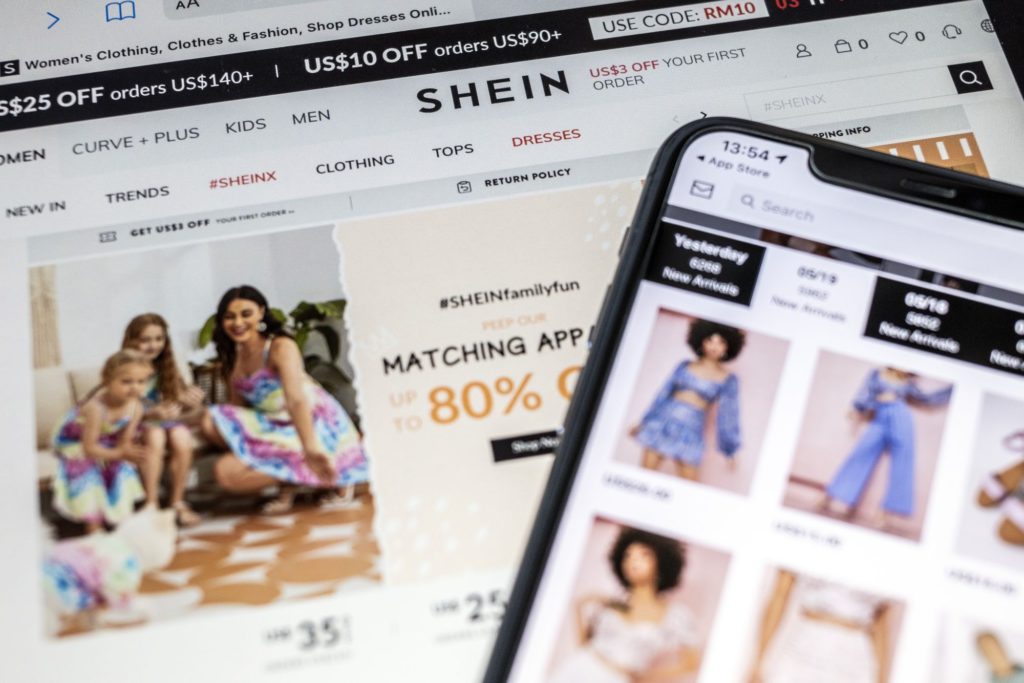
(Bloomberg) — Shein, the Chinese fast fashion giant that’s quickly become the third-most valuable startup in the world, is seeing a reality check with sales growth slowing from the lofty heights of the pandemic, just as it faces mounting pressure to live up to a $100 billion valuation. 

The online-only retailer of inexpensive clothes, beauty and lifestyle products has become a global phenomenon, with a following of mostly tweens and teenagers in the West making its app one of the most downloaded in the world. 

Shein, however, saw annual sales growth slow to around 60% in 2021, according to people familiar with the business. That’s a steep plunge from an eye-popping 250% growth in 2020, when the arrival of Covid-19 turbocharged e-commerce demand from consumers stuck at home. 

Overall, annual revenue reached at least $16 billion in 2021, up from $10 billion in 2020, said the people, who declined to be identified as they’re not authorized to speak publicly. 

While revenue last year was overall in line with company expectations, what worries Shein’s top executives is that expansion was strong in the first half of the year, but decelerated at a worse-than-expected pace in the second half, with the slowdown continuing into 2022, according to the people. 

The trend is reflected in transaction data in the US, Shein’s biggest market: for the first quarter, sales growth fell to 57%, down from a quarterly range of 105% to 264% in 2021, according to figures from Bloomberg Second Measure, a research firm which analyzes US consumer transactions to measure revenue.  

While sales growth in the high double digits still outstrips fast-fashion giants like Hennes & Mauritz AB or Inditex SA’s Zara, Shein’s slowdown comes as it’s persuaded investors including General Atlantic that it is worth about $100 billion — more than the market capitalizations of H&M and Zara combined, and behind only ByteDance Ltd. and Ant Group on Crunchbase’s list of most valuable startups in the world. 

That’s despite having no network of physical stores and a myriad of challenges, including the threat of legislation in the US that would erode a cost advantage which currently allows Shein to sell dresses, crop tops and bikinis for a fraction of competitors’ prices. 

Read more: Trump’s Trade War Created China’s Global Fashion Giant

A representative for Shein said the company doesn’t comment on speculation about its business. 

Lockdown Hit

“As one of the top online exporters in China, Shein’s slower growth shows the increasing challenges suffered by the entire sector,” said Wang Xin, head of the Shenzhen Cross-Border E-Commerce Association, an organization representing some 3,000 exporters. She cited the weakening yuan and growing geopolitical tension with the US as other headwinds.

The deceleration also comes as the company gets caught between the polar opposite pandemic approaches of the US and China. While life in America normalizes to pre-Covid norms and shoppers venture out more, China’s rolling Covid lockdowns as the country continues to try and stamp out all infection has disrupted Shein’s production and logistics operations in the southern province of Guangdong, its key sourcing hub, said the people. 

Shein’s concentrated supply chain there, key to its fast deliveries and ability to churn out thousands of new, on-trend items every day, is now at risk of paralysis whenever pandemic containment measures are applied in the area, said Leng Yun, a Shanghai-based apparel sector consultant. 

“It’s the hardest time for China’s exporters since early 2020, even more challenging than when the pandemic first started, as the supply chain is significantly hit in recent months,” said Leng. 

U.S. Listing

Other data show that the attention of the company’s young consumer base may be shifting away from Shein, which hired entertainers Lil Nas X and Katy Perry as brand ambassadors during the pandemic. Web traffic to Shein.com, which more than doubled or even tripled during the first eight months of last year compared to the same period in 2020, dropped to low double-digit growth by late 2021, according to data provider Similarweb. Web traffic in April inched up just 8% compared to a year ago. 

Shein’s rapid rise from low-cost Chinese apparel merchant to global fashion juggernaut in less than five years is a unique success story among consumer brands in the world’s No. 2 economy. The company has succeeded despite avoiding its home turf, the globe’s biggest consumer market, distancing itself from its China to focus on Western consumers.

As part of its latest $1 billion fundraising round, Shein told existing investors including Tiger Global Management, IDG Capital and Sequoia Capital China that it’s looking to list to list on a US bourse in as soon as two years, people familiar with the company’s thinking said. 

Shein is considering a shift of corporate domicile to Singapore to pave the way for a US IPO, the people said. 

The company’s Singapore-based entity, Roadget Business Pte. Ltd, is already its vehicle for signing contracts with customers, according to the terms and conditions page on Shein’s website. 

Shein’s challenge in sustaining high growth reflects a wider issue for China’s cross-border e-commerce sector, which in 2020 pulled ahead of traditional exporters to expand at 40% thanks to tax breaks and demand from Western consumers. Last year, growth slowed to 24.5%. 

“While Shein’s growth slows, many smaller players are struggling to survive,” said Wang. “We are no longer talking about a fast-growing sector filled with easy money as the business becomes more volatile and challenging with slimmer profits and higher risks.”

(Updates with analyst comments in 10th and 20th paragraphs.)

More stories like this are available on bloomberg.com

©2022 Bloomberg L.P.
Tether Takes Victory Lap After Stablecoin Regains Peg

(Bloomberg) — Amidst worries that Tether, the world’s biggest stablecoin, was losing its 1-to-1 peg to the dollar, Paolo Ardoino stepped in to reassure investors. Tether’s chief technology officer emphasized that the private company behind the coin that plays a critical role in the crypto ecosystem had no problem with redemptions, including even a $600-million repayment in the last 24 hours.

“Actually the peg was not broken,” Ardoino said on Twitter Spaces Thursday. “It would have been broken if Tether didn’t honor redemption at $1.” Ardoino spoke for an hour together with crypto pioneers Samson Mow, chief executive office of Jan3, and Adam Back, CEO of Blockstream.

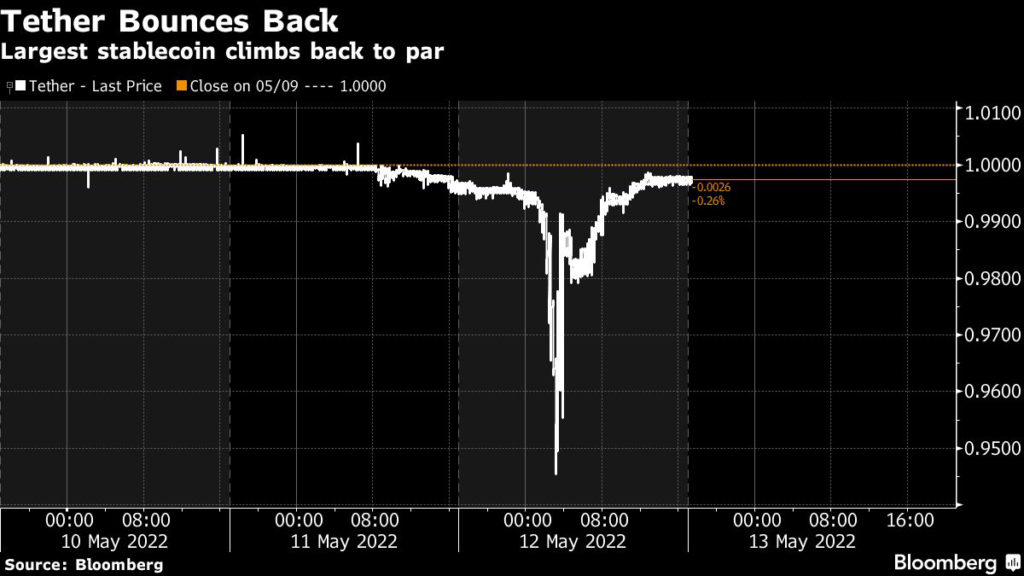
Soon after the Twitter Spaces ended, Tether — known as USDT — regained its peg, which briefly dropped to 94.55 cents earlier in the day, its lowest level since December 2020. Crypto markets slumped today partly on worries about the future of Tether, where traders park their funds in times of high volatility: About half of all Bitcoin is bought with USDT, per CryptoCompare. A much smaller stablecoin, TerraUSD, known as UST, collapsed this week, and many traders worried that others may follow. Some new crypto users also may have confused UST with USDT.

“That is definitely part of the confusion,” Mow said. “There’s a lot of Tether fud flying around. There’s just a massive confusion and panic in the market.” Bitcoin is down by more than 20% in the last seven days, according to CoinMarketCap.

Much of the Spaces discussion, attended by more than 1,500 people, focused on how Tether is different from TerraUSD. UST’s peg was supposed to be maintained via algorithms and trading incentives, and partly relied on Bitcoin reserves. Tether, meanwhile, keeps more than half of its reserves in U.S. Treasuries, Ardoino said. So when many people want to redeem funds, Tether can sell the securities quickly and comply — something that UST couldn’t do.

“The worst-case scenario, Tether just shrinks,” Ardoino said. 

Tether’s reserves management is shrouded in mystery, and it settled with New York Attorney General for making false statements about its reserves.

Read more: Bitfinex Settles New York Probe Into Tether, Hiding Losses

Ardoino said that UST’s mistake was in growing too fast to ensure reimbursements could happen even if crypto prices fell. Its usefulness was also limited to yield farming — users invested it into decentralized finance to earn a yield of up to 20% — and it wasn’t used in payments or trading, Ardoino said. Tether, meanwhile, is used to buy everything from everyday essentials to homes.

“There’s a real use case behind Tether, and this is missing from the other projects,” said Mow of Jan3.

Blockstream’s Back blamed venture capitalists behind Terra for causing the stablecoin’s downfall by trying to increase the price of a related token, Luna.

“What they were looking to do is push up the value of the Luna tokens,” Back said. “They use some of Luna to juice some of the interest rates to 20%, to incentivize more people to come in. It looks fun until the music stops.”

The bottom line? 

“This puts everybody on notice that you have to make safer, more robust things,” Back said. “It should impose rationality on the market.”

More stories like this are available on bloomberg.com

©2022 Bloomberg L.P.
UK Starts £120 Million Fund to Develop Nuclear Power Technology

(Bloomberg) — The UK government is giving £120 million ($147 million) to a new fund for the development of nuclear power as the country seeks to put atomic energy at the heart of its electricity mix.

The Future Nuclear Enabling Fund will help the government meet its goal of approving eight new reactors by 2030, as committed to in its energy security strategy last month, according to a statement published Friday. The fund aims to encourage private investment in U.K. projects.  

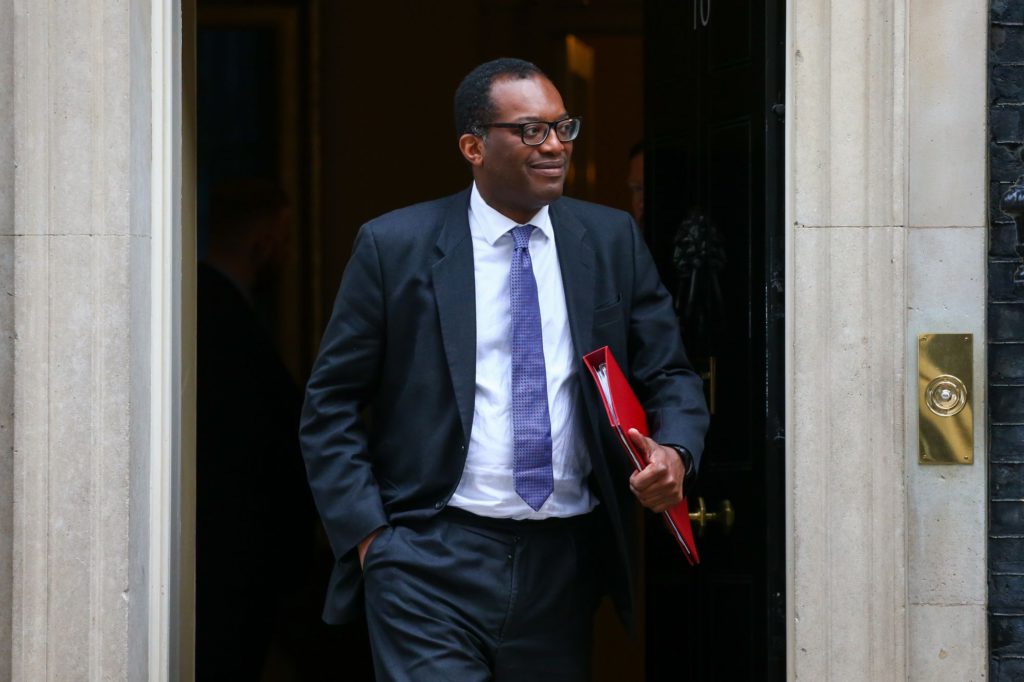
The “fund will push forward our plan to deploy a new fleet of nuclear power stations as part of a British nuclear renaissance,” said Kwasi Kwarteng, the U.K.’s secretary of state for energy. 

Under Prime Minister Boris Johnson’s new plan, nuclear will provide 25% of the country’s power in three decades, up from 16% at present. But it’s not the first time the U.K. has tried to revive its nuclear industry: efforts have been underway since the 1980s under different governments. But just one plant is being built — Hinkley Point C.

The size of the fund is small compared with what’s needed to make the government’s vision a reality. Electricite de France SA’s Sizewell C project on the English coast will cost about £20 billion, of which the UK has pledged £1.7 billion.

The biggest hurdle for new nuclear is financing. To help overcome that, the new fund will provide grants that will help nuclear construction projects, including small modular reactors, to attract the private investment they need to help make them a reality.


More stories like this are available on bloomberg.com

©2022 Bloomberg L.P.
UK-US Space Deal Aims to Cut Red Tape on Commercial Launches

(Bloomberg) — A new UK-US space partnership will help make commercial launches from both countries cheaper and easier, the British government said.

Transport Secretary Grant Shapps signed a declaration with his US counterpart Pete Buttigieg to work together on future missions, in a move that aims to cut red tape and reduce costs and duplication.

The deal lays the foundation for “rockets, high-altitude balloons and space planes to lift off from space ports across the UK very soon,” Britain’s transport department said in an emailed statement.

It comes as the UK prepares to make its first domestic launch this year from Spaceport Cornwall. Virgin Orbit will launch a satellite into space using a modified Boeing 747 plane.

“With seven spaceports being developed across the UK, the space industry is already injecting billions into our economy, while offering high-skilled jobs,” Shapps said in the statement.

The deal will “significantly boost opportunities for both UK and US companies to operate from respective spaceports, introducing new customers and revenues to each country,” the UK transport department said.

More stories like this are available on bloomberg.com

©2022 Bloomberg L.P.

Nomura Starts Offering Bitcoin Derivatives to Clients in Asia

(Bloomberg) — Nomura Holdings Inc. has started offering Bitcoin derivatives to clients in Asia after institutional demand for cryptocurrency products increased “significantly” in the past two years. 

Japan’s biggest brokerage is offering non-deliverable forwards and non-deliverable options settled in cash, and can now trade Bitcoin futures and options, Tim Albers, head of forex structuring in Asia ex-Japan, said in an interview. 

Nomura carried out its first digital trade on CME Group Inc.’s platform this week with Cumberland DRW LLC, a market-maker in Bitcoin and other cryptocurrencies. That trade was made despite a recent meltdown in the crypto sector after the collapse of the TerraUSD stablecoin triggered a flight from many popular digital tokens. 

“There has been significant volatility recently,” Albers said. “Once the dust settles, valuations will become more attractive for institutional clients. We’re pretty excited to get this off the ground” as the launch “marks the start of our journey into the space” for the global markets business.

Crypto Expansion

Nomura is tapping resources within its Singapore-based foreign exchange team and its wholesale digital office for the crypto expansion in its global markets division. The digital office was created in 2018 to identify and execute new technology-led revenue opportunities such as digital assets, artificial intelligence and to support its e-trading platforms. The brokerage plans to expand its trading capabilities across other global markets over time, said Albers, without disclosing details.

Nomura’s expansion comes as crypto firms face growing scrutiny from policymakers in the U.S., prompting some to hunt down less bureaucratic jurisdictions like Bermuda. Cryptocurrencies and other risky assets are also under pressure after the Federal Reserve and other central banks raised interest rates to fight inflation, creating an unfavorable environment for such assets. 

“We expect the sector to mature over time, to become more regulated, which makes it more attractive for institutional investors,” Albers said. “As a result, volatility should reduce over time.”

Nomura in October agreed to a third party allocation of shares from Crypto Garage Inc., which offers blockchain related settlement services in Japan and overseas. Its digital asset custody venture Komainu, formed with partners Ledger and CoinShares, raised $25 million in capital in March 2021.

EXPLAINER: How Derivatives Amp Up Already Heady Crypto Markets: QuickTake

More stories like this are available on bloomberg.com

©2022 Bloomberg L.P.
EU Parliamentarian Welcomes Tech Antitrust Push in Congress

(Bloomberg) — The European Union lawmaker behind the bloc’s new gatekeeper rules for digital platforms endorsed US congressional efforts to rein in the largest technology companies, saying regulators can be more effective by acting together.

“It will be a strong signal to the markets, but also to the citizens that we defend their interests together,” Andreas Schwab, who led the negotiations for Europe’s Digital Markets Act in the European Parliament, said in an interview in Washington on Thursday. 

Schwab, a Parliament member from Germany, met with Democratic Senator Amy Klobuchar of Minnesota, Republican Senator Marsha Blackburn of Tennessee and Representative David Cicilline, a Rhode Island Democrat. 

Klobuchar and Blackburn are the lead sponsors of US antitrust legislation intended to foster competition among the largest tech companies -– bills substantially similar to the Digital Markets Act. 

Cicilline, who is chair of the House Judiciary Antitrust Subcommittee, is leading that chamber’s push to rein in online platforms with a similar package of bills.

The EU regulations, set to take effect next year, would bar so-called “gatekeepers” like Meta Platforms Inc.’s Facebook and Amazon.com Inc., from favoring their own products and require explicit user consent to combine personal data in order to target advertising. It also would force Apple and Alphabet Inc.’s Google to ensure fair access to their app stores. 

The new rules would apply to companies whose market value exceeds 75 billion euros ($82.6 billion) and have at least 45 million monthly end users and 10,000 yearly business users. The EU won’t designate gatekeepers until next year, though the law is expected to apply to the five largest US tech platforms — Apple Inc., Amazon, Meta, Google and Microsoft Corp. — as well as China’s Alibaba Group Holding Ltd. and Bytedance Inc.’s TikTok Inc. Online marketplaces Zalando SE and Booking Holdings Inc. may also be affected.

Klobuchar’s bill would similarly bar large tech platforms companies from favoring their own products while Blackburn’s measure focuses on app stores. 

“We want this to be done together because it’s a common Western world principle,” Schwab said. “The more we can partner, the better for everyone.”  

More stories like this are available on bloomberg.com

©2022 Bloomberg L.P.
Close Bitnami banner
Bitnami