Bloomberg

Apple Drops 22% From January Peak as Tech Selloff Continues

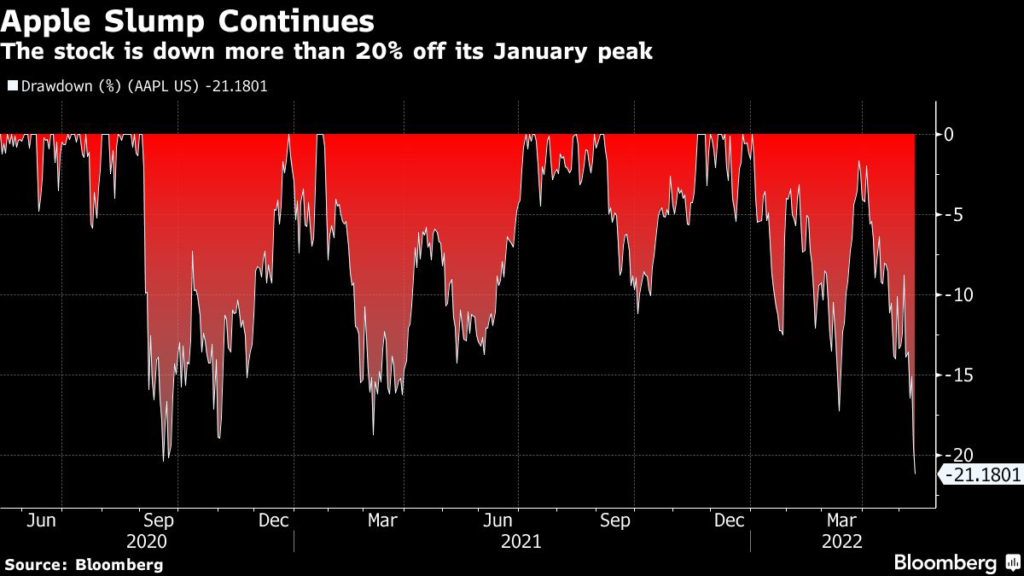
(Bloomberg) — Apple Inc. shares fell on Thursday, with the stock now about 22% below its January peak as a selloff in technology stocks spreads from more speculative shares to the world’s biggest companies.

The stock fell as much as 3.3% to $141.66 and is trading at its lowest since Oct. 14. The slump has erased about $696 billion in Apple’s market value since the Jan. 3 record, a slump that enabled Saudi Aramco — which has benefited from this year’s surge in oil prices — to overtake the tech giant as the world’s most valuable company.

The widespread tech weakness has been spurred by concerns about inflation and rising interest rates. The Nasdaq 100 Index has slumped more than 7% over the past four days and on track for a sixth straight negative week, its longest losing streak since 2012.

“Sentiment is very depressed, and uncertainty surrounding inflation is going to continue to complicate the picture,” said Keith Lerner, co-chief investment officer and chief market strategist at Truist Advisory Services. “Even though prices are getting cheaper, we need a spark to start moving us up, and I don’t see one.”

While the tech-heavy Nasdaq 100 has been under pressure all year, Apple’s decline has been relatively recent. The stock has fallen nearly 10% this week alone amid mounting concerns about an economic slowdown. It’s a sudden turnaround for Apple from about six weeks ago, when shares were trading close to their record.

The stock is on track for a seventh straight weekly drop, which would represent its longest such streak since November 2018.

Apple continues to face supply chain challenges that the company predicted would cost $4 billion to $8 billion in revenue during the current quarter. Still, its strong balance sheet, hefty profits and loyal customer base has insulated it from some of the turmoil in the tech sector.

The stock is still outperforming the tech-heavy Nasdaq 100 index, which has lost nearly 30% of its value this year, compared with Apple’s year-to-date decline of about 19%.

Lerner suggested that the weakness in Apple and other big-tech names could be a sign of a bottoming process in markets. “You want to see the generals fall to find a good bottom, so this could be a positive from that perspective, though we can always get more oversold.”

(Updates share price move, adds commentary.)

More stories like this are available on bloomberg.com

©2022 Bloomberg L.P.

JLR Owner Sees Chips, Inflation Weighing After Surprise Loss

(Bloomberg) — Jaguar Land Rover expects the global semiconductor shortage to persist into 2023, after the scarcity cut into sales and pushed its Indian owner into an unexpected quarterly loss.

Parent Tata Motors Ltd., as well as its British luxury JLR unit, plan to increase prices in order to offset some of the expected rise in costs, Chief Financial Officer P.B. Balaji said Thursday, declining to offer more details. The protracted issues in sourcing enough chips and rising inflation are the company’s biggest concerns, he said.

Automakers globally are grappling with a semiconductor shortage and higher input costs, which have been exacerbated by supply-chain snarls triggered by China’s pandemic lockdowns. The issues led to Tata Motors posting a loss of 10.3 billion rupees ($133 million) for the three months ended March 31, missing analyst estimates of a 2.86 billion rupee profit.

The lockdowns “as well as the new Range Rover Sport model changeover are expected to limit volume improvements” in the June quarter, possibly resulting in negative earnings before interest and taxes as well as negative free cash flows, JLR said in an earnings statement.

Record Orders

On a brighter note, JLR said its order backlog rose 8.4% quarter on quarter to [a record] 168,000 units, with the [high-margin?] new Range Rover and Land Rover Defender accounting for over half of customer requests. 

The carmaker’s conglomerate parent Tata Group is planning to manufacture semiconductors to mitigate the chip crisis and will announce plans to manufacture batteries for electric vehicles soon. 

Tata Motors, which leads India’s nascent EV market, is doubling down on its switch to cleaner transport. The company’s local electric-vehicle business attracted investments from TPG and others in October and the carmaker aims to roll out 10 electric vehicles by 2026. 

Jaguar Land Rover is seeking to cut carbon emissions by about half across its operations, including the automaker’s manufacturing and supply chains, by 2030 to help reach its net-zero targets. Under Chief Executive Officer Thierry Bollore, JLR has said it will electrify its lineup and ditch combustion engines at Jaguar — the smaller of its two brands — by 2025, while Land Rover will get its first fully electric model in 2024.

The British marque was working to advance the timelines on its electrification plan, Balaji said on the call. 

“We will do everything we can to bring it forward but currently we haven’t put a date in any of those yet,” he said. “All efforts are underway to see how best we can bring to forward.”

(Updates with comments from Tata CFO throughout)

More stories like this are available on bloomberg.com

©2022 Bloomberg L.P.

Citi Urges Caution, Sees US Equities Exiting ‘Bubble Territory’

(Bloomberg) — US stocks have started exiting bubble territory and returns from here will be muted, according to Citigroup Inc. strategists, as risks from monetary tightening and collapse in technology stocks mount. 

“With the US exiting bubble territory, this calls for caution on US equity risk,” strategists including Dirk Willer wrote in a note. They expect “subpar” returns from here and recommend favoring cheaper, so-called value stocks over growth shares.

The strategists said that the US stock market entered bubble territory in October 2020, and that most of the froth has been concentrated in non-profitable American technology companies. Other global assets, including US real estate, aren’t triggering bubble warnings, Citi said. 

“When a major equity market bubble is deflating, it may undermine most global equity markets, not just the one that is deflating,” Citi strategists said. “This would suggest that a potentially deflating US bubble should be a negative for equity risk more broadly.” 

Stocks that are valued on future earnings growth, and especially tech, have been leading the selloff in global equities over the past weeks. As the Federal Reserve embarks on interest rate hikes to tame surging inflation, expensive growth shares have suffered as higher rates mean a bigger discount for the present value of future profits. This marks a shift in investor outlook after tech stocks had been some of the market’s best performers for years. 

Citi strategists led by Robert Buckland earlier today also said in a note that growth stocks, including the battered tech sector, will likely remain under pressure as central banks tighten monetary policy, driving yields higher. They are especially wary of growth stocks in the US, where the tech-heavy Nasdaq 100 has slumped to November 2020 lows and is down 27% this year.

Buckland prefers cheaper, so-called value stocks, according to a portfolio they’ve modeled to protect against rising real yields. They also favor UK and emerging market stocks over the US and continental Europe.

“Any stabilization in nominal yields should eventually help to stabilize real yields and hence equity valuations,” he wrote in a note.

The Nasdaq 100 index is now trading at about 20 times forward earnings, the lowest since April 2020 and at about the average level seen over the past decade, according to data compiled by Bloomberg. This compares with about 29 times seen at a record high in November. 

(Updates with Willer’s comments from first paragraph)

More stories like this are available on bloomberg.com

©2022 Bloomberg L.P.

Nubank Offers Bitcoin, Ether Trading to Customers

(Bloomberg) — Nu Holdings Ltd., a Brazilian digital bank backed by Warren Buffett’s Berkshire Hathaway Inc., partnered with blockchain startup Paxos Trust Co. to allow its customers to trade cryptocurrencies.

Nubank’s more than 50 million customers will initially be able to trade Bitcoin and Ethereum as of Wednesday, according to Paxos Head of Revenue Michael Coscetta. Paxos has seen demand increase for digital assets in Brazil and that the move will create more financial inclusion for Nubank’s customers by giving them access to more payment methods, he said.

“You’ll see a lot more desire to participate [in crypto] not just in Brazil, but across Latin America,” Coscetta said in an interview.

Nubank will gradually roll out crypto trading to its entire costumer base by the end of June, the Sao Paulo-based firm said in a statement. Nu Holdings also buy Bitcoin equivalent to as much as 1% of its balance sheet cash position, the firm said in the same statement, without providing an exact figure.

Latin America has been an area of focus for crypto companies. Coinbase Global Inc. planned to acquire Brazilian crypto brokerage 2TM Participacoes SA before the deal fell apart. However, the US crypto exchange said it is committed to the Brazilian market. Paxos also provides crypto services to Mercado Libre Inc., an Argentinian online marketplace.

Coscetta said there’s also been interest in Latin America in terms of increasing access to digital dollars. He said that Paxos, which issues Pax Dollar, a stablecoin pegged to the US dollar, is interested in adding access to the currency on Nubank’s platform.

In addition to Nubank, Paxos works with other publicly traded companies, including PayPal Holdings Inc., Interactive Brokers LLC and Mastercard Inc. Nubank has lost more than a third of its market value less than five months after going public and faces pressure from the end of a stock lockup on May 17 that will allow $26 billion worth of its shares to be publicly traded.

(Corrects the title of Michael Coscetta in the second paragraph.)

More stories like this are available on bloomberg.com

©2022 Bloomberg L.P.

Microsoft’s ZeniMax Delays Two Xbox Games Until 2023

(Bloomberg) — Microsoft Corp.’s ZeniMax Media is delaying two of its anticipated video games until the first half of 2023, marking a slip for the Xbox.

Starfield, being produced by ZeniMax unit Bethesda Softworks, is the first new intellectual property developed by the studio in almost 30 years. The space-themed action role-playing game was announced in 2018. The other game, Redfall, is a first-person shooter developed by Arkane Austin, another subsidiary of ZeniMax, that was announced in 2021.

The teams “have incredible ambitions for their games and we want to ensure that you receive the best, most-polished versions of them,” Bethesda wrote in a tweet. 

Microsoft acquired ZeniMax Media in late 2020 for $7.5 billion. As a result, Microsoft won landmark franchises such as The Elder Scrolls, Fallout and Doom. 

More stories like this are available on bloomberg.com

©2022 Bloomberg L.P.

Metal Demand Seen Surging for Decades on Strength of Energy Transition, World Bank Says

(Bloomberg) — Demand for metals used in everything from wind-turbine blades to batteries will surge for decades to come, driven by efforts to decarbonize the global economy and shift away from fossil fuels, according to the World Bank.

Even as consumption growth for other commodities like grain probably will trail off in the next 30 years, metals will remain in high demand, delivering “windfall gains for countries that export them,” the bank’s economists wrote in a report released on Thursday. The adoption of low-carbon power generation “implies a permanent increase in demand for copper, nickel, cobalt, and lithium, and an eventual drop in the use of fossil fuels.”

The long-term outlook for metals and other commodity classes has profound implications for developing nations, two-thirds of which are reliant on raw-material exports for much of their income, according to the report. 

The bank urged commodity-dependent governments to build so-called rainy-day funds, avoid debt accumulation and shy away from protectionist trade policies when price volatility looms.  

More stories like this are available on bloomberg.com

©2022 Bloomberg L.P.

Nielsen’s 72-Year Grip on TV Ratings Is Starting to Slip

(Bloomberg) — Network executives, TV stars and media salespeople are all gathering in New York next week to pitch advertisers on their fall program lineups, an annual ritual known as the upfronts. This year a new kind of guest is also making an appearance.

A number of upstart audience measurement firms will be there claiming their systems for tracking TV viewers are better than those provided by Nielsen Holdings Plc, the current industry standard. Tracking viewers has become more complex in the streaming age, and critics say Nielsen hasn’t sufficiently captured that migration. NBC, for example, will for the first time use data from iSpot.tv Inc., a Nielsen rival, to make deals with advertisers.

While the end of Nielsen’s monopoly has been predicted for some time, many industry insiders believe there’s now serious momentum for change. Horizon Media, a media buying agency that works with brands such as Corona, Geico and Capital One, expects to transact as much as 15% of its deals based on Nielsen alternatives at this year’s upfronts.

“This is happening and it should happen,” said Dave Campanelli, Horizon’s chief investment officer. “We need to think about what we need to get off Nielsen exclusively.”

Nielsen, whose system for measuring audiences dates back to the earliest days of television, has historically relied on a panel of viewers, thousands of Americans selected to represent the general population. “Nielsen homes” have devices that track what people watch on their televisions. Marketers and networks use the data to determine if the shows deliver the agreed upon audience targets in the $65 billion TV ad market.

Nielsen, which is being taken private in a $16 billion buyout, is still expected to provide the bulk of audience data for this season and years to come. Griping about its measurements has come from TV networks where viewership has tumbled in favor of online programming. 

So, in come the competitors. Ispot, which tested its system earlier this year with NBC and the Winter Olympics, said it gets its viewer numbers from more than 40 million smart TV sets, allowing it to determine who’s watching faster and more accurately. The 10-year-old company just raised $325 million from Goldman Sachs Group Inc.

Video Amp, founded in 2014, uses data gleaned from set-top box providers like TiVo to capture viewers of live TV and on-demand programs. The company, which plans to go public this year, said it can track one-third of American households and model the remaining homes using big data that “is significantly more accurate than a panel-first approach,” said Chief Executive Officer Ross McCray. 

Comscore Inc., best known for collecting data on movie theaters and website traffic, has also been expanding in TV. According to Chief Marketing Officer Tania Yuki, Comscore’s experience tracking social media usage and other digital platforms gives it a more comprehensive view of what is on users’ screens.

Many ad buyers want information that goes beyond Nielsen’s traditional metrics of race, income level, gender and age. “People started looking for a sense of precision and measurement as they were seeing in search with Google and in social with Facebook,” said Dave Morgan, chief executive officer of Simulmedia, which helps marketers place their ads more precisely. 

While Nielsen has long been accused by networks of undercounting viewers, the company’s woes grew during the pandemic when it could not conduct its normal repairs on hardware installed in Nielsen homes. 

Nielsen has updated its services in recent years and plans to launch a new offering, Nielsen One, in the fourth quarter. Executives said the product will measure across platforms using large data sets, including signals from set-top boxes and smart TVs, in addition to its traditional panel-based measurement.  

“There’s a lot of things that we have to change,” Nielsen’s Chief Executive Officer David Kenny said in an interview. “We’re retooling all of that in order to do what we’ve always done exceptionally well.”

Even so, there is no perfect product, said Jason Lim, U.S. chief planning officer at advertising company MediaCom Worldwide Inc. “There are limitations across the board,” he said. Lim expects the industry will adopt an evolved measurement system, be it Nielsen One or a competitor. 

Broadcasters and networks may ultimately look at data from a range of companies to make deals, said Arun Kumar, chief data and marketing technology officer at Interpublic Group of Cos, the parent of ad agencies such as Deutsch and Foote, Cone & Belding. The challenge will be comparing the unique systems. 

“It’s going to be chaotic,” he said. “How do you compare apples and oranges and beet roots and cabbages?”

Still by next year, 30% or more of TV ad deals will be based on rival data sets, predicts Bharad Ramesh, who leads the research department at advertising giant Group M. 

“There are beginnings of movement to have really credible competition in this space,” he said in an interview. “That’s what makes this upfront very different.”

More stories like this are available on bloomberg.com

©2022 Bloomberg L.P.

Wood’s ARKK Is Epicenter of Market Rout as ETF Nears Covid Low

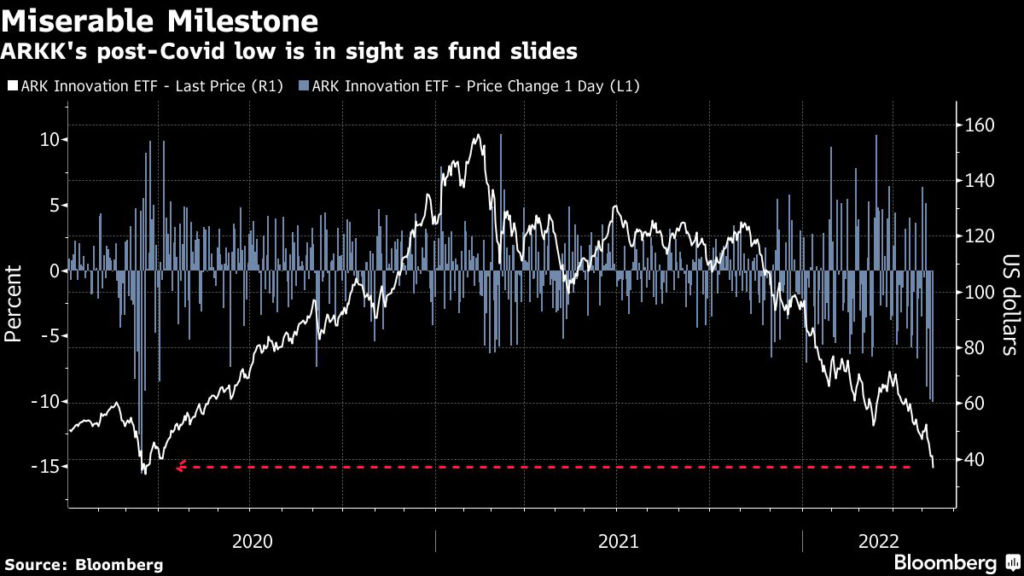
(Bloomberg) — Cathie Wood’s flagship fund is in danger of plunging below its lowest close in the pandemic crash, threatening another ignominious milestone for the ETF at the heart of a market backlash against speculative tech.

A day after its third-worst performance on record, the ARK Innovation ETF was 2.8% lower as of 8:22 a.m. Thursday in early trading in New York. The exchange-traded fund is now around 3.4% away from its close in the March 2020 rout, when the global spread of Covid-19 triggered a historic market-wide crash.

Wood’s main ETF is the standard-bearer for the brutal selloff in expensive tech shares sweeping Wall Street as inflation surges and policy makers rush to raise interest rates aggressively. That pressure hurts bets on profitless companies that offer the promise of earnings years into the future, exposures typically favored by Wood and her team. 

“Speculative tech is a wreck,” Neil Wilson, chief market analyst for Markets.com, wrote in a morning note. “ARK, and the flagship Innovation fund, are the epicenter of the market collapse — the collapse in the bloated valuations of loss-making technology stocks that had been pumped up by a flood of free money.”

The plunge over the past five trading days to Wednesday is a record for the fund, and takes this year’s slide to a whopping 61%. 

Wood maintains that her firm, ARK Investment Management, has a five-year investment horizon, and that this kind of turmoil simply makes her top picks cheaper. The firm regularly uses pullbacks to increase its bets, and has taken advantage of a rout in digital assets this week to boost its holdings of Coinbase Global, Inc. 

The operator of the biggest US crypto exchange has been plunging as a bear market sweeps the industry and after its results missed expectations. Nonetheless, Wood’s ETFs added almost 550,000 more shares on Thursday, according to ARK’s daily trading update.


“The market is not pricing assets based on fundamentals,” Brett Winton, ARK’s director of research, told Bloomberg Television on Thursday. “From our perspective, you’re getting amazing sales prices on innovation assets.”

Remarkably, investors still show no sign of panic. Numbers overnight show only about $33 million exited the innovation fund on Tuesday, meaning it still boasts net inflows in May of more than $500 million. Because of the way the fund settles trades, flow data arrives with a one-day lag.

More stories like this are available on bloomberg.com

©2022 Bloomberg L.P.
Amphenol Among Bidders for $1 Billion Schneider Unit

(Bloomberg) — Amphenol Corp. is among groups vying for control of Schneider Electric SE’s industrial automation and control unit, which could be valued at about $1 billion, people familiar with the matter said.

The Wallingford, Connecticut-based industrials firm is into the second round of bidding for the former Telemecanique business, the people said, asking not to be identified discussing confidential information. 

Others through to the next round of bidding include private equity firms Cerberus Capital Management, Lone Star Funds, KKR & Co. and PAI Partners, according to the people. Taiwan-based electronic component manufacturer Yageo Corp. has also been studying the asset, they said.

Deliberations are ongoing and no final decisions on a sale of the business have been taken, the people said. Representatives for Cerberus, KKR, PAI and Schneider declined to comment, while spokespeople for Amphenol, Lone Star and Yageo couldn’t immediately be reached for comment.

The Telemecanique unit, which can trace its origins back to 1924, makes products including sensors, switches and signaling devices for the industrial, infrastructure and building sectors. It was purchased by French industrial conglomerate Schneider in 1988. 

The potential sale forms part of Schneider Chairman and Chief Executive Officer Jean-Pascal Tricoire’s plan to offload non-core businesses and channel more investment into products that help companies with the shift to digitalization.

Amphenol, led by President and Chief Executive Officer Richard Adam Norwitt, has been an active buyer of businesses in recent years. It agreed to buy sensor technologies firm MTS Systems and fiber optic components maker Halo Technology Ltd.

More stories like this are available on bloomberg.com

©2022 Bloomberg L.P.

BMO Capital Markets Head Fears Deep Recession on Rate Hikes

(Bloomberg) — Two of Canada’s top investment bankers voiced concern that the rising interest rates that have already dragged down asset values from stocks to cryptocurrencies could plunge the global economy into a recession.

Dan Barclay, chief executive officer of capital markets at the Bank of Montreal, said interest rate hikes by central banks around the world could fail to arrest recent spikes in consumer prices because they are rooted in post-pandemic supply chain snarls and Russia’s invasion of Ukraine. But they could still wallop economic growth.

“I’m hoping you’ll have a nice correction, we will take some of the froth out of a bunch of markets and we’ll have a nice soft landing,” he said at the Bloomberg Canada Capital Markets Forum in Toronto. “That would be my hope story. My fear story is that they raise rates really, really hard, they can’t fix demand, because it’s a supply problem and not demand, and we will have a very deep recession.”

Central banks around the world are embarking on an unusually aggressive campaign of interest rate increases — both the US Federal Reserve and the Bank of Canada raised rates by 50 basis points recently, twice their normal pace — to try to wrestle inflation down from multi-decade highs. 

That rapid rise in borrowing costs has already resulted in US stocks tumbling 18% from this year’s peak, while assets from bonds to Bitcoin have been routed too.

The S&P 500’s latest move lower has nearly priced in the risks for recession to develop in the next year, according to the fair-value model of Bloomberg Intelligence. The equity benchmark would only need to fall another 4.4% to hit 3,760, which is the level where investors are pricing in a U.S. economic downturn, BI data show.

A US Recession Is Almost Priced Into the Market: Taking Stock

Roman Dubczak, managing director and head of global investment banking at Canadian Imperial Bank of Commerce, added that the central bankers’ job is even more difficult because they’re unwinding the programs of bond purchases they put in place to drive down market borrowing rates during times of crisis, at the same time that they’re raising rates.

“You’ve got to land two planes on a postage stamp, not one,” he said, speaking at the same Bloomberg event. “Hence you’re seeing market activity being what it is. It’s just a lot of precision required right now.”

(Updates information on S&P 500 fall, Bloomberg Intelligence model)

More stories like this are available on bloomberg.com

©2022 Bloomberg L.P.

Close Bitnami banner
Bitnami