Bloomberg

Product Tracking Luna Cryptocurrency Tumbles 99%

(Bloomberg) — Digital-asset turmoil is sweeping through exchange-traded products, with one tracking the troubled Luna token seeing its price almost evaporate in what may be the biggest ETP wipeout ever. 

The 21Shares Terra ETP (ticker: LUNA SW) tumbled 99% to 0.01 Swiss Francs on Thursday, having closed at 22.29 Swiss Francs on May 6. That was before the TerraUSD stablecoin, to which Luna is linked, crashed from its dollar peg — triggering a collapse in Luna’s price. The VanEck Terra ETN (VLNA GR) dropped by a similar magnitude. 

While it’s hard to track one-day declines for all ETPs since many end up delisted, it looks like the worst day for a product ever seen, according to Bloomberg Intelligence. In recent years, the implosion of the VelocityShares Daily Inverse VIX Short-Term ETN (XIV) in the “Volmageddon” turmoil of 2018 is one of the few events to come close. That product was liquidated after it dropped 93% in a single session, fueling widespread market turmoil.

TerraUSD (UST) was designed to keep its peg to the dollar through an algorithm-based system through which it can be swapped for Luna, and vice versa, to keep its value stable. When UST crashed from the peg in the past few days, UST’s backers increased the supply of Luna coins in a so far unsuccessful attempt to bring the stablecoin back to $1. The huge increase in supply caused Luna’s price to crater.


The total circulating supply of LUNA has surged to 1.46 billion tokens from 377 million yesterday, data from researcher Messari show.

The 21Shares product tracking Luna now faces the prospect of delisting, Hany Rashwan, chief executive officer of issuer 21shares AG, said in a Telegram message through a spokesperson. 

“As LUNA experiences low prices and high volatility it is likely that exchange spreads will continue to widen, which may ultimately lead to delisting on the part of the exchanges,” he said.  

More stories like this are available on bloomberg.com

©2022 Bloomberg L.P.

Biggest Stablecoin Loses Dollar Peg as Crypto Anxiety Spreads

(Bloomberg) — Tether, the largest of the stablecoins used in cryptocurrency markets to facilitate trading, briefly dropped to the lowest level since December 2020 as the fallout from the collapse of the TerraUSD token continues to reverberate across the digital-asset landscape. 

The price slipped as low as 94.55 cents from its intended 1-to-1 peg to the dollar on Thursday morning in London before recovering to just above 98 cents, Bloomberg-compiled data show. Paolo Ardoino, Tether’s chief technology officer, said in a tweet that investors can continue to redeem the tokens at a one-to-one value to the dollar via its platform. 

With a market value of about $84 billion, Tether is an essential cog to the array of crypto trades being actioned across the market at any given time. Investors turn to stablecoins as a way of retaining value without leaving the digital asset ecosystem, acting as a safe haven from volatile coins or even simply as a means of digital payment. It is the most traded cryptocurrency by far, charting more than double the volume of second-place Bitcoin over the last 24 hours at $178 billion.

The Tether price dip came as a massive selloff in cryptocurrencies wiped more than $200 billion in value from the market in 24 hours. Tether operates differently to TerraUSD, or UST, which was designed to use a complex mix of code, trader incentives and swaps with its sister token Luna to maintain its peg. Its decline highlights the overall risk-off mood that’s sweeping through crypto markets, analysts said.


“Tether’s de-pegging seems more driven by market sentiment rather than real concern over its reserves, which demonstrates how important centralized markets are for maintaining a stablecoin’s peg,” Clara Medalie, research director at Kaiko, said in an email.

Ardoino appeared to seek to alleviate any concern about Tether’s stability, saying in his tweet that it had redeemed over $300 million in tokens in the last 24 hours “without a sweat drop.”

As of Thursday morning in London, the broader stablecoin market had experienced bouts of volatility but largely avoided the same dramatic collapse as Terra’s UST. Other major tokens including Circle Internet Financial Ltd.’s USDC, Binance Holdings Ltd.’s Binance USD and Maker’s DAI were trading at their pegs on Thursday, according to pricing data from CoinGecko.

“There may be some stablecoin contagion following UST, however Tether continues to honor 1:1 redeemable ratio on their platform,” Fadi Aboualfa, head of research at crypto custodian Copper, said in an email. “Anyone who was around 2017-2019 and saw massive drops in Tether, and it was really an opportunity to buy at a discount.”

Stablecoin Swaps

Tether’s price activity hasn’t been limited just to traders wanting to exchange it directly for fiat currency, either. 

Data from Dune Analytics, which tracks the distribution of currency reserves in a pool where traders can swap one stablecoin for another, showed a sharp surge in Tether’s share of the total liquidity pool on Thursday. On May 7, Tether’s USDT constituted 42.6% of the total reserves in Curve’s 3pool — a figure which jumped to 92.6% as of mid-morning on Thursday. Tether’s value against the other stablecoins in that pool, DAI and USDC, has slipped as a result.

“I think given the situation with UST and market volatility retail traders are motivated to exchange their stablecoins for actual dollars, and the imbalance in the Curve pool is a result of that fluctuating demand rather than a full-on bank run,” said Andrew Thurman, who is in charge of content at blockchain data firm Nansen.

“Quite a few people are lacking confidence in all stablecoins at the moment. I wouldn’t be surprised if a lot of USDT holders saw what happened to Terra and are now exchanging for cheap Bitcoin,” said Mati Greenspan, founder of crypto research outfit Quantum Economics.

More than $1.8 billion of Tether was removed from the market between Wednesday and Thursday, as Tether’s market value dropped to as low as $82,2 billion from $84,2 billion,  according to data from CoinGecko. 

(Updates with context, price chart, comment from analysts throughout)

More stories like this are available on bloomberg.com

©2022 Bloomberg L.P.

KPMG Fined £14 Million Over Carillion Audit Scandal

(Bloomberg) —

KPMG LLP will pay more than £14 million ($17.1 million) over misconduct on major work it carried out for collapsed Carillion Plc and data services company Regenersis, in the latest in a long list of audit scandals surrounding the firm. 

The Financial Reporting Council, the UK’s audit watchdog, asked a tribunal to sanction the firm for as much as £20 million, at the start of a two-day London hearing. Its executive counsel said that the firm had agreed to a severe reprimand, with the fine reduced to £14.4 million for admissions and mitigating factors. It will also pay all of the costs from the case.

The proceedings follow a five week tribunal hearing in January where details of KPMG and six ex-employees’ wrongdoing, including accusations of acting dishonestly, came to light. 

The FRC’s counsel also proposed sanctions against five former KPMG staff. It asked for a £400,000 pound fine for Peter Meehan, KPMG’s audit engagement partner at the time, and for him to be excluded as a qualified accountant for 15 years. 

Three senior managers, Alistair Wright, Richard Kitchen and Adam Bennett, should be fined £100,000 apiece and excluded for 12 years, with audit junior Pratik Paw excluded for four years and facing a £50,000 fine. A decision on the final amount will be delivered in the coming months. 

The watchdog opened an investigation after KPMG self-reported concerns related to the Carillion audit, and later widened it out to include Regenersis. KPMG admitted to the misconduct. The claims relate to a 2015 audit of Regenersis, now known as Blancco Technology Group Plc, and a 2017 audit of Carillion. 

The latest hefty fine is a fresh blow to KPMG which has faced ongoing criticism over the quality of its work. The company faces an accumulation of disciplinary action over its audits of Carillion, including a £1.3 billion suit by its administrators.  It has previously been fined millions of pounds over shoddy audits of companies including Conviviality Plc, Silentnight Group and Ted Baker Plc.

“I am saddened that a small number of former employees acted in such an inappropriate way, and it is right that they – and KPMG – now face serious regulatory sanctions as a result,” Jon Holt, Chief Executive of KPMG UK, said. “As a firm, we are committed to serving the public interest with honesty and integrity.”

The FRC’s record fine was when it penalized Deloitte LLP £15 million over the audit of Autonomy Corp. 

Top Audit Firms in Crosshairs as U.K. Watchdog Beefs Up Powers

More stories like this are available on bloomberg.com

©2022 Bloomberg L.P.

Klarna Pushes Hybrid Shopping as Retailers Emerge From Pandemic

(Bloomberg) — Buy-now-pay-later provider Klarna Bank AB is pushing further into the retail industry by offering traditional stores a platform to stream and video-chat with online customers. 

Stockholm-based Klarna said its virtual shopping tools are being used by about 300 brands including Levi’s and Hugo Boss, allowing customers to interact directly with shop assistants when browsing online. 

“We replicate the brick-and-mortar experience of receiving personalized advice from an in-store expert and bring it to the online realm,” said David Sandstrom, Klarna’s chief marketing officer.

The new merchant-facing app comes after Klarna’s acquisition in July 2021 of social shopping platform Hero. Adam Levene, founder of Hero, said customers are far more likely to make a purchase after speaking with an in-store expert online. 

The platform also has the potential to reshape the working day for sales assistants. They could be sharing videos and photos of items during quieter times in the physical store, or even while working from home, according to Klarna. It could mean stores, which were forced to overhaul their business models during the pandemic, become more like content creation studios, with fewer or no customers but a bustling online presence. 

Klarna said it would not be responsible for training retail staff in this new role, but would offer tutorial videos on the app. Retailers, who pay a onetime set-up fee to use the platform, will also be responsible for allocating time for virtual shopping assistance. Sales representatives will be able to toggle their availability to chat, and can log credit or commission for sales on the app.

The virtual shopping feature is going live in 18 markets: the US, Canada, UK, Australia, New Zealand, Norway, Denmark, France, Poland, Netherlands, Belgium, Germany, Austria, Switzerland, Spain, Portugal, Italy, and Sweden. The offering will roll out to additional countries later in the year, Klarna said.

Buy-now-pay-later credit use exploded when the Covid-19 pandemic drove shoppers to online stores. Klarna was valued at $45.6 billion in its most recent funding round last June, which made it Europe’s most valuable startup. 

Financial regulators are looking at tighter rules on these increasingly popular short-term debt products, and Klarna has said it will start providing information on UK customers to credit agencies. 

Klarna has been seeking to expand beyond its buy-now-pay-later service. In November 2021, the firm announced it acquired PriceRunner, a Nordic comparison shopping service, to incorporate more product information into its app. 

More stories like this are available on bloomberg.com

©2022 Bloomberg L.P.
Crypto Investors Are Likely Paying Less Than Half the Taxes They Owe

(Bloomberg) — Cryptocurrency investors are collectively not paying the IRS at least half of the taxes they owe on their virtual-currency trades, according to new analysis from Barclays Plc.

A research note by Joseph Abate, a managing director at Barclays, paints a picture of an exploding new industry that the Internal Revenue Service is struggling to hold to account. 

The U.S. tax agency hasn’t released any recent estimate of its own on the difference between the levies owed and those paid on a self-reported basis. So Abate, a veteran analyst of money markets and Treasury Department funding, extrapolated from a 2017 IRS calculation to find the current tax gap would be around $50 billion per year — accounting for about 10% of all unpaid taxes. 

Abate’s estimate doesn’t include newer decentralized finance, which includes mining, staking, or participating in liquidity pools.

Bottom line, in the crypto sphere: “It is difficult for the IRS to figure out who owes taxes.” That’s because all counterparties are anonymous, even if visible on blockchains.

The crypto challenges are part of a broader, and growing, challenge. IRS Commissioner Chuck Rettig that the total tax gap is significantly larger than previous agency studies have found. Rettig told the Senate Finance Committee last year the shortfall — spanning crypto, capital gains and all other levies — may be as high as $1 trillion a year, or several times what previous estimates concluded. He attributed the jump in part to crypto.

The IRS has already begun to crack down on tax evasion among crypto investors, and in 2023 will begin requiring brokers to report transactions worth at least $10,000 to the agency. The IRS has also increased enforcement activity and is working with tax authorities in Australia, the UK, Netherlands and Canada to investigate financial crimes.

QuickTake: How Taxing Crypto Got Changed by New U.S. Law

Increased attention to taxing crypto transactions is part of a sharper focus on regulating the industry. Lawmakers and regulators this week renewed calls for new rules after a popular stablecoin lost its peg to the US dollar, putting investors and the market more broadly at risk.

Read More: Lawmakers Call For Regulation After Terra Stablecoin Meltdown

(Updates with context on regulation in final paragraph.)

More stories like this are available on bloomberg.com

©2022 Bloomberg L.P.
Foxconn Completes Acquisition of Lordstown Motors Electric Truck Factory

(Bloomberg) — Taiwan’s Foxconn Technology Group completed a transaction with Lordstown Motors Corp. to acquire the electric-truck startup’s Ohio factory for $230 million and take over production of its Endurance pickup truck, a critical step as the iPhone manufacturer seeks to diversify into electric vehicles.

Foxconn will invest $55 million for 55% of a joint venture for product development, and will take on approximately 400 Lordstown employees, the company said in a statement. The facility will become the Taiwanese company’s EV manufacturing hub for North America, it said. 

Foxconn, the primary assembler of iPhones for Apple Inc., has been looking to expand in the fast-growing electric-vehicle market with a similar business model, in which it would handle manufacturing for automakers. On Thursday, EV maker Fisker Inc. reaffirmed its plan to have Foxconn build the upcoming Fisker Pear model at the Ohio factory starting in 2024. Another potential customer would be Apple, which has been exploring getting into the auto business for years.


The finalization of the Ohio transaction provides relief for Lordstown, whose shares rallied on the news after the close of regular US trading Wednesday and were up about 17% to $1.77 in premarket trading Thursday. The company’s stock sank May 9 after it said the closing might be delayed as late as May 18. 

Foxconn previously had made $200 million in down payments toward the purchase. Had the deal not closed, Lordstown would have had to pay the money back — something it didn’t have enough cash to do. 

The transaction creates a lifeline for Lordstown Motors, which now can benefit from the giant company’s purchasing power. Foxconn will operate the factory, including some equipment that Lordstown will continue to own, such has its hub-motor assembly and battery module lines, the Ohio company said in a US Securities and Exchange Commission filing Wednesday. 

Lordstown Motors bought the factory in 2019 after General Motors Co. decided to close the plant, which was founded in 1966. Its closure was a liability for US President Donald Trump, who a year earlier went so far as to discourage rally-goers from selling their homes because of all the jobs he would bring back to the area.

Lordstown said that this week it has to delay some equipment purchases that would help it lower production costs. The company will need to raise $150 million in cash this year, down from initial plans calling for $250 million, because of the deferred tooling investments, Chief Financial Officer Adam Kroll told analysts. But without that tooling, the cost to build the battery-powered Endurance truck will exceed its sale price. 

The startup, which has no revenue yet, also on Monday signaled delays in plans for mass production of the pickup. While production will start on time in the third quarter to build the first 500 trucks, it said some of those won’t be delivered until 2023. 

Foxconn has been branching out into EV development and production over the past 18 months, seeing the rising interest in the category as potential boost for revenue growth. The iPhone assembler unveiled its first electric cars last year, boosting its credentials as a serious candidate for Apple’s secretive automotive project.

Young Liu, chairman of Foxconn’s flagship unit Hon Hai Precision Industry Co., said in November that the company is planning to launch an EV project in the Middle East focused on software for passenger cars.

(Adds reference to Fisker’s plan with Foxconn in third paragraph and updates Lordstown shares)

More stories like this are available on bloomberg.com

©2022 Bloomberg L.P.

Crypto Stress Is Feeding the Wider Selloff in Global Markets

(Bloomberg) —

Cryptocurrencies were once touted as a risk hedge. Now they look more like a risk spreader. 

As markets slumped in unison on Thursday, traders pointed to the chaos in crypto as a focal point of their concern. Strategists are increasingly worried that small traders, already nursing losses from the meme stock craze, will be wiped out on their crypto holdings and sell everything else. 

“Contagion here is not via linkages between the crypto ecosystem and the traditional financial system, but via retail investors sentiment,” said Nikolaos Panigirtzoglou, global market strategist at JPMorgan Chase & Co. “If the $1 trillion capital loss in crypto markets causes broad-based retrenchment by retail investors in other risk assets such as equities, then that’s where the spillover is.”

Nasdaq futures slid 0.6% and European stocks sank 1.7%, along with other risk assets like commodities. The classic haven trades, like Treasuries and the yen, were bid higher. 

More Than $200 Billion Wiped Off Cryptocurrency Market in a Day

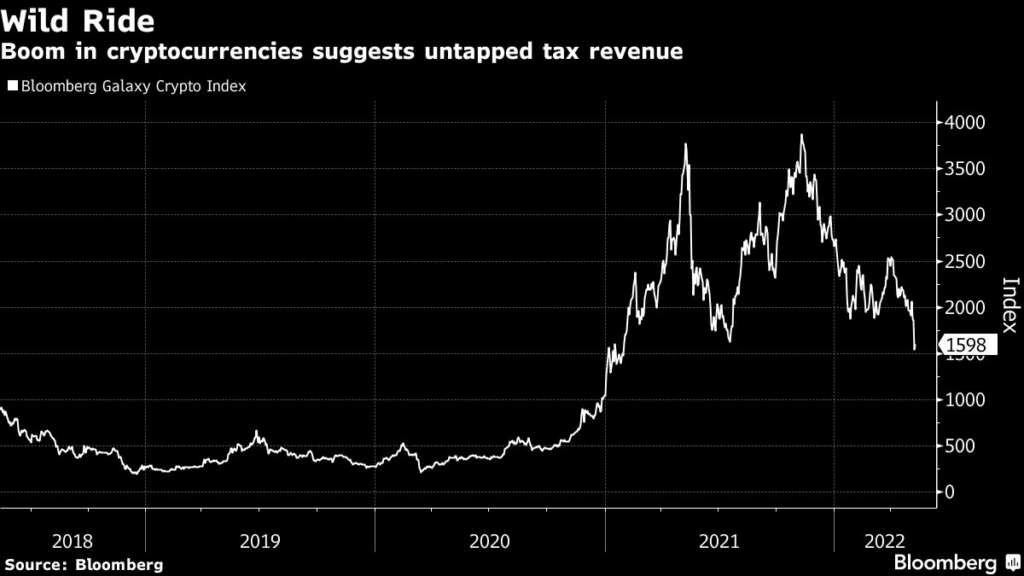
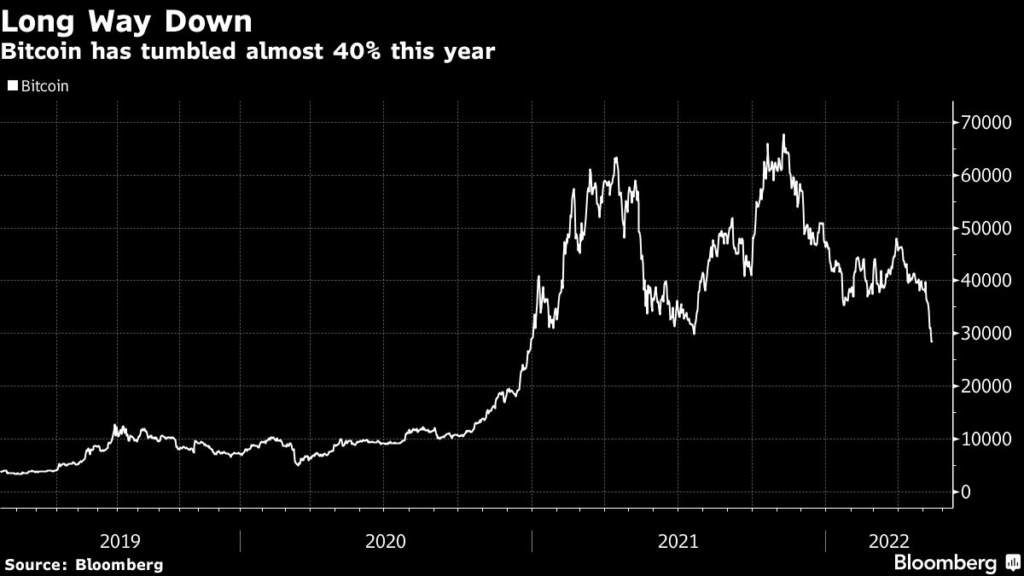
The entire crypto space has come under extreme pressure this week, with Bitcoin tumbling below $30,000 and the TerraUSD stablecoin crashing below its dollar peg. The moves have fueled questions about Tether, the biggest stablecoin, and the stability of digital assets. 

Traders in other markets were paying close attention to the reverberations from crypto, and what the downdraft means for risk sentiment. Asset prices also took a hit on Thursday from hotter-than-expected US inflation and a softer outlook from Walt Disney Co. 

“Today there is a new bear factor that has come into play, namely the collapse in the cryptocurrencies,” wrote Malcolm Freeman, a director at Kingdom Futures. 

“Investors are getting wiped out in many cases and the question is: Are those investors also involved in equities? Because if they run for the exit, then metals will take notice and most likely head in the same direction,” he said. 

Bitcoin erased losses in the US morning after dipping close to $25,000 on Thursday. The wider cryptocurrency selloff has wiped over $200 billion of wealth from the market in just 24 hours, according to estimates from price-tracking website CoinMarketCap. 

“You had Terra at the start of the week and now we have Tether getting sucked into it and that’s raising a few eyebrows,” said Chris Turner, head of FX strategy at ING Bank NV. “There’s a frisson of uncertainty running through FX markets, and that’s why the yen is doing so well.”

More stories like this are available on bloomberg.com

©2022 Bloomberg L.P.
Billionaire Heiress of HCL to Focus on Cloud Services for Growth

(Bloomberg) — Roshni Nadar Malhotra, the chairwoman of HCL Technologies Ltd., is seeking to grow sales at the software services company founded by her billionaire father in double digits and planning to expand business into newer geographies.

“My vision for HCL Technologies is that we should keep growing in double digits,” Malhotra, the only woman among those helming top software makers in India, said at a media briefing in Mumbai. “Five years from now, we will grow in more geographies and business lines.”

C Vijayakumar, chief executive officer and managing director for the company, said the firm plans to spend big on providing cloud computing services to clients, even while focusing on engineering, infrastructure and product verticals to achieve double-digit growth.

The company founded by tech tycoon Shiv Nadar clocked revenues of $2.99 billion in the quarter to March 31, a jump of 11% over the past year, exchange filings show. It counts plane maker Boeing Co. and health care major Merck & Co among its clients and expects revenues to grow by as much as 14% in the year to March 2023.

IT services for chip companies are also a focus area for HCL Tech, Malhotra said, as the world moves toward chip sovereignty with countries including the US, Japan and India wooing semiconductor makers to build factories.

Malhotra took over HCL, India’s third-largest IT services company, after her father stepped down in 2020. Nadar, considered a pioneer in India’s tech industry, started HCL in the 1970s as a hardware firm that made computers. The company gradually began offering software services to global clients and has since become a key player in India’s IT services industry.

(adds CEO’s comments in third paragraph.)

More stories like this are available on bloomberg.com

©2022 Bloomberg L.P.

Top Abu Dhabi Wealth Fund Closes Latin America Equities Team

(Bloomberg) — Sign up for our Middle East newsletter and follow us @middleeast for news on the region.

The Abu Dhabi Investment Authority has shut down a team investing in Latin American equities, as part of efforts to focus on higher-growth areas, according to people familiar with the matter.

ADIA, the world’s third-largest sovereign wealth fund, made the decision to terminate the internally-managed Latin America mandate at the end of March, the people said. The move affects seven portfolio managers, two of whom will stay on at ADIA in different roles, the people said. 

Abu Dhabi’s rainy-day fund still retains some of its Latin America public equities exposure but through externally-managed mandates that also include Mexico and the Andean region, the people said, asking not to be named because the information is confidential. 

ADIA declined to comment.

In recent years, ADIA has made a number of internal changes to the way it invests and operates — the fund closed its Japan equities desk in 2020 and last year overhauled its real estate division. 

The Latin America team, led by former HSBC Asset Management executive Eduardo Favrin, was part of ADIA’s equities department that was created in 2020 by merging the fund’s internal and external equities teams. Favrin was appointed head of the Latin America portfolio in 2012. 

The sovereign wealth fund is estimated to hold over $800 billion in assets, according to advisory firm Global SWF. Over the past two years, ADIA has hired dozens of people with backgrounds in science and mathematics to bolster its in-house expertise in areas such as artificial intelligence and machine learning.

ADIA was set up in 1976 to invest the surplus oil revenues of Abu Dhabi, one of the world’s largest crude exporters. It employs 1,680 people, according to its most recent annual review. 

More stories like this are available on bloomberg.com

©2022 Bloomberg L.P.

This London Startup Has a Cheaper Way to Suck Carbon From the Air

(Bloomberg) — A London startup that uses simple chemistry and off-the-shelf equipment to suck planet-warming carbon dioxide out of the air raised one of the largest funding rounds for a carbon-removal startup based in the UK.

Breakthrough Energy Ventures, a fund led by Microsoft Corp. co-founder Bill Gates, and mining company Anglo American Plc invested $5 million to help Mission Zero Technologies develop its technology. 

To limit the rise in global temperatures, the world has to cut greenhouse gas emissions to zero. But climate scientists are now sure that meeting that goal will almost certainly require removing CO₂ already accumulated in the atmosphere. Though the approach will only be desperately needed to remove billions of tons of carbon after mid-century, getting to that scale means technologies have to start growing rapidly this decade.

Mission Zero is entering a crowded market. A $100-million prize for carbon-removal ideas sponsored by Elon Musk, the world’s richest man, received more than 1,100 entries. Mission Zero was a part of one of the 15 teams that were shortlisted in the first phase of the prize and awarded a $1 million grant to further their technology. Last month, Swiss startup Climeworks AG, which builds machines to capture CO₂ from air, raised $650 million — the largest round globally for a carbon-removal startup so far.

Mission Zero’s proposition is that it can drastically cut the amount of energy needed to capture CO₂ and thus bring down the cost of capture to less than $100 a ton. People have “designed, financed, built and operated this equipment for many, many years” for a variety of manufacturing purposes, said Chief Executive Officer Nicholas Chadwick. “The expertise needed to scale this technology to capture CO₂ instead is already out there and ready to be repurposed.”

This is how CO₂ is usually removed from the air. Big fans draw in large amounts of air to bring it in contact with a chemical — different ones are used depending on the company — that has special affinity for CO₂ over other ingredients of air, like oxygen and nitrogen. Once the CO₂ has been trapped, it’s moved into another place where some form of energy, often heat, is applied to release it as a pure stream of gas. The chemical is then recycled to trap more CO₂.

Mission Zero’s innovation is that it cuts the amount of energy needed to bind and unbind CO₂ to the chemical. The reason some chemicals have an affinity with CO₂ is that the gas is slightly acidic. That’s what produces the slight tang in soda water. Chemicals that are basic — such as those found in cleaning liquids — tend to attract acidic compounds such as CO₂. 

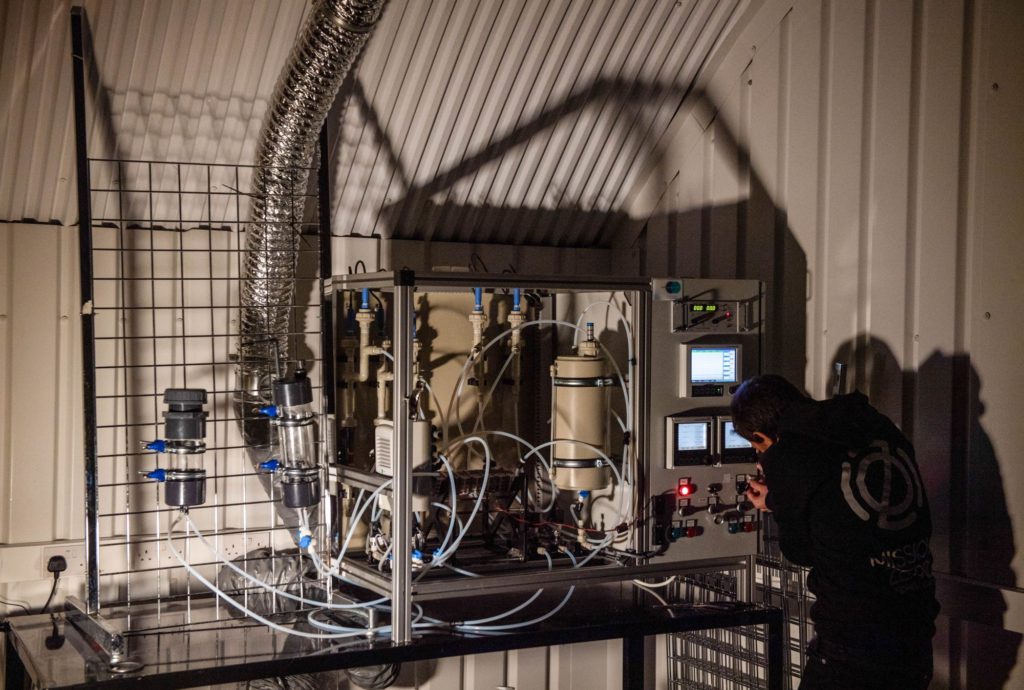
That scientific fact underpins Mission Zero’s technology. The company uses a process called electrodialysis, which uses electricity to pass chemicals through a membrane. The machine traps CO₂ using a basic chemical — called an amine — in water in one half of the cell, dissolving the gas into negatively charged particles. Only these particles — known as bicarbonate ions — are able to pass through the membrane to the other half of the cell. Leave that bicarbonate-rich water long enough and CO₂ bubbles out as a pure stream of gas, just like soda going flat. That escaping gas can then be compressed into a liquid and sunk deep into the Earth where it can be stored for centuries. 

Industries that use electrodialysis at scale today, such as the dairy and pharmaceutical sectors, already rely on equipment that could be repurposed to build machines that capture 1 million tons of CO₂ annually, said Gaël Gobaille-Shaw, Mission Zero’s chief technology officer.

Because electrodialysis doesn’t require heat, which can be more than 100°C in the case of other carbon capture technologies, the total amount of energy Mission Zero uses is much lower. The company claims its capture and release process will require as little as one-third the total energy needed by startups such as Climeworks, which runs the world’s largest direct air capture plant in Iceland.

But it’s early days. Mission Zero has been able to show its approach works by capturing tens of grams of CO₂ daily, whereas Climeworks can remove 4,000 tons a year. Mission Zero says it soon will be able to capture tens of kilograms of CO₂. The new funds, along with a further $5 million in grants that it has acquired over the past two years, will be spent buying equipment that will allow it to capture 120 tons of CO₂ per year.

More stories like this are available on bloomberg.com

©2022 Bloomberg L.P.
Close Bitnami banner
Bitnami

