Bloomberg

OneCoin Cryptoqueen Named Among Europe’s Most Wanted Fugitives

(Bloomberg) —

The founder of the OneCoin cryptocurrency was placed on the European law enforcement agency’s most wanted list for her role in the multibillion dollar fraud.

Ruja Ignatova, known as the so-called cryptoqueen, “is suspected of having prompted investors worldwide to invest in this actually worthless ‘currency’,” Europol said on its website. The agency is offering a 5,000 euro ($5,217) reward for information that will lead to the arrest of 41-year-old Ignatova.

OneCoin claimed to have more than 3 million members worldwide. Generating 3.4 billion euros in revenue from the fourth quarter of 2014 to the third quarter of 2016, it operated as a multilevel market network that paid commission to members worldwide for recruiting others, prosecutors told a US court in 2019.

The subject of a successful BBC podcast ‘The Missing Cryptoqueen’, Ignatova created OneCoin in 2014 in Sofia, Bulgaria, and headed the organization until she vanished from the public eye in October 2017, according to prosecutors. Her brother, Konstantin Ignatov assumed the top leadership position in the middle of 2018, they said. He pleaded guilty to fraud and money laundering.

More stories like this are available on bloomberg.com

©2022 Bloomberg L.P.

Fortum Plans ‘Controlled Exit’ From Russia Through Sales

(Bloomberg) — Finland’s Fortum Oyj plans to leave Russia by selling assets as policy makers pushed for the state-owned utility to exit because of the war in Ukraine. 

“We have decided to pursue a controlled exit from the Russian market,” Chief Executive Officer Markus Rauramo said in a statement. “As the preferred path, this decision includes a potential divestment of Fortum’s Russian operations.”

The announcement comes just weeks after a 2.1 billion-euro ($2.2 billion) writedown on the value of the firm’s and its German subsidiary Uniper SE’s Russian operations. In early April, Finnish Prime Minister Sanna Marin signaled that a withdrawal from the country should come as soon as possible.

The company didn’t offer any further substantial details on a call with analysts. Fortum and Uniper will keep the assets in “good shape” so that they are ready for a potential sale, Rauramo said. The utility has also decided to stop using the Fortum brand in Russia. 

Other energy companies have also taken hits on their businesses in Russia. BP Plc earlier this month confirmed a $25.5 billion charge linked to its exit. TotalEnergies SE took a $4.1 billion writedown on a flagship gas project that looks likely to be hindered by European Union sanctions. Shell Plc said in its first-quarter results that its withdrawal will result in a $3.9 billion accounting charge.

Those examples show the difficulties facing companies trying to leave the country, with “few potential buyers and a costly exit option,” analysts at Credit Suisse wrote in a note. They didn’t rule out Fortum selling its Russian business given the Finnish government’s stance against ownership of such assets.

READ: Russia Exit Is Painful But Strategically Needed: BI React 

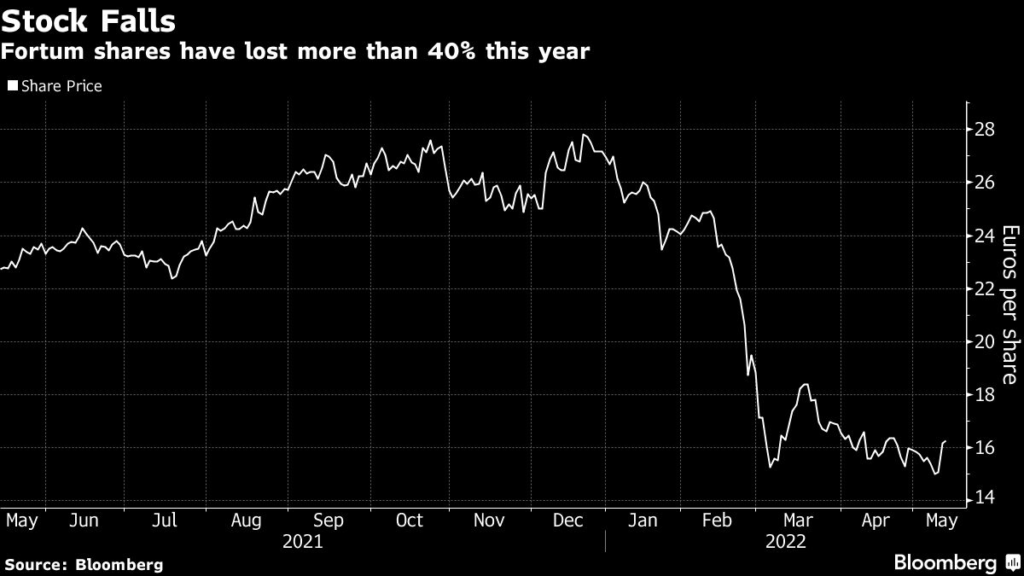
Fortum declined as much as 4.2% in Helsinki. The stock has lost about 40% this year as the company’s Russian assets discouraged investors. 

Fortum runs seven power plants in Russia, as well as the nation’s largest wind and solar portfolio. Uniper has another five units. The value of their net assets in Russia after impairments totals 3.3 billion euros.

Click here to read more about Fortum’s first-quarter results, announced on Thursday. 

(Updates with analyst comment in sixth paragraph)

More stories like this are available on bloomberg.com

©2022 Bloomberg L.P.

SoftBank’s Son Pays Price for Tech Bets With $20 Billion Loss

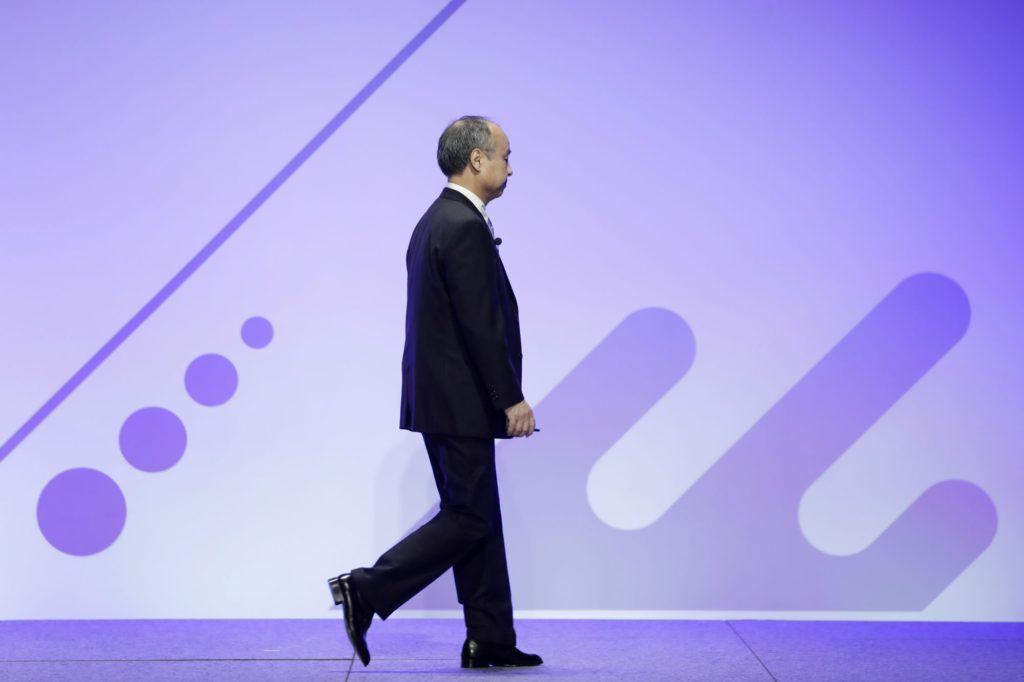
(Bloomberg) — Masayoshi Son is paying a steep price for his outsized wagers on money-losing technology companies. 

Son’s SoftBank Group Corp. reported a record annual loss at its Vision Fund unit as a selloff in tech shares pummeled the value of its portfolio companies, including public holdings like Coupang Inc., Uber Technologies Inc. and Didi Global Inc. The Vision Fund swung to a loss of 2.64 trillion yen ($20.5 billion) for the year ended Mar. 31, compared with a 4.03 trillion yen profit in the previous year.  

The world’s largest tech fund has been grappling with pandemic-driven writedowns and a market rout that hammered the valuations of public and private tech companies. SoftBank’s own stock fell 8% Thursday before earnings, bringing the year-to-date decline to 17%.

While Son has a reputation for making aggressive and unpredictable strategic moves, he spent most of a 90-minute press conference reassuring investors that he knows how to weather difficult times. He began with slide entitled “Concerns about SoftBank?” and then addressed questions about his debt load, the decline in his equity holdings and his cash position.

“In terms of personality, I do like to play offense,” said Son. But with the “pandemonium” of Covid-19 and war in Ukraine, he understands now is the time to play defense. “When it rains, you open an umbrella,” he said.

Son said SoftBank’s “safe driving” in recent months has solidified its financial position. He explained in a slide that the company has allocated 2.9 trillion yen of cash, or roughly twice the 1.3 trillion yen due for bond redemptions in fiscal 2022 and 2023.

The Vision Fund unit has also dramatically scaled back its investments, doling out just $2.5 billion in the January-to-March quarter. That’s down from $10.4 billion a quarter earlier and far below the peak of $33.3 billion in one quarter in fiscal 2018.

Son argued that SoftBank is less vulnerable to unpredictable hits now that it has been in the past. Its loan-to-value ratio fell to 20.4%, comfortably below to 25% target he thinks of as the maximum. 

SoftBank’s net asset value — another key metric for Son — dropped to 18.5 trillion yen, far below its peak. But SoftBank is less vulnerable to the Chinese government’s crackdown on its tech sector, with Alibaba Group Holding Ltd. — his most valuable holding — accounting for 22% of its NAV compared with 59% before.

Son is taking a personal hit of about $2.4 billion from his decision to get into trading public stocks. SoftBank set up a controversial side venture in 2020 called SB Northstar, which was aimed at using the company’s excess cash to make some money picking stocks. Son took a personal 33% interest in the unit, while the company held the rest of the equity.

With tech stocks crashing in the last quarter, Northstar got hammered. SoftBank said it would recognize a loss of 670 billion yen for the last fiscal year, while Son is on the hook for 315 billion yen.

SoftBank’s portfolio is full of money-losing tech companies that traded at sky-high valuations during the years of easy money. Blockbuster listings by firms like South Korean e-commerce giant Coupang, China ride-hailing pioneer Didi and Chinese online property platform KE Holdings Inc. have gone from being the main driver of profit growth, to biggest drags. 

Coupang shares dropped 40% in the first quarter, Didi fell 50% and KE Holdings slid 39%. Scandals and missteps from WeWork Inc., Wirecard AG and Greensill Capital have also dented Son’s reputation for picking startups.

“People thought Son could make good investment decisions,” said Mio Kato, an analyst at LightStream Research who publishes on SmartKarma. “Now there is less evidence that SoftBank management’s investment decisions are good. Wirecard and WeWork are among the examples. When the environment changes, they are no longer effective.” 

A year ago, SoftBank set a record for highest quarterly profit in Japanese history and the company made a full-year profit of 5 trillion yen. This year, with the Vision Fund losses, SoftBank Group had a annual net loss of 1.71 trillion yen. 

Son shifted his tone near the end of the press conference, however, and began to talk about the opportunities to play offense. He expressed bullishness about the prospects for Arm Ltd., the chip designer that is preparing for an initial public offering. He detailed how the business is growing and said the company may well become the most valuable asset in its portfolio.

Son pointed out that the path to an IPO has been cleared by the removal of the rogue CEO of Arm’s China business, a controversy that has lingered for two years after the board fired the executive and he refused to leave. Pressed about the precise timing for Arm’s IPO, Son pointed out that markets are now tumultuous and demurred to give specifics because his lawyers would object.

“We will thoroughly protect ourselves while playing offense,” Son said. 

More stories like this are available on bloomberg.com

©2022 Bloomberg L.P.

A Sleepy California City Gets the Elon Musk Makeover

(Bloomberg) — Tim Berry was working as an engineer at Space Exploration Technologies Corp. earlier this year when he started looking for a new job. He found one less than a mile from his old employer’s front door.

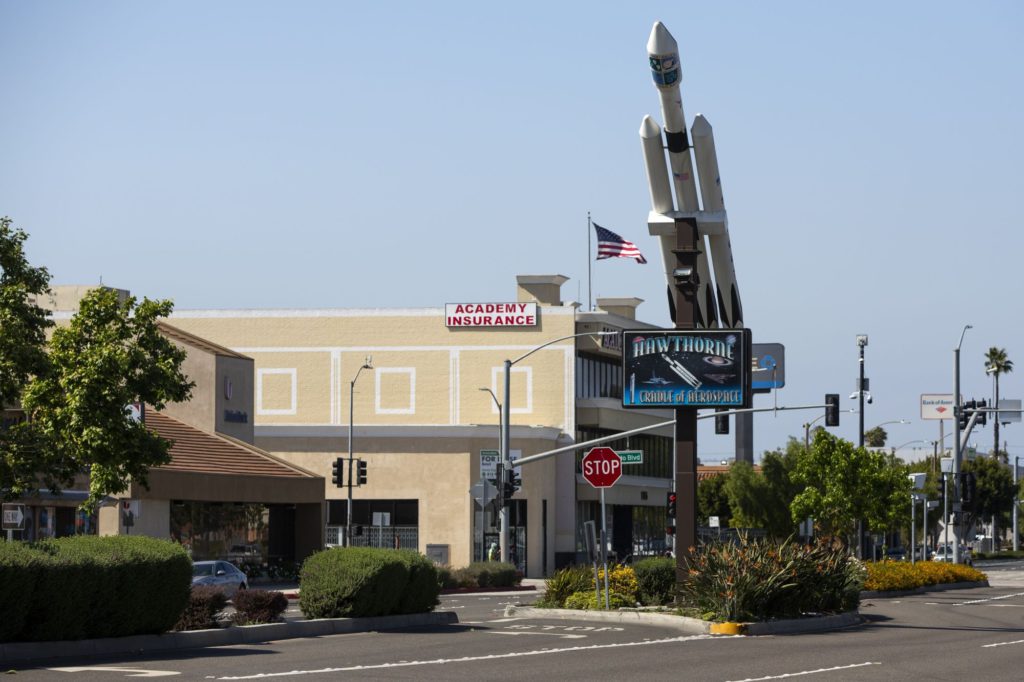
Berry is in Hawthorne, California, a largely working-class city of 88,000 that’s about a 10-minute drive from the Los Angeles airport. He’s one of a small army of aerospace professionals who have descended on Hawthorne in recent years. Drawn by Elon Musk’s SpaceX, the most valuable startup in the US, many highly skilled engineers have stayed put because of the city’s cheap rent and burgeoning aerospace startup scene.

Berry’s new employer is Launcher, a company that helps get satellites into orbit at low cost. He says he wouldn’t have taken the job if it had involved traveling too much further. “I’m not a big fan of the East Coast or New York, sorry,” Berry says. Instead he kept his commute entirely intact. “I was super happy to actually be able to still work in Hawthorne.”

Local officials are pleased, if a bit surprised, by the city’s turn as a startup hub. “Hawthorne has a lot to offer,” says Councilman David Patterson. It’s close to the vibrant aerospace scene in Los Angeles, which houses many startups of its own, but it isn’t as cripplingly expensive. There was an effort a few years ago to create an accelerator in Hawthorne, Patterson says, but the idea never got beyond the discussion stage.

It turns out the city didn’t need one. For seven of the past 10 years, Musk’s companies, SpaceX and tunneling venture Boring Co., were the only startups in the city to attract venture capital. By 2020, startups in Hawthorne not owned by Musk brought in a respectable $105.2 million. And last year, those startups attracted $356.7 million, according to research firm PitchBook. The city is on pace to double that number this year.

Many cities have tried to create their own versions of Silicon Valley, some more successfully than others. Buzzy destinations like Austin, Texas—the recently adopted home of Musk—and Miami have attracted fleets of software developers during the pandemic’s remote work explosion. (San Francisco still lays claim to Twitter Inc., the Tesla Inc. billionaire’s latest plaything.) But Hawthorne is a different kind of boomtown. Startups in the city haven’t been buoyed by the ease of Zoom meetings so much as by the ready availability of actual physical space—that, and a surplus of the kinds of people who know how to use mills, lathes and 3D printers.

It’s a good time to be a hub for high-tech manufacturing. As stock markets stumble, less tangible inventions like cryptocurrencies have faced a reckoning. And many engineers and coders increasingly don’t want to only manipulate ones and zeros or sell targeted ads—they’re looking to create real objects. Just as the rise of software-based companies like Google and Facebook in the early 2000s led to a roughly two-decade era when software ventures became the dominant type of startup, the success of SpaceX and other hardware companies is helping change entrepreneurial ambitions. Venture capitalist Marc Andreessen summed up the industrial fervor with his 2020 cri de coeur, “It’s time to build.” In recent years, venture capitalist and engineering attention alike has gravitated toward physical inventions—especially airborne ones.

Of course, in Hawthorne, as with any success story, there’s an uncomfortable side, too. Familiar themes of gentrification and inequality gnaw at the edges, even as the city is poised for tremendous growth. 

Named for novelist Nathaniel Hawthorne, the city holds an early claim to fame as the childhood home of the Beach Boys. It was also the sometime residence of Jim Thorpe, the first Native American to win an Olympic gold medal, and also to Marilyn Monroe (then Norma Jeane Baker). The greater Los Angeles area has a storied history of aeronautics innovation, and Hawthorne’s first taste of aerospace stardom came in 1939, when aviation pioneer Jack Northrop founded his company there. Musk’s SpaceX, as a scrappy startup, moved into former Northrop Corp. buildings in 2008.

SpaceX quickly became an established member of the space-industrial complex, with facilities across the country and a critical role in the celestial ambitions of the US. In 2016, a few engineers left the company but stayed in neighboring El Segundo, California, founding Second Order Effects, a consulting firm to help other startups as well as bigger companies. The creation of Second Order Effects helped spark the startup scene in the region, says Shaun Arora of MiLA Capital Advisors LLC, who has been backing firms in the area for years.

Arora says he’s seen an uptick in the number of startups in Hawthorne in the past few years. It helps, he says, that companies run by Musk tend to burn employees out, even while inspiring them. “SpaceX teaches people that hard work and optimism can make the impossible possible,” Arora says. At the same time, “many alums I speak with say that while the company purpose was compelling, they felt professionally under-appreciated.”

The talent pool of rocket-savvy engineers seeded by SpaceX was a major draw for Max Haot, the founder of Launcher, who decided to locate his company in Hawthorne after considering other places like Austin, New Orleans and Pasadena, California. Haot has hired at least 14 former SpaceX employees for his Hawthorne-based team of about 55 people.

Another perk: Hawthorne is cheap. Launcher’s 24,000-square-foot facility was “so much more affordable” than space in slightly fancier nearby towns like El Segundo, Haot says. Plus, while those neighboring cities may house big warehouses, landlords there are busy refurbishing them for higher-rent uses, more suitable for software-based companies. Haot looked at some warehouses that were once wired for 1,000 or 2,000 amps of electrical power, and which, after renovation, were only able to handle a few hundred amps. That’s fine for most businesses but not for the orbit startup, where engineers are working on electricity-intensive projects like figuring out how to power rockets and running multiple 3D printers at once.

Joel Ifill, founder of drone delivery company Dash Systems, is also taking advantage of Hawthorne’s low rents. He’s paying well below $2 a square foot. Ifill’s business operates just north of SpaceX, out of a hangar at Hawthorne Municipal Airport.

“Hangar space is usually some of the cheapest square footage you’ll find in major cities,” he says. In its cavernous digs, Dash has room for its Cessna 208B Grand Caravan turboprop plane, desks, a small engineering shop and an area with a carpet, a coffee table and a sofa, perfect for watching the steady stream of small aircraft taking off and landing. (That includes occasional sightings of Musk’s jet.)

Ifill doesn’t currently employ any SpaceX alumni, but he found plenty of other big companies in the area to choose from. Those include Lockheed Martin Corp., Boeing Co. and Northrop Grumman Corp., all with offices in El Segundo. “We have people from Tesla, Virgin Galactic, WET Design,” he says, referring to a water-engineering company based in Sun Valley, 30 miles north. 

Some Hawthorne startups have little to do with rockets or satellites. Ring, the next-generation doorbell company now owned by Amazon.com Inc., is based in the city. So is Stellar Pizza, an automated pie company run by former SpaceX engineers.

Most, however, take a space tack. Another example is Venturi Astrolab Inc., based out of a former bus-bench factory just south of SpaceX. Venturi makes rovers that founder Jaret Matthews hopes will be selected for NASA’s future Artemis lunar missions.

“We’re building big robots,” Matthews says. “We need a lot of space to test them.” That includes indoors, as well as a covered area behind the building strewn with basalt to better simulate moon conditions. Besides himself, Matthews’s team includes several former SpaceX hands.

Downtown Hawthorne doesn’t yet look like a thriving business hub. Its main drag features car dealerships, rundown storefronts and a 24-hour laundromat. That’s where Luis Castaneda, a part-time handyman, was sitting on a recent afternoon. He has noticed more upscale workers in town, he says, and blames them for rising prices. The room he rents costs $700 a month, he says, compared to $400 for a similar room 10 years ago, when he first arrived in the city.

Alejandra Alarcon, 29, grew up in Hawthorne, in a house she, her mother, her brother and grandmother shared. Almost every house on the block had a similar demographic mix. Now, she says, newcomers’ households typically contain a couple with a dog and no children. She admits to mixed feelings about SpaceX, its offshoots and the ensuing prosperity for the city.

“SpaceX brings jobs to Hawthorne,” she says. “I’m not convinced SpaceX brings jobs to Hawthorne residents.” Alarcon commutes about seven miles north each day for her job at a university in the Westchester section of Los Angeles. She likes having a new brewpub or two in her Hawthorne neighborhood, but finds it disconcerting as well.

“When I walk into these spaces, I stop feeling like I’m in my hometown, because everyone looks so different to the people I grew up with,” she says. “Everyone I grew up with was working class.”

Alarcon was stunned to see a glitzy-looking, new apartment complex open last year. It’s on Crenshaw Boulevard, a seven-lane road two miles east of the town’s largely abandoned shopping mall.

Rents at the building, called the Millennium South Bay, run as much as $3,725 for a two-bedroom, an agent at the building’s office said—far higher than the $2,285 median in the city, according to Zillow. The new building’s website promises easy access to the beach and other local restaurants. But the most enticing amenity at the Millenium is, of course, the SpaceX headquarters—located just one block up the street.


More stories like this are available on bloomberg.com

©2022 Bloomberg L.P.

Mercedes Drivers Go Hands-Free on Jammed German Autobahns

(Bloomberg) —

Mercedes-Benz has been all about showing off what it can do with respect to electric vehicles and software lately.

The German carmaker announced last month that one of its EV prototypes drove more than 1,000 kilometers (621 miles) on a charge, breaking a range barrier that long seemed elusive for a four-seat sedan. After years of criticism for being late to go electric, the manufacturer stepped up its game last year with the launch of its battery-powered flagship, the EQS. Then in December, Mercedes became the first automaker to win approval to deploy a hands-free driving system in Germany, pulling ahead in the race to offer higher levels of automation in one of the world’s most competitive car markets.

The announcements are part of CEO Ola Kallenius’s attempt to seize some technology limelight from Tesla and transform the storied manufacturer into an EV leader.

I caught a glimpse of these efforts last week when Mercedes presented its hands-free driving offering in Berlin. Dubbed Drive Pilot, the system is capable of Level 3 automated driving, a notch higher than Tesla’s Autopilot. Drive Pilot will go on sale next week as an option for S-Class and EQS models at a cost of 5,000 euros ($5,270) and 7,430 euros, respectively.

“This is a big step for us and for automated driving in general,” said Florian Kunkel, a Mercedes development engineer who accompanied me on my test drive through the German capital. “It’s our moon landing.”

Tesla’s Autopilot and $12,000 “Full-Self Driving” features, which consumers are beta-testing in the US and Canada, require drivers to be fully attentive and keep their hands on the wheel and eyes on the road. Mercedes’s Drive Pilot takes over completely in certain scenarios, allowing the person behind the wheel to stop paying attention to the road and instead answer emails, read a book or watch a movie.

“You will get the ultimate gift back, which is time,” Kallenius said Monday during the Financial Times Future of the Car summit.

Before we took off in a black S-Class, Kunkel walked around the car to show me the cameras as well as the radar, lidar, ultrasound and moisture sensors that allow the machine to take over. Vehicles equipped with Drive Pilot have built-in redundancies to ensure components ranging from the sensors and battery to the steering motor keep working safely.

Still, the system has its limitations. It’s only approved for stretches of Germany’s Autobahn highway network at a speed of up to 60 kilometers (37 miles) per hour, meaning it’s largely limited to handling slow-moving traffic jams. Lane changes aren’t allowed and the software usually doesn’t work in tunnels. Drivers must remain awake and able to retake the wheel if the system alerts them to do so, and Mercedes doesn’t recommend holding devices like a tablet or laptop between your body and the airbags.

Soon after we reached Berlin’s busy city Autobahn, we ran into heavy traffic, so I pushed a button on the inside of the steering wheel to hand over driving to the software. I was surprised how smooth it handled braking and accelerating. After a minute of talking to Kunkel next to me, I stopped paying attention to the traffic — and it didn’t feel awkward at all. When we approached a stretch of highway with a lot of tunnels, the software pinged me to take over.

Mercedes is working on getting Drive Pilot approved elsewhere in Europe and the US. Company officials expect regulators to eventually allow the system to operate at faster speeds and on roads beyond just the Autobahn.

“We’ve only taken the first baby steps,” Kallenius said. “I think this will be one of the most exciting developments in the auto industry in this decade.”

Like getting this newsletter? Subscribe to Bloomberg.com for unlimited access to trusted, data-driven journalism and subscriber-only insights.

More stories like this are available on bloomberg.com

©2022 Bloomberg L.P.

Stablecoin Rescue Plan Gets Cold Shoulder From Big Investors

(Bloomberg) — Backers of TerraUSD (UST), the closely-watched algorithmic stablecoin that broke from its dollar peg, are struggling to win investor support for a rescue.

Talks stalled after big-name firms were approached by various individuals with connections to Terraform Labs in recent days, according to sources familiar with the matter who asked not be named because the discussions are private. 

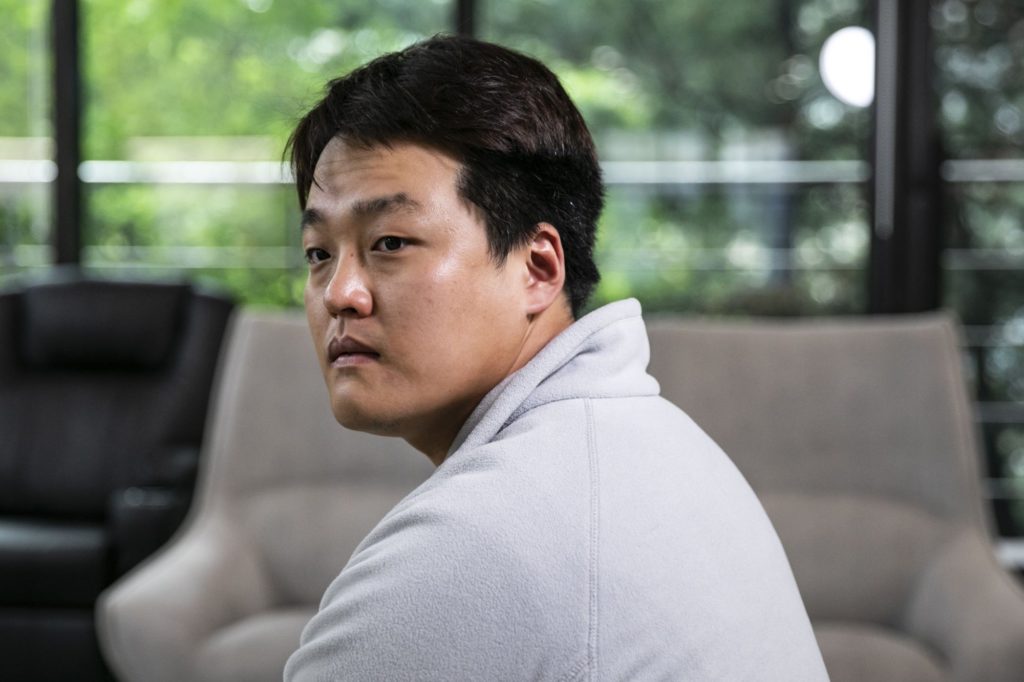
Do Kwon, CEO of Terraform Labs and UST’s chief evangelist, repeatedly alluded on Twitter to recovery efforts, saying on May 10 that he was “getting close” and encouraging his followers to “stay strong.” Kwon did not return a request for comment.  

Terraform Labs said Wednesday it was unable to comment. “The TFL team is heads down right now so we would be unable to fulfill commentary requests at the moment,” a spokesperson told Bloomberg by email. 

Read more: ‘Everything Broke’: Terra Goes From DeFi Darling to Death Spiral

Alameda Research, Celsius, Galaxy Digital Holdings Ltd., Jane Street, Jump Crypto, and Nexo were among those in these discussions, the people said.

Celsius tweeted that they were not involved, while Nexo confirmed to Bloomberg that they had been approached and had opted not to join the effort. Jane Street and Alameda declined to comment. 

Jump Crypto, whose president Kanav Kariya is a member of the Luna Foundation Guard, also declined to comment. Jump Crypto is an affiliate of Jump Trading LLC. Galaxy did not return a request for comment. 

Rescue Plans

The situation is fluid and could change based on market conditions, the people said. As of Thursday morning in London, UST was trading at around 58 cents. The Luna coin, which is part of the peg mechanism for UST, has tumbled 99% in the past 24 hours, complicating Kwon’s rescue efforts. 

Read more: What Are Stablecoins? Why Did TerraUSD Go So Wobbly?: QuickTake

On Thursday, Terraform Labs tweeted that it proposed to to burn its remaining 371 million UST coins as part of the emergency plan to defend the token. In total, the current rescue plan entails eliminating 1.39 billion tokens, or 11% of UST supply. Much of those tokens had been accumulated in recent days to absorb the selloff in UST, Terraform Labs said. 


Potential investors in one proposed deal from the Luna Foundation Guard were offered the opportunity to buy a related token, Luna, at a 50% discount to the spot price, Kumar Gaurav, the founder and chief executive of crypto liquidity provider Cashaa, told Bloomberg News earlier in an interview, adding his firm won’t participate. 

The backers of the stablecoin were trying to raise about $1.5 billion to shore up the token, Gaurav said. The Block reported the fundraising plans on Tuesday. 

The Luna Foundation Guard did not respond to repeated requests for comment. 

(Updates with latest Terraform Labs proposal in 10th paragraph.)

More stories like this are available on bloomberg.com

©2022 Bloomberg L.P.
More Than $200 Billion Wiped Off Cryptocurrency Market in a Day

(Bloomberg) — A massive sell-off in cryptocurrencies wiped over $200 billion of wealth from the market in just 24 hours, according to estimates from price-tracking website CoinMarketCap.

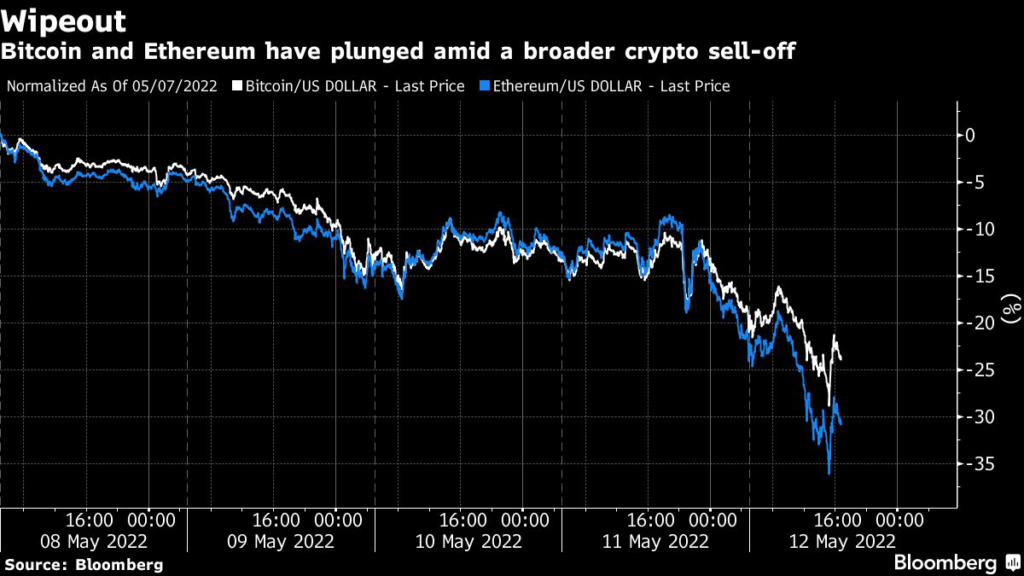
The broad plunge in the crypto complex, driven by the collapse of the TerraUSD stablecoin, hit major tokens hard. Bitcoin plunged by as much as 10% in the last day to its lowest level since Dec. 2020, while Ethereum dropped as much as 16%.

What Are Stablecoins? Why Did TerraUSD Go So Wobbly?: QuickTake

The carnage showed signs of spreading further Thursday as crypto-related stocks in Asia also cratered. Hong Kong-listed fintech firm BC Technology Group Ltd. closed down 6.7%. Japan’s Monex Group Inc. — which owns the TradeStation and Coincheck marketplaces — ended the day down 10%.

As central banks across the world move to aggressively tighten monetary policy to fight inflation, digital tokens have faced selling pressure amid a broader flight from risk assets. S&P 500 futures lost 0.8% Thursday, tracking losses in the benchmark MSCI Asia Pacific Index.

Investors in the crypto space are no stranger to wild swings in the market, however, and Bitcoin and Ethereum pared losses quickly to trade down 4.2% and 9%, respectively, as of 4:45 p.m. Hong Kong time. 

More stories like this are available on bloomberg.com

©2022 Bloomberg L.P.
China’s White Knight Tycoon Can’t Save His Own Firm From Default

(Bloomberg) — Sun Hongbin, dubbed the “white knight” in China for bailing out fellow billionaires and their empires, was unable to rescue his own from the property crisis that’s engulfing the world’s second-biggest economy.

Though he dipped into his own pocket to the tune of $450 million, tapped investors to buy shares and raised more than $2 billion in all, it wasn’t enough for Sun to avoid default at his Sunac China Holdings Ltd.

Sunac joins more than a dozen developers including China Evergrande Group that have defaulted on dollar bonds in the past few months, potentially inflicting more pain on global high-yield investors.

The struggles at Sunac — China’s No. 4 developer by sales — may herald further distress among property firms that were deemed too strong to fail just a few months ago. They also underscore how developers are straining under Beijing’s crackdown on borrowing and a housing slump that’s being made worse by strict Covid restrictions.

“Sunac’s default means that no private Chinese developer is now safe from default this year” without new financing, said Wei Chong, head of bond research at Fuhui Juli Wealth Management Corp., a hedge fund that owned Sunac’s onshore debt before selling earlier this year.

Sunac declined to comment.

For Chairman Sun, 58, the default is another setback in a roller-coaster career that’s included a separate failed property firm, a stint in prison over embezzlement charges for which he was later exonerated, and a meteoric rise to found one of the country’s biggest developers. He amassed a $12 billion fortune along the way. 

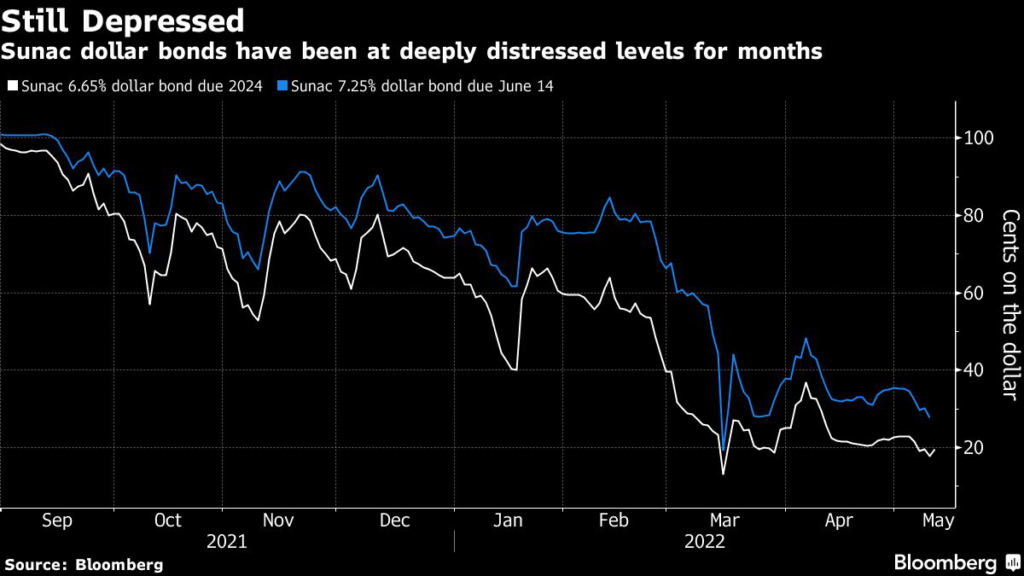
Just a few months ago, Sun’s company was projected to be one of the survivors of China’s moves to reduce risk in the financial sector by limiting developers’ ability to borrow in public markets. Sunac, with Harvard University-educated Sun as its biggest shareholder, was rated BB as recently as March last year at S&P Global Ratings, two notches below investment grade. The dollar bonds that slipped into default traded at 82 cents on the dollar in December.

Sunac’s sales blossomed to about 230 billion yuan ($34 billion) in 2020, a 10-fold jump from 2015 as it benefited from surging demand in its top-tier markets of Shanghai and Beijing. The firm ranked third by contracted sales last year, according to China Real Estate Information Corp., a position it maintained in the first two months of 2022 before slipping to fourth. That growth made Sunac a stock darling for a time, gaining more than 400% in 2017 alone.

That lofty perch made Sun popular among tycoons in need. 

When China’s Tesla Inc.-wannabe LeEco had cash-flow problems, Sun offered a lifeline of $2.5 billion to founder Jia Yueting’s operations. In 2017, Sun agreed to buy hotels and theme parks from Dalian Wanda Group Co. for more than $6 billion after China planned to cut off funding for billionaire Wang Jianlin. Sun also came close to buying Kaisa Group Holdings Ltd. when the troubled developer defaulted on offshore debt. He later dropped the deal.

Yet Sunac’s massive spending spree and expansion into sectors ranging from indoor ski hills to amusement parks has been raising eyebrows for years. The investments in businesses unrelated to property, which included a struggling internet company, prompted Fitch Ratings to cut the firm deeper into junk status in 2017, citing what it called its “acquisitive business approach.” 

“He’s quite gung-ho,” said Cheng Wee Tan, an analyst at Morningstar Inc. “He’s always been relying on a strategy of aggressive expansion funded by leverage.”

As the liquidity crunch deepened last year following Beijing’s crackdown, Sun took steps to bolster Sunac’s balance sheet, determined to avoid a repeat of a failed property firm known as Sunco that he ran more than 15 years ago.

Sun, a U.S. citizen, dipped into his own coffers to provide a $450 million interest-free loan to Sunac, which also raised $580 million in a January stock sale and unloaded a stake in its property-services unit.

Bonds Tumble

None of it was enough to avoid default for a company saddled with almost $11 billion in domestic and offshore bonds. Sunac is now the biggest developer to default on a public bond payment this year, as Sun joins fellow billionaire Hui Ka Yan at Evergrande in failing to keep up with massive debt payments. 

“The group’s contracted sales have continued to decline significantly, while access to new financing has become increasingly difficult,” Sunac said in a statement Thursday.

Sunac is trying to find state-backed strategic investors to improve the company’s credit status and restore financing capabilities, Hong Kong Economic Times reported, citing unidentified people.

Sun’s personal fortune meanwhile, has tumbled along with Sunac’s share price, which was off 61% this year before it was suspended from trading in March after the company failed to release earnings. 

His net worth has slipped to $1.3 billion, a decline of $2 billion in 2022 alone, according to the Bloomberg Billionaires Index.   

More stories like this are available on bloomberg.com

©2022 Bloomberg L.P.
Hong Kong Investigates High Virus Levels Found in Sewage

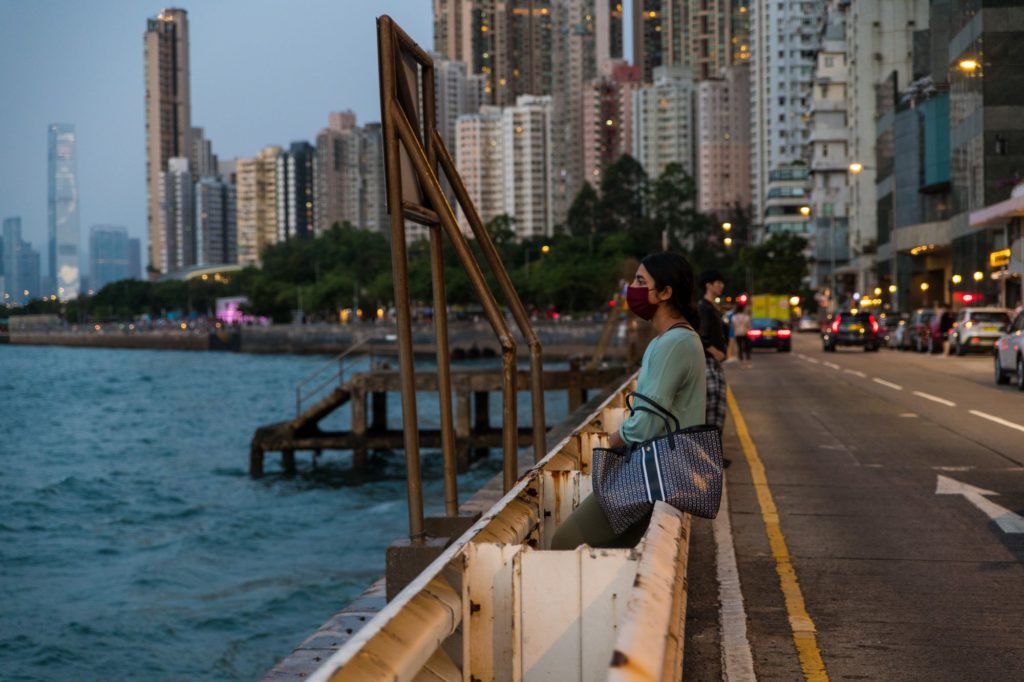
(Bloomberg) — Hong Kong officials are asking thousands of residents to test themselves for Covid-19 after an examination of the sewage from their buildings found high levels of the virus, suggesting there may be hidden chains of transmission in the city even as documented infections fall. 

City workers are distributing 195,000 rapid antigen test kits to residents, cleaning workers and property management staff in five areas, including the Sai Kung district known for beautiful beaches, the Kennedy Town neighborhood popular with expatriates, and Kowloon, a densely populated neighborhood across Victoria Harbor. Those testing positive should report their infections, the government said in a statement. 

News of the possible threat first emerged after The University of Hong Kong’s medical school posted a warning on social media, telling students and staff to avoid Kennedy Town because of a potential Covid cluster. 

Hong Kong is coming out of an omicron-driven wave that has shrouded the city since early 2022, with many residents on edge amid fears that the recent easing of restrictions could lead to a rebound in case counts. The city reported 294 new infections on Thursday, down from a peak of more than 70,000 in March. 

The notice, posted to Twitter and Facebook on Thursday morning, said the Li Ka Shing Faculty of Medicine became aware of “potentially a large Covid-19 cluster developing” in Kennedy Town, which neighbors the university. It went on to ask students and staff to refrain from visiting the vicinity for lunch or engaging in any mask-off activities for the rest of the week. The government statement flagged numerous housing estates, including one university dorm. 

Early Stage

The findings are at an initial stage and there’s no detail on how big the cluster is or could grow to, said people familiar with the matter, who declined to be identified as they aren’t authorized to speak publicly. 

Health workers will collect more samples to further gauge the extent of the risk, said Chuang Shuk-kwan, head of the Department of Health’s communicable disease branch, during a Thursday briefing. The sudden increase in virus levels is what has people concerned, she said. 

Sewage testing involves checking wastewater for signs of infection, often using material collected from multiple buildings to detect even low levels of the pathogen. The laboratory tests run on the sewage can help determine if the virus is present and at what levels. 

Hong Kong has taken action based on sewage results before, ordering the entire enclave of Discovery Bay to undergo mandatory testing in February after the virus was found in samples there. Anyone who was in the neighborhood of more than 20,000 people on Lantau island for more than two hours was required to get tested. 

Health authorities stopped publishing details of new cases in February after transmission became rampant in the city. As the outbreak abated, information on a restaurant cluster in the northern district of Yuen Long was released last week. It has since grown to about 20 infections. 

(Adds details on Discovery Bay testing in the seventh paragraph. An earlier version of this story corrected the spelling of the Li Ka Shing Faculty of Medicine in the fifth paragraph)

More stories like this are available on bloomberg.com

©2022 Bloomberg L.P.
IPhone Maker Hon Hai’s Profit Beats Despite China Lockdowns

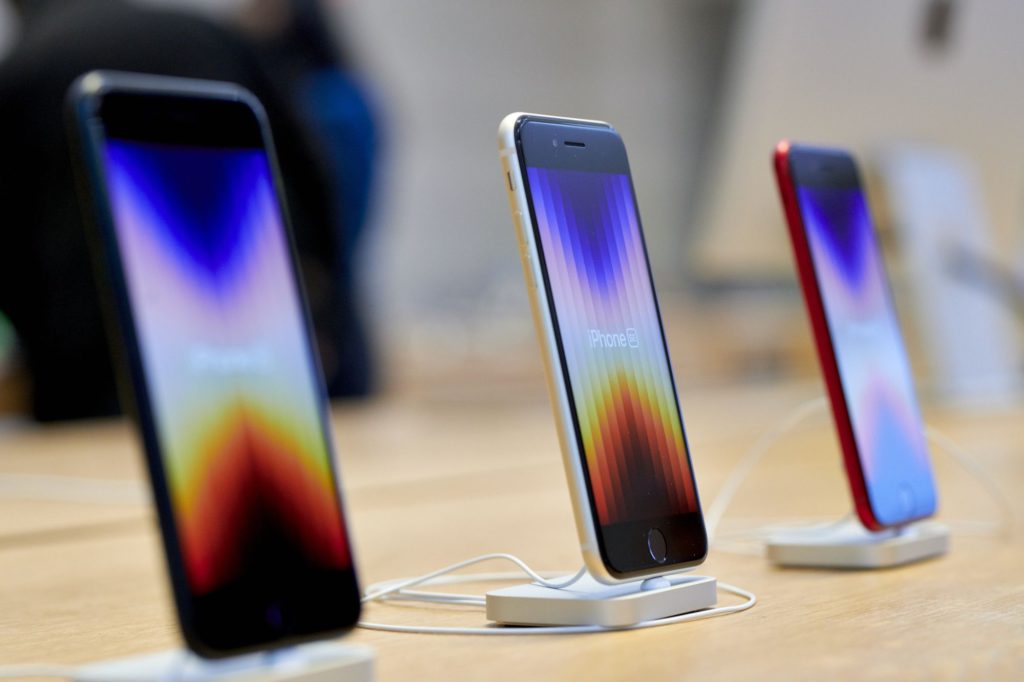
(Bloomberg) — Hon Hai Precision Industry Co., the maker of most of the world’s iPhones, posted earnings ahead of estimates after keeping production running despite component shortages and strict pandemic controls across China.

Apple Inc.’s biggest assembly partner reported net income of NT$29.5 billion ($989 million) for the quarter through March, outpacing the average projection for NT$28.5 billion. Revenue totaled NT$1.41 trillion, Hon Hai reported previously.

Hon Hai is the largest of a bevy of Apple-suppliers now struggling with prolonged component shortages and logistic bottlenecks resulting from China’s Covid-19 lockdowns. But the Taiwanese company, which makes everything from iPhones to Dell desktops and Sony PlayStations at its Chinese factories, has managed to keep its plants humming by employing closed-loop production sites. Hon Hai’s scale also grants it bargaining power with customers and suppliers. 

The world’s largest contract electronics manufacturer said Thursday it expects revenue to remain little changed this quarter, given the uncertainty of China’s Covid measures. It anticipates strong growth in cloud and networking products even as its consumer electronics business may decline slightly, the company said in a presentation posted online.

While Foxconn’s sites in China are running stably, including key tech hubs in Zhengzhou and Shenzhen, the situation on the ground can change swiftly and unpredictably. Last Thursday, employees at MacBook maker Quanta Computer’s Shanghai plant flooded past isolation barriers, underscoring the depth of frustrations among residents subject to often abrupt lockdowns.

What Bloomberg Intelligence Says:

While its iPhone business may moderate in 2022, Hon Hai’s data center hardware and component segments should stand out and support gross margin trajectory with the trend of cloud migration. The company’s target of 10% gross margin by 2025 looks feasible to us, as EV, cloud and components may contribute to nearly half of the company’s revenue by then, we believe, vs. 29-30% now.

-Steven Tseng, analyst

Click here for research.

With consumer electronics facing a potential slowdown, the company has been making steps to diversify its business and move toward a new ambition: electric vehicles.

Its ambitions hinge on Lordstown Motors Corp.’s electric pickup trucks. Lordstown Motors said on Thursday it closed the sale of its Ohio EV factory to Hon Hai for $230 million. With the deal, Hon Hai plans to expand its customer base and establish its first EV production outpost in North America.

Chairman Young Liu said on a conference call that expanding its EV business is Hon Hai’s top priority, with the company targeting 5% market share in 2025. Its goal is to ship 500,000 to 750,000 EVs that year, he said.

Production at the Ohio plant is set to start in the second half of this year, while mass output from Foxconn’s EV factory in Thailand is set to start in 2024.

(Updates with comment from chairman in eighth paragraph)

More stories like this are available on bloomberg.com

©2022 Bloomberg L.P.
Close Bitnami banner
Bitnami