Bloomberg

Citi Strategists See Even More Losses Ahead for Growth Stocks

(Bloomberg) — Growth stocks, including the battered tech sector, will likely remain under pressure as central banks tighten monetary policy, driving yields higher, according to Citigroup Inc. strategists.

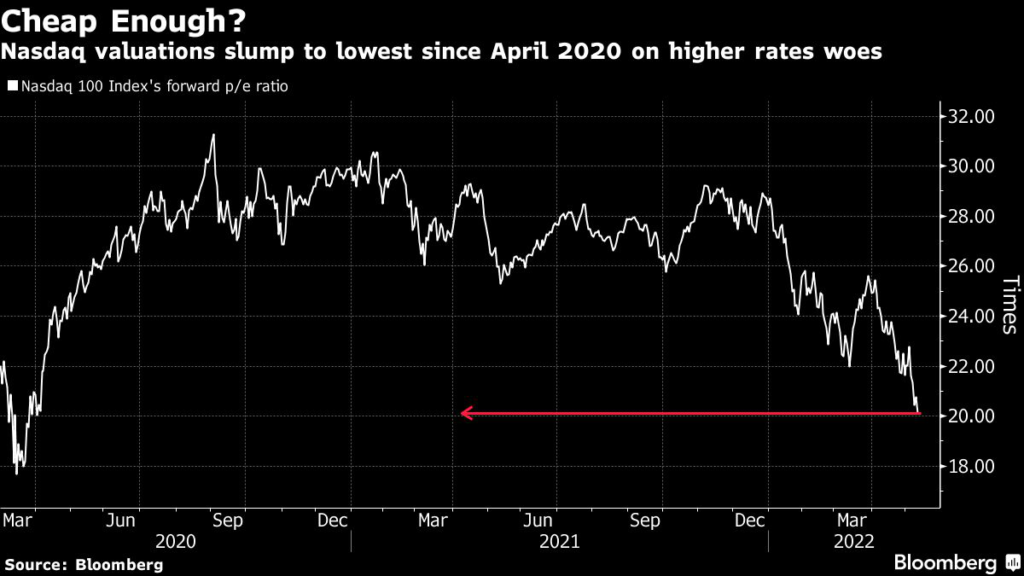
“Now that central banks are unwinding monetary support, growth stocks’ valuations have further to fall,” strategists including Robert Buckland wrote in a note. They are especially wary of growth stocks in the US, where the tech-heavy Nasdaq 100 has slumped to November 2020 lows and is down 27% this year.

Stocks that are valued on future earnings growth, and especially tech, have been leading the selloff in global equities over the past weeks. As the Federal Reserve embarks on interest rate hikes to tame surging inflation, expensive growth shares have suffered as higher rates mean a bigger discount for the present value of future profits. This marks a shift in investor outlook after tech stocks had been some of the market’s best performers for years. 

Citi strategists prefer cheaper, so-called value stocks, according to a portfolio they’ve modeled to protect against rising real yields. They also favor UK and emerging market stocks over the US and continental Europe.

“Any stabilization in nominal yields should eventually help to stabilize real yields and hence equity valuations,” they said.

The Nasdaq 100 index is now trading at about 20 times forward earnings, the lowest since April 2020 and at about the average level seen over the past decade, according to data compiled by Bloomberg. This compares with about 29 times seen at a record high in November. 

More stories like this are available on bloomberg.com

©2022 Bloomberg L.P.

Tether Reassures Markets After Biggest Stablecoin Slips

(Bloomberg) — Tether, which operates the biggest stablecoin, took to Twitter to reassure crypto markets after the token briefly slipped to the lowest since December 2020. 

Paolo Ardoino, Tether’s chief technology officer, said in a tweet that investors can continue to redeem the tokens at a one-to-one value to the dollar. Tether recovered to from an intraday low of 94.55 cents to trade just below 99 cents at 9:13 a.m in London, data compiled by Bloomberg show. 

Ardoino added that Tether had redeemed over $300 million in tokens in the last 24 hours “without a sweat drop.”

Tether’s brief dip underscores the unease in crypto markets after algorithmic stablecoin TerraUSD (UST) crashed from its dollar peg, forcing its backers to seek a rescue. While Tether claims to be backed dollar-for-dollar by actual assets, questions about the quality of the assets it holds have persisted.  

Hedge Fund Fir Tree Bets Big With Short of Stablecoin Tether (1)

“There may be some stablecoin contagion following UST, however Tether continues to honor 1:1 redeemable ratio on their platform,” Fadi Aboualfa, head of research at crypto custodian Copper, said in an email. “Anyone who was around 2017-2019 and saw massive drops in Tether, and it was really an opportunity to buy at a discount.”

EXPLAINER: What Are Stablecoins? Why Did TerraUSD Go So Wobbly?: QuickTake

(Updates with comment from analyst in final paragraph.)

More stories like this are available on bloomberg.com

©2022 Bloomberg L.P.

SoftBank’s Son Takes $2.4 Billion Hit in Northstar Trading Unit

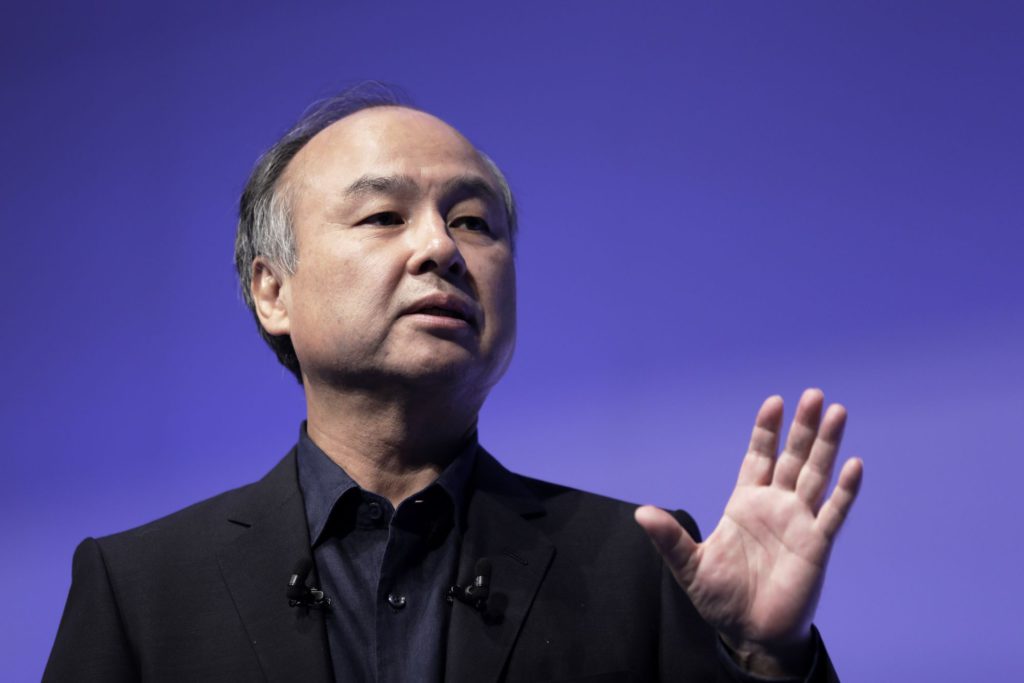
(Bloomberg) — Masayoshi Son’s decision to get into trading public stocks just backfired.

The founder of SoftBank Group Corp. set up a controversial side venture in 2020 called SB Northstar, which was aimed at using the company’s excess cash to make some money picking stocks. Son took a personal 33% interest in the unit, while the company held the rest of the equity.

With tech stocks crashing in the last quarter, Northstar has gotten hammered. SoftBank said it would recognize a loss of 670 billion yen for the last fiscal year, while Son is on the hook for 315 billion yen ($2.44 billion).

“SB Northstar has incurred significant losses,” the company said in a statement, as it reported earnings for the fourth fiscal quarter. The unit now “is scaling down its business to reallocate funds to investments under SoftBank Vision Fund 2, which is currently the primary focus of SBG.”

SoftBank reported a record annual loss at its Vision Fund unit as a global selloff in tech shares pummeled the value of public holdings like Coupang Inc. and Didi Global Inc. The Vision Fund unit swung to a loss of 2.64 trillion yen for the year ended March 31, down from a record 4.03 trillion yen profit in the previous year. 

The Vision Fund’s portfolio dragged the Japanese company’s overall annual net loss to 1.7 trillion yen, from a 5 trillion yen profit a year ago. 

More stories like this are available on bloomberg.com

©2022 Bloomberg L.P.

Dollar, Yen See Haven Buying as Global Risk Sentiment Sours

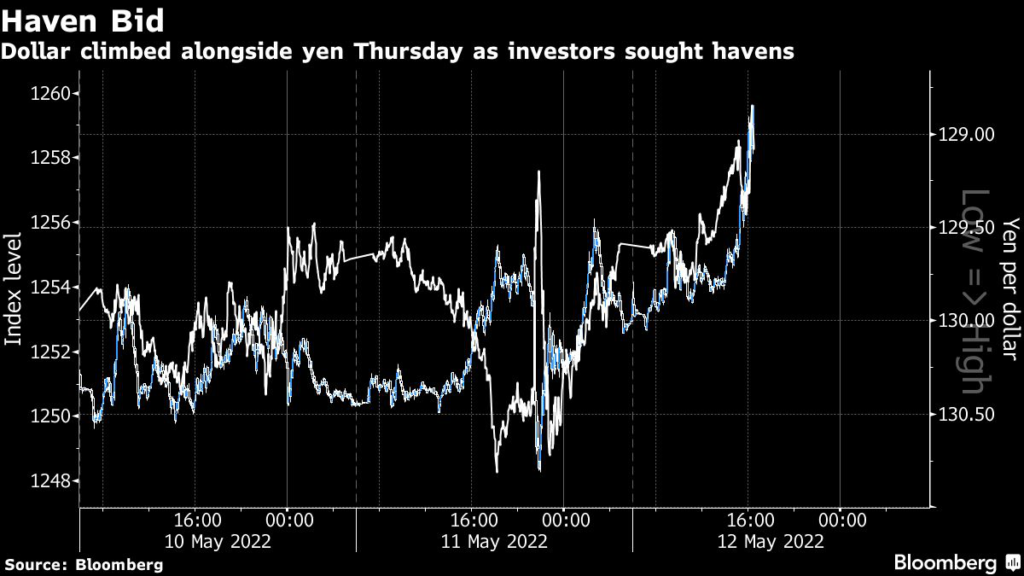
(Bloomberg) — The dollar and the yen marched higher Thursday as traders fled to havens amid growing concerns over more aggressive Federal Reserve policy and slowing economic growth in China.

The yen rose by as much as 1.1% against the greenback, while a gauge of the US dollar against a basket of peers climbed for a sixth day — its longest winning streak in two weeks. Treasuries also gained as risk sentiment soured, while stocks slumped in Asia and cryptocurrencies came under pressure.

The greenback’s strength could last another month given the heightened uncertainty over monetary policy, according to John Bromhead, a currency strategist at Australia & New Zealand Banking Group.

“At the moment it’s really benefiting from the volatility, its defensive characteristics are really shining through,” he said. “Once the market gets a feel for the fact that the Fed hiking cycle is set in stone, which it still isn’t, that’s when you can start thinking about some dollar shorts.”

Soured Sentiment

Investors sought havens after Wednesday’s US inflation print sparked fears of more aggressive hikes from the Fed that could lead to a slowdown in growth. Meanwhile another Chinese property developer defaulted on a dollar bond, becoming one of the biggest to renege on its obligations amid a record-breaking wave of missed payments.

In Hong Kong, the Monetary Authority defended its dollar peg after it hit the weak end of its trading band for the first time in three years.

China’s onshore yuan extended its decline to the lowest since September 2020 as comments by a central bank official comment on guiding interest rates on loans lower also weighed on the currency. The Australian and New Zealand dollars fell to levels they haven’t seen since mid-2020, while the South Korean won tumbled to its lowest since July 2009. 

“Most Asian currencies are also closely linked to China’s economy and rely heavily on energy imports, making them more vulnerable to potential Chinese recession and rising prices,” said Ha Keon-hyeong, an economist at Shinhan Investment Corp. In the background, “the rapid pace of Fed tightening continues to provoke concerns over global growth.”

More stories like this are available on bloomberg.com

©2022 Bloomberg L.P.

Rare Russia Criticism Within China Shows Simmering Policy Debate

(Bloomberg) — Russian setbacks in Ukraine have begun to prompt more explicit warnings in China about Moscow’s value as a diplomatic partner, in a sign of growing unease over President Xi Jinping’s strategic embrace of Vladimir Putin. 

Russia was headed for defeat and being “significantly weakened” by the conflict, a former Chinese ambassador to Ukraine told a recent Chinese Academy of Social Sciences-backed seminar in remarks widely circulated online. The comments, which Bloomberg News was unable to verify, were attributed to retired diplomat Gao Yusheng, who served as China’s top envoy in Kyiv from late 2005 to early 2007.

Gao described the war as the “most important” international event since the Cold War ended, according to an article published by Hong Kong-based Phoenix Television before being taken down. He had previously been posted in Moscow at the time of the Soviet Union’s fall in 1991. 

“The so-called revival or revitalization of Russia under the leadership of Putin is a false proposition that does not exist at all,” Gao said. “The failure of the Russian blitzkrieg, the failure to achieve a quick outcome, indicates that Russia is beginning to fail.”

Chinese Foreign Ministry spokesman Zhao Lijian told a regular news briefing Wednesday that he was “not aware” of Gao’s speech, a response that was left out of the official transcript. Some prominent nationalist commentators questioned whether Gao’s remarks had been faked. 

While China has said it doesn’t support the war, it has repeatedly defended Putin’s rationale for invading and opposed U.S.-led efforts to force Russia’s withdrawal. Chinese diplomats have reaffirmed plans to expand strategic ties with Moscow, a policy course set when Xi declared a “no limits” friendship with Putin in February, just weeks before the invasion. 

Beijing’s embrace of Moscow is rooted in part in concern that the US will use its global alliance network and financial influence to contain China as its now doing to Russia. China can’t afford to be similarly isolated, since it depends on the Europe Union and the US for more than one-quarter of its total trade. 

The Biden administration has warned China against any effort to support Russia’s war effort, raising the threat of secondary sanctions. At the same time, China’s refusal to condemn the invasion of an aspiring EU member has prompted European leaders to rethink their relationship with Beijing. 

The speech by Gao represents one of the most the prominent critiques of China’s Ukraine policy since the invasion, with news that reflects badly on Russia, including allegations of war crime and large troop and equipment losses, glossed over in heavily censored news coverage. Instead, state media is awash with reports and commentaries blaming Washington for stoking tensions. 

Besides Gao’s comments, one of the country’s most prominent international relations scholars said this week that the war meant “nothing good” for China because it accelerated a shift from globalization. 

“The war makes it almost impossible for Russia to have any global influence,” Yan Xuetong, dean of Tsinghua University’s Institute of International Relations, said in an interview Tuesday with Phoenix TV. The conflict brings “only losses and damages to China, but no benefits whatsoever,” Yan said. 

Yan had previously published a commentary in Foreign Affairs in which he argued that Russia’s war had left China in a “strategic predicament” since its balancing strategy had brought economic costs.

Gao, the former ambassador to Ukraine, went further to say that Russia was “duplicitous” and had reneged on promises. 

“It has never truly recognized the independence, sovereignty and territorial integrity of other former Soviet countries, and frequently violates their territories and sovereignty,” he said. “This is the greatest threat to peace, security and stability in the Eurasian region.”

More stories like this are available on bloomberg.com

©2022 Bloomberg L.P.

Hong Kong Investigating Virus in Kennedy Town Sewage

(Bloomberg) — Hong Kong officials are investigating the Kennedy Town neighborhood after sewage testing showed a potentially large Covid cluster forming among residents there, people familiar with the matter said. 

The findings are at an initial stage and there’s no detail on how big the cluster is or could grow to, said the people, who declined to be identified as they aren’t authorized to speak publicly. Levels of the virus detected in the sewage is high, said one of the people, adding that further details are not yet available. 

Residents became aware of a possible threat in the area after social media postings by The University of Hong Kong’s medical school that warned students and staff to avoid the neighborhood. Besides being near the city’s best-known tertiary institution, Kennedy Town is a popular expatriate residential area dense with restaurants and bars.

Hong Kong is coming out of an omicron-driven wave that has shrouded the city since early 2022, with many residents on edge as the recent easing of restrictions could lead to a rebound in case counts. The city has been reporting about 200 to 300 daily infections, down from a peak of more than 70,000 cases in March. 

The notice, posted to Twitter and Facebook on Thursday morning, said the Li Ka Shing Faculty of Medicine became aware of “potentially a large Covid-19 cluster developing” in Kennedy Town, which neighbors the university. It went on to ask students and staff to refrain from visiting the vicinity for lunch or engaging in any mask-off activities for the rest of the week.

Sewage testing involves checking wastewater for signs of infection, often using material collected from multiple buildings to detect even low levels of the pathogen. The laboratory tests run on the sewage can help determine if the virus is present and at what levels. 

The medical faculty declined to provide more details and said to contact the health authority for more information. City health officials haven’t issued any information on a potential new outbreak in the area. The Center for Health Protection is looking into the statement, a spokesperson said.

Health authorities stopped publishing details of new cases in February after transmission became rampant in the city. As the outbreak abated, information on a restaurant cluster in the northern district of Yuen Long was released last week. It has since grown to about 20 infections. 

(Corrects the spelling of the Li Ka Shing Faculty of Medicine in the fifth paragraph)

More stories like this are available on bloomberg.com

©2022 Bloomberg L.P.
Terra Crunch Shakes Foundations of Crypto Stablecoin Complex

(Bloomberg) — Stablecoins besides TerraUSD are failing to live up to their billing as the collapse of the algorithmic token has investors pondering the implications of the tumult for the broader market.

Most rival algorithmic stablecoins, which use a complex combination of computer code and trader incentives to maintain their pegs of one-to-one to the dollar, are also below that threshold — though not at the 80% extreme seen on TerraUSD on Wednesday. MakerDAO’s Dai slipped 0.4% before recovering to its peg and Fei slipped 0.5%. Neutrino USD fell 20% over the same period of time, according to data from CoinMarketCap.

Tether, the biggest stablecoin which claims to be backed by actual assets including dollars, was trading slightly off its dollar peg at around 97 cents at 8 a.m. in London, data compiled by Bloomberg show. USDC, the second largest, was basically holding its peg. 

“Algorithmic stablecoins are at an experimental stage currently, nothing more,” said Dan Liebau, chief investment officer for Modular Asset Management’s blockchain strategy. Those backed by an increasing/decreasing amount in the stablecoin’s own protocol token comprise a “particularly risky category,” he added.

TerraUSD, or UST, and its related token Luna, had a long way to fall. They both recently climbed into the top 10 tokens by market value after Terra founder Do Kwon established the Luna Foundation Guard, which bought billions of dollars of Bitcoin to back it up. Investors had rushed to take advantage of yields that might reach almost 20% on Anchor Protocol, which is powered by the Terra blockchain.

On Wednesday, Kwon announced measures aimed at bringing TerraUSD back to the $1 peg, which includes minting Luna at an increased pace. The total circulating supply of Luna has surged to 1.46 billion tokens from 377 million yesterday, data from researcher Messari show.

“The effects of the UST collapse will bring a bit more caution while evaluating for other algorithmic stablecoins for investment,” said Paul Veradittakit, a partner at Pantera Capital in Menlo Park, California. Also, apps built on Terra/Luna “will likely want to diversify platforms to mitigate risk and apps that are tapping into Anchor for yields will have to tap into other cryptocurrencies and liquidity protocols.”

TerraUSD isn’t the first algorithmic stablecoin whose peg has blown up. Neutrino, which sought to keep at equilibrium by issuing and burning tokens, lost its peg last month. It happened to Iron Finance last June — an incident that caused Dallas Mavericks owner and crypto fan Mark Cuban to call for regulation defining what a stablecoin is, and what collateralization is acceptable.

“We do not believe that the UST situation means anything for the centralized stablecoin market,” a statement from Tether said. “They are entirely different types of assets.”

EXPLAINER: What Are Stablecoins? Why Did TerraUSD Go So Wobbly?: QuickTake

(Updates with Tether price in third paragraph.)

More stories like this are available on bloomberg.com

©2022 Bloomberg L.P.
BT Unveils £633 Million Sport Deal With Warner Bros Discovery

(Bloomberg) — BT Group Plc set out a route to sell pay-TV unit BT Sport to American media giant Warner Bros Discovery Inc., cementing a reversal after its high-profile entry into football rights a decade ago.

Alongside in-line full-year results Thursday, London-based BT said it and Warner Bros. Discovery will create a new 50-50 sport TV joint venture, combining Premier League football rights with Eurosport into a new bundle that will have a single brand in the future. 

BT will transfer its pay-TV operating businesses to the US firm and receive £93 million ($113 million) cash up front as well as £540 million in the future, subject to certain earn-out conditions which it didn’t specify. 

Warner Bros will then get a call option to buy out BT’s interest in the business. The parties expect the deal to close by the end of 2022. Lazard advised BT on the deal.

BT introduced its sports broadcasting service in 2013 and has spent billions to win broadcasting rights to the European Champions League and English Premier League football matches. 

Shares in BT rose 0.8% to 177.8 pence in early London trading.

Stable Results

Chief Executive Officer Philip Jansen also deepened a years-long cost-cutting drive to take out another £500 million in costs by the end of 2025. He’s trying to simplify the group while tackling cost inflation and supply chain issues, but BT’s biggest union is threatening a strike after worker representatives rejected a pay offer last month. 

French billionaire Patrick Drahi is known to be keen on cost-cutting and is circling the former British phone monopoly after building an 18% stake last year. A standstill on him launching a takeover expires next month, and he moved more money into his BT vehicle in March.

BT’s new chairman Adam Crozier, who joined in December, is also overhauling the board. Chanel CEO Leena Nair will leave after less than three years and the phone company will seek new directors, BT said. 

BT reiterated forward-looking guidance of growing adjusted revenue and growing adjusted earnings to at least £7.9 billion before interest, tax, depreciation and amortization next year. 

It largely hit sales and profit guidance for 2021, with fourth-quarter adjusted earnings before interest, tax, depreciation and amortization of £1.87 billion versus an estimated £1.88 billion and revenue of £5.17 billion versus an estimated £5.19 billion.

(Updates with additional context throughout)

More stories like this are available on bloomberg.com

©2022 Bloomberg L.P.
SoftBank Vision Fund Posts a Record Loss as Son’s Bets Fail

(Bloomberg) — SoftBank Group Corp. logged a record annual loss at its Vision Fund unit as a global selloff in tech shares pummeled the value of public holdings like Coupang Inc. and Didi Global Inc.

The Vision Fund unit swung to a loss of 2.64 trillion yen ($20.5 billion) for the year ended Mar. 31, down from a record 4.03 trillion yen profit in the previous year. It was the biggest annual loss since founder Masayoshi Son repositioned his firm into an investment holding company with the Vision Fund’s launch in 2017. 

The world’s largest tech fund has been grappling with pandemic-driven writedowns and a global stock market rout that sent once-hot technology darlings tumbling. The Vision Fund’s portfolio dragged the Japanese company’s annual net loss to 1.71 trillion yen, from a 5 trillion yen profit a year ago. 

SoftBank Investors Await More Buyback Fuel Amid Results: Preview

“All the investments in the portfolio continue to go down,” Kirk Boodry, an analyst at Redex Research, said ahead of the earnings release. “There’s a lot more concern and worry about where stocks can eventually end up.”

SoftBank shares are down 17% year-to-date, including an 8% drop on Thursday. The tech-heavy Nasdaq 100 Index has slumped 27% and tumbled into a bear market in March over concerns of runaway inflation, rising interest rates and a possible slowdown in U.S. economic growth. 

SoftBank’s controversial SB Northstar unit also revealed that it lost 669.5 billion yen while investing in publicly traded stocks. The unit is a joint venture between SoftBank and Son, who personally holds a 33% stake.

The downturn in global equities is dealing a blow to SoftBank’s basket of stock picks, which is full of tech names that have traded in high multiples backed by easy money. Blockbuster listings by firms like South Korean e-commerce giant Coupang, China ride-hailing pioneer Didi and Chinese online property platform KE Holdings Inc. have gone from being the main driver of profit growth, to biggest drags. Coupang shares dropped 40% in the first quarter, Didi fell 50% and KE Holdings slid 39%.

Even Alibaba Group Holding Ltd., the Chinese e-commerce giant that became one of the most successful venture deals of all time, has lost luster. Scandals and missteps from WeWork Inc., Wirecard AG and Greensill Capital have led to international scrutiny.

“People thought Son could make good investment decisions,” said Mio Kato, an analyst at LightStream Research who publishes on SmartKarma. “Now there is less evidence that SoftBank management’s investment decisions are good. Wirecard and WeWork are among the examples. When the environment changes, they are no longer effective.” 

(Updates with details of SB Northstar loss from sixth paragraph)

More stories like this are available on bloomberg.com

©2022 Bloomberg L.P.
U.K. Economy Unexpectedly Shrinks in March: The London Rush

(Bloomberg) — Here’s the key business news from London this morning.

GDP : The U.K.’s economy unexpectedly contracted in March as the cost of living squeeze saw consumers cut back on spending.

  • Gross domestic product fell 0.1% from February, when growth was flat, according to data released by the Office for National Statistics

BT Group Plc: The telecommunications company has agreed to transfer the operating businesses of BT Sport to Warner Bros. Discovery Inc, as part of a new 50:50 joint venture for sport broadcasting in the UK & Ireland.

  • The British company will receive £93 million as part of the deal with the opportunity to earn about £540 million more if conditions are met 

Hargreaves Lansdown Plc: The retail investment company reported lower net new business inflows than expected in the third quarter, pointing to  “unprecedented” macroeconomic and geopolitical events impacting investor confidence

  • The company reiterated their guidance for this year, and raised their revenue margin on cash expectations to 30-35bps as the impact of base rate rises start to come through

Outside The City

Boris Johnson will spend the next few days considering whether the UK will introduce legislation to override its post-Brexit settlement with the European Union. He will hold further discussions with Foreign Secretary Liz Truss after she meets EU negotiator Maros Sefcovic in Brussels Thursday.

The Bank of England will have to raise interest rates further to control surging prices, and there’s a risk that the UK’s worst inflation crisis in decades will take longer to ease fully, Deputy Governor Dave Ramsden told Bloomberg.

Read the latest coverage of the war in Ukraine here.

In Case You Missed It

Fierce competition for workers pushed UK salaries higher in April, according to a survey that will put pressure on the Bank of England to continue tightening monetary policy in its battle to tame inflation.

And with the shift to hybrid working set to continue, Tesco Plc teamed up with flexible office company IWG Plc to convert excess space in a south London supermarket into a work hub. 

Looking Ahead

As the earnings week draws to a close, software publishing company Sage Group Plc and power generation firm ContourGlobal Plc are set to report results tomorrow. 

More stories like this are available on bloomberg.com

©2022 Bloomberg L.P.

Close Bitnami banner
Bitnami