
Bloomberg

Brexit Hobbled London Crypto. But That Could Soon Change

(Bloomberg) —

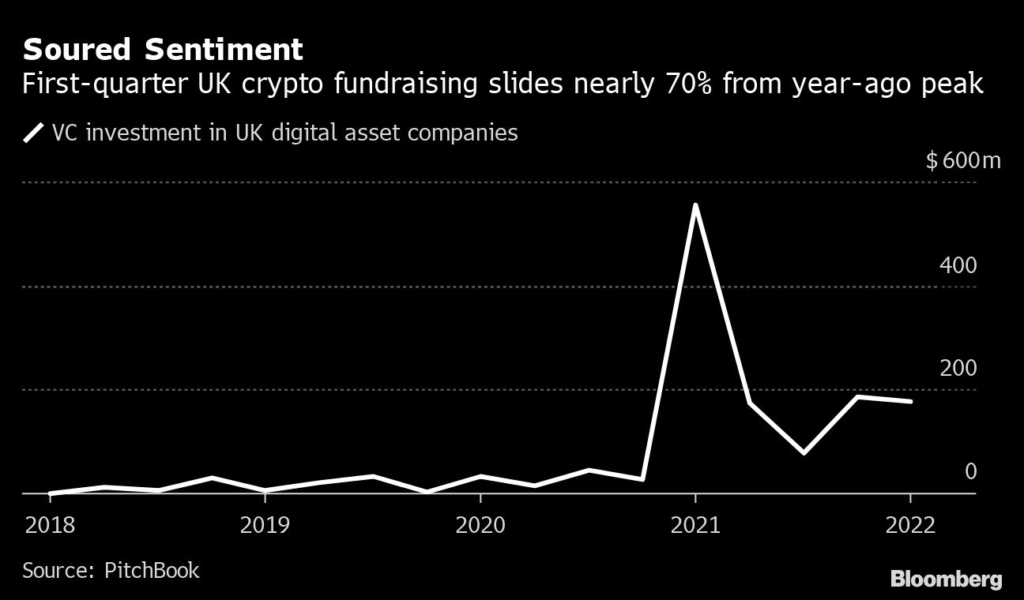
Brexit hamstrung the UK’s efforts to create a thriving crypto industry. Now, it just might be the country’s ticket to regaining lost ground.

That’s the view of more than half a dozen digital-asset executives, who expressed cautious optimism in interviews about the UK’s prospects, after a string of recent government initiatives intended to stem an exodus of crypto companies. 

“There’s a real opportunity, for the first time post-Brexit in particular, for crypto to have legislation that will enable all of its key ambitions,” said Blair Halliday, UK head of cryptocurrency exchange Gemini. 

The messy divorce from the European Union in 2016 created a regulatory overload that pushed the fledgling digital-assets industry to the bottom of the UK’s priority list. When officials finally set their sights on crypto, the result was a regime that sought to regulate it in the same way as traditional financial services, with a framework that threatened to stifle innovation. Unable to meet the strict standards, entrepreneurs started moving their companies abroad.

But Brexit also offered Britain a chance to chart its own path on crypto, and officials have recently moved to seize on that freedom by seeking to assuage some of the sector’s concerns. At the same time, the EU has riled the industry with tougher regulations governing crypto transfers. 

“Whatever you thought about Brexit, we’re now seizing the opportunity that comes from it,” said Economic Secretary to the Treasury John Glen in an interview. “This regulatory freedom is critical.”

Glen, the government’s de facto crypto czar, embarked on a world tour to meet executives and policy makers in San Francisco, Washington, Brussels, Madrid and Luxembourg in recent months. In June, he’s set to spend time in Switzerland’s “Crypto Valley” of Zug, an area that itself has benefited from the country’s regulatory independence from the bloc. 

The Treasury announced its intention for the UK to become a “global crypto hub” last month, responding to inroads by other financial centers from Switzerland to Dubai. Among the initiatives unveiled were new powers for the Financial Conduct Authority to establish clearer rules for cryptoassets, as well as regulation for issuers of stablecoins — digital tokens pegged to an asset like the US dollar.

Even with the about-face, there are areas of the digital assets beat where Britain might struggle to catch up. 

The FCA’s 2021 ban on UK retail investors accessing cryptocurrency derivatives has hurt the wider industry, said Bradley Duke, chief executive of ETC Group, a crypto exchange-traded product provider. London clearing houses have been reluctant to offer crypto derivatives even to professional investors for fears of a regulatory backlash, he said, without giving examples.

In January, the FCA said it would impose tougher rules on crypto marketing, rattling the industry. Its temporary registration regime for digital-asset firms saw more than 80% of applicants either withdraw their bids or be rejected.  

Dan Moczulski, head of cryptocurrency exchange and derivatives provider eToro in the UK, said that while the Treasury’s sudden outpouring of support for the industry is positive, “it doesn’t quite feel like it’s mirrored by the FCA at the moment.”

That said, the EU’s recent actions may have provided an opening for Britain. More than 40 companies signed a letter to EU finance ministers last month to protest against proposed changes to the bloc’s transfer of funds regulations, which would require exchanges to obtain, hold and submit information on all crypto transfers, regardless of the sums being sent. 

Meanwhile, an earlier version of the bloc’s Markets in Cryptoassets (MiCA) framework that sought to effectively ban mining of energy-intensive tokens like Bitcoin was vetoed after fierce resistance from the industry.

“A lot of these companies are quite global, and they can relocate to wherever is the most preferable location,” said Diana Biggs, chief strategy officer at crypto ETP provider DeFi Technologies Ltd. and a co-organizer of the letter.

Britain is taking tentative steps to ensure that it remains in contention. The FCA held its first “crypto sprint” this week — a two-day event where officials listened to feedback from executives, academics and stakeholders on how to better regulate the sector.  

Gemini’s Halliday said that while UK crypto companies earlier looked “fondly” at Europe, the British government is now in “a better place than ever” to reverse that trend. 

“They’re at a point where they’re not stymied or held back by having to consider these transitional agreements and arrangements,” he said. “The foundation is there. Now they’re able to assess what the landscape is in financial services, and really push on.”

More stories like this are available on bloomberg.com

©2022 Bloomberg L.P.
The World Wide Web’s Creator Wants Metaverse VR

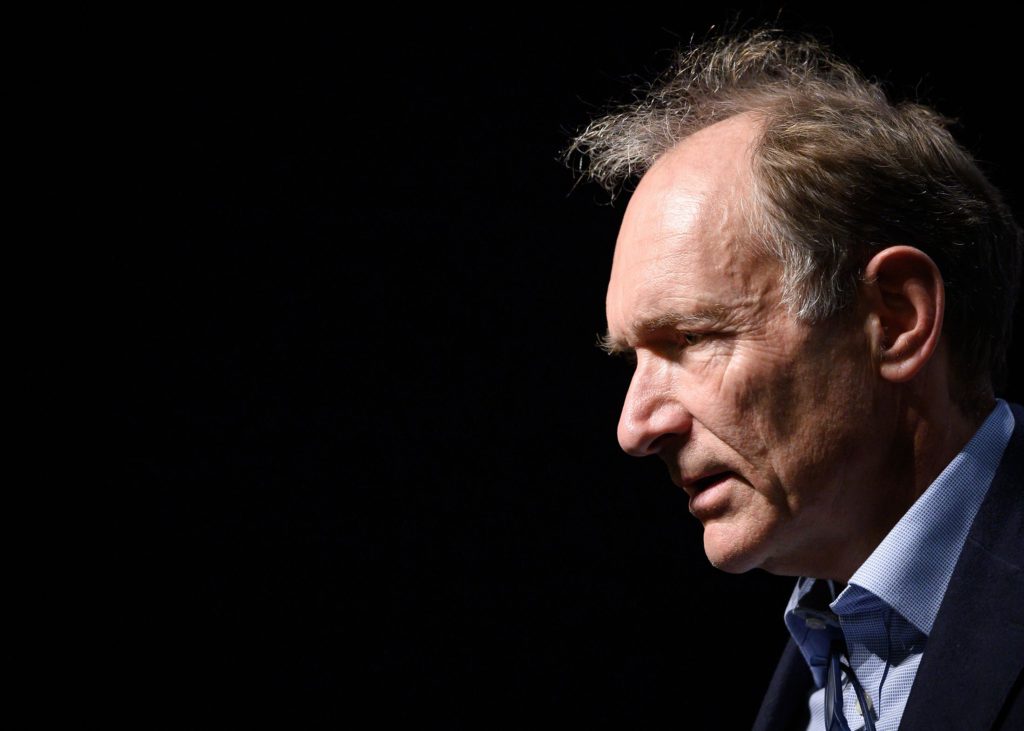
(Bloomberg) — The creator of the World Wide Web said he expects virtual reality, and technologies based around a so-called metaverse, to be part of how people interact with his invention in the future.

But in a new interview with Bloomberg Quicktake, British computer scientist Tim Berners-Lee also restated his opposition to the world’s biggest technology companies being in control of so much of their users’ personal data.

“People ask about virtual reality, and if the metaverse is going to be the whole future, and the answer is that it’s going to be part of the future,” Berners-Lee said in an interview for an episode of Bloomberg Quicktake’s “Emma Barnett Meets,” airing Wednesday.

“With VR, we’re getting a new media,” he said. “I think you’ll be able to sit between a movie and a VR world of that movie, for example. That’s what I hope.”

The popularity of buzzwords such as Web3 and NFT divide public opinion. Some experts are adamant that retooling the internet’s most important functions are essential for the future of functional democracy, while others mock them as opportunistic cash-grabs. 

The NFT Phenomenon Is for Real: Leonid Bershidsky

Berners-Lee has demonstrated his leaning toward being part of the first group. Last year, his original source code for the web sold at Sotheby’s for $5.4 million in the form of an NFT, a type of smart contract that uses blockchain technology. He’s also co-founder and chief technology officer of Inrupt, a company developing a decentralized data-storage system called Solid, which he promotes as a successor to Web 2.0. 

Inside ‘Web3,’ Crypto’s Plan to Retool the Internet: QuickTake

The inventor said in the new interview that Solid is “like a USB drive in the sky,” but differentiated from cloud computing platforms by offering a “pod” of data storage an individual owns and chooses who to give access to. 

“We got 100,000 creating pods very quickly just to try and understand what it was, and got interest from some big companies,” he said, “but mainly we got incoming from governments.”

More stories like this are available on bloomberg.com

©2022 Bloomberg L.P.

Google Devices Chief Says ‘Ambient Computing’ Is Future Goal

(Bloomberg) — Google is staking its vision for the future on what it’s calling “ambient computing,” according to Rick Osterloh, Google’s hardware chief.

“Computers should be able to help you with whatever you need seamlessly, and be all around you,” Osterloh said in a Bloomberg Television interview on Wednesday.

Earlier that day at its annual I/O conference, Alphabet Inc.’s Google introduced a fleet of product updates and upcoming devices, including a new Pixel-branded tablet and smartwatch. 

At the end of the event, Google teased a more audacious gadget: a pair of glasses that use its Google Translate service. In a video demo, an elderly mother who speaks Mandarin was able to understand her daughter’s English. 

Read more about Google’s AR glasses

Google’s first attempt at internet-connected eyewear — Google Glass — was a famous flop that left the search giant more cautious about the futuristic field. In the decade since launching that device, Google has had skunkworks projects on similar augmented reality technology, but has kept most of its hardware line to more conventional smartphones, laptops and home speakers similar to rivals like Apple Inc. 

“We learned so much from the introduction with Glass,” Osterloh said on Bloomberg TV. “We clearly learned how hard it is to develop this kind of technology, and learned a lot about what users care about, and what’s important.”

Osterloh did not share plans on when the AR glasses would be available to consumers, saying only that Google had “a number of engineers and developers continuing to build” the product for internal use. “It’s a bit of a ways off, but we are very much continuing to invest in the AR space,” he said.

But such a product plays a key role in Google’s ambient computing vision, Osterloh said. “You could see how wonderful it would be to have something on your face, that enables you to do real-time communication, to do translation to be able to live caption the world around you,” he said.

Read more about Google’s smartwatch

Smaller competitors Meta Platforms Inc. and Snap Inc. have released sleeker versions of AR glasses and Apple is working on the tech as well. Google also invested in Magic Leap, a startup that raised scores of cash to make an immersive reality headset but ended up pivoting to enterprise sales after failing to get traction.

More stories like this are available on bloomberg.com

©2022 Bloomberg L.P.

Rivian Reaffirms 25,000 EV Target Despite Supply Chain Pain

(Bloomberg) — Rivian Automotive Inc. reaffirmed guidance to deliver 25,000 battery-electric vehicles this year, despite ongoing supply chain snarls hampering its ramp in production.

The Irvine, California-based carmaker has built about 5,000 vehicles since production started in September, it said Wednesday. That includes 2,553 units built in the first quarter against a backdrop of assembly line pauses due to parts shortages. The company, which manufactures a mix of pickup trucks, SUVs and commercial vans, delivered 1,227 vehicles to customers in the quarter.

Rivian surged as much as 14% in after hours trading, before paring some of the gain. The stock earlier closed down 9.6% to $20.60 and has dropped about 80% so far this year. The shares were rocked this week by a lockup expiry that allowed insiders and big-name investors to sell.

Read more: Ford Sold 8 Million Shares of Rivian at $26.80 Each on Monday

The all-electric startup is struggling after a blockbuster listing in November, the sixth biggest IPO on U.S. record, helped put it on the map. The company was first-to-market with an electric pickup, beating out Ford Motor Co. — one of its investors — and the likes of General Motors Co and Tesla Inc. It has blamed parts shortages, Covid-19 outbreaks and production hiccups for holding it back.

Rivian reported $95 million of first-quarter revenue, less than the average analyst estimate of $131.2 million. The EV-maker recorded an adjusted loss of $1.43 a share, slightly better than the average estimate of $1.45. 

“Supply chain continues to be the bottleneck of our production,” Rivian said in its shareholder letter. “We have been forced to stop production for longer periods than anticipated, resulting in approximately a quarter of the planned production time being lost due to supplier constraints.”

Shipping Costs

The company encountered increased shipping and logistics costs as it tried to circumvent parts shortages. While a lack of semiconductors remains a problem, the worst of the shortage has passed, Chief Executive Officer RJ Scaringe said on a call with analysts.

Rivian doesn’t foresee any issues around the supply of battery cells over the next five years, Scaringe said. The company is, however, trying to reach longer-term deals for battery metals supply as global EV output, and competition, grows.

Rivian said it ended the quarter with $17 billion in cash and cash equivalents, excluding additional lines of credit, down from $18.4 billion at the end of 2021. The company said the funds are sufficient to take it through to the start of production of a next-generation mid-price vehicle to be assembled at a new plant to be built in Georgia by 2025.

Amazon Order

Alongside its consumer models, Rivian has an order for 100,000 battery-electric delivery vans from Amazon.com Inc., its second-largest shareholder. The first 10,000 are due by the end of this year and are factored into its full-year guidance.

While output from Rivian’s sole operational plant in Normal, Illinois, is constrained, it’s already trying to expand its manufacturing footprint to boost capacity. The company received $1.5 billion in state and local incentives earlier this month to build a second $5 billion factory near Atlanta.

Cash burn is still a concern for investors. Rivian said it would work through about $7 billion in 2022, split across negative earnings before interest, taxes, depreciation and amortization, and capital expenditures. 

In working toward its full-year delivery target, Rivian plans to add a second shift at the Illinois plant as long as its supplier base can support the output. That facility has installed capacity to produce 150,000 units annually.

The company said it has more than 90,000 net pre-orders, stripping out those that have been delivered, for its consumer vehicles. This includes 10,000 new orders placed since the company raised prices in March in a series of U-turns that hurt the stock.

(Updates with details from conference call and outlook on supply chain.)

More stories like this are available on bloomberg.com

©2022 Bloomberg L.P.
Abortion-Rights Bill Blocked in Senate as Court Decision Looms

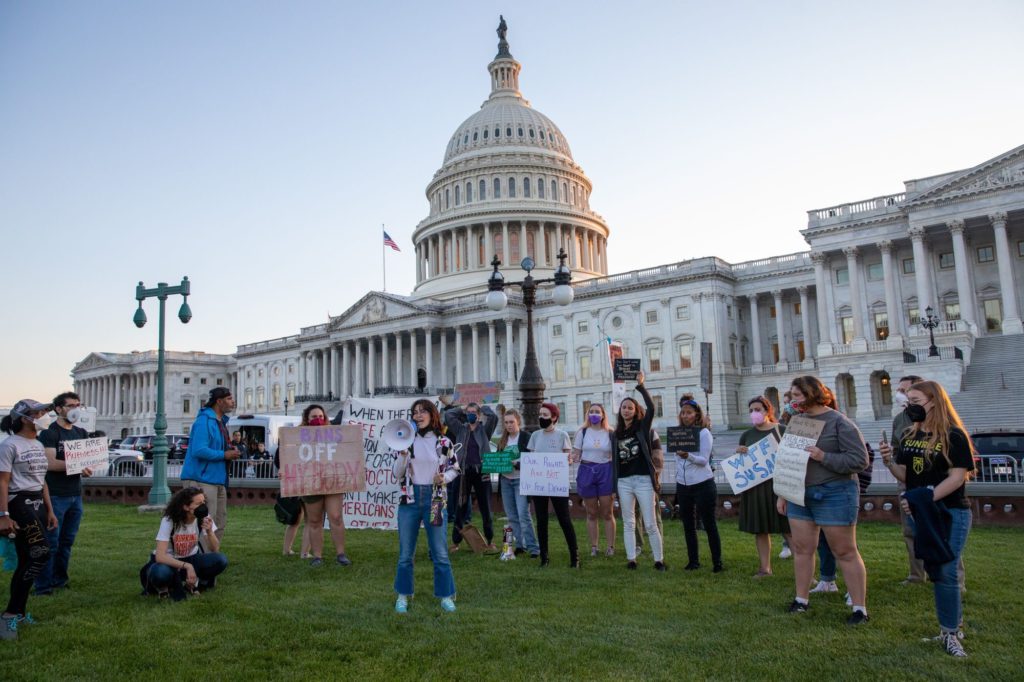
(Bloomberg) — Senate Democrats were blocked in their attempt to enshrine abortion rights in federal law in a vote that highlighted both the deep divide on the politically explosive issue and the party’s schism over ending the filibuster to achieve their goals.

All Senate Republicans and one Democrat — Joe Manchin of West Virginia — voted to keep legislation ensuring nationwide access to abortions from reaching the Senate floor. The 49-51 vote was well below the 60 votes needed. 

With the Supreme Court poised to overturn the landmark Roe v. Wade decision that legalized abortion nationwide, Senate Majority Leader Chuck Schumer said he aimed to put all the chamber’s Republicans on record at a time when polls continue to show most voters want Roe to remain intact.

“Republicans are going to have to go on record as to whether they want this to be the first generation of American women with less freedom than their mothers,” Washington Senator Patty Murray, a member of Schumer’s leadership team, said.

Schumer set the vote as a signal to the Democratic Party’s core voters, who largely support abortion rights and could be motivated to turn out for the midterm election that will decide control of Congress for the remainder of President Joe Biden’s first term. In a sign of how important the issue is for the party, Vice President Kamala Harris presided over the vote in her role as president of the Senate. And before the procedural vote, dozens of progressive House Democrats and aides marched across the Capitol before the vote to demand senators bring legislation to the floor.

Biden, in a statement after the bill was blocked, made a direct appeal to voters, asking them to elect more senators who will back abortion rights.

 “If they do, Congress can pass this bill in January, and put it on my desk, so I can sign it into law,”  he said, making an argument that was echoed by Schumer and other Democrats.

But the abortion issue also animates the GOP base, and Republican senators have branded the Democratic legislation as radical and extreme.

“This extreme legislation would invalidate all state laws that limit abortions after 20 weeks of gestation,” Republican Senator John Cornyn of Texas said. “This wouldn’t just impact pro-life red states. This change is so radical that it would invalidate existing laws in blue states as well.”

The legislation at issue, introduced by Democratic Senator Richard Blumenthal of Connecticut, would establish a federal statutory right for doctors to provide abortion services and for patients to choose to have the procedure, without limitations or requirements such as specific tests or other medical procedures unless they’re required for comparable procedures. Health providers could sue on behalf of their staffs or patients if there are any violations. It is backed by the Biden administration.

“Americans strongly oppose getting rid of Roe, and they will be paying close attention from now until November to Republicans who are responsible for its demise,” Schumer said on the Senate floor Wednesday.

Senator Bob Casey of Pennsylvania, who has been opposed to abortion, announced his support for it on Monday. Two Republicans who have backed abortion rights in the past — Susan Collins and Lisa Murkowski of Maine — drafted a more limited bill codifying existing court rulings and didn’t support the Democratic measure. Manchin opposed the Democratic bill, but indicated he would have supported the Collins and Murkowski bill had it been put on the floor.

Democrats’ inability to move the abortion legislation for a second time this year — after being stifled on voting rights, policing reform, an immigration overhaul and other matters — has again highlighted the limits of their wafer-thin majority and the rancor within the party over doing away with the filibuster. Manchin and Arizona Senator Kyrsten Sinema, two pivotal Democratic votes, oppose ending the rule.

In January, after a bid to push voting rights legislation was blocked in the Senate, Schumer tried to change Senate rules to end the legislative filibuster and allow it to pass on a simple majority vote. That was rejected 52-48 with Manchin and Sinema, who both backed the legislation, joining Republicans in preserving the 60-vote threshold to advance it. Schumer has given no indication that he will try again to hold a vote on the filibuster.

Sinema, who supports abortion rights, has particularly come under fire from fellow Democrats for her stance. After last week’s leak of a draft Supreme Court majority opinion indicating Roe would be overturned, two progressives — Representative Alexandria Ocasio-Cortez and Senator Bernie Sanders — urged the party to put up a primary challenger to Sinema when she’s up for re-election in 2024 because of her opposition to getting rid of the filibuster.

Sinema, who was censured by Arizona Democrats in January, has repeatedly said the filibuster is necessary to protect Democratic priorities should Republicans take control of Congress.

“Protections in the Senate safeguarding against the erosion of women’s access to health care have been used half-a-dozen times in the past ten years, and are more important now than ever,” she said in a statement last week. 

Senate GOP leader Mitch McConnell this week vowed that he wouldn’t back any effort to gut the filibuster rule to pass a national abortion ban if Republicans take control next year. But he also told USA Today late last week that a national abortion ban is “possible” if Roe is overturned. 

There is wide distrust among Democrats.

“Mitch McConnell has said the doors are open for Congress to ban abortion all across the country,” Massachusetts Senator Elizabeth Warren said. “Mitch McConnell has delivered in the past. And I very much fear if he gets the chance he’ll deliver in the future.”

(Updates with Biden statement in sixth, seventh paragraph)

More stories like this are available on bloomberg.com

©2022 Bloomberg L.P.

Citadel Securities, BlackRock Deny Involvement in Terra Fall

(Bloomberg) — Citadel Securities, no stranger to social-media controversies, has found itself the subject of another one: the collapse of the algorithmic stablecoin TerraUSD, which it says it had nothing to do with.

The trading firm says it is not involved in the situation and “does not trade stablecoins, including UST,” a representative for the firm told Bloomberg, repudiating claims circulating on social media in recent days. BlackRock Inc, also named in various posts, denied their involvement.

“Rumors that BlackRock had a role in the collapse of UST are categorically false. In fact, BlackRock does not trade UST,” said spokesperson Logan Koffler in an emailed statement. The asset manager recently backed Circle Internet Financial Ltd, which runs another stablecoin, USD Coin. 

TerraUSD, or UST has spiraled to new lows since breaking its peg of one-to-one to the dollar over the weekend. The collapse poses one of the biggest tests yet to decentralized finance and the will of its backers to defend it.

The situation sparked a barrage of speculation about the cause. Such was the intensity of the attention that Ken Griffin’s market-making firm and BlackRock decided to respond. Last year, Citadel found itself subject to attacks related to its role in the meme-stock frenzy involving GameStop Corp. and other companies.

TerraUSD’s backers are trying to raise about $1.5 billion to shore up the token after its crash, but are struggling to win investor support for a rescue, Bloomberg reported Wednesday.

(Updates to add response from BlackRock starting second paragraph)

More stories like this are available on bloomberg.com

©2022 Bloomberg L.P.
FTC’s Khan Gets Path to Go Big on Antitrust With Biden’s Nominee

(Bloomberg) — The US Senate confirmed Alvaro Bedoya as a member of the Federal Trade Commission, forming a Democratic voting majority at the agency after months of deadlock.

Bedoya’s confirmation passed 51-50 on Wednesday. Vice President Kamala Harris cast the tie-breaking vote after all the chamber’s GOP members voted against him.

“With the FTC at full membership, this important agency will be empowered to drive full steam ahead in cracking down on bad actor companies who are using anticompetitive practices, inflation, and price manipulation to bilk consumers and drive up profits,” Senate Majority Leader Chuck Schumer said in a statement. 

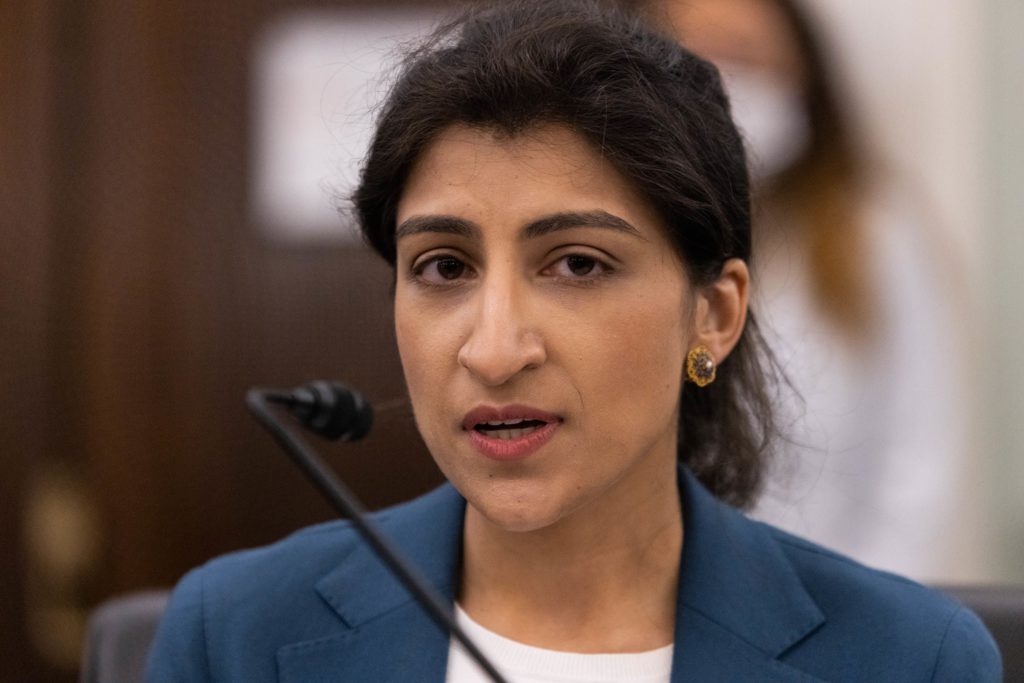
Bedoya’s confirmation clears the way for bold privacy and antitrust enforcement under Chair Lina Khan, who has pushed for progressive policies aimed limiting the power of big corporations and increase regulations on company data policies. 

Khan hailed Bedoya’s confirmation, as did advocates of vigorous antitrust enforcement. “Alvaro’s knowledge, experience, and energy will be a great asset to the FTC as we pursue our critical work,” she said. Some business groups like the U.S. Chamber of Commerce and NetChoice, both of which accept funding from tech companies including Alphabet Inc.’s Google and Meta Platforms Inc., however, raised concerns about the direction Khan will take with the agency now that Democrats control a majority.

Bedoya is likely to be sworn in Thursday or Friday after President Joe Biden formalizes his appointment.

Bedoya, who is a visiting professor at Georgetown Law, brings expertise on the intersection of privacy and technology to the agency. He’s the founding director of the Center on Privacy and Technology and the author of a report analyzing the facial-recognition network used by police forces. 

The FTC, which is run by five commissioners including the chair, has been split 2-2 between Democrats and Republicans since October 2021, slowing momentum for regulatory action. That impasse stopped the FTC from suing to block Amazon’s acquisition of Metro-Goldwyn-Mayer in March. 

The confirmation comes after several delays, including a recent block by Senate Republicans in the Commerce, Science and Transportation Committee. 

GOP senators complained that Bedoya lacked the temperament needed for a bipartisan commission, citing social media posts in which he criticized former President Donald Trump and Republicans over immigration policies. 

Senate Minority leader Mitch McConnell of Kentucky on Tuesday urged the Biden administration to pull Bedoya’s nomination, calling it a “foolish choice” because Bedoya had criticized the police, among other allegations.

“Today’s vote sends a clear message to businesses of all sizes: buckle up. Chair Khan now has the potential third vote she needs to unleash greater uncertainty — the enemy of business growth and opportunity — on the economy,” said Neil Bradley, chief policy officer of the Chamber of Commerce. 

(Updates with comment from Lina Khan in fifth paragraph. An earlier version of the story was corrected to show that Bedoya was confirmed Wednesday)

More stories like this are available on bloomberg.com

©2022 Bloomberg L.P.
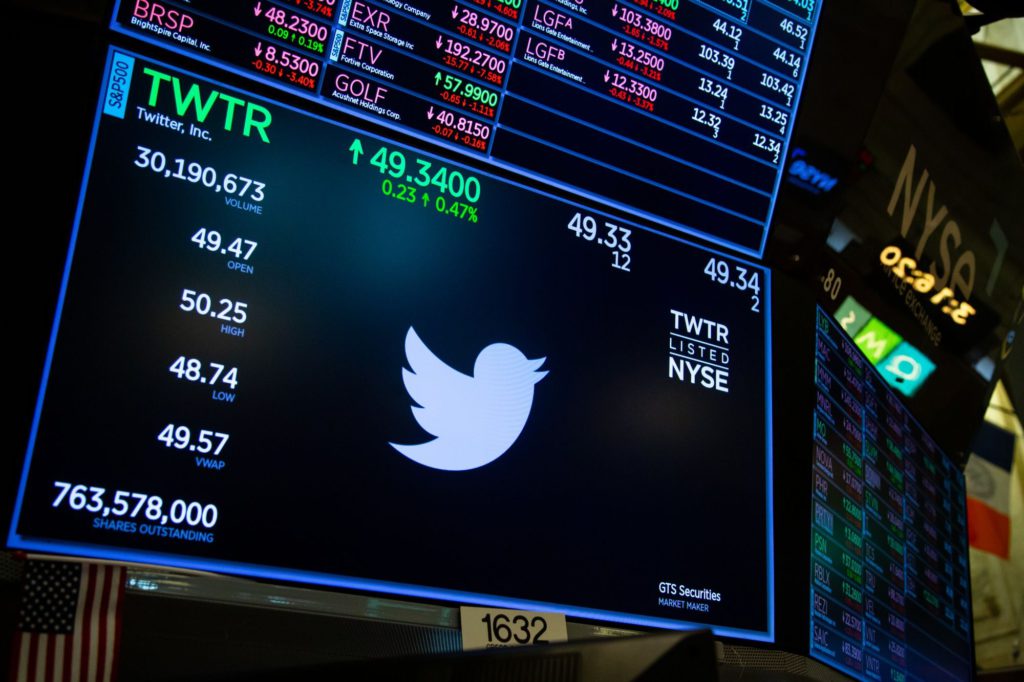
Small-Time Funds Get Path to Invest in Musk’s Twitter Buyout

(Bloomberg) — The roster of backers supporting Elon Musk’s acquisition of Twitter Inc. could soon get much more crowded. 

Some potential investors — including hedge funds and wealthy individuals — have been pitched the opportunity to invest $5 million or more in the Twitter buyout, according to people with knowledge of the matter. They’re being invited to commit money through special-purpose vehicles that will pool capital together from a variety of smaller sources, the people said. 

One party canvassing investors is seeking to collect $500 million in total, and plans to charge a 5% fee to whoever it brings in. The move could allow a well-connected financier to rope in investors who might not have direct access to the deal, but nonetheless want to join one of the biggest leveraged buyouts in history. 

The setup would also provide a way for an investor already participating in the deal to reduce its exposure by using other people’s money. While channeling capital from dozens of parties through a special-purpose fund is common in the venture capital world, it’s rarely seen in the world of public company takeovers. 

Getting into the deal through one of these side funds isn’t being sanctioned by Musk, according to a person familiar with the matter. Musk’s existing equity investment agreements have been structured to forbid investors from raising a special purpose vehicle, the person said. If investors do participate in them, they risk losing their shares, the person said.

Still, Musk is open to smaller investors getting involved and has already agreed to accept checks from as low as $5 million, a filing showed last week.

It’s not uncommon to have unsanctioned private stock sales in Silicon Valley. 

It couldn’t immediately be learned who was behind the approaches. Investors who were approached have a few weeks to decide whether to participate, some of the people said. A representative for Musk didn’t respond to a request for comment. 

Sprawling consortium

Last week, a filing showed a group of investors has committed a combined $7.1 billion to help Musk take Twitter private. The list of investors looked more like a financing round for a company on the verge of an initial public offering rather than a typical take-private. Instead of private equity firms that usually show up in leveraged buyouts, a sprawling consortium of investors offered to join Musk’s bid, with check sizes ranging from $5 million to $1 billion.

The list included funds affiliated with high net-worth individuals like Oracle Corp. chairman and Tesla Inc. board member Larry Ellison, venture firms like Andreessen Horowitz and Sequoia Capital, and Qatar’s sovereign wealth fund. 

Investment banks are still soliciting additional investors to support the deal, according to people familiar with the matter. Apollo Global Management Inc. is in talks to lead a preferred $1 billion financing for Musk, along with Sixth Street Partners, Bloomberg News reported on Tuesday.

(Updates with details on investment agreements starting in fifth paragraph)

More stories like this are available on bloomberg.com

©2022 Bloomberg L.P.
Dallas Fed Names Central Bank Insider Lorie Logan as New Chief

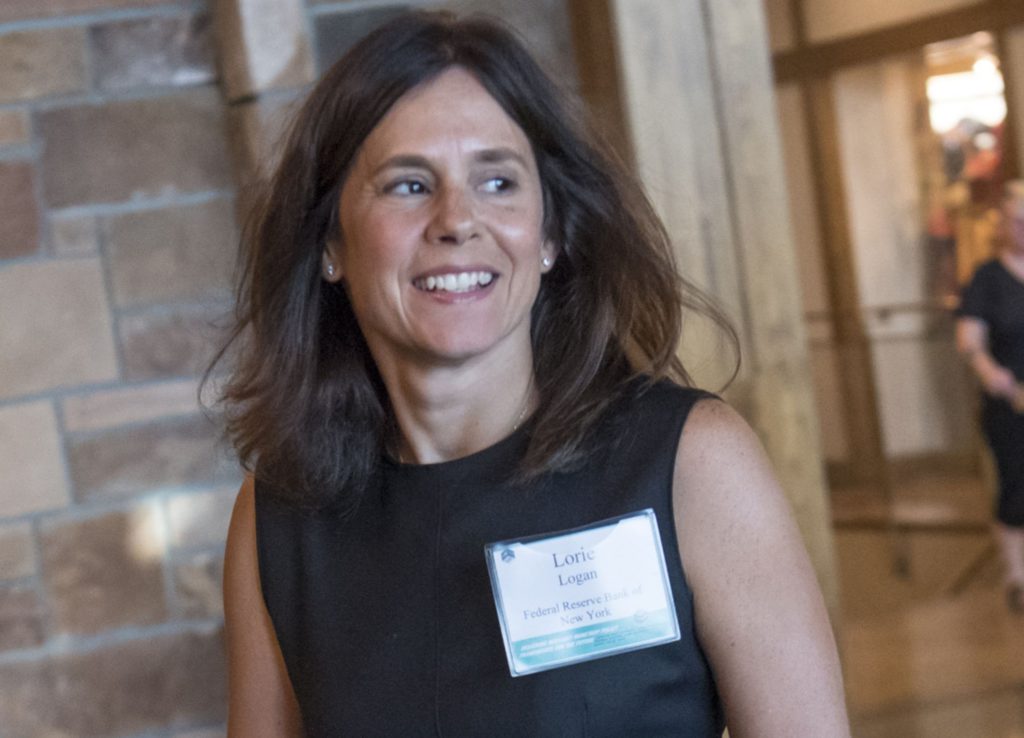
(Bloomberg) — The Federal Reserve Bank of Dallas on Wednesday named Lorie Logan as its next president, elevating a central bank insider who brings decades of monetary policy experience to the post and making her the first woman to lead the bank.

Logan, 49, comes to Dallas from the New York Fed, where she currently oversees implementation of monetary policy as manager of the Fed’s $9 trillion securities portfolio and serves as executive vice president. She has led market operations, monitoring and analysis there since 2012 and started at the bank in 1999.

Logan succeeds Robert Kaplan, who stepped down from the Dallas Fed last year following disclosures about his personal trading activity in 2020.

The appointment is effective Aug. 22. The Dallas Fed’s next turn to vote on monetary policy is in 2023.

Logan will become the eighth woman among the Fed’s 19 policy makers once she takes office, helping further diversify a group that has historically been dominated by White men. She is already well known among top officials: In her current role, she attends Federal Open Market Committee meetings and advises policy makers on their decisions. 

“We anticipate that Logan will be in the sensible center,” Evercore ISI’s Krishna Guha and Peter Williams wrote in a note to clients. “We would expect her to favor a calibrated hawkish approach focused on upside inflation-risk management and restoring price stability without injecting unnecessary volatility into markets or the economy.”

Presidents of the 12 regional banks rotate their vote annually — except New York, which goes every year. Officials are currently trying to curb the hottest inflation in decades by removing emergency pandemic support, while attempting to avoid stalling the economy in the process.

“What we’re seeing is a huge, seismic shift in the composition of the Fed, and a much more balanced shift on gender — some on race, not as much as I’d like,” said Diane Swonk, chief economist at Grant Thornton LLP and a longtime Fed watcher. 

The Dallas Fed district encompasses the oil-producing regions of Texas, southern New Mexico and northern Louisiana, and analyzing the energy sector is one of the bank’s research strengths. Its proximity to the Mexican border has also made immigration a significant focus for the bank in recent years and just under 40% of the district is Latino. 

Choosing an insider like Logan was a win for “continuity” at the Fed, said Aaron Klein, a senior fellow in economic studies at the Brookings Institution in Washington.

While Logan may need to spend time getting to know the region’s unique business environment, her monetary policy expertise will be a boon to the FOMC right now, said Ray Perryman, an economist who run a research firm in Waco, Texas, and has been tracking the state’s economy for 40 years.

“To bring in someone with this level of specific experience in monetary policy at this moment I think is just a very, very strong thing to do,” Perryman said. “To have that person representing our region on the Open Market Committee would be something that’s very advantageous for our region.”

Some argued that the pick was a missed opportunity to broaden the voices heard by policy makers.

“People who have spent most of their career inside the Fed tend to be loyal to the institution and defensive of its decisions, rather than bringing a fresh and independent perspective to the Fed’s policy deliberations,” said Andrew Levin, a former Fed adviser and a professor at Dartmouth College.

Hispanic members of Congress, who urged the Dallas Fed to pick a Latino as its next president, were disappointed with the selection. 

With Logan’s appointment, the regional bank “chose to perpetuate a legacy that has largely excluded Latino voices at all levels of the institution,” Senator Bob Menendez of New Jersey and Representative Raul Ruiz of California said Wednesday. Ruiz chairs the Congressional Hispanic Caucus. “We are deeply disappointed by today’s decision and will work to find solutions to address the Federal Reserve’s ongoing diversity problem.”

Less than a quarter of the workforce is Latino at the Dallas Fed, which hired an executive search firm to help it fill the position and pledged to consider a large and diverse pool of candidates. 

“The Dallas Fed had a chance to make themselves more representative of their region, but they didn’t take that chance seriously,” said Ben Dulchin, director of the Fed Up Campaign at the Center for Popular Democracy. “The fact that the Fed’s presidents are 75% White undermines the legitimacy of the system.”

Navigating Crises

Logan has seen the New York Fed navigate several crises during her tenure there, including the Sept. 11 attacks, the 2008 financial crisis and the Covid-19 pandemic. She played a prominent role in developing and implementing the emergency lending programs the New York Fed established during the last two crises to smooth market functioning and keep credit flowing.

She was key to establishing the Fed’s overnight reverse-repurchase facility after the financial crisis, a program that became a popular place for money-market funds and other firms to park excess cash during the pandemic. 

Logan will stay with the New York Fed’s markets team through August and will oversee the beginning of the shrinking of the central bank’s balance sheet, which will start June 1.

Patricia Zobel, Logan’s deputy as head of the Fed’s bond holdings, known as the System Open Market Account, will become manager “pro tem” of the portfolio.

Logan fills a role vacated by Kaplan in October as the Fed was engulfed in its most serious ethics scandal in years.

The announcement of his departure, on the same day that Boston Fed President Eric Rosengren said he was stepping down due to ill health, followed revelations of their unusual trading activity as the central bank swept into action to shield the economy from Covid-19.

Fed Vice Chair Richard Clarida also came under scrutiny for his transaction on the eve of a Fed statement signaling it was getting ready to calm market panic. He resigned Jan. 14, ahead of the expiration of his term as governor on Jan. 31.

The Boston Fed announced in February that University of Michigan economist Susan Collins, the first Black woman to lead one of the central bank’s districts, will become its new president on July 1.

The scandal provoked a demand from the Senate floor by Massachusetts Democrat Elizabeth Warren for an investigation of potential insider trading. Chair Jerome Powell asked the Fed’s internal watchdog to investigate and the central bank subsequently adopted sweeping restrictions on officials’ investing and trading, prohibiting the purchase of individual securities and boosting disclosure requirements among policy makers and senior Fed staff.

(Updates with lawmakers’ names in 16th paragraph.)

More stories like this are available on bloomberg.com

©2022 Bloomberg L.P.
Crypto Billionaires’ Vast Fortunes Are Destroyed in Weeks

(Bloomberg) — It’s been a long few weeks since the crypto crowd was partying in Miami.

Coinbase Global Inc. founder Brian Armstrong had a personal fortune of $13.7 billion as recently as November and about $8 billion at the end of March. That’s now just $2.2 billion, according to the Bloomberg Billionaires Index, after a selloff in digital currencies from Bitcoin to Ether triggered a precipitous decline in the market value of Coinbase, the largest US cryptocurrency exchange.

The firm’s shares have tumbled 84% since their first day of trading in April 2021, closing Wednesday at $53.72 after the company warned that trading volume and monthly transacting users were expected to be lower in the second quarter than in the first.  

It’s raised questions about Coinbase’s ability to withstand the sharp decline in crypto prices, forcing Armstrong to take to Twitter to defend the company. There is “no risk of bankruptcy” even amid a “black swan” event and users’ funds are safe, said Armstrong, the firm’s chief executive officer.

Then there’s Michael Novogratz. The CEO of crypto merchant bank Galaxy Digital has seen his fortune plummet to $2.5 billion, from $8.5 billion in early November. He’s been a champion of TerraUSD, the algorithmic stablecoin that’s now at risk of a complete collapse amid a breakdown in the price of a crypto token in the same ecosystem, Luna.

“I’m probably the only guy in the world that’s got both a Bitcoin tattoo and a Luna tattoo,” Novogratz said at the Bitcoin 2022 conference in Miami on April 6. 

Billionaire crypto fortunes that swelled over the last two years are disappearing after a selloff that began with tech stocks spilled over into digital money. Bitcoin, the most popular cryptocurrency, and Ether have both fallen more than 50% since their record highs late last year.

While almost all crypto holders have suffered wealth declines, some of the biggest and most visible losses are concentrated among founders of exchanges, where traders buy and sell digital currencies. 

At least on paper, Changpeng Zhao, the CEO of closely held Binance, has lost an even larger fortune than Armstrong or Novogratz. He debuted on the Bloomberg wealth index in January with a net worth of $96 billion, one of the world’s largest. By Wednesday that had shrunk to $11.6 billion, using the average enterprise value to sales multiples of Coinbase and Canadian crypto firm Voyager Digital as a basis for the calculations. 

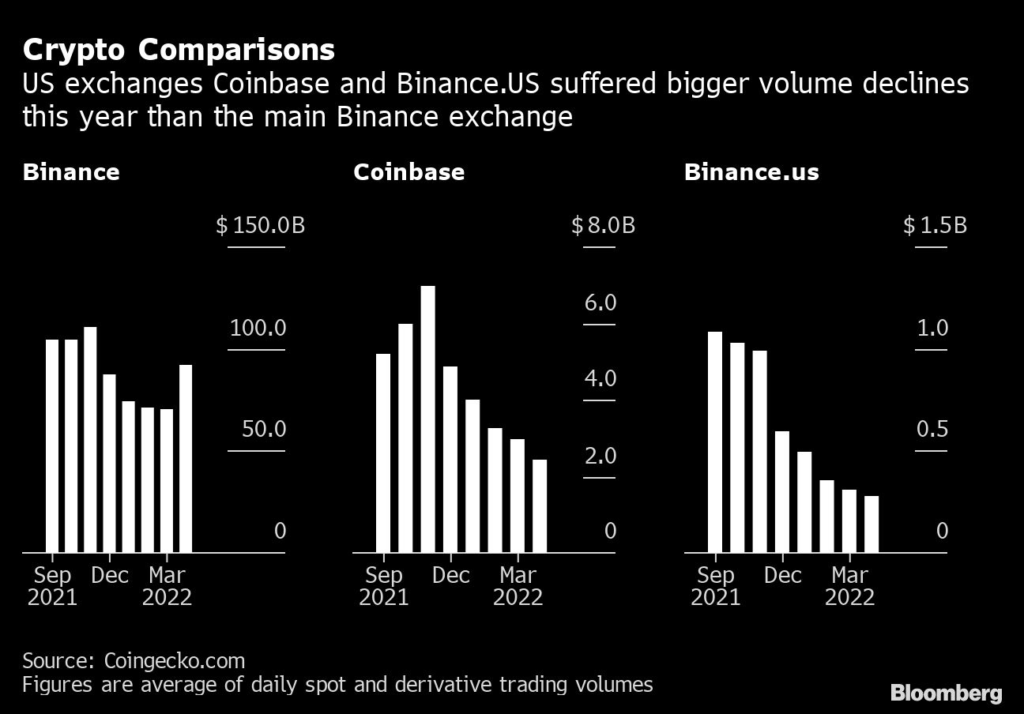
Crypto exchanges in the US appear to be suffering more of a downturn than their global competitors. Trading volumes at Coinbase have steadily fallen since the beginning of the year, while more internationally focused Binance saw an uptick in volume last month. Binance’s US-focused business, by comparison, experienced even steeper declines than Coinbase’s.

Tyler and Cameron Winklevoss, co-founders of rival crypto exchange Gemini, have each lost about $2.2 billion — or roughly 40% — of their wealth this year. The fortune of Sam Bankman-Fried, CEO of crypto exchange FTX, has fallen by half since the end of March to about $11.3 billion. 

Armstrong isn’t the only Coinbase billionaire losing money. Co-founder Fred Ehrsam, a former Goldman Sachs Group Inc. trader, is currently worth $1.1 billion, down more than 60% this year.

Armstrong owns 16% of Coinbase and controls 59.5% of its voting shares, according to the company’s 2022 proxy statement, while Ehrsam has a 4.5% stake and controls 26% of its voting stock. 

Coinbase’s bonds have also plunged, recently trading in line with some of the riskiest junk-rated notes. 

(Updates valuations throughout.)

More stories like this are available on bloomberg.com

©2022 Bloomberg L.P.

Close Bitnami banner
Bitnami
