Bloomberg

Brazil’s Nubank Offers Bitcoin, Ether Trading to Customers

(Bloomberg) — Nu Holdings Ltd., a Brazilian digital bank backed by Warren Buffett’s Berkshire Hathaway Inc., partnered with blockchain startup Paxos Trust Co. to allow its customers to trade cryptocurrencies.

Nubank’s more than 50 million customers will initially be able to trade Bitcoin and Ethereum as of Wednesday, according to Paxos Chief Executive Michael Coscetta. Paxos has seen demand increase for digital assets in Brazil and that the move will create more financial inclusion for Nubank’s customers by giving them access to more payment methods, he said.

“You’ll see a lot more desire to participate [in crypto] not just in Brazil, but across Latin America,” Coscetta said in an interview.

Nubank will gradually roll out crypto trading to its entire costumer base by the end of June, the Sao Paulo-based firm said in a statement. Nu Holdings also buy Bitcoin equivalent to as much as 1% of its balance sheet cash position, the firm said in the same statement, without providing an exact figure.

Latin America has been an area of focus for crypto companies. Coinbase Global Inc. planned to acquire Brazilian crypto brokerage 2TM Participacoes SA before the deal fell apart. However, the US crypto exchange said it is committed to the Brazilian market. Paxos also provides crypto services to Mercado Libre Inc., an Argentinian online marketplace.

Coscetta said there’s also been interest in Latin America in terms of increasing access to digital dollars. He said that Paxos, which issues Pax Dollar, a stablecoin pegged to the US dollar, is interested in adding access to the currency on Nubank’s platform.

In addition to Nubank, Paxos works with other publicly traded companies, including PayPal Holdings Inc., Interactive Brokers LLC and Mastercard Inc. Nubank has lost more than a third of its market value less than five months after going public and faces pressure from the end of a stock lockup on May 17 that will allow $26 billion worth of its shares to be publicly traded.

(Adds comment from Nubank in the fourth paragraph.)

More stories like this are available on bloomberg.com

©2022 Bloomberg L.P.

Faraday Future Says Ethical Lapses Led to Inaccurate Filings

(Bloomberg) — Faraday Future Intelligent Electric Inc., the electric-vehicle startup that shook up its executive ranks last month, said a recently completed internal investigation found that its leaders didn’t demonstrate “a commitment to maintain integrity and ethical values.”

This “material weakness” in financial reporting was disclosed in the company’s Form 10-Q for the third quarter of 2021, which was filed late Friday. That was the deadline for Faraday Future to submit the document to the US Securities and Exchange Commission or risk being delisted from the Nasdaq.

The startup in April limited the role of its founder, Jia Yueting, after completing the probe into allegations of fraud; at the time, Faraday Future said another vice president resigned and that it fired some other employees who weren’t executive officers. Its chairman stepped down into a lesser role on the board in February. The internal probe was launched in late 2021 after a short-selling research firm claimed Faraday Future misrepresented SUV preorders following its merger with a special purpose acquisition company. 

In Friday’s filing, Faraday Future said senior managers “failed to reinforce the need for an attitude of compliance and internal control awareness with certain of FF’s governance, accounting and finance policies and procedures.” Those failings led to “inaccurate and incomplete disclosures of certain relationships, arrangements, and transactions,” the Los Angeles-based company said.

Faraday Future didn’t explain what transactions it was referring to and didn’t respond to follow-up questions. A person familiar with the matter told Bloomberg News that it has to do in part with how founder Jia moved money into and out of the startup over the years. Jia didn’t immediately respond to an email seeking comment.

Jia built a technology empire in China before relocating to the US in 2017. He often issued loans to Faraday Future from other companies he controlled in China, the US and offshore jurisdictions, according to documents filed with the SEC and his personal bankruptcy, as well as other reports.

The startup’s investigation concluded that some employees withheld “their relationships with certain related parties and affiliated entities in connection with, and following, the business combination, and failed to fully disclose relevant information, including but not limited to, information in connection with related parties and corporate governance to the Company’s independent registered public accounting firm PricewaterhouseCoopers LLP.” 

“Further, certain individuals failed to cooperate and withheld potentially relevant information in connection with the Special Committee investigation,” the company wrote in the filing.

Faraday Future shares have lost about 90% of their value since closing at a 52-week high of $16.54 in late June.

More stories like this are available on bloomberg.com

©2022 Bloomberg L.P.

China’s Covid Zero Policy Makes 2020-Style Rebound Less Likely

(Bloomberg) — China’s tightening Covid rules and extended lockdowns are making a 2020-style V-shaped economic recovery a dim possibility this time around. 

The slump in output may not be as deep as two years ago, when most of the country was under some form of restriction from late January through much of February following the outbreak in Wuhan. Currently, areas making up only about 30% of gross domestic product are under full or partial lockdown, according to estimates from Nomura Holdings Inc. 

However, this time around, given the ability of the highly infectious omicron variant to evade stringent controls, there’s greater risk of cities shutting down and then reopening repeatedly over several months. Major hub Shanghai is still in lockdown after five weeks, and while cases are easing there now, Beijing and other cities are tightening restrictions to curb their own outbreaks. 

The result is that businesses will have to live with the ever-present threat of disruption of the kind that’s halted production at companies like Tesla Inc. and roiled supplies at Sony Group Corp. Consumer confidence and spending will likely also remain weak, putting the government’s GDP growth target of about 5.5% for this year further out of reach. 

“The main concern is that given the high transmissibility of omicron, the containment and lockdowns could be in place longer than in 2020,” said Wei Yao, head of research for Asia Pacific and chief economist at Societe Generale SA. “The confidence shock could be more sizable because the difficulties of extinguishing outbreaks make it almost impossible for business and households to forecast an end to recurring disruptions.”

CHINA INSIGHT: Plunging Subway Use, Home Sales Show Lockdown Hit

Unlike 2020, the economy must also weather the Covid crisis without one of its key growth drivers: property. Home sales are dropping, real-estate investment is plunging and property developers are under severe financial strain after Beijing tightened rules last year to curb runaway prices and control debt. 

Another difference from two years ago is the global environment. Central banks around the world are hiking interest rates to curb soaring inflation, energy prices are spiking because of Russia’s war with Ukraine, and global demand for China’s exports — a key driver of the economy’s 2020 rebound — is set to slow. 

“There is less space for policy easing than in 2020,” said Louis Kuijs, Asia-Pacific chief economist at S&P Global Ratings. “Debt and leverage is materially higher now than at the beginning of 2020, constraining the ability to use fiscal policy and credit to support growth. On the monetary side, rising US interest rates also make it harder to ease monetary policy.”

Here’s a deeper look at how the economic impact of the current lockdowns differ from two years ago and what the implications are likely to be.

Retail Sales

Retail sales have never recovered from the pandemic, with growth rates well below the 8% or more expansion seen in 2019 and before. Sales fell in March nationwide even before Shanghai was fully in lockdown, and with restrictions expanding nationwide since then, it’s expected that consumption dropped in April too.  

In Shanghai alone, sales plunged 19% in March and consumption at restaurants and hotels was down almost 40% from a year earlier. 

Mobility Data

The number of people riding the subway in 11 of China’s largest metro systems has slumped back to the level seen in 2020, as the lockdown of Shanghai and Zhengzhou and outbreaks in other cities forced people to stay home. 

An average of 29 million people took the subway each day over the past week in those 11 cities, down 43% from a year earlier. Even without Shanghai, that was still a 14% slump in the number of passengers, and outbreaks in other areas are continuing to affect ridership. Beijing has shut more than 70 metro stations so far to prevent infections from spiraling out of control.

Manufacturing Slump

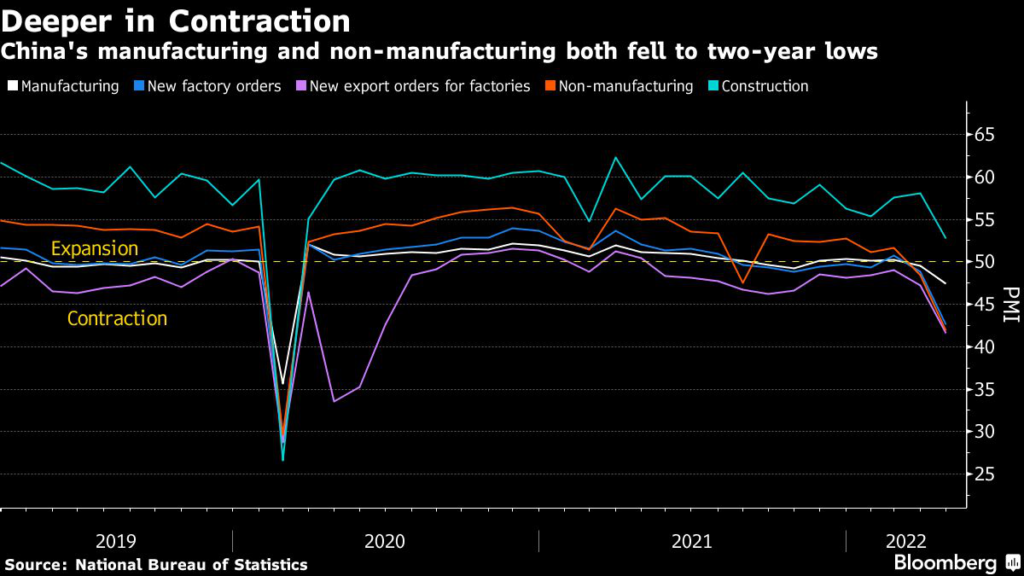
The official purchasing managers’ index for manufacturing, a leading indicator for factory output, fell to 47.4 in April, when Shanghai was in lockdown. In February 2020, the index fell to 35.7, indicating a deeper contraction in output then.

To minimize production losses, local governments have allowed some businesses to continue operating in so-called closed looped systems, where employees are kept at factory locations and undergo regular Covid testing to prevent outbreaks. 

“Productions are not completely shut and ports are still partially functional even in cities under lockdown such as Shanghai and Shenzhen with ‘close-loop’ management,” said Liu Peiqian, a China economist at NatWest Group Plc. “Exports were also growing, albeit at very low rate compared to regional peers.”

However, while the government is trying to get production back on track, many foreign businesses say they’re still unable to resume operations. Restrictions on the movement of people and testing requirements at border checkpoints have led to truck shortages, making it difficult for companies to transport their goods across provinces or to the ports.  

Logistics Nightmare

The PMIs show disruptions to supply chains are almost as severe as in 2020. Suppliers are experiencing the longest delays in over two years in delivering raw materials to their factory customers. Satellite data also show port activity is below levels seen in early 2020. 

Disruptions to factory output and logistics resulted in an abrupt slowdown in export growth and added to strains on global supply chains. 

Export growth slowed in April to its weakest pace since June 2020, while imports contracted for a second month. Two years ago, exports contracted the most on record when the coronavirus outbreak led to extended holidays, depressed factory output, and blocked transport and movement across the country. 

Property Woes

Even though many cities have loosened home purchase restrictions and cut mortgage rates this year, housing sales have continued to tumble, curbing demand in related industries from steel and cement, to furniture. 

More importantly, the downturn has cut local governments’ income from land sales which is a key source of revenue, limiting their ability to boost spending to spur growth. Many provinces are forecasting double-digit declines in land sale revenue this year, including rich areas like Beijing, Shanghai and Zhejiang. In 2020, regional authorities reported a 15.9% jump in the income.

An extra burden on local finances is the increased expenditure on virus testing. Since the Labor Day holidays in May, many cities have implemented mandatory regular nucleic acid testing for residents to access public transportation and venues. If this strategy was expanded to the whole of mainland China, it would cost between 0.9% and 2.3% of the country’s GDP, according to an estimate from Nomura.

Job Losses

The surveyed unemployment rate climbed to 5.8% in March amid the lockdowns, the highest since May 2020, according to the latest official data. In 2020, the jobless rate reached a peak of 6.2%.

The latest PMI surveys indicate a slightly smaller loss of jobs now than two years ago, but even so, employment in the manufacturing and non-manufacturing sectors in April were both at their worst levels since February 2020.

Going into this year, job losses were already mounting, especially among technology firms and after-school tutoring companies, after Beijing’s regulatory crackdown on those sectors. Tech giants like Tencent Holdings and JD.com Inc. have made national news headlines with tens of thousands of layoffs. 

Chinese Premier Li Keqiang held a national teleconference this month, warning of a “complicated and grave” job situation, language that conveyed more concern about the employment outlook now versus two years ago.

At the same meeting, Li’s deputy Hu Chunhua urged officials to “closely follow changes in the job situation, identify emerging problems in a timely manner and effectively prevent and resolve risks and hidden dangers in labor relationship and other issues,” a call that wasn’t made in 2020.

More stories like this are available on bloomberg.com

©2022 Bloomberg L.P.

Chicken Soup for the Soul Buys Redbox as SPAC Market Sputters

(Bloomberg) — Chicken Soup for the Soul Entertainment Inc. has acquired Redbox Entertainment Inc., a movies-to-rent streaming service that went public through a blank-check company last year, another sign that once-booming SPACs and the deals they fueled are losing steam.

The acquisition is valued at about $31 million, according to data compiled by Bloomberg, a huge markdown from the $254 million valuation Redbox had traded for before the deal was announced Wednesday. Chicken Soup has agreed to take on about $321 million in Redbox debt and got the company a new term loan. 

As part of the all-stock transaction, shareholders of Redbox will receive 0.087 of Chicken Soup’s Class A common stock per share. Apollo Global Management, one of the largest backers of Redbox, will own roughly 15.2% of the newly combined entity while direct lender HPS Partners will own about 4%. The deal is set to close in the second half of 2022.

Redbox shares, which plunged as much as 50% Wednesday, closed down 43% to $3.20 apiece. Since the blank-check deal that took the company public, Redbox’s shares have now fallen more than 66%, giving it a market value of $145 million

Chicken Soup, whose stock had fallen almost 78% in the past year through Tuesday, didn’t fare much better after the deal was announced. Its shares swung between a 23% surge and an 12% drop, closing down 9.9% to $7.14 to shrink its market value to $110 million.

‘Cleaning Up’ Structure

“What we really tried to do was look at what should each of us own in the combined company based on what we were each bringing to it,” Chicken Soup Chief Executive Officer Bill Rouhana said in an interview with Bloomberg News. “We were bringing assets that were helpful in terms of the debt, cleaning up of the capital structure, access to new cash and they were bringing these incredible assets, this bigger revenue business and the ability to generate a lot of cash flow.”

The market for SPACs, or special purpose acquisition companies, got hugely popular in the past half decade. The once-niche business had been seen as a way for companies to avoid some of the requirements of an initial public offering, and the market lured all manner of financiers, celebrities and even former President Donald Trump, who sought to cash in. But SPACs have recently been hounded by regulators with new liability guidelines. If enacted, those proposed rules would apply not only to initial listings by SPACs, but also would extend through their mergers with target companies.

This year, 66 SPACs have raised $11.5 billion on U.S. exchanges, compared with $102 billion at this point in 2021, according to data compiled by Bloomberg.

Based in Oakbrook Terrace, Illinois, Redbox is best known for its early days of having DVD rental kiosks across the US. But in the era of streaming, the business expanded its focus to other customer touch points.

Mall Cop, Spiderman

Today, Redbox serves movie buffs through both a premium and ad-supported streaming option and tent-pole theatrical releases such as “Mall Cop” and “Spiderman: No Way Home.”

It still has kiosks, with 64 million rentals through them last year, Redbox Chief Executive Officer Galen Smith told Bloomberg News. And while most may think that DVDs sticking around is due to stubborn film aficionados defying an upgrade to the latest technology, Rouhana attributes it to a lack of proper broadband access. 

Chicken Soup, an advertising-video-on-demand (AVOD) network operator, has been on the hunt to continue growing its content library and user base of more than 40 million monthly active viewers. Headquartered in Connecticut, the company operates multiple ad-supported streaming services including PopcornFlix, Chicken Soup for the Soul and also Crackle, which it acquired in 2019 from Sony Pictures Television. 

According to Rouhana and Smith, the deal for Redbox came together in a matter of days. Nothing was agreed upon as of Sunday night. But initial talks from two years back helped discussions pick up where they left off when Redbox in an February filing with the U.S. Securities and Exchange Commission said it was exploring strategic options of its business. 

“It’s always been logical, it’s always made sense, and everybody around the table has always known that,” Rouhana said. “So you could say its taken two years, you could say its taken three months, and if you’ve lived in it you could say it was a day.” 

But “I’m happy that we broke through and got it right,” he added.

(Updates with closing share prices in fifth paragraph)

More stories like this are available on bloomberg.com

©2022 Bloomberg L.P.
Sonos Launches Own Voice Assistant to Take on Alexa and Siri

(Bloomberg) — Audio-electronics maker Sonos Inc. is introducing its own voice-activated digital assistant, pushing into a market dominated by tech giants like Amazon.com Inc. and Apple Inc.

The new service, called Sonos Voice Control, is focused on controlling media content and the company’s devices, rather than serving up information in the style of Amazon’s Alexa or Apple’s Siri. Still, it marks an ambitious expansion for a company best known for sound bars and other audio accessories. 

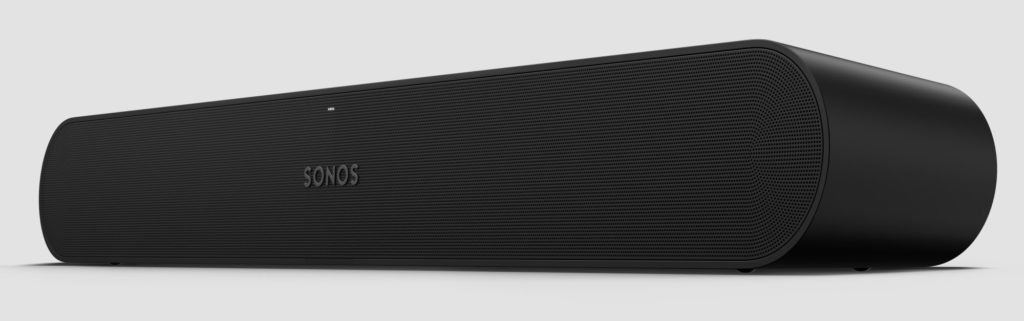
The service was part of a new lineup of products announced Wednesday that also included a new lower-cost sound bar aimed at TVs. The functionality, which Sonos claims is the most private on the market because data isn’t shared to the cloud or monitored by the company, will be added to existing Sonos devices via a software update on June 1.

Sonos also released upbeat quarterly results Wednesday, sending the shares soaring in late trading.

Sonos Voice Control can manage music and video playback, adjust volume and allows users to specify which speakers in their home they want the audio to play on. Similar to the “Hey Siri” and “Hey Google” wake words used by rival systems, the Sonos technology can be activated by saying “Hey Sonos.” The service will launch first in the US and eventually roll out to France and other regions, the company said. 

Sonos’s new Ray sound bar, meanwhile, will cost $279 — well below the price of its $449 Beam and $899 Arc models. It’s also releasing its Roam portable speaker in new blue, orange and green colors. 

While Sonos is known as one of the premier companies in the personal and home audio space, it’s facing a more crowded market — and that’s taken a toll on its stock price. The shares had declined about 30% so far this year as the company competed with new Amazon speakers and devices from Apple.

The latest results brought a jolt of optimism. Revenue for its second quarter came in at about $400 million, beating the average analyst prediction of $352 million. Earnings of 26 cents a share, excluding some items, also sailed past estimates. That sent the shares up as much as 23% in extended trading Wednesday. Still, Sonos warned that supply-chain snags and rising component prices would continue to be challenges this year.

The company is looking to push into other new areas to maintain growth. Sonos has long been working on wireless headphones to better compete outside of the home, for instance.

(Updates with the company’s earnings results starting in fourth paragraph.)

More stories like this are available on bloomberg.com

©2022 Bloomberg L.P.

Google Shows Early Preview of Augmented Reality Glasses

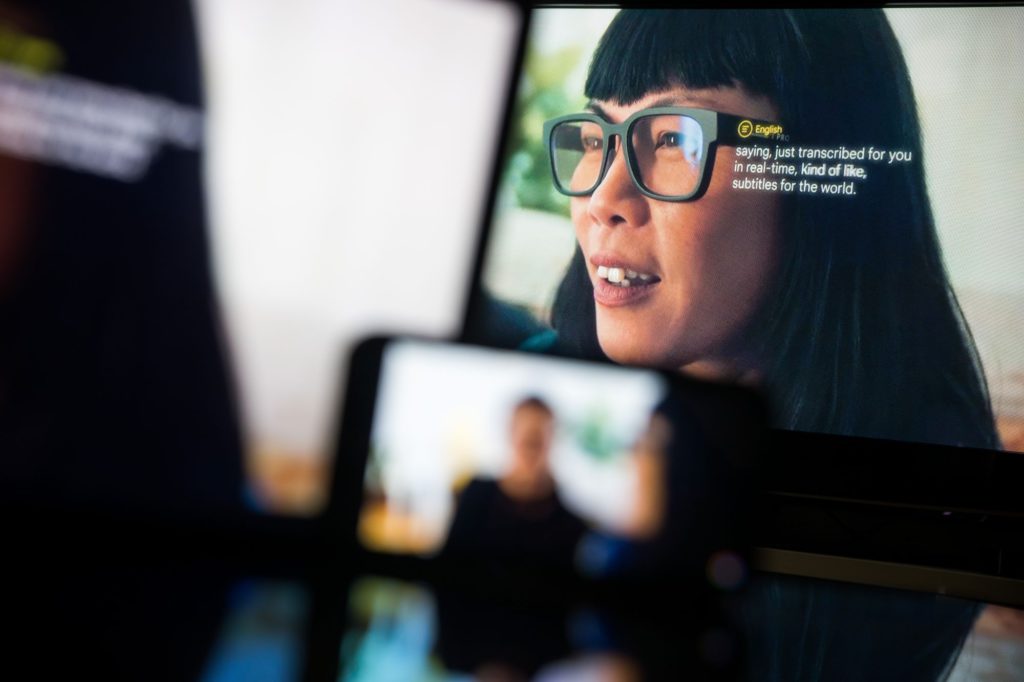
(Bloomberg) — Alphabet Inc.’s Google, which failed to find a consumer audience for its internet-connected glasses about a decade ago, on Wednesday presented a prototype of augmented reality glasses aimed at the general public. 

In a brief demonstration at its annual I/O developer conference, the company showed glasses using an AR version of Google Translate. The company didn’t say when the glasses would be ready for consumers, but Chief Executive Officer Sundar Pichai indicated Google has a “long way to go” before releasing them.

“It’s important we design in a way that’s built for the real world and doesn’t take away from it,” Pichai said. 

The company has long offered an enterprise-focused Google Glass headset, but the device has sold poorly after being panned as a consumer product. Google’s new AR glasses will rival ongoing efforts from Meta Platforms Inc. and Apple Inc., which are developing similar products. 

More stories like this are available on bloomberg.com

©2022 Bloomberg L.P.
Coinbase Lets Users Know What a Bankruptcy Could Mean for Their Crypto

(Bloomberg) — Coinbase Global Inc., like the rest of the cryptocurrency market, is having a really tough week. Not filing-for-bankruptcy bad, but the biggest US crypto exchange did just mention the B-word in a regulatory filing, giving its customers a painful reminder of how bad things could get for them if Coinbase ever does get seriously distressed.

In its quarterly report, Coinbase added a risk disclosure: if the company were to file for bankruptcy, the court might treat customer assets that the exchange is custodian for — their Bitcoin, Dogecoin or whatever — as Coinbase’s assets. And they’d be at the back of the line for repayment, forcing normal people, unaccustomed to the ins and outs of federal bankruptcy court, to claw back their money along with everybody else owed money by the exchange.

It’s a huge amount at stake. Coinbase was custodian for $256 billion of customer money on March 31, according to the filing.

Chief Executive Officer Brian Armstrong quickly took to Twitter to elaborate, saying the company is not at risk of going bankrupt and that users’ funds are safe.

Adam Levitin, a Georgetown University law professor who studies bankruptcy, examined this scenario in a February post on the Credit Slips blog.

“So what happens to a customer if an exchange files for bankruptcy? I think it ends very badly for the customers,” Levitin wrote. The insolvency proceedings would probably prevent customers from selling or exchanging their coins because of the so-called automatic stay imposed on creditors.

US courts have not yet dealt with the bankruptcy of a cryptocurrency exchange, and there are a bevy of open legal and regulatory questions. One thing is clear enough, though: if Coinbase users were to become so-called general unsecured creditors — and the company’s disclosure says they might — they’d likely have an unpleasant time.

General unsecured creditors are the last to recover money. Ahead of them would be senior debtholders — Coinbase has $2 billion of senior unsecured bonds outstanding — along with the lawyers and bankers that help any company navigate bankruptcy, racking up potentially huge bills along the way.

Users would need to fill out paperwork demanding what they’re owed, file it on time and potentially wait months or years for payout. Often, low-ranking creditors are left with pennies on the dollar.

Coinbase’s bonds due in 2028 and 2031 have both tumbled below 70 cents on the dollar this week — far from brink-of-bankruptcy levels, but in line with some of the riskiest high-yield debt in the market.

More stories like this are available on bloomberg.com

©2022 Bloomberg L.P.

‘Everything Broke’: Terra Goes From DeFi Darling to Death Spiral

(Bloomberg) — A celebrated experiment that combined math and software to get a digital currency to behave like a dollar is crashing in dramatic fashion, posing the biggest test yet to decentralized finance and the will of its backers to defend it.

TerraUSD, or UST, is an algorithmic stablecoin, meaning it uses a complex combination of code, trader incentives, smart contracts and no small amount of faith to maintain its peg of one-to-one to the dollar. It does this by working with a crypto token in the same ecosystem, Luna, which can be swapped for UST and vice versa by traders to keep the price of UST where it should be.

The point of projects like UST is to enable crypto traders to make transactions easily and quickly without needing to leave the digital asset ecosystem, rely on intermediaries or worry about the value of their coins going up and down. By using software programs to manage the token’s volatility, the opportunities for profiting off arbitrage are even greater — DeFi lender Anchor Protocol was known for offering market-beating rates of up to 20% to traders willing to deposit UST on its platform. In summary, it’s the crypto dream.

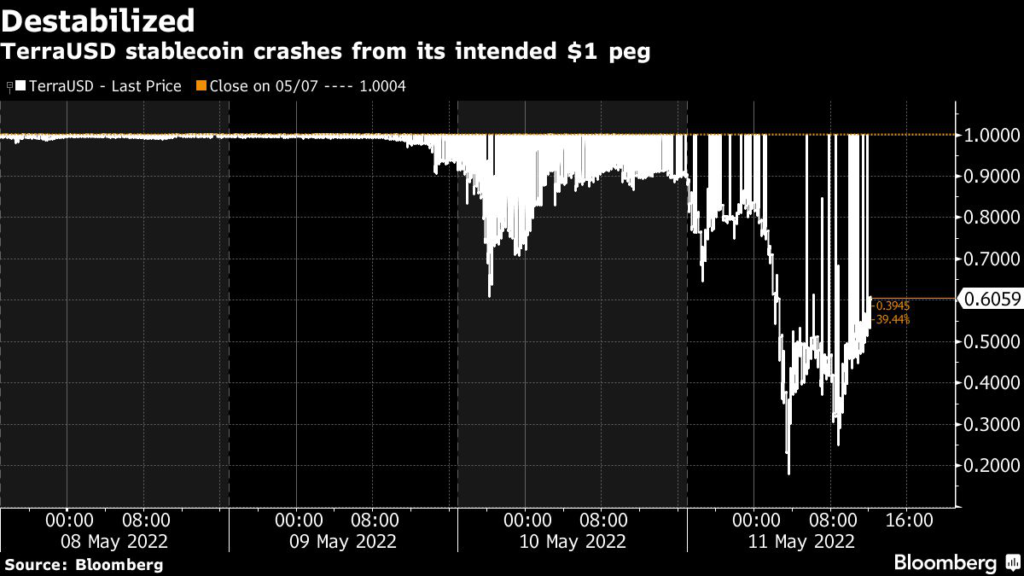
A month ago, the future looked bright for Terra and its main backer Do Kwon: A consortium called the Luna Foundation Guard aimed at providing collateral for Luna — then at an all-time high value of $119 — had bought more than $1.5 billion in Bitcoin to shore up UST’s peg, with its members reading like a Who’s Who of crypto. But on Monday, all of the mechanisms that were supposed to keep UST stable weren’t. It fell to a low of 60 cents on that day, and reached a further low of around 20 cents in another crash on Wednesday, taking its market value down from $18.4 billion to $5 billion. Luna also fell considerably, dropping to as low as $2.35.

“Many people were caught off guard,” said Nikita Fadeev, partner and head of crypto fund Fasanara Digital, which de-risked its position in advance of the crash. “Everything broke there. It is full capitulation.”

Exactly why all of Terra’s carefully-planned mechanisms failed to do their job remains unclear, and conspiracy theories abound about shadowy actors with untold wealth to play with. But one thing’s for certain: Kwon isn’t going down without a fight. 

Read more: Crypto’s Audacious Algorithmic Stablecoin Experiment Crumbles

He’s now attempting to raise $1.5 billion from new and old investors alike to provide more collateral to UST, hoping to rebuild the token’s liquidity after it virtually disappeared from order books overnight. Some suspect that $1.5 billion won’t even be enough, and it could take days, if not weeks, for UST to re-peg to the dollar.

“Once liquidity evaporated, this perpetuated the collapse of the stablecoin,” said Clara Medalie, research director at Kaiko, in an email. In order for UST to re-peg, she said, buy orders from crypto traders will need to consume all of the asking price’s liquidity to get it up to $1. “This morning, there is virtually nothing left.”

Read more: Terra Stablecoin Rescue Efforts Struggle to Win Investor Support

Terraform Labs, which powers the Terra blockchain, is backed by firms including Galaxy Digital, Pantera Capital and other players in crypto. 

Among the firms that were approached via a round robin in the latest financing attempt were Nexo and crypto banking app Cashaa, which declined to participate. Meanwhile, crypto firm Celsius said it “was not and is not involved” in any Luna bailout, while Alameda Research, Galaxy, Jane Street and Jump Crypto were said to be among those in discussions over financing. 

Anchor, now a shadow of its former self as the main driver of demand for UST on the Terra network, has proposed temporarily cutting its interest rate to a minimum of 3.5%. While its total amount deposited sat as high as $14 billion on Monday, it had around $3.6 billion in UST still on its books by mid-afternoon in London on Wednesday.

Already, comparisons with the 2008 financial crisis have started to roll in. Hallmarks of shadow banking, such as circular market mechanics and extremely high leverage, are readily visible among Terra’s ecosystem, something that academics fear could create a second, digital wave of failed lenders and wiped-out savings. 

“It will get worse before it will get better — way too much UST is looking to exit, and the death spiral is very reflexive at these levels,” added Fadeev. “It’s a long road ahead.”

(Adds additional firms said to be in talks over financing.)

More stories like this are available on bloomberg.com

©2022 Bloomberg L.P.
Disney Bulls Stay Put Even After Netflix Streaming Slump

(Bloomberg) — Even as Walt Disney Co.’s stock heads for its biggest annual drop in at least 47 years, analysts are clinging to their price targets for the media giant, betting that it can avoid the loss of streaming-video subscribers that’s crushed rival Netflix Inc.’s share price.

Analysts expect the stock to rise by about 69% in the next year, based on the average target compiled by Bloomberg. Underpinning their optimism: Disney’s streaming unit still has room to grow and, unlike Netflix, the company has businesses such as theme parks that are set to rebound now that pandemic lockdowns have ended in the U.S. and Europe.

Collectively analysts have predicted such a big gain only one other time, when Disney plunged at the outset of the pandemic in March 2020. That drop happened so quickly that brokers had little time to adjust their models. This year, however, the stock’s 30% drop has been more gradual and brokerages have largely held on to their targets. 

Now the next catalyst for the stock comes as the company reports earnings after markets close Wednesday. With Netflix shocking Wall Street last month with its first customer decline in more than a decade, investors will be keen to see if the Disney+ streaming service will face similar issues and hit a subscriber wall.

Analysts predict Disney+ had 134.4 million subscribers in its fiscal second quarter, up 3.5% from the first, with growth forecast to accelerate in the second half.

“The industry’s streaming dreams may be losing their luster, but Disney+ could shine with content and scale that outperforms, especially with a new ad-supported tier, ” Bloomberg Intelligence senior analyst Geetha Ranganathan said. The company is likely to add 40 million subscribers this year thanks to “a steady pace of new titles, local content and added markets.”  

The Hollywood studio’s stock got a boost during the pandemic-induced lockdowns as Disney+ attracted millions of new customers. Now with economies opening up and travel recovering, the company is also being benefiting from its theme park business rebounding. 

To be sure, analyst optimism on Disney hasn’t paid off lately. The stock has slumped 48% from March 2021 high and this year is on track for its biggest drop since at least 1975. And it may be that their price targets are so bullish now only because analysts missed the decline in the stock and are late in catching up to it.

In addition to concern about a streaming slowdown, investors are already wondering how long the good times can last for the theme parks given that recession fears are mounting.

“We think sentiment on both is overdone,” Steven Cahall, a Wells Fargo & Co. analyst who sees the stock gaining 69% in the next year, said in a note. 

Disney’s diversified business has helped the stock avoid the violent selloffs that have rocked former stay-at-home favorites like Netflix, Peloton Interactive Inc. and Zoom Video Communications Inc., which have fallen between 75% and 92% from their peaks.


Tech Chart of the Day

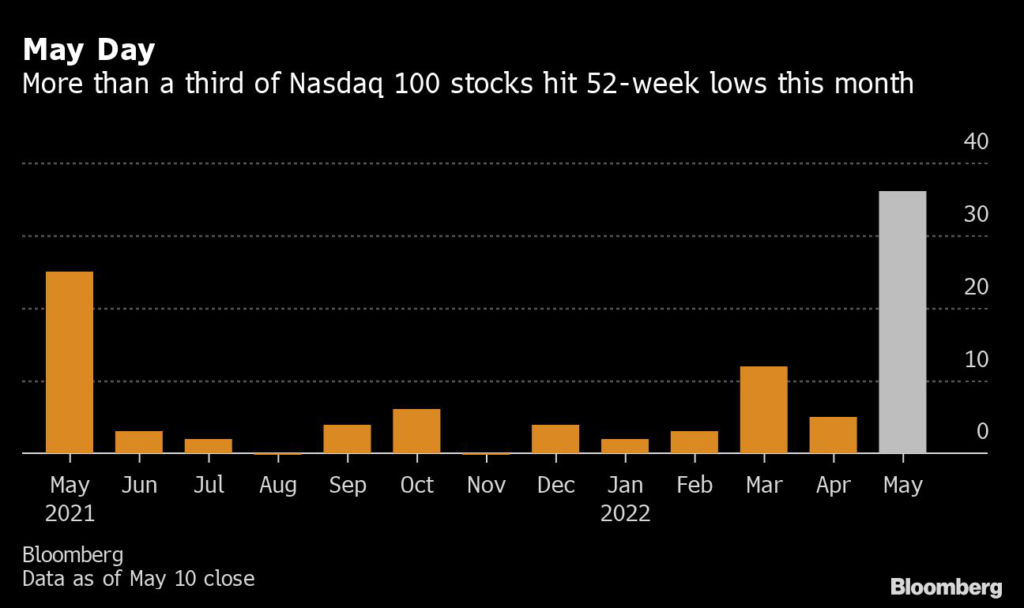
There’s something about May: The Nasdaq 100 Index has had a rough start to the month, with 36 stocks hitting 52-week lows in the first seven sessions, and there are still more than two weeks to go. Last year was similar, with more than two dozen 52-week lows in May.  

Top Tech Stories

  • Three years after US officials sounded the national-security alarm about Chinese-made telecommunications equipment, the technology remains in place throughout America — including in some surprising places
  • Panasonic Holdings Corp. said it plans a potential stock market listing for its supply chain management arm, as it seeks to increase the independence of its operating businesses
  • Electronic Arts Inc. reported revenue for the current quarter that missed analysts’ estimates, as the video game publisher continues to feel the effects of an industry-wide downturn and the flop of last fall’s Battlefield game
  • GlobalFoundries Inc., the biggest U.S.-based provider of made-to-order semiconductors, posted quarterly sales and profit that topped analysts’ estimates, a sign it’s benefited from industrywide shortages
  • Roblox Corp., a video-game platform aimed at preteens and teenagers, reported bookings that declined from a year ago and missed analysts’ estimates, continuing a trend that saw the time players spent on the platform growing slower than during the pandemic
  • Unity Software Inc. shares slumped as much as 30% in U.S. premarket trading after the 3D game-development company gave a second-quarter revenue forecast that was weaker than expected
  • Twitter Inc. was “foolish in the extreme” in kicking former US President Donald Trump off its service and his permanent ban should be ended, said Elon Musk, the billionaire who has agreed to acquire the social media company
  • Traders are the most skeptical they’ve ever been about whether Elon Musk will actually complete his proposed purchase of Twitter Inc. The spread on the deal, which offers an indication of how much Wall Street believes the takeover will be completed, jumped to $6.94 on Tuesday — the widest since the billionaire launched his bid

(Updates share price moves throughout.)

More stories like this are available on bloomberg.com

©2022 Bloomberg L.P.
Google Debuts Smartwatch to Rival Apple as It Expand Devices

(Bloomberg) — Alphabet Inc.’s Google outlined a significant in-house hardware expansion, highlighted by its first branded smartwatch to compete with Apple Inc.’s popular product.

Google Pixel Watch, in contrast with the Apple Watch, has a circular screen, mimicking most classic wristwatches. The device was primarily developed by Fitbit, which Google acquired in January 2021, and includes Fitbit-based health tracking integration. 

At its annual I/O developer conference Wednesday, the search giant also introduced high-end earbuds, new smartphones and its first tablet since exiting the category three years ago. 

Google’s watch will run its Wear OS software and support tasks like tap-to-pay, finding directions in Google Maps and receiving notifications. It will also be controlled by Google’s voice assistant and a tactile crown on the side — similar to the Apple Watch with digital assistant Siri and its Digital Crown. Like Apple, Google will also offer a version with 4G cellular connectivity. 

Unlike other smartwatches running on Wear OS, Google’s Pixel Watch won’t be compatible with Apple’s iPhones.

The smartwatch market is fairly saturated, with Apple owning about 30% of sales. Samsung Electronics Co. holds 10%, while the rest of the market is made up of Fitbit, Garmin Ltd. and smaller China-based players like Huawei Technologies Co., according to Counterpoint Research. 

While Google’s hardware business has yet to become a major revenue contributor since the first Pixel phone launched in 2016, the company has continued to push out new phones and other devices annually. Google called last year’s Pixel 6 its most successful device to date, far outselling previous generations of the phone. The company doesn’t disclose hardware revenue. Google’s “other revenue,” which includes hardware, app store sales and video subscriptions, generated more than $28 billion last year.

Google’s Pixel Watch will be released in the fall, but the company didn’t provide information about the cost to consumers. In an interview, Rick Osterloh, Google’s head of hardware, said it would be a “premium-priced” device. Apple’s stainless steel Apple Watch starts at $749 and the company is planning new watches later this year.

Google is also working on a Pixel Tablet and plans to launch it next year. The company didn’t disclose pricing, specific release details or unique capabilities, but Osterloh said its size would be on the larger side. Apple sells tablets from about 7-inches to 13-inches in size, while Samsung makes a large 15-inch device. Google had stopped designing new tablets in 2019 to focus on laptops. 

Osterloh also previewed the Pixel 7 and Pixel 7 Pro, the company’s next high-end smartphones planned for release in the fall. The devices will have an updated design for the back camera system and a faster processor. The company didn’t disclose pricing. 

Coming sooner will be two products: the Pixel 6a and the Pixel Buds Pro. The Pixel 6a is a lower-cost version of last year’s Pixel 6, priced at $449 instead of $599. It has cheaper materials like aluminum edges, a smaller, 6.1-inch screen, lesser 12 megapixel cameras, but the same custom Tensor processor inside. 

The new earbuds rival Apple’s AirPods Pro and Samsung’s Galaxy Buds Pro. Like with rivals, the main new feature is noise-cancellation, a transparency mode to hear outside noise and a stronger ability to limit background noise during calls. The earbuds also have seven hours of battery life with noise-cancellation turned on. 

More stories like this are available on bloomberg.com

©2022 Bloomberg L.P.
Close Bitnami banner
Bitnami