
Bloomberg

Google Debuts Smartwatch to Rival Apple as It Expands Devices

(Bloomberg) — Alphabet Inc.’s Google outlined a significant in-house hardware expansion, highlighted by its first branded smartwatch to compete with Apple Inc.’s popular product.

Google Pixel Watch, in contrast with the Apple Watch, has a circular screen, mimicking most classic wristwatches. The device was primarily developed by Fitbit, which Google acquired in January 2021, and includes Fitbit-based health tracking integration. 

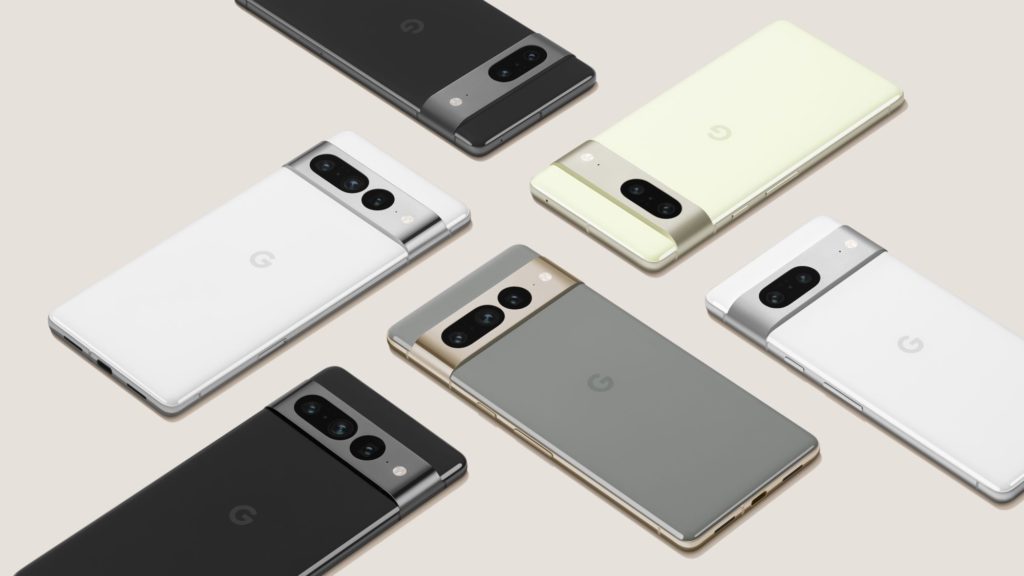
At its annual I/O developer conference Wednesday, the search giant also introduced high-end earbuds, new smartphones and its first tablet since exiting the category three years ago. 

Google’s watch will run its Wear OS software and support tasks like tap-to-pay, finding directions in Google Maps and receiving notifications. It will also be controlled by Google’s voice assistant and a tactile crown on the side — similar to the Apple Watch with digital assistant Siri and its Digital Crown. Like Apple, Google will also offer a version with 4G cellular connectivity. 

Unlike other smartwatches running on Wear OS, Google’s Pixel Watch won’t be compatible with Apple’s iPhones.

The smartwatch market is fairly saturated, with Apple owning about 30% of sales. Samsung Electronics Co. holds 10%, while the rest of the market is made up of Fitbit, Garmin Ltd. and smaller China-based players like Huawei Technologies Co., according to Counterpoint Research. 

While Google’s hardware business has yet to become a major revenue contributor since the first Pixel phone launched in 2016, the company has continued to push out new phones and other devices annually. Google called last year’s Pixel 6 its most successful device to date, far outselling previous generations of the phone. The company doesn’t disclose hardware revenue. Google’s “other revenue,” which includes hardware, app store sales and video subscriptions, generated more than $28 billion last year.

Google’s Pixel Watch will be released in the fall, but the company didn’t provide information about the cost to consumers. In an interview, Rick Osterloh, Google’s head of hardware, said it would be a “premium-priced” device. Apple’s stainless steel Apple Watch starts at $749 and the company is planning new watches later this year.

Google is also working on a Pixel Tablet and plans to launch it next year. The company didn’t disclose pricing, specific release details or unique capabilities, but Osterloh said its size would be on the larger side. Apple sells tablets from about 7-inches to 13-inches in size, while Samsung makes a large 15-inch device. Google had stopped designing new tablets in 2019 to focus on laptops. 

Osterloh also previewed the Pixel 7 and Pixel 7 Pro, the company’s next high-end smartphones planned for release in the fall. The devices will have an updated design for the back camera system and a faster processor. The company didn’t disclose pricing. 

Coming sooner will be two products: the Pixel 6a and the Pixel Buds Pro. The Pixel 6a is a lower-cost version of last year’s Pixel 6, priced at $449 instead of $599. It has cheaper materials like aluminum edges, a smaller, 6.1-inch screen, lesser 12 megapixel cameras, but the same custom Tensor processor inside. 

The new earbuds rival Apple’s AirPods Pro and Samsung’s Galaxy Buds Pro. Like with rivals, the main new feature is noise-cancellation, a transparency mode to hear outside noise and a stronger ability to limit background noise during calls. The earbuds also have seven hours of battery life with noise-cancellation turned on. 

More stories like this are available on bloomberg.com

©2022 Bloomberg L.P.
Kohl’s Fends Off Activist Macellum’s Bid to Overhaul Board

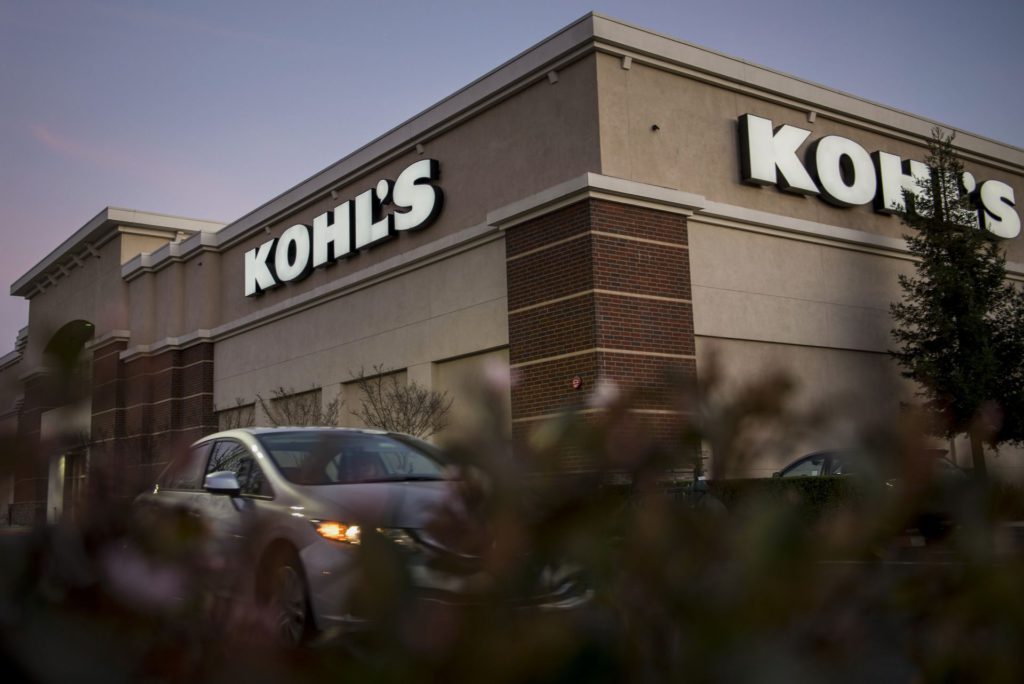
(Bloomberg) — Activist investor Macellum Capital Management’s bid to overhaul the board of Kohl’s Corp. was rejected by investors on Wednesday.

Kohl’s shareholders voted against all 10 directors nominated by Macellum, according to a preliminary tally, the retailer said in a statement. The hedge fund has been pressuring the company for two years to overhaul its board or sell itself. That seems unlikely now in the wake of the proxy outcome, said Neil Saunders, an analyst with GlobalData.

“Kohl’s does need to ramp up its performance and be more radical,” Saunders said in a phone interview. “But the solutions being provided by Macellum aren’t the answer to that.”

Shares of the Menomonee Falls, Wisconsin-based retailer fell as much as 4.6% in New York. Bloomberg News reported the vote result earlier Wednesday, citing people familiar with the situation.

Kohl’s shares had declined 23% through Tuesday since reaching a 52-week high of $64.06 nearly a year ago. The slump garnered attention from numerous unsolicited suitors, including a $64-a-share offer from Acacia Research Corp., or about $9 billion. Kohl’s said in February that it had rejected takeover offers that it viewed as too low and hired bankers to field additional interest in the company.

“The Board remains focused on running a robust and intentional review of strategic alternatives while executing our strategy to drive shareholder value,” Kohl’s Chairman Peter Boneparth said in Wednesday’s statement.

Macellum’s nominees to the 13-member board included Kenneth Seipel, a former vice president of Old Navy, and Jeffrey Kantor, a former Macy’s executive. Kohl’s said the slate lacked retail experience and that Macellum, which has about a 5% stake in the retailer, was pushing “for a hasty sale at any price.”

Kohl’s board shouldn’t take the vote as a sign that shareholders are satisfied, said Jonathan Duskin, Macellum’s managing partner. 

“It’s unfortunate that many investors voting for the incumbents seem to have bought into the narrative that change in the boardroom would be too disruptive during a sale process and possibly delay or jeopardize a near-term transaction,” Duskin said. “The Board should not misconstrue today’s result as a ringing endorsement of its preferred operating plan, which has been met with considerable market skepticism.”

Saunders said Kohl’s management will be under pressure to improve sales growth in the absence of a deal. The company will report first-quarter results on May 19.

The retailer has sought to drive sales by expanding its athletic wear and forming partnerships with Sephora and Amazon. Meanwhile, Macellum contends that Kohl’s should sell its real estate assets or separate the e-commerce division if it’s unwilling to sell the full company.

(Updates with analyst commentary in third paragraph, Macellum in eighth.)

More stories like this are available on bloomberg.com

©2022 Bloomberg L.P.
Google Is Remaking Search, Maps for the TikTok Generation

(Bloomberg) — Alphabet Inc.’s Google unveiled a series of planned upgrades to its search and maps services revealing the company’s augmented reality ambitions—and its appeal to a generation of internet users drifting away from the  company.

The new features include ways for people to search for nearby items using images and identify physical objects with their smartphone cameras. On Google Maps, the company promised a way for people to explore detailed 3D digital models of landmarks and neighborhoods before setting foot in person. Google shared the plans on Wednesday for the first day of its annual I/O developer conference held near its Mountain View, California headquarters.

Google is working to keep its products relevant and growing as users’ needs evolve beyond text. “Search should be something that you can do anywhere, in any way you want, using any of your senses,” Prabhakar Raghavan, Google’s senior vice president and product chief, said in an interview. Google’s core search advertising business has continued to grow steadily during the pandemic, despite recent middling financial results. Yet the I/O announcements underscored nascent threats Google sees to its flagship services. 

Read about Google’s new device announcements

People in emerging markets are more likely to search with voice features than typing, which has driven Google to invest more in its voice assistant feature. And according to Google, younger internet users have started turning to social media apps for both entertainment and information on world events and daily decisions. “They could start at Instagram or TikTok to figure out where to go for lunch,” said Raghavan. “We see a tendency—a demand even—to interact with the physical world.”

He added, “We have to look at our role in that and make sure we don’t remain stuck in the past when the audience is seeking something beyond.”

Google will start letting people use photos and text together in local searches with a new “multisearch” update that taps its computer vision and data resources. This feature identifies products nearby, which will likely appeal to marketers that pay for ads in a certain geographic proximity to a user. 

And Google is expanding the utility of Lens, its feature for identifying objects in the real world, which investors are eager to see contribute more to its e-commerce operations. Google said there are over 8 billion visual searches on Lens a month, up threefold from a year ago.  Raghavan introduced the Lens search feature by promising consumers could find a particular product at a pharmacy or a Black-owned wine label at a local corner store. 

Read more about Google’s new Wallet app

As part of an effort to increase news literacy, Google is expanding a tool it unveiled last year, called “About this Result,” beyond search. Today, the tool is available in English on search results, letting users see a short description of a website, such as its political leaning or its governmental affiliation, before they visit it. Soon, when users view a website on the Google app, they will be able to see information about the source while they’re already on the website. 

The company also demonstrated a more “immersive” version of its maps product. The company said people will be able to zoom in and view the architecture of sites like Big Ben up close, and use a tool to understand what it looks like at different times of day, in order to guess traffic, crowd size or weather conditions. In the future, developers will be able to build similarly three-dimensional experiences.  Raghavan stressed that these were early trials and not a proof of the next computing frontier. “For this to really blossom into a metaverse or something of that nature, we need 200 or 2,000 such experiences,” he said. “We’re so early in the game that I’m not anxious to rush into characterizing the phenomenon yet.” 

Google this year shied away from making grand pronouncements about futuristic virtual and augmented reality tools. A decade ago, co-founder Sergey Brin skydived into the conference wearing the Google Glass headgear; the company showcased several VR units in later years. All of those projects have been shelved or set aside. Google has since focused more deeply on artificial intelligence and, unlike rival Meta Platforms Inc., hasn’t eagerly pitched a vision of a virtual world replacing our own.To beef up personal account security, Google announced new safety tools to its products. The Account Safety status will appear as a yellow circle around users’ avatars when there is something that needs their attention. The company added that while working on Google Docs, Sheets and Slides, users should expect more proactive phishing alerts soon.

The company also unveiled what it is calling a new Protected Computing Initiative. To help users protect their personal contact information, Google is launching a new tool that lets people flag their phone numbers or addresses when they appear in a public search. The company said it would continue its efforts to remove personal identifying information from account data and invest robustly in encryption.

Like prior I/O events, most of what Google shared isn’t available yet. The Maps features will begin in Los Angeles, New York, London, San Francisco and Tokyo, coming to more cities later, the company said. The new search features will be released later this year.

(Updates with website context feature in the eighth paragraph.)

More stories like this are available on bloomberg.com

©2022 Bloomberg L.P.
Luna Bailout Terms Put a Crypto Spin on Death-Spiral Financing

(Bloomberg) — From borrowing and lending platforms to synthentic equities to simply trying to build a stable proxy for the US dollar, cryptocurrency projects have long attempted to reimagine traditional financial vehicles for the age of the blockchain. 

Now, after the values of both the Luna and TerraUSD coins have collapsed in dramatic fashion, something that in broad strokes resembles an old Wall Street tactic is being revived in hopes of saving the project behind them — death-spiral financing — as well as another money-raising tool favored by strapped companies, a PIPE, where stock is sold to institutions at below-market prices.

As the phrase implies, death-spiral financing is when desperate companies raise capital by issuing a type of convertible bond that can lead to a flood of shares in the market, potentially dooming the stock price. The last-ditch effort to save an insolvent company is so fraught with risk that modern Wall Street firms tend to avoid getting involved, though it’s been seen more commonly in recent years in the sketchy corners of the penny stock market. 

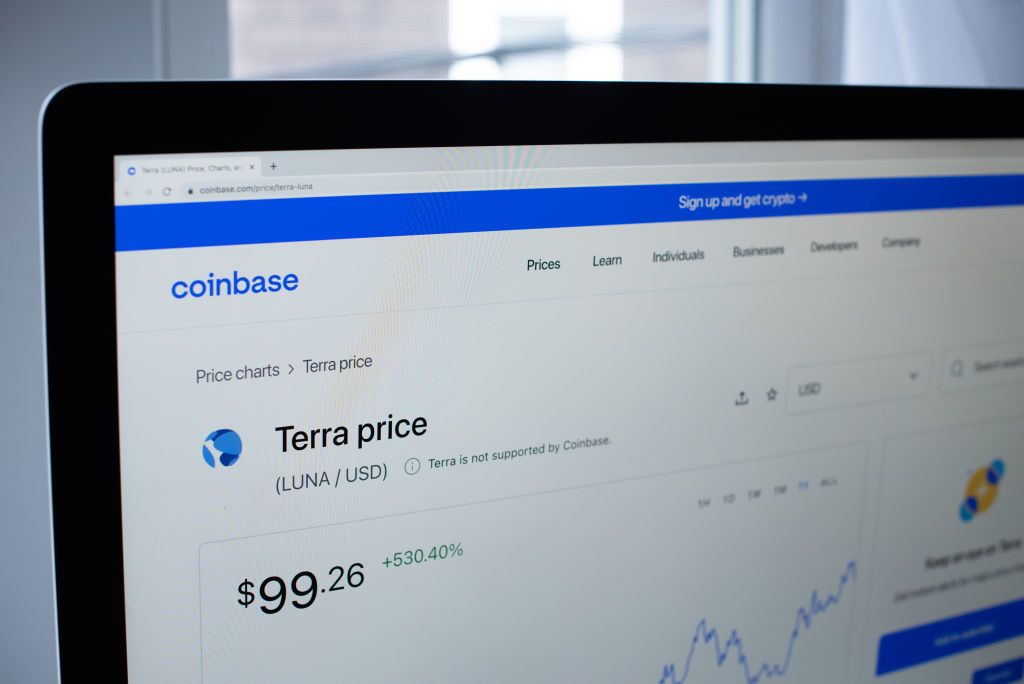
In the latest example of the crypto world imitating traditional finance, backers of the TerraUSD algorithmic stablecoin (known as UST) are trying to raise about $1.5 billion to shore up the token after it crashed from its dollar peg, according to the founder of a firm that was approached about the deal from the Luna Foundation Guard, a consortium set up to help UST maintain a $1 value. Investors would be able to buy the Luna cryptocurrency — a coin with fluctuating value that’s used on the other side of arbitrage trades meant to keep UST pegged at $1 — at a 50% discount to the spot price. The LFG didn’t immediately respond to requests for comment. 

That spot price is a swiftly moving target, however. Luna traded for more than $116 in early April, but a crisis of confidence in the project has caused its value to crash to as low as 84 cents on Wednesday, according to CoinMarketCap.com. The UST stablecoin that’s always meant to be worth $1 traded for less than 30 cents on Wednesday before rebounding to about 50 cents. 

To Max Gokhman, chief investment officer for AlphaTrAI, selling something that’s crashed so hard at a 50% discount is like a bad joke. 

“There’s catching falling knives and then there’s standing outside when it’s raining chainsaws,” Gokhman said. “This feels like the latter.”

Terraform Labs, which created the Terra blockchain where Luna and UST were born, is backed by some of the deepest pockets in the industry, including Coinbase Ventures, Galaxy Digital and a host of others. Yet skepticism is rampant that Terra will be able to line up enough financing to save its stablecoin from a death spiral.

The Luna Foundation Guard, which the project set up to help UST maintain a $1 value, had been on a Bitcoin-buying binge in hopes that holdings of the oldest cryptocurrency could be used in tandem with the Luna token to safeguard the stablecoin’s value.  

Yet crashing values of both Luna and Bitcoin made maintaining that $1 peg harder and harder.  

Read more: Bitcoin’s Most-Watched Whale Is the King of the ‘Lunatics’

“Risky assets are correlated and the selling pressure drags one asset into a deeper discount,” said Wilfred Daye, chief executive officer of Securitize Capital, a digital asset management firm. “The selling pressure drags the price further down on BTC, and then you have a whole loop, if you will. That’s the death spiral. It’s crazy.”

In order for Terra to issue enough Luna to get UST back up to $1, dilution of as much as 1,000% may be needed, according to Kunal Goel, an analyst at crypto-research firm Messari. The resulting mismatch between demand for Luna and supply of UST from investors fleeing Terra’s borrowing and lending protocol Anchor may prove to be fatal.  

For Stephane Ouellette, chief executive of FRNT Financial Inc., even a 50-cent value for UST seems odd. The stablecoin that currently had a market value of about $7.5 billion as of Wednesday morning is backed by somewhere between $1 billion and $2 billion of assets, he said. 

“The whole thing looks like it’s headed to zero anyways,” he said.

More stories like this are available on bloomberg.com

©2022 Bloomberg L.P.

VW Revives Dormant Scout Brand With EV Models for US Growth

(Bloomberg) — Volkswagen AG is breathing life into the defunct Scout offroad vehicle brand with a plan for a rugged electric sport utility vehicle and pickup model to capture market share in the US, where the company has long struggled. 

Europe’s biggest carmaker, which already counts 10 different automotive brands, plans to set up an independent company in the US this year that will design and make the vehicles, VW said Wednesday. Success in the world’s second-biggest auto market has eluded the manufacturer because of a lack of SUVs and pickups.

“Electrification provides a historic opportunity to enter the highly attractive pickup and R-SUV segment as a group, underscoring our ambition to become a relevant player in the US market,” Chief Executive Officer Herbert Diess said in a statement. 

Reviving Scout would add yet another brand to VW’s stable of nameplates that include Audi, Porsche and Bentley — even as the company has said it wants to make the German behemoth leaner to better compete with the likes of Tesla Inc. and Rivian Automotive Inc. The desire to streamline is competing with Diess’s goal of more than doubling VW’s market share in the lucrative US market to 10%. That target will require focusing on the larger vehicles that appeal to local drivers.

The Scout brand will be an independent company within the VW group that’s going to be managed by a separate team “to align with the new group steering model,” Chief Financial Officer Arno Antlitz said in the statement. 

The Wall Street Journal earlier reported on the plans, saying VW aims to invest more than $1 billion to ready the project, while it’s open to inviting external investors and eventually may take the business public.

Reviving Scout via a platform designed specifically for off-road use is an interesting move, “albeit a competitive one where they will be late behind Rivian, Ford, RAM,” Redburn analysts led by Charles Coldicott said in a note on Wednesday.

Diess has vowed to turn around Volkswagen’s performance in the US, including plans for battery and automotive plants. Earlier this month, he hinted at potentially deeper ties with partner Ford Motor Co. The pair in 2019 decided to cooperate on electric and self-driving car technology to save costs. Ford is using VW’s electric-vehicle platform for mass-market cars in Europe where Ford plans to produce a second electric model.

While sales for VW’s main brand in the US climbed 15% to about 375,000 units last year, that’s still a far cry from the more than half a million vehicles the company delivered during the late 1960s and early ’70s, when the Beetle and original minibus proved popular with American drivers.

READ: VW CEO’s Road Trip Underscores Eagerness to Be Relevant in U.S.

It won’t be easy. Japanese automakers’ efforts to ding Detroit’s dominance of pickups have largely failed, with Toyota Motor Corp.’s Tundra and Nissan Motor Co.’s Titan never coming close to the volumes mustered by Ford’s F-Series or General Motors Co.’s Chevrolet Silverado.

Scout vehicles competed with the Ford Bronco and Land Rover and Jeep models from the 1960s until the business ceased production in 1980. VW bought the name as part of its acquisition of Navistar International Corp. in 2020.

(Updates to include company confirmation of plans.)

More stories like this are available on bloomberg.com

©2022 Bloomberg L.P.

Terra Stablecoin Rescue Efforts Struggle to Win Investor Support

(Bloomberg) — Backers of TerraUSD (UST), the closely-watched algorithmic stablecoin that broke from its dollar peg, are struggling to win investor support for a rescue.

Talks stalled after big-name firms were approached by various individuals with connections to Terraform Labs in recent days, according to sources familiar with the matter who asked not be named because the discussions are private. 

Do Kwon, CEO of Terraform Labs and UST’s chief evangelist, repeatedly alluded on Twitter to recovery efforts, saying on May 10 that he was “getting close” and encouraging his followers to “stay strong”. Kwon did not return a request for comment.  

Terraform Labs said they were unable to comment. “The TFL team is heads down right now so we would be unable to fulfill commentary requests at the moment,” a spokesperson told Bloomberg by email. 

Read more: ‘Everything Broke’: Terra Goes From DeFi Darling to Death Spiral

Alameda Research, Celsius, Galaxy Digital Holdings Ltd., Jane Street, Jump Crypto, and Nexo were among those in these discussions, the people said.

Celsius tweeted that they were not involved, while Nexo confirmed to Bloomberg that they had been approached and had opted not to join the effort. Jane Street and Alameda declined to comment. 

Jump Crypto, whose president Kanav Kariya is a member of the Luna Foundation Guard, also declined to comment. Jump Crypto is an affiliate of affiliate of Jump Trading LLC. Galaxy did not immediately return a request for comment. 

The situation is fluid and could change based on market conditions, the people said. As of mid-afternoon in New York, UST was trading around 70 cents, according to data from Binance. 

Potential investors in one proposed deal from the Luna Foundation Guard were offered the opportunity to buy a related token, Luna, at a 50% discount to the spot price, Kumar Gaurav, the founder and chief executive of crypto liquidity provider Cashaa, told Bloomberg News earlier in an interview, adding his firm won’t participate. The backers of the stablecoin were trying to raise about $1.5 billion to shore up the token, he said.

The Luna Foundation Guard did not respond to repeated requests for comment. 

More stories like this are available on bloomberg.com

©2022 Bloomberg L.P.
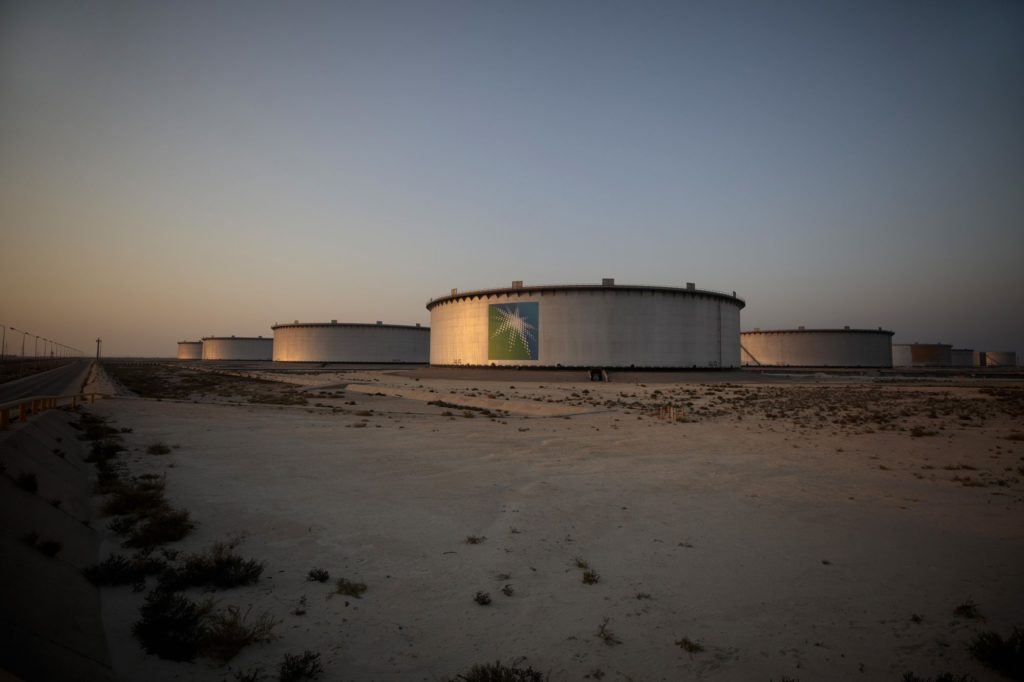
Aramco Topping Apple Shows Oil Is King in Energy-Short 2022

(Bloomberg) — Saudi Aramco taking the crown of the world’s most valuable company from Apple Inc. underscores investors’ appetite for oil and gas as the countries around the globe battle rampant inflation and fear of energy shortages. 

Buying the future through tech stocks is taking a back seat to the concerns of the present, as fossil fuels reassert their critical importance in all aspects of daily life. Elevated inflation is underpinned by rising energy costs that ripple through all aspects of the economy, from food to flying. 

For much of the past decade, low oil and gas prices and muffled inflation allowed central banks to reduce rates to spur their economies in the long exit from the financial crisis in 2008. Investors took the opportunity to buy into the new economy built on technology as the consumers transitioned toward a low-carbon future. 

But the global economy still runs on oil and gas, and surging demand after the pandemic combined with Russia’s invasion of Ukraine is causing a shortfall in supplies that plays right into the hands of traditional energy producers. Aramco now trades near the highest on record and nine of the top ten stocks in the S&P 500 Index this year are oil and gas companies. Energy has nearly doubled its share of the index this year, with domestic shale producers and refiners leading the charge. 

Even so, the reversal from tech to oil and gas still has some way to go. Despite losing a third of its value this year, Tesla Inc.’s market capitalization is more than double that of Exxon Mobil Corp.


More stories like this are available on bloomberg.com

©2022 Bloomberg L.P.
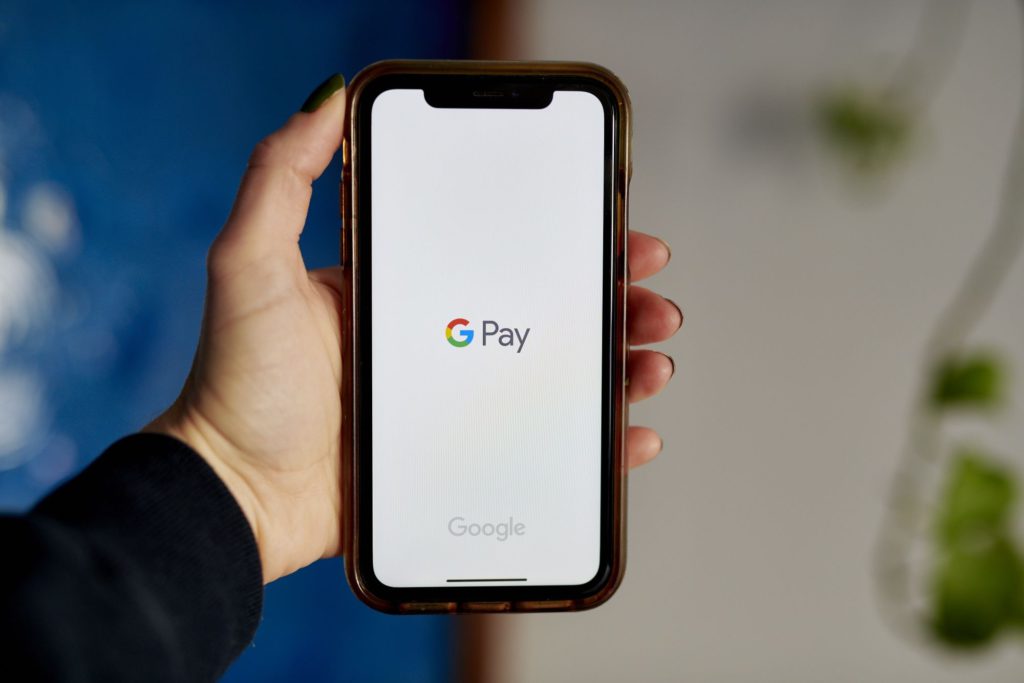
Google Creates Wallet App for Credit Cards, Tickets, Car Keys

(Bloomberg) — Alphabet Inc.’s Google will let consumers store and use credit cards, event tickets and car keys in a new Wallet app that it’s separating from its longtime Pay app. 

Consumers in the U.S. and Singapore will have access to both apps, with Pay used for financial management and transferring money to friends or family, while in 39 other markets the Wallet app will replace Pay, the Mountain View, California-based company said at its annual Google I/O developer conference Wednesday. 

“As things have digitized so quickly, it became very clear that you’re moving beyond just the payments context, and so we need to give users a dedicated home for that,” Bill Ready, Google’s president of commerce, said in an interview. “Mobile drivers’ licenses, car keys, those are well beyond just payment use cases.” 

Google debuted its payment app in 2015 and revamped it in late 2020 as a hub for consumers to track expenses and hunt for discounts. The company said at the time the app had 150 million monthly active users globally. But Google faces tough competition from Apple Inc. as well as its own partners on Android devices, such as Samsung Electronics Co.

With Ready, who joined the technology giant in 2020, Google has been shaking up its approach to payments. In October, for instance, the company shelved a yearslong plan to debut a digital checking and savings service for the Pay app that it had already lined up nearly a dozen banking partners for.

Google Pay has gained some traction in India. There, users will be able to use the Pay app they’re familiar with, the company said in a statement. 

Separately, Google announced a change to its Chrome browser that will allow users to turn any credit and debit cards they have saved with Chrome’s auto-fill feature into a virtual card. That means they won’t have to hunt down the extra security code on the back of their cards when paying online.

Ready, who spent eight years at PayPal Holdings Inc. and some of its subsidiaries, said Google isn’t charging users for the changes to its apps. Instead, he said, the aim is to boost use of the company’s myriad apps and services. 

“We don’t need to monetize on the payments,” Ready said. “We’re not charging for this, but we believe it has the potential to be quite beneficial to the advancement of the free and open web, and we see that comes back and pays dividends for the ecosystem.”

More stories like this are available on bloomberg.com

©2022 Bloomberg L.P.
Cryptocurrencies Crater as Terra Collapse Triggers DeFi Exodus

(Bloomberg) —

Cryptocurrencies underpinning some of the most popular decentralized finance protocols tumbled as the collapse of the TerraUSD stablecoin triggers a stampede out of many of the digital-asset market’s most popular tokens. 

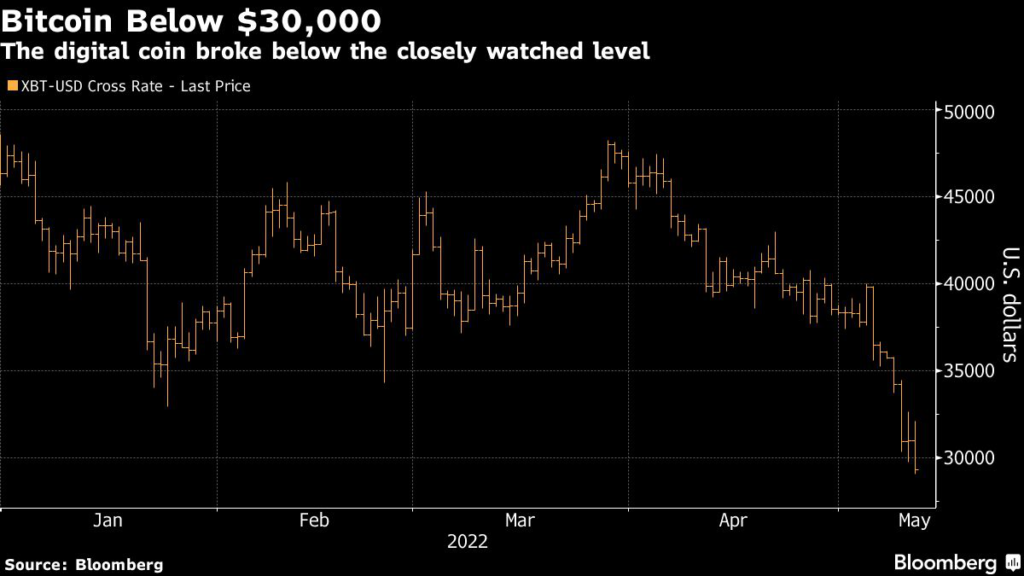
DeFi favorite Avalanche plunged about 30%, while Solana slumped more than 20% and Aave fell 24%. Bitcoin fared better, and was down about 3.7% after tumbling to an almost 11-month low of less than $30,000. The TerraUSD stablecoin continued its downward spiral. 

“UST’s collapse undercuts confidence in all liquidity protocols,” said Aaron Brown, a crypto investor who writes for Bloomberg Opinion. “If UST can fail, maybe Aave can too. Sort of like when Bear Stearns failed, it focused people’s attention on whether Lehman would fail.”

The TerraUSD algorithmic stablecoin continued to spiral lower, bouncing between 20 and 90 cents. Backers of the coin are trying to raise about $1.5 billion to shore up the token after it crashed from its dollar peg, according to the founder of a firm that was approached about the deal. 

“Is the market getting spooked by what’s happening with Terra? The answer is yes,” Craig W. Johnson, chief market technician at Piper Sandler, said by phone. “Money-market funds are important to investors and right now we’re questioning the third-largest money-market fund in crypto land. People did not think we were going to break the buck on that and that’s clearly happened.”   

Terra’s troubles have been the dominant story in finance all week. “The breaking of an inadequately robust or collateralized protocol is destroying value,” said Hugo Rogers, chief investment officer at Deltec Bank & Trust. “And this is having knock-on effects.” 

Sentiment was also crushed after data showed US consumer prices rose by more than forecast in April, indicating inflation will persist at elevated levels for longer. The data point also suggests the Federal Reserve will stay on its path of aggressive interest-rate hikes, creating an unfavorable environment for cryptos and other risk assets. 

“There is extreme fear across the crypto market,” said Marcus Sotiriou, an analyst at the UK-based digital-asset broker GlobalBlock. 

Cryptocurrencies and other riskier assets have been under pressure all year. The Fed and other central banks are raising interest rates to fight red-hot inflation, creating an unfavorable environment for risk assets. 

Bitcoin on Wednesday afternoon in New York was trading around $29,700. The area around $30,000 had been an “especially sensitive zone,” for Bitcoin, wrote James Malcolm, head of foreign exchange and crypto research at UBS. That’s where mining economics turn negative, “ which could potentially lead to increased coin sales by this key cohort,” he said. He added that long-term accumulators like MicroStrategy Inc. begin to fall below historical breakevens. 

“Below this there is little technical support until the low-20ks, where margin calls kick in,” Malcolm wrote. 

Bitcoin’s Relative Strength Index is now at 22, showing that it’s at its most oversold since January. The coin now needs to hold $28,000. A break below that level could start a new wave of selling.

Meanwhile, Coinbase Global Inc. shares and bonds fell to new lows Wednesday, signaling investor skepticism about the prospects of the crypto exchange in a bear-market. The company reported lower-than-expected revenues yesterday, and warned trading volume and monthly transacting users in the second quarter is expected to be lower than in the first. 

Piper Sandler‘s Johnson says that’s another concern for crypto investors right now. “It’s the largest exchange here in the United States and they just turned a loss,” he said, adding that Terra’s troubles are all “snowballing in crypto land.”

Read more: Coinbase Tumbles to Record Lows as Crypto Meltdown Deepens

Still, a lot of crypto investors, cognizant of the fact that Bitcoin has gone through a boom-and-bust cycle before only to recoup losses over and over again, are preaching patience. 

“Ultimately every investor needs to size positions based on their risk level and time horizon,” said Alex Tapscott, managing director of the digital asset group at Ninepoint Partners. “We believe Bitcoin will recover and that we’re still in the early stages of this new internet of value. Keep calm and HODL.”

(Updates throughout.)

More stories like this are available on bloomberg.com

©2022 Bloomberg L.P.
Coinbase Tumbles to Record Lows as Crypto Meltdown Deepens

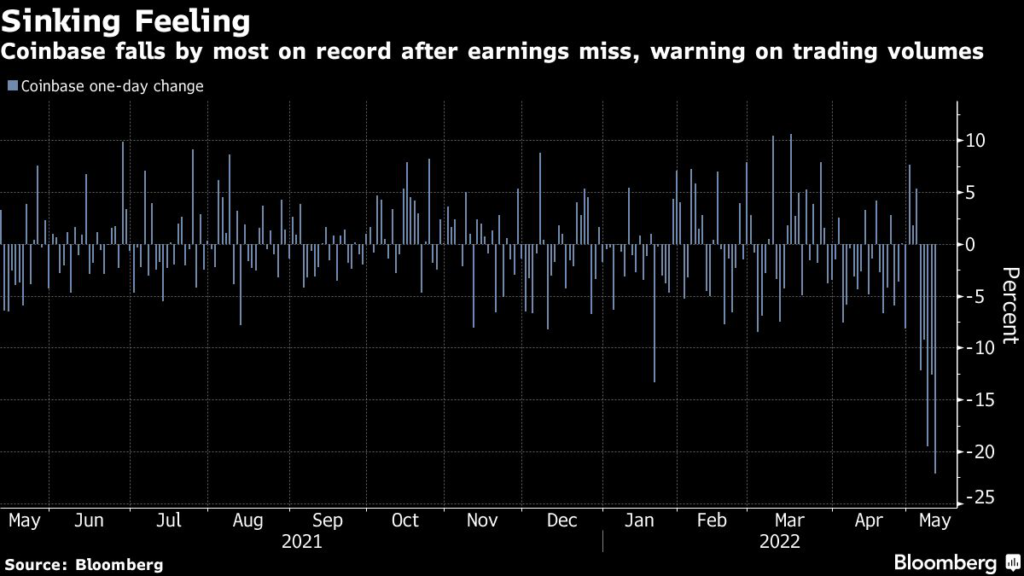
(Bloomberg) — Coinbase Global Inc. shares and bonds plunged to new lows, signaling investor skepticism about the prospects of the crypto exchange in a worsening bear-market. 

Shares plunged as much as 31% to $50.15 on Wednesday, a far cry from its first-day closing price of $328.28 when it went public last April. Its bonds also plunged, trading in line with some of the highest-risk junk-rated notes.

Coinbase is “unlikely to return to recent levels of profitability in the near term absent a significant increase in crypto prices or volatility,” Will Nance, an analyst at Goldman Sachs Group Inc. wrote in a note. “We believe COIN’s stock will struggle to outperform in the near term.” 

Adding to the concern, cryptocurrencies underpinning some of the most popular decentralized finance protocols tumbled Wednesday as the collapse of the TerraUSD stablecoin triggered a stampede out of many of the digital-asset market’s most popular tokens. 

The company reported lower-than-expected revenues yesterday, and warned trading volume and monthly transacting users in the second quarter is expected to be lower than in the first. A new risk disclosure in its filing triggered concerns among some users about the safety of their crypto assets held in custody by the company in the event of a bankruptcy. 

Brian Armstrong, Coinbase’s chief executive officer, took to Twitter to clarify that there is “no risk of bankruptcy” and users’ funds are safe, while apologizing for not communicating proactively about the disclosure. 

Bitcoin fell below $30,000 and touched its lowest level since June, while the TerraUSD stablecoin continued its downward spiral. Coinbase Chief Financial Officer Alesia Haas said yesterday that the company sees “bear-market conditions” but can still afford to make 2022 “an investment year.” 

(Updates the price declines.)

More stories like this are available on bloomberg.com

©2022 Bloomberg L.P.

Close Bitnami banner
Bitnami
