Bloomberg

Dish Tumbles as Update on 5G Network Disappoints Some Investors

(Bloomberg) — Dish Network Corp. slumped to a two-year low, reflecting investor disappointment over the outlook for the company’s 5G wireless network and plans to transition from a satellite TV provider to a mobile broadband competitor.

The shares were down 11% to $19.27 at 11:32 a.m. in New York, the lowest price since April 2020. They had lost 33% this year through Tuesday’s close.

The cloud-based wireless network will attract as many as 40 million subscribers and lift Dish’s annual revenue above $30 billion, co-founder Charlie Ergen and four of his top executives told analysts at a presentation in Las Vegas Tuesday. But some found that less than ideal.

“Overall we found the company’s targets extremely optimistic and heard varying levels of conviction in them from management — we take them more as an indication of where Dish hopes to go,” JPMorgan Chase & Co.’s Phil Cusick wrote in a note.

In addition to building a more nimble network than those operated today by Verizon Communications Inc., AT&T Inc. and T-Mobile US Inc., Dish says it will also unseat the competition through “disruptive” pricing at its Boost mobile business. 

As part of that effort, the company started offering a BoostOne mobile app that lets pay-as-you-go users reduce their charges by viewing ads and loading apps. The company also announced Boost Infinite, its first regular monthly plan, which is intended to take share from its bigger rivals.

Last week, Dish launched service in Las Vegas for its 5G network, called Project Genesis. The $30-a-month package includes unlimited calling, text and data, and is expected to be available in 120 cities in June.

More stories like this are available on bloomberg.com

©2022 Bloomberg L.P.

UK Startup Raises $150 Million in Largest Round for Carbon Capture

(Bloomberg) — A London-based startup that makes small, modular units to capture carbon emissions from smokestacks has raised $150 million from investors that include the venture arms of Chevron Corp., Saudi Arabian Oil Co., and Samsung Group.

Carbon Clean Solutions Ltd. has tested its technology at more than 40 sites around the world, and says it can capture as much as 97% of carbon dioxide released by steel and cement factories and power plants.

The company has been developing the technology for more than a decade and is now ready to scale up, according to Chief Executive Officer Aniruddha Sharma. For climate startups, “the hardest thing is actually getting the tech out there and commercialized,” Sharma said. 

Carbon capture technology is more than a century old. It was commercialized by gas companies to separate CO₂ that sometimes was found mixed with natural gas. In the 1970s, rather than releasing the CO₂, companies found a use for the greenhouse gas: it could be injected into an aging field to increase oil production.

Sharma’s company is using the broader market for CO₂, such as for making fizzy drinks or as a cooling agent like dry ice, to get customers to pay for its technology. The largest commercial unit it has deployed is in India and it uses the captured CO₂ to make soda ash, which is then used in detergents.

Although carbon-capture plants worth billions of dollars have been built before, $150 million is the largest single raise for a point-source capture startup.  Jefferies Financial Group Inc. acted as the financial adviser for the funding round.

Read More:  Scaling Carbon Capture Might Mean Thinking Small, Not Big

In the climate era, however, CCS technology’s majority use is going to be simply burying the captured gas deep underground. Some 40 million metric tons of CO₂ is buried each year today, but most of it goes toward enhancing oil production. Climate models see the use of the technology growing to 10 times within the next decade to put the world on track to slow the rise in global temperatures.

CCS technology is separate from the set of technologies that aim to suck CO₂ directly out of the atmosphere. That process has to use a much more diluted stream of CO₂, which requires more energy to capture and thus typically costs a lot more. 

Carbon Clean will test out storing away the greenhouse gas in partnership with Chevron in California, where it hopes to capture as much as 30,000 tons of CO₂ each year. The company says that it has captured 1.5 million tons of CO₂ over the past decade, though none of it has been stored away permanently yet.

The startup is betting that its modular approach means it can fit into existing factories more seamlessly than current custom-built capture plants. That should allow it to drastically lower the cost of captured CO₂ to as little as $30 per ton. For comparison, companies covered by the European Union’s emissions market pay about $100 per ton for their pollution.

The new funds will go toward hiring 100 new staff to add to Carbon Clean’s  current tally of 60. The rest will go to buying more carbon capture units, which are currently manufactured using components from the US, Denmark and Germany.

(Adds scope of funds raised in sixth paragraph.)

More stories like this are available on bloomberg.com

©2022 Bloomberg L.P.

Finnish Startup Aiven Gets Eurazeo Funds at $3 Billion Valuation

(Bloomberg) — Finnish software startup Aiven has raised $210 million of new funding, giving the company cash to expand abroad and hire developers. 

The Helsinki-based firm’s fresh investment round was led by Eurazeo SE, joined by funds and accounts managed by BlackRock Inc, and valued Aiven at $3 billion before accounting for the new money. Chief Executive Officer Oskari Saarenma said in an interview that the funds will be used to hire and expand abroad, and potentially for making its first acquisitions.

Founded in 2016, Aiven focuses on building tools for developers using open-source technologies to manage data. It has grown its headcount to about 400 people and has recently hired employees in Japan as it aims to expand into the Asia-Pacific and Latin America regions. Sales are on track to double this year thanks to clients such as sports retailer Decathlon SA and food delivery company Wolt Enterprises Oy, Saarenmaa said in an interview. 

Aiven’s funding round — which is all equity and mainly primary investment — also offers a sign that some private technology companies are still getting financing even amid turbulent markets. Venture capitalists have been more hesitant to make deals as public technology stocks crater.

“There is a demand for the solutions that we’re creating,” Saarenmaa said. He added that the company aimed to eventually hold an initial public offering but it was not actively preparing for a market debut.

More stories like this are available on bloomberg.com

©2022 Bloomberg L.P.

Rogers-Shaw Antitrust Suit Over Mobile Unit Baffles Analysts

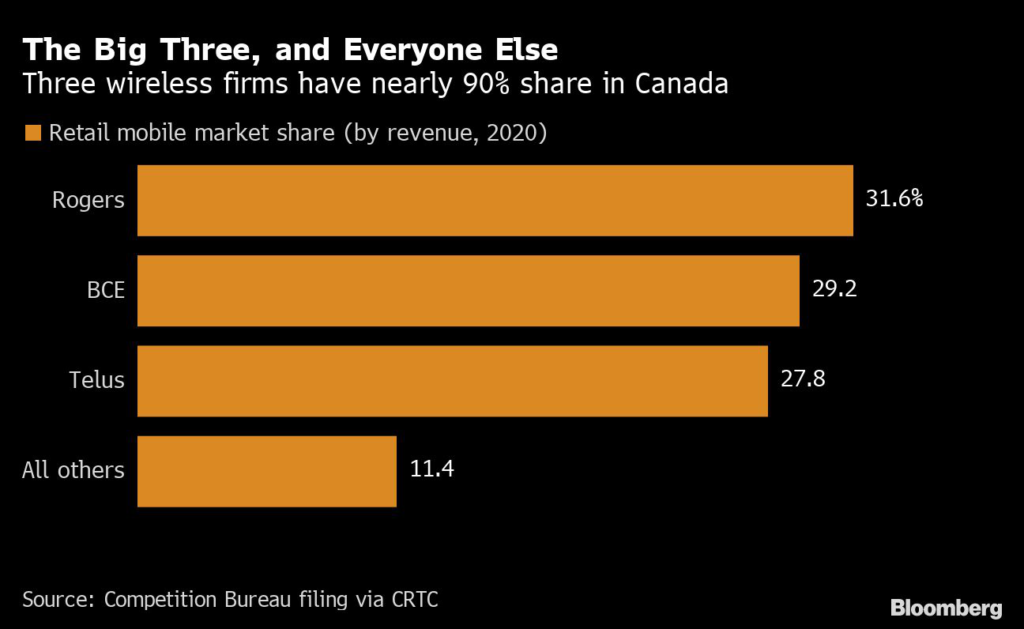
(Bloomberg) — The antitrust case against Rogers Communications Inc.’s takeover of a rival is thousands of pages long but comes down to one core idea: the company it’s buying is too good. Analysts don’t see it that way. 

Toronto-based Rogers is trying to acquire Shaw Communications Inc. for about C$20 billion ($15.4 billion) in what would be one of the largest mergers in Canadian history. This week, the country’s competition watchdog sued to block the deal, arguing that it would weaken Shaw’s Freedom Mobile division, the country’s fourth-largest wireless provider.

Freedom has been “a strong, independent competitor in Canada’s wireless market — one that has driven down prices, made data more accessible, and offered innovative services,” Competition Commissioner Matthew Boswell said. 

Rogers has agreed to sell the unit and has already lined up a buyer, but Boswell said in court documents that wasn’t an adequate solution. Separated from Shaw, Freedom’s business wouldn’t be as strong, and consumers “are likely to pay higher prices, have less choice and receive lower-quality service,” he wrote.

But while Freedom may be a tough competitor, analysts question how healthy it really is. Shaw is struggling to generate much cash flow from it. 

Shaw earned C$393 million from wireless on an adjusted basis before interest, taxes, depreciation and amortization in the fiscal year ended Aug. 28. It spent C$280 million in capital and would face larger costs in the years ahead to make network improvements for 5G services. 

‘No Plan B’

Anthony Lacavera, a telecom entrepreneur who launched Freedom Mobile as Wind Mobile in 2009, says the company will need to invest heavily to keep up with the country’s big three mobile carriers — Rogers, BCE Inc. and Telus Corp. Whichever company owns Freedom Mobile should expect “no cash flows for the next few years,” Lacavera said in an interview.

The costs of investing in Freedom Mobile were a major factor in the Shaw family’s decision last year to sell the entire company to Rogers, according to BMO Capital Markets analyst Tim Casey.

“There is no plan B, in our view,” Casey told clients in a recent note. “We think the company is selling to Rogers based on insufficient returns from their wireless operations even before 5G.” 

Shaw shares were down 4.1% to C$34.04 as of 10:54 a.m. in Toronto. Rogers was little changed. 

Shaw didn’t participate in an auction of midband spectrum last year, on which telecom companies spent a combined C$8.9 billion, and has stayed on the sidelines as Rogers, BCE and Telus launch and promote 5G plans to consumers. 

Given the Shaw family’s reluctance to invest more, it doesn’t make sense for Boswell to reject the idea of Rogers selling Freedom Mobile to a new owner, National Bank Financial analyst Adam Shine said. 

“It’s generally well understood that Freedom must not be allowed to get acquired by one of the Big Three or just disappear. It somehow must persist,” Shine said in a note to clients Wednesday. “Surely, the best solution now is for it to be in new hands. There’s no guarantee that Shaw will continue to invest optimally in wireless or even launch a standalone 5G network.”

Through a spokesperson, Boswell declined an interview request.

Rogers has cut a deal to sell the business to Xplornet Communications Inc. and its controlling shareholder, New York-based Stonepeak Partners LP. It has also opened the door to negotiations with Montreal-based Quebecor Inc., should an Xplornet deal fall through. 

Most of Freedom Mobile’s customers are in and around the Toronto region, Canada’s largest city. It also operates in Alberta and British Columbia, where Shaw is a big player in cable television and internet service. But with a smaller network and minuscule marketing budget compared with the three biggest players, Freedom tends to attract less lucrative customers.

Shaw’s average monthly “billing per subscriber unit,” an industry metric known as ABPU, was C$37.38 in the quarter ended Feb. 28. Rogers and Telus have blended ABPU of more than C$60 and BCE is over C$70, according to TD Securities. 

The Shaw family “would like to call it quits as an owner of all its telecom assets,” Shine wrote. “How is forcing the family to stay in operation make any sense or be viewed as being in the best interests of Freedom?”

More stories like this are available on bloomberg.com

©2022 Bloomberg L.P.

Bitcoin Touches 11-Month Low While TerraUSD Extends Declines

(Bloomberg) —

Bitcoin swung between gains and losses after tumbling to an almost 11-month low, while the TerraUSD stablecoin continued its downward spiral. 

The world’s largest cryptocurrency by market value fell as much as 6.2% to $29,085 before trading little changed. Analysts had been watching the $30,000 level as a key threshold, with many projecting that losses could accelerate once the coin falls below it. 

Meanwhile, the TerraUSD algorithmic stablecoin continued to spiral lower, trading at less then 30 cents. Backers of the coin are trying to raise about $1.5 billion to shore up the token after it crashed from its dollar peg, according to the founder of a firm that was approached about the deal.  

“Bitcoin and cryptos have become a risk-on/risk-off trade this year and the CPI data is a risk-off development,” said Matt Maley, chief market strategist at Miller Tabak + Co. “As for Terra, this news is having an impact as well. Its collapse is lower confidence in an asset class that has been losing confidence among investors all year.”

Other cryptocurrencies also fell, with Bitcoin Cash losing more than 11% and Dash dropping nearly 16%.

The drop came after data showed US consumer prices rose by more than forecast in April, indicating inflation will persist at elevated levels for longer. The data point also suggests the Federal Reserve will stay on its path of aggressive interest-rate hikes. 

“There is extreme fear across the crypto market,” said Marcus Sotiriou, an analyst at the UK-based digital-asset broker GlobalBlock. “In addition to ongoing macro headwinds, there is now a fundamental risk to the crypto industry as the UST stablecoin has de-pegged from $1.”

Cryptocurrencies and other riskier assets have been under pressure all year. The Federal Reserve and other central banks are raising interest rates to fight red-hot inflation, creating an unfavorable environment for risk assets. 

The area around $30,000 had been an “especially sensitive zone,” for Bitcoin, wrote James Malcolm, head of foreign exchange and crypto research at UBS. That’s where mining economics turn negative, “ which could potentially lead to increased coin sales by this key cohort,” he said. He added that long-term accumulators like MicroStrategy Inc. begin to fall below historical breakevens. 

“Below this there is little technical support until the low-20ks, where margin calls kick in,” Malcolm wrote. 

Bitcoin’s Relative Strength Index is now at 21, showing that it’s at its most oversold since January. The coin now needs to hold $28,000. A break below that level could start a new wave of selling.

Still, a lot of crypto investors, cognizant of the fact that Bitcoin has gone through a boom-and-bust cycle before only to recoup losses over and over again, are preaching patience. 

“Ultimately every investor needs to size positions based on their risk level and time horizon,” said Alex Tapscott, managing director of the digital asset group at Ninepoint Partners. “We believe Bitcoin will recover and that we’re still in the early stages of this new internet of value. Keep calm and HODL.”

More stories like this are available on bloomberg.com

©2022 Bloomberg L.P.

SEC’s Gensler Says Crypto Exchanges Trading Against Clients

(Bloomberg) — Gary Gensler is ratcheting up his criticism of digital-asset exchanges, arguing that some platforms are shirking rules and may be betting against their own customers.

The US Securities and Exchange Commission chair reiterated Tuesday that most digital assets fall under his agency’s purview and venues trading them should register with the regulator. The SEC is also beefing up its enforcement efforts, he added.

Speaking in an interview with Bloomberg News, Gensler said he’s concerned that crypto exchanges aren’t putting up proper walls between different parts of their businesses such as custody, market-making, and offering a trading venue. He said the “commingling” of services may not be in clients’ best interests. 

“Crypto’s got a lot of those challenges– of platforms trading ahead of their customers,” Gensler said. “In fact, they’re trading against their customers often because they’re market-marking against their customers.” 

The securities regulator also raised issues with stablecoins, digital assets that are typically pegged to the dollar or another fiat currency. The three largest stablecoins — Tether, USD Coin, and Binance USD — are all affiliated with exchanges, Gensler said in the interview.

“I don’t think that’s a coincidence,” he said. “Each one of the three big ones were founded by the trading platforms to facilitate trading on those platforms and potentially avoid AML and KYC,” he added, referring to anti-money laundering and know-your-customer controls.

The largest stablecoin, Tether, which has an $83 billion market value, has ties to the people behind the Bitfinex crypto exchange. Another major one, USDC was created by a consortium of several companies including Coinbase Global Inc. The world’s biggest crypto exchange, Binance, is connected with Binance USD, which has a $17 billion market value. 

In response to Gensler’s comments, Binance referred to a blog where it says its stablecoin adheres to “strict guidelines and remaining transparent with the user community.” Coinbase declined to comment. 

In a statement, Bitfinex said that it welcomes any additional clarity over rules. “We look forward to continuing to work alongside authorities to ensure that we are following the proper guidance of regulators,” the firm said. 

On Tuesday, Coinbase’s shares tumbled after its first-quarter revenue missed estimates and it warned its trading volumes in the current quarter will be lower than in the first. Bitcoin is down more than 50% since its all-time high in early November.

Concerns around stablecoins have also proliferated in the past week on Capitol Hill after TerraUSD, or UST, lost its peg to the dollar over the weekend. 

UST is a so-called algorithmic stablecoin, meaning that it’s not backed by assets like cash or cash-equivalents. Instead, it relies on trading and treasury management to maintain its value.

The backers of the TerraUSD are trying to raise about $1.5 billion to shore up the token after it crashed from its dollar peg, according to Kumar Gaurav, the founder and chief executive of crypto liquidity provider Cashaa.

The whole episode demonstrates the need for “some kind of framework” to assure investors that stablecoins are in fact stable, Senator Mark Warner said in an interview on Tuesday.

“Frankly, maybe this disruption in the market may take some of the some of the air out of this very overheated balloon,” said Warner, a Virginia Democrat.

(Updates with comment from Bitfinex in ninth paragraph.)

More stories like this are available on bloomberg.com

©2022 Bloomberg L.P.

Volkswagen to Revive Dormant Scout Brand to Aid US Growth Push

(Bloomberg) — Volkswagen AG is set to revive the Scout offroading vehicle brand to bolster its expansion in the US, where the company has long struggled due to a lack of popular sport utility vehicle and pickup models in its lineup.

Europe’s biggest carmaker plans to introduce an electric SUV and a battery-powered pickup truck under the Scout nameplate, according to people familiar with the matter, who asked not to be identified because the information is private. VW’s board of directors is expected to sign off on the move later on Wednesday. VW declined to comment.

The Wall Street Journal first reported on the plans, saying VW aims to invest more than $1 billion to ready the project, is open to inviting in external investors and eventually may take the business public.

Chief Executive Officer Herbert Diess has vowed to turn around Volkswagen’s performance in the US, where it has languished behind domestic brands in part because it lacked models in the lucrative pickup truck sector.

READ: VW CEO’s Road Trip Underscores Eagerness to Be Relevant in U.S.

Succeeding won’t be easy. Japanese automakers’ efforts to ding Detroit’s dominance of pickups have largely failed, with Toyota Motor Corp.’s Tundra and Nissan Motor Co.’s Titan never coming close to the volumes mustered by Ford Motor Co.’s F-Series or General Motors Co.’s Chevrolet Silverado.

Scout vehicles competed with the Ford Bronco and Land Rover and Jeep models from the 1960s until the business ceased production in 1980. VW bought the name as part of its acquisition of Navistar International Corp. in 2020.

More stories like this are available on bloomberg.com

©2022 Bloomberg L.P.
EU May Ask Tech Companies to Scan for Sexual Abuse Material

(Bloomberg) — The European Commission presented its plan to fight online child sexual abuse material, which includes demanding the world’s biggest technology companies to scan for, detect and report it to law enforcement bodies.

The measures announced in Brussels on Wednesday allow courts in the EU to require social networks to track and report efforts by their users to groom children via messaging tools.

Other proposed methods to achieve these requirements include:

  • Using age verification to identify minors joining a platform
  • Checking user-generated content for signs of abuse imagery
  • Deploying artificial intelligence to detect language patterns associated with grooming
  • Reporting offending material discovered to law agencies to investigate

A new European agency similar to the U.S.’s National Center for Missing and Exploited Children, which will work alongside Europol, will be created for companies to report their findings to. Courts in the EU will be able to require companies take down flagged material or block access to web addresses. Companies will be allowed to appeal such orders.

Ylva Johansson, the commissioner for home affairs in charge of the proposal, said Wednesday that she expects criticism from companies because “protecting children is maybe not profitable.” Privacy activists and lawmakers alike have already voiced concern, likening the plans to surveillance tactics.

Johansson said there are many “rumors” about the commission’s plans, but that the proposal is not about encryption or reading people’s communications. She added that companies will have to use the least intrusive methods to detect the material online.

A spokesperson for Meta Platforms Inc., Facebook’s parent company, said “it’s important that any measures adopted do not undermine end-to-end encryption, which protects the safety and privacy of billions of people, including children.”

Scanning for child sexual abuse material has long been controversial due to privacy concerns, but it’s something all major tech firms and social networks do. This includes sharing digital fingerprints of known illegal material so it can be automatically detected, removed and reported. Facebook, Microsoft and many others have done this for years.

Numerous companies attempt to go further, with mixed results. Last year, Apple Inc. announced, then halted, plans to detect child abuse imagery in its users’ photo libraries after widespread concern voiced by privacy advocates. The commission’s own plans have also been delayed for years for related reasons.

But the amount of child pornography online has been increasing, especially during the Covid-19 pandemic, Johansson said. Reports cited by the commission show that 85 million photos and videos containing child sexual abuse were reported online in 2021. Advocacy group Thorn said in March this was a 38% increase from 2020.

It’s part of the reason the EU’s proposal goes beyond conventional scanning for known offending material, and will allow courts to require companies proactively scan for new abuse, be it pictures, videos, or grooming of children via chat. AI could be used, such as to speed up detection of concerning language patterns, the commission said, but would need human oversight.

The EU’s plan will need the sign-off from member countries and the European Parliament, a process that can take years, especially with such a controversial proposal. 

(Updates with comments in fifth paragraph)

More stories like this are available on bloomberg.com

©2022 Bloomberg L.P.
Bitcoin Tumbles to 11-Month Low While TerraUSD Extends Declines

(Bloomberg) —

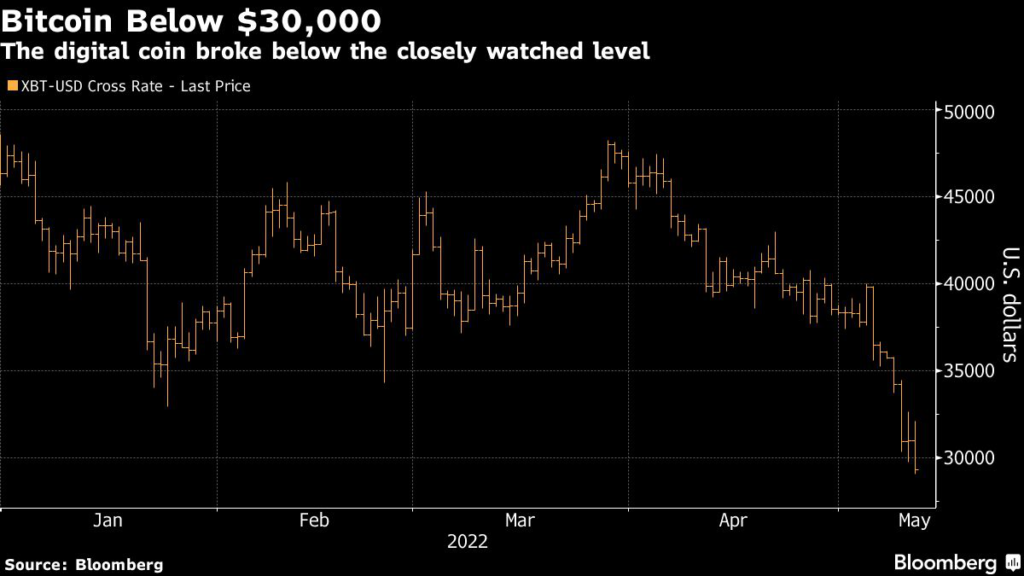
Bitcoin fell below $30,000 and touched its lowest level since June, while the TerraUSD stablecoin continued its downward spiral. 

The world’s largest cryptocurrency by market value fell more than 6% at one point Wednesday to trade at $29,085, nearly an 11-month low. Analysts had been watching the $30,000 as a key threshold, with many projecting that losses could accelerate once the coin falls below it. 

Meanwhile, the TerraUSD algorithmic stablecoin continued to spiral lower, trading at less then 30 cents. Backers of the coin are trying to raise about $1.5 billion to shore up the token after it crashed from its dollar peg, according to the founder of a firm that was approached about the deal.  

“Bitcoin and cryptos have become a risk-on/risk-off trade this year and the CPI data is a risk-off development,” said Matt Maley, chief market strategist at Miller Tabak + Co. “As for Terra, this news is having an impact as well. Its collapse is lower confidence in an asset class that has been losing confidence among investors all year.”

Other cryptocurrencies also fell, with Bitcoin Cash losing more than 11% and Dash dropping nearly 16%.

The drop came after data showed US consumer prices rose by more than forecast in April, indicating inflation will persist at elevated levels for longer. The data point also suggests the Federal Reserve will stay on its path of aggressive interest-rate hikes. 

“There is extreme fear across the crypto market,” said Marcus Sotiriou, an analyst at the UK-based digital-asset broker GlobalBlock. “In addition to ongoing macro headwinds, there is now a fundamental risk to the crypto industry as the UST stablecoin has de-pegged from $1.”

Cryptocurrencies and other riskier assets have been under pressure all year. The Federal Reserve and other central banks are raising interest rates to fight red-hot inflation, creating an unfavorable environment for risk assets. 

The area around $30,000 had been an “especially sensitive zone,” for Bitcoin, wrote James Malcolm, head of foreign exchange and crypto research at UBS. That’s where mining economics turn negative, “ which could potentially lead to increased coin sales by this key cohort,” he said. He added that long-term accumulators like MicroStrategy Inc. begin to fall below historical breakevens. 

“Below this there is little technical support until the low-20ks, where margin calls kick in,” Malcolm wrote. 

Bitcoin’s Relative Strength Index is now at 21, showing that it’s at its most oversold since January. The coin now needs to hold $28,000. A break below that level could start a new wave of selling.

Still, a lot of crypto investors, cognizant of the fact that Bitcoin has gone through a boom-and-bust cycle before only to recoup losses over and over again, are preaching patience. 

“Ultimately every investor needs to size positions based on their risk level and time horizon,” said Alex Tapscott, managing director of the digital asset group at Ninepoint Partners. “We believe Bitcoin will recover and that we’re still in the early stages of this new internet of value. Keep calm and HODL.”

More stories like this are available on bloomberg.com

©2022 Bloomberg L.P.
Google Joins Amazon in Mulling a Bid for Coveted Cricket Event

(Bloomberg) — Alphabet Inc., owner of the ubiquitous search engine Google, has flagged an interest in bidding for the broadcast rights of the Indian Premier League, or IPL, joining the ranks of half a dozen media giants vying for the coveted asset in cricket-crazy India. 

The American tech company, which also has the video-streaming website YouTube, purchased the bid-related documents from the Board of Control for Cricket in India, or BCCI, according to people familiar with the matter, who asked not to be named as the information isn’t public. SuperSport, a South Africa-based group of television channels, bought the documents too, according to a person familiar. 

Amazon.com Inc., The Walt Disney Co., billionaire Mukesh Ambani-led Reliance Industries Ltd., Sony Group Corp., homegrown Zee Entertainment Enterprises Ltd. and fantasy-sports platform Dream11 have also signaled their interest by purchasing these information dockets from BCCI, Bloomberg reported earlier.

Google’s interest in the global media rights of India’s top cricket league intensifies the fight for a sports event that has emerged as the world’s third-largest, trailing only the Premier League and the National Football League in terms of viewers. Last year’s edition of the IPL brought in 600 million viewers, according to BCCI estimates, underscoring the sheer media clout this event represents in India’s highly competitive entertainment market.

BCCI and a YouTube representative in India declined to comment.

BCCI, the sport’s governing body in India which values the IPL at about $7 billion, will be auctioning its broadcast and live streaming rights for the years 2023-2027 starting June 12. Purchasing application documents doesn’t lead to a certain offer and the firms can decide to not bid, the people said.

Bagging IPL’s media rights — considered the Super Bowl of cricket by some — will allow companies to reach out to hundreds of millions of eyeballs and bolster their advertisement revenue.

More stories like this are available on bloomberg.com

©2022 Bloomberg L.P.

Close Bitnami banner
Bitnami

