
Bloomberg

TerraUSD Stablecoin Plunges as Crypto Market Awaits Rescue

(Bloomberg) —

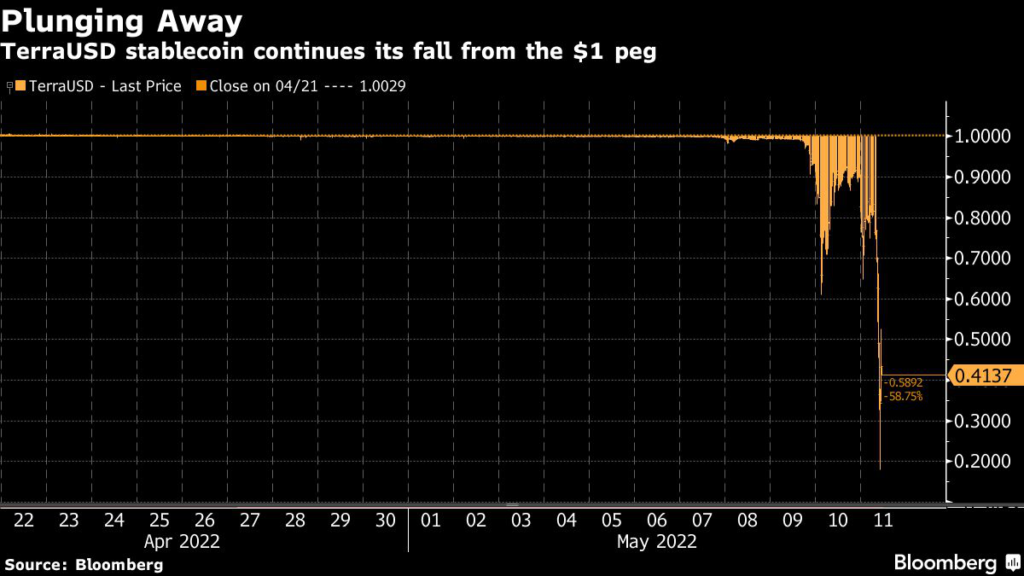
TerraUSD, the controversial algorithmic stablecoin, slumped on Wednesday as crypto markets await a rescue led by primary backer Do Kwon.  

The token fell further from its intended 1-to-1 peg to the US dollar to trade at around 50 cents at 10 a.m. in London, wiping out billions of dollars of value, data compiled by Bloomberg show. Luna, a coin that’s part of the peg mechanism for TerraUSD, tumbled 83% over the past 24 hours, according to CoinMarketCap. 

Broader crypto markets showed few signs of getting caught up in the turmoil, with stablecoins like Tether holding their pegs and major tokens including Bitcoin and Ether trading little changed. 

TerraUSD’s market value now stands at $7.7 billion, CoinMarketCap data show. It was worth $18.4 billion before crashing from its peg.

The plunge in TerraUSD, or UST, has reignited the debate over algorithmic stablecoins. Over the weekend, the token lost its intended peg to the US dollar, falling to about 99 cents. A wave of selling followed, and by Monday evening UST had hit 60 cents. On Tuesday, following an earlier tweet from Kwon that he was “close to announcing a recovery plan,” the token rallied to around 94 cents.


“The market is displaying a clear lack of confidence in this ship’s ability to right itself,” said Mati Greenspan, chief executive officer of Quantum Economics.


Unlike conventional stablecoins like Tether’s USDT or Circle’s USDC that are backed by real-world highly liquid cash equivalents or dollars, algorithmic tokens are designed to maintain their peg (and investor confidence) through a combination of mathematical equations and active trading. In the case of UST, investors can exchange one unit of the token, no matter what price it’s currently trading at, for $1 worth of Luna. The embedded arbitrage trade helps keep UST at or close to $1, or so the theory goes. 

Fadi Aboualfa, head of research at crypto custodian Copper, said in an email that TerraUSD’s complex approach to algorithmic management means a drop was “destined to happen in any significant downtrend.”

“The simplest protocols with a clearly defined economic structure will win,” Aboualfa wrote. 

Kwon and a group of investors known as the Luna Foundation Guard had previously issued $1.5 billion in loans denominated in both Bitcoin and UST to external firms in an attempt to support the peg.

(Updates with comment from analyst in fourth paragraph.)

More stories like this are available on bloomberg.com

©2022 Bloomberg L.P.

Google to Pay Over 300 EU News Outlets to Publish Content

(Bloomberg) — Alphabet Inc.’s Google has reached agreements with over 300 European Union-based news publications in order to publish their stories on the search engine. 

Publishers in Germany including ZEIT, Frankfurter Allgemeine Zeitung and Spiegel, along with others in Hungary, France, Austria, the Netherlands and Ireland have signed up to the agreement with the search engine, Google said in a blog post on Wednesday. The post did not reveal how much Google would pay for the deals. 

The European Copyright Directive, which came into force in 2019, was the culmination of an effort from the European Union to ensure publishers from inside the bloc are compensated for their content. The copyright law, which is being rolled out across the region by each country, allows publishers to ask for payment whenever online platforms use their content. The new rules have allowed news outlets to negotiate with web platforms such as Google and Facebook over the reproduction of their content.

How Europe Is Rewriting the Rules for Digital Media: QuickTake

In 2021, Google entered an agreement with German publishers to create a criteria for payments to publishers with an exemption for hosting small extracts of stories, which can be used free of charge. Google is now expanding the roll-out of these agreements through a web tool, to facilitate future deals with publishers.

Over 220 news outlets in Germany have now entered into these licensing agreements with Google, the company announced in a seperate blog post Wednesday. These agreements aren’t limited to print publishers but also to multimedia, such as TV channels n-tv and RTL.

Australia has also been forcing tech giants to renegotiate payments with content providers. In early 2021, Facebook Inc. reached a multiyear deal with News Corp. in Australia, agreeing to pay Rupert Murdoch’s publishing arm for access to additional stories.


More stories like this are available on bloomberg.com

©2022 Bloomberg L.P.

Panasonic Considers US IPO for Blue Yonder Software Arm

(Bloomberg) — Panasonic Holdings Corp. said it plans a stock market listing for its supply-chain management arm, including the Blue Yonder business that it acquired for about $7 billion last year.

Panasonic, which also makes consumer electronics and batteries for Tesla Inc., sees the listing as an effective way to accelerate growth in the supply-chain unit, making it easier to recruit staff and make acquisitions. It’s also part of a broader push to increase the independence of its operating businesses, it said.

Panasonic bought full control of the Scottsdale, Arizona-based Blue Yonder last year after taking a minority stake in 2020, in one of the largest acquisitions by a Japanese company recently. Blue Yonder, founded in 1985, makes supply-chain management software and uses artificial intelligence to predict product demand. 

In a press conference after the announcement, Panasonic Chief Executive Officer Yuki Kusumi said he would consider taking the division public outside of Japan, perhaps in the US. He said the timing of the deal is difficult to predict, especially given recent tumult in global markets. 

“It’s hard to say now when we would be able to list the company because we just started mulling the idea,” he said. “But we hope to move as fast as we can because we’re aware speed is important. What units would be included into the new entity is one of many factors we will be considering.”

A market listing would also be a way to reward and retain employees at Blue Yonder, which had already filed for its own IPO when Panasonic swooped in with the acquisition. At the time of the deal, Blue Yonder had more than 3,000 customers, including Best Buy Co., Coca-Cola Co. and Walmart Inc. 

Panasonic announced the listing news after reporting earnings for the March quarter, including operating income that fell short of analyst estimates. It also forecast operating profit for the 2023 fiscal year that was shy of expectations.

CEO Kusumi said it’s unlikely the company would consider a similar spinoff for the battery business that supplies Tesla.

“We do not have any plans to list any other units of Panasonic, including the battery business,” he said.

(Updates with CEO comments from fourth paragraph)

More stories like this are available on bloomberg.com

©2022 Bloomberg L.P.

Toyota Reveals Pessimistic Outlook, Blames ‘Unprecedented’ Costs

(Bloomberg) — Toyota Motor Corp. forecast a 20% decline in operating profit for the current fiscal year despite posting robust annual car sales, citing an “unprecedented” rise in costs for logistics and raw materials that are negating the benefits of a depreciated yen. 

The world’s largest automaker forecast an operating profit of 2.4 trillion yen ($18.4 billion) for the fiscal year through March, short of 3 trillion yen posted during the just-ended period, and well down on analysts’ average projection for 3.4 trillion yen. Shares fell 4.4%, the most in two months.

Although Toyota is known for issuing conservative guidance only to exceed it later, the tepid outlook took investors by surprise. In recent months, Toyota’s sales have kept up a strong pace, leading the automaker to post its second-highest unit sales ever for the year ended March. Toyota’s results are also being buoyed by a sharp decline in the value of the yen, which increases the value of earnings it brings back from overseas sales.

“It’s going to be a challenge,” said Satoru Aoyama, senior director of Asia-Pacific corporates at Fitch Ratings. With the current year bringing supply chain issues, chip shortages, Covid-related lockdowns in China and cost inflation, “there are many factors that are compiling to create a negative trend,” he said. 

Toyota is predicting higher vehicle sales for the current fiscal year, with a target of 10.7 million units, compared with 9.5 million for the period that ended March. Net sales for the year are also predicted to climb about 5% to 33 trillion yen, Toyota said, also announcing plans to buy back as much as 200 billion yen of its own stock, or about 1% of total shares.

Read more: Toyota Tops Annual Sales Goal With Second-Highest Total Ever

At the same time, Toyota executives said the company is grappling with “unprecedented” increases in materials and logistics costs, speaking at a briefing Wednesday. Because Toyota is forecasting a 1.45 trillion yen hit from soaring material prices for the current year, Chief Financial Officer Kenta Kon said the weakened yen won’t deliver a “major” lift. 

Toyota is also assuming a exchange rate of 115 yen for each dollar, which implies a smaller boost compared with current levels near 130 yen, leading some to question Toyota’s forecasts. 

“Given current Bank of Japan communications we are not convinced that the risk of yen appreciation is greater than that of further yen depreciation,” Mio Kato, an analyst at LightStream Research, wrote in a note. Toyota’s added burden of material costs “could be almost completely offset by a weaker yen,” according to Kato.

Though the yen’s historic fall had somewhat bolstered optimism around Japanese automaker earnings, industry analysts have, at the same time, been warning of a growing number of risks related to both automotive supply and demand in the coming year. 

In March, IHS Markit downgraded its output forecast for the current calendar year in order to factor in the impact from Russia’s invasion of Ukraine, then revised it down further last month in response to the fallout from Covid-related lockdowns in China, along with other mounting risks. 

Read more: World’s Top Carmakers Feeling Full Force of China Covid Stance

Others are warning of potential shocks to demand. Jefferies Financial Group Inc. sees expectations for Toyota’s earnings as being “too bullish” for the current fiscal year. The aggravation of cost inflation due to the Ukraine crisis and a potential slowdown in global economic growth will probably cause “considerable damage” to the auto sector overall, according to analyst Takaki Nakanishi.

Fitch Ratings’ Aoyama said that for Japanese automakers in general the yen depreciation has a positive impact accounting-wise for the medium-term. At the same time, “the yen depreciation, it’s like window-dressing. It doesn’t resolve the real, underlying issues,” he said.

(Updates with context throughout.)

More stories like this are available on bloomberg.com

©2022 Bloomberg L.P.
Shell Plans 10-Fold Jump in UK Electric Vehicle Chargers

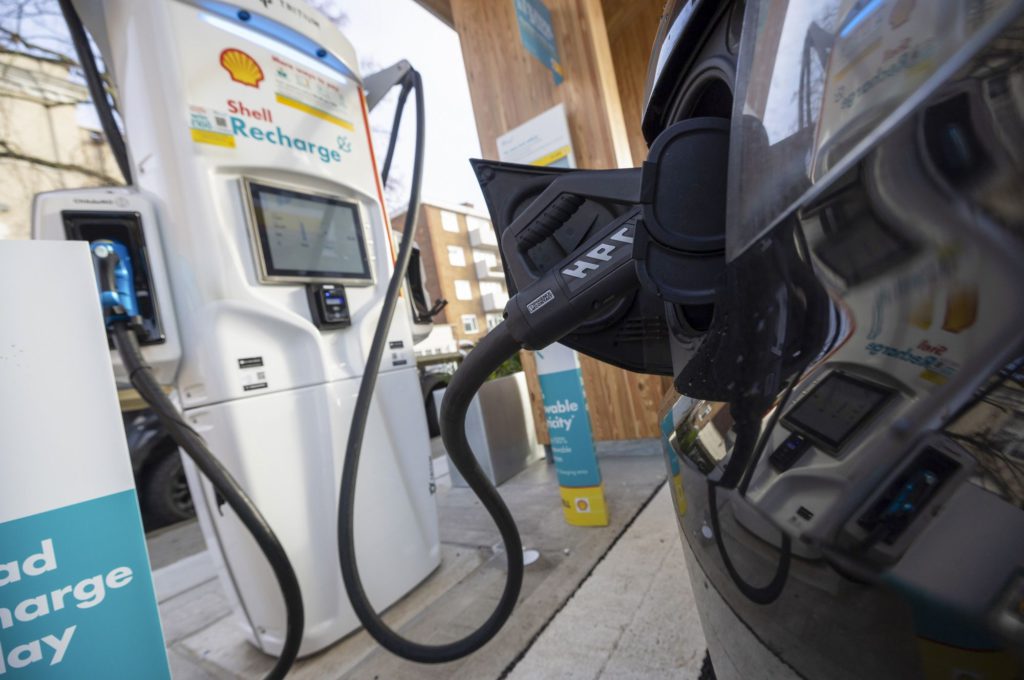
(Bloomberg) — Shell Plc targets a 10-fold jump in electric-vehicle charging points in the UK as part of plans to ramp up investments into cleaner energy.

The company will install 100,000 chargers in the country by 2030, according to a statement on Tuesday. It’s the latest move by an oil and gas major to refocus its traditional business as investors, governments and consumers call for greater efforts to combat climate change.

Shell plans to invest as much as £25 billion ($31 billion) in Britain’s energy system over the next decade, three-quarters of which will be directed toward low-carbon products and services, and the remainder on oil and gas in the North Sea. It has been bulking up its EV network after buying Ubitricity last year, and aims to have 2.5 million charging points globally by 2030.

“Access to public charging needs to be made available to everyone, no matter where you live,” Shell’s UK Country Chair David Bunch said in the statement.  

The announcement follows a recent pledge by the British government to increase the number of public charging points to 300,000 by 2030. Prime Minister Boris Johnson’s administration is seeking to phase out gasoline and diesel-burning cars, the sale of which will be banned from then on.

“It’s crucial that government and industry join forces on this transition,” Transport Minister Grant Shapps said in a separate statement. “This step forward supports the government’s recently published £1.6 billion Electric Vehicle Infrastructure Strategy where we committed to making the charging network more affordable and accessible.” 

(Updates with minister’s comments in final paragraph.)

More stories like this are available on bloomberg.com

©2022 Bloomberg L.P.
BlackRock’s Star Trader Goes Short as Hedge Fund Loss Mounts

(Bloomberg) — BlackRock Inc. star money manager Alister Hibbert has turned bearish as his hedge fund endures its worst-ever losses amid a sharp decline in stocks. 

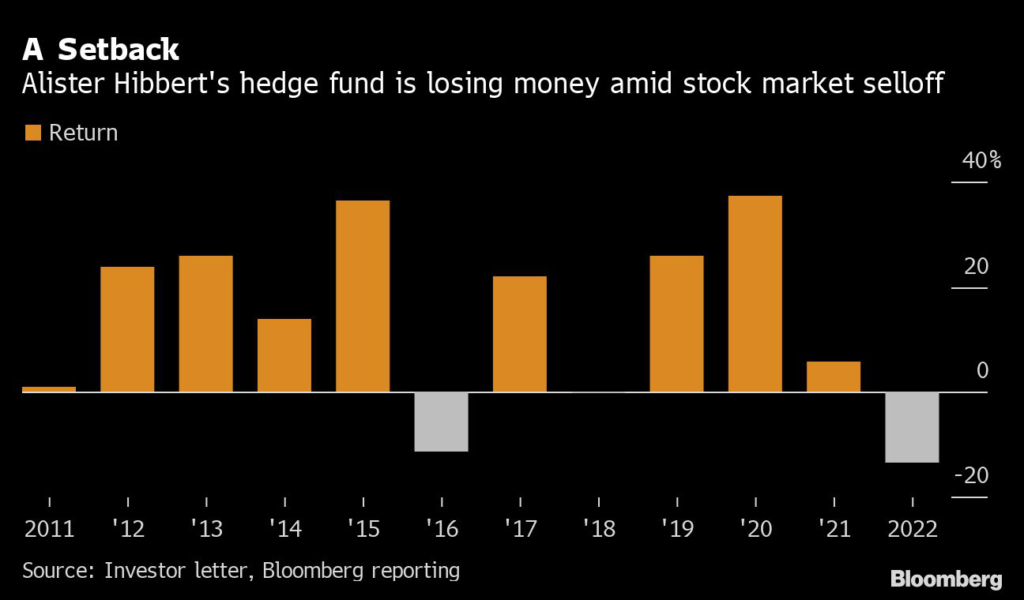
The BlackRock Strategic Equity Hedge Fund tumbled 13% this year through April, a person with knowledge of the matter said. That exceeds its worst annual decline of 11%. The money manager, who has profited from the historic surge in stocks since starting the fund in 2011, turned net short for the first time ever this month, said the person. His portfolio was net long about 35% at the end of last year. 

The reversal marks a seismic shift underway in global markets as soaring inflation forces central banks to end quantitative easing and raise interest rates. That has led to a selloff in markets with growth stocks, led by the technology sector, falling further in a setback for equity-focused hedge funds.

Hibbert has run his fund with a tilt toward growth stocks and owned shares such as Microsoft Corp. and Mastercard Inc. He flagged his cautious outlook earlier this year, telling clients that the strongest phase of economic recovery, characterized by soaring earnings and cyclical performance, was now over. The fund had about $9 billion of assets on Dec. 31.

“It is clear that the normalization of the economy post-pandemic is not going to be an entirely orderly process,” he wrote in a letter to investors in March.

A BlackRock spokesman declined to comment.  

BlackRock shares have tumbled about 34% this year. In a March letter to investors, Chief Executive Officer Larry Fink expressed disappointment in the stock’s performance and cited challenging markets for the decline.

London-based Hibbert has long been one of the best-paid risk-takers at the world’s biggest asset manager and key to BlackRock’s expansion into active management and driven-performance fees. He earned a nine-figure sum, more than triple the size of Fink’s $30 million payout in 2020. 

Hibbert started the hedge fund more than a decade ago with just $13 million and turned it into one of the largest long/short money pools, generating annualized returns of almost 17% until last year. The fund has had only two annual declines. Hibbert also runs a concentrated long only fund — BlackRock Global Unconstrained Equity Fund — which is down about 20% this year, according to Bloomberg data.

Equity hedge funds have been the worst performing broad strategy so far this year, losing 6.4% through April, according to data compiled by Bloomberg.

(Updates with hedge fund returns data in the final paragraph)

More stories like this are available on bloomberg.com

©2022 Bloomberg L.P.
BlackRock’s $100 Million London Trader Turns Bearish Amid Record Losses

(Bloomberg) — BlackRock Inc. star money manager Alister Hibbert has turned bearish as his hedge fund endures its worst-ever losses amid a sharp decline in stocks. 

The BlackRock Strategic Equity Hedge Fund tumbled 13% this year through April, a person with knowledge of the matter said. That exceeds its worst annual decline of 11%. The money manager, who has profited from the historic surge in stocks since starting the fund in 2011, turned net short for the first time ever this month, said the person. His portfolio was net long about 35% at the end of last year. 

The reversal marks a seismic shift underway in global markets as soaring inflation forces central banks to end quantitative easing and raise interest rates. That has led to a selloff in markets with growth stocks, led by the technology sector, falling further in a setback for equity-focused hedge funds.

Hibbert has run his fund with a tilt toward growth stocks and owned shares such as Microsoft Corp. and Mastercard Inc. He flagged his cautious outlook earlier this year, telling clients that the strongest phase of economic recovery, characterized by soaring earnings and cyclical performance, was now over. The fund had about $9 billion of assets on Dec. 31.

“It is clear that the normalization of the economy post-pandemic is not going to be an entirely orderly process,” he wrote in a letter to investors in March.

A BlackRock spokesman declined to comment.  

BlackRock shares have tumbled about 34% this year. In a March letter to investors, Chief Executive Officer Larry Fink expressed disappointment in the stock’s performance and cited challenging markets for the decline.

London-based Hibbert has long been one of the best-paid risk-takers at the world’s biggest asset manager and key to BlackRock’s expansion into active management and driven-performance fees. He earned a nine-figure sum, more than triple the size of Fink’s $30 million payout in 2020. 

Hibbert started the hedge fund more than a decade ago with just $13 million and turned it into one of the largest long/short money pools, generating annualized returns of almost 17% until last year. The fund has had only two annual declines. Hibbert also runs a concentrated long only fund — BlackRock Global Unconstrained Equity Fund — which is down about 20% this year, according to Bloomberg data.

Equity hedge funds have been the worst performing broad strategy so far this year, losing 6.4% through April, according to data compiled by Bloomberg.

(Updates with hedge fund returns data in the final paragraph)

More stories like this are available on bloomberg.com

©2022 Bloomberg L.P.

Thyssenkrupp Lifts Outlook After Earnings Beat Estimates

(Bloomberg) — Thyssenkrupp AG raised its outlook for profits this year after posting better-than-expected earnings in the first three months of the year, marking a bright point in the steelmaker’s efforts to improve years of sluggish performance.

The company said Wednesday it expects full-year earnings to reach 2 billion euros ($2.10 billion) before interest and taxes, up from its previous high-end projection of 1.8 billion euros. Quarterly earnings rose to 802 million euros in the three months ending March 31, exceeding analyst forecasts of 576 million euros. The shares rose as much as 7.8% in early trading.

Thyssenkrupp cautioned that the improved guidance reflects expectations for stable pricing and unrestricted access to natural gas and other raw materials. Even so, the results are a boon to the company, which has been struggling to overcome deep-seated structural issues and shaky finances.

Even so, the German company said it would continue to burn through cash this year, reinstating guidance suspended in the wake of Russia’s invasion of Ukraine. The company now expects negative cash flow on the order of a mid-three-digit-million euros range, below the breakeven level anticipated before guidance was withdrawn in March.

“Despite more difficult conditions in our automotive and components-related businesses, we had a good second quarter,” Chief Executive Officer Martina Merz said in a statement, referring to supply chain problems such as a global semiconductor shortage and disruptions to parts deliveries.

Once synonymous with German industrial prowess, Thyssenkrupp is fighting for survival. Boom times for the steel industry are helping steady Thyssenkrupp’s long-shaky finances, with its material-services division, which trades and supplies metals to industrial firms, and its steel unit leading the group’s earnings improvement. Yet, the company said Wednesday that almost 5,000 jobs were lost during the quarter, pushing the number of employees below 100,000.

Merz’s management team has turned the company’s free cash flow guidance into a yardstick to measure its turnaround progress.

“We expect that there will be sequential improvements for us in the subsequent quarters,” Chief Financial Officer Klaus Keysberg said of the new guidance. “A return to positive free cash flow before M&A remains our priority goal.”

(Updates with shares in second paragraph, job losses in sixth.)

More stories like this are available on bloomberg.com

©2022 Bloomberg L.P.

Grocery Startup Jokr Starts Advertising Business in Profit Push

(Bloomberg) — Rapid grocery startup Jokr will roll out a media platform to sell targeted advertising, in a bid to boost sales and get closer to profitability at a time when food delivery companies are under pressure from investors to stem losses.

Jokr on Wednesday will launch an offering to allow advertisers to reach consumers both on the company’s mobile application and off-line through placements such as stickers on couriers’ bags or in deliveries, Chief Executive Officer Ralf Wenzel said in an interview. The company is following others in the sector such as Delivery Hero SE and Gopuff in looking to advertising as a new source of revenue.

The New York-based company will use its trove of customer purchase data to attract brands, whose enthusiasm for advertising on platforms like Meta Platforms Inc.’s Facebook is waning. 

“If we can share with retailers what people are buying, then it gives a very targeted possibility to advertise,” Wenzel said. He expects advertising to eventually reach around 10% of the total value of transactions on Jokr.

The sales push comes as investors shift their attention to prospects for profit at startups instead of growth. Jokr is not profitable, and Wenzel declined to specify how much money it’s losing. He said the company should turn a profit in less than 10 years.

Latin America

Jokr, which generates about 90% of its sales across Brazil, Mexico, Colombia and Peru, last raised funding at a $1.2 billion valuation in December. Wenzel said he currently isn’t raising new financing and will evaluate future opportunities as they arise.

The company says its profit margin on products is 28% of revenue in Latin America, and aims to increase that to 40% by focusing more on local, fresh and directly sourced goods.

Wenzel said companies operating in the delivery and e-commerce space such as Amazon.com Inc. and Delivery Hero have seen their stocks drop too far given the large opportunity that exists to take consumers’ retail spending online.

“The industry got basically bashed to a certain extent in an unjustified way,” Wenzel added. “Those that can combine efficient growth, sustainability and scale will come out as absolutely fantastic companies.”

More stories like this are available on bloomberg.com

©2022 Bloomberg L.P.

Compass Boosts Outlook Amid Outsourcing Boom: The London Rush

(Bloomberg) — Here’s the key business news from London-listed companies this morning.

Compass Group Plc: The food service staff company boosted its full year revenue forecast, as it expects inflation to encourage more companies to outsource staff for the first time in order to cut costs.

  • The company doesn’t expect inflation to impact margins, instead they anticipate they’ll improve as the year goes on

ITV Plc: The media company’s advertising revenue rose more than expected in the first quarter, as a post-pandemic rebound in advertising continued alongside demand for content from streaming giants. 

LXi REIT: The real estate investment trust has agreed a deal to buy Secure Income REIT valuing the company at about £1.5 billon.

  • The two investment trusts will merge, creating what they says is a “more compelling investment case” for the combined company

Outside The City

The number of Britons living in destitution could reach 1 million over the next year, according to the National Institute of Economic and Social Research. The think tank said the government needs to provide a £4.2 billion support package to ensure the hardest-hit households can feed themselves.

Boris Johnson is travelling to Sweden and Finland today to discuss security issues, including the two countries’ ambitions to join NATO. Read the latest coverage of the war in Ukraine here.

In Case You Missed It

Shell Plc is targeting a 10-fold jump in electric-vehicle charging points in the UK, with a plan to install 100,000 chargers by 2030. 

Also, the UK is the theme of this week’s MLIV Pulse survey for Bloomberg Terminal subscribers . The team is asking ‘What level is next for the pound?’, and ‘What have been the benefits of Brexit?’, among other questions. Participation takes one minute and is anonymous, so click here to get involved. Check back in next Monday, May 16, to see the results.

Looking Ahead

Telecommunications giant BT Group Plc reports full-year results tomorrow. In February, the company lowered its forecast for the year, citing Covid-19 and supply chain issues.

Also on Thursday, the UK will report GDP data for the first quarter. That’s after the Bank of England last week warned of double-digit inflation and the risk of a recession. 

More stories like this are available on bloomberg.com

©2022 Bloomberg L.P.

Close Bitnami banner
Bitnami