Bloomberg

UK Carbon Capture Startup Raises $150 Million to Scale Tech

(Bloomberg) — A London-based startup that makes small, modular units to capture carbon emissions from smokestacks has raised $150 million from investors that include the venture arms of Chevron Corp., Saudi Arabian Oil Co., and Samsung Group.

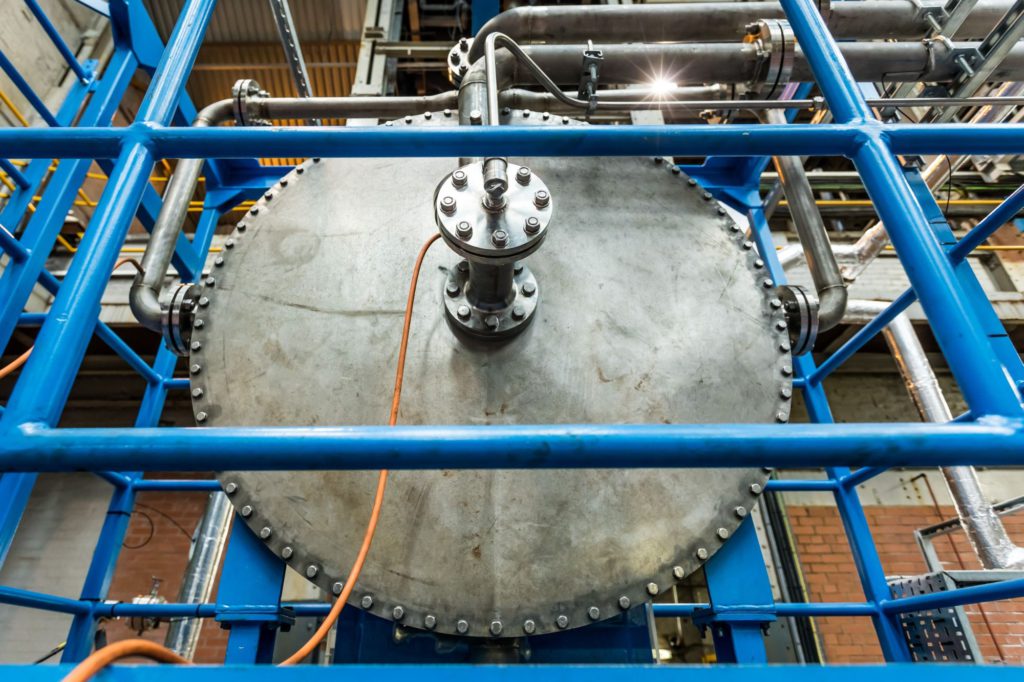
Carbon Clean Solutions Ltd. has tested its technology at more than 40 sites around the world, and says it can capture as much as 97% of carbon dioxide released by steel and cement factories and power plants.

The company has been developing the technology for more than a decade and is now ready to scale up, according to Chief Executive Officer Aniruddha Sharma. For climate startups, “the hardest thing is actually getting the tech out there and commercialized,” Sharma said. 

Carbon capture technology is more than a century old. It was commercialized by gas companies to separate CO₂ that sometimes was found mixed with natural gas. In the 1970s, rather than releasing the CO₂, companies found a use for the greenhouse gas: it could be injected into an aging field to increase oil production.

Sharma’s company is using the broader market for CO₂, such as for making fizzy drinks or as a cooling agent like dry ice, to get customers to pay for its technology. The largest commercial unit it has deployed is in India and it uses the captured CO₂ to make soda ash, which is then used in detergents. 

Read More:  Scaling Carbon Capture Might Mean Thinking Small, Not Big

In the climate era, however, CCS technology’s majority use is going to be simply burying the captured gas deep underground. Some 40 million metric tons of CO₂ is buried each year today, but most of it goes toward enhancing oil production. Climate models see the use of the technology growing to 10 times within the next decade to put the world on track to slow the rise in global temperatures.

CCS technology is separate from the set of technologies that aim to suck CO₂ directly out of the atmosphere. That process has to use a much more diluted stream of CO₂, which requires more energy to capture and thus typically costs a lot more. 

Carbon Clean will test out storing away the greenhouse gas in partnership with Chevron in California, where it hopes to capture as much as 30,000 tons of CO₂ each year. The company says that it has captured 1.5 million tons of CO₂ over the past decade, though none of it has been stored away permanently yet.

The startup is betting that its modular approach means it can fit into existing factories more seamlessly than current custom-built capture plants. That should allow it to drastically lower the cost of captured CO₂ to as little as $30 per ton. For comparison, companies covered by the European Union’s emissions market pay about $100 per ton for their pollution.

The new funds will go toward hiring 100 new staff to add to Carbon Clean’s  current tally of 60. The rest will go to buying more carbon capture units, which are currently manufactured using components from the US, Denmark and Germany.

More stories like this are available on bloomberg.com

©2022 Bloomberg L.P.

UK Money Manager Fasanara Raising New Crypto and Fintech Fund

(Bloomberg) — London-based asset manager Fasanara Capital Ltd is raising a new $350 million venture capital fund to invest in financial technology and cryptocurrency companies, giving it fresh cash to seize opportunities at a time when many investors are sitting out reeling markets. 

Fasanara is a data-driven investment firm with more than 150 employees and more than $3.5 billion in assets under management. It provides financing to firms including cryptocurrency exchanges and digital lending businesses. The company has previously raised about $550 million across two venture funds to back tech companies, including consumer-electronics rental startup Grover and buy-now-pay-later company Scalapay. 

The company is currently raising its third fund to back early-stage technology startups, and has already held a first close of $100 million, Chief Executive Officer Francesco Filia said in an interview. Unlike previous venture funds, Fasanara’s new fund will be open to new external investors, he added.

Given its background as a hedge fund, Filia said the firm is particularly keen on investing in crypto companies that intersect with trading. Other firms have also sought to bolster their crypto-investing capability, including hedge fund Marshall Wace. 

Filia said that the current turbulence in technology valuations is beneficial for his strategy.  “As the market goes through a difficult phase we can do better deals,” he said.

More stories like this are available on bloomberg.com

©2022 Bloomberg L.P.

Toyota Slumps on Pessimistic Outlook, ‘Unprecedented’ Costs

(Bloomberg) — Toyota Motor Corp. shares fell the most in two months after the carmaker forecast a lower operating profit outlook for the current year, citing an “unprecedented” rise in costs for logistics and raw materials that are negating the benefits of a depreciated yen. 

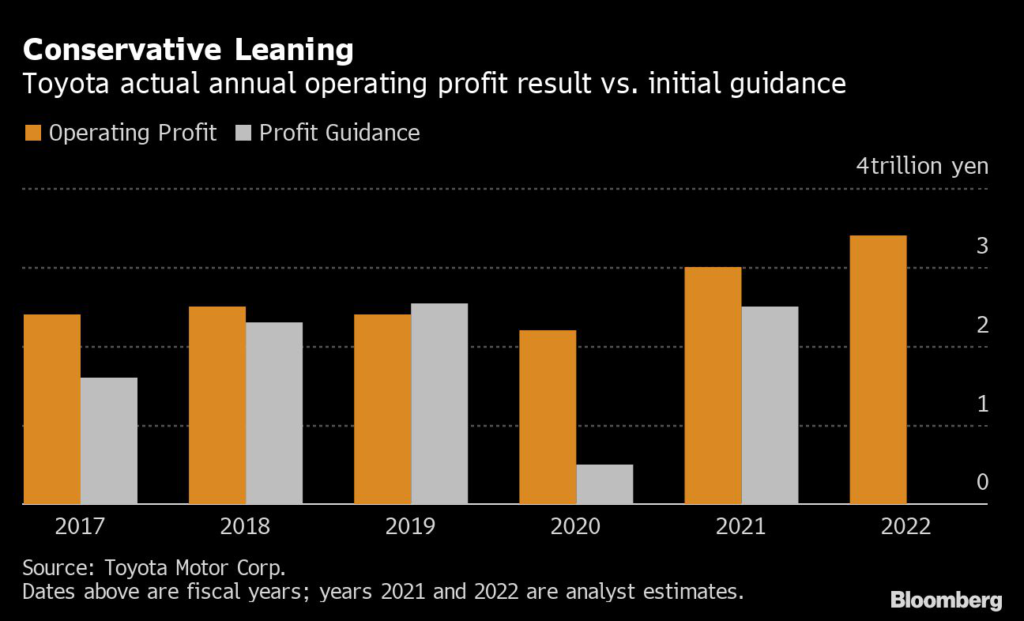
The shares of Toyota fell as much as 5.9%, the biggest intraday drop since March 7, after the world’s largest automaker forecast an operating profit of 2.4 trillion yen ($18.4 billion) for the fiscal year through March, short of analysts’ average projection for 3.4 trillion yen and profit of 3 trillion yen for the just-ended period.

Although Toyota is known for issuing conservative guidance, its tepid outlook took investors by surprise. In recent months, Toyota’s sales have kept up a strong pace, leading the automaker to post its second-highest unit sales ever for the year ended March. Toyota’s results are also being buoyed by a sharp decline in the value of the yen, which increases the value of earnings it brings back from overseas sales.

“It’s going to be a challenge,” said Satoru Aoyama, senior director of Asia-Pacific corporates at Fitch Ratings. “There are many factors that are compiling to create a negative trend.”

Despite issuing a profit outlook below estimates, Toyota is predicting higher vehicle sales for the current fiscal year, with a target of 10.7 million units, compared with 9.5 million for the period that ended March. 

Read more: Toyota Tops Annual Sales Goal With Second-Highest Total Ever

Net sales for the year will climb about 5% to 33 trillion yen, Toyota said, short of analysts’ prediction for 34.7 trillion yen. The company is also buying back as much as 1% of its shares for 200 billion yen.

Industry analysts have been warning of a growing number of risks related to both automotive supply and demand in the coming year. 

Global car production is facing further disruptions after more than a year of shortages of automotive semiconductors. In March, IHS Markit downgraded its output forecast for the current calendar year in order to factor in the impact from Russia’s invasion of Ukraine, then revised it down further last month in response to the fallout from Covid-related lockdowns in China, along with other mounting risks. 

Read more: World’s Top Carmakers Feeling Full Force of China Covid Stance

Others are warning of potential shocks to demand. Jefferies Financial Group Inc. sees expectations for Toyota’s earnings as being “too bullish” for the current fiscal year. The aggravation of cost inflation due to the Ukraine crisis and a potential slowdown in global economic growth will probably cause “considerable damage” to the auto sector overall, according to analyst Takaki Nakanishi.

Fitch Ratings’ Aoyama said he remains “cautiously optimistic,” at least for the next six months. 

“The yen depreciation has a positive impact accounting-wise but for the medium and long-term we still have greater uncertainty,” Aoyama said. “The yen depreciation, it’s like window-dressing but it doesn’t resolve the real, underlying issues.” 

(Updates with unit sales forecast in fifth paragraph.)

More stories like this are available on bloomberg.com

©2022 Bloomberg L.P.

Bitcoin Holds Rebound as Crypto World Awaits Stablecoin Rescue

(Bloomberg) — Bitcoin held a partial rebound from this week’s selloff amid steadier sentiment in global markets and expectations of help for a stablecoin whose struggles have cast a cloud over the cryptocurrency sector.

The world’s largest token hovered around $31,000 as of 12:50 p.m. in Singapore on Wednesday after bouncing from a brief dip below $30,000 a day earlier. Ether, Solana and other coins fluctuated in somewhat narrow ranges.

All eyes are on TerraUSD, an algorithmic stablecoin that should maintain a one-to-one ratio to the dollar. It has lost the peg and was trading at about 80 US cents. Stablecoins are key elements of the plumbing in the crypto market. 

Luna, a token that’s part of the peg mechanism for TerraUSD, is also under pressure. It has dropped about 60% in the past 24 hours.

Do Kwon, founder of Terraform Labs — which powers the Terra blockchain — is moving to shore up the stablecoin. He said on Twitter that a recovery plan is close to being unveiled. Treasury Secretary Janet Yellen said TerraUSD’s de-pegging highlighted the need for a regulatory framework for stablecoins.

The regulatory focus “appears to be weighing on sentiment for stablecoins” amid softening demand to some extent for the broader crypto ecosystem, said Tony Sycamore, senior market analyst at StoneX Retail.

He expects US stock indexes and Bitcoin to continue to move in tandem, after the correlation between the two reached a record level.

Bitcoin has struggled this year, shedding about 33%, compared with a 17% slide in global stocks. A range of speculative assets have been hurt by ebbing liquidity amid a global wave of monetary tightening to fight high inflation.

Read this next: Inside Do Kwon’s $10 Billion Plan to Prop Up Terra

More stories like this are available on bloomberg.com

©2022 Bloomberg L.P.

Ukraine Latest: US House Approves $40 Billion Aid Package

(Bloomberg) — The US House of Representatives easily passed a more than $40 billion Ukraine aid bill that funds new weapons and provides economic assistance. The legislation, which is larger than the $33 billion package President Joe Biden requested last month, now heads to the Senate where approval is likely next week. 

Italian Prime Minister Mario Draghi met Biden at the White House and called on allies to work on a long-lasting peace process in Ukraine, even as they seek to punish Russia over its invasion.

The number of people internally displaced by the war in Ukraine has surpassed the 8 million mark, a United Nations agency said.

(See RSAN on the Bloomberg Terminal for the Russian Sanctions Dashboard.)

Key Developments

  • Russia Trains Missiles on Ukraine’s Quiet Zone to Target Trade
  • House Approves $40 Billion Ukraine Aid Bill, Sends to Senate
  • Spy Chief Says Ukraine Could Leave Russia Weaker But Aggressive
  • Ukraine, Russia Gas Clash Raises Threat to Europe’s Supply
  • EU Must Speed Green Deal to Shut Out Russian Gas, CEOs Say
  • Draghi Urges Biden to Foster Long-Term Peace Plan for Ukraine

All times CET: 

More Than 8 Million People Displaced (5:03 a.m.)

The UN’s International Organization for Migration wrote in its latest report that many of the 8 million people internally displaced by the war said they are in need of financial help.

Two-thirds of the respondents to a survey it conducted between April 19 and May 3 said they needed cash assistance, up from 49% at the beginning of the war, the agency said. 

House Approves Aid Bill (4:02 a.m.)

The 368 to 57 vote underscores bipartisan support for Ukraine in a Congress deeply divided on most other issues.

The aid bill approved by the House includes $19.7 billion for the Defense Department, more than $3 billion above the level requested by the Biden administration. This includes the $6 billion in direct security assistance to Ukraine that Biden sought last month and $9.05 billion to replenish weapons stocks given from the Pentagon to Ukraine. 

Read more: House Approves $40 Billion Ukraine Aid Bill, Sends to Senate

Ukraine’s First Post-Soviet Leader Dies (2:16 a.m.)

Former President Leonid Kravchuk, independent Ukraine’s first post-Soviet leader, has died at the age of 88, current President Volodymyr Zelenskiy said in a social media video post. 

Zelenskiy described Kravchuk, who led the country from 1991 until 1994, as a person who knew the costs of freedom and wanted peace for Ukraine. Kravchuk played a key role in phasing out Ukraine’s nuclear arsenal after the Soviet Union collapsed. 

Draghi, Biden Hold Talks at White House (1:20 a.m.)

Draghi met Biden to discuss the war and coordinate their response to Russia’s invasion, in the first visit to Washington by a European Union leader since combat broke out in Ukraine on Feb. 24.

“People are asking, how can we end those atrocities? How can we reach a cease-fire? At the moment it is hard to have answers to that, but we need to think carefully about those questions,” Draghi told Biden. During their meeting, Biden told Draghi the US is ready to increase its oil production if that won’t affect clean energy goals, according to remarks shared by Italian officials.

Read more: Draghi Urges Biden to Foster Long-Term Peace Plan for Ukraine

NATO Chief Stoltenberg Tests Positive for Covid (9:53 p.m.)

NATO Secretary General Jens Stoltenberg has Covid-19, according to a tweet from the alliance’s press office. Stoltenberg is experiencing mild symptoms and will work from home, according to the statement. The diagnosis comes just days before NATO foreign ministers are due to meet in Berlin this weekend.

US Reviews Carveout for Russian Bond Payments (7:30 p.m.)

The US Treasury is busy examining whether or not it will extend a time-limited carveout from sanctions measures that has so far allowed Russia to keep making payments on its foreign currency bonds and steer clear of default. 

The future of those provisions — which allow US holders of Russian sovereign bonds to receive payments on the debt and are currently set to expire May 25 — are being “actively” examined at present, Treasury Secretary Janet Yellen told lawmakers Tuesday in response to questioning.

“We want to make sure that we understand what the potential consequences and spillovers would be of allowing the license to expire,” Yellen said.

Zelenskiy Asks Malta to End ‘Golden Passports’ for Russians (7:01 p.m.)

President Zelenskiy said it is “high time” for Malta to end its support for so-called golden passports, which typically offer people citizenship in exchange for investing in a nation’s property or assets, for Russians. 

He also called on Malta to block Russian citizens’ access to real estate, bank accounts and yachts, among other things. 

EU Seeks to Boost Ukraine’s Food Exports Via Land (5:48 p.m.)

The EU is finalizing a plan to facilitate land exports of Ukraine’s stocks of food products with the Russian invasion blocking access to the country’s vital Black Sea ports. The bloc on Wednesday will consider a strategy that would address technical and bureaucratic initiatives to speed up the shipping of vegetable oils, corn and wheat, some of Ukraine’s key exports, people familiar with the discussions said.

Ukraine Gas Grid Says Russia Flows Via Key Entry Point to Stop (5:20 p.m.)

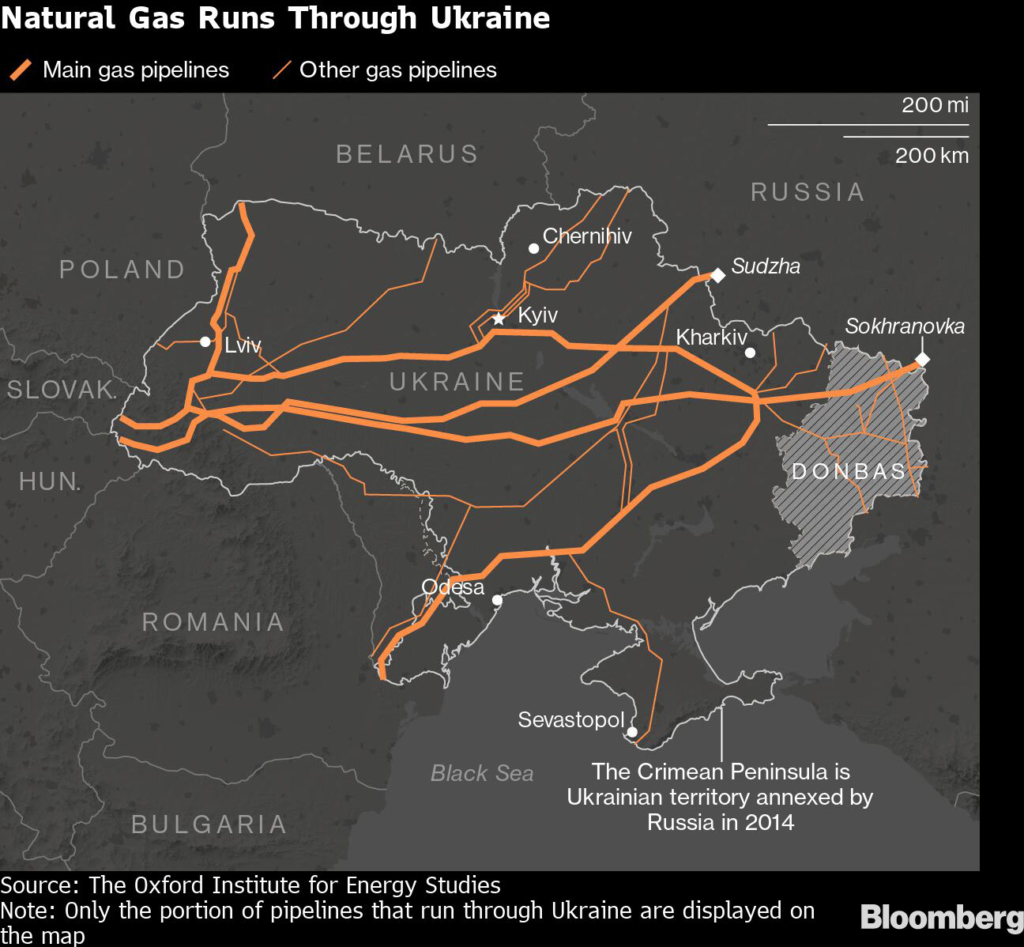
Ukraine’s natural gas grid said Russian flows to Europe via a key entry point will stop from Wednesday as occupying forces disrupt operations, a move that has the potential to reduce supplies.

The Gas Transmission System Operator of Ukraine said it can no longer accept Russian gas transit via Sokhranivka from 7 a.m. local time, according to a statement on its website. It’s still possible for the fuel to be re-routed via another key entry point, allowing European contracts to be fulfilled, though it’s unclear who is responsible for making that decision.

NSA Probing Kaspersky’s Reach in US (4:19 p.m.)

The National Security Agency is investigating the extent to which software made by the Russian cybersecurity company Kaspersky is embedded in US businesses and organizations.

“I am still very worried about US companies that are using Kaspersky,” said Rob Joyce, the NSA’s director of cybersecurity, in an interview in which he revealed the inquiry. “We think that is ill-advised with this global situation.”

Some companies, including those in financial services, voluntarily abandoned Kaspersky antivirus products after the US government banned the company’s software from federal systems in 2017, citing espionage fears. 

Swedish Ruling Party Reported to Say Yes to NATO (2:37 p.m.)

Sweden’s ruling Social Democrats are set to declare their support on May 15 for the country to join NATO, Finland’s largest newspaper Helsingin Sanomat reported, citing sources it didn’t identify.

Finland’s government has been aware of the conclusion since at least last week, the newspaper said. 

Previous reports by news agency TT indicate that Swedish Prime Minister Magdalena Andersson wants to wait for the delivery of the country’s cross-party security policy review, due May 13, before she decides on the NATO position.

Zelenskiy Urges Slovakia to Back Russian Oil Ban (1:57 p.m.)

President Zelenskiy urged Slovak lawmakers to back the EU’s proposed ban on purchasing oil from Russia as the government in Bratislava tries to negotiate a three-year exemption with the bloc because of its heavy dependence on Russian crude.

Zelenskiy thanked Slovakia for supplying his military with weapons but said that the EU’s sixth package of sanctions was also vital for Ukraine’s defense. “If they will be weaker, it will be harder for us. We need this sixth package.” Zelenskiy told lawmakers in a video speech. “We understand it will be hard for you, but banning oil is important.”

Finnish Parliament Committee Says Country Should Join NATO (12:25 p.m.)

Finland should join the North Atlantic Treaty Organization to best ensure the security of all Finns, according to the parliament’s defense committee, as the nation prepares to decide on an application within days.

Russia’s invasion of Ukraine galvanized public support for joining the military alliance. Finland is, along with Sweden, considering NATO membership and giving up its non-alignment that stretches back to before the cold war.

EU Approves Release of 600 Million Euros for Ukraine (12:08 p.m.)

The EU has approved the release of 600 million euros to help Ukraine with its urgent financial needs, according to bloc officials who asked not to be identified. The money is part of the EU’s 1.2 billion euro emergency assistance package adopted by the bloc early this year.

The European Commission is expected to complete the process Wednesday and the funds could be transferred in the coming days, according to one of the officials.

Ukrainian Troops Retreat From Popasna in Luhansk Region (12:06 p.m.)

Ukrainian troops retreated from Popasna in the Luhansk region to more fortified positions, the area’s Governor Serhiy Haiday said in statement on Facebook. 

Fighting over the city, which is near the border between the Luhansk and Donetsk regions and occupies strategic heights, was ongoing over the last two months. 

German, Dutch Foreign Ministers Visit Kyiv (12:00 p.m.)

German Foreign Minister Annalena Baerbock and her Dutch counterpart Wopke Hoekstra traveled to Kyiv Tuesday for meetings with Ukrainian government officials.

Baerbock visited the town of Bucha near the capital, which is the site of alleged Russian atrocities against civilians, while Hoekstra was in the Kyiv suburb of Irpin, where he viewed bombed-out houses and buildings. “These acts cannot go unpunished,” he said in a tweet. “The Netherlands is committed to establish the truth and achieve justice.”

Macron Speaks With Orban on Energy Security (11:48 a.m.)

Orban spoke about energy security on Tuesday with Macron, whose country holds the EU’s rotating presidency, an aide to the Hungarian leader said, as diplomacy over potential sanctions on Russian oil continues. 

A video call between Orban, European Commission President Ursula von der Leyen and Hungary’s neighbors won’t be held Tuesday, according to a spokesman for the bloc. He didn’t immediately explain why the call, which was announced the previous day, was delayed. 

The EU’s sixth sanctions package would ban crude oil shipments over the next six months and refined fuels by early January, but Hungary has threatened to veto the measures due to its reliance on Russian energy imports. Orban and von der Leyen made progress in talks over the issue Monday but failed to reach a breakthrough, according to both sides. 

More stories like this are available on bloomberg.com

©2022 Bloomberg L.P.

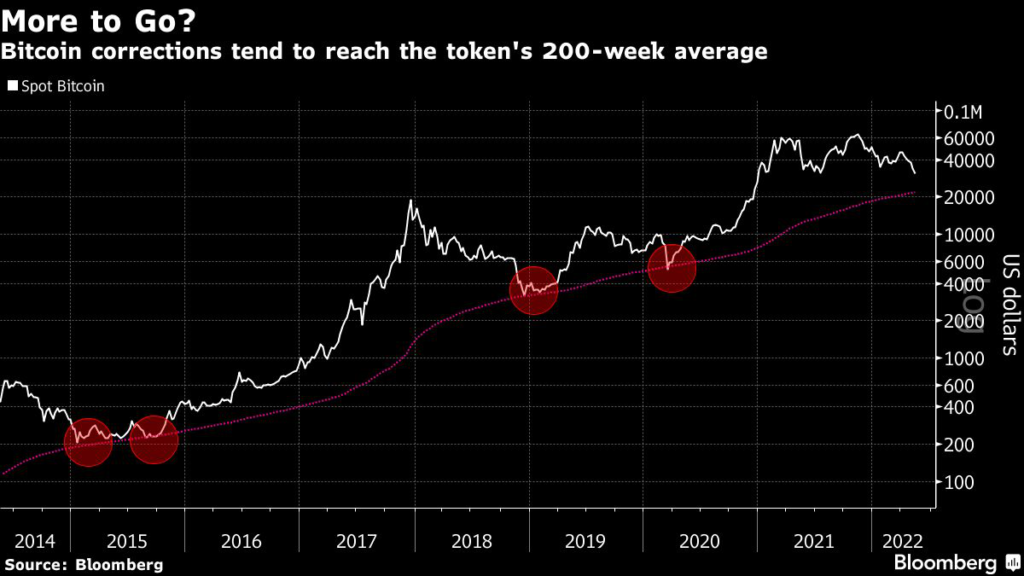
History of Bitcoin Slumps Makes $20,000 Realistic Target

(Bloomberg) — Crypto fans desperate for a floor in Bitcoin’s selloff may have to be patient. Every significant slump in the largest cryptocurrency since 2014 has reached the 200-week moving average. That lies close to $20,000 — or about 35% below Bitcoin’s current price, which is already down by a similar percentage in 2022.

More stories like this are available on bloomberg.com

©2022 Bloomberg L.P.
Coinbase CEO Says No Risk of Bankruptcy Amid ‘Black Swan’ Event

(Bloomberg) — Coinbase Global Inc. Chief Executive Officer Brian Armstrong said there is “no risk of bankruptcy” for the largest U.S. cryptocurrency exchange, even amid a “black swan” event that saw Bitcoin drop below $30,000 on Tuesday for the first time since the middle of 2021.

Coinbase will take additional steps to ensure that it offers protection for its retail customers that match those offered to Prime and Custody consumers, Armstrong said in Twitter thread late Tuesday. 

“We should have updated our retail terms sooner, and we didn’t communicate proactively when this risk disclosure was added,” Armstrong wrote. “My deepest apologies.”

Shares in the company fell 16% after regular trading as first-quarter revenue missed analyst estimates.

More stories like this are available on bloomberg.com

©2022 Bloomberg L.P.
Nintendo’s Surprise Stock Split May Only Offer Brief Share Boost

(Bloomberg) — A surprise stock split plan by Japanese game maker Nintendo Co. may provide only a fleeting boost to its shares as concerns about the company’s earnings outlook persist.

The Mario creator’s stock jumped as much as 4.5% in Wednesday morning trade, a day after the 10-for-1 split was announced. The company forecast full-year operating income which trailed analysts’ estimates, reflecting the impact of a global chip shortage and slowing demand for the Switch console.

Stock splits typically provide a lift to share prices — as seen in the case of Tesla Inc. and Alphabet Inc. — as the move puts the counters within the reach of retail investors. Based on Tuesday’s close, the minimum investment lot — 100 shares — for Nintendo’s stock is 5.64 million yen ($43,273), far above the Tokyo Stock Exchange’s guideline of 50,000 to 500,000 yen.

“In general, there is no rational reason to think a stock split is positive for stock prices,” said Kenichi Hirayama, chief strategist at Tokio Marine Asset Management Co. “If there is any effect, that should be only a temporary one.”

That’s borne out by the recent record of stock splits by big Japanese firms. Among companies with market capitalization of more than $50 billion that have conducted a stock split since 2015, only Keyence Corp. rallied in the aftermath.

Even so, Nintendo’s shares may enjoy a brief spell of sizable gains.

“Now that the stocks have split, investors are now able to buy it at around 560,000 yen which will be easier for them to reach,” said Tomoichiro Kubota, senior market analyst at Matsui Securities Co. He noted that the regular investment size for an individual investor would be 300,000-400,000 yen.

More stories like this are available on bloomberg.com

©2022 Bloomberg L.P.
China Inflation Exceeds Forecasts as Lockdowns Roil Supplies

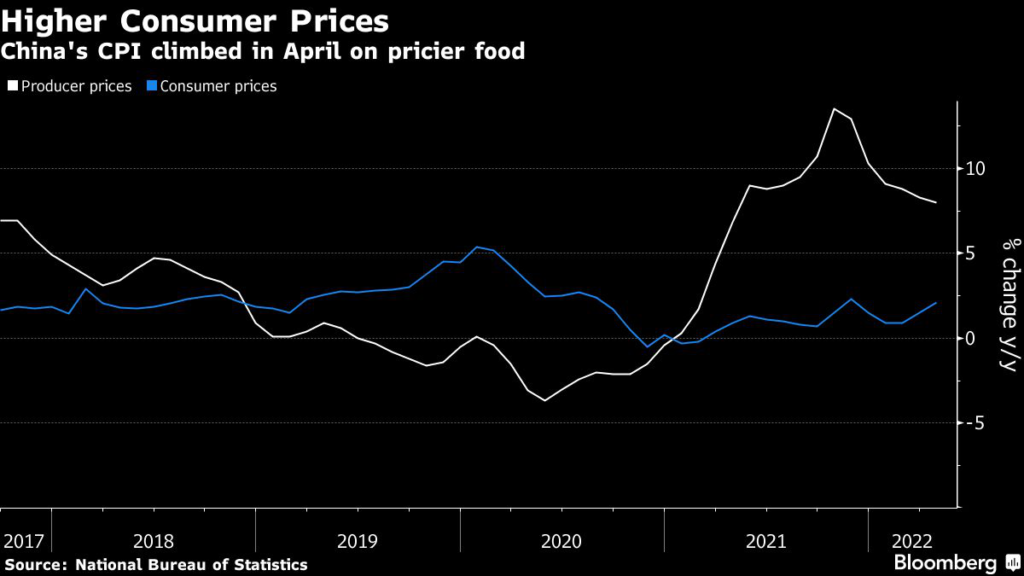
(Bloomberg) — China’s factory and consumer prices rose faster than expected in April as Covid lockdowns battered supply chains and pushed people to stockpile food. 

The producer price index rose 8% from a year earlier compared to 8.3% in March, official data showed Wednesday, above the median estimate of a 7.8% increase in a Bloomberg survey of economists. Consumer-price growth accelerated to 2.1% from 1.5% in the previous month, faster than a projected 1.8% gain.

While commodity prices are inching down from the very high levels spurred by the war in Ukraine, costs remain elevated and have squeezed manufacturers’ profits. Covid outbreaks in China and restrictions intended to contain them have indirectly added to operating costs, making it tougher for factories to maintain production, obtain raw materials and ship out finished goods.

The uptick in consumer inflation was attributable to virus outbreaks and higher global commodity prices, Dong Lijuan, senior statistician at the National Bureau of Statistics, said in a statement accompanying the data.

“Panic buying and stocking among consumers likely also pushed up demand,” said Zhang Zhiwei, president and chief economist at Pinpoint Asset Management. “As supply chain disruption is gradually resolved, inflationary pressure may fade away.”

Despite the higher-than-expected inflation figures, Zhang said the issue is not a concern for policy makers. “The main challenge remains the balance between containing omicron outbreaks and stabilizing economic growth,” he said. 

China’s benchmark CSI 300 Index gained as much as 1.7%, extending Tuesday’s rise while the ChiNext Index advanced 3.3%. The rally came as virus cases in China declined, boosting sentiment among traders.

The onshore yuan, meanwhile, advanced by 0.2% to 6.7235 as of 10:34 a.m. against a softer US dollar. Yields on 10-year Chinese government bond edged up 1 basis point to 2.82%.

Pricier food

Food became pricer in April as several areas locked down to contain the spread of Covid. Fresh vegetable costs jumped 24% from a year ago, compared to an increase of 17.2% in March, NBS data showed. Pork prices continued to fall, plunging 33.3%. Wholesale vegetable prices in the first week of May have continued to drop from the level in April, but are still almost 12% above the price in the same week last year.  

A 28% jump in fuel costs also contributed to higher consumer prices. Prices of vehicle fuel rose the fastest of any metric within the CPI basket, according to a breakdown provided by the NBS.

Core CPI, which excludes volatile food and energy prices, rose 0.9%, compared to March’s 1.1% increase.

The lockdown in Shanghai threatens to exacerbate global supply chain pressures and inflation concerns, according to economists at Fitch Ratings. The economists cited a plunge in Shanghai freight traffic volume in April and early May resulting in backlogs at the port of Shanghai as contributors to those issues, according to a research note published Tuesday before China’s inflation data was released. 

“With Shanghai handling around a fifth of China’s port volume and China accounting for 15% of world merchandise exports, shortages of manufactured goods could intensify, adding to existing global inflationary pressures,” the Fitch economists wrote. “This channel is likely to outweigh the effect of slower growth in China on global inflation through a weakening of commodity demand and prices.”

What Bloomberg Economics Says … 

Beneath the mixed headlines, details in China’s April price data offer more evidence of the demand-hit from the covid lockdowns. Consumer price inflation outside of energy and food dropped to a 10-month low, while sequential gains in factory-gate prices decelerated to half March’s pace. The moderating PPI and benign CPI inflation open a wider path for the People’s Bank of China to ease. 

— Eric Zhu, economist

Read the full report here

The decision to stand by a strategy built on strict Covid curbs has led several economists to cut growth forecasts for the year to well below the government’s target of about 5.5%, as an unswerving commitment to Covid Zero means more cities will lock down or mass test their citizens for as long as the virus is spreading. The capital city Beijing, e-commerce hub Hangzhou and Yiwu, a city known for wholesaling Christmas decorations, have all rolled out restrictions to contain the virus.

As long as authorities can contain the virus and alleviate the disruption to supply chains, though, the rise in consumer prices will remain “benign” for the year, according to Bruce Pang, head of macro and strategy research at China Renaissance Securities Hong Kong Ltd.

The room for policy action by the People’s Bank of China “is more constrained by the policy tightening of overseas major economies and the need to maintain a stable yuan exchange rate,” he said.

(Updates throughout with further analyst comments.)

More stories like this are available on bloomberg.com

©2022 Bloomberg L.P.
Midea Former CFO Choy Joins Product Testing Firm UL

(Bloomberg) — Midea Group Co.’s former chief financial officer Jeremy Choy is joining product testing, inspection and certification firm UL as a senior dealmaker, according to a person with knowledge of the matter. 

Choy will start in UL’s Hong Kong office and relocate to its headquarters in Northbrook, Illinois in the summer, said the person, who asked not to be identified as the information isn’t public. As senior vice president, chief strategy and corporate development officer, his responsibilities will include mergers & acquisitions, the person said.

The company provides testing, inspection and certification, training, advisory and risk management services, according to its website. It traces its history back to 1894, when the Underwriters Electrical Bureau began testing electrical products for fire safety. The organization was later restructured into the for-profit UL and the non-profit Underwriters Laboratory Inc. which houses research and standards and engagement units. 

UL has employees based in more than 40 countries and customers from over 100 countries, the website showed. Its rivals include the U.K.’s Intertek Group Plc and Switzerland’s SGS SA. UL acquired South Korean medical and consumer device safety testing firm KBW Corp. in February for an undisclosed amount, according to a press release. 

Choy resigned from Midea in January citing personal reasons, according to a company statement. The veteran dealmaker was previously HSBC Holdings Plc’s head of technology mergers and acquisitions in Asia before joining the appliance maker last year.

A representative for UL didn’t immediately respond to a request for comment.

(Updates with KBW acquisition in fourth paragraph.)

More stories like this are available on bloomberg.com

©2022 Bloomberg L.P.
Close Bitnami banner
Bitnami