
Bloomberg

Nintendo to Split Stock Into 10 to Counter an Aging Switch

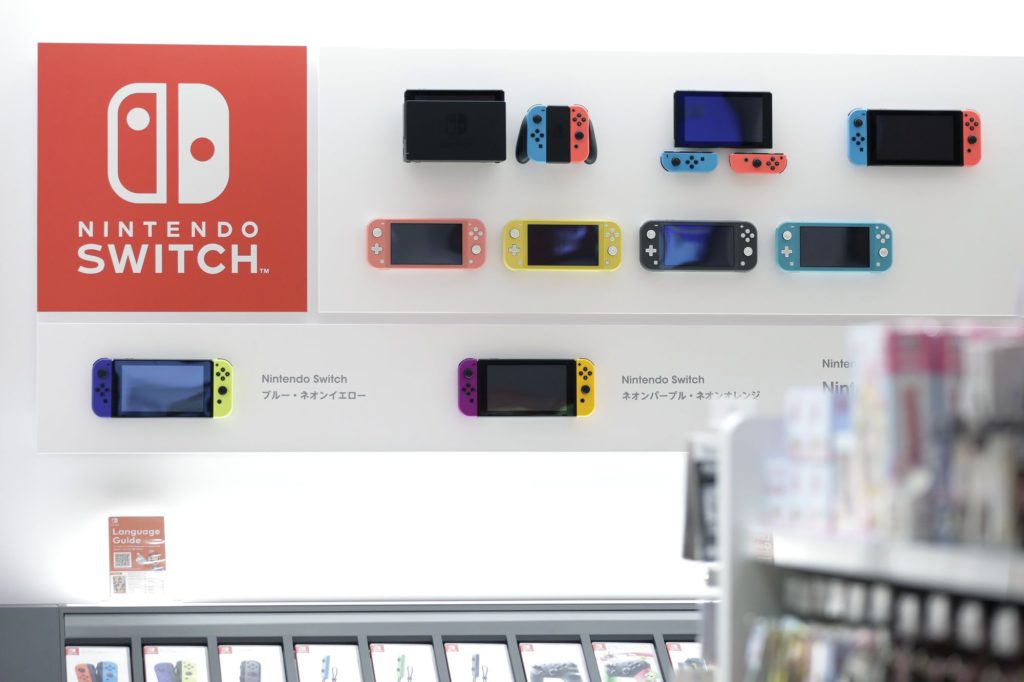
(Bloomberg) — Nintendo Co. unveiled plans to split its stock into 10 from October, issuing an appeal to investors as the Mario creator struggles to revitalize a five-year-old Switch console and overcome a global chip shortage.

The Kyoto-based company projected full-year operating income below analysts’ estimates after reporting a mere 0.6% rise in profit for the March quarter. It’s expecting to sell 21 million Switch devices this year, shy of the 21.7 million anticipated.

Its shares briefly climbed as much as 2.5% in Tokyo before giving up those gains Wednesday, underscoring persistent concerns about its ability to navigate supply chain snarls that have hindered production. The hybrid Switch console, updated with an OLED model last year, was constrained during the period by issues with component supplies and logistics.

Nintendo’s forecasts are often conservative, but the disappointing set of numbers also illustrated the Switch’s slowing momentum. Even when production and deliveries return to normal, the aging device will struggle to maintain its previous sales pace, said Toyo Securities senior analyst Hideki Yasuda. 

Nintendo Fluctuates as Analysts Assess Guidance, Stock Split

What Bloomberg Intelligence Says

Nintendo may be destined for another round of declines in the top and bottom line in fiscal 2023 ending March, particularly as both hardware and software sales are likely to be weaker this year, barring the release of an upgraded, yet unconfirmed new Switch console. A sales boost from higher video-game software units, largely driven by new Pokemon games, was more than offset by lower Switch units, leading to a 3.6% fall in fiscal 2021 net sales. Software sales may reach 210 million units this year amid new game releases, vs. last year’s 235.1 million, while hardware falls to 21 million from 23.1 million driven by chip shortages, based on latest guidance.

– Nathan Naidu, analyst

Click here for the research.

Sony, whose flagship PlayStation 5 game console also suffered supply constraints from component shortages and logistics disruptions, reported disappointing results Tuesday. Nintendo President Shuntaro Furukawa told reporters he saw no end to the semiconductor crunch, which has constrained global production of cars and smartphones.

“The outlook on chip shortages remains unclear. We do not see an end to this situation,” he said.

Nintendo’s operating profit inched higher to 120.2 billion yen ($922 million) in the quarter ended March, with sales growing 6% to 375.13 billion yen. Analysts had expected about 120.1 billion yen in profit and 373.4 billion yen in revenue. The company projected full-year operating income of 500 billion yen, versus projections for 612.7 billion yen.

Read more: Sony to Buy Back Stock After Profit Falls Short of Estimates

Nintendo underperformed in spite of the yen’s weakening against the dollar and euro. Roughly four-fifths of the company’s revenue comes from overseas and its software sales, whose production costs are mostly yen-denominated, benefited from the home currency’s fall. During the quarter, it also recorded strong sales of Pokémon Legends: Arceus, a game that’s become the fastest-selling title in the long-running franchise, according to its publisher. 

Nintendo plans a string of high-profile game releases from its in-house development studios this year, including additions to the Pokémon, Splatoon and Xenoblade Chronicles franchises. Furukawa has argued that hardware sales can be sustained through the release of attractive new titles.

On Tuesday, the Nintendo president declined to comment when asked during a media briefing about when his company might unveil the next iteration of its marquee console.

“The only option for Nintendo to prop up the hardware’s sales momentum is to release upgraded hardware,” Yasuda said.

(Updates with share action from the fourth paragraph)

More stories like this are available on bloomberg.com

©2022 Bloomberg L.P.

Car-Sharing Startup Getaround Nears InterPrivate SPAC Merger

(Bloomberg) — Getaround, a car-sharing marketplace that functions as an Airbnb for vehicles, has agreed to go public through a merger with InterPrivate II Acquisition Corp., a special purpose acquisition company, according to people with knowledge of the matter.

A transaction that gives the combined company an equity value of about $1.2 billion, if there are no redemptions, may be unveiled as soon as Wednesday, said the people, who requested anonymity.

Getaround founder and Chief Executive Officer Sam Zaid will lead the company, which is set to trade on the New York Stock Exchange with the ‘GETR’ ticker, the people said. Getaround investors including SoftBank Vision Fund, Menlo Ventures, Reinvent Capital, and actor Ashton Kutcher are poised to remain owners of the combined entity. 

Representatives for San Francisco-based Getaround and InterPrivate II declined to comment. 

InterPrivate II, led by Chairman and CEO Ahmed Fattouh and executive vice presidents Brian Pham and Alan Pinto, raised about $259 million in a March 2021 initial public offering. The first InterPrivate SPAC merged with Aeva Technologies Inc., a laser-sensor startup founded by two ex-Apple Inc. engineers.

Read more: Car-Sharing Startups Emerge From Pandemic With New Lease on Life

Founded in 2009 and launched in 2011, Getaround operates in eight countries including the US, UK, France and Germany. The company, which asserts non-shared cars are idle 22 hours per day, has said it aims to reduce the number of vehicles on the road, which may limit carbon emissions and overall congestion.

Its rival Turo Inc., backed by IAC/InterActiveCorp. among others, in January filed for an IPO. 

More stories like this are available on bloomberg.com

©2022 Bloomberg L.P.

Mixed Messages From Top China Leaders Feed Speculation of Split

(Bloomberg) — Premier Li Keqiang’s warning of China’s “complicated and grave” employment situation on Saturday was particularly dire, even for someone who has sounded the alarm for months. But it was also notable another reason: It didn’t mention President Xi Jinping’s Covid Zero strategy. 

Just days earlier, the Politburo Standing Committee — on which both Xi and Li sit — warned China’s citizens not to question Covid-control policies that have locked down cities across the country, including Shanghai. That statement, by contrast, contained no mention of the economy. 

Besides confusing local officials who must find a way to eliminate Covid and grow the economy, the mixed messages from China’s most powerful leaders raise questions about whether there’s a split at the top over the best way out of the pandemic. 

Any space between Xi and Li is closely scrutinized for signs of power struggles unfolding in China’s opaque government. Once considered rivals for the top job, the pair continue to be seen as standard-bearers for separate strains in policy making, with Xi representing the more ideological wing and Li associated with more technocratic tradition. 

“It is probably a stretch to say that Xi and Li are personally at loggerheads, but their statements do represent divergent views within the system on Covid and its impact,” said Richard McGregor, author of the “The Party: The Secret World of China’s Communist Rulers.” “China is reaching the point where the need for a genuine debate about whether the price being paid for further lockdowns is worth the economic damage.”

With much of the world seeking to return to normal as vaccines proliferate and virus deaths recede, China is pressing ahead with Covid Zero, increasingly equating dissent against the policy with subverting Xi. Beijing has trumpeted the government’s success in stopping outbreaks before they get out of hand as evidence of how China’s model of governance is superior to U.S.- or European-style democracy. 

Still, the lockdown-dependent strategy has resulted in sustained social tensions in the country’s largest city, Shanghai, where many of its 25 million people have been under restrictions for more than a month. Curbs in the capital Beijing have become progressively tighter in recent days. 

While the Standing Committee last week made no mention of balancing Covid controls with economic growth, Li’s statement emphasized unemployment, which climbed to 5.8% in March, the highest since May 2020. “Stabilizing employment matters to people’s livelihoods” Li said, adding that doing so was “also a key support for the economy to operate within a reasonable range.”

Joblessness is a topic Li raises regularly, including in remarks at the National People’s Congress in March when he announced he wouldn’t return as premier next year after a party reshuffle that will likely extend Xi’s rule. China’s economy will see 16 million new urban job seekers in 2022, and ensuring their employment will require greater policy support, Li said.

Andy Chen, a senior analyst with Beijing-based consultancy Trivium China, said the country’s leaders don’t see the policy priorities to be at odds. Li, as premier and head of the government, is supposed to focus on the economy, as opposed to Xi, the runs the party and therefore serves as its political leader. 

“They see getting the Covid outbreaks under control as the precondition and basis for maintaining a strong economic momentum,” Chen said. “So emphasizing on ensuring employment doesn’t mean pandemic control is less of a priority. It’s still the No. 1 priority.”

Whether China’s top leaders see their instructions as contradictory, they’re creating dilemmas for local officials, who might find Covid controls as literal barriers to keeping supply chains running smoothly. After the Standing Committee’s latest decree, “local governments lack a real incentive to dismantle roadblocks” installed on highways to prevent Covid from spreading, Trivium said in its newsletter. 

Besides holding different portfolios, Xi and Li hail from separate corners of the party elite. The president is the “princeling” son of a revolutionary while the premier is a trained economist and seen as a protege of former President Hu Jintao. Xi was chosen over Li in 2007 as Hu’s successor. Potential successors for Li’s job include Li Qiang, a former Xi secretary who’s now in charge of the Shanghai lockdown effort. 

Li Keqiang “has always represented a strain of more technocratic policy-making in the system that today is very frustrated with how the commitment to Covid Zero has played out,” said Jordan Schneider, a senior analyst at Rhodium Group. “Li in his statement was trying to make room for cadres to take into consideration economic, as well as public health, considerations.”

Schneider said there’s been a pattern of reactive messaging in recent months in which technocratic officials have been called on to give statements that reassure markets only for policies to fall short of expectations. “What may be going on is less a disagreement between the two and more that dovish policy messaging isn’t followed up with dovish policy,” he said. 

A similar split emerged last year after efforts by local officials to meet Xi’s ambitious carbon goals were blamed for power shortages. Li later indicated the government would rethink the pace of China’s energy transition, slamming a “one-size-fits-all” approach in shutting down energy-intensive projects or “campaign-style” carbon reduction.

McGregor, the author of “The Party” who’s now a senior fellow for East Asia at the Lowy Institute in Sydney, said Xi was trying to dictate the outcome of the debate over Covid policy by suppressing one side of the argument. He suggested watching to see if Li becomes more vocal on policy issues as he prepares to leave the premier’s job. 

“The key question is whether Li persists in speaking up in public about the economy,” McGregor said. “Then, we might have the real makings of a split.”

More stories like this are available on bloomberg.com

©2022 Bloomberg L.P.
Coinbase Sinks After Warning the Slide in Volume to Worsen

(Bloomberg) — Coinbase Global Inc. shares tumbled after first-quarter revenue missed estimates and the largest U.S. cryptocurrency exchange warned that total trading volume in the current quarter will be lower than in the first. 

The company’s shares fell about 16% after the close of regular trading. Monthly transacting users fell to 9.2 million, below an estimate of 9.5 million. First-quarter revenue slumped to $1.17 billion, while analysts were expecting revenue of $1.48 billion, according to Bloomberg data. 

“We continue to see the trading volume is weak, the macro headwinds is still here, what that means is trading volume may be stagnant over the next few months or so,” said Owen Lau, an analyst from Oppenheimer & Co. Inc., who has an “outperform” rating on the shares. “If they maintain these high investments, then they may not be able to maintain profitability this year. “

Coinbase’s results came amid a sell-off of speculative assets from stocks to crypto across global markets. Bellwether Bitcoin is down more than 50% since its all-time high in November, pushing many retail traders to stay on the sidelines. Coinbase earns the bulk of its revenue from trading fees, and its shares have fallen to all-time lows — down more than 70% from where they traded when the company went public a year ago.

Coinbase, which made its debut in the junk-bond market last year, also saw its notes drop in secondary. Its $1 billion of bonds due in 2031 fell 5.5 cents to 66.5 cents on the dollar, according to Trace pricing.

“We definitely see bear-market conditions, but it’s hard to call it a winter yet,” Alesia Haas, chief financial officer, said in an interview. She said the company could be slower with hiring, but hasn’t yet. The company is choosing to invest in growth this year, Coinbase executives said on its earnings call.

Coinbase expects total trading volume and monthly transacting users in the second quarter to be lower than in the first quarter, but its outlook for 2022 is “largely unchanged,” Haas said. During a prolonged bear market, the company will continue to aim to manage its full-year potential adjusted Ebitda losses to about $500 million, it said in an investor letter. 

Coinbase is working to diversify its business and to reduce its reliance on trading fees. Its staking product — allowing users to put their coins into special yield-earning accounts — continues to gain traction. Coinbase has also been working on launching crypto derivatives. Last week, it opened its new marketplace for nonfungible tokens — essentially, digital art connected to blockchain — to all users, but its uptake has been slow. 

Coinbase expects to relaunch in India soon after encountering problems, Chief Executive Officer Brian Armstrong said during the call. 

Competitive pressures in the crypto market are growing. Blockchain.com may consider going public as early as this year, Bloomberg reported earlier. Binance, the world’s biggest cryptocurrency exchange, just agreed to provide $500 million in funding to Elon Musk’s takeover of Twitter Inc., potentially getting more access to the social media platform’s users. Decentralized exchange Uniswap is starting to see volumes that are close to Coinbase’s.

(Adds comments on profitability and relaunching in India, starting in the sixth paragraph.)

More stories like this are available on bloomberg.com

©2022 Bloomberg L.P.
Musk-Twitter Deal Spread at Widest as Traders Doubt Takeover

(Bloomberg) — Traders are the most skeptical they’ve ever been about whether Elon Musk will actually complete his proposed purchase of Twitter Inc.

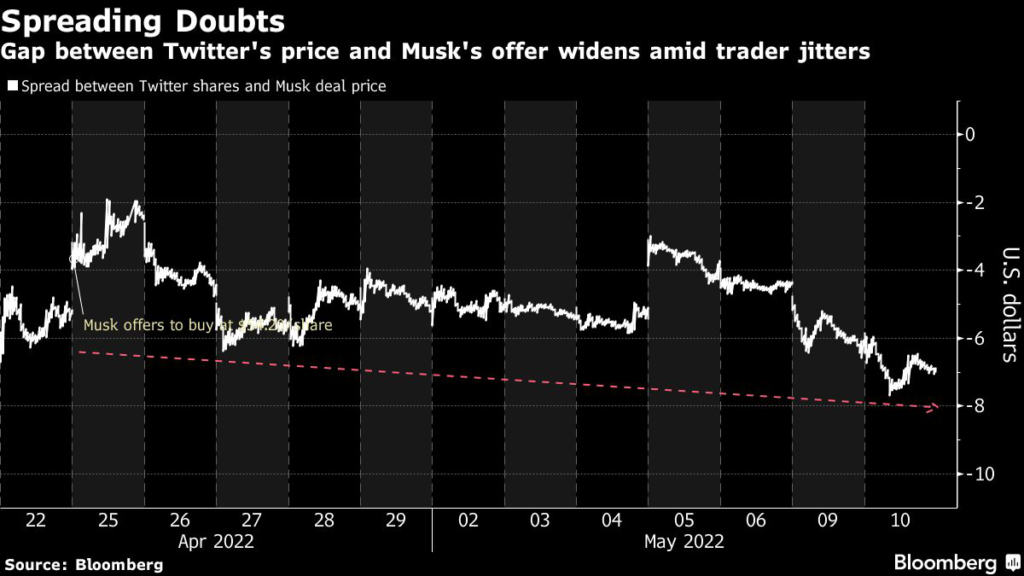
The spread on the deal, which offers an indication of how much Wall Street believes the takeover will be completed, jumped to $6.94 on Tuesday — the widest since the billionaire launched his bid and almost twice where it was last week when he announced a roughly $7.1 billion financing commitment. Twitter shares ended Tuesday at $47.26, while Musk has offered to purchase the social media platform for $54.20.


After the close Bloomberg reported that Apollo Global Management is in talks to lead a preferred financing for Musk’s bid that will exceed $1 billion. 

The news came after investors were left scratching their heads Tuesday over comments Musk made during an interview at the Financial Times Future of the Car summit that seemed to hedge his plans.

“I don’t own Twitter yet, so this is not like a thing that will definitely happen,” Musk said, referring to his intention to reinstate former President Donald Trump’s Twitter account if he buys the company. “What if I don’t own Twitter?”

At current levels, Twitter’s merger arbitrage spread is among the widest of all pending US transactions, according to Bloomberg data. It represents a 14.7% gross return if the take-private plan goes through, compared with 8.36% in Nielsen’s take private deal, according to Bloomberg data.

QuickTake: Confused by Musk’s Twitter LBO? Here’s What’s Weird

(Adds details on Apollo financing in third paragraph.)

More stories like this are available on bloomberg.com

©2022 Bloomberg L.P.
SoftBank Faces Record Loss as Masayoshi Son’s Bets Tumble Again

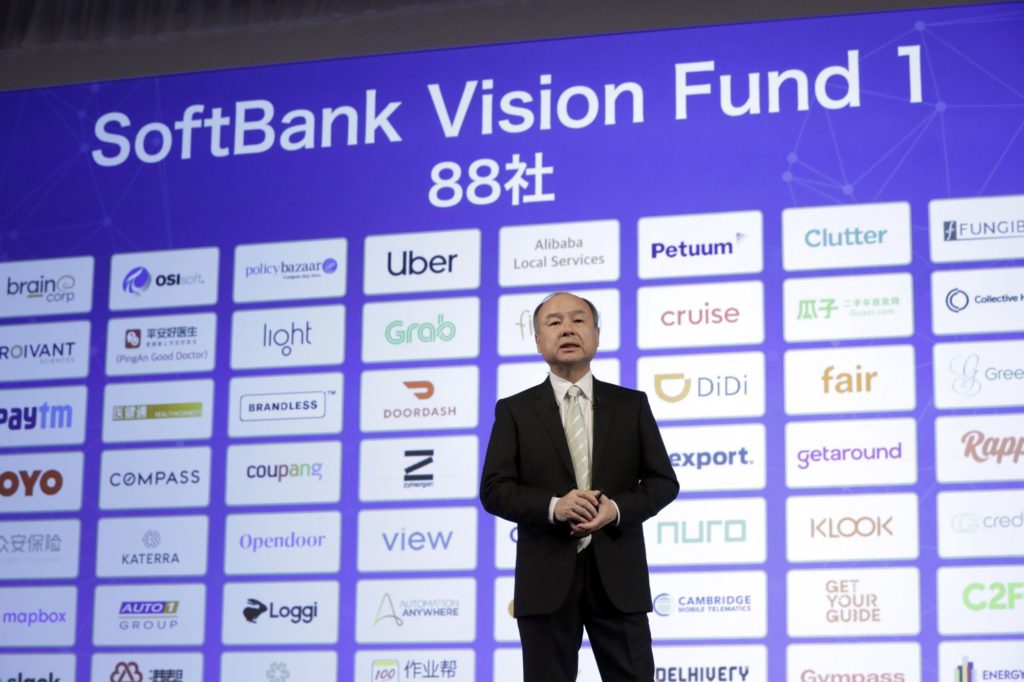
(Bloomberg) — Billionaire Masayoshi Son is poised to set another record — and not the good kind. When he reports earnings for the March quarter Thursday, SoftBank Group Corp.’s Vision Fund investment unit may have lost more money in one quarter than it ever has before. 

The world’s largest tech fund is estimated to have lost about $18.6 billion on its public portfolio alone during the quarter ended Mar. 31, even greater than the record $18.3 billion drop marked in the fiscal second quarter, according to Kirk Boodry, an analyst at Redex Research who publishes on SmartKarma. That would mean a loss for the Vision Fund unit of about $10 billion, accounting for SoftBank’s stake in each fund, Boodry estimates.

It’s a drastic reversal from a year ago when Son took the stage in Tokyo to announce SoftBank had earned more money in a single quarter than any Japanese company in history. The company he founded about 40 years earlier hit net profit of 1.93 trillion yen ($17.7 billion at the time), eclipsing Japan Inc. heavyweights such as Toyota Motor Corp. and NTT Corp.

“It’s not normal. Investors, markets are starting to get worried,” Boodry said. When it comes to “the scale or potential of losses, markets seem to be building in more downside in general.”  

SoftBank’s two Vision Funds have been hit hard by plunging tech valuations as global interest rates climb and China tightens its regulatory grip on the industry. South Korea’s Coupang Inc. and China’s Didi Global Inc. have been among the biggest drags for the Vision Fund, with each of them posting their biggest quarterly share-price slump of 40% and 50%, respectively. 

The Vision Fund’s biggest loss to date — 825.1 billion yen — came in the fiscal second quarter when global stock markets tumbled. The unit then regained profitability, earning 109 billion yen in the three months ended Dec. 31. 

The actual bottom line for the fiscal fourth quarter will hinge on how SoftBank marks the value of its vast number of privately-held holdings. These include ByteDance Ltd., which operates the popular short video platform TikTok, and India’s Oyo Hotels. 

“There is much less visibility on this part of the portfolio, particularly at Vision Fund 2 where many of these investments are smaller or at an earlier stage,” Boodry wrote in a note to investors. Still, “SoftBank will likely take meaningful losses in the private portfolio too.” 

A sharp downturn in global stock markets is working against SoftBank’s business model, which Son repositioned into an investment holding company with the Vision Fund in 2016. A series of scandals and missteps from WeWork Inc., Wirecard AG and Greensill Capital have led to international scrutiny.

Now jitters over further tech valuation falls have dented Son’s reputation and raised concern over the sustainability of its business. The lack of transparency over how much of the funds’ assets are collateralized is another factor fanning market anxiety.

“Softbank’s entire business structure is dependent on one key assumption and that is ever-rising stock prices,” specifically in tech stocks, which are leading the current market sell-off, Amir Anvarzadeh of Asymmetric Advisors wrote in a note. This “fundamental flaw” is being increasingly exposed by the bear market, he said. 

The Vision Fund lost money on 32 out of 34 public holdings last quarter, according to Nomura Securities Co. analyst Daisaku Masuno. That includes South Korea’s Coupang ($5.4 billion), Singapore’s Grab Holdings Ltd. ($2.4 billion), China’s Didi ($2.4 billion), India’s Paytm ($1.3 billion) and the U.S.’s DoorDash Inc. ($1.1 billion).

Unrealized losses in the public portfolio were in the range of $37 billion to $38 billion for fiscal 2021, according to Boodry. All together, Vision Fund’s public portfolio companies are down more than 50% from their all-time highs. 

To be sure, SoftBank losses are largely on paper, just as his profits were a year ago. Few analysts provide estimates, at least publicly. Because of the company’s transformation into an investment holding company, it has to log mark-to-market values on holdings. Warren Buffett has long argued such quarterly figures for investment firms like his Berkshire Hathaway are almost meaningless. 

Still, SoftBank’s latest quarter could be a stain on Son’s reputation as he strives to reinvent himself and become the world’s most influential venture capitalist. 

Son had built his Vision Fund initiative on his track record of picking startups, including a bet on China e-commerce giant Alibaba Group Holding Ltd. that became one of the most successful venture deals of all time. But even that deal has lost luster, as Beijing’s crackdown on Jack Ma’s empire has wiped out more than 70% of Alibaba’s value since its peak in October 2020. 

The Nasdaq 100, a key benchmark for tech shares, is down about 25% year-to-date and on track for its worst annual performance since 2008. The measure rallied 27% last year following a whopping 48% gain in 2020.

Tech-heavy funds have been hit across the globe including Chase Coleman’s Tiger Global Management, one of the most successful equity hedge funds of the past two decades. The fund posted the industry’s largest loss so far in 2022, with the tech rout helping to erase $16 billion from its hedge and long-only funds. 

Dan Baker of Morningstar Inc. is among those who are less pessimistic about SoftBank’s prospects. While the performance for tech funds that invest in early-stage companies will be just as volatile, SoftBank – with its scale – will have greater access and more opportunities to invest, he said. 

“It’s not for everyone,” Baker said. “But if you’re willing to accept the volatility, then if you look at the long-term performance of the company, it’s actually been pretty decent.”

More stories like this are available on bloomberg.com

©2022 Bloomberg L.P.

Apollo Plans to Lead $1 Billion Financing for Musk’s Twitter Bid

(Bloomberg) — Apollo Global Management Inc. is in talks to lead a preferred financing for Elon Musk’s proposed buyout of Twitter Inc., according to people with knowledge of the deal. 

The funding, arranged by Morgan Stanley, will exceed $1 billion and may include Sixth Street Partners, among other firms, the people said.

Apollo, Sixth Street and Morgan Stanley declined to comment.

Shares of Twitter closed Tuesday at $47.26 apiece, with traders growing more skeptical that Musk, the chief executive officer of Tesla Inc., will complete the purchase at the $54.20 offer price. 

Read more: Musk-Twitter Deal Spread Hits Widest as Traders Doubt Takeover

That’s despite Musk revealing last week he’s getting $7.1 billion in equity commitments from investors including Larry Ellison, Sequoia Capital and Qatar. He persuaded Saudi Prince Alwaleed bin Talal to roll his $1.9 billion of Twitter stock into the privatized company and is seeking to do the same with Twitter co-founder Jack Dorsey.

It’s not clear how the preferred equity might change the existing financing proposal, which requires Musk and his partners to contribute $27.25 billion in equity to fund the $44 billion purchase, with the rest coming from junk-rated debt and a margin loan tied to Musk’s Tesla stock.

Preferred equity is a hybrid of debt and equity capital that sits above common equity in the capital structure. Some preferred equity is convertible into common shares at a pre-agreed price. 

Musk recently boosted his cash position by selling Tesla stock — about $8.5 billion in the latest round — and he’s already amassed 9.6% of Twitter’s outstanding shares.

Musk is the world’s richest person with a net worth of $231.8 billion, according to the Bloomberg Billionaires Index, but much of that fortune is illiquid. Tesla’s stock has tumbled 26% since Musk announced his desire to buy Twitter, stoking concerns among investors that he may need to sell or pledge considerable amounts of stock to fund the bid.

More stories like this are available on bloomberg.com

©2022 Bloomberg L.P.

Blue-Chip NFT Collections Hit Harder Than Bitcoin in Crypto Rout

(Bloomberg) — Blue-chip NFT collections like Bored Ape Yacht Club, which for a while outperformed the rest of the crypto market, are being hit harder than cryptocurrencies by a deep rout that is souring sentiment across the sector.

BAYC’s average sales price plummeted 29% over the last seven days in US dollar terms, while transactions have tanked by 21% and user numbers are down 27%, according to NFT watchers Price Floor and DappRadar. 

Until recently, the popular NFT collection has generally fared better than the rest of the crypto sphere. Its floor price hit an all-time high at the end of April, according to NFT Price Floor data. Meanwhile, Bitcoin is down by more than 50% since its all-time high in early November. 

“There have been substantial portfolios of NFTs built in the last six months,” said Michael Bucella, a partner at BlockTower Capital Advisors, in an interview with Bloomberg.

But BAYC’s recent fall from favor seems to reflect a wider trend spreading across the marketplace for nonfungible tokens. The JPG NFT Index, which provides exposure to a broad basket of NFTs, also fell by about 26% this past week. 

“They are just fairly illiquid markets generally,” said Bucella. “If the market is selling off en masse, they are going to sell whatever they have.” 

In comparison, crypto bellwether Bitcoin tumbled 17% and Ether is down 15% over the last week, according to CoinMarketCap. Token prices were seen slipping during the recent selloff in tech stocks in traditional markets and as troubles surrounding TerraUSD, an algorithmic stablecoin meant to be pegged to the US dollar, have come to light. 

NFT-backed loans, which allow borrowers to put up their digital artwork as collateral in order to obtain funds, may also be contributing to the recent nosedive in NFT sales. 

“This could be just collateral selldowns to satisfy loan obligations,” said Bucella. “If you had folks taking some pretty significant hits on their assets, there’s a potential loan unwind.”

Meanwhile, the average sales price for the Otherdeeds NFT collection by Yuga Labs — the same creator of the BAYC NFT collection — sank 23% in the last seven days, according to NFT Price Floor. Average sale prices for Moonbirds, a collection of owl-themed NFTs, also dropped 19%. 

A token tied to BAYC, dubbed ApeCoin and distributed to BAYC holders in March, is also down about 36% this week, according to CoinMarketCap. 

More stories like this are available on bloomberg.com

©2022 Bloomberg L.P.
Peloton Slides After Outlook Dashes Hopes for Quick Comeback

(Bloomberg) — Peloton Interactive Inc. tumbled 8.7% to a record low after the fitness company reported a deeper loss than predicted and cut its revenue guidance, dashing hopes that the onetime pandemic darling will soon pull out of a slump. 

After posting disappointing quarterly results Tuesday, Peloton offered an outlook with little to relish: Demand for its once-hot stationary bikes continues to soften, and some subscribers may balk at proposed price increases. Shipping costs also are squeezing margins, and the company will likely be mired in losses for years.

Peloton also signed a deal with JPMorgan Chase & Co. and Goldman Sachs Group Inc. to borrow $750 million, underscoring its challenges. The loan, which the company committed to on Monday, matures in five years. The company has been exploring a potential sale of a large equity stake as well, Bloomberg reported last week, though Peloton didn’t discuss that possibility Tuesday.

“Turnarounds are hard work,” Chief Executive Officer Barry McCarthy said in a letter to shareholders. “It’s intellectually challenging, emotionally draining, physically exhausting and all-consuming.”

The results suggest Peloton’s comeback effort is still a long way from taking hold, despite a shake-up earlier this year. In February, co-founder John Foley was ousted as CEO after sales slowed and Peloton struggled to manage its production. He was replaced by McCarthy, the former finance chief at Spotify Technology SA and Netflix Inc., who vowed to cut costs and generate more of Peloton’s revenue from subscriptions.

So far, it’s been an uphill fight. Peloton reported revenue of $964.3 million in the fiscal third quarter, missing a Wall Street estimate of $971.6 million. The net loss was $757.1 million, excluding some items, compared with an average estimate of $132.1 million.

“Given its level of cash, inventory and cash burn, we view existential threats on Peloton as rising,” MKM Partners analyst Rohit Kulkarni said in a report Tuesday. Fewer people are staying home to avoid Covid-19, and both interest rates and commodity prices are rising. Moreover, consumers may be poised to curb spending as we head into the second half of the year, he said.

Looking forward, Peloton expects to report $675 million to $700 million in revenue in the fourth quarter, well below analysts’ average estimate of $820.9 million. Peloton put the forecast miss down to “softer demand” compared with its previous guidance.

McCarthy’s comeback push involves lowering prices on the company’s bikes and other hardware, while increasing the rates that subscribers pay. The hope is to hook more customers, who then spend more on recurring monthly fees for Peloton’s fitness classes.

But in the short term at least, the hardware price cuts are weighing on sales. And the company’s subscribers are forecast to grow a bit more slowly than analysts projected during the current quarter.

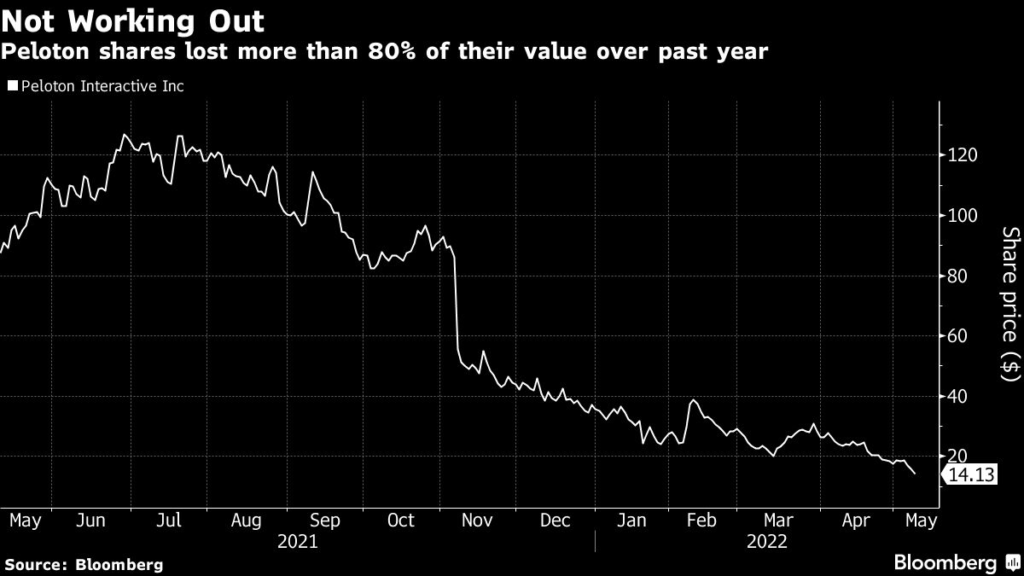
Peloton had thrived during the early days of the pandemic, when locked-down consumers rushed to buy its bikes and treadmills. But the company went from a boom to a bust and lost more than 80% of its value over the past year.

The slide continued Tuesday, with the stock initially plunging as much as 20% to $11.25 in New York trading. It recovered somewhat — to $12.90 — but remains at the lowest level since Peloton’s initial public offering in September 2019.

The new five-year loan, which would mature in 2027, has a special feature called a “springing maturity” that requires the debt to be repaid before the company’s existing notes, according to a filing on Tuesday. That would provide some protection for JPMorgan and Goldman Sachs.

February’s reshuffling replaced much of the company’s upper management and included thousands of layoffs. Under McCarthy, Peloton has tested out new programs, like a leasing model for hardware. He also has promised to release new products, but hasn’t provided many specifics about what the company is working on.

The company said the number of members grew 5% quarter-on-quarter to 7 million, with the number of workouts during the quarter growing by 32% to 184.3 million. In the letter to shareholders, McCarthy said his goal is to get to 100 million members, an effort that Chief Financial Officer Jill Woodworth acknowledged is a “long way from where we sit today.” The way to get there is by making Peloton’s digital app a big success, McCarthy said, adding that international markets are very important, too.

Though McCarthy has only been in the job for about three months, outside investors have complained the New York-based company is heading in the wrong direction and should be put on the block instead. 

In April, Blackwells Capital LLC reiterated a plea to put the fitness company up for sale. “Peloton will continue to be poorly valued for as long as a close-knit group of insiders, who have proven themselves incapable of creating value, continue to wield voting power far in excess of their economic interest,” Blackwells Chief Investment Officer Jason Aintabi said in a statement at the time. 

Blackwell believes that Amazon.com Inc. or Netflix could be potential bidders for the company, which now has a market capitalization of under $5 billion. 

McCarthy has said he’s not pursuing a sale of the company, but there are other possibilities on the table. Last week, Bloomberg reported that Peloton is seeking to sell as much as 20% of the company to an outside investor in a move to shore up cash and further its turnaround. 

In the earnings report, McCarthy acknowledged that — with $879 million in cash on hand — the company is “thinly capitalized for a business of our scale.” But as Peloton begins to sell down excess inventory, he said the cash flow headwind should become a tailwind in fiscal 2023.

As McCarthy wrapped up the earnings call, which lasted under an hour and skipped the usual recap of the numbers, he apologized for ending on a down note. “Notwithstanding the stock price, I’m feeling optimistic about the path ahead,” he said. 

(Updates with more on loan in 13th paragraph.)

More stories like this are available on bloomberg.com

©2022 Bloomberg L.P.
Nissan Investors Seek Momentum From Likely Swing Back to Profit

(Bloomberg) — Nissan Motor Co. probably turned profitable in the recently ended fiscal year and investors will be looking for hints as to whether that momentum will carry forward as the Japanese automaker faces new risks from rising material prices to a potential slow-down in demand for cars.

Analysts, on average, estimate Nissan will report an annual operating profit on Thursday for the first time in three years, of around 223 billion yen ($1.7 billion) for the period ended March. Nissan forecast in February a 210 billion yen profit.

Over the past two years, Nissan has been working to restructure operations and bolster its profitability by cutting costs, streamlining operations and increasing quality of sales via a slew of new and refreshed models. Those efforts recently got a boost by a weakened yen that’s lifting the value of its overseas earnings. 

At the same time, Nissan’s unit sales have dropped off from the highs seen a year earlier in recent months, and challenges are mounting. Japanese automakers are grappling with impacts from the ongoing shortage of automotive chips, rising material costs and virus outbreaks in China. Nissan reported earlier this week that its April China vehicle sales dropped 46% from a year earlier and said that semiconductor and supply chain disruptions were to blame. 

Some analysts warn that the fiscal year ending March 2023 may bring a slowdown in economic growth that could dent global auto sales.

In the near-term, the weakened yen will provide a “moderate lift” for Nissan, helping to offset other business environment challenges, according to Bloomberg Intelligence. But for later in the year, Nissan’s profit outlook — likely to be issued Thursday — will reveal more on how the automaker sees these converging factors impacting its bottom line.

Beyond profit figures, investors will be looking for updates on a potential resumption of Nissan’s dividend. Nissan Chief Operating Officer Ashwani Gupta said in February that improvements in business conditions are moving the automaker closer to a point at which it can resume dividend payments. The COO pledged to provide an update at Nissan’s fiscal year earnings announcement.

Investors will also be looking for updates on any new developments with regard to Nissan’s alliance with Renault SA after Bloomberg News reported the French automaker is considering selling part of its stake in its Japanese counterpart. 

Read more: Renault Is Said to Explore Nissan Stake Sale for EV Shift

Renault Chief Executive Officer Luca de Meo and Chairman Jean-Dominique Senard will be in Japan over the coming week for the monthly meeting of the alliance. 

Nissan shares fell by around 7% in the recently ended fiscal year.

More stories like this are available on bloomberg.com

©2022 Bloomberg L.P.

Close Bitnami banner
Bitnami
