Bloomberg

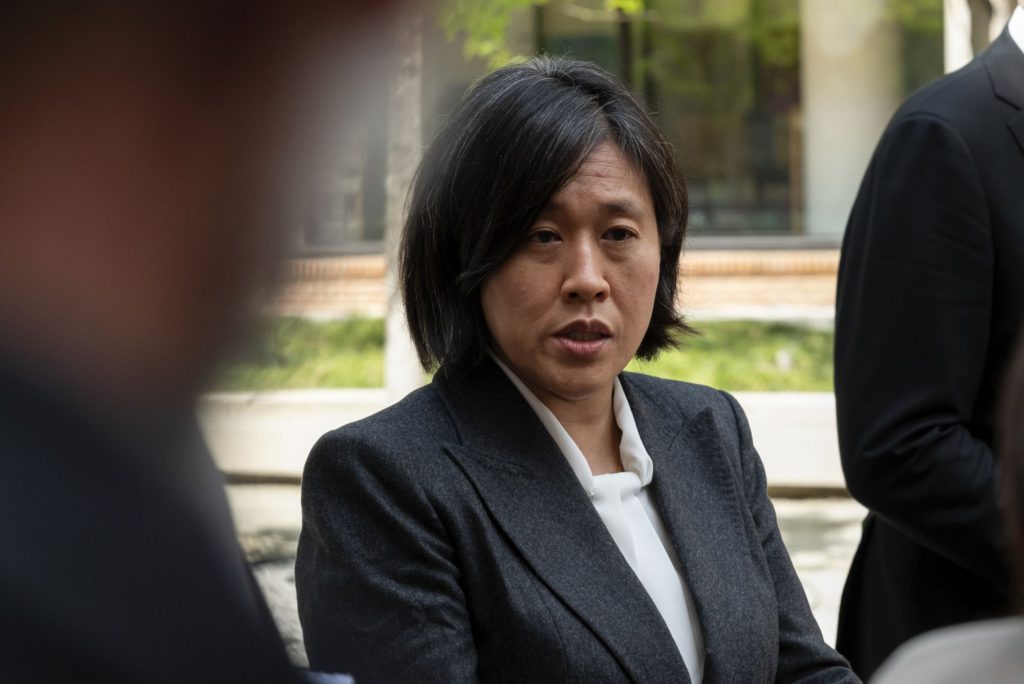
Senators Blast US Trade Chief on Failure to Consult Congress

(Bloomberg) — A bipartisan group of the top senators on the committee that deals with trade blasted President Joe Biden’s chief negotiator for failure to adequately consult with lawmakers regarding the administration’s positions.

US Trade Representative Katherine Tai’s recent consultations with Congress haven’t met the standard of transparency principles announced last year, Senators including Ron Wyden and Mike Crapo, the leading Democrat and Republican on the Senate Finance Committee, wrote in a letter on Tuesday.

In particular, they faulted the USTR for failing to consult on progress in World Trade Organization talks related to the waiver of intellectual-property rights for Covid-19 vaccines. In that case, the trade agency publicly announced a “compromise outcome” with the European Union, India and South Africa before consulting with members of Congress and their staffs, the lawmakers said.

“We want to ensure that this failure to consult properly with Congress will not be replicated in other areas,” the lawmakers said. They cited concerns about being properly consulted in negotiations for the Indo-Pacific Economic Framework, or IPEF, that the Biden administration plans to launch with countries including Japan, Singapore and New Zealand.

“It is essential for USTR to improve consultation with Congress and stakeholders,” they wrote. 

The criticism comes after senators weeks ago at a hearing faulted Biden’s trade agenda for a lack of ambition for negotiating new agreements and countering China in Asia.

In response to the letter, Greta Peisch, USTR’s general counsel and chief transparency officer, said in a statement that the agency takes its “commitment to transparency and consultation with members of Congress extremely seriously.”

“We have routinely consulted Congress and sought input from stakeholders as the administration works to facilitate an outcome on intellectual property at the WTO,” Peisch said. “Those efforts have increased since the director-general released text last week and they will continue before an agreement is reached on this, or any other issue,” she said, referring to WTO chief Ngozi Okonjo-Iweala.

Separately, the head of the US Chamber of Commerce, the largest American business-lobbying group, issued a scathing criticism of Biden’s trade policy, saying that the administration is “consumed by caution and internal reviews.”

The administration “has yet to pick up even the lowest-hanging fruit,” such as talks for free-trade deals with the UK and Kenya started under President Donald Trump but stalled under Biden, chamber President Suzanne Clark said. The US also should provide relief from tariffs on imports inherited from Trump that are serving as a tax on Americans, Clark said.

IPEF remains “a far cry” as a replacement for the Trans-Pacific Partnership abandoned by Trump, Clark said. The current White House has made clear that it has no plans to join a successor deal.

US officials are set to discuss the IPEF when Biden visits the region this month; they’ve also said this won’t include negotiating tariff reductions.

“America in many ways is standing still on new trade agreements,” Clark said at a virtual conference hosted by the chamber. “And if you’re standing still on trade, you’re falling behind.”

Clark’s appearance was followed by Commerce Secretary Gina Raimondo, who is co-leading the administration’s work on the Indo-Pacific framework. Raimondo promoted the initiative, saying that it will help identify opportunities to collaborate on shared priorities like infrastructure investments, semiconductors, research and development and standards for artificial intelligence and privacy.

Tai has repeatedly stressed that the administration is pursuing a “worker-centered” policy and called free-trade pacts a “very 20th-century tool” that have their place, but need to be updated to reflect current realities.

Although the US and UK haven’t resumed free-trade talks, Tai recently visited Aberdeen, Scotland for a dialogue with her counterpart, International Trade Secretary Anne-Marie Trevelyan. USTR staff also visited Kenya earlier this month to explore way to deepen that relationship, though Washington hasn’t restarted free-trade deal talks.

(Updates with comments from USTR in seventh paragraph.)

More stories like this are available on bloomberg.com

©2022 Bloomberg L.P.

BlackRock’s Star Trader Goes Net Short as Hedge Fund Loss Mounts

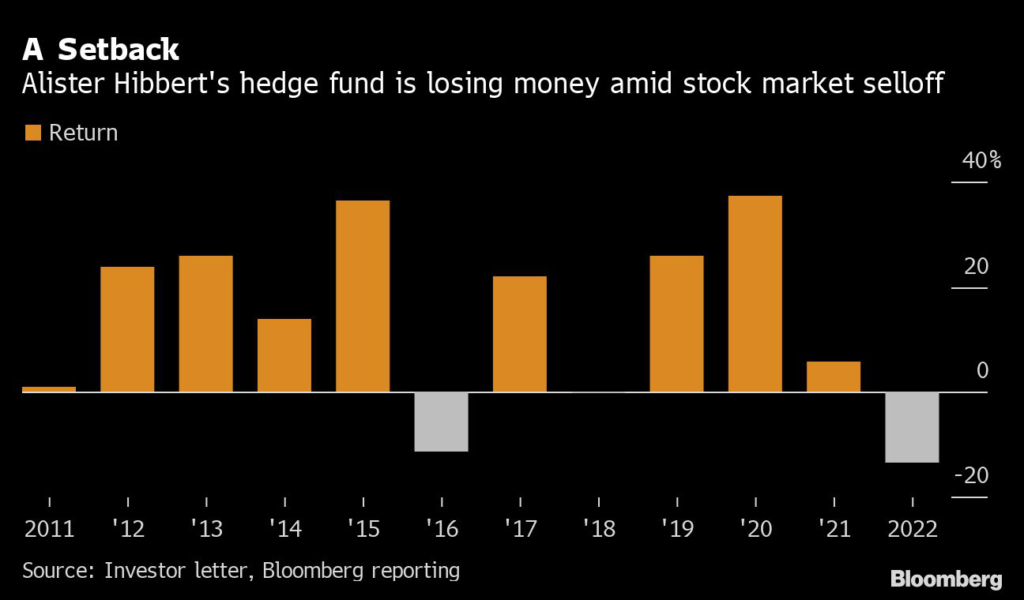
(Bloomberg) — BlackRock Inc. star money manager Alister Hibbert has turned bearish as his hedge fund endures its worst-ever losses amid a sharp decline in stocks. 

The BlackRock Strategic Equity Hedge Fund tumbled 13% this year through April, a person with knowledge of the matter said. That exceeds its worst annual decline of 11%. The money manager, who has profited from the historic surge in stocks since starting the fund in 2011, turned net short for the first time ever this month, said the person. His portfolio was net long about 35% at the end of last year. 

The reversal marks a seismic shift underway in global markets as soaring inflation forces central banks to end quantitative easing and raise interest rates. That has led to a selloff in markets with growth stocks, led by the technology sector, falling further in a setback for equity-focused hedge funds.

Hibbert has run his fund with a tilt toward growth stocks and owned shares such as Microsoft Corp. and Mastercard Inc. He flagged his cautious outlook earlier this year, telling clients that the strongest phase of economic recovery, characterized by soaring earnings and cyclical performance, was now over. The fund had about $9 billion of assets on Dec. 31.

“It is clear that the normalization of the economy post-pandemic is not going to be an entirely orderly process,” he wrote in a letter to investors in March.

A BlackRock spokesman declined to comment.  

BlackRock shares have tumbled about 34% this year. In a March letter to investors, Chief Executive Officer Larry Fink expressed disappointment in the stock’s performance and cited challenging markets for the decline.

Hibbert has long been one of the best-paid risk-takers at the world’s biggest asset manager and key to BlackRock’s expansion into active management and driven-performance fees. He earned a nine-figure sum, more than triple the size of Fink’s $30 million payout in 2020. 

Hibbert started the hedge fund more than a decade ago with just $13 million and turned it into one of the largest long/short money pools, generating annualized returns of almost 17% until last year. The fund has had only two annual declines. Hibbert also runs a concentrated long only fund — BlackRock Global Unconstrained Equity Fund — which is down about 20% this year, according to Bloomberg data.

More stories like this are available on bloomberg.com

©2022 Bloomberg L.P.

FIFA Video Game Will Be Renamed After EA Licensing Deal Ends

(Bloomberg) — FIFA, one of the most popular video game franchises, will be renamed EA Sports FC after the game’s publisher, Electronic Arts Inc., failed to reach a new licensing agreement with the world soccer governing body of the same name.

Chief Executive Officer Andrew Wilson said he was “thankful for our many years of great partnership” with FIFA and that the final game in the franchise will be released this year. The new series will retain licensing agreements with more than 300 of EA’s partners, allowing future games to continue featuring most global soccer players, teams and stadiums. 

The relationship between the two began nearly three decades ago with 1993’s FIFA International Soccer game, which topped the charts on Sega Genesis and Super Nintendo. Since then, the partners have churned out a new game every year, bringing in more than $20 billion in revenue for EA and allowing it to quash potential competitors with an exclusivity arrangement. In 2013, the two extended their deal until the end of 2022.

But negotiations over the contract renewal had grown contentious and were drawn out into the public in October when EA said in a public statement that it was considering a name change. “As we look ahead, we’re also exploring the idea of renaming our global EA SPORTS football games,” EA Sports general manager Cam Weber wrote at the time. “This means we’re reviewing our naming rights agreement with FIFA, which is separate from all our other official partnerships and licenses across the football world.”

FIFA was seeking more than double the fees it was already receiving for EA to use its name, the New York Times reported, and the two companies also battled over whether EA’s exclusivity rights extended to areas beyond the game such as highlights, tournaments and non-fungible tokens. The partnership seemed destined for failure when EA registered the trademark for EA Sports FC, signaling its willingness to move on.

Now, FIFA is free to work with other game companies, although it may struggle to find a partner that fits. The only other rival soccer video game franchise, Pro Evolution Soccer, from Konami Holdings Corp., has declined in recent years. Last year’s entry, the rebranded eFootball 2022, was unanimously panned.

From a practical perspective, the change may not amount to much for EA, analysts said. With the same rosters and stadiums, players might not even notice much of a difference — except for a less catchy name.

(Updates with details on the partnership from third paragraph.)

More stories like this are available on bloomberg.com

©2022 Bloomberg L.P.

EU’s Plans to Combat Child Pornography Raise Privacy Concerns

(Bloomberg) — The European Commission’s plan to combat child sexual abuse material online is already raising privacy concerns.

The proposal would allow courts in the EU to require companies to detect child sexual abuse material and grooming of children online, according to documents seen by Bloomberg.

Privacy advocates and lawmakers are already raising alarm bells about the proposal ahead of its publication on Wednesday, arguing that it would allow companies spy on people using the internet. 

Jan Penfrat at the European Digital Rights group posted on Twitter that the proposal looks like a “shameful” surveillance law “entirely unfitting for any free democracy.”

If the commission “got away with this proposal, the privacy of digital correspondence would be dead,” Moritz Körner, a German member of the European Parliament, said in a statement after a leaked draft began to circulate. “Private companies would be forced to play police, spy on their customers and report them to the state.”

Action against sexual abuse material has long been controversial due to privacy concerns. Apple Inc. halted plans last year to detect child sexual abuse images on users’ devices after concern that the moves would harm encryption. 

With the EU’s proposal, lead by Commissioner Ylva Johansson, sites with users younger than 18 will have to conduct risk assessments for how they are detecting child pornography and the solicitation of children. These reports will be sent to a new European agency equivalent to the U.S.’s National Center for Missing and Exploited Children that will work alongside Europol. Politico previously reported on the plans.

Johansson knows that the commission is gearing up for a fight with privacy advocates worried about the curtailing of privacy online and creating a backdoor for law enforcement to access encrypted messages.

“The attitude that I sometimes hear is that we have to choose between privacy for adults, or protecting children, and I will never accept that black or white,” Johansson said in January.

National authorities can ask a court to order a company to specifically remove or block this material on their site. 

The European courts can also require internet providers to block a web address if they cannot specifically remove the material. Companies, who can appeal these orders, also may be required to install technology that can detect the child sexual abuse material, according to the proposal that isn’t public yet.

The rules will apply to messaging apps that use end-to-end encryption, which is an “important tool to guarantee the security and confidentiality of the communication of users, including those of children,” the proposal said. Companies should ensure the “safeguard measures” do not undermine user’s security and privacy. 

Hosting platforms and messaging services need to take action against child pornography and grooming children. This can include age verification to confirm children use their services, change how the service operates or increase supervision of the services. Companies will also be able to work with other tech companies and civil society groups to monitor the material, according to the proposal. 

Similarly, software companies will also have to detect and take action to ensure their products aren’t at risk of being used to groom children.

Action taken by companies must be “targeted and proportionate” and consider how the measures will impact the “fundamental rights” of users, according to the drafts. 

Victims of sexual abuse material can also work with the EU center to have material depicting them taken down.

More stories like this are available on bloomberg.com

©2022 Bloomberg L.P.

Ukraine’s Economy to Drop 30% This Year From War, EBRD Says

(Bloomberg) — Sign up for the New Economy Daily newsletter, follow us @economics and subscribe to our podcast.

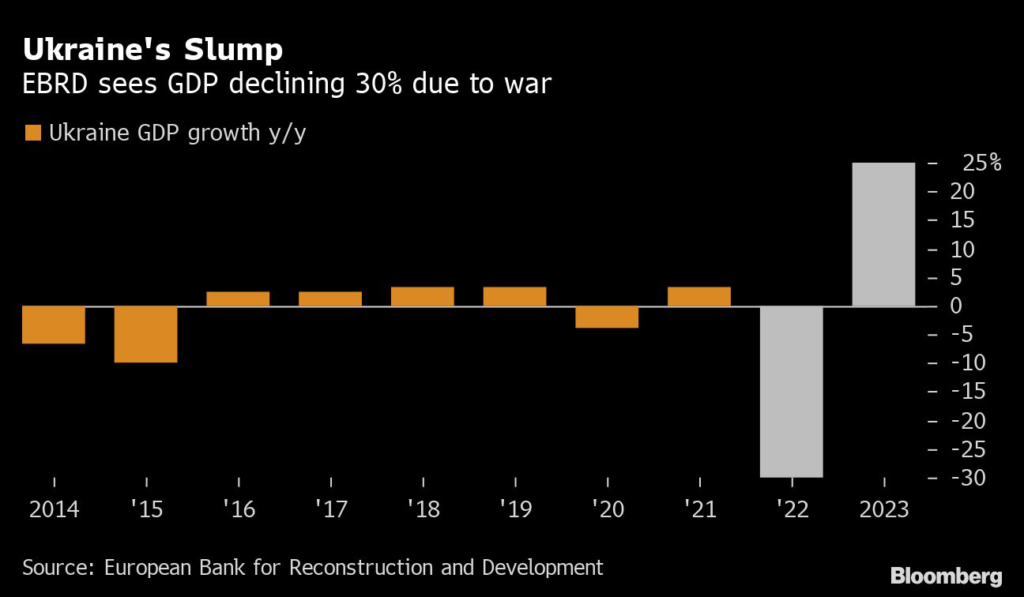
Ukraine’s economy will plunge by almost a third in 2022, more than previously expected, in a scenario in which the war ends this year, the European Bank for Reconstruction and Development said. 

The expected downturn is deeper than the 20% contraction the EBRD estimated in March because of a “larger-than-previously-expected contraction in Ukraine as the war drags on,” it said in its report. 

Russia’s invasion has upended trade in energy, agricultural commodities and fertilizers and disrupted supply chains, resulting in slower growth across eastern Europe. Gas prices in Europe have risen to historic highs, fueling inflation across the region and putting manufacturers at a disadvantage compared with U.S.-based companies where gas is as much as four times cheaper, the EBRD said. 

“Aside from direct war damage, agricultural production is hampered by lack of fuel, access to seeds, fertilizer and equipment,” the bank said in its report. Ukraine, which accounts for almost 10% of global wheat exports, 14% for corn and 37% of sunflower oil, is not expected to be able to plant or harvest up to 20%-30% of its agricultural land.

Speaking in Marrakesh, Morocco, EBRD President Odile Renaud-Basso said the bank would disburse 1 billion euros ($1.1 billion) this year to sectors of Ukraine’s economy that have been hit by the war. The bank is also working to phase out its holdings in Russian companies, she said.

The forecasts assume that a cease-fire will be negotiated this year and reconstruction of the country can begin in 2023, with the economy projected to grow 25% next year. 

The war has also revealed vulnerabilities in global supply chains, according to the EBRD. Two Ukrainian companies account for about 35% of the global supply of purified neon, a key component for the manufacture of semiconductor chips. 

Russia’s economy is expected to shrink 10% this year and stagnate in 2023, according to the EBRD. 

(Updates with comment on investment from EBRD to Ukraine in fifth paragraph.)

More stories like this are available on bloomberg.com

©2022 Bloomberg L.P.

Antitrust Chief Barred From Google Cases Amid Recusal Push

(Bloomberg) — The Justice Department’s top antitrust official has been barred from working on monopoly investigations of Alphabet Inc.’s Google as the department wrestles with whether he must recuse himself because of his previous work for the search giant’s rivals, according to people familiar with the matter.

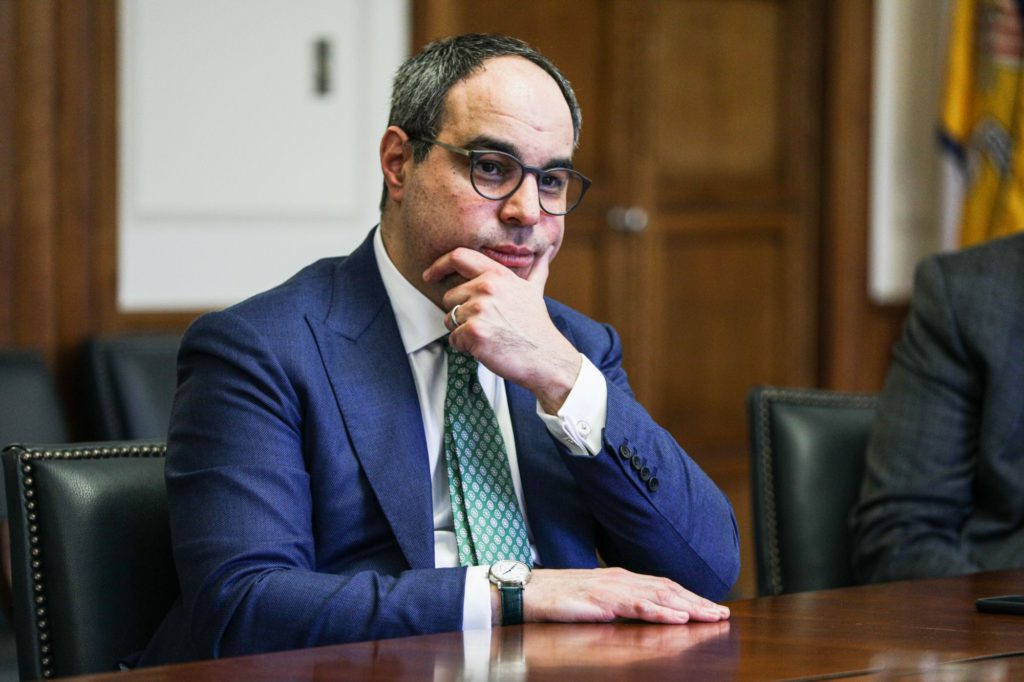
Jonathan Kanter, a longtime advocate for antitrust enforcement against Google, was brought in by the Biden administration to tackle difficult antitrust investigations into tech giants like Google and Apple Inc. that began under former President Donald Trump. 

In November, Google urged the Justice Department to review whether Kanter should be recused from all actions involving the company because of his past work representing its critics. 

No decision has been made in the nearly six months since Kanter started the job on Nov. 16, while the department continues to waver over whether his involvement represents a conflict of interest, one of the people said.

The department sued Google in October 2020 for allegedly abusing its dominance of the online search market in the most significant antitrust case against an American company in two decades. It’s also preparing a second monopoly lawsuit over the company’s digital advertising business, Bloomberg has reported. 

In private practice, Kanter represented News Corp., Yelp Inc. and Microsoft Corp., among others, who offered evidence to Justice Department antitrust officials that the companies said showed how Google’s conduct harmed their business.

A Justice Department spokeswoman declined to comment, citing a department policy against confirming recusals. A Google representative also declined to comment.

Federal ethics rules require an official “to avoid an appearance of loss of impartiality in the performance of his official duties.” But those conflicts, as well as a separate ethics pledge by the White House, can be waived on a case-by-case basis. Solicitor General Elizabeth Prelogar, for example, was granted a waiver to participate in a Supreme Court case regarding Harvard University’s admission despite having been a lecturer at Harvard Law School. 

Associate Attorney General Vanita Gupta, Kanter’s boss, will decide on whether or not he should be recused from the Google cases, two of the people said. Gupta herself received a waiver to oversee civil rights cases despite having lobbied both Congress and the Justice Department on behalf of the Leadership Conference on Civil and Human Rights. 

In the meantime, Kanter’s top deputy, Doha Mekki is acting as the decision maker on both the Google lawsuit and the active investigation, two people familiar with the issue said. 

Mekki, a seven-year veteran of the antitrust division, has already stepped into the deciding role in other cases where Kanter is recused, such as the agency’s challenge of UnitedHealth Group Inc.’s proposed $7.8 billion purchase of Change Healthcare Inc. and antitrust litigation between Apple Inc. and Epic Games Inc. Kanter represented rival health insurer Cigna Corp. and a yoga app whose executive testified in the Apple-Epic case before he became the top U.S. antitrust official. 

Trial in 2023

The Justice Department’s antitrust suit against Google is slated for trial in September 2023. The department has asked Judge Amit Mehta in Washington to sanction Google for improperly shielding sensitive business documents from regulators through an overly broad reading of attorney-client privilege. Google denies any wrongdoing. Both sides are to finish interviewing executives and gathering documents later this month.

Kanter’s possible recusal has been a hot-button issue that’s straining relationships between the Biden administration and progressive Democrats, who advocate for aggressive action against the technology companies. 

In January, Representative Pramila Jayapal, a Washington State Democrat, and Senator Elizabeth Warren, a Massachusetts Democrat, criticized Google for what they called the company’s attempts to bully Kanter into recusal. 

On Tuesday, Warren criticized Google’s attempts to persuade the Justice Department to recuse Kanter.

Laurence Tribe, a prominent constitutional law scholar at Harvard, wrote a public defense of Kanter, saying Google’s recusal efforts “have little legal basis and strain common sense.”

Meta Platforms Inc. used similar conflict of interest arguments seeking to recuse Federal Trade Commission Chair Lina Khan, but a judge dismissed those in a January opinion. “It is natural that the president will select a candidate based on her past experiences and views, including on topics that are likely to come before the commission during her tenure, and how that administrator will implement the administration’s priorities,” Judge James Boasberg said.

Kanter “was a consistent proponent of vigorous antitrust enforcement in the private sector,” said Jeff Hauser, founder of the Revolving Door Project, an advocacy group. “In that world, it’s not problematic to be on the same side. The Biden administration found in Kanter somebody with a proven track record taking a set of concerns seriously that the administration wanted to take seriously.”

(Updates with comment from Elizabeth Warren in 15th paragraph)

More stories like this are available on bloomberg.com

©2022 Bloomberg L.P.

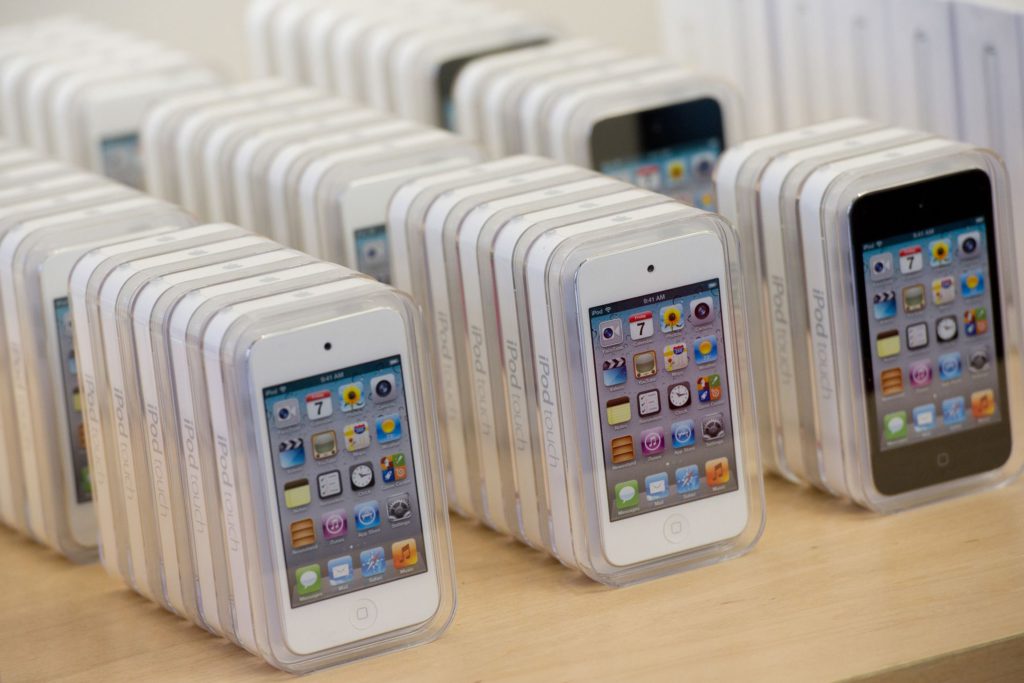
End of an Era: Apple Discontinues Its Last iPod Model

(Bloomberg) — Apple Inc.’s iPod, a groundbreaking device that upended the music and electronics industries more than two decades ago, is no more. 

The company announced Tuesday that it would discontinue the iPod Touch, the last remnant of a product line that first went on sale in October 2001. The touch-screen model, which launched in 2007, will remain on sale until supplies run out.

Apple released dozens of versions of the iPod over the years, but the product was gradually eclipsed by its other devices, especially the iPhone. That led the company to begin phasing out models in 2014. At the time, the company stopped making the iPod classic, a version with a click wheel and small screen that was most similar to the original version. In 2017, Apple stopped making its smallest music players, the iPod Nano and iPod Shuffle.

The iPod Touch — popular as a cheaper alternative to the iPhone — held on a few more years. The device was last updated in 2019 and cost $199. Compare that with the cheapest iPhone in Apple’s portfolio: the SE, which costs $429. 

But with so many other ways to get music, Apple no longer sees the product as necessary.

“We’ve integrated an incredible music experience across all of our products, from the iPhone to the Apple Watch to HomePod mini, and across Mac, iPad and Apple TV,” said Greg Joswiak, Apple’s senior vice president of worldwide marketing. 

Introduced by Steve Jobs, the iPod was credited with helping to turn Apple from a nearly bankrupt company to an eventual $3 trillion behemoth. The iPod set the stage for the development of the iPhone, iPad and AirPods — products that now make up most of Apple’s revenue. 

More stories like this are available on bloomberg.com

©2022 Bloomberg L.P.

Yellen Cites UST Breakdown While Calling for Stablecoin Rules

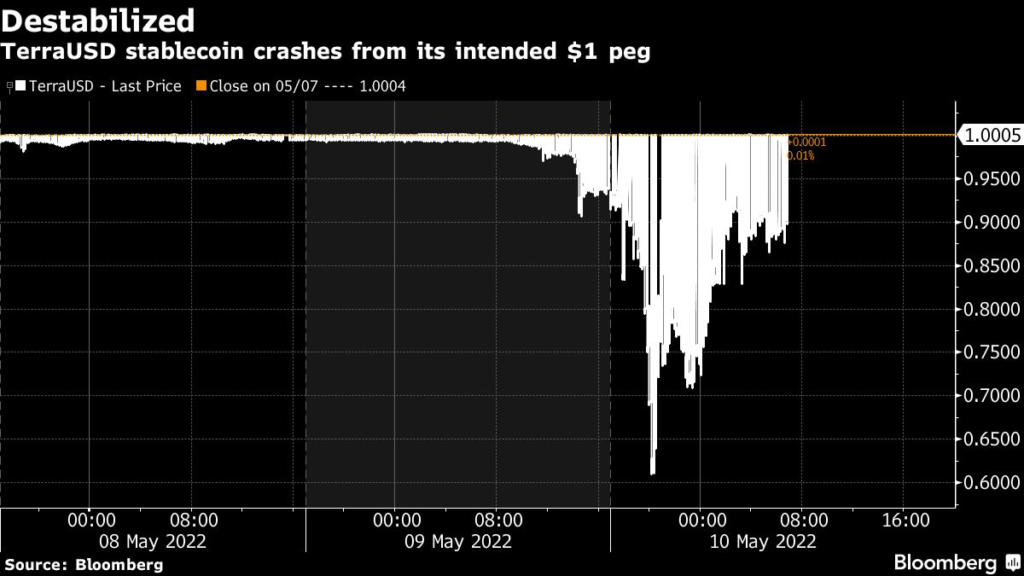
(Bloomberg) — Treasury Secretary Janet Yellen said the de-pegging of TerraUSD shows the urgency to have a regulatory framework on stablecoins, which aim to minimize the volatile price swings seen in most cryptocurrencies. 

“A stablecoin known as TerraUSD experienced a run and had declined in value,” Yellen said during testimony before the Senate Banking, Housing and Urban Affairs Committee on Tuesday. “I think that simply illustrates that this is a rapidly growing product and that there are risks to financial stability and we need a framework that’s appropriate.”

Her response was to a question by Senator Pat Toomey, the top Republican on the Banking Committee, on the urgency to pass a regulatory framework for the stablecoin sector. She said it would be “highly appropriate” to aim for passing a legislation this year. 

Yellen reiterated that the current regulatory framework does not provide “consistent” and comprehensive standards to the risks of stablecoins as a new type of payment product. 

TerraUSD, or UST, is an algorithmic stablecoin that’s supposed to work like its centralized counterparts like Tether or USD Coin. But instead of maintaining a constant price, its value plummeted far below $1 since Saturday as all of the mechanisms to maintain its value stopped working.

The Federal Reserve also warned of the financial risks posed by stablecoins, saying they are “vulnerable to runs.” In its semi-annual Financial Stability Report published Monday, it said the increasing use of stablecoins to meet margin requirements in leveraged crypto trades may heighten redemption risks. 

Stablecoins are an important part of the digital-asset space. Crypto traders use them as a place to park their money to avoid wild swings in crypto in lieu of regular dollars. Stablecoins are also used for day-to-day payments by many people around the world. The biggest stablecoins by market value are Tether, USD Coin, Binance USD, and UST. 

More stories like this are available on bloomberg.com

©2022 Bloomberg L.P.

Ukraine Latest: EU’s Oil Sanctions Hinge on Hungary’s Resistance

(Bloomberg) — A video call between the European Union and Prime Minister Viktor Orban to discuss proposed sanctions on Russian oil imports that Hungary is resisting was postponed. Meanwhile, a key committee in Finland’s parliament backed NATO membership. 

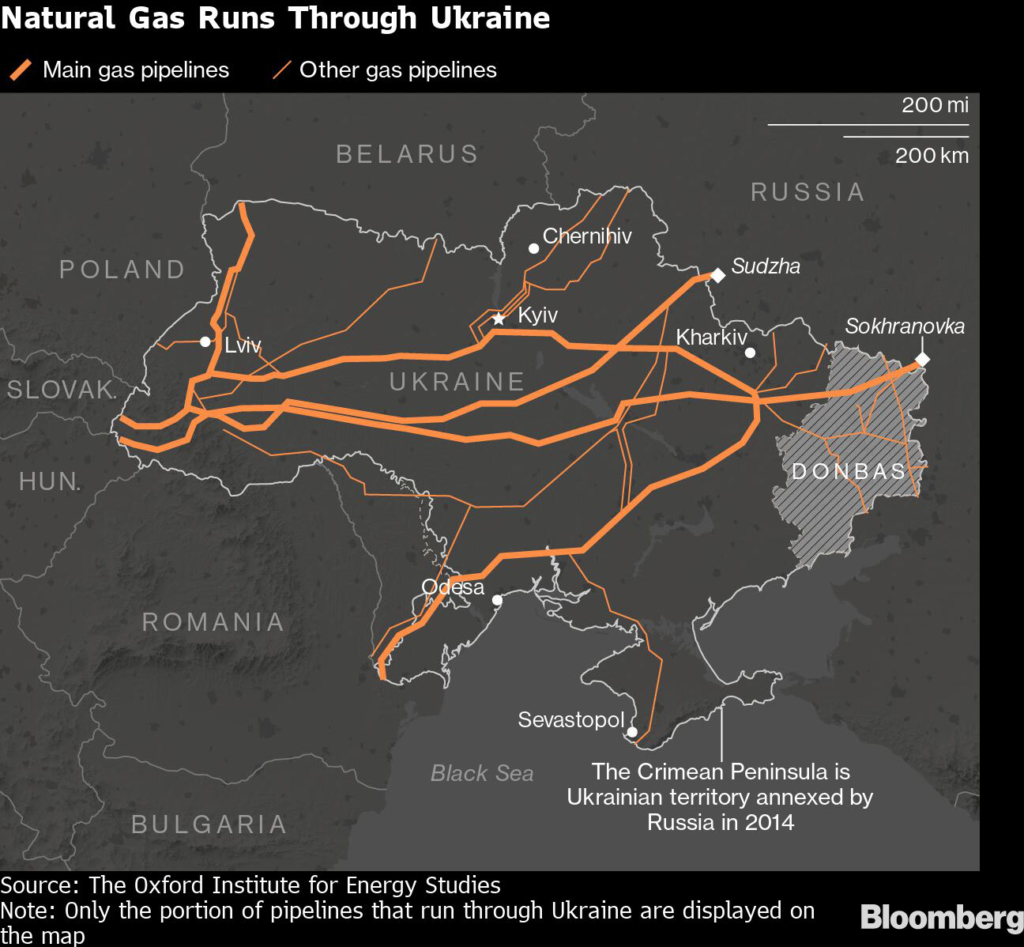
Ukraine’s natural gas grid said Russian flows to Europe via a key entry point will stop from Wednesday as Moscow’s forces disrupt operations, a move that has the potential to reduce supplies.

The EU approved the release of 600 million euros ($634 million) in aid for Ukraine as it considers issuing joint debt to finance the country’s long-term reconstruction, which may end up costing hundreds of billions of euros. 

(See RSAN on the Bloomberg Terminal for the Russian Sanctions Dashboard.)

Key Developments

  • Spy Chief Says Ukraine Could Leave Russia Weaker But Aggressive
  • Macron, Orban Discuss Energy as EU Presses for Sanctions Deal
  • EU Weighs Joint Debt to Fund Ukraine’s Long-Term Rebuilding
  • Putin’s Crackdown Pushes Independent Russian Media Into Crypto
  • Finland Should Join NATO, Key Parliament Committee Concludes

All times CET: 

EU Seeks to Boost Ukraine’s Food Exports Via Land (5:48 p.m.)

The EU is finalizing a plan to facilitate land exports of Ukraine’s stocks of food products with the Russian invasion blocking access to the country’s vital Black Sea ports. The bloc on Wednesday will consider a strategy that would address technical and bureaucratic initiatives to speed up the shipping of vegetable oils, corn and wheat, some of Ukraine’s key exports, people familiar with the discussions said.

The EU’s executive arm is concerned about logistical bottlenecks that could hamper efforts to utilize alternative land routes via neighboring countries, since infrastructure gaps could hinder exports despite recent moves to remove trade barriers with Kyiv. It will be a challenge to move a significant portion of the 25 million tons of products stuck there in time for the beginning of the next harvest season.

Ukraine Gas Grid Says Russia Flows Via Key Entry Point to Stop (5:20 p.m.)

Ukraine’s natural gas grid said Russian flows to Europe via a key entry point will stop from Wednesday as occupying forces disrupt operations, a move that has the potential to reduce supplies.

The Gas Transmission System Operator of Ukraine said it can no longer accept Russian gas transit via Sokhranivka from 7 a.m. local time, according to a statement on its website. It’s still possible for the fuel to be re-routed via another key entry point, allowing European contracts to be fulfilled, though it’s unclear who is responsible for making that decision.

Ukraine had already warned Russia that the actions of its troops and occupiers in the Luhansk region could end up disrupting about a third of the gas the Eastern European nation transits to Europe. 

NSA Probing Kaspersky’s Reach in US (4:19 p.m.)

The National Security Agency is investigating the extent to which software made by the Russian cybersecurity company Kaspersky is embedded in US businesses and organizations amid rising security concerns over Russia’s invasion of Ukraine.

“I am still very worried about US companies that are using Kaspersky,” said Rob Joyce, the NSA’s director of cybersecurity, in an interview in which he revealed the inquiry. “We think that is ill-advised with this global situation.”

Some companies, including those in financial services, voluntarily abandoned Kaspersky antivirus products after the US government banned the company’s software from federal systems in 2017, citing espionage fears. But the company’s products continue to be used in the US, which Joyce called “an installed base across random critical infrastructure and industry.”

Swedish Ruling Party Reported to Say Yes to NATO (2:37 p.m.)

Sweden’s ruling Social Democrats are set to declare their support on May 15 for the country to join NATO, Finland’s largest newspaper Helsingin Sanomat reported, citing sources it didn’t identify.

Finland’s government has been aware of the conclusion since at least last week, the newspaper said. 

Previous reports by news agency TT indicate that Swedish Prime Minister Magdalena Andersson wants to wait for the delivery of the country’s cross-party security policy review, due May 13, before she decides on the NATO position.

Zelenskiy Urges Slovakia to Back Russian Oil Ban (1:57 p.m.)

Ukrainian President Volodymyr Zelenskiy urged Slovak lawmakers to back the EU’s proposed ban on purchasing oil from Russia as the government in Bratislava tries to negotiate a three-year exemption with the bloc because of its heavy dependence on Russian crude.

Zelenskiy thanked Slovakia for supplying his military with weapons but said that the EU’s sixth package of sanctions was also vital for Ukraine’s defense. “If they will be weaker, it will be harder for us. We need this sixth package.” Zelenskiy told lawmakers in a video speech. “We understand it will be hard for you, but banning oil is important.”

Finnish Parliament Committee Says Country Should Join NATO (12:25 p.m.)

Finland should join the North Atlantic Treaty Organization to best ensure the security of all Finns, according to the parliament’s defense committee, as the nation prepares to decide on an application within days.

Russia’s invasion of Ukraine galvanized public support for joining the military alliance. Finland is, along with Sweden, considering NATO membership and giving up its non-alignment that stretches back to before the cold war.

EU Approves Release of 600 Million Euros for Ukraine (12:08 p.m.)

The EU has approved the release of 600 million euros to help Ukraine with its urgent financial needs, according to bloc officials who asked not to be identified. The money is part of the EU’s 1.2 billion euro emergency assistance package adopted by the bloc early this year.

The European Commission is expected to complete the process Wednesday and the funds could be transferred in the coming days, according to one of the officials.

Ukrainian Troops Retreat From Popasna in Luhansk Region (12:06 p.m.)

Ukrainian troops retreated from Popasna in the Luhansk region to more fortified positions, the area’s Governor Serhiy Haiday said in statement on Facebook. 

Fighting over the city, which is near the border between the Luhansk and Donetsk regions and occupies strategic heights, was ongoing over the last two months. 

German, Dutch Foreign Ministers Visit Kyiv (12:00 p.m.)

German Foreign Minister Annalena Baerbock and her Dutch counterpart Wopke Hoekstra traveled to Kyiv Tuesday where they will hold meetings with Ukrainian government officials.

Baerbock visited the town of Bucha near the capital, which is the site of alleged Russian atrocities against civilians, while Hoekstra was in the Kyiv suburb of Irpin, where he viewed bombed-out houses and buildings. “These acts cannot go unpunished,” he said in a tweet. “The Netherlands is committed to establish the truth and achieve justice.”

Macron Speaks With Orban on Energy Security (11:48 a.m.)

Orban spoke about energy security on Tuesday with Macron, whose country holds the EU’s rotating presidency, an aide to the Hungarian leader said, as diplomacy over potential sanctions on Russian oil continues. 

A video call between Orban, European Commission President Ursula von der Leyen and Hungary’s neighbors won’t be held Tuesday, according to a spokesman for the bloc. He didn’t immediately explain why the call, which was announced the previous day, was delayed. 

The EU’s sixth sanctions package would ban crude oil shipments over the next six months and refined fuels by early January, but Hungary has threatened to veto the measures due to its reliance on Russian energy imports. Orban and von der Leyen made progress in talks over the issue Monday but failed to reach a breakthrough, according to both sides.

German Investor Confidence Stabilizes (11:16 a.m.)

Investor confidence in Germany’s pandemic rebound improved but remained deeply negative as the war in Ukraine darkens the outlook for Europe’s largest economy.

The ZEW institute’s gauge of expectations rose to -34.3 in May from -41 the previous month, defying expectations for a third straight deterioration. Germany’s economy is feeling the effects of Putin’s invasion in large part due to its high dependence on Russian energy imports. 

Ikea Still Buying Russian Wood Despite Pledge, Newspaper Says (10:18 a.m.)

Ikea is continuing to source wood from Russia despite making a public promise to halt trade with the country following the war in Ukraine, Sweden’s tabloid Aftonbladet reported, citing internal email exchanges between Ikea’s purchasing managers.

In early March, the Swedish retailer said it was pausing operations in Russia and Belarus, including all exports and imports with those countries. Ikea representatives didn’t immediately respond to a request for comment.

Mazda Halted Russian Plant, Nikkei Reports (10:08 a.m.)

Mazda Motor Corp. halted production at its Vladivostok joint venture with Sollers in late April after it previously stopped exporting parts to Russia, Nikkei reported, citing the company.

Russia’s auto sector has been among the hardest hit domestic industries from sanctions as parts supplies have dried up. Volkswagen AG, BMW AG, Ford Motor Co. and every Japanese car company with production in the country have suspended operations there.

Oil Extends Slump as EU Softens Sanctions Proposals (8:34 a.m.)

Oil extended its biggest drop in more than five weeks after the European Union softened its proposed sanctions on Russian crude exports and as economic growth concerns weighed on sentiment.

West Texas Intermediate futures fell below $103 a barrel in Asian trading after sliding around 6% on Monday. The bloc will scrap a proposed ban on EU-owned vessels transporting Russian crude after objections from members including Greece. 

Independent Russian Media Turns to Crypto for Funding (8:10 a.m.)

Meduza, a prominent independent Russian-language news site, is soliciting donations via cryptocurrencies as President Vladimir Putin’s crackdown on the press and western sanctions made raising money in Russia impossible.

The site lost about a third of traffic after the Kremlin blocked its content in Russia and was forced to become creative in its fundraising to keep the lights on. Data show that Meduza’s Bitcoin and Ether wallets listed on its website held crypto worth around $230,000 at current prices.

Munich Re Writes Down $740 Million Over War (7:56 a.m.)

Munich Re wrote down Russian and Ukrainian bonds in its investment portfolio and warned that the war poses “considerable uncertainty” to its outlook.

The German reinsurer cut the value of the securities by almost 700 million euros ($740 million) in the first quarter and recorded about 100 million euros in costs related to the conflict.

Putin’s invasion has forced a series of financial hits among reinsurers, in part because of Russia’s move to effectively impound planes leased from foreign lessors. Swiss Re said earlier this month that it had set aside $283 million in reserves related to the war during the first quarter, and Hannover Re made additional provisions for possible losses in the low triple-digit million-euro range in the period.

Ukraine’s Economy to Shrink 30% This Year: EBRD (7:10 a.m.)

That forecast is more than previously expected and in a scenario where the war ends this year, the European Bank for Reconstruction and Development said. 

Russia’s invasion has upended trade in energy, agricultural commodities and fertilizers and disrupted supply chains, resulting in slower growth across eastern Europe.

More stories like this are available on bloomberg.com

©2022 Bloomberg L.P.

UniCredit Approves $3.2 Billion State-Backed Telecom Italia Loan

(Bloomberg) — Italian lender UniCredit SpA approved a credit facility of about 3 billion euros ($3.2 billion) for Telecom Italia SpA, according to people with knowledge of the matter.

The loan will become effective after the financing receives sign-off from Italy’s trade-credit insurer Sace SpA, the people said, asking to not be named because the process is private. The guarantee will also require the publication of a decree signed by Italy’s finance and economic development ministries. 

UniCredit is leading a pool of banks to arrange the state-backed facility for Telecom Italia, which would help the former phone monopolist shore up its finances after booking an 8.6 billion-euro fourth-quarter loss. The phone carrier also reported falling earnings in the first quarter of this year.

Sace’s board of directors will meet Wednesday to approve the financing, some of the people said. Unicredit’s risk committee approved the loan last week.

Representatives for Telecom Italia and UniCredit declined to comment. A representative for Sace wasn’t immediately available to comment.

Sace traditionally provides loans to Italian exporters, but has stepped in to back some of the country’s largest companies throughout the pandemic. If approved, the Telecom Italia loan would be one of its largest guarantees since backing a 6.3 billion-euro credit for the Italian unit of Fiat Chrysler Automobiles NV in 2020. 

More stories like this are available on bloomberg.com

©2022 Bloomberg L.P.
Close Bitnami banner
Bitnami