Bloomberg

Regional Central Bank Slams Central African Republic for Adopting Bitcoin

(Bloomberg) — The Central African Republic adopted Bitcoin in disregard of a decades-old agreement on a common currency with five of its neighbors, a regional monetary authority said.

The CAR’s announcement of the cryptocurrency as legal tender last month was made without consulting the Bank of Central African States. It goes against a “fundamental rule” that all six states of the Central African Monetary Union should use the CFA franc, Governor Abbas Mahamat Tolli said in a letter dated April 29 and seen by Bloomberg.

“The adoption of an official currency other than the CFA franc is problematic in light of measures put in place to manage monetary issuances and monetary policy,” Tolli wrote in the letter addressed to the CAR’s Finance Minister Herve Ndoba. The member state’s new cryptocurrency law “can be read as calling into question the monetary cooperation of central African states.”

Ndoba didn’t immediately respond to calls seeking comment on Tuesday.

Read: Central Bank Caught Unaware as African Nation Endorses Bitcoin

The African nation became the second to adopt Bitcoin as legal tender after El Salvador, despite concerns around using cryptocurrencies and its low internet connectivity. The government said Bitcoin will spur economic growth and help to stabilize the war-wracked country.

The central bank’s condemnation adds to criticism from the International Monetary Fund, which said the CAR’s decision raised major legal and transparency concerns. 

Tolli asked Ndoba, who heads of the monetary union’s administrative board, to call an emergency meeting on May 5 and 6 to discuss the matter with other board members and ministers. A communications officer for the regional banking regulator said Tuesday that the meeting hadn’t taken place.  

More stories like this are available on bloomberg.com

©2022 Bloomberg L.P.

Madison Dearborn Promotes Sullivan, Souleles in Succession Plan

(Bloomberg) — Private equity firm Madison Dearborn Partners has set a succession plan in motion for its co-founders Paul Finnegan and Sam Mencoff, according to a statement reviewed by Bloomberg News.

Finnegan and Mencoff, both of whom have served as co-chief executive officers since 2007, will be succeeded by managing directors Tim Sullivan and Tom Souleles. Sullivan and Souleles will take over as co-CEOs after the formation of the Chicago-based private equity firm’s ninth fund, Madison Dearborn Capital Partners Fund IX, which is slated to launch in 2023, the company said. 

As part of the plan, Finnegan will become chairman of the overall firm while Mencoff will continue contributing in the capacity of a senior advisor. 

Until they become the Co-CEOs, Sullivan and Souleles will serve as co-presidents, working closely with Finnegan and Mencoff on firm-wide operations. Sullivan will continue working as head of the firm’s health care unit while Souleles will stay the co-head of the basic industries team.

“Tim and Tom are invaluable members of MDP leadership, who have been critical to the firm’s growth and success for more than 25 years,” Finnegan said in a statement. “With proven track records driving investment value, attracting and building high-performing teams and advancing MDP’s culture and core values, they are the right leaders for MDP’s next chapter.”

Madison Dearborn, which was co-founded by Sullivan and Mencoff, has raised more than $28 billion since its inception in 1992, and has completed more 150 investments in that time. The private equity firm invests across a variety of sectors such as health care, financial services, government and business software, and technology, media and telecommunications. 

More stories like this are available on bloomberg.com

©2022 Bloomberg L.P.

Peloton Plunges to Record Low After Hopes for Comeback Dim

(Bloomberg) — Peloton Interactive Inc. plunged as much as 20% to a record low after the fitness company reported a deeper loss than predicted and cut its revenue guidance, dashing hopes that the onetime pandemic darling will soon pull out of a slump. 

After posting disappointing quarterly results Tuesday, Peloton offered an outlook with little to relish: Demand for its once-hot stationary bikes continues to soften, and some subscribers may balk at proposed price increases. Shipping costs also are squeezing margins, and the company will likely be mired in losses for years.

Peloton also signed a deal with JPMorgan Chase & Co. and Goldman Sachs Group Inc. to borrow $750 million in five-year term debt, underscoring its challenges. 

“Turnarounds are hard work,” Chief Executive Officer Barry McCarthy said in a letter to shareholders. “It’s intellectually challenging, emotionally draining, physically exhausting and all consuming.”

The results suggest Peloton’s comeback effort is still a long way from taking hold, despite a shake-up earlier this year. In February, co-founder John Foley was ousted as CEO after sales slowed and Peloton struggled to manage its production. He was replaced by McCarthy, the former finance chief at Spotify Technology SA and Netflix Inc., who vowed to cut costs and generate more of Peloton’s revenue from subscriptions.

So far, it’s been an uphill fight. Peloton reported revenue of $964.3 million in the fiscal third quarter, missing a Wall Street estimate of $971.6 million. The net loss was $757.1 million, excluding some items, compared with an average estimate of $132.1 million.

“Given its level of cash, inventory and cash burn, we view existential threats on Peloton as rising,” MKM Partners analyst Rohit Kulkarni said in a report Tuesday. Fewer people are staying home to avoid Covid-19, and both interest rates and commodity prices are rising. Moreover, consumers may be poised to curb spending as we head into the second half of the year, he said.

Looking forward, Peloton expects to report $675 million to $700 million in revenue in the fourth quarter, well below analysts’ average estimate of $820.9 million. Peloton put the forecast miss down to “softer demand” compared with its previous guidance.

McCarthy’s comeback push involves lowering prices on the company’s bikes and other hardware, while increasing the rates that subscribers pay. The hope is to hook more customers, who then spend more on recurring monthly fees for Peloton’s fitness classes.

But in the short term at least, the hardware price cuts are weighing on sales. And the company’s subscribers are forecast to grow a bit more slowly than analysts projected during the current quarter.

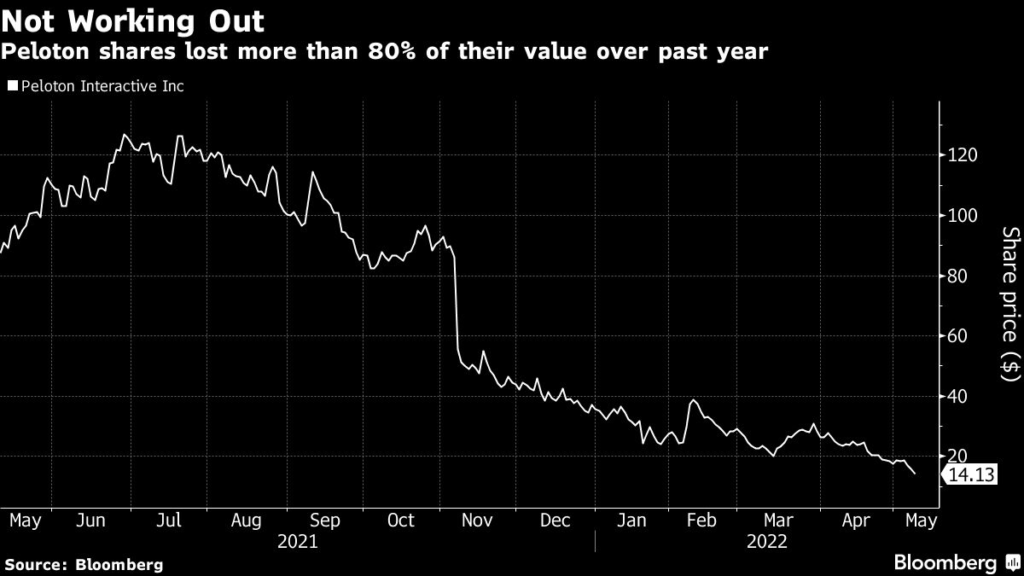
Peloton had thrived during the early days of the pandemic, when locked-down consumers rushed to buy its bikes and treadmills. But the company went from a boom to a bust and lost more than 80% of its value over the past year.

The slide continued Tuesday, with the stock dropping to $11.25 in New York trading — the lowest level since Peloton’s initial public offering in September 2019.

February’s reshuffling replaced much of the company’s upper management and included thousands of layoffs. Under McCarthy, Peloton has tested out new programs, like a leasing model for hardware. He also has promised to release new products, but hasn’t provided many specifics about what the company is working on.

The company said the number of members grew 5% quarter-on-quarter to 7 million, with the number of workouts during the quarter growing by 32% to 184.3 million. In the letter to shareholders, McCarthy said his goal is to get to 100 million members, an effort that Chief Financial Officer Jill Woodworth acknowledged is a “long way from where we sit today.” The way to get there is by making Peloton’s digital app a big success, McCarthy said, adding that international markets are very important, too.

Though McCarthy has only been in the job for about three months, outside investors have complained the New York-based company is heading in the wrong direction and should be put on the block instead. 

In April, Blackwells Capital LLC reiterated a plea to put the fitness company up for sale. “Peloton will continue to be poorly valued for as long as a close-knit group of insiders, who have proven themselves incapable of creating value, continue to wield voting power far in excess of their economic interest,” Blackwells Chief Investment Officer Jason Aintabi said in a statement at the time. 

Blackwell believes that Amazon.com Inc. or Netflix could be potential bidders for the company, which now has a market capitalization of under $5 billion. 

McCarthy has said he’s not pursuing a sale of the company, but there are other possibilities on the table. Last week, Bloomberg reported that Peloton is seeking to sell as much as 20% of the company to an outside investor in a move to shore up cash and further its turnaround. 

In the earnings report, McCarthy acknowledged that — with $879 million in cash on hand — the company is “thinly capitalized for a business of our scale.” But as Peloton begins to sell down excess inventory, he said the cash flow headwind should become a tailwind in fiscal 2023.

As McCarthy wrapped up the earnings call, which lasted under an hour and skipped the usual recap of the numbers, he apologized for ending on a down note. “Notwithstanding the stock price, I’m feeling optimistic about the path ahead,” he said. 

(Updates with analysts’ comments starting in seventh paragraph.)

More stories like this are available on bloomberg.com

©2022 Bloomberg L.P.

El Salvador’s Bitcoin Losses Swell to 28% as Bukele Buys More

(Bloomberg) — President Nayib Bukele’s Bitcoin gambit is becoming onerous for cash-strapped El Salvador but that isn’t stopping him from adding to his stockpile.

Bukele’s bought 2,301 Bitcoins for the government since making them legal tender back in September, based on his announcements on Twitter. That includes a purchase of 500 coins yesterday as their price plunged below $31,000, extending a wild six-month sell-off. Those tokens are worth $74 million today. That’s 28% less than the $103 million Bukele paid for them, according to calculations by Bloomberg. 

Bukele has shown himself to be a true believer in crypto, winning attention and admirers from around the world in the process, and says he trades the nation’s stockpile of coins on his phone. The 40-year-old has said he will push ahead with plans to issue a $1 billion blockchain bond to fund the construction of Bitcoin City, an income and capital gains tax-free jurisdiction he hopes to create on the country’s coast. 

Bukele tweeted pictures on Monday of a mockup for the planned city, which includes an international airport. It would use geothermal energy from a nearby volcano. 

Bukele’s office didn’t return a message seeking comment. The government doesn’t publish data on its Bitcoin holdings, and the activities of a $150 million fund to back Bitcoin conversions at state-run bank Bandesal has been deemed confidential. The central bank declared information about remittances sent through the government’s Bitcoin wallet, Chivo, a state secret. 

The Central American nation’s dollar bonds have plunged 24% this year, among the worst performers in JPMorgan’s emerging market bond index, as concern mounts that the government will fail to pay back $800 million of notes that come due in January. Moody’s cut the government’s credit rating to Caa3 last week, citing an increased risk of default. 

(Adds table with El Salvdor’s Bitcoin purchases)

More stories like this are available on bloomberg.com

©2022 Bloomberg L.P.

Warehouse Owner Prologis Offers to Buy Duke Realty for $24 Billion

(Bloomberg) — Prologis Inc., the giant global warehouse owner, unveiled a roughly $24 billion all-stock offer to acquire Duke Realty Corp., taking its bid public after months of private pushback from the Indianapolis-based real estate investment trust. 

The proposal values Duke at $61.68 a share, a 29% premium to its closing price on May 9, according to a letter from Prologis Chief Executive Officer Hamid Moghadam to Duke made public on Tuesday. Duke investors would own 19% of the combined company. 

Duke shares were up 10% to $52.46 at 10:52 a.m. in New York. Prologis stock was down 2.9%. A representative for Duke declined comment. 

The bid for Duke, which owns about 165 million square feet (15.3 million square meters) of industrial real estate in the US, comes amid a boom in warehouse demand driven by the ongoing shift to e-commerce. The US vacancy rate fell to 3.4% in the first three months of this year even as developers rushed to build new logistics properties, according to Jones Lang LaSalle Inc. 

Read more: KKR to Build Warehouses as Demand for Space Outstrips Supply

While Amazon.com Inc. said last month that it had overbuilt its logistics network, landlords see persistent demand for new properties. The tight market for space, meanwhile, is pushing up rents, increasing the logic for mergers. 

“The offer reflects that warehouse rent growth has continued to exceed expectations,” Bloomberg Intelligence analyst Lindsay Dutch said in an interview. “M&A gives you quick expansion and exposure to rising rents, compared to the time it takes to build new warehouses.”

If accepted, the Duke proposal would mark a return to dealmaking for Prologis, which acquired DCT Industrial Trust in 2018 and Liberty Property Trust in 2020. Moghadam’s firm has relied on new development to expand its holdings over the past two years, boosting its US portfolio to more than 600 million square feet — roughly 200 million square feet more than its closest competitor, Blackstone Inc., had at the end of June.  

San Francisco-based Prologis cited those deals in its letter and called its track record as an acquirer “incredibly strong,” with recent purchases materially benefiting investors.

Prologis first approached Duke about a potential combination in November, according to the letter. After Duke spurned a series of offers, Moghadam concluded “that a public approach may be more constructive.”

Duke’s industrial holdings are “highly strategic” and “complimentary” to Prologis’s own portfolio of logistics assets, according to the letter. Moghadam said the deal would add to Prologis’s earnings and benefit shareholders of both companies.

What Bloomberg Intelligence Says

“Prologis’ proposal to buy smaller, U.S.-exclusive Duke Realty reignites an acquisition streak that’s been dormant since early 2020 and offers rapid expansion amid strong warehouse rent growth.”

— Lindsay Dutch, BI industry analyst

(Updates with analyst commentary, share trading.)

More stories like this are available on bloomberg.com

©2022 Bloomberg L.P.

US Chamber of Commerce Goes After Biden for ‘Caution’ in Trade Policy

(Bloomberg) — The head of the largest U.S. business-lobbying group issued a scathing criticism of President Joe Biden’s trade policy, saying that the administration is “consumed by caution and internal reviews.”

The administration “has yet to pick up even the lowest-hanging fruit,” such as talks for free-trade deals with the U.K. and Kenya started under President Donald Trump but stalled under Biden, US Chamber of Commerce President Suzanne Clark said on Tuesday. The US also should provide relief from tariffs on imports inherited from Trump that are serving as a tax on Americans, Clark said.

The Biden administration’s plan to boost economic ties with Asia — known as the Indo-Pacific Economic Framework, or IPEF — remains “a far cry” as a replacement for the Trans-Pacific Partnership abandoned by Trump, Clark said. The current White House has made clear that it has no plans to join a successor deal. 

US officials are set to discuss the IPEF when Biden visits the region this month; they’ve also said this won’t include negotiating tariff reductions.

“America in many ways is standing still on new trade agreements,” Clark said at a virtual conference hosted by the chamber. “And if you’re standing still on trade, you’re falling behind.”

“The American business community is surging forward, even if our government isn’t,” she added.

Clark’s appearance was followed by Commerce Secretary Gina Raimondo, who is co-leading the administration’s work on the Indo-Pacific framework. Raimondo promoted the initiative, saying that it will help identify opportunities to collaborate on shared priorities like infrastructure investments, semiconductors, research and development and standards for artificial intelligence and privacy. 

Read more: Biden Trade Plans Criticized by Senators as Lacking Ambition

The Biden administration also has drawn criticism from US senators from both parties, who at a recent hearing with US Trade Representative Katherine Tai faulted a shortage of ambition for negotiating new deals and countering China in Asia. 

Tai has repeatedly stressed that the administration is pursuing a “worker-centered” policy and called free-trade pacts a “very 20th-century tool” that have their place, but need to be updated to reflect current realities.


More stories like this are available on bloomberg.com

©2022 Bloomberg L.P.

Ken Griffin Spends $8 Million on Bezos Space Flight and Will Donate It to a Teacher

(Bloomberg) — For those in crypto and the stock markets who’ve been feeling some pain, the Robin Hood Foundation benefit Monday night offered a few hours’ respite. And the chance at a real picker-upper: a rocket to space. 

Ken Griffin, the billionaire founder of hedge fund Citadel, made the winning $8 million bid, in absentia, but doesn’t plan to take the flight. Instead he’s giving his seat on Jeff Bezos’s Blue Origin New Shepard to a New York City public school teacher, who’ll join another educator already scheduled to be aboard.  


“I hope this moment will ignite the imagination of our students and inspire the next generation to push the boundaries of what humanity can achieve while underscoring the extraordinary role our teachers play in the lives of our children,” Griffin said in an emailed statement Tuesday.

Corrects price of the Blue Origin seat in headline of the web article.

Citadel Chief Technology Officer Umesh Subramanian made the final bid on behalf of Griffin. Mike Novogratz had raised his hand at $4 million.

Taking it all in at the Javits Center were Bezos and his girlfriend Lauren Sanchez; Dina Powell McCormick, Alison Mass, Lisa Opoku and Chris Kojima of Goldman Sachs; Guggenheim’s Alan Schwartz; Nelle Miller of JPMorgan; and hedge fund managers Boaz Weinstein, Scott Goodwin, Larry Robbins and Leon Cooperman. 

The live auction, conducted by Lydia Fenet of Christie’s, was brief but it drove home the big idea of the night: Those with money, power, privilege and access are in a position to lift up those with less of it. 


The event brought in $126 million, all for Robin Hood’s poverty-fighting initiatives in New York. A big chunk of that — $100 million — will fund a new initiative to expand childcare programs. The goal is not only to nurture children, but to provide support to working parents. 

Here’s how it added up: Mayor Eric Adams said the city would contribute $50 million, while Alexis Ohanian, the founder of Reddit and of 776 Fund Management, put in $25 million. The Bezos Family Foundation kicked in $10 million. Some of the rest came from donations made during the event, solicited by Paul Tudor Jones, who donned a spacesuit for the occasion.

“Every dollar invested in quality early childhood experience yields $9 in benefits to society,” Robin Hood CEO Richard Buery said.

“That’s a 900% return,” Tudor Jones added, “which is a hell of a lot better than the stock market’s doing this year.” 


As for the spacesuit costume, Tudor Jones milked it, as he asked guests to pull out their mobile phones and give. 

“This is one small step for childrenkind in New York City,” he said. 

After dinner, guests lined up to go inside a New Shepard crew capsule, as John Legend performed. 

Solace over the markets was still in order. To the “finance folk who’ve had a rough week or so,” Legend said, he played “Bridge Over Troubled Water.” 

Before the auction began, comedian John Mulaney voiced skepticism about going to space. 

“If a force is trying to hold you on a planet, stay on that planet,” he said. “Also what are everyone’s priorities right now? We need to go to Mars? Get Florida under control.”


More stories like this are available on bloomberg.com

©2022 Bloomberg L.P.

Biden Team Sees China Tilt Aided as Putin Falters in Ukraine

(Bloomberg) — As Europe’s largest conflict since World War II rages in Ukraine, top Biden administration aides are increasingly convinced it could provide the US with an unexpected advantage — against China.

US officials see the conflict’s toll and the slew of sanctions placed on Moscow as leaving Russia hobbled for years to come. Combined with bolstered European defense spending, that means the US may have a freer hand to accelerate its long-term shift toward China, viewed as America’s biggest future challenge, according to several officials interviewed by Bloomberg News.

The officials acknowledge that the war’s outcome is uncertain. And previous attempts to channel US government attention toward Asia have ended up derailed by events in the Middle East and elsewhere, including former President Barack Obama’s “pivot” to Asia. 

But even with so much of the administration’s bandwidth focused on Ukraine, the officials say they believe this time could be different. They and top lawmakers from both parties warn that Beijing is closely watching the US and allied response to the invasion, drawing potential lessons for any tensions over Taiwan.

“The war in Ukraine could end up being bad for the pivot in the short-term, but good in the long-term,” said Richard Fontaine, the chief executive officer of the Center for a New American Security and an adviser to late Republican Senator John McCain. 

Russia’s Economy Facing Worst Contraction Since 1994

The move toward Asia is seen as critical, with President Joe Biden and his top aides saying China is increasingly trying to use its economic and military clout to bend the “rules-based international order” to its will, citing the country’s moves to take greater control of Hong Kong, expand its presence in the South China Sea and crack down on dissent and human rights in the Xinjiang region. Chinese officials dispute those characterizations and say the US should get over its “Cold War” view of the world.

Although Russia’s invasion of Ukraine initially appeared to put China — which has long touted its support for “territorial integrity” — in a bind, officials in Beijing have continued to tout their partnership with Moscow.

But with the war now dragging out and Russia’s military shortcomings becoming more obvious, one senior US official said that a Beijing-Moscow diplomatic alliance originally viewed as a force multiplier for China increasingly looks more like an anchor.

Defense Secretary Lloyd Austin has been explicit about Washington’s hope that Putin’s setbacks in Ukraine will undermine Moscow. Russia “has already lost a lot of military capability, and a lot of its troops quite frankly,” Austin told reporters on April 25. “We want to see Russia weakened to the degree that it can’t do the kinds of things that it has done in invading Ukraine.”

Surprised by the outbreak of war on the continent, European nations rushed to accelerate defense spending. And Finland and Sweden, long reluctant to join the North Atlantic Treaty Organization, have sought membership. 

How US Is Targeting Chinese Firms for Delisting: QuickTake

Even Germany, which before the war resisted both ramping up defense outlays to the 2% of GDP target set by NATO and sending modern weapons to other countries, has changed tack. If implemented, the shift would make Germany the world’s third-largest military spender — up from seventh in 2020.

“If Russia emerges from this conflict as a weakened version of itself and Germany makes good on its defense spending pledges, both trends could allow the US to focus more on the Indo-Pacific in the long run,” Fontaine said.

Two US defense officials who spoke on condition of anonymity agreed, saying that if the Ukraine crisis leaves Europe more capable of defending itself, it could free up the US to do more in Asia. That would likely mean a range of actions, including shifting troops and weaponry and expanding economic and political ties across the Indo-Pacific. 

The Biden administration had been taking steps to shift resources and energy toward Asia before the war. 

Why the Solomon Islands’ China Pact Has U.S. Riled: QuickTake

For starters, the president and his team sought to bolster the Quad grouping with Japan, India and Australia. The US also reached a controversial agreement with the UK and Australia — at France’s expense — to share nuclear submarine technology with Sydney. That development was decried in Beijing, which has accused America of trying to establish an Indo-Pacific version of NATO. 

With a semiconductor shortage undercutting the US economy, the Biden administration moved to shore up and diversify supply lines, pressing for legislation being negotiated between House and Senate lawmakers to get more chip-making moved back to America. 

The administration’s focus on Asia will also be front and center when Biden travels to South Korea and Japan later this month, a trip meant to meet the nations’ new leaders on their home turf as well as demonstrate unity against another national security priority: North Korea. 

Despite those efforts, there’s plenty that could go wrong with the administration’s plans. In the short term, events in Ukraine have consumed the attention of cabinet officials and their deputies across Washington’s national security apparatus. Another foreign crisis or terrorist attack could quickly erupt, drowning out efforts to look toward Asia. 

China Speech

Most glaringly, 16 months into Biden’s presidency, the administration hasn’t publicly detailed its strategy toward China, and it has shied away from promoting freer trade as a counterweight to Beijing in Asia. Officials at one point said the China policy would be shared by the end of 2021, a deadline that came and went. A scheduled speech outlining the policy by Antony Blinken last week was delayed after the secretary of state contracted Covid-19. No new date for its release has been announced. 

Chinese officials are skeptical of the idea that the war in Ukraine might aid the US pivot to Asia. And they aren’t waiting to see how the situation unfolds. Beijing officials projected that defense spending will grow 7.1% this year, the fastest pace since 2019.  

One Chinese diplomat said that increased German defense spending and a weaker Russia could end up emboldening Europe’s push for what French President Emmanuel Macron has called “strategic autonomy,” opening up the possibility that Europe could split with the US over China ties. Another said it’s too early to tell what the long-term implications of the conflict will be, but that China is ready to compete with the US in Asia either way. 

Not all Biden administration officials are in lockstep behind the idea that events in Ukraine will help the US One senior official said there’s still potential the US will double down on Europe at the expense of Asia, a tendency that could be reinforced by Ukraine. The person said the still-uncertain outcome of the conflict will be crucial to determining what happens. 

Even if Russia — which has faced major downturns in the past including the collapse of the Soviet Union and an economic crisis in the late 1990s — emerges from the Ukraine war weaker, it will remain a nuclear power, one with a predilection for unpredictable behavior. 

China “doesn’t need a strong Russia, they just need a surly Russia that keeps the US worried,” said Daniel Russel, a former assistant secretary of State for East Asian and Pacific Affairs in the Obama administration. “You’d have to believe that Putin was going to stop being a serious mischief maker to believe that leaving Putin management to Germany would be plausible.” 

(Adds analyst’s quote)

More stories like this are available on bloomberg.com

©2022 Bloomberg L.P.

NSA Probing Reach of Software From Russia’s Kaspersky in US Systems

(Bloomberg) — The National Security Agency is investigating the extent that software made by the Russian cybersecurity company Kaspersky is embedded in US businesses and organizations amid rising security concerns arising from Russia’s invasion of Ukraine.

“I am still very worried about US companies that are using Kaspersky,” said Rob Joyce, the NSA’s director of cybersecurity, in an interview in which he revealed the inquiry. “We think that is ill-advised with this global situation.”

Some companies, including those in financial services, voluntarily abandoned Kaspersky antivirus products after the US government banned the company’s software from federal systems in 2017, citing espionage fears. But the company’s products continue to be used in the US, what Joyce called “an installed base across random critical infrastructure and industry.”

The Biden administration has repeatedly warned it has intelligence indicating Russia may carry out cyberattacks against US critical infrastructure in retaliation for punitive sanctions imposed over the invasion of Ukraine. US officials say they fear that Russia could use Kaspersky products to infiltrate key sectors of the American economy. 

Following the February invasion, the US Federal Communications Commission placed Kaspersky on a list of companies deemed a threat to national security, the first such Russian entity added. And some other countries, including Germany and Italy, have raised concerns about using Kaspersky or Russian cybersecurity products since the war began.

“As there has been no public evidence or due process to otherwise justify any actions against the company since 2017, Kaspersky believes any expansion of prohibitions or limitations are a response to the geopolitical climate rather than a comprehensive evaluation of the integrity of Kaspersky’s products and services,” a Kaspersky representative said, in a statement to Bloomberg.

Kaspersky, which says it protects 400 million users and 240,000 companies, is based in Moscow and has offices in the US, UK and elsewhere. Its executives have repeatedly denied having improper ties with the Kremlin or any other government and say they regularly cooperate with law enforcement to catch ransomware thieves.

In 2018, it lost a legal battle to bring a lawsuit against the US government over its 2017 decision to ban federal agencies from using its software, a decision it argued was unconstitutional. In 2018, the company relocated its data storage and processing from Russia to Switzerland in a bid to allay concerns. Kaspersky said the recent FCC listing and German warning were made on “political grounds” and based on unsubstantiated claims.

Following Russia’s invasion of Ukraine, Kaspersky Chief Executive Officer Eugene Kaspersky tweeted in March that his company is “in shock regarding the recent events” and has welcomed negotiations, hoping they can end hostilities and result in “compromise”.

The NSA’s Joyce said antivirus providers gain such sweeping access to systems that customers can’t see their activities or understand the decisions they make. The NSA is also worried about “white label” services, in which Kaspersky software runs unbranded inside other products.

“So there are routers, for example, that come with a Kaspersky engine inside them, and it’s not clear people understand that that’s buried inside a product that looks US or Western. So we’re trying to understand where those risks are in the supply chain and where the biggest ones exist,” Joyce said.

Kaspersky’s anti-virus technologies have been integrated into more than 150 IT partner products, according to its website. Kaspersky has said vendors are responsible for publicly communicating any third-party products they use.

Reuters reported in March that the US government began privately warning some American companies the day after Russia invaded Ukraine that Moscow could manipulate software designed by Kaspersky to cause harm. On Monday, Reuters reported that US Commerce Department has ramped up an investigation into Kaspersky since the invasion of Ukraine.


More stories like this are available on bloomberg.com

©2022 Bloomberg L.P.

Intel Debuts Data-Center Chips Aimed at Fending Off Nvidia, AMD

(Bloomberg) — Intel Corp. is rolling out new processors designed for data centers, a lucrative market where it’s facing tougher competition from Nvidia Corp. and Advanced Micro Devices Inc. 

The new lineup will include updated artificial intelligence chips, fresh versions of Intel’s Xeon processors and semiconductors that help connect telecommunications networks. For the first time, the company also will sell graphics chips designed for data centers, challenging Nvidia on its own turf.

Intel Chief Executive Officer Pat Gelsinger, a year into a turnaround effort at the chip giant, is announcing the products at a company event in Dallas on Tuesday. Though Intel’s processors remain the most widely used in the massive data centers that run the internet and corporate networks, other companies are growing faster and taking share. That’s set up the market as a key battleground where Intel can reassert its dominance.

Nvidia’s data-center business has tripled since 2019 to more than $10 billion a year. AMD, meanwhile, saw overall revenue surge 71% in the first quarter, fueled by sales of processors for cloud-computing servers. 

The new products are designed to bolster Intel’s position outside of central processing units — its traditional strength — and push deeper into artificial intelligence. Cloud service providers pioneered the use of AI to make sense of the flood of data created by smartphones and internet applications. Many of those programs work better with so-called accelerators, which specialize in handling certain parts of data manipulation.

Nvidia led the way in adapting graphics processors for the data-center market, and AMD followed its lead. Now Intel is playing catch-up. The company, which has never offered stand-alone graphics chips before, will begin selling two versions of a processor called Arctic Sound starting in the third quarter. Dell Technologies Inc., Hewlett Packard Enterprise Co. and Cisco Systems Inc. all plan to offer computers featuring the new chip, Intel said.

The company also is updating its Habana Gaudi and Greco AI accelerators, chips that are used to train and then run AI software as it makes decisions based on the data it receives. The new version will be built on better production technology and compare favorably to Nvidia products in the market, Intel said. Voice and image recognition are two applications that can take advantage of such accelerators. 

More stories like this are available on bloomberg.com

©2022 Bloomberg L.P.

Close Bitnami banner
Bitnami