Bloomberg

Delivery Hero Shares Sink Below 2017 IPO Price After 75% Rout

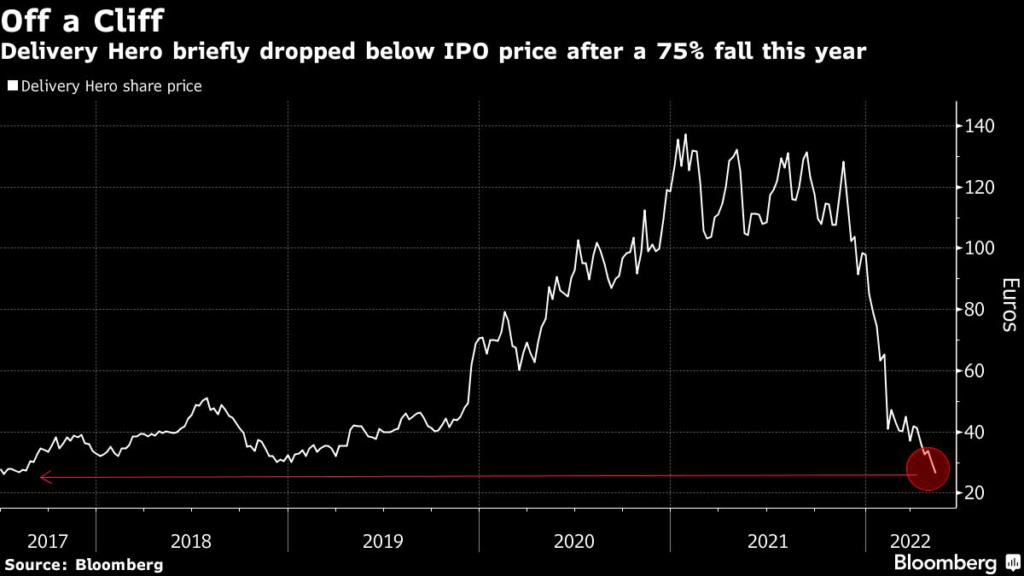
(Bloomberg) — Delivery Hero SE briefly slipped below its initial public offering price for the first time since 2017, after a relentless selloff this year wiped out nearly three quarters of its market value.

The food-delivery stock has cratered this year, shedding about 18.1 billion euros ($19.1 billion) of its market value as investors question the company’s path to profitability amid rising borrowing costs. European peers have also hit a rough patch, with Just Eat Takeaway.com NV plunging 62% and Deliveroo Plc down 59%. 

Delivery Hero shares dropped as much as 2.7% to a record low of 24.96 euros before reversing losses on Tuesday, dipping below the IPO price of 25.50 euros for the first time in five years. The stock is also the Stoxx 600 Index’s worst performer in 2022.

This time last year, the food-delivery industry was still riding high on a pandemic-fueled boom in demand. That optimism came crashing down as economies reopened. Relentless competition and inflation are squeezing already tight budgets, pressuring a sector that has yet to turn a profit. Rising interest rates and a broader rotation out of high growth stocks didn’t help.

Inflation is also hitting consumer wallets. Sagging sales are adding further fuel to the heated competition for market share in Europe, with rapid grocery delivery the latest battleground as startups like Getir and Gorillas push into the fray.

“Inflationary headwinds have been building, obviously, but they’re getting worse,” Berenberg analyst Sarah Simon said in a phone interview. Simon cited Tuesday’s data from Barclays Plc, showing that growth of consumer card spending on food takeaways slowed in the U.K. in April.

Disclosure concerns are weighing heavily on Delivery Hero’s stock. The company failed to break out order numbers in the first quarter after shifting to focus on profitability rather than volume. 

To be sure, the sector may have reached a floor with this year’s losses. And the industry’s renewed focus on breaking even is being welcomed by the market. Delivery Hero said last month it expects to hit an adjusted measure of profitability for the first time next year. 

Nonetheless, Simon said investors may stay on the sideline before the company delivered on its profit target. “We want to see these numbers before we actually invest on the basis of them,” she said. “It’s not about what could happen. It’s what has happened.”

More stories like this are available on bloomberg.com

©2022 Bloomberg L.P.

Peloton Plunges After Cutting Outlook; Losses Mount Post-Covid

(Bloomberg) — Peloton Interactive Inc. reported a deeper loss than analysts predicted, cut its revenue guidance, and signed a deal with JPMorgan Chase & Co and Goldman Sachs Group to borrow $750 million in five-year term debt, marking the latest setbacks for the onetime pandemic darling. The shares tumbled about 17% as the market opened.

The results suggest Peloton’s comeback effort is still a long way from taking hold, despite a shake-up earlier this year. In February, co-founder John Foley was ousted as chief executive officer after sales slowed and Peloton struggled to manage its production. He was replaced by former Spotify Technology SA and Netflix Inc. Chief Financial Officer Barry McCarthy, who vowed to cut costs and generate more of Peloton’s revenue from subscriptions. 

The fitness technology company reported revenue of $964.3 million in the fiscal third quarter on Tuesday, missing a Wall Street estimate of $971.6 million. The net loss was $757.1 million, excluding some items, compared with an average estimate of $132.1 million.

Looking forward, Peloton expects to report $675 million to $700 million in revenue in the fourth quarter, well below analysts’ average estimate of $820.9 million. Peloton put the forecast miss down to “softer demand” compared to its previous guidance, and recent hardware price reductions. 

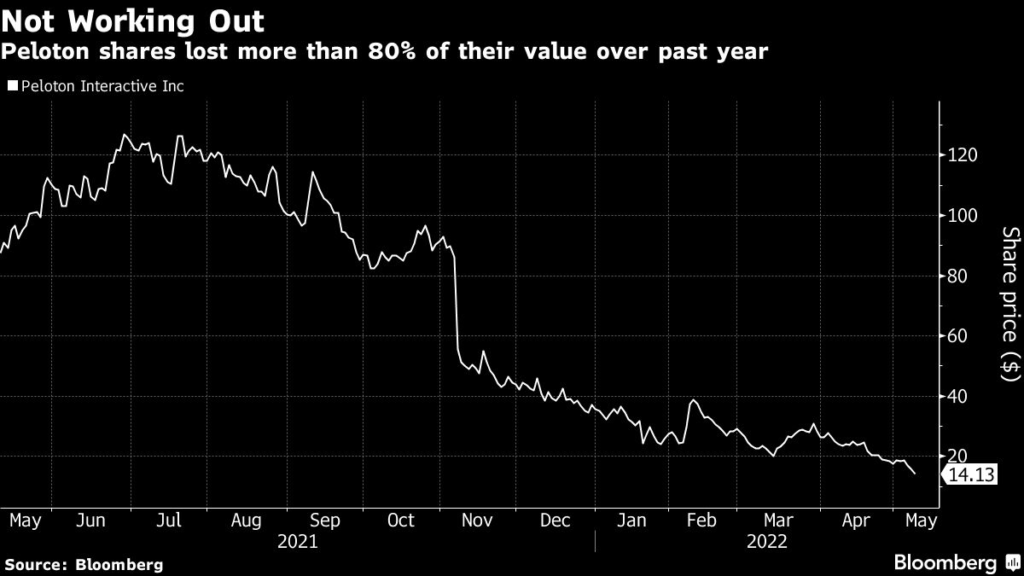
Peloton had thrived during the early days of the pandemic, when locked-down consumers rushed to buy its bikes and treadmills. But the company went from a boom to a bust, and Peloton has lost more than 80% of its value over the past year. The shares fell to $11.71 in New York on Tuesday morning.

Since February’s reshuffling, which included thousands of layoffs, the shares have continued to slide. Under McCarthy, Peloton has cut the prices of its devices and tested out new programs, like a leasing model for hardware. McCarthy also has promised to release new products, but hasn’t provided many specifics about what the company is working on.

The company said the number of members grew 5% quarter-on-quarter to 7 million, with the number of workouts during the quarter, growing by 32% to 184.3 million. In a letter to shareholders, McCarthy said his goal is to get to 100 million members, an effort that Chief Financial Officer Jill Woodworth acknowledged is a “long way from where we sit today.” The way to get there is by making the digital app a big success, McCarthy said, adding that international markets are very important, too.

“Turnarounds are hard work,” McCarthy said. “It’s intellectually challenging, emotionally draining, physically exhausting, and all consuming.”

Though McCarthy has only been in the job for three months, outside investors have complained the company is heading in the wrong direction and should be put on the block instead. 

In April, Blackwells Capital LLC reiterated a plea to put the fitness company up for sale. “Peloton will continue to be poorly valued for as long as a close-knit group of insiders, who have proven themselves incapable of creating value, continue to wield voting power far in excess of their economic interest,” Blackwells Chief Investment Officer Jason Aintabi said in a statement at the time. 

Blackwell believes that Amazon.com Inc. or Netflix could be potential bidders for the company, which now has a market capitalization of under $5 billion. 

McCarthy has said he’s not pursuing a sale of the company, but there are other possibilities on the table. Last week, Bloomberg reported that Peloton is seeking to sell as much as 20% of the company to an outside investor in a move to shore up cash and further its turnaround. 

In the earnings report, McCarthy acknowledged that with $879 million in cash on hand, that leaves the company “thinly capitalized for a business of our scale.” As Peloton begins to sell down excess inventory, he said the cash flow headwind should become a tailwind in fiscal 2023.

As McCarthy wrapped up the earnings call, which lasted under an hour and skipped the usual recap of the numbers, he apologized for ending on a down note. “Notwithstanding the stock price, I’m feeling optimistic about the path ahead,” he said. 

(Updates with shares in first paragraph.)

More stories like this are available on bloomberg.com

©2022 Bloomberg L.P.

Brazil Says Impact of ‘Intense’ Rate Hikes Is Still to Be Seen

(Bloomberg) — Brazil’s central bank said much of the impact of its “intense and timely” cycle of interest rate hikes is still to come even as it left the door open to smaller borrowing cost increases amid a tough inflation outlook.

Policy makers wrote that a likely extension of tightening with a smaller increase in June was appropriate to bring inflation expectations to target, according to the minutes of the May 3-4 rate-setting meeting, when the board raised borrowing costs by a full percentage point.

“It was emphasized that the current monetary tightening cycle was quite intense and timely and that, due to monetary policy lags, much of the expected contractionary effect and its impact on current inflation are still to be seen,” they wrote in the minutes published Tuesday. Their strategy, together with tightening that’s been implemented, “reinforces the cautious monetary policy stance and emphasizes the uncertain scenario,” they wrote.

Policy makers led by Roberto Campos Neto are fine-tunning the end of a tightening cycle that has added 10.75 percentage points to borrowing costs in about a year. They face persistent double-digit inflation along with rising consumer price forecasts. Civil servants are demanding higher wages to make up for lost purchasing power, adding to pain from costlier raw materials.

Read more: Traders Get It Right in South America Doubting Central Banks

What Bloomberg Economics Says:

“The minutes were slightly more hawkish than the post-meeting statement, in our view, and consistent with the possibility of additional hikes in the second half of the year as the yield curve is currently pricing in. We see relevant risks that inflation expectations for 2023 remain above target for some time; this may lead to a higher terminal rate than the BCB now has planned.”

— Adriana Dupita, Latin America economist

— Click here for the full report 

Swaps rates on the contract due on January 2023, which indicate investor expectations for monetary policy at year’s end, slipped two basis points in morning trading.

Deterioration 

In the minutes, central bankers wrote that “an additional deterioration was observed in both the short-term inflationary dynamics and the longer-term projections.” Some policy makers wrote high current inflation contaminated forecasts “beyond what was expected.”

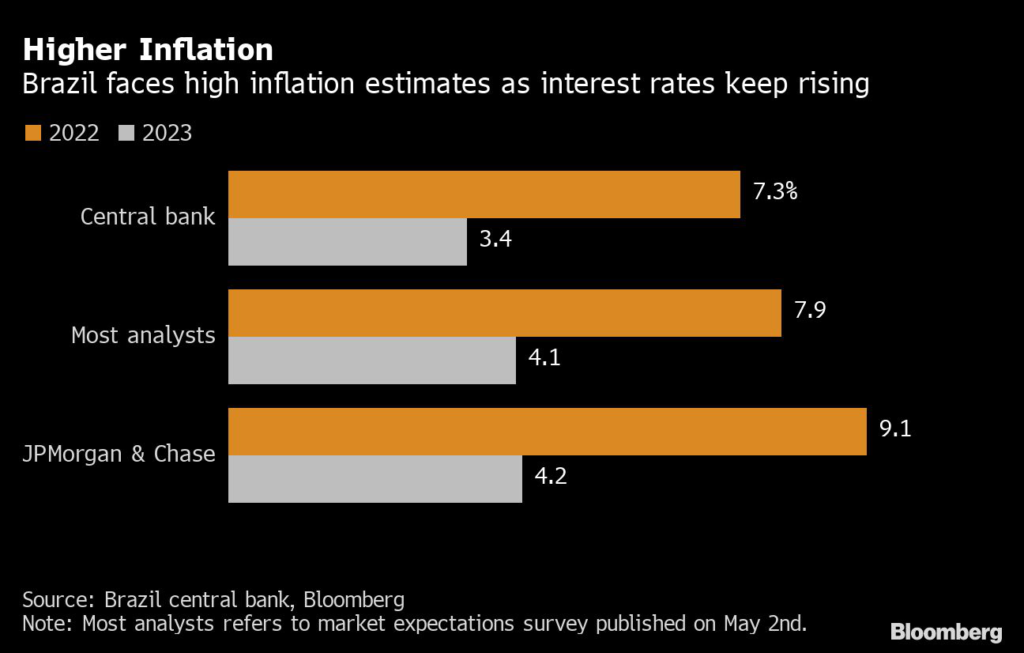
Annual inflation topped 12% in early April, driven by higher oil costs after Russia’s invasion of Ukraine. Major Wall Street banks now see consumer price increases above 9% at year’s end, well above the 2022 target of 3.5%.

On Monday, state-controlled oil company Petroleo Brasileiro S.A., commonly known as Petrobras, raised diesel prices to 4.91 reais ($0.96) per liter from 4.51 reais per liter, according to a statement. Gasoline costs were kept unchanged.

“Deteriorating inflation expectations a pretty common theme” in today’s minutes, said Brendan McKenna, strategist at Wells Fargo & Co. He sees another hike of either 50 or 75 basis points in June, while an additional increase in August isn’t “completely taken off the table either.”

Growth Risk

In a separate release on Tuesday, Brazil’s retail sales rose 1% in March, with purchases of office supplies and books driving the gains. That was more than the 0.5% median forecast from analysts in a Bloomberg survey.

Still, extending the hiking cycle may prove difficult, as most analysts see gross domestic product growth at just 0.7% this year, according to the latest central bank survey of economists. 

“The Committee highlighted that economic growth came in line with expectations, but the tightening of financial conditions brings a risk of greater-than-anticipated deceleration in the quarters ahead, when its impacts tend to be more evident,” central bankers wrote in the minutes.

Brazil’s central bank is also weighing more challenging global outlook, as the US Federal Reserve raises its borrowing costs. Last week, its Chair Jerome Powell said it would move “expeditiously” to tame inflation.

(Updates with analyst comment in fifth paragraph, market move in sixth)

More stories like this are available on bloomberg.com

©2022 Bloomberg L.P.

JPMorgan’s ‘Uninvestable’ Call on China Was Published in Error

(Bloomberg) — In the buttoned-down world of Wall Street research, JPMorgan Chase & Co.’s description of Chinese Internet companies was an instant shocker: “uninvestable.”

The evocative label helped erase about $200 billion from U.S. and Asian markets and prompted one Chinese technology company to downgrade JPMorgan’s underwriting role on an upcoming initial public offering.

It was also never meant to see the light of day, according to people familiar with the matter who asked not to be named discussing internal deliberations. JPMorgan editorial staff in charge of vetting the bank’s research asked for “uninvestable” to be removed from 28 reports penned by technology analyst Alex Yao and his team before they were published on March 14, the people said.

While the word was cut from most of the reports  — in some cases replaced with “unattractive” — it appeared in the published version of four, including one on JD.Com Inc.: “As risk management becomes the most important consideration among global investors in relation to their China investment strategy, as they price in China’s geopolitical risks, we view China Internet as uninvestable on a six-12-month view with a binary share price outlook.”

After looking into what happened, JPMorgan concluded that an editorial error allowed the word to slip through even though the editors, analysts and supervisors involved had all agreed before publication that it wasn’t the best choice of word, the people said. While Yao’s team was undoubtedly turning more cautious on Chinese Internet companies, its prediction of share-price gains for at least 10 of them by year-end suggested the sector wasn’t entirely “uninvestable.”

Tightrope Act 

The previously unreported episode highlights the fierce debate across Wall Street over the attractiveness of Chinese assets at a time when crackdowns on the tech sector and Covid Zero lockdowns are roiling the world’s second-largest economy. It also underscores the tightrope act facing global banks like JPMorgan as they try to ramp up their businesses in China while still giving clients access to candid research on the country’s turbulent financial markets.

JPMorgan was removed as the most senior underwriter for Kingsoft Cloud Holdings Ltd.’s planned Hong Kong stock offering after Yao’s team cut the price target on the company’s U.S.-listed shares by half as part of its flurry of downgrades in March, people familiar with the matter said last month. The bank remains a sponsor of the IPO, but is now ranked behind UBS Group AG and China International Capital Corp. on the deal.

“We stand by our published research and the analyst’s independent analysis of the sector,” a JPMorgan spokesperson said in an emailed response to questions. “A few subjective terms used interchangeably doesn’t change that.”

JPMorgan’s research unit uses additional screens when dealing with sensitive issues that require caution and that system remains unchanged, one of the people said.

Research analysts at global banks are supposed to operate independently of the firms’ investment bankers, but it’s a tricky relationship. UBS lost business in China in 2019 after one of its economists sparked online furor over a quip about pork prices. Countries such as Russia and Turkey are also sensitive to wording that might affect markets or disparage the economy. 

The stakes are perhaps the highest in China, which is opening up to foreign banks to allow access to its vast financial system and billions of dollars in potential profits. 

Few firms understand the promise and perils of the market better than JPMorgan. Chief Executive Officer Jamie Dimon, who has pledged to bring his firm’s “full force” into China, attracted global attention last year with a quip that JPMorgan would outlast the country’s ruling Communist Party. Soon after, he issued a statement of regret. 

More stories like this are available on bloomberg.com

©2022 Bloomberg L.P.

Chinese Miners and Battery Makers Team Up in Rush for Lithium

(Bloomberg) — Chinese miners and battery makers are forging closer ties as the accelerating shift to electric vehicles highlights the shortage of a metal that’s key to the clean-energy revolution.

Lithium jumped more than 400% in China over the past year, unnerving Beijing and sparking a flurry of deals from Argentina to Zimbabwe. Battery manufacturers are rushing to secure supplies of lithium — a silvery-white material used in power packs — as EV demand pushes prices higher. 

Chinese battery maker Gotion High-tech Co. is looking at cooperating with Argentina’s state-owned miner Jujuy Energía y Minería Sociedad del Estado, while weighing the construction of a lithium carbonate refinery in the region. In Zimbabwe, Chengxin Lithium Group Co. and Sinomine Resource Group Co. are setting up a joint venture to explore for the metal.  

“Much of the new developments involve smaller players in China looking to secure resource supply overseas, a strategy that China has employed to gain control of the supply chain,” said Allan Ray Restauro, analyst at BloombergNEF. Nationalization in some countries may pose a risk to that strategy, he said.

Chinese mining giant Tianqi Lithium Corp. is teaming up with battery maker CALB. The companies will invest, cooperate and research in areas including battery-cell production and lithium salt refining, after signing a separate supply deal.

China’s domination of the battery metals industry is also forcing the U.S. and Europe to respond as supply chain woes during the pandemic showed the importance of having materials readily available locally. The Biden Administration has been pushing to accelerate U.S. production of key battery metals, while on Monday commodities trader Trafigura Group announced plans to invest in a new lithium refinery in the U.K.

More stories like this are available on bloomberg.com

©2022 Bloomberg L.P.

Archegos Spurs CFTC Boss’s Vow to Scrutinize Family Offices

(Bloomberg) — The top U.S. derivatives regulator is ratcheting up scrutiny of family offices after last year’s blow up of Archegos Capital Management exposed significant blind spots in the swaps market.

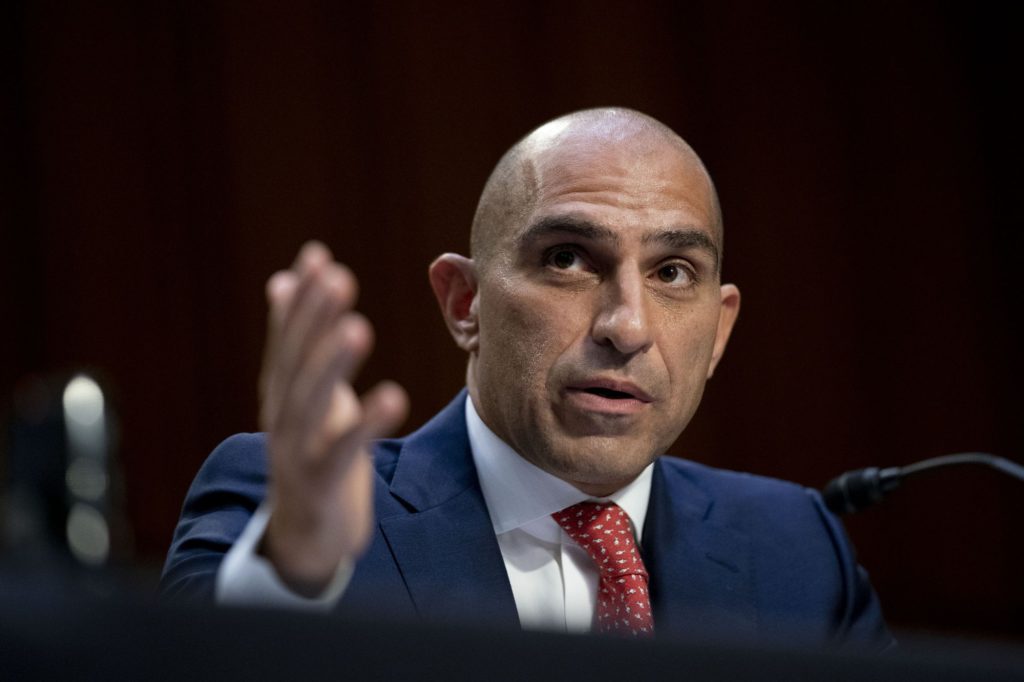
Commodity Futures Trading Commission Chairman Rostin Behnam said Monday that the collapse of Bill Hwang’s firm shows a need to rethink some of the agency’s rules. The episode also underscored the danger of one investor building up a massive swaps position while leaving regulators unaware, he added.

“It would not surprise me if there were other Bill Hwangs,” Behnam said in an interview at Bloomberg’s Washington office. “Clearly there was a failure across many different desks and I think there’s a role for regulators to play in terms of data that we collect, reporting that’s required and, again, a more macro review of stability and resiliency issues.” 

The implosion of Archegos has been held up as an example by regulators pressing for more transparency in financial markets. The firm’s wrong-way derivatives bets sent shares in companies from ViacomCBS Inc. to Baidu Inc. tumbling in March 2021. The latest twist came last month when Hwang and his chief financial officer were arrested after being indicted on criminal charges including racketeering conspiracy. Hwang and Patrick Halligan, the CFO, have pleaded not guilty.

Two former executives agreed to cooperate with authorities, including the CFTC. Even as court cases advance, Behnam said one thing is already clear: more visibility into family offices like Archegos is needed.

The CFTC may propose additional rules for individual investors that have significant swaps positions, according to Behnam. The regulator is also reviewing reporting requirements and risk management at private funds, prime brokers and banks, he added, noting that most of Hwang’s trades were in equity swaps which are not under his agency’s jurisdiction. 

Regulators need to have a macro view of markets and the full network of counter-party relationships “so we know where risk pockets may exist,” Behnam said. “This isn’t the traditional family office that we are accustomed to,” Behnam said about the size of the positions held by Archegos.  

Hwang’s bets set off panic on Wall Street when he was was unable to make payments due on risky bets he made using billions of dollars lent to him by major banks, including Credit Suisse Group AG, Morgan Stanley and Nomura Holdings Inc. The trading led to several investigations, including one into how banks exited their souring positions. 

During a wide-ranging interview, Behnam also discussed the CFTC’s plans for crypto regulation. He also said the regulator was stepping up efforts to police trading in other derivatives. Specifically, he said the market used by some companies to reduce their net emissions by buying carbon offsets “deserves scrutiny and has a lack of credibility at this point.” 

(Adds Behnam photo)

More stories like this are available on bloomberg.com

©2022 Bloomberg L.P.

JPMorgan Launches Data Platform for Buy Side Facing Deluge

(Bloomberg) — JPMorgan Chase & Co. is launching a platform to help buy-side firms sort through data in a bid to take on more functions for money managers swamped with information and facing fee pressure. 

Fusion by JPMorgan will be offered through the biggest U.S. bank’s securities services business within the corporate and investment bank. Helmed by Teresa Heitsenrether, the unit provides services including custody, fund administration, agency lending and collateral management. It had $31.6 trillion in assets under custody as of the end of March. 

“We’ve been in a massive transformation of the securities services business,” JPMorgan President Daniel Pinto said in an interview. “The challenge for the clients is: How do you effectively use the data that you have and enhance it with other data? You need to standardize.”

Fusion launches Tuesday as an interface, allowing clients to sort through data. They’ll be able to access the data on the firm’s platform or within their own applications.

At first it’ll offer JPMorgan proprietary data and then will expand to include other sources. The firm’s approach will be “partner-intensive,” Heitsenrether said in an interview.

“The challenge clients have is that they have multiple providers and also their own data,” Heitsenrether said. “Our ambition is to provide a data-management service with JPMorgan data and enrich it with data clients get from all sources. We’re taking on a function the buy side would’ve done itself.”

JPMorgan hired Gerard Francis as head of data solutions last year. Francis previously worked at Bloomberg LP, parent company of Bloomberg News.

(Updates with additional details in fourth paragraph. A previous version corrected the figure in the second paragraph.)

More stories like this are available on bloomberg.com

©2022 Bloomberg L.P.

Goldman’s Oppenheimer Sees Value in $11 Trillion Stock Rout

(Bloomberg) — The rout in global equity markets that erased $11 trillion since the end of March may be reaching a floor for now as battered valuations, particularly among tech stocks, attract dip buyers. 

For some, the argument rests on technical indicators, while others are looking at what corporates are offering, such as strong balance sheets and high dividend yields. Plus, investors have already priced in a lot of concerns, according to Peter Oppenheimer, chief global equity strategist at Goldman Sachs Group Inc., including about inflation and growth, central bank policy tightening and the war in Ukraine.

“Equities are starting to look attractive for medium-to-longer term buyers,” he told Bloomberg Television on Tuesday. While the downside risks still lurk, “all of that really is absorbed into the market already.”

European stocks rebounded on Tuesday, following another selloff across both sides of the Atlantic on Monday. The Stoxx 600 index was up 1.3% as of 1:30 p.m in London. S&P 500 and Nasdaq 100 futures pointed to a positive open for U.S markets, with the latter advancing as much as 1.8% as bargain hunters returned. 

Amid concerns about how aggressively central banks will move, markets may also have taken some relief from Raphael Bostic, Federal Reserve Bank of Atlanta president, who said late Monday that he doesn’t support rate hikes bigger than 50 basis points.

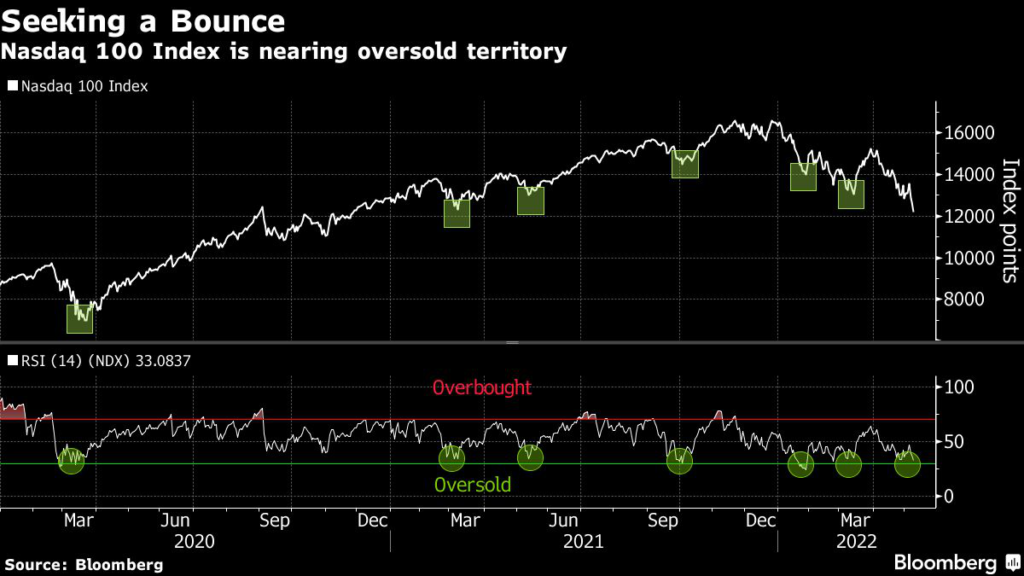
The S&P 500 has fallen for four straight weeks, while the Stoxx 600 has tested the lows reached after the war in Ukraine erupted. In Europe, stocks are technically “oversold” based on the 14-day relative strength index, a momentum indicator measuring the magnitude of recent price changes, while the Nasdaq is also closing in on such levels. The reading has been a good predictor of a short-term bottom in the past year.

“While it has been realized on a lower volume profile with less panic, it is worth noting the Stoxx 600 just hit its most technically oversold level since March this year,” said Carl Dooley, head of EMEA trading at Cowen. “The last time that happened markets rallied over 10% in a straight line.”

Stocks are getting notably cheaper, as earnings growth forecasts continue to improve, while prices have plunged. Europe’s Stoxx 600 is now trading at 12 times its forward earnings, below its average forward price-to-earnings ratio of 13.2 since 2005. It’s suffered a 22% de-rating this year, a similar valuation drop to the S&P 500.

“We have seen quite a big correction now,” Oppenheimer said. “There are inevitably times when you are going to get some of the setback rebounding.”

Oppenheimer is not alone in seeing a floor. JPMorgan Chase & Co.’s Marko Kolanovic repeated his dip-buying calls on Monday, urging investors to add risk as central bank hawkishness has reached its peak. Still, the problem is that such calls by die-hard bulls have failed investors before. 

Back in mid-April, Kolanovic said sentiment and positioning are too bearish, and advised investors to buy growth stocks including tech, biotech and innovation, alongside value stocks like metals and mining. The Nasdaq 100 index has ended every single week since then in the red. 

For bears, such as Bank of America Corp.’s equity strategy team, the selloff may continue until October, and the S&P 500’s fall below 4,000 index points may tip it into a more severe rout as investors flee. Morgan Stanley’s Michael Wilson has said the “S&P 500 has minimum downside to 3,800 in the near term and possibly as low as 3,460.”

Much of that concern is tied to the economic backdrop, and the growing risk of stagflation looming large over the investment outlook. Even the long tradition of markets outperforming during earnings seasons has been challenged. While corporate profits both in Europe and the U.S. came in again above expectations, the beats have failed to assuage broad concerns. 

“We have a perfect storm at the moment — inflation, Ukraine war, zero Covid policy in China, normalization of monetary policy,” said Vincent Juvyns, a global market strategist at JPMorgan Asset Management. Still, he insisted, “a lot is priced in at the moment” and “we may soon hit the bottom.”

(Updates European prices, U.S. futures in fourth paragraph)

More stories like this are available on bloomberg.com

©2022 Bloomberg L.P.

Ukraine Latest: EU Postpones Call With Orban Over Oil Sanctions

(Bloomberg) — A video call between the European Union and Prime Minister Viktor Orban to discuss proposed sanctions on Russian oil imports that Hungary is resisting was postponed, while the Hungarian leader spoke with French President Emmanuel Macron on energy issues. 

The EU approved the release of 600 million euros ($634 million) in aid for Ukraine as it considers issuing joint debt to finance the country’s long-term reconstruction, which may end up costing hundreds of billions of euros. Ukraine’s economy is expected to contract by almost a third this year as the Russian invasion drags on, according to a new forecast. 

The German and Dutch foreign ministers visited Kyiv for meetings. Ukrainian forces pulled out of a strategic city in the Luhansk region after two months of fighting. A key committee in Finland’s parliament backed NATO membership. 

(See RSAN on the Bloomberg Terminal for the Russian Sanctions Dashboard.)

Key Developments

  • Macron, Orban Discuss Energy as EU Presses for Sanctions Deal
  • EU Weighs Joint Debt to Fund Ukraine’s Long-Term Rebuilding
  • Putin’s Crackdown Pushes Independent Russian Media Into Crypto
  • Finland Should Join NATO, Key Parliament Committee Concludes
  • EU Seeks to Boost Solar Energy to Cut Russian Gas, Draft Shows

All times CET: 

Zelenskiy Urges Slovakia to Back Russian Oil Ban (1:57 p.m.)

Ukrainian President Volodymyr Zelenskiy urged Slovak lawmakers to back the EU’s proposed ban on purchasing oil from Russia as the government in Bratislava tries to negotiate a three-year exemption with the bloc because of its heavy dependence on Russian crude.

Zelenskiy thanked Slovakia for supplying his military with weapons but said that the EU’s sixth package of sanctions was also vital for Ukraine’s defense. “If they will be weaker, it will be harder for us. We need this sixth package.” Zelenskiy told lawmakers in a video speech. “We understand it will be hard for you, but banning oil is important.”

Finnish Parliament Committee Says Country Should Join NATO (12:25 p.m.)

Finland should join the North Atlantic Treaty Organization to best ensure the security of all Finns, according to the parliament’s defense committee, as the nation prepares to decide on an application within days.

Russia’s invasion of Ukraine galvanized public support for joining the military alliance. Finland is, along with Sweden, considering NATO membership and giving up its non-alignment that stretches back to before the cold war.

EU Approves Release of 600 Million Euros for Ukraine (12:08 p.m.)

The EU has approved the release of 600 million euros to help Ukraine with its urgent financial needs, according to bloc officials who asked not to be identified. The money is part of the EU’s 1.2 billion euro emergency assistance package adopted by the bloc early this year.

The European Commission is expected to complete the process Wednesday and the funds could be transferred in the coming days, according to one of the officials.

Ukrainian Troops Retreat From Popasna in Luhansk Region (12:06 p.m.)

Ukrainian troops retreated from Popasna in the Luhansk region to more fortified positions, the area’s Governor Serhiy Haiday said in statement on Facebook. 

Fighting over the city, which is near the border between the Luhansk and Donetsk regions and occupies strategic heights, was ongoing over the last two months. 

German, Dutch Foreign Ministers Visit Kyiv (12:00 p.m.)

German Foreign Minister Annalena Baerbock and her Dutch counterpart Wopke Hoekstra traveled to Kyiv Tuesday where they will hold meetings with Ukrainian government officials.

Baerbock visited the town of Bucha near the capital, which is the site of alleged Russian atrocities against civilians, while Hoekstra was in the Kyiv suburb of Irpin, where he viewed bombed-out houses and buildings. “These acts cannot go unpunished,” he said in a tweet. “The Netherlands is committed to establish the truth and achieve justice.”

Macron Speaks With Orban on Energy Security (11:48 a.m.)

Orban spoke about energy security on Tuesday with Macron, whose country holds the EU’s rotating presidency, an aide to the Hungarian leader said, as diplomacy over potential sanctions on Russian oil continues. 

A video call between Orban, European Commission President Ursula von der Leyen and Hungary’s neighbors won’t be held Tuesday, according to a spokesman for the bloc. He didn’t immediately explain why the call, which was announced the previous day, was delayed. 

The EU’s sixth sanctions package would ban crude oil shipments over the next six months and refined fuels by early January, but Hungary has threatened to veto the measures due to its reliance on Russian energy imports. Orban and von der Leyen made progress in talks over the issue Monday but failed to reach a breakthrough, according to both sides.

German Investor Confidence Stabilizes (11:16 a.m.)

Investor confidence in Germany’s pandemic rebound improved but remained deeply negative as the war in Ukraine darkens the outlook for Europe’s largest economy.

The ZEW institute’s gauge of expectations rose to -34.3 in May from -41 the previous month, defying expectations for a third straight deterioration. Germany’s economy is feeling the effects of Putin’s invasion in large part due to its high dependence on Russian energy imports. 

Ikea Still Buying Russian Wood Despite Pledge, Newspaper Says (10:18 a.m.)

Ikea is continuing to source wood from Russia despite making a public promise to halt trade with the country following the war in Ukraine, Sweden’s tabloid Aftonbladet reported, citing internal email exchanges between Ikea’s purchasing managers.

In early March, the Swedish retailer said it was pausing operations in Russia and Belarus, including all exports and imports with those countries. Ikea representatives didn’t immediately respond to a request for comment.

Mazda Halted Russian Plant, Nikkei Reports (10:08 a.m.)

Mazda Motor Corp. halted production at its Vladivostok joint venture with Sollers in late April after it previously stopped exporting parts to Russia, Nikkei reported, citing the company.

Russia’s auto sector has been among the hardest hit domestic industries from sanctions as parts supplies have dried up. Volkswagen AG, BMW AG, Ford Motor Co. and every Japanese car company with production in the country have suspended operations there.

Oil Extends Slump as EU Softens Sanctions Proposals (8:34 a.m.)

Oil extended its biggest drop in more than five weeks after the European Union softened its proposed sanctions on Russian crude exports and as economic growth concerns weighed on sentiment.

West Texas Intermediate futures fell below $103 a barrel in Asian trading after sliding around 6% on Monday. The bloc will scrap a proposed ban on EU-owned vessels transporting Russian crude after objections from members including Greece. 

Independent Russian Media Turns to Crypto for Funding (8:10 a.m.)

Meduza, a prominent independent Russian-language news site, is soliciting donations via cryptocurrencies as President Vladimir Putin’s crackdown on the press and western sanctions made raising money in Russia impossible.

The site lost about a third of traffic after the Kremlin blocked its content in Russia and was forced to become creative in its fundraising to keep the lights on. Data show that Meduza’s Bitcoin and Ether wallets listed on its website held crypto worth around $230,000 at current prices.

Munich Re Writes Down $740 Million Over War (7:56 a.m.)

Munich Re wrote down Russian and Ukrainian bonds in its investment portfolio and warned that the war poses “considerable uncertainty” to its outlook.

The German reinsurer cut the value of the securities by almost 700 million euros ($740 million) in the first quarter and recorded about 100 million euros in costs related to the conflict.

Putin’s invasion has forced a series of financial hits among reinsurers, in part because of Russia’s move to effectively impound planes leased from foreign lessors. Swiss Re said earlier this month that it had set aside $283 million in reserves related to the war during the first quarter, and Hannover Re made additional provisions for possible losses in the low triple-digit million-euro range in the period.

Ukraine’s Economy to Shrink 30% This Year: EBRD (7:10 a.m.)

That forecast is more than previously expected and in a scenario where the war ends this year, the European Bank for Reconstruction and Development said. 

Russia’s invasion has upended trade in energy, agricultural commodities and fertilizers and disrupted supply chains, resulting in slower growth across eastern Europe.

More stories like this are available on bloomberg.com

©2022 Bloomberg L.P.

Renault Deepens Overhaul With New Car-Sharing Growth Targets

(Bloomberg) — Renault SA set targets to expand its Mobilize car-sharing and leasing businesses as the struggling French automaker deepens its corporate overhaul.

The brand, which currently generates losses, is to achieve double-digit margins for each category of services outside of its finance arm by 2027, the French carmaker said Tuesday. Renault is sticking to its goal for Mobilize to make up a fifth of group revenue by the end of this decade, betting consumers will increasingly shun vehicle ownership.

Renault is trying to expand emerging business areas as it faces fierce competition selling mass-market autos and challenges exiting Russia, which was its second-biggest market before the country’s invasion of Ukraine. The manufacturer is now exploring breaking itself up into electric-vehicle and combustion-engine companies, a move that could also reshape its cross-shareholding relationship with Japanese partner Nissan Motor Co. 

Chief Executive Officer Luca de Meo is under pressure to make good on promises to improve margins and cut costs, while facing a slump in European car sales and competition from rivals in rolling out new EV models and expanding into mobility services. Both Volkswagen AG and Stellantis NV have recently bolstered their new-mobility offerings with acquisitions.

READ: Stellantis to Buy Mercedes and BMW’s Car-Sharing Venture

In a further sign of profound changes to come, the automaker also announced on Tuesday closer cooperation with Chinese auto giant Geely Automobile Holdings, which is buying a 34% stake in its Korean unit.

Renault’s financing arm RCI Bank and Services is changing its name to Mobilize Financial Services and aims to have a fleet of 1 million vehicles for leasing and 200,000 for subscription in 2030. By that same year, Mobilize is to raise the number of installed EV chargers to 165,000, from 22,000 last year.

Mobility Offerings

Renault is counting on consumer behavior to shift away from outright auto purchases, with the biggest growth expected to come in the leasing segment.

“In our sector, most of the products lose more than 50% of their value after three years,” de Meo said during a presentation. “This isn’t fair to our customers or the quality of our business.”

Renault aims to expand leasing, refurbishing and selling used cars as well as pushing into auto-subscription services using low-cost models like the Duo and Bento. The carmaker plans to start car-sharing operations in the U.K. and Germany before the end of the year, adding to existing businesses in Spain, Italy, France, the Netherlands and Brazil.

While there are currently no plans to separately list Mobilize, new partners could be brought in to help shoulder the brand’s roughly 100 million euros ($106 million) in annual investment, Deputy CEO Clotilde Delbos said. Renault may provide more details on how Mobilize would fit into a potential company split later this year, she said.

(Updates with CEO comment in seventh paragraph.)

More stories like this are available on bloomberg.com

©2022 Bloomberg L.P.
Close Bitnami banner
Bitnami