
Bloomberg

Antitrust Chief Barred From Google Cases Pending Recusal Ruling

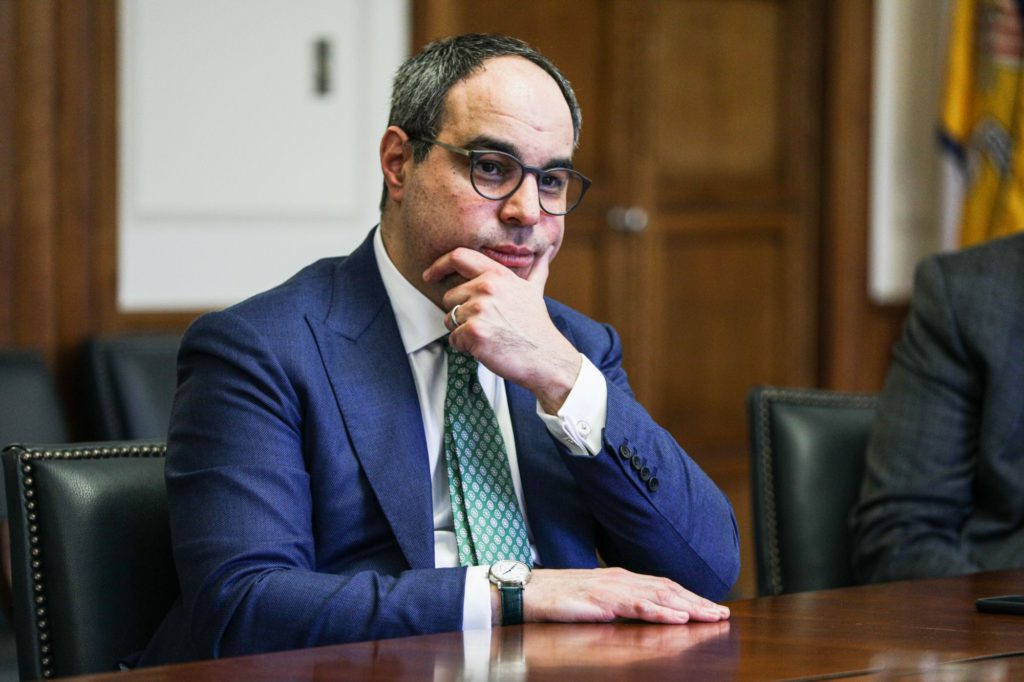
(Bloomberg) — The Justice Department’s top antitrust official has been barred from working on monopoly investigations of Alphabet Inc.’s Google as the department wrestles with whether he must recuse himself because of his previous work for the search giant’s rivals, according to people familiar with the matter.

Jonathan Kanter, a longtime advocate for antitrust enforcement against Google, was brought in by the Biden administration to tackle difficult antitrust investigations into tech giants like Google and Apple Inc. that began under former President Donald Trump. 

In November, Google urged the Justice Department to review whether Kanter should be recused from all actions involving the company because of his past work representing its critics. 

No decision has been made in the nearly six months since Kanter started the job on Nov. 16, while the department continues to waver over whether his involvement represents a conflict of interest, one of the people said.

The department sued Google in October 2020 for allegedly abusing its dominance of the online search market in the most significant antitrust case against an American company in two decades. It’s also preparing a second monopoly lawsuit over the company’s digital advertising business, Bloomberg has reported. 

In private practice, Kanter represented News Corp., Yelp Inc. and Microsoft Corp., among others, who offered evidence to Justice Department antitrust officials that the companies said showed how Google’s conduct harmed their business.

A Justice Department spokeswoman declined to comment, citing a department policy against confirming recusals. A Google representative also declined to comment.

Federal ethics rules require an official “to avoid an appearance of loss of impartiality in the performance of his official duties.” But those conflicts, as well as a separate ethics pledge by the White House, can be waived on a case-by-case basis. Solicitor General Elizabeth Prelogar, for example, was granted a waiver to participate in a Supreme Court case regarding Harvard University’s admission despite having been a lecturer at Harvard Law School. 

Associate Attorney General Vanita Gupta, Kanter’s boss, will decide on whether or not he should be recused from the Google cases, two of the people said. Gupta herself received a waiver to oversee civil rights cases despite having lobbied both Congress and the Justice Department on behalf of the Leadership Conference on Civil and Human Rights. 

In the meantime, Kanter’s top deputy, Doha Mekki is acting as the decision maker on both the Google lawsuit and the active investigation, two people familiar with the issue said. 

Mekki, a seven-year veteran of the antitrust division, has already stepped into the deciding role in other cases where Kanter is recused, such as the agency’s challenge of UnitedHealth Group Inc.’s proposed $7.8 billion purchase of Change Healthcare Inc. and antitrust litigation between Apple Inc. and Epic Games Inc. Kanter represented rival health insurer Cigna Corp. and a yoga app whose executive testified in the Apple-Epic case before he became the top U.S. antitrust official. 

Trial in 2023

The Justice Department’s antitrust suit against Google is slated for trial in September 2023. The department has asked Judge Amit Mehta in Washington to sanction Google for improperly shielding sensitive business documents from regulators through an overly broad reading of attorney-client privilege. Google denies any wrongdoing. Both sides are to finish interviewing executives and gathering documents later this month.

Kanter’s possible recusal has been a hot-button issue that’s straining relationships between the Biden administration and progressive Democrats, who advocate for aggressive action against the technology companies. 

In January, Representative Pramila Jayapal, a Washington State Democrat, and Senator Elizabeth Warren, a Massachusetts Democrat, criticized Google for what they called the company’s attempts to bully Kanter into recusal. 

Laurence Tribe, a prominent constitutional law scholar at Harvard, wrote a public defense of Kanter, saying Google’s recusal efforts “have little legal basis and strain common sense.”

Meta Platforms Inc. used similar conflict of interest arguments seeking to recuse Federal Trade Commission Chair Lina Khan, but a judge dismissed those in a January opinion. “It is natural that the president will select a candidate based on her past experiences and views, including on topics that are likely to come before the commission during her tenure, and how that administrator will implement the administration’s priorities,” Judge James Boasberg said.

Kanter “was a consistent proponent of vigorous antitrust enforcement in the private sector,” said Jeff Hauser, founder of the Revolving Door Project, an advocacy group. “In that world, it’s not problematic to be on the same side. The Biden administration found in Kanter somebody with a proven track record taking a set of concerns seriously that the administration wanted to take seriously.”

More stories like this are available on bloomberg.com

©2022 Bloomberg L.P.

Wave Financial Starts Stablecoin Fund Touting Eye-Popping Yield

(Bloomberg) — Wave Financial LLC is looking to grab the attention of yield-seeking investors with the launch of a stablecoin fund that it says could yield 12% annually.

The Wave Stable Asset Yield Fund (or SAYF) will hold USDC, a currency backed by Circle Internet Financial and Coinbase, as well as USDT, or Tether, among other stablecoins. It could generate a yield of 8% to 12% and will also offer a monthly dividend, according to a press release Tuesday.

“A lot of our investors are coming to us to ask for higher-yielding instruments,” Ben Tsai, co-founder and president of Wave, said by phone. “They want low volatility, they want U.S.-dollar-correlated returns, but they want very high yield and they want it with liquidity.”

The fund is making its debut into a volatile market, where prices for cryptos large and small have plummeted. Bitcoin, the largest digital coin, has lost almost 30% over the past month, and there’s been trouble in the stablecoin markets too. The closely watched stablecoin TerraUSD got propped up by its backers after losing its peg to the dollar.

Wave’s new fund, its eighth, is set up for monthly subscriptions and redemptions, so investors are able to move in and out easily, which makes it convenient to use, Tsai said. The product is meant for qualified clients in the U.S. and internationally. 

Eye-Popping 

The fund’s target yields are eye-popping in a low-rate, high-inflation environment. Tsai says the company will lend out investor cash to generate the yields. Wave will work with lending and borrowing desks that are active in this space.

Yields in decentralized finance, or DeFi, can be higher than in traditional markets because DeFi platforms tend to subsidize the lending and borrowing in order to incentivize people to use them.

Stablecoins are a type of cryptocurrency that is pegged to traditional currencies, like the dollar. They’re seen as being less volatile than traditional digital assets like Bitcoin, though they’re not without controversy. Tether’s reserves, for instance, largely remain a mystery, though they include billions of dollars of short-term loans to large Chinese companies, Bloomberg News reported last year.

The Federal Reserve has also flagged concerns over financial risks posed by stablecoins. The coins are “vulnerable to runs” and there’s a lack of transparency around the assets used to back the tokens, it said in a report released Monday.

There’s always the risk a stablecoin de-pegs, Tsai said. In addition, some platforms come with cybersecurity risks. 

“There are risks associated with all of these investment products, but overall we believe that this is a pretty robust economy,” he said, adding that Wave’s sticking with the larger names it knows and has done extensive research on. 

More stories like this are available on bloomberg.com

©2022 Bloomberg L.P.
Apple’s Ford Hire Is a Shot in the Arm for Its Car Project

(Bloomberg) —

Just when it seemed a little too quiet around Apple Inc.’s car project, another auto industry hire has the car and tech industries buzzing again.

Last week, Keith Naughton and I broke the news that Desi Ujkashevic, a 31-year Ford Motor Co. veteran, joined the iPhone maker’s car team. Ujkashevic is the highest-profile move to Apple under the division’s current leader, Kevin Lynch. It’s the surest sign in several months that Apple is pushing ahead with its vehicle efforts, undeterred by a series of setbacks.

The project has been in flux for more than a year amid several executive departures, most notably that of Doug Field, who ran the operation prior to leaving in September. Field started at Apple in 2008, left for Tesla Inc. in 2013 and returned to Apple in 2018, after a rocky period in which the world’s most valuable company paused car development to focus on self-driving software.

Field evidently decided trying to turn Ford into an electric-vehicle powerhouse would be a more worthwhile task than attempting to launch Apple’s next big thing. He was the fourth executive to run and then leave the vehicle program in a six-year period.

The move immediately cast doubt on Apple’s automotive plans. A car is one of a few future product categories under development by the Cupertino, California-based technology giant, and one that most analysts and investors agree gives the company the best opportunity to future-proof its revenue and profit growth. So Apple put a known commodity in charge: Lynch, who had joined from Adobe Inc. in 2013 and led development of the Apple Watch’s software and health features.

A smartwatch is a complicated product, but it’s far from as complex as a car. Apple can only succeed if it brings in expertise from the auto world — individuals like Ujkashevic who actually know something about shipping a vehicle.

A regular rotation of hires and departures have marked Lynch’s tenure so far. Apple has brought on a few dozen engineers from both established and startup auto companies in recent months, including Tesla, Rivian Automotive Inc., Argo AI, Alphabet Inc.’s Waymo, Mercedes-Benz AG and Volvo Car AB. The additions of Ulrich Kranz in June 2021 and Stuart Bowers in 2020 were met with mixed reactions. The former used to run startup Canoo Inc., and the latter was an engineering vice president at Tesla working on Autopilot software for less than a year and a half.

Ian Goodfellow, a well-known researcher in the artificial intelligence community, left Apple last week. Goodfellow led some machine learning teams for the car project, including one based out of Zurich. He told colleagues he was leaving over Apple’s return-to-work policy. Many others, including the car project’s hardware chief and senior engineers, also have bolted.

There’s plenty of reason to believe an Apple car is still in the works, at least in some form. But as has been the primary challenge almost from the start, aside from the Field years, the car project has lacked strong leadership and vision from the car world.

An Apple-designed electric car that syncs well with the Apple ecosystem and brings new-age bells and whistles would be an especially competitive rival to Tesla, Lucid and Rivian. While Apple has privately aimed for a debut by 2025, the company needs to prove it can both hire and retain talent from the auto world. Otherwise, Apple is likely to keep putting off or scaling back its ambitions for the sector.

Like getting this newsletter? Subscribe to Bloomberg.com for unlimited access to trusted, data-driven journalism and subscriber-only insights.

More stories like this are available on bloomberg.com

©2022 Bloomberg L.P.
Apple Ramps Up Hiring From Ford, Rivian and Mercedes in Car Push

(Bloomberg) —

Just when it seemed a little too quiet around Apple Inc.’s car project, another auto industry hire has the car and tech industries buzzing again.

Last week, Keith Naughton and I broke the news that Desi Ujkashevic, a 31-year Ford Motor Co. veteran, joined the iPhone maker’s car team. Ujkashevic is the highest-profile move to Apple under the division’s current leader, Kevin Lynch. It’s the surest sign in several months that Apple is pushing ahead with its vehicle efforts, undeterred by a series of setbacks.

The project has been in flux for more than a year amid several executive departures, most notably that of Doug Field, who ran the operation prior to leaving in September. Field started at Apple in 2008, left for Tesla Inc. in 2013 and returned to Apple in 2018, after a rocky period in which the world’s most valuable company paused car development to focus on self-driving software.

Field evidently decided trying to turn Ford into an electric-vehicle powerhouse would be a more worthwhile task than attempting to launch Apple’s next big thing. He was the fourth executive to run and then leave the vehicle program in a six-year period.

The move immediately cast doubt on Apple’s automotive plans. A car is one of a few future product categories under development by the Cupertino, California-based technology giant, and one that most analysts and investors agree gives the company the best opportunity to future-proof its revenue and profit growth. So Apple put a known commodity in charge: Lynch, who had joined from Adobe Inc. in 2013 and led development of the Apple Watch’s software and health features.

A smartwatch is a complicated product, but it’s far from as complex as a car. Apple can only succeed if it brings in expertise from the auto world — individuals like Ujkashevic who actually know something about shipping a vehicle.

A regular rotation of hires and departures have marked Lynch’s tenure so far. Apple has brought on a few dozen engineers from both established and startup auto companies in recent months, including Tesla, Rivian Automotive Inc., Argo AI, Alphabet Inc.’s Waymo, Mercedes-Benz AG and Volvo Car AB. The additions of Ulrich Kranz in June 2021 and Stuart Bowers in 2020 were met with mixed reactions. The former used to run startup Canoo Inc., and the latter was an engineering vice president at Tesla working on Autopilot software for less than a year and a half.

Ian Goodfellow, a well-known researcher in the artificial intelligence community, left Apple last week. Goodfellow led some machine learning teams for the car project, including one based out of Zurich. He told colleagues he was leaving over Apple’s return-to-work policy. Many others, including the car project’s hardware chief and senior engineers, also have bolted.

There’s plenty of reason to believe an Apple car is still in the works, at least in some form. But as has been the primary challenge almost from the start, aside from the Field years, the car project has lacked strong leadership and vision from the car world.

An Apple-designed electric car that syncs well with the Apple ecosystem and brings new-age bells and whistles would be an especially competitive rival to Tesla, Lucid and Rivian. While Apple has privately aimed for a debut by 2025, the company needs to prove it can both hire and retain talent from the auto world. Otherwise, Apple is likely to keep putting off or scaling back its ambitions for the sector.

Like getting this newsletter? Subscribe to Bloomberg.com for unlimited access to trusted, data-driven journalism and subscriber-only insights.

More stories like this are available on bloomberg.com

©2022 Bloomberg L.P.
Spain Fires Spy Chief After Premier, Catalan Leaders Were Hacked

(Bloomberg) — Spain replaced the head of its intelligence agency in a bid to calm a furor sparked by the discovery that Prime Minister Pedro Sanchez and dozens of Catalan separatist leaders had their phones hacked with spyware.

Esperanza Casteleiro, who has spent most of her career at CNI, as the agency is called, will replace Paz Esteban, Defense Minister Margarita Robles said in a news conference Tuesday following a cabinet meeting.

The uproar over the use of the Pegasus spyware erupted last month following a report by The New Yorker magazine that more than 60 people linked to the Catalan separatist movement, including lawyers and lawmakers, had been targeted for surveillance between 2017 and 2020. 

The revelations strained Sanchez’s relations with Esquerra Republicana, the Catalan secessionist party whose votes he has relied on to pass key legislation. The plot thickened on May 2 when the government announced that Sanchez and Robles had also been spied on between May and June 2021 with the same technology.

Not Clear

It’s still not clear who hacked the premier’s phone or why the intelligence agency, known as CNI, took more than a year to find out that it had happened. 

Pegasus is developed by NSO Group, an Israeli firm, and is supposedly only sold to governments and state agencies. The European Union’s in-house privacy watchdog in February recommended its use be banned. 

When queried in Parliament last month about the use of Pegasus to spy on Catalan secessionist leaders and activists, Robles said that any potential use made of the spyware was carried out legally. She also dismissed the importance of the New Yorker article, saying she’d never heard of the magazine.

After spending most of her career at the CNI, Casteleiro was named secretary of state for defense under Robles in 2020. Esteban, the sacked spy chief, had spent almost four decades at the agency before being named to the top job in 2020. 

More stories like this are available on bloomberg.com

©2022 Bloomberg L.P.
Elon Musk Says Twitter Will Comply With EU Content Rules After Takeover

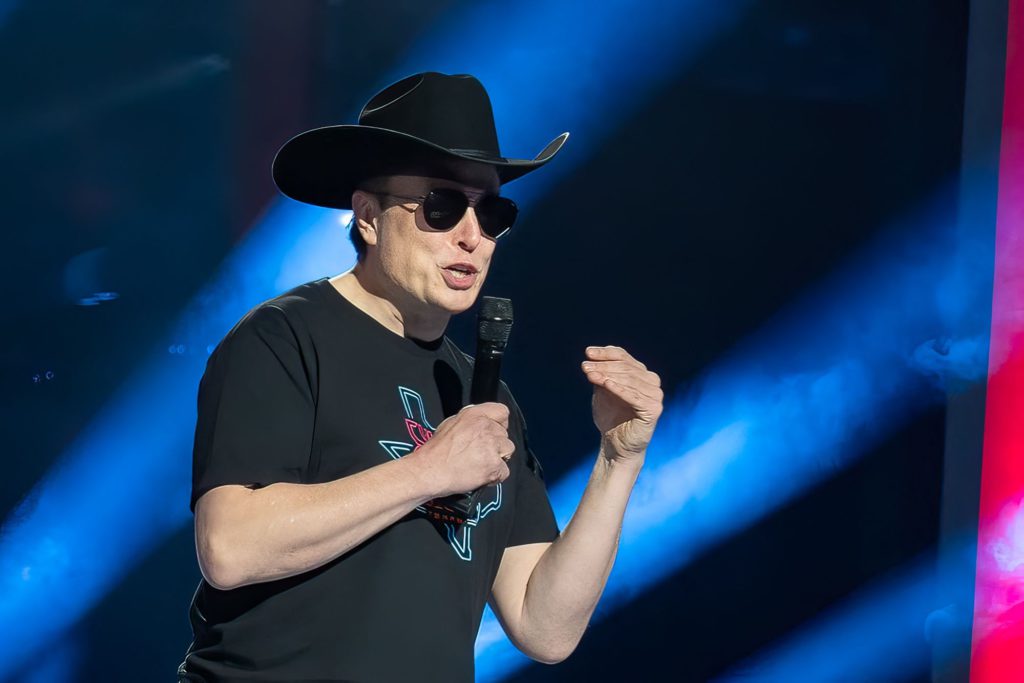
(Bloomberg) — One of the leading officials from the European Union paid a visit to Elon Musk in Texas, and came away convinced the billionaire will keep Twitter Inc. on the right side of lawmakers.

After meeting Musk on Monday, Thierry Breton, the EU’s internal market commissioner, said that he and the Tesla Inc. chief executive officer agreed on everything.

“To tell you the truth, there was definitely no disagreement — none,” Breton told Bloomberg in an interview.

Musk said Twitter would comply with the European Union’s rules on content if he completes his proposed takeover, despite his plans to loosen restrictions on the network.

Breton is one of the first major tech regulators to discuss Musk’s proposed $44 billion takeover of Twitter — at least publicly. The EU is one of the fiercest regulators of major tech firms, and has previously launched scathing attacks on prominent founders including Mark Zuckerberg.

Breton previously warned that Twitter, even after a change of ownership, would have to comply with the EU’s new digital content rules.

Musk, who calls himself a free speech absolutist, has criticized Twitter’s content moderation policies, saying he will focus on “free speech” values. 

However, Musk is aligned with the EU especially on the idea of making the algorithms more transparent, and on requiring companies to have consistent rules about banning people from platforms.

“I agree with everything you said, really,” Musk said in a video post after the two met in Texas. “I think we’re very much on the same line.”

Twitter, Musk and Why Online Speech Gets Moderated: QuickTake

The European Union agreed on the Digital Services Act last month, aiming to force tech platforms to better police content. The rules mainly focus on taking down illegal content like terrorist posts and hate speech, but could also affect tech companies’ algorithms to down-rank harmful posts, such as messages harassing others or promoting eating disorders.

Twitter has become more active in flagging and taking down content in recent years due to increasing public scrutiny. The platform famously banned former U.S. President Donald Trump from the site last year for inciting violence. The move provoked condemnation from conservatives in the U.S., who argued the ban hindered free speech.

Musk’s purchase of the platform could mark a shift in how Twitter mediates content disputes, eschewing rapid take-downs in favor of promoting a broadly open platform.

Musk however has said he believes the platform should follow the rules of each country it operates in. “In my view, Twitter should match the laws of the country,” Musk said in April at a TED conference before Twitter accepted his bid to buy the platform. 

Breton confirmed that Musk understood that the EU’s rules require that what is illegal offline should be illegal online. Breton told Bloomberg that Musk “was very comfortable” with what Europe was doing. “He was pretty much aligned with the philosophy of what we have done in Europe.”

It is yet to be seen to what extent European regulators will push platforms like Twitter to do more on harmful content including disinformation and harassment. Very large platforms like Twitter will be required to submit annual reports to the EU detailing what they are doing to combat legal but harmful content on their platform. 

If companies are not doing enough, the EU could require companies down-rank certain content or change their algorithms. 

There’s also the prospect of major financial penalties if Musk and the EU disagree. If the company doesn’t comply with the DSA, the EU can issue fines of as much as 6% of a company’s annual revenue and even ban the platform from operating in the bloc.

(Updated with additional context throughout)

More stories like this are available on bloomberg.com

©2022 Bloomberg L.P.
Meta Attacks German ‘All-or-Nothing’ Assault on Facebook

(Bloomberg) — Meta Platforms Inc.’s Facebook attacked Germany’s competition watchdog for taking an “all-or-nothing approach” conflating data protection and antitrust law to seek an unprecedented overhaul of the firm’s business model.

The Federal Cartel Office’s strategy led to a “clearly flawed” decision in 2019 targeting the social-media giant’s business practices, lawyers for Meta told the European Union’s Court of Justice at a hearing on Tuesday. 

“The Federal Cartel Office, based on its misguided all-or-nothing approach conducted only an incomplete and skewed data protection assessment,” Hans-Georg Kamann, a lawyer for Meta, told a 15-judge panel in Luxembourg. “A formal competition order has revealed itself to be in substance actually a data-protection order.”

The EU court challenge is key to Facebook’s attempts to overturn the 2019 crackdown, which imposed changes to how it tracks users’ web browsing. The EU court’s ruling on the legality of the Germany authority’s move could guide authorities across the region as the EU seeks to bolster oversight of Silicon Valley tech giants. The case comes as the EU has adopted sweeping new rules aimed at preventing tech “gatekeepers” from abusing their market power.

Facebook’s Model Attacked by German Antitrust Regulator 

The case ended up at the EU court after judges in Germany sought guidance on whether a violation of data regulations can be cited in an antitrust case. It’s one of several challenges the tech firm is facing in Europe, including from privacy watchdogs.

Meta on Tuesday accused the watchdog of violating a key EU principle of “sincere cooperation,” by failing to include the Data Protection Authority in Ireland, where Meta has its EU base, in its investigations before adopting a final decision.

The EU’s General Data Protection Regulation, which took effect in 2018, gave data watchdogs unprecedented fining powers and also made those authorities, where a firm has its EU base, the main supervisor for them. 

Joerg Nothdurft, a lawyer for the German Cartel Office, countered the point, saying the agency has “almost 100” documents that show how it cooperated with various data-protection authorities. 

“We competition authorities cannot assess large digital firms and measure their market power, or judge their behavior if we cannot look at what access they have to data and what they do with that data, how much and which data they have, and how much and which data they are allowed to have,” he said.

The challenge comes as Facebook was added to a list of big tech companies that are subject to the German regulator’s beefed-up supervisory powers, following a similar move against Alphabet Inc. and its Google unit earlier this year. 

Advocate General Athanasios Rantos of the EU court said he would issue a non-binding opinion about Tuesday’s case on Sept. 20. Opinions often give an indication which way the court’s judgment will go.

The case is: C-252/21, Facebook Inc. and Others v. Bundeskartellamt.


(Updates with comments from hearing and ruling date starting in sixth paragraph.)

More stories like this are available on bloomberg.com

©2022 Bloomberg L.P.

Crypto’s Audacious Algorithmic Stablecoin Experiment Crumbles

(Bloomberg) — Algorithmic stablecoins, like their more “traditional” counterparts, are supposed to provide calm in the chaos of crypto. Instead, as investors in one such token are rapidly finding out, they can serve as lightning rods for volatility.

Rather than trading at $1, as designed, the TerraUSD coin, or UST, slipped over the weekend to around 99 cents. By Monday evening in New York, it had plunged to 60 cents, obliterating its previous low of 92 cents in May 2021. It clawed back losses on Tuesday and is fluctuating between around 90 cents and $1 —  a sign of trouble.

What caused Terra’s coin to become untethered is a topic of intense internet debate. The disconnect happened alongside a sharp selloff in cryptoassets — including a plunge in Bitcoin to below $30,000 — and a broader retreat from risk assets including stocks. Whatever the catalyst, it’s no small thing: There are around 18.5 billion of UST in circulation, according to CoinMarketCap, a big enough presence that its swings could have systemic implications for other coins and protocols. And Do Kwon, the crypto upstart behind UST, has previously committed to buying as much as $10 billion worth of Bitcoin as part of his support of the coin, further entwining the project with the core of the digital-asset market. 

“It’s fairly clear that there is a crisis of confidence,” said Kyle Samani of Multicoin Capital. He added that it was not certain whether UST would survive. That raises the prospect of the current turbulence snowballing into one of the biggest crypto blowups in recent memory. 

Issuers of conventional stablecoins like Tether’s USDT or Circle’s USDC maintain that their tokens are backed by “real” assets like cash or highly rated bonds on a 1-to-1 basis. These coins hold their peg because, the theory goes, they can be readily exchanged for cash or highly liquid cash equivalents. By contrast, algorithmic stablecoins attempt to hold their value through a combination of instructions encoded in software programs and active treasury management. UST — which functions in tandem with a related token, Luna — is the most popular and controversial of these kinds of tokens.

Terra’s Mechanics

In the case of Terra’s stablecoin, if its price falls below $1, traders are incentivized to swap units of UST for Luna, which removes the former from circulation. Similarly, software programs are triggered to do the same. If the price rallies above $1, the mechanism applies in reverse – remove Luna tokens from circulation to create equivalent, new units of UST.

Traders seeking to profit from arbitrage opportunities regularly swap UST for Luna and vice versa, thus ensuring the price stays at or very close to $1. Another contributor to UST’s price stability was crypto’s equivalent of above-market interest rates offered through Anchor Protocol, a “decentralized lender” built on Terra’s blockchain. Anchor offers rates of around 20% on deposits of UST, which offered a significant demand incentive for the token.

But over the weekend, all of those mechanisms stopped working and UST lost its dollar peg, while Luna also slid in value. That led to a series of crypto market interventions from Kwon and the so-called council of the Luna Foundation Guard (LFG), a consortium of crypto players that includes Kanav Kariya of Jump Crypto. Jump Crypto declined to comment. Near midnight New York time on Monday, UST remained under pressure. Luna was trading around $29, down 52% from a day earlier, according to CoinMarketCap.

LFG is a nonprofit incorporated last December, according to a business profile from Singapore’s Accounting and Corporate Regulatory Authority. Kwon is listed as a director. Kwon, who splits his time between Seoul and Singapore, did not immediately return a request for comment. 

“The biggest losers from all of this will be retail [investors] that didn’t understand the risks they were taking,” Multicoin’s Samani said.

EXPLAINER: What Are Stablecoins?: QuickTake

(Updates with latest market price in second paragraph.)

More stories like this are available on bloomberg.com

©2022 Bloomberg L.P.

Cathie Wood’s Famed Market-Beating Return Is Disappearing

(Bloomberg) — The outsized gain that turned Cathie Wood into one of the world’s most-famous proponents of active fund management is quickly evaporating as some of her favorite stock picks tumble.

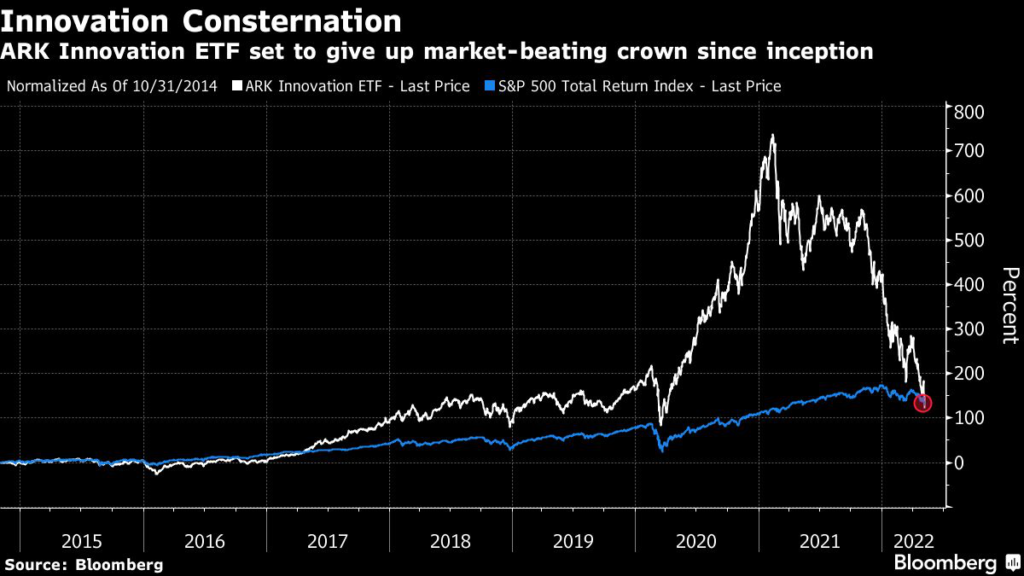
After years of trouncing the market and just days after Wood issued a broadside against passive investing, her flagship ARK Innovation ETF (ticker ARKK) has given up all the outperformance it once enjoyed against the S&P 500 Index. Wood’s strategy of picking stocks involved in “disruptive innovation” has fallen victim to the tech meltdown as investors flee high-priced growth shares in an environment of rising interest rates and high inflation.

ARKK’s almost 10% slump on Monday as the S&P 500 slid 3.2% means the fund’s total return since its 2014 debut has dropped to about 122%, according to data compiled by Bloomberg. The U.S. benchmark boasts a total return of around 128% over the same period. 

Wood’s firm didn’t immediately respond to a request for comment sent after business hours.

Elon Musk, Cathie Wood Say Passive Funds Have Gone Too Far

The shift in sentiment against tech stocks has created a perfect storm for Wood, the founder of ARK Investment Management LLC. Rising interest rates eat into equity valuations while concerns about economic growth have cooled speculative ardor — putting the shares of companies betting on new technologies particularly at risk. ARKK has slumped more than 70% from last year’s peak. 

Still, Wood enjoys remarkable investor loyalty. Despite retreating over 50% in 2022, the ETF has posted net inflows this year. Data overnight showed that it added another $41 million on Friday.

ARKK was about 2.8% higher in early trading in New York as the recent stock rout took a breather.

Meanwhile, not all of Wood’s funds have given up their outperformance. The smaller ARK Next Generation Internet ETF (ARKW) has handily beaten the S&P 500 since inception even after tumbling from its high, according to data compiled by Bloomberg.

Wood remains committed to the tech space despite recent losses. In recent tweets she suggested the global economy is undergoing the largest technological transformation in history and talked up the potential for Zoom Video Communications Inc. and Microsoft Corp.

(Updates with latest returns, flow data and premarket trading.)

More stories like this are available on bloomberg.com

©2022 Bloomberg L.P.

Walmart Executive Moves to Marketing-Technology Unicorn

(Bloomberg) — Amanda Whalen, the former finance head at Walmart Inc.’s international operation, is taking over as chief financial officer at Klaviyo, a marketing-technology company. 

Whalen said she was eager to help build a business after five years with the world’s largest retailer. At Walmart, she assisted with the company’s digital revamp and oversaw finance across its international portfolio, which includes growth companies and established retailers. 

Klaviyo has thousands of paying users including Unilever and Solo Stove, and now is looking to expand its retail-technology business and grow overseas. It’s also looking to add new clients in industries such as restaurants and hospitality. In addition to overseeing accounting and financial planning, Whalen will work with Chief Executive Officer Andrew Bialecki on long-term expansion plans. 

“She’s seen such a breadth of different businesses,” said Bialecki, who co-founded Klaviyo. He said Whalen would also help the company expand with “discipline and smart growth.”

Whalen started at Boston-based Klaviyo on Monday, joining just as Walmart prepares to welcome John Rainey next month as its new CFO. 

Klaviyo has raised more than $675 million from investors including Accel and Summit Partners. A funding round last year brought investment from Whale Rock Capital Management, ClearBridge Investments and Counterpoint Global, a unit of Morgan Stanley. 

A year ago, Klaviyo said it had a valuation of more than $9 billion, excluding the impact of its latest funding round. That put it well above the $1 billion threshold for “unicorn” startups. Bialecki declined to comment on any potential plans for an initial public offering.

The company’s software is designed to help clients deepen their digital relationships with customers. That means storing data on their purchases, marketing products more effectively with email and text messages, and using machine learning to improve capabilities over time. 

“Businesses want to be connecting with their customers digitally, and that is only going to increase,” Whalen said.

More stories like this are available on bloomberg.com

©2022 Bloomberg L.P.

Close Bitnami banner
Bitnami