
Bloomberg

Bitcoin Recovers After Briefly Crashing Below $30,000

(Bloomberg) —

Bitcoin rebounded from a swoon below $30,000 as a selloff in stocks eased and a bout of calm washed across global markets.

The world’s largest digital token added as much as 5.4% on Tuesday before giving up some gains and trading at around $31,500 at 11:52 a.m in London. Ether at one point climbed 6.4%, while coins like Solana and Avalanche were also in the green. The crypto recovery came as equities advanced across Europe, highlighting how the two asset classes are trading in tandem. 

Bitcoin’s recent plunge has taken it to levels last seen in the middle of 2021, reversing a bull market that peaked in November. Whether the calm will last is an open question. Tightening monetary policy to combat runaway inflation is curbing liquidity, creating a formidable obstacle for speculative assets like cryptocurrencies. 

Michael Novogratz, the billionaire cryptocurrency investor who leads Galaxy Digital Holdings Ltd., warned that he expects things to get worse before they get better. Among challenges facing digital assets is that they’re increasingly trading in line with technology stocks, which are getting hammered by rising interest rates. 

“Crypto probably trades correlated to the Nasdaq until we hit a new equilibrium,” Novogratz said on Galaxy’s first-quarter earnings call on Monday, adding that investors may see “a very choppy, volatile and difficult market for at least the next few quarters before people are getting some sense that we’re at an equilibrium.” 

The crypto market is also monitoring TerraUSD, an algorithmic stablecoin that aims to maintain a one-to-one peg to the dollar. The peg appeared to fray, with the token’s value falling close to 60 U.S. cents before climbing back above 90 cents on Tuesday.

Do Kwon, the founder of Terraform Labs, which powers the Terra blockchain, is moving to shore up the stablecoin. Luna Foundation Guard, the association created to support the decentralized token and Terra blockchain, said it will issue loans worth about $1.5 billion in Bitcoin and TerraUSD to help strengthen TerraUSD’s peg.

Kwon captured the attention of the crypto world earlier this year by pledging to buy as much as $10 billion in Bitcoin to prop up TerraUSD. The Luna coin, which functions in tandem with TerraUSD, has tumbled about 50% in the past 24 hours, according to data from CoinGecko. 

Breaking Lower

Bitcoin is down more than 50% since hitting a record of almost $69,000 in November and has underperformed both global stocks and gold so far in 2022. The recent rout also broke it out of the narrow trading range where the token has spent most of this year, prompting some technical analysts to predict more pain ahead. Short bets against Bitcoin have climbed to a record, according to data compiled by CoinShares going back to January 2020.

Jeffrey Halley, a senior market analyst at Oanda, said in a note that technical patterns suggest Bitcoin could slump to the $17,000 area. 

“That is a big call, and it does seem to be making a stand ahead of $30,000.00” Halley wrote. “Realistically, it needs to reclaim $37,000.00 to change the technical outlook and give the HODLers hope of a good night’s sleep.”


(Updates with data on Bitcoin short bets in third-to-last paragraph.)

More stories like this are available on bloomberg.com

©2022 Bloomberg L.P.

How to Speed Up the Rollout of Small Nuclear Power Plants

(Bloomberg) — The invasion of Ukraine has put the U.S. and Europe on a wartime mission to abandon Russian fossil fuels. This series looks at speeding up zero-carbon alternatives by lowering political and financial barriers. Sign up here to get the next story sent to your inbox.

Building big, conventional nuclear power plants is slow and expensive. That’s one reason the industry is staking its future on a new generation of smaller advanced reactors. Still in development, these offer the promise of carbon-free energy and could back up the ebbs and flows of renewable power in clean grids of the future. 

As Russia’s war in Ukraine galvanizes Western countries to break their reliance on Russian energy exports, in part by accelerating green technologies that will replace fossil fuels, one solution could be boosting the deployment of nuclear energy. Advanced nuclear startup Oklo Inc. says it could build a new plant in about one year. It wouldn’t be big, but it could be ready quickly if the U.S. was willing to fast-track the regulatory process, said Oklo’s Chief Executive Officer Jacob DeWitte. 

However, the type of fuel its reactor would run on is scarce—and mostly sourced from Russia right now. A domestic supply would take years to jump-start. 

Whereas conventional nuclear reactors have about 1 gigawatt (1,000 megawatts) of capacity, Silicon Valley-based Oklo has designed a 15-megawatt system that could provide clean power to about 10,000 homes. The first one would fit in a small warehouse and cost about $50 million. After that, additional systems could start rolling out of factories every three to six months, according to DeWitte, and could be assembled fast on-site, thanks to Oklo’s modular design.  

“All this stuff, we could do it in months,” said DeWitte. “It takes time, but it’s not years.” 

DeWitte says the design is ready to go, but he can’t proceed without a license from the Nuclear Regulatory Commission. Oklo submitted an application in 2020, which the agency kicked back in January, saying it was missing some key details. The company says its technology is different from conventional reactors and so was its application; it expects to submit a revised version by year’s end. 

There have been lofty expectations of advanced nuclear for years but the nascent industry still has little tangible to show for them. On the current crisis footing, governments might throw more support behind the sector as a potential solution. If the U.S. government made it a national-security priority, much of the regulatory process could potentially be accelerated. There are already efforts on Capitol Hill to streamline the licensing process for small reactors. 

Deploying more nuclear energy at home could eventually free up U.S. fuel supplies that could be routed elsewhere. And once the production process is in full swing, small modular reactors could be shipped in pieces and assembled overseas, easing other countries’ demand for coal or natural gas. 

However, the NRC approval process is comprehensive and lengthy for a reason: the risk of a catastrophic accident. Even if companies say they’re ready to start construction, it may not be prudent to rush the process, said Chris Gadomski, head nuclear analyst for BloombergNEF, a clean energy research group. New reactors need to be vetted. And since none of them have ever been built before, bugs could emerge once they start moving from blueprints to factories. (Among the tiny number of small modular reactors in operation in the world right now are two on a ship floating off Russia’s far eastern coast.) 

“It’s a big thing, going from a PowerPoint reactor to being an actual reactor that’s in service,” Gadomski said. “When you license a nuclear reactor, if something goes wrong, everyone starts pointing fingers.” 

Some small-reactor designs may be harder to accelerate. TerraPower LLC announced last year plans for a 345-megawatt plant in Wyoming that’s expected to go into service in 2028. The company, founded by billionaire Bill Gates, expects to submit its application for an NRC license late next year. 

Even with full government support, construction will initially take four to five years, said Jeff Navin, TerraPower’s director of external affairs. Once production is going smoothly, subsequent plants would take about three years and cost about $1 billion each. 

Part of the challenge is that most of these advanced reactors are using new technologies. Unlike the conventional nuclear plants in use today, TerraPower will use liquid sodium as a coolant instead of water. It will also include a molten-salt storage system to retain heat that will let the operators boost output when there’s strong demand for electricity. Oklo’s design uses liquid metal as a coolant.

“The first one always takes longer,” said Navin. “It will be about seven years from handshake to operation.” 

Besides the engineering challenges of building something that’s never been built before, both companies, and some other advanced nuclear developers, expect to use a new type of fuel that’s currently in short supply. Fuel for conventional reactors is made with advanced centrifuges that enrich uranium to a concentration of about 4% to 5%. For HALEU—high assay low-enriched uranium—the same machines boost that to almost 20%. Most of the world’s supply of HALEU comes from Russia and there’s no commercial supplier in the U.S. 

Centrus Energy Corp. is trying to fill that gap. The company already has NRC approval, as well as a demonstration line with 16 centrifuges that can make about 1 metric ton of HALEU a year. Chief Executive Officer Dan Poneman said he would need 42 months to install 120 centrifuges, enough to turn out 6 tons a year, and then six more months to add another 120 machines, for about $500 million to $1 billion.  

The nuclear industry moves at a notoriously slow pace, in large part because of the critical safety concerns. However, the schedules outlined by companies pushing for the industry’s next generation show that these advanced technologies may be ready in the near future. 

“We can do this in a hurry when we put our minds to it,” said Poneman.

More stories like this are available on bloomberg.com

©2022 Bloomberg L.P.
Crypto Exchange KuCoin Scores Funding at $10 Billion Valuation

(Bloomberg) — KuCoin, one of the world’s most popular crypto-exchanges, has raised $150 million from investors led by Jump Crypto, boosting its valuation to $10 billion.

Circle Ventures, IDG Capital and Matrix Partners took part in the pre-Series B financing, the Seychelles-based startup said in a statement. It will use the proceeds to expand in decentralized finance and non-fungible tokens via its own venture investment arms.

Its fundraising coincides with turbulence in global crypto markets as tightening monetary policy to combat runaway inflation curbs liquidity, turning investors away from speculative assets. Bitcoin dropped below $30,000 on Tuesday for the first time since July, bringing its decline from a November record high to about 55% amid a global flight from riskier investments.

Founded in September 2017, KuCoin was among a slew of crypto upstarts with a Chinese founding team. But like much-bigger rival Binance, it quickly expanded overseas during Beijing’s crypto-crackdown. KuCoin says it has 18 million users across over 200 countries, and last month it started operations in Turkey.

Read More: Coinbase Sinks by Most on Record Ahead of Earnings: Preview

KuCoin hosted about $4.7 billion in trading volume over the past 24 hours, roughly two-thirds the turnover handled by Coinbase Global Inc., according to data tracker CoinGecko. Shares of the U.S. exchange have plunged 67% this year, valuing the firm at about $18.5 billion. 

The company operates with a net margin of more than 60% and employs close to 1,000 employees, Chief Investment Officer Justin Chou said in an interview.

More stories like this are available on bloomberg.com

©2022 Bloomberg L.P.
Goldman’s Oppenheimer Sees Value After $11 Trillion Stock Rout

(Bloomberg) — The rout in global equity markets that erased $11 trillion since the end of March may be reaching a floor for now as battered valuations, particularly among tech stocks, attract dip buyers. 

For some, the argument rests on technical indicators, while others are looking at what corporates are offering, such as strong balance sheets and high dividend yields. Plus, investors have already priced in a lot of concerns, according to Peter Oppenheimer, chief global equity strategist at Goldman Sachs Group Inc., including about inflation and growth, central bank policy tightening and the war in Ukraine.

“Equities are starting to look attractive for medium-to-longer term buyers,” he told Bloomberg Television on Tuesday. While the downside risks still lurk, “all of that really is absorbed into the market already.”

European stocks and U.S. futures rebounded on Tuesday, following another selloff across both sides of the Atlantic on Monday. The S&P 500 has fallen for four straight weeks, while in Europe, the Stoxx 600 benchmark has tested the lows reached after the war in Ukraine erupted. Futures on the tech-heavy Nasdaq 100 — which slumped to the lowest since November 2020 on Monday — advanced as much as 1.8% today as bargain hunters returned. 

Amid concerns about how aggressively central banks will move, markets may also have taken some relief from Raphael Bostic, Federal Reserve Bank of Atlanta president, who said late Monday that he doesn’t support rate hikes bigger than 50 basis points.

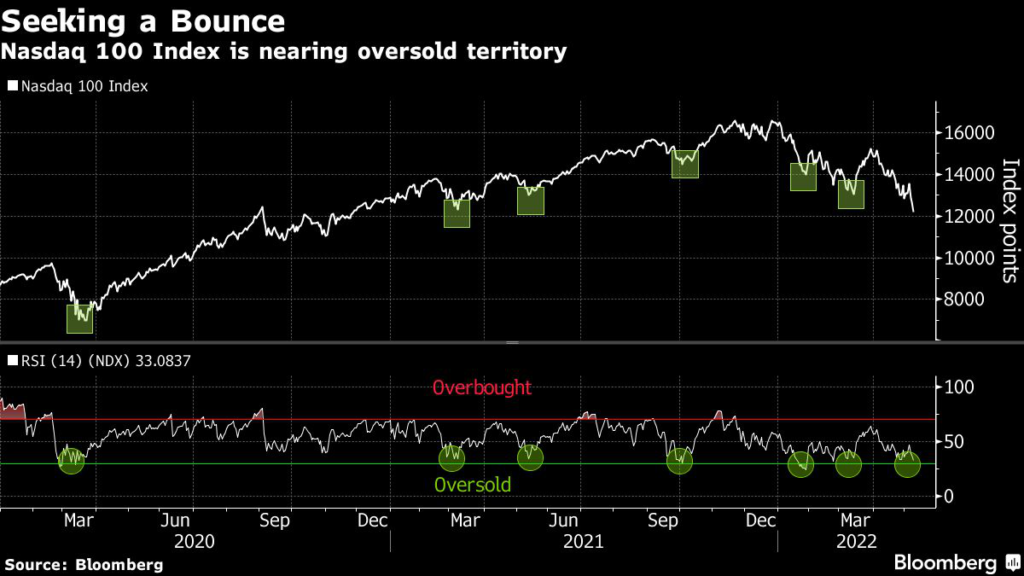
In Europe, stocks are technically “oversold” based on the 14-day relative strength index, a momentum indicator measuring the magnitude of recent price changes, while the Nasdaq is also closing in on such levels. The reading has been a good predictor of a short-term bottom in the past year.

“While it has been realized on a lower volume profile with less panic, it is worth noting the Stoxx 600 just hit its most technically oversold level since March this year,” said Carl Dooley, head of EMEA trading at Cowen. “The last time that happened markets rallied over 10% in a straight line.”

Stocks are getting notably cheaper, as earnings growth forecasts continue to improve, while prices have plunged. Europe’s Stoxx 600 is now trading at 12 times its forward earnings, below its average forward price-to-earnings ratio of 13.2 since 2005. It’s suffered a 22% de-rating this year, a similar valuation drop to the S&P 500.

“We have seen quite a big correction now,” Oppenheimer said. “There are inevitably times when you are going to get some of the setback rebounding.”

Oppenheimer is not alone in seeing a floor. JPMorgan Chase & Co.’s Marko Kolanovic repeated his dip-buying calls on Monday, urging investors to add risk as central bank hawkishness has reached its peak. Still, the problem is that such calls by die-hard bulls have failed investors before. 

Back in mid-April, Kolanovic said sentiment and positioning are too bearish, and advised investors to buy growth stocks including tech, biotech and innovation, alongside value stocks like metals and mining. The Nasdaq 100 index has ended every single week since then in the red. 

For bears, such as Bank of America Corp.’s equity strategy team, the selloff may continue until October, and the S&P 500’s fall below 4,000 index points may tip it into a more severe rout as investors flee. Morgan Stanley’s Michael Wilson has said the “S&P 500 has minimum downside to 3,800 in the near term and possibly as low as 3,460.”

Much of that concern is tied to the economic backdrop, and the growing risk of stagflation looming large over the investment outlook. Even the long tradition of markets outperforming during earnings seasons has been challenged. While corporate profits both in Europe and the U.S. came in again above expectations, the beats have failed to assuage broad concerns. 

“We have a perfect storm at the moment — inflation, Ukraine war, zero Covid policy in China, normalization of monetary policy,” said Vincent Juvyns, a global market strategist at JPMorgan Asset Management. Still, he insisted, “a lot is priced in at the moment” and “we may soon hit the bottom.”

More stories like this are available on bloomberg.com

©2022 Bloomberg L.P.
Sony Struggles to Make Enough PlayStations as Supply Disrupted

(Bloomberg) — Sony Group Corp. is facing fresh challenges in its critical video game division as component shortages and supply-chain disruptions risk hampering production of the flagship PlayStation 5 hardware.

The Tokyo-based company said it sold 11.5 million units of the $500 device in the fiscal year that ended in March and would aim to sell roughly 18 million units in the current fiscal year. Both figures are well behind initial targets of 14.8 million and 22.6 million units, respectively.

In a conference call after earnings, Chief Financial Officer Hiroki Totoki said the lower target for the current year stems from supply-chain complications because of the Covid-19 pandemic, including lockdowns in China. The city of Shanghai, a key center for tech production, has largely been under lockdown since the beginning of April. 

The 18 million figure is “our best current estimate,” Totoki said during the call. “A downside risk would be if there is a further worsening in the supply chain, including the potential widening of lockdowns in China.”

Sony reported operating profit for the fourth fiscal quarter that fell short of analyst estimates and projected earnings for the current fiscal year that were also less than projected. The company said it would buy back as much as 200 billion yen ($1.5 billion) of its own shares, which could bolster the stock. 

The PlayStation 5 has suffered supply constraints from component shortages and logistics disruptions since the product’s release in November 2020. Data from outside firms such as U.S.-based NPD Group Inc. show Microsoft Corp.’s Xbox hardware began to outpace PlayStation in recent months. 

“It is a risk given they have assumed China Covid issues are resolved in three months time,” said MST Financial senior analyst David Gibson. “No one really knows what will happen in China.”

Another concerning sign is the trend of user activity on the PlayStation platform, with both monthly active users and the number of PlayStation Plus subscription service declining in the March quarter. Totoki said the company sees the numbers positively as they both remained high despite some weakening of stay-home entertainment demand. Analysts said the company should boost the numbers this year to ensure the success of its gaming platform.

“This year will be crucial. Sony can’t miss this chance to revitalize the PlayStation 5’s momentum,” said Morningstar Research analyst Kazunori Ito.

Sony will roll out new online services for PlayStation users in June, including an option similar to Xbox’s Game Pass subscription offering. But reactions by fans to the new service are not all positive, especially because Sony doesn’t plan to add new games to the all-you-can-play list like the Xbox offers. Sony’s Totoki said the company doesn’t plan to match Xbox on that front “for the sake of building a better brand image.”

Sony’s shares have dropped 27% so far this year, roughly in line with the tech-heavy Nasdaq index.

In the fiscal year that just ended, Sony benefited from its movie business, thanks largely to the success of the hit “Spider-Man: No Way Home.” Sales for the division surged more than 50% to 1.24 trillion yen, while operating income more than doubled to 217.4 billion yen.


While the Japanese currency has plummeted in recent weeks, the weak yen is unlikely to give a substantial lift to Sony’s bottom line — even if the currency slips further against the dollar and euro — according to Bloomberg Intelligence analyst Masahiro Wakasugi. The company’s PlayStation and smartphone hardware units have significant costs in foreign currency, offsetting the upside for its image-sensor division, Wakasugi said.

Read more: Yen Freefall Has Fewer Benefits for Japan Inc. as Economy Shifts

More stories like this are available on bloomberg.com

©2022 Bloomberg L.P.
Stellantis CEO Says Supply Issues Risk Derailing Electric Shift

(Bloomberg) — Stellantis NV said its target to sell only electric vehicles in Europe by the end of this decade depends on fixing the litany of supply-chain problems that have beset carmakers.

The shift to EVs will work only if the region ensures access to enough clean energy, batteries, raw materials and charging infrastructure, Stellantis Chief Executive Officer Carlos Tavares said Tuesday during an event organized by the Financial Times.

Even as automakers build up battery plants, “one can easily anticipate” that the West will become more dependent on Asia for EV parts, he said.

Stellantis seeks to introduce more than 75 fully electric models by the end of this decade, with annual sales of 5 million vehicles. While the carmaker is spending big on the rollout, it’s pledging to maintain strong returns, relying on extra revenue from software and services as well as premium vehicles.

Read more: Stellantis Targets Double-Digit Margins in Costly EV Shift

A key challenge of the shift will be to keep EVs affordable for the middle class, the CEO said. Otherwise, the customer base will shrink — and car companies with it. 

“The big race is going to be on cost competitiveness,” he said.

More stories like this are available on bloomberg.com

©2022 Bloomberg L.P.
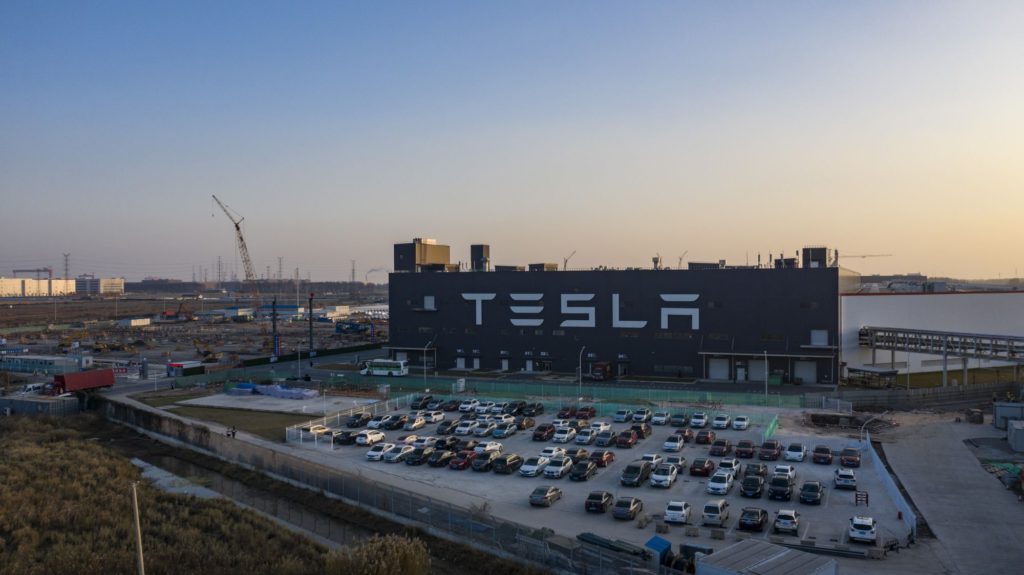
Tesla’s China Plant Facing More Disruptions From Covid Lockdown

(Bloomberg) — Tesla Inc.’s China factory is experiencing some disruptions and may see more curbs to production this week as Shanghai’s long-running Covid-19 lockdown continues to impact supply chains. 

The U.S. carmaker is having some issues with logistics, a spokesman for its China operations said Tuesday. Reuters reported earlier that output at the plant south of Shanghai had been halted, prompting Tesla to say it had received no notice the factory had ceased to operate and that some cars were still being made there. 

Tesla’s China factory was shuttered for three weeks in April as Shanghai was plunged into lockdown in an attempt to halt an outbreak of Covid. The plant started up again in late April under a so-called closed loop system whereby workers live on site and are tested regularly, but Shanghai largely remains in lockdown, presenting challenges for delivery of supplies and materials.

Read more: Tesla Looking to Boost Shanghai Car Production With Second Shift

The automaker shipped just 1,512 vehicles out of Shanghai last month, amid a 35.7% slide in overall passenger car sales in China, the biggest plunge in two years, data Tuesday showed. 

Prior to the lockdown-induced halt on March 28, Tesla workers in Shanghai were working three shifts covering 24 hours, seven days a week. The workers in the current closed-loop system have been doing 12-hour shifts, six days a week.

Though the shift is meant to be 12 hours, a shortage of some parts means most days work has had to stop after about eight hours, a person familiar with the situation said.

And while workshops at the EV maker’s China plant were operating on Tuesday, the situation is fluid and logistics problems may force production to cease entirely later this week, the person said, declining to be identified because the details are private.

One of the problems stems from a shortage of wire harnesses from Aptiv Plc, which had to stop shipping supplies from a plant that supplies Tesla and General Motors Co. after infections were found among its employees, Reuters reported.

When asked about the reduced 12-hour shift, a Tesla representative said the company would provide updates when necessary.

Tesla’s Shanghai factory, which in regular times pumps out around 2,100 cars a day, remains challenged by component shortages, other people familiar said last month. Then, the automaker only had inventory for just over two weeks based on its current closed-loop schedule and logistics were a major problem for many other parts.

Export Hub

China’s Passenger Car Association said Tuesday that Tesla produced 10,757 cars last month, since resuming production on April 19, equal to a run rate of about 900 cars a day.

The China plant, Tesla’s first outside of the U.S., is an increasingly vital cog in its global operations, with cars made there not just sold in the country, but exported to markets in Asia and Europe. 

Of the Tesla cars shipped from its China factory in April, however, none were exported, a reflection of the reduced output levels. By way of comparison, Tesla shipped 65,814 electric cars from Shanghai in March, and in January and February exported an average of 36,900 EVs to other countries in Asia and parts of Europe.

China’s zero-tolerance approach to the virus is increasingly disrupting the world’s second-largest economy and leaving the country isolated as the rest of the world accepts Covid as endemic and normalizes. The so-called Covid Zero policy has become harder to deploy in the face of more contagious variants, leading to more intense restrictions — like lockdowns — in order to quash community spread. 

Read more: Six Moves That May Signal China Is Abandoning Covid Zero

More than 15% of U.S. companies with operations in Shanghai reported their businesses there remain fully shut, according to a survey conducted by the American Chamber of Commerce in China between April 29 and May 5. Nearly 60% of respondents, who have operations throughout China, said production capabilities were slowed or reduced due to a lack of employees, difficulty in get supplies, or government-ordered lockdowns.

(Updates with new headline; April shipment, sales data from fourth paragraph.)

More stories like this are available on bloomberg.com

©2022 Bloomberg L.P.
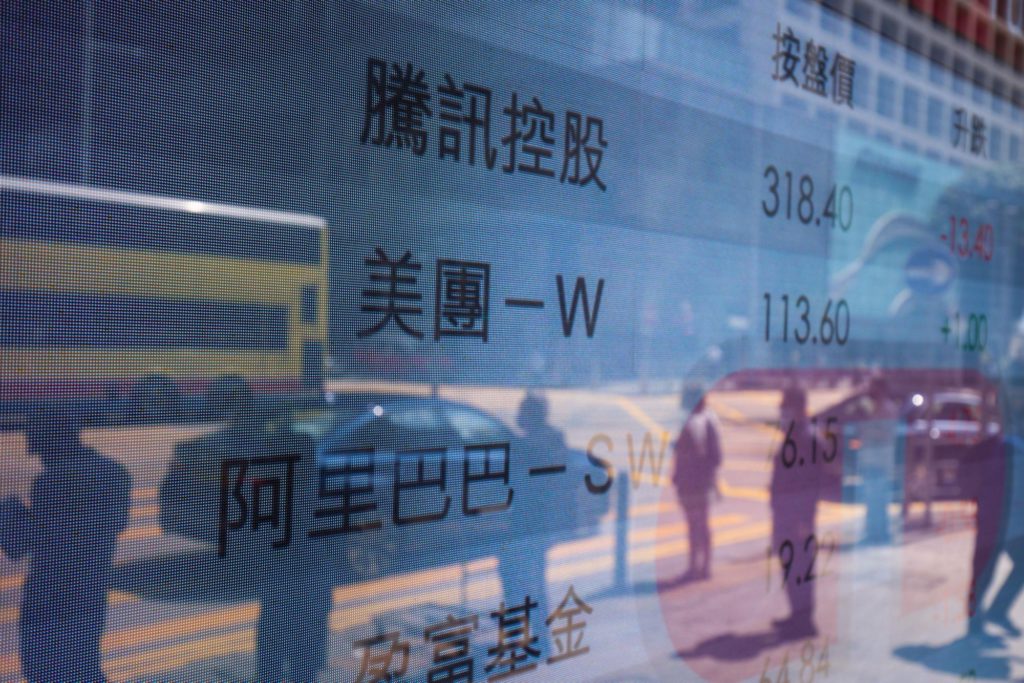
China Tech Stocks Slide as Growth Woes, Global Rout Grip Traders

(Bloomberg) — Chinese tech stocks fell as Hong Kong markets reopened after a holiday to face renewed growth worries and persistent regulatory risks, sparking another bout of selling.

The Hang Seng Tech Index tumbled 3.2% on Tuesday, extending its slide into a fifth day. JD.com Inc. and Alibaba Group Holding Ltd. were among the biggest drags. Key equities gauges across the region all slumped, with an index of Chinese firms in the city sliding more than 2%.

The broad decline tracks a global selloff that intensified after the Federal Reserve hiked rates by 50 basis points last week. Beijing is showing no signs of letup in its stringent Covid Zero policy that’s already hurt businesses, and there are growing indications the damage is rippling through the global economy. 

In China, “economic figures to be released in coming weeks can be quite ugly given the Covid lockdowns,” said Banny Lam, head of research at CEB International Investment Corp. “The situation may calm down in Shanghai in May or June, but still, the Covid controls are worrying investors. The road will remain bumpy.”

READ: China’s Export Growth Weakens to 2020 Low as Lockdowns Bite 

Meantime, Chinese regulators further tightened their oversight on the internet industry over the weekend, banning younger users from sending virtual gifts on livestream platforms. The latest action came despite a string of recent promises by the authorities to take a softer stance on the sector. 

Assurances

Authorities tried to reassure investors again on Tuesday. The onshore market has “solid” foundations for stability, according to a CCTV report citing China’s securities regulator. The short-term market fluctuations won’t change the long-term good momentum of the nation’s capital market, the report added. 

The message came amid mounting concerns over growth prospects. Chinese Premier Li Keqiang warned of a “complicated and grave” employment situation on Monday as Beijing and Shanghai tightened curbs on residents in a bid to contain recent outbreaks. Chinese exports also weakened to the slowest pace since the early days of the pandemic, capturing the impact of Covid restrictions. 

READ: China Investors Lose Interest in Stock Funds as Market Wavers

Large investors have also started turning away. BlackRock Inc. said it’s jettisoning its bullish stance on China given the lockdowns. Chinese authorities have made repeated promises in the past couple months to support the economy and stabilize markets, but that’s so far failed to give a sustainable boost to stock prices. 

The Hang Seng Index fell 1.8%. Hong Kong’s market was closed on Monday. The CSI 300 Index, a benchmark for mainland stocks, closed up 1.1%.

More stories like this are available on bloomberg.com

©2022 Bloomberg L.P.

Ukraine’s Economy to Shrink 30% This Year Due to War, EBRD Says

(Bloomberg) — Sign up for the New Economy Daily newsletter, follow us @economics and subscribe to our podcast.

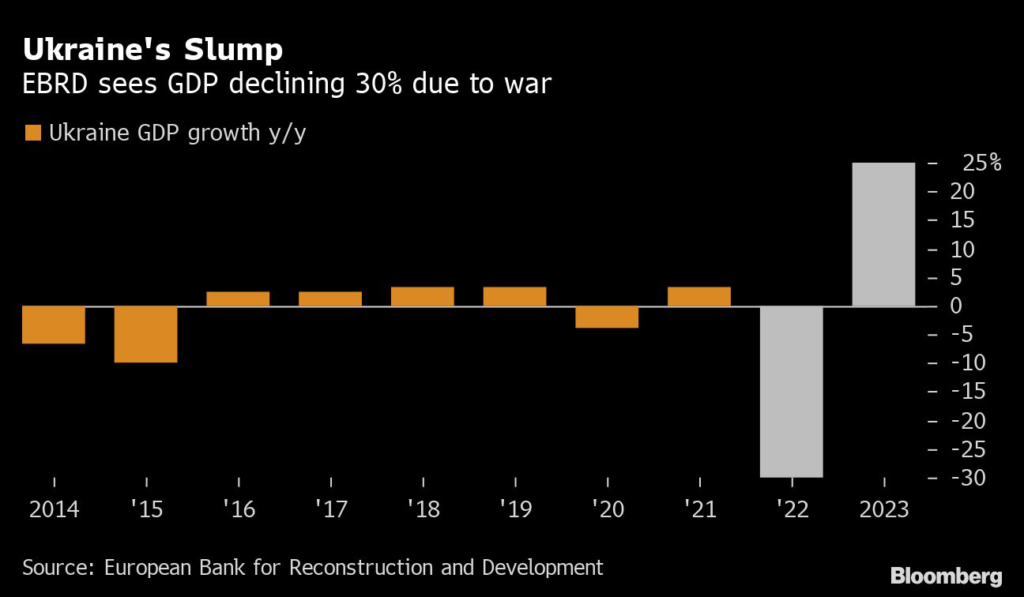
Ukraine’s economy will plunge by almost a third in 2022, more than previously expected, in a scenario in which the war ends this year, the European Bank for Reconstruction and Development said. 

The expected downturn is deeper than the 20% contraction the EBRD estimated in March because of a “larger-than-previously-expected contraction in Ukraine as the war drags on,” it said in its report. 

Russia’s invasion has upended trade in energy, agricultural commodities and fertilizers and disrupted supply chains, resulting in slower growth across eastern Europe. Gas prices in Europe have risen to historic highs, fueling inflation across the region and putting manufacturers at a disadvantage compared with U.S.-based companies where gas is as much as four times cheaper, the EBRD said. 

“Aside from direct war damage, agricultural production is hampered by lack of fuel, access to seeds, fertilizer and equipment,” the bank said in its report. Ukraine, which accounts for almost 10% of global wheat exports, 14% for corn and 37% of sunflower oil, is not expected to be able to plant or harvest up to 20%-30% of its agricultural land. 

The forecasts assume that a cease-fire will be negotiated this year and reconstruction of the country can begin in 2023, with the economy projected to grow 25% next year.

The war has also revealed vulnerabilities in global supply chains, according to the EBRD. Two Ukrainian companies account for about 35% of the global supply of purified neon, a key component for the manufacture of semiconductor chips. 

Russia’s economy is expected to shrink 10% this year and stagnate in 2023, according to the EBRD. 

More stories like this are available on bloomberg.com

©2022 Bloomberg L.P.

U.K.’s Renishaw Cuts Forecast as China Lockdowns Cast a Cloud

(Bloomberg) — British engineering firm Renishaw Plc cut its profit outlook for the year while highlighting that trading levels in China are difficult to predict due to lockdowns.

The Gloucestershire, England-based company also narrowed its revenue forecast range for 2022, saying it was “mindful of global uncertainties,” according to an earnings statement on Tuesday. The company now anticipates adjusted pretax profit to be between 155 million pounds ($191 million) and 170 million pounds, down from the 157 million pounds to 181 million pounds range announced in February, and expects revenue of 655 million pounds to 675 million pounds, compared with 650 million pounds to 690 million pounds previously.

Renishaw shares fell as much as 6% in early London trading. 

The company said it’s closely monitoring the current lockdowns in China and is taking mitigating actions where possible against potential business disruption. “This uncertain position makes trading levels in China in the remainder of this financial year difficult to predict,” it said. 

Renishaw is in the process of ceasing its trading operations in Russia and booked a 2 million-pound impairment on its assets in the country during the third quarter. Combined sales to Russia and Belarus have represented around 1% of total group revenue, the company said.

More stories like this are available on bloomberg.com

©2022 Bloomberg L.P.

Close Bitnami banner
Bitnami