Bloomberg

Bitcoin Rebounds From Sub-$30,000 Amid Respite in Global Markets

(Bloomberg) —

Bitcoin rebounded from a swoon below $30,000 as a selloff in stocks moderated and a bout of calm washed across global markets.

The world’s largest digital token added as much as 5.4% to $32,636.08 as of 7:48 a.m. in London. Ether at one point climbed 6.4%, while coins like Solana and Avalanche were also in the green.

Bitcoin’s earlier plunge had taken it to levels last seen in the middle of 2021. Whether the calm will last is an open question. Tightening monetary policy to combat runaway inflation is curbing liquidity, creating a formidable obstacle for speculative assets like cryptocurrencies. 

For instance, Michael Novogratz, the billionaire cryptocurrency investor who leads Galaxy Digital Holdings Ltd., warned that he expects things to get worse before they get better. 

“Crypto probably trades correlated to the Nasdaq until we hit a new equilibrium,” Novogratz said on Galaxy’s first-quarter earnings call on Monday, adding that investors may see “a very choppy, volatile and difficult market for at least the next few quarters before people are getting some sense that we’re at an equilibrium.” 

Bitcoin’s correlation with U.S. stocks is around record levels, and the token pushed higher as S&P 500 and Nasdaq 100 equity futures stabilized and then rallied Tuesday.

Stablecoin Drama

The crypto market is also monitoring TerraUSD, an algorithmic stablecoin that aims to maintain a one-to-one peg to the dollar. 

The peg appeared to fray, with the token’s value falling below 70 U.S. cents Tuesday before climbing back above 92 U.S. cents.

Do Kwon, the founder of Terraform Labs, which powers the Terra blockchain, is moving to shore up the stablecoin.

Luna Foundation Guard, the association created to support the decentralized token and Terra blockchain, said it will issue loans worth about $1.5 billion in Bitcoin and TerraUSD to help strengthen TerraUSD’s peg.

‘Watching Carefully’

Kwon captured the attention of the crypto world earlier this year by pledging to buy as much as $10 billion in Bitcoin to prop up Terra.

“We’re watching carefully to see how the market fares over the next 24 hours,” Steven Goulden, senior research analyst at crypto market maker Cumberland DRW, said in an email. “Including whether mechanisms being introduced to help increase reliance, such as LFG lending out Bitcoin to OTC trading firms, will be enough to hold in times of deep stress or if we need additional stabilization mechanisms.”

Bitcoin is down more than 50% since hitting a record of almost $69,000 in November. It’s underperformed both global stocks and gold over the course of 2022 so far.

More stories like this are available on bloomberg.com

©2022 Bloomberg L.P.

Renault Maps Out Car-Sharing Growth Amid Struggle to Turn Around

(Bloomberg) — Renault SA set targets to expand its Mobilize car-sharing business as the struggling French automaker tries to close a chapter on operations in Russia. 

The brand, which currently generates losses, is to achieve double-digit margins for each category of services by 2027, the carmaker said Tuesday. Renault is sticking to its goal for Mobilize to make up a fifth of group revenue by the end of this decade.

Renault is focusing on new business areas as it faces fierce competition selling mass-market vehicles and challenges exiting Russia, its second-biggest market. In a sign of potential deeper changes to come, the automaker also announced on Tuesday closer cooperation with Chinese auto giant Geely Automobile Holdings, which is buying a 34% stake in Renault’s Korean unit.

Read more: Renault, China’s Geely Deepen Ties With Korean Stake Deal

Chief Executive Officer Luca de Meo is under pressure to make good on targets to improve margins and cut costs, while facing a slump in European car sales and competition from rivals to roll out new electric vehicles.

Read More: Stellantis to Buy Mercedes and BMW’s Car-Sharing Venture (1)

Renault’s financing arm RCI Bank and Services is changing its name to Mobilize Financial Services and aims to have a fleet of 1 million vehicles for leasing and 200,000 for subscription in 2030. By that same year, Mobilize is to raise the number of installed EV chargers to 165,000, from 22,000 last year.

More stories like this are available on bloomberg.com

©2022 Bloomberg L.P.

Ukraine Latest: EBRD Sees Ukrainian Economy Slumping 30% in 2022

(Bloomberg) — Ukraine’s economy will plunge by almost a third this year as the Russian invasion drags on, the European Bank for Reconstruction and Development said in a report forecasting a steeper decline than the 20% contraction it predicted in March. 

The European Union is considering the issuance of joint debt to finance the country’s long-term reconstruction, which may end up costing hundreds of billions of euros, according to an EU official familiar with the plan. 

U.S. President Joe Biden signed into law a measure making it easier for Washington to send weapons and supplies to the government in Kyiv, while Congressional Democrats drafted a Ukraine aid package worth almost $40 billion, more than the $33 billion Biden requested from lawmakers last month. 

(See RSAN on the Bloomberg Terminal for the Russian Sanctions Dashboard.)

Key Developments

  • Biden Signs Lend-Lease Act to Speed Weapons Delivery to Ukraine
  • Draghi Has Started Unpicking Decades of Italian Ties to Russia
  • Putin’s Crackdown Pushes Independent Russian Media Into Crypto
  • Germany Comes to Grips With Its Hard-Power Role in Europe
  • Ukraine Bomb Shelters Help Parts Maker Keep VW and BMW Supplied

All times CET: 

Oil Extends Slump as EU Softens Sanctions Proposals (8:34 a.m.)

Oil extended its biggest drop in more than five weeks after the European Union softened its proposed sanctions on Russian crude exports and as economic growth concerns weighed on sentiment.

West Texas Intermediate futures fell below $103 a barrel in Asian trading after sliding around 6% on Monday. The bloc will scrap a proposed ban on EU-owned vessels transporting Russian crude after objections from members including Greece. 

Independent Russian Media Turns to Crypto for Funding (8:10 a.m.)

Meduza, a prominent independent Russian-language news site, is soliciting donations via cryptocurrencies as President Vladimir Putin’s crackdown on the press and western sanctions made raising money in Russia impossible.

The site lost about a third of traffic after the Kremlin blocked its content in Russia and was forced to become creative in its fundraising to keep the lights on. Data show that Meduza’s Bitcoin and Ether wallets listed on its website held crypto worth around $230,000 at current prices.

Munich Re Writes Down $740 Million Over War (7:56 a.m.)

Munich Re wrote down Russian and Ukrainian bonds in its investment portfolio and warned that the war poses “considerable uncertainty” to its outlook.

The German reinsurer cut the value of the securities by almost 700 million euros ($740 million) in the first quarter and recorded about 100 million euros in costs related to the conflict.

Putin’s invasion has forced a series of financial hits among reinsurers, in part because of Russia’s move to effectively impound planes leased from foreign lessors. Swiss Re said earlier this month that it had set aside $283 million in reserves related to the war during the first quarter, and Hannover Re made additional provisions for possible losses in the low triple-digit million-euro range in the period.

Ukraine’s Economy to Shrink 30% This Year: EBRD (7:10 a.m.)

That forecast is more than previously expected and in a scenario where the war ends this year, the EBRD said. 

Russia’s invasion has upended trade in energy, agricultural commodities and fertilizers and disrupted supply chains, resulting in slower growth across eastern Europe.

EU Eyes Joint Debt to Fund Ukraine Reconstruction (7:01 a.m.)

The long-term reconstruction could cost hundreds of billions of euros, according to an official familiar with the plan.

The bloc is also weighing using loans, guaranteed by member states, to provide urgent funds to Ukraine, which says it needs as much as $7 billion a month to fill a budget gap, said the official. The European Commission will present a package addressing Ukraine’s financial needs on May 18.

Draghi Has Started Unpicking Decades of Italian Ties to Russia (6:52 a.m.)

Less than a week before Russia invaded Ukraine, Italian Prime Minister Mario Draghi was planning a trip to Moscow and discussing a possible increase in gas supplies with Russian President Vladimir Putin. His approach is very different now.

What changed Draghi’s thinking was the increasing brutality of the war. He was particularly horrified by images of alleged war crimes in Bucha and other areas occupied by Russian troops, according to a person familiar with his thinking. Draghi is set to meet Biden at the White House Tuesday.

More stories like this are available on bloomberg.com

©2022 Bloomberg L.P.

Sony to Buy Back Stock After Profit Falls Short of Estimates

(Bloomberg) — Sony Group Corp. said it would buy back as much as 200 billion yen ($1.5 billion) of its own shares after reporting earnings that missed analyst estimates. 

The entertainment group reported operating profit of 138.6 billion yen in the fourth fiscal quarter, falling short of consensus analyst estimates of 148.5 billion yen. The company forecast operating income of 1.16 trillion for the current fiscal year, also shy of estimates of 1.2 trillion yen.

Sony said it would repurchase as many as 25 million shares over the next year, 2.02% of the total outstanding. It also announced a 200 billion yen buyback program a year earlier as it reported results. The company’s shares have dropped 27% so far this year, roughly in line with the tech-heavy Nasdaq index.

Sony’s flagship PlayStation 5 game console has suffered supply constraints from component shortages and logistics disruptions. The company has said unfilled demand is strong enough to eventually bring the PS5 back on track to be its fastest-selling console generation, but data from outside firms such as U.S.-based NPD Group Inc. show Microsoft Corp.’s Xbox hardware began to outpace PlayStation in recent months.

Sony will roll out new online services for PlayStation users in June, including an option similar to Xbox’s Game Pass subscription offering.

“We expect Sony to accelerate the PlayStation 5’s production volume in this fiscal year to recapture the ground, though at the cost of pressure on profit margins,” said Macquarie Capital Securities analyst Damian Thong said.

Sony benefited from its movie business in the fiscal year that just ended, thanks largely to the success of the hit “Spider-Man: No Way Home.” Sales for the division surged more than 50% to 1.24 trillion yen, while operating income more than doubled to 217.4 billion yen.

While the Japanese currency has plummeted in recent weeks, the weak yen is unlikely to give a substantial lift to Sony’s bottom line — even if the currency slips further against the dollar and euro — according to Bloomberg Intelligence analyst Masahiro Wakasugi. The company’s PlayStation and smartphone hardware units have significant costs in foreign currency, offsetting the upside for its image-sensor division, Wakasugi said.

Read more: Yen Freefall Has Fewer Benefits for Japan Inc. as Economy Shifts

(Updates with details of buyback program from third paragraph)

More stories like this are available on bloomberg.com

©2022 Bloomberg L.P.

Putin’s Crackdown Pushes Independent Russian Media Into Crypto

(Bloomberg) —

Meduza, a prominent independent Russian-language news site, knew it was in trouble after Russian President Vladimir Putin invaded Ukraine. But it didn’t expect the issues to come from Western sanctions.

Soon after the measures were announced, Russian readers began complaining payments via Stripe to the Latvian-based outlet weren’t going through, after the payments firm was forced to stop its service in the country.

“We couldn’t predict that the sanctions of Western governments will come first and destroy our crowdfunding,” forcing Meduza to start soliciting crypto and rely entirely on money from foreigners for the first time, Editor-in-Chief Ivan Kolpakov said.

After Putin essentially outlawed independent reporting on the war, keeping the lights on has become as important to Russia’s free press as figuring out how to report about their country from abroad after the new restrictions scattered hundreds of local journalists around the world. 

The unprecedented pressure forced numerous independent media outlets to shut down, and other resources have been blocked by the government censor. Novaya Gazeta, whose editor Dmitry Muratov won the Nobel Peace Prize last year, suspended publication in March after regulators issued it warnings about its coverage, while Ekho Moskvy radio station had its FM frequency handed over to a state-run propaganda outlet. 

Russia Paper Whose Editor Won Nobel Shuts Down Under Pressure

The Kremlin is also targeting social media, blocking Meta Platforms Inc.’s Facebook and Instagram for “extremist” activities. Roskomnadzor, the internet censor, has issued fines and warnings to Alphabet Inc.’s Google over its YouTube policies. TikTok suspended live-streaming in Russia over the restrictions. 

Amid the media crackdown, Putin’s popularity has soared, though it’s not clear how accurate public opinion polling is in Russia. In a March survey by the independent Levada Center, 83% approved of Putin’s actions as president, an increase of 12 percentage points on the previous month and the highest since 2017.

Blocked Content

Meduza continues to publish investigations, including a recent chronicle of alleged atrocities committed during the Russian occupation of a town near Kyiv. The Kremlin denies its troops have committed war crimes. 

The content is blocked in Russia, forcing users in Meduza’s main market to use virtual private networks to access it. 

Their audience adapted quickly, as Meduza has pushed readers to download their news app and follow their Telegram channel. Kolpakov said they felt like a group of survivors in a bunker warning that the “apocalypse will come.”

Meduza lost about a third of its traffic after the restrictions. And they still have bills to pay. Now, instead of relying on donations from some 30,000 Russian readers who supported it before the war, Meduza is asking its international audience to send dollars, euros or crypto as soon as possible to help its 25 journalists resettle mostly in Riga. 

Their donations page includes instructions on how to buy Bitcoin and Ethereum on Binance or, for contributors concerned about anonymity, a step-by-step guide to sending untraceable payments via Monero. The Bitcoin and Ether wallets listed on Meduza’s website held crypto worth around $230,000 at current prices, according to on-chain data.

Wake-up Call

Svetlana Reiter is one of Meduza’s reporters who moved to Riga after the invasion. In the two weeks after she arrived, she had three sources effectively block her on messaging apps. Reiter thinks it’s proof “that everyone is nervous now” to talk to exiled media. Even so, Meduza reporters still participate on Kremlin spokesman Dmitry Peskov’s daily conference call.

The disruption served as a wake-up call for her about how precarious journalism has always been in Russia, where nearly 60 reporters were killed over the last three decades. 

“For a moment, I think we forgot we are living in this really strange reality,” Reiter said.

Those remaining in Russia face intimidation and worse. Shortly after Novaya Gazeta was shut, Muratov was attacked by two men on a train with red paint laced with acetone. In another incident, Ekho Moskvy’s long-time editor Alexei Venediktov posted images of a pig head left outside his apartment with an antisemitic sticker.

For Meduza, which was founded in Riga in 2014 during a previous media crackdown following Russia’s annexation of Crimea from Ukraine, the funding freeze wasn’t the first time it had to change its business model on the fly. When Russia designated the site a “foreign agent” last year, in a move that requires it to post a bulky disclaimer on every article and social media post, advertising revenue evaporated overnight. 

Now Russia is considering an expansion of its law on foreign agents to allow the designation to be used even if individuals or groups don’t get funding from outside the country. Russia has designated scores of independent groups, journalists and activists under the existing legislation, first passed a decade ago.

The restrictions have also impacted international media in Russia. Bloomberg News suspended newsgathering in Russia. Bloomberg LP, parent of Bloomberg News, later suspended all operations in the country.

Some news organizations funded by foreign governments were tagged as foreign agents. 

Media Hub

With Russia increasingly off limits, Latvia, a Baltic country of about 2 million with a large Russian speaking population, has become a hub for exiled media. 

Its capital Riga has become one of the main destinations, together with Tbilisi in Georgia and Istanbul, for Russian journalists seeking to escape Putin’s censorship after a law passed that carries a sentence of as much as 15 years in prison for spreading “fake” news about what the Kremlin calls a “special military operation.” 

Outlets including Deutsche Welle and Radio Free Europe/Radio Liberty have relocated their Russian services there, while Novaya Gazeta’s new European offshoot will be published in Riga.

Jamie Fly, the chief executive of U.S. government-funded RFE/RL said the restrictions will make them rely more on freelancers and user-generated content, methods they’ve used in other countries including Iran, and could undermine attempts to reach their audience. 

“You can’t just push out a URL and assume everyone’s gonna come to it and watch that livestream of a program,” Fly said. 

For now, Meduza is raising about half of what it needs to develop, forcing it to live hand-to-mouth, according to Kolpakov, who declined to disclose how much in donations it brings in. 

And the site’s reporters are still adapting to their new home outside Moscow. Alexey Kovalyov, Meduza’s investigative editor, can no longer meet with high-ranking government sources in person, and he’s no longer convinced his stories will change Russians’ minds. 

He’s doing the work now for some day in the future when he hopes there will be a Russian war crimes trial. The shift in his mindset was only made more salient when Kovalyov’s friend, Russian reporter Oksana Baulina, was killed reporting from Kyiv.

More stories like this are available on bloomberg.com

©2022 Bloomberg L.P.

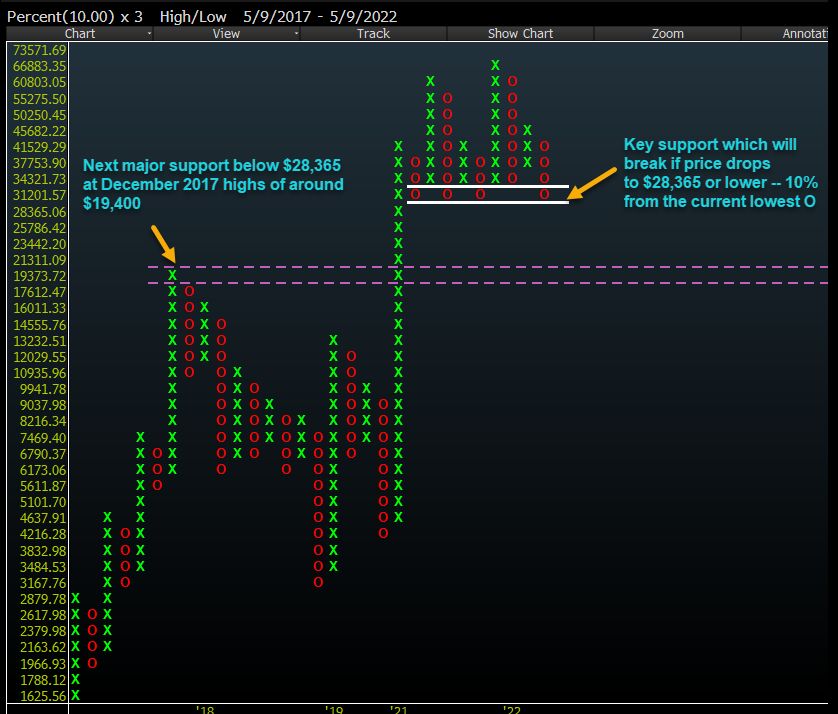
Bitcoin Chart Points to Next Key Level: 2017’s Bull Market Peak

(Bloomberg) — Bitcoin could be in for more pain if it takes another leg down, based on a so-called point and figure analysis. Another 10% drawdown (as marked by red o’s) would drag it below the recent support zone (highlighted by the parallel white lines). If that happens, the next level of support is were the 2017 bull market topped out (dotted purple line) — or around $19,400

More stories like this are available on bloomberg.com

©2022 Bloomberg L.P.
EU’s Joint Debt Plan, ECB Pay Tension, Fed’s Warning: Eco Day

(Bloomberg) — Sign up for the New Economy Daily newsletter, follow us @economics and subscribe to our podcast.

Welcome to Tuesday, Europe. Here’s the latest news and analysis from Bloomberg Economics to help you start the day.

  • The European Union is considering the issuance of joint debt to finance Ukraine’s long-term reconstruction, which may end up costing hundreds of billions of euros, according to an EU official familiar with the plan
  • ECB President Christine Lagarde rejected calls by staff to link salary increases to inflation, which has hit a record in the euro area
  • The Federal Reserve warned of deteriorating liquidity conditions across key financial markets amid rising risks from the war in Ukraine, monetary tightening and high inflation in a new report Monday
    • The Fed also reiterated concerns over financial risks of stablecoins, saying the increasing use of them to meet margin requirements in leveraged trades involving other cryptocurrencies may heighten redemption risks, according to the report
    • Separately, Federal Reserve Bank of Atlanta President Raphael Bostic said he favors policy makers continuing to raise rates by half-point increments rather than doing anything larger
  • The ECB has flagged measures to cope with a future sovereign bond crisis, but they would almost certainly come up short, Bloomberg Economics says
  • Romania will probably lift borrowing costs for a sixth meeting as the central bank faces the deepening conundrum of tackling the fastest inflation in almost two decades while the war in neighboring Ukraine exacerbates risks to economic growth
  • U.K. retail sales are falling on an annual basis for the first time since the start of last year as the cost of living crisis crushes consumer confidence and puts the brakes on spending
  • U.S. Treasury Secretary Janet Yellen will travel to Europe next week for meetings with counterparts from top industrial economies, aiming to keep up sanctions pressure on Russia
  • Northern Ireland’s Democratic Unionist Party said it won’t join a new government with the nationalists Sinn Fein until the U.K. and European Union make changes to trading arrangements in their Brexit deal
  • Soaring fuel costs amid dwindling supplies look set to further squeeze U.S. consumers and businesses alike this summer


More stories like this are available on bloomberg.com

©2022 Bloomberg L.P.

China Tech Stocks Slide on Renewed Growth Fears, Global Rout

(Bloomberg) — Chinese tech stocks fell as Hong Kong markets reopened after a holiday to face renewed growth worries and persistent regulatory risks, sparking another bout of selling.

The Hang Seng Tech Index plunged as much as 7% early Tuesday before paring losses by about half, on track for a fifth straight session of declines. JD.com Inc. and Alibaba Group Holding Ltd. were among the biggest drags. Key equities gauges across the region all slumped, with an index of Chinese firms in the city sliding more than 4%.

The broad decline tracks a global selloff that intensified after the Federal Reserve hiked rates by 50 basis points last week. Beijing is showing no signs of letup in its stringent Covid Zero policy that’s already hurt businesses, and there are growing indications the damage is rippling through the global economy. 

In China, “economic figures to be released in coming weeks can be quite ugly given the Covid lockdowns,” said Banny Lam, head of research at CEB International Investment Corp. “The situation may calm down in Shanghai in May or June, but still, the Covid controls are worrying investors. The road will remain bumpy.”

READ: China’s Export Growth Weakens to 2020 Low as Lockdowns Bite 

Meantime, Chinese regulators further tightened their oversight on the internet industry over the weekend, banning younger users from sending virtual gifts on livestream platforms. The latest action came despite a string of recent promises by the authorities to take a softer stance on the sector. 

Assurances

Authorities tried to reassure investors again on Tuesday. The onshore market has “solid” foundations for stability, according to a CCTV report citing China’s securities regulator. The short-term market fluctuations won’t change the long-term good momentum of the nation’s capital market, the report added. 

The message came amid mounting concerns over growth prospects. Chinese Premier Li Keqiang warned of a “complicated and grave” employment situation on Monday as Beijing and Shanghai tightened curbs on residents in a bid to contain recent outbreaks. Chinese exports also weakened to the slowest pace since the early days of the pandemic, capturing the impact of Covid restrictions. 

READ: China Investors Lose Interest in Stock Funds as Market Wavers

Large investors have also started turning away. BlackRock Inc. said it’s jettisoning its bullish stance on China given the lockdowns. Chinese authorities have made repeated promises in the past couple months to support the economy and stabilize markets, but that’s so far failed to give a sustainable boost to stock prices. 

The Hang Seng Index fell 2.3% as of 1:24 p.m. local time, having fallen as much as 4.1% to below the key 20,000 level. The Hang Seng Tech gauge was down 3.7%. Hong Kong’s market was closed on Monday. The CSI 300 Index, a benchmark for mainland stocks, traded 0.8% higher after earlier losing as much as 1.8%. 

More stories like this are available on bloomberg.com

©2022 Bloomberg L.P.

$3 Billion Hedge Fund Firm Bucks Trend by Planning to Set Up Hong Kong Office

(Bloomberg) — U.S. hedge-fund firm North Rock Capital Management LLC plans to open its first Asian office in Hong Kong even as some peers seek other options following years of political unrest and Covid-19 travel restrictions in the city.

North Rock recruited former Credit Suisse Group AG prime broker Simon Chow to spearhead the effort, said two people with knowledge of the matter, who asked not to be identified discussing private information. More hires will be made later this year, one of them added. 

Hong Kong has seen 176,629 more residents leave than arrive since the start of 2021, with nearly 80% of the net departures occurring this year, according to official data. The brain drain has been sparked by strict quarantine requirements and flight suspensions, adding to concerns about the city’s political stability and future as a regional financial hub.

A growing number of Hong Kong-based hedge funds or global firms with regional hubs in the city have opened satellite offices in other locations, including Singapore, London or New York.

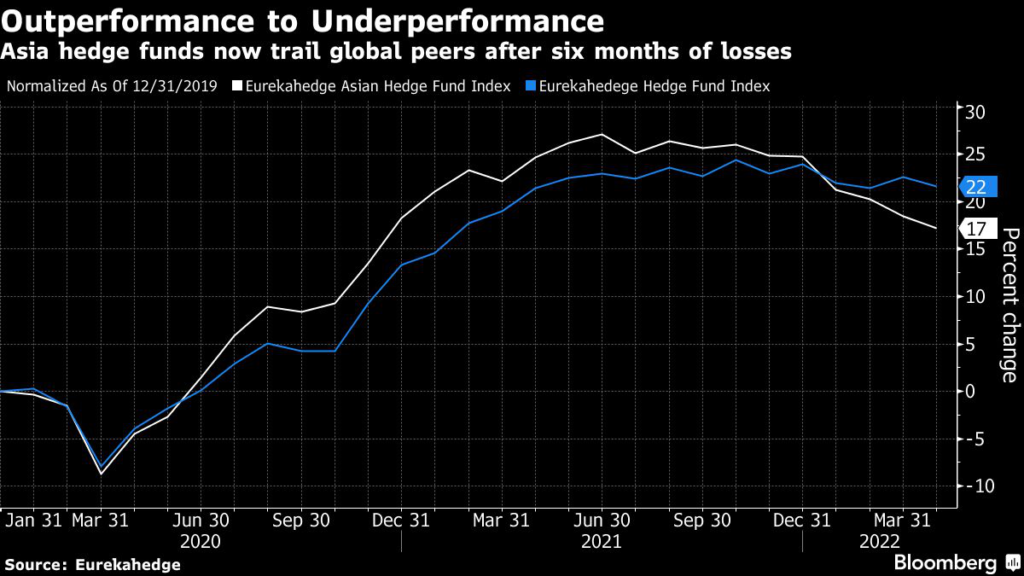
North Rock is expanding after Asia-focused hedge funds likely wrapped up a sixth-straight month of losses, according to preliminary data from Eurekahedge Pte. Managers are struggling as growth stocks fall out of favor amid rising interest rates, geopolitical tensions and regulatory changes. 

North Rock, based in Palm Beach Gardens, Florida, oversees about $3 billion in assets, according to its website. It allocates capital among more than 45 teams of investors, mostly industry specialists who use fundamental analysis or quantitative methods to pick stocks. 

That puts it among the so-called hedge fund platforms, including larger rivals Millennium Management and Point72 Asset Management, whose teams of investors using diverse strategies and risk limits have helped shield their performances from broad market sell-offs.

Led by Chief Investment Officer Kelly Perkins, North Rock also has offices in New York and London. Perkins didn’t reply to an email seeking comment.

Chow was until last month a Hong Kong-based managing director on Credit Suisse’s prime brokerage team, responsible for Asia sales.

More stories like this are available on bloomberg.com

©2022 Bloomberg L.P.

East Ventures Closes $550 Million Fund for Indonesian Startups

(Bloomberg) — Indonesia-focused venture capital firm East Ventures closed its latest fund at $550 million to back tech startups in Southeast Asia’s largest economy.

The fund will allocate $150 million for early-stage deals and $400 million for growth-stage investments, said Willson Cuaca, co-founder and managing partner of East Ventures.

Founded in 2009, the Singapore-based firm has bet on more than 200 startups including e-commerce pioneer Tokopedia, which merged with ride-hailing and delivery giant Gojek before the combined company GoTo Group went public in Indonesia last month.

East Ventures raised what it says is a record Indonesia-focused VC fund as a global selloff of tech stocks intensifies. The Federal Reserve warned of deteriorating liquidity conditions across key financial markets amid rising risks from the war in Ukraine, monetary tightening and high inflation in a semi-annual report published Monday.

“We’ve been through these cycles before and we’re more than ready to embrace it,” Cuaca said in an interview. “With a well-educated digital generation, fundamentals in Indonesia are still good.”

The firm has more than $1 billion of assets under management and said it has helped to draw $6.7 billion in follow-up funding for its portfolio companies, which include online learning platform Ruangguru, e-commerce firm SIRCLO, digital payments firm Xendit, logistics startup Waresix and Moladin, a used-car marketplace.

More stories like this are available on bloomberg.com

©2022 Bloomberg L.P.
Close Bitnami banner
Bitnami