
Bloomberg

Bitcoin Drops Below $30,000 for the First Time Since July 2021

(Bloomberg) —

Bitcoin dropped below $30,000 on Tuesday for the first time since July 2021, bringing its decline from a November record high to about 55% amid a global flight from riskier investments.

The world’s largest digital token fell as much as 3.9% to $29,764 in Asia before paring the slide. It was trading at $30,850 as of 11:28 a.m. in Singapore. Ether, the second biggest token, recovered sufficiently to eke out a small gain. Other coins like Solana and Avalanche remained in the red. 

“We’re seeing a slow-motion meltdown, partially because it’s mostly been long holders selling” instead of levered liquidations, said Josh Lim, head of derivatives at New York-based brokerage Genesis Global Trading. “Now that some corporate treasuries are hovering near their cost basis, markets are waiting and watching to see if shareholders will force some de-risking.”

The crypto swoon comes as tightening monetary policy to combat runaway inflation curbs liquidity, turning investors away from speculative assets. 

Michael Novogratz, the billionaire cryptocurrency investor who leads Galaxy Digital Holdings Ltd., warned that he expects things to get worse before they get better. 

“Crypto probably trades correlated to the Nasdaq until we hit a new equilibrium,” Novogratz said on Galaxy’s first-quarter earnings call on Monday. “My instinct is there’s some more damage to be done, and that will trade in a very choppy, volatile and difficult market for at least the next few quarters before people are getting some sense that we’re at an equilibrium.”  

The crypto market is also monitoring TerraUSD, an algorithmic stablecoin that aims to maintain a one-to-one peg to the dollar. The peg appeared to fray, with the token’s value falling below 70 U.S. cents Tuesday, according to CoinGecko data.

Do Kwon, the founder of Terraform Labs, which powers the Terra blockchain, is moving to shore up the stablecoin.

Luna Foundation Guard, the association created to support the decentralized token and Terra blockchain, said it will issue loans worth about $1.5 billion in Bitcoin and TerraUSD to help strengthen TerraUSD’s peg.

Kwon captured the attention of the crypto world earlier this year by pledging to buy as much as $10 billion in Bitcoin to prop up Terra.

‘Watching Carefully’ 

“We’re watching carefully to see how the market fares over the next 24 hours,” Steven Goulden, senior research analyst at crypto market maker Cumberland DRW, said in an email. “Including whether mechanisms being introduced to help increase reliance, such as LFG lending out Bitcoin to OTC trading firms, will be enough to hold in times of deep stress or if we need additional stabilization mechanisms.”

Bitcoin’s decline puts it at risk of firmly dropping out of the range where it’s been trading in 2022, reversing the most recent bull run that drove the token to a record of almost $69,000 in November. 

With its 40-day correlation with the S&P 500 stock benchmark around a record, according to data compiled by Bloomberg, any further hit to equities sentiment would risk dragging Bitcoin down as well. 

More stories like this are available on bloomberg.com

©2022 Bloomberg L.P.
Tesla Says Shanghai Plant Still Making Cars; No Halt Notice

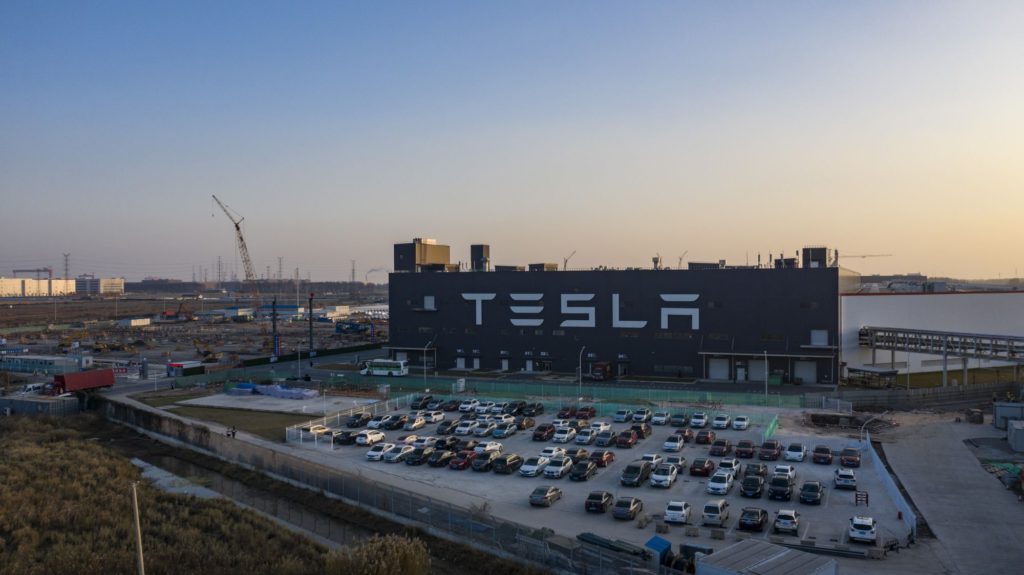
(Bloomberg) — Tesla Inc. hasn’t halted output at its Shanghai factory, though it is experiencing some disruption to logistics amid the city’s long-running Covid-19 lockdown, a spokesperson for the U.S. carmaker said Tuesday.

Reuters reported earlier that output had halted, prompting Tesla to issue a statement saying it had received no notice of any Shanghai plant cessation and pointing out that some vehicles are still being made. 

Tesla’s China factory was shuttered for three weeks in April as Shanghai was plunged into lockdown in an attempt to halt community spread of Covid-19. The plant started up again in late April under a so-called closed loop system whereby workers live on site and are tested regularly.

Read more: Tesla Looking to Boost Shanghai Car Production With Second Shift

Prior to the pandemic-induced halt on March 28, Tesla workers in Shanghai were working three shifts covering 24 hours, seven days a week. The workers in the current closed-loop system have been doing 12-hour shifts, six days a week.

However although the shift is meant to be 12 hours, a shortage of some parts means most days work has had to stop after about eight hours, a person familiar with the matter said.

And while workshops at the EV maker’s China plant were operating on Tuesday, the situation is fluid and logistics problems may force production to cease later this week, the person said, declining to be identified because the details are private.

One of the problems stems from a shortage of wire harnesses from Aptiv Plc, which had to stop shipping supplies from a plant that supplies Tesla and General Motors Co. after infections were found among its employees, Reuters said.

When asked about the reduced 12-hour shift, a Tesla representative said the company would provide updates when necessary.

Tesla’s Shanghai factory, which in regular times pumps out around 2,100 cars a day, remains challenged by component shortages, other people familiar said last month. The automaker only has inventory for just over two weeks based on its current closed-loop schedule and logistics are a major problem for many other parts.

Local media, citing an unidentified company official, reported that Tesla produced around 10,000 vehicles from its Shanghai plant between April 19 and April 30, or a run rate of about 830 cars a day.

Vehicles sales in China overall likely tumbled 47.6% last month to 1.17 million units, preliminary data released by the China Association of Automobile Manufacturers last week showed.

(Updates with shift situation from 5th paragraph.)

More stories like this are available on bloomberg.com

©2022 Bloomberg L.P.
The World’s First 510-Ton Hydrogen-Fueled Truck Produces No CO2

(Bloomberg) — Four years ago, Anglo American Plc couldn’t find any industry partners to support its idea of replacing open-pit mining’s monster diesel trucks with climate-friendly, green hydrogen-fueled vehicles. 

After investing as much as $70 million on its own to back the concept, the global miner revealed last week a new 220-ton vehicle capable of carrying about 290 tons of ore without producing global warming emissions in the process. 

“It’s fair to say our desire to drive this was ahead of a lot of the industry’s ambitions,” Tony O’Neill, Anglo’s technical director said in an interview at Mogalakwena, the world’s biggest open-cast platinum mine, on Friday. “When it came down to timing we were pretty much alone.”

Anglo American, like rivals such as Glencore Plc and Rio Tinto Group, are feeling pressure from investors who are concerned about global warming to cut carbon pollution. Replacing the mine haul trucks with hydrogen fueled ones would slash emissions at Anglo’s open-pit mines by 80%, a key step in reaching the company’s target of carbon neutrality by 2040. 

Trucks make up “a big part” of the company’s greenhouse gas contributions, said Natascha Viljoen, chief executive officer of Anglo American Platinum Ltd., the Anglo American subsidiary that operates Mogalakwena, in an interview. 

Anglo’s prototype truck is part of the company’s NuGen program, which also includes a solar-powered system for producing green hydrogen on mining sites. An electrolyzer uses energy from the sun to split water and create hydrogen. Anglo enlisted the help of technology and hydrogen companies including Engie SA, First Mode Holdings Inc., Ballard Power Systems Inc. and NPROXX BV. 

Duncan Wanblad, Anglo American’s chief executive, said the company considered synthetic fuels and biofuels before it became “crystal clear” that hydrogen was the solution.  Anglo “built it from scratch,” he said about the program in a speech at the mine, which is 180 miles northeast of Johannesburg. 

There is still lots of work to be done to reduce the cost to convert existing diesel trucks to hydrogen. O’Neill said the company has spent tens of millions to launch its prototype. Regular diesel mine haul trucks are priced between $6 million and $7 million each.  As the technology develops, economies of scale will kick in and costs will fall, he said. 

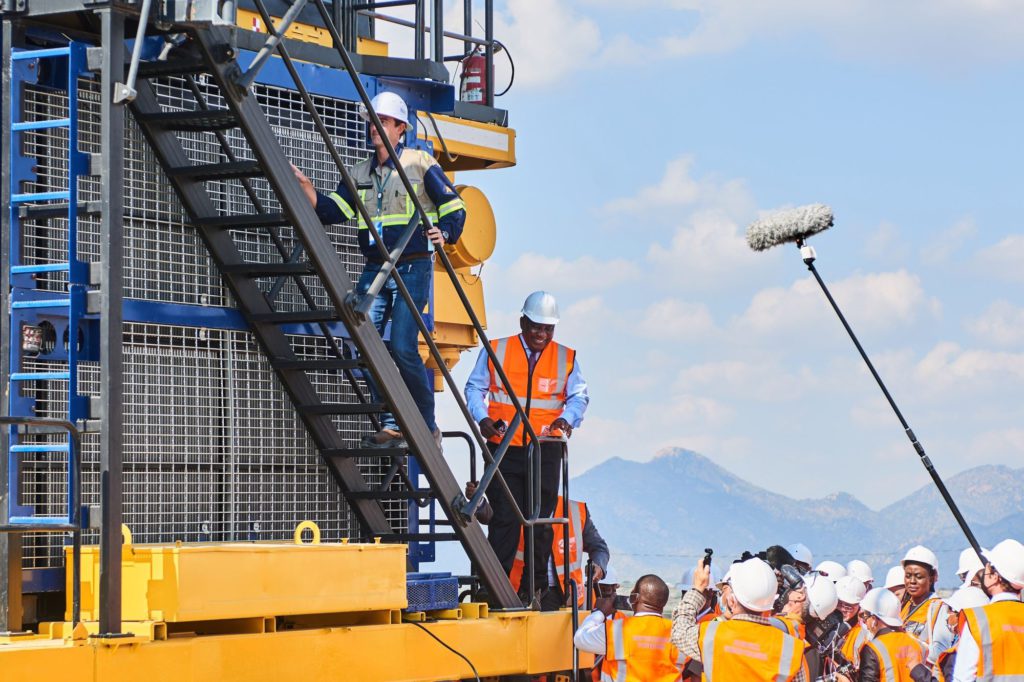
The prototype — a converted Komatsu 930E — is a blue and yellow behemoth that on Friday trundled up a mound of dirt and retrieved a full load of ore under the watchful eyes of executives, employees and South Africa’s President Cyril Ramaphosa. 

It’s powered by a 1.2 megawatt battery pack and eight 100-kilowatt hydrogen fuel cells. 

The initial plan is to convert Mogalakwena’s 40 diesel-fueled trucks to hydrogen by 2026. That will need 140 megawatts of solar power and a massive expansion of the hydrogen conversion and storage facilities on site. 

On cloudy days the plan is to obtain power from wind and solar plants owned by the company in other parts of the country through the national grid to ensure that the operation of the trucks doesn’t contribute to global warming, said Carl van den Ordel, a mine engineer for Anglo at Mogalakwena. 

By 2030 the company plans to convert its global fleet of 400 mine haul trucks — which operate across platinum, copper and iron ore operations — to hydrogen. The impact of that would be equivalent to taking half a million diesel cars off the road in terms of emissions reductions, the company said. 

O’Neill said Anglo would like to sell the vehicles to its peers and believes the technology it has developed has other applications that could include use in trains and ships. O’Neill’s technical group is also looking at more efficient ways of extracting metals from ores and treating rocks with microwaves to ease the digging of tunnels. The latter is similar to the technology used by Elon Musk’s The Boring Company, he said.

For now, the hydrogen-truck business is a part of Anglo American, a former conglomerate that slimmed down to a pure mining operation after moving its headquarters to London from Johannesburg in 1999. Yet, O’Neill said there is still a question of whether it will remain in the company in the future. 

“It’s something we will think about,” he said.

More stories like this are available on bloomberg.com

©2022 Bloomberg L.P.

How Anglo American Developed the World’s Biggest Hydrogen-Fueled Truck

(Bloomberg) — Four years ago, Anglo American Plc couldn’t find any industry partners to support its idea of replacing open-pit mining’s monster diesel trucks with climate-friendly, green hydrogen-fueled vehicles. 

After investing as much as $70 million on its own to back the concept, the global miner revealed last week a new 220-ton vehicle capable of carrying about 290 tons of ore without producing global warming emissions in the process. 

“It’s fair to say our desire to drive this was ahead of a lot of the industry’s ambitions,” Tony O’Neill, Anglo’s technical director said in an interview at Mogalakwena, the world’s biggest open-cast platinum mine, on Friday. “When it came down to timing we were pretty much alone.”

Anglo American, like rivals such as Glencore Plc and Rio Tinto Group, are feeling pressure from investors who are concerned about global warming to cut carbon pollution. Replacing the mine haul trucks with hydrogen fueled ones would slash emissions at Anglo’s open-pit mines by 80%, a key step in reaching the company’s target of carbon neutrality by 2040. 

Trucks make up “a big part” of the company’s greenhouse gas contributions, said Natascha Viljoen, chief executive officer of Anglo American Platinum Ltd., the Anglo American subsidiary that operates Mogalakwena, in an interview. 

Anglo’s prototype truck is part of the company’s NuGen program, which also includes a solar-powered system for producing green hydrogen on mining sites. An electrolyzer uses energy from the sun to split water and create hydrogen. Anglo enlisted the help of technology and hydrogen companies including Engie SA, First Mode Holdings Inc., Ballard Power Systems Inc. and NPROXX BV. 

Duncan Wanblad, Anglo American’s chief executive, said the company considered synthetic fuels and biofuels before it became “crystal clear” that hydrogen was the solution.  Anglo “built it from scratch,” he said about the program in a speech at the mine, which is 180 miles northeast of Johannesburg. 

There is still lots of work to be done to reduce the cost to convert existing diesel trucks to hydrogen. O’Neill said the company has spent tens of millions to launch its prototype. Regular diesel mine haul trucks are priced between $6 million and $7 million each.  As the technology develops, economies of scale will kick in and costs will fall, he said. 

The prototype — a converted Komatsu 930E — is a blue and yellow behemoth that on Friday trundled up a mound of dirt and retrieved a full load of ore under the watchful eyes of executives, employees and South Africa’s President Cyril Ramaphosa. 

It’s powered by a 1.2 megawatt battery pack and eight 100-kilowatt hydrogen fuel cells. 

The initial plan is to convert Mogalakwena’s 40 diesel-fueled trucks to hydrogen by 2026. That will need 140 megawatts of solar power and a massive expansion of the hydrogen conversion and storage facilities on site. 

On cloudy days the plan is to obtain power from wind and solar plants owned by the company in other parts of the country through the national grid to ensure that the operation of the trucks doesn’t contribute to global warming, said Carl van den Ordel, a mine engineer for Anglo at Mogalakwena. 

By 2030 the company plans to convert its global fleet of 400 mine haul trucks — which operate across platinum, copper and iron ore operations — to hydrogen. The impact of that would be equivalent to taking half a million diesel cars off the road in terms of emissions reductions, the company said. 

O’Neill said Anglo would like to sell the vehicles to its peers and believes the technology it has developed has other applications that could include use in trains and ships. O’Neill’s technical group is also looking at more efficient ways of extracting metals from ores and treating rocks with microwaves to ease the digging of tunnels. The latter is similar to the technology used by Elon Musk’s The Boring Company, he said.

For now, the hydrogen-truck business is a part of Anglo American, a former conglomerate that slimmed down to a pure mining operation after moving its headquarters to London from Johannesburg in 1999. Yet, O’Neill said there is still a question of whether it will remain in the company in the future. 

“It’s something we will think about,” he said.

More stories like this are available on bloomberg.com

©2022 Bloomberg L.P.
Ukraine Bomb Shelters Help Parts Maker Keep VW and BMW Supplied

(Bloomberg) — A few weeks after Russia invaded Ukraine, the reality of the war raging hundreds of miles away hit home for Andrea Beierlein. 

Beierlein recalled how, sitting in Nuremberg at the headquarters of German cable manufacturer Leoni AG, sirens suddenly blared on a conference call. Colleagues joining from Ukraine then calmly informed her they’d need to interrupt the conversation and seek shelter from possible rocket impact. 

“It was incredibly loud, and there was stunned silence on the German side,” Beierlein, a vice president and global head of sales support at Leoni, recounted the episode in an interview. “That, for me, was the moment when the war really became present in the room.”

A vital supplier to the automotive industry, Leoni was forced to swiftly overhaul how it operates in Ukraine — from shifts to shelters to shipping goods across the border — providing a lesson how to keep a mission-critical business running during a war now in its third month.

Maintaining production at its two factories in Stryi and Kolomyia in Western Ukraine, where Leoni employs 7,000 people, initially didn’t seem feasible. Following Russia’s Feb. 24 invasion, Leoni sent all workers home as a precaution. Female employees, who make up two-thirds of its local workforce, were given the option to move with their children to Romania, where Leoni also has a production site.

The suspension quickly rippled through the industry. Leoni’s factories in Ukraine produce wire harnesses, a complex tangle of cables and plugs woven together by hand that form the neurological command center of modern cars. As a result, customers including Volkswagen AG and BMW AG were forced to also temporarily stop output of cars at some sites. 

But then workers in Ukraine, fearful that their jobs might permanently be lost, petitioned that they come back, drawing up a plan how to revive operations.

Besides the obvious safety aspect, logistics turned out to be an issue. Many components used in the factories are imported from Western Europe, the U.S. and China. But initially, delivery trucks from the European Union couldn’t enter. And many male Ukrainian truck drivers were barred by law from leaving the country. As a result, Leoni’s local management recruited women from its workforce willing to drive 40-ton trucks across the border and back to the factories. 

Another challenge was finding space for bomb shelters. While there were Soviet-area sites in the vicinity, some turned out to be flooded and needed to be pumped dry with the help of equipment hauled over from Germany. 

By early March, Leoni was able to resume production with a single shift. There are some notable adjustments to the pre-war routine. Workers now keep their personal belonging on the production lines instead of a locker, allowing for swifter evacuation. Shelters can be reached in less than 15 minutes, and staff return to their stations once they’re given the all-clear.

Leoni has also reinstated a late shift, which now starts before the government-imposed night curfew kicks in. While interruptions from sirens remain a common daily feature, output has almost returned to pre-war levels on calmer days.

Returning to work remains voluntary, and employees who would rather not show up still get paid, according to the company. Leoni says it has lost less than 10% of its original workforce in the country. A few male reservists were drafted, about 200 joined the battlefield, and about 400 female employees decided to leave the war-torn country, the company says.

Truck deliveries are almost back to normal, after subcontractors recruited drivers older than 60. To avoid another shutdown, Leoni is duplicating production at locations in Romania and Serbia as well as at three sites in North Africa. For simpler wire harnesses, some lines outside of Ukraine are already up and running. For more complex products, duplication will take months.

“We have to look from day to day what’s possible,” said Chief Executive Officer Aldo Kamper. “Supplying our customers while ensuring the safety of our employees.” 

More stories like this are available on bloomberg.com

©2022 Bloomberg L.P.

Prosecutor Who Took Down President Now Running South Korea

(Bloomberg) — South Korea’s Yoon Suk Yeol, a former prosecutor who made his name taking down a president, must now show he can govern as one.

Yoon took office Tuesday as South Korea’s eighth elected president since full democracy in 1987, facing daunting challenges from a Covid-ravaged economy to increasing weapons tests by North Korean leader Kim Jong Un. The conservative must overcome a hostile legislature, a lack of diplomatic experience and historically low popularity for an incoming elected leader in Asia’s fourth-largest economy.

“I solemnly pledge today that I will do my utmost to elevate Korea into a country that truly belongs to the people, a country based on the pillars of freedom, human rights, fairness and solidarity,” Yoon said in his inauguration speech delivered from the front steps of the National Assembly on a sunny Tuesday to a crowd of several thousand people.

His comments echoed pledges he made during the campaign to decrease the role of government in markets and bolster private sector-driven economic growth.

Yoon, who in March squeaked out a victory in the closest presidential race in the country’s history, has called for greater private-sector-led growth, bolstering the nuclear power industry and a tougher approach toward China and North Korea. 

“The Yoon administration must revise and change pretty much all of the South Korean government’s strategic policies, including foreign policy and the policy for North Korea,” said Cheon Seong-whun, a former security strategy secretary for South Korea’s presidential office. 

Conservative Election Win in South Korea Shows Hawkish Turn

While market players have been encouraged about the prospects of Yoon abolishing a capital gains tax planned for next year, surveys show the majority of the public are not sold on him as he embarks on the single, five-year term for presidents. Yoon takes office with an approval rating of 41%, according to Gallup Korea, making him the first new elected leader not to hit 50% before taking over. The support rate is also below that of Moon, who leaves with a mark of 45%, it said.

Yoon will quickly be tested with President Joe Biden set to visit Seoul for talks about 10 days after he takes office. The U.S. leader may like what he hears from Yoon, who vowed the major semiconductor-producing country would take part in the Biden administration’s new supply chain initiative, strengthen military cooperation and back the Quad grouping of Australia, India, Japan and the U.S. that is seen as a counter to China’s assertiveness in the region.

“The incoming South Korean administration’s willingness to collaborate more with the United States as well as the Quad could have an impact on non-traditional security issues such as supply chain resilience,” said Naoko Aoki, a nonresident senior fellow at the Atlantic Council.

Aoki added coordination that involves the broader international community may be a challenge due to Russia’s invasion of Ukraine and U.S.-China competition. “It could also be difficult to steer the attention of the United States away from the Ukraine crisis, too, despite North Korea’s frequent missile tests,” she said.

Moon’s feud with Japan over contrition for its 1910-1945 colonial rule on the Korean Peninsula and efforts to court China frustrated U.S. efforts to stitch together a stronger coalition in Asia. In a bid to begin to defrost the relationship, Hayashi and Yoon’s pick for foreign minister, Park Jin met over dinner on Monday and agreed that strategic ties between their countries have never been so important, Japan’s Foreign Ministry said in a statement.  

But gridlock awaits Yoon, with Moon’s Democratic Party holding a supermajority in parliament until at least the next elections in 2024. 

Yoon squandered political capital before taking office with an unpopular decision to immediately move the presidential office from the long-used office and residence known as the Blue House. His government will take it to a part of Seoul where the Defense Ministry is located that also hosted a U.S. military base for decades.

South Korea President Yoon’s Blue House Move Will Reshape Seoul

North Korea’s official media has only mentioned Yoon once, delivering a one-sentence dispatch when Yoon won the March election. But Pyongyang has let him know that a rough ride awaits, after Moon for five years sought rapprochement and often avoided punishing North Korea for its bad behavior. 

Since Yoon’s election, North Korea has been on a pace for its busiest year of missile tests, firing off in March its first intercontinental ballistic missile since 2017 and launching new missiles designed to strike South Korea with an atomic weapon. Meanwhile satellite imagery indicates North Korea is preparing for its first nuclear test in nearly five years.

Yoon extended an olive branch to North Korea, saying his government was ready to offer it an “auspicious package” of aid if it truly embarked on ending its atomic arsenal.

“North Korea’s denuclearization will greatly contribute to bringing lasting peace and prosperity on the Korean Peninsula and beyond,” Yoon said.

(Updates throughout with Yoon’s inauguration speech)

More stories like this are available on bloomberg.com

©2022 Bloomberg L.P.

Billionaire Spends $8 million on Bezos Space Flight and Will Donate It to a Teacher

(Bloomberg) — A seat in a Blue Origin New Shepard capsule going to space was auctioned for $8 million Monday night, with the winning bid coming from Ken Griffin, the billionaire founder of hedge fund Citadel. 

Griffin will donate the spot to a New York City school teacher, whose selection will be organized by poverty-fighting philanthropy the Robin Hood Foundation, auctioneer Lydia Fenet of Christie’s said. Another school teacher from the city will also be on the flight. They have yet to be chosen.

Citadel Chief Technology Officer Umesh Subramanian made the bid on behalf of Griffin, who wasn’t at the auction, the proceeds of which went to the Robin Hood Foundation. The flight is likely to be in the first half of next year. 

Blue Origin and Amazon.com Inc. founder Jeff Bezos was at Monday’s event at Manhattan’s Javits Center, which raised a total of $126 million for the Robin Hood Foundation, including $10 million from the Bezos Family Foundation. 

For the first Blue Origin flight in July 2021, a seat to join Bezos, Mark Bezos and Wally Funk was auctioned for $28 million. The proceeds went to Club for the Future. The bidder then decided to fly on a later trip due to a scheduling conflict and the seat went to the 18-year-old son of a Dutch financier.

Comedian John Mulaney performed at Monday’s event, joking about space travel ahead of the auction. “Did you know you can go to outer space? That’s the new having a boat, is going to space. Boats used to be a big deal.”

More stories like this are available on bloomberg.com

©2022 Bloomberg L.P.

Billionaire Spends $8 Million on Bezos Space Flight and Will Donate It to a Teacher

(Bloomberg) — A seat in a Blue Origin New Shepard capsule going to space was auctioned for $8 million Monday night, with the winning bid coming from Ken Griffin, the billionaire founder of hedge fund Citadel. 

Griffin will donate the spot to a New York City school teacher, whose selection will be organized by poverty-fighting philanthropy the Robin Hood Foundation, auctioneer Lydia Fenet of Christie’s said. Another school teacher from the city will also be on the flight. They have yet to be chosen.

Citadel Chief Technology Officer Umesh Subramanian made the bid on behalf of Griffin, who wasn’t at the auction, the proceeds of which went to the Robin Hood Foundation. The flight is likely to be in the first half of next year. 

Blue Origin and Amazon.com Inc. founder Jeff Bezos was at Monday’s event at Manhattan’s Javits Center, which raised a total of $126 million for the Robin Hood Foundation, including $10 million from the Bezos Family Foundation. 

For the first Blue Origin flight in July 2021, a seat to join Bezos, Mark Bezos and Wally Funk was auctioned for $28 million. The proceeds went to Club for the Future. The bidder then decided to fly on a later trip due to a scheduling conflict and the seat went to the 18-year-old son of a Dutch financier.

Comedian John Mulaney performed at Monday’s event, joking about space travel ahead of the auction. “Did you know you can go to outer space? That’s the new having a boat, is going to space. Boats used to be a big deal.”

Corrects price of the Blue Origin seat in headline of the web article.

More stories like this are available on bloomberg.com

©2022 Bloomberg L.P.

Kim Dotcom Vows to Fight Extradition as Co-Defendants Get Deal

(Bloomberg) — Kim Dotcom, the internet entrepreneur facing extradition to the U.S. from New Zealand, vowed to continue his legal battle as his remaining co-defendants strike a deal with prosecutors.

Mathias Ortmann and Bram van der Kolk will face charges in New Zealand for offenses similar to those they faced in the U.S. and once those charges are heard the U.S. will drop extradition proceedings, the NZ Herald reported earlier Tuesday, citing a statement from their lawyer Peter Spring.

The two have an agreement with the U.S. and New Zealand governments, and no longer face extradition, Dotcom said in a tweet. He claimed the pair would become witnesses against him.

“I want to congratulate my former friends and partners to have found a case resolution,” he said. “I’m happy for them. After 10 years of U.S. lawfare I understand why they have given up. I don’t blame them and I sincerely wish them all the best.”

The U.S. is seeking the extraditions over Dotcom’s now defunct file-sharing website Megaupload.com, which is alleged to have been the vehicle for the biggest copyright infringement in U.S. history. Prosecutors allege that Megaupload, which once accounted for 4% of all internet traffic, generated more than $175 million in criminal proceeds from the exchange of pirated films, music and files. Dotcom and his co-accused have always maintained their innocence.

“I’m now the last man standing in this fight and I will continue to fight because unlike my co-defendants I won’t accept the injustice we have been subjected to,” Dotcom said in his tweet. “If I have to go to jail for what Megaupload users did on our site then many Big Tech CEOs are in the same boat with me.”


More stories like this are available on bloomberg.com

©2022 Bloomberg L.P.

Tesla, Polestar Could Crack Tough South Korean Auto Market

(Bloomberg) — The 9th International Electric Vehicle Expo on the resort island of Jeju, at the vanguard of South Korea’s ambitions to go green, was held earlier this month and delivered several interesting takeaways.

The expo was the first major public event in Jeju since the pandemic, but was still smaller than expected, with just 65 companies participating. Some, like Hyundai, were conspicuous by their absence — odd given that Hyundai and subsidiary Kia account for just over two of every three cars sold in Korea.

Still, the International Convention Center in Seogwipo was bustling with business executives, young couples and families, and even a group of middle-aged tourists in hiking gear who looked like they might have stopped by before climbing nearby Hallasan Mountain. About 30,000 people flocked to the four-day event, showing the growing demand for electric cars in Korea, where EV sales last year topped100,000 for the first time, according to BloombergNEF.There was also interest in looking beyond local champions like Hyundai’s Ioniq range and the Kia Niro. Price is probably a big factor — both retail for at least $40,000, even after taking into account government subsidies.

What surprised me was there were more elderly people and young women than I expected. An older couple test drove a $8,000, two-seater EV from Korean startup Maiv, while two 20-something women were trying to master a bright orange three-wheeler made by Carver.

The star of the show, of course, was Tesla, which was making its first appearance at the expo. While the EV pioneer’s booth was low key, crowds flocked to check out the Model Y and Model 3 on display. With six outlets in Korea, Tesla became the fourth-largest foreign automaker in the famously parochial market in 2021 with sales of 17,826 cars, overtaking Volkswagen and Volvo.

Polestar, which opened its first showroom in Seoul in December, was also a darling for visitors. Its outdoor display was as large as Tesla’s, showcasing a white Polestar 2. That was the top-selling foreign EV model in April, with about 460 units shipped, according to the Sweden-based company.

The first floor was dominated by electric motorbikes. Two-wheelers occupy a grey area in South Korea. While it’s not uncommon to see electric scooters zipping down bicycle lanes, electric motorbikes are currently prohibited from using EV charging stations, an inconvenience that damps their appeal. That’s probably why Samsung SDI displayed a battery-swapping station next to motorbikes fitted with its cells.

The most intriguing item on display was KSV’s $120,000 electric camper boat. Part-caravan (it comes complete with kitchen, shower room, bed and TV and can be parked on land) and part-boat, with a range of 60 kilometers from its two 30-kilowatt hour batteries, it attracted a lot of curious onlookers.

My takeaways from the expo: Korea’s EV market will continue to grow, and there’s opportunity for foreign automakers like Tesla and Polestar to make inroads into the nation’s notoriously parochial car market.

(Corrects fourth paragraph to remove reference to global EV sales.)

More stories like this are available on bloomberg.com

©2022 Bloomberg L.P.

Close Bitnami banner
Bitnami