Bloomberg

Family Offices Face Scrutiny as CFTC Boss Vows No Archegos Redux

(Bloomberg) — The top U.S. derivatives regulator is ratcheting up scrutiny of family offices after last year’s Archegos Capital Management’s blowup exposed significant blind spots in the swaps market.

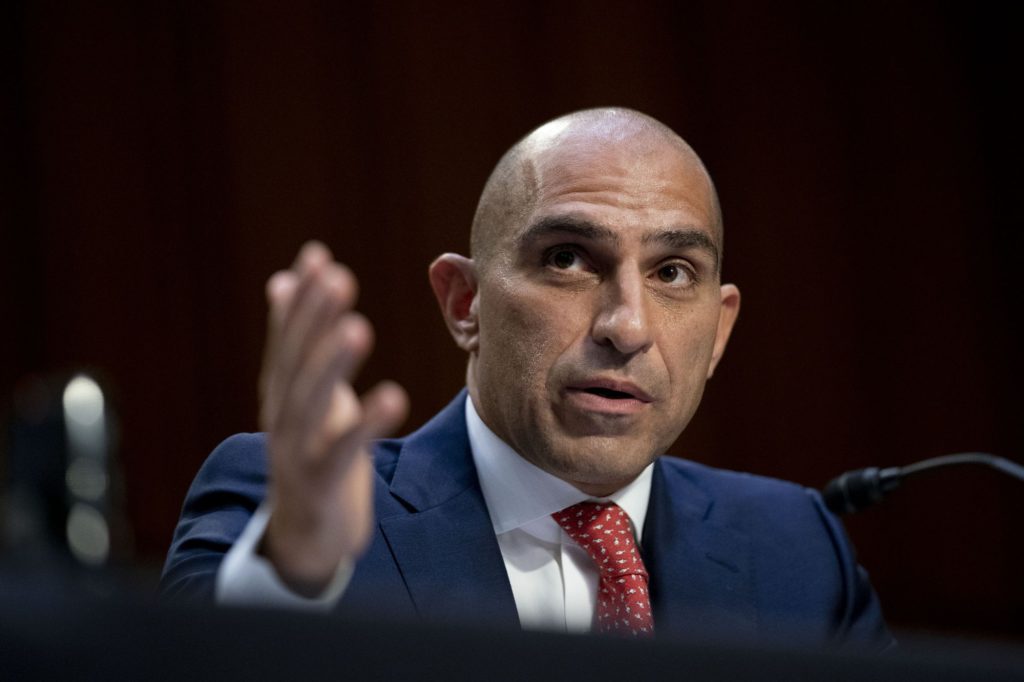
Commodity Futures Trading Commission Chairman Rostin Behnam said Monday that the collapse of Bill Hwang’s firm shows a need to rethink some of the agency’s rules. The episode also underscored the danger of one investor building up a massive swaps position while leaving regulators unaware, he added.

“It would not surprise me if there were other Bill Hwangs,” Behnam said in an interview at Bloomberg’s Washington office. “Clearly there was a failure across many different desks and I think there’s a role for regulators to play in terms of data that we collect, reporting that’s required and, again, a more macro review of stability and resiliency issues.” 

The implosion of Archegos has been held up as an example by regulators pressing for more transparency in financial markets. The firm’s wrong-way derivatives bets sent shares in companies from ViacomCBS Inc. to Baidu Inc. tumbling in March 2021. The latest twist came last month when Hwang and his chief financial officer were arrested after being indicted on criminal charges including racketeering conspiracy. Hwang and Patrick Halligan, the CFO, have pleaded not guilty.

Two former executives agreed to cooperate with authorities, including the CFTC. Even as court cases advance, Behnam said one thing is already clear: more visibility into family offices like Archegos is needed.

The CFTC may propose additional rules for individual investors that have significant swaps positions, according to Behnam. The regulator is also reviewing reporting requirements and risk management at private funds, prime brokers and banks, he added, noting that most of Hwang’s trades were in equity swaps which are not under his agency’s jurisdiction. 

Regulators need to have a macro view of markets and the full network of counter-party relationships “so we know where risk pockets may exist,” Behnam said. “This isn’t the traditional family office that we are accustomed to,” Behnam said about the size of the positions held by Archegos.  

Hwang’s bets set off panic on Wall Street when he was was unable to make payments due on risky bets he made using billions of dollars lent to him by major banks, including Credit Suisse Group AG, Morgan Stanley and Nomura Holdings Inc. The trading led to several investigations, including one into how banks exited their souring positions. 

During a wide-ranging interview, Behnam also discussed the CFTC’s plans for crypto regulation and stepping up efforts to regulate other derivatives, including those used by some companies to reduce their net emissions by buying carbon offsets. That market “deserves scrutiny and has a lack of credibility at this point,” he said. 

More stories like this are available on bloomberg.com

©2022 Bloomberg L.P.

Tencent’s Riot Games Alleges ByteDance Unit Copied ‘Wild Rift’

(Bloomberg) — Tencent Holdings Ltd.-owned Riot Games sued ByteDance Ltd.’s Shanghai Moonton Technology Co. alleging it copied “Wild Rift,” the mobile version of its blockbuster “League of Legends” game.

Riot Games alleges Moonton lifted content and promotional material from the “League of Legends” franchises for its “Mobile Legends: Bang Bang” game, which has been downloaded more than 500 million times on Android. 

“Moonton has used its copyist tactics to create and market its mobile video game, Mobile Legends: Bang Bang (‘MLBB’), which competes with Wild Rift using Riot’s own extensive, expressive content in Wild Rift itself as well as its trailers, promotional materials, and other content,” Riot claimed in the complaint, filed Monday in federal court in Los Angeles. “Moonton’s actions constitute copyright infringement.” 

A representative for Moonton did not immediately respond to a request for comment.

In an emailed statement, Riot Games said, “This action seeks to stop Moonton from continuing its deliberate and sustained campaign to free ride on Riot’s highly valuable League of Legends: Wild Rift and related content.” The company added: “This copying must stop.”

(Updates last paragraph with Riot statement.)

More stories like this are available on bloomberg.com

©2022 Bloomberg L.P.

Stablecoins Are Vulnerable to Runs, May Heighten Risks, Fed Says

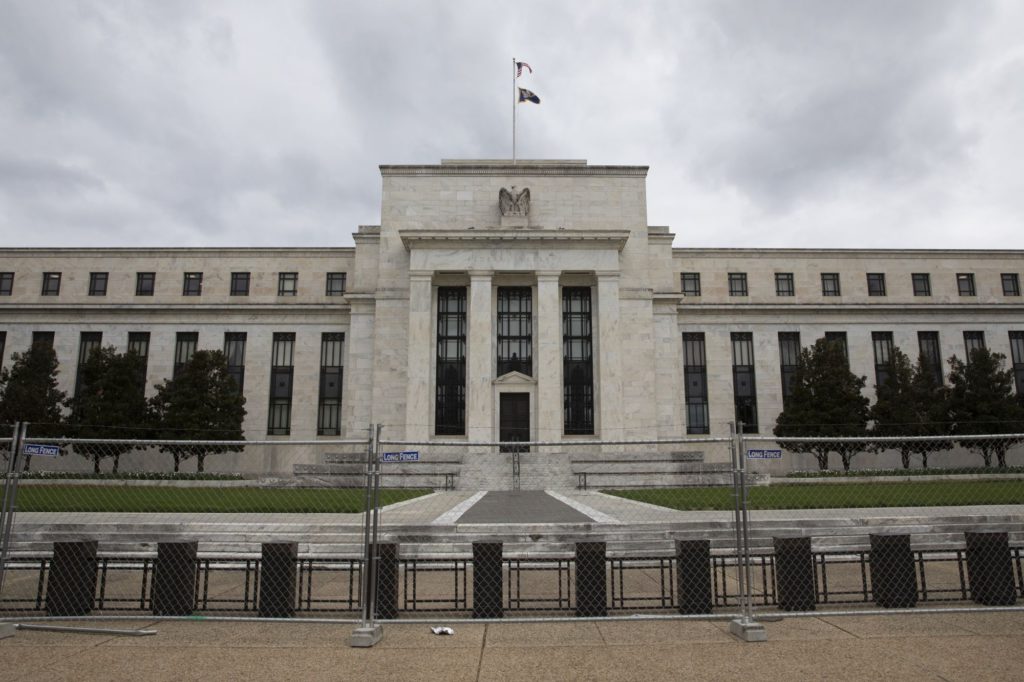
(Bloomberg) — The increasing use of stablecoins to meet margin requirements in leveraged crypto trades may heighten redemption risks, the Federal Reserve said in its semi-annual Financial Stability Report published Monday.

Designed to maintain a peg to a hard currency like the U.S. dollar, stablecoins are backed by assets that may lose value or become illiquid during stress. The U.S. central bank repeated its concerns that the tokens are therefore “vulnerable to runs” and said a lack of transparency around the assets may exacerbate those vulnerabilities. 

“Additionally, the increasing use of stablecoins to meet margin requirements for levered trading in other cryptocurrencies may amplify volatility in demand for stablecoins and heighten redemption risks,” the report said. The Fed has previously warned of financial risks posed by the fast-growing asset class.

  • Read more: Central Banks in the Crypto Age: New Economy Daily

Tightening monetary policy and ebbing liquidity are turning investors away from speculative assets across global markets: On Monday, Bitcoin fell below $31,000 for the first time since July 2021. As cryptocurrencies across the risk asset spectrum tumbled, algorithmic stablecoin TerraUSD risked losing its peg to the U.S. dollar. Its backers are moving aggressively to defend the peg. 

The Fed report did not mention any algorithmic stablecoin by name, instead noting the sector remained highly concentrated among the traditional issuers. The three largest stablecoins — Tether’s USDT, Circle’s USDC, and BUSD from Binance and Paxos — make up more than 80% of the total market value. 

Tether, the largest stablecoin with a market value of $83 billion, has also faced skepticism over whether it can maintain its peg. It has survived years of speculation that the token wasn’t backed one-to-one with dollars and dollar equivalents, and continues to serve as a foundation for much of the trading in the broader cryptocurrency market. 

  • Read more: What Are Stablecoins? Why Are Regulators After Them?: QuickTake

More stories like this are available on bloomberg.com

©2022 Bloomberg L.P.

Terra Blockchain Backer to Lend Bitcoin After UST Losing Dollar Link

(Bloomberg) — The closely watched stablecoin TerraUSD is getting propped up by its backers after losing its peg to the dollar over the weekend.

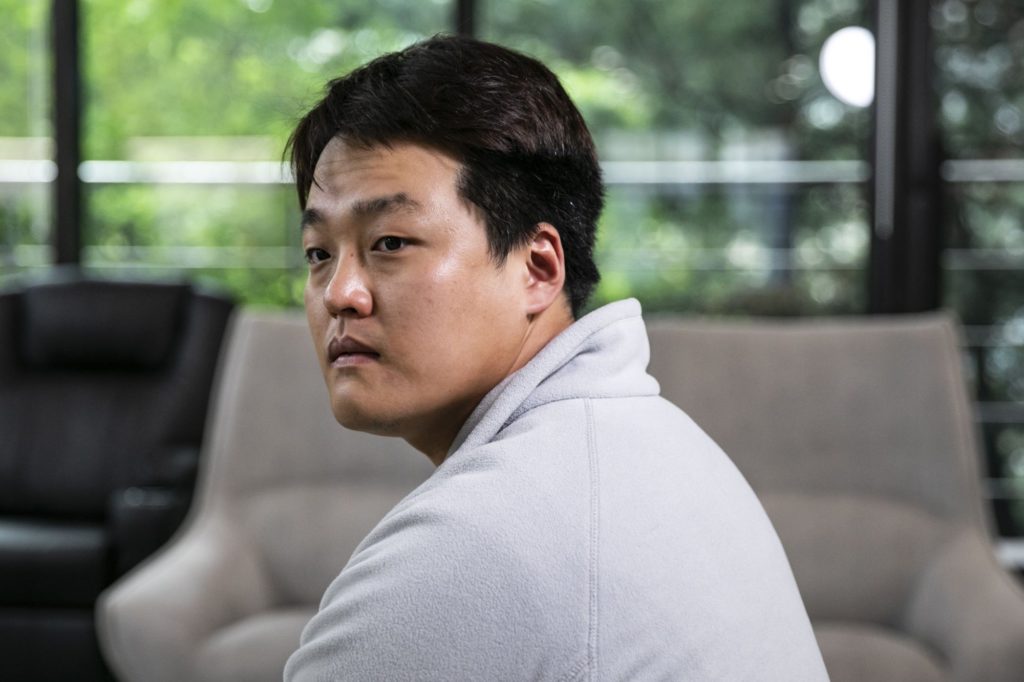
TerraUSD, or UST, dropped well below the crucial $1 level again on Monday, trading as low as 88 cents on the crypto exchange Binance. The declines spurred backers led by Do Kwon, the founder of Terraform Labs — which powers the Terra blockchain — to issue $1.5 billion in loans denominated in both UST and Bitcoin to help support the digital currency. 

Stablecoins are supposed to maintain a peg to the value of currencies like the U.S. dollar, and traditional forms of these tokens are backed by assets such as cash or cash-equivalents. But UST is as an algorithmic stablecoin that lacks any such asset backing, relying instead on trading and treasury management to maintain its value.

Kwon and his team at the Luna Foundation Guard, the association created to support the decentralized token and Terra blockchain, earlier this year pledged to buy as much as $10 billion in Bitcoin to support the stablecoin.

“We’re watching carefully to see how the market fares over the next 24 hours,” Steven Goulden, senior research analyst at crypto market maker Cumberland DRW, said in an email. “Including whether mechanisms being introduced to help increase reliance, such as LFG lending out Bitcoin to OTC trading firms, will be enough to hold in times of deep stress or if we need additional stabilization mechanisms.”

Stablecoins are still mostly used by speculators, often as a place to park their money to avoid wild swings in crypto markets in lieu of regular dollars. Traditional bucks typically only enter and exit the crypto universe via exchanges, which follow the same “know-your-customer” rules as banks and brokerages. Stablecoins can be used in various DeFi platforms that offer users anonymity, as well as cutting-edge — and risky — ways to speculate on more crypto.

Unlike centralized stablecoins USD Coin or Tether that are backed by real-world, dollar-denominated reserve assets, TerraUSD maintains its peg largely by another volatile cryptocurrency, LUNA, through algorithms programming on the Terra blockchain. To oversimplify this, for every TerraUSD created, about $1 of LUNA is taken out of the circulation and vice versa.  

The de-pegging was likely triggered by withdrawals of TerraUSD on decentralized projects Curve Finance and Anchor, according to blockchain data and crypto market participants.

Data from blockchain data tracker Nansen show that more than 121 million TerraUSD tokens were withdrawn from the decentralized exchange Curve Finance over the weekend. Curve Finance essentially allows users to provide liquidity to different “pools” with different tokens, while using a mechanism called an automated market maker that helps determine the price of a token when people trade crypto in every pool. At the same time, the total deposits of TerraUSD on Anchor, a lending project on the Terra blockchain, fell to $11.8 billion from $14.1 billion.

Kwon said on Twitter that Terraform Labs initially removed $150 million TerraUSD from Curve to prepare for a new liquidity pool going live this week and sent back $100 million TerraUSD after the TerraUSD depeg. Some observes pointed to a mysterious wallet that sent about $84 million TerraUSD to Ethereum and cashed out in USD Coin through Curve. Kwon said on Twitter the wallet didn’t belong to Terraform Labs. He didn’t immediately respond to a request for comment.

As a result of the large withdrawal of TerraUSD, prices of LUNA also tanked over the weekend. LUNA’s trading at about $58.48, according to CoinGecko, down about 11% in the past 24 hours. Many traders redeemed LUNA from the withdrawn TerraUSD, leaving more LUNA tokens for sale on exchanges. Data from derivatives data provider Coinglass shows traders on Binance started shorting LUNA heavily on Saturday.

“The weekend UST event looked, felt, and played out like an attempt to manipulate UST lower on the back of the 4pool Curve pool going live,” John Kramer, director of trading at crypto market maker GSR, said. “LUNA bore the brunt of the offensive as participants will mint LUNA with their UST.”

Terra has a capital control to prevent too much TerraUSD from being taken out of circulation so it can be redeem for LUNA, according to Ryan Watkins, co-founder of crypto hedge fund Pangea. As a result, the majority of TerraUSD dumping is taking place on Curve Finance and other exchanges. Michael Egorov at Curve Finance said that there was “massive” trading activity on TerraUSD at Curve.

It wasn’t clear how LFG’s vote to use $750 million in Bitcoin from the reserve and $750 million TerraUSD would help sustain the peg. Kwon noted in his tweets that LFG is not trying to “exit” its Bitcoin position.

“As markets recover, we plan to have the loan redeemed to us in BTC, increasing the size of our total reserves,” he tweeted.

Read this next: King of the ‘Lunatics’ Becomes Bitcoin’s Most-Watched Whale

(Updates the price of UST in the second paragraph.)

More stories like this are available on bloomberg.com

©2022 Bloomberg L.P.

Grindr Dating App to Go Public Through Tiga SPAC at $2.1 Billion Valuation

(Bloomberg) — Grindr LLC, the dating app that specializes in connections for the LGBTQ+ community, has agreed to go public through a blank-check firm in a deal that values the combined company at $2.1 billion including debt.

The predominantly male dating app is merging with Tiga Acquistion Corp., which debuted in November 2020. The special purpose acquisition company isn’t offering any private investment in public equity, or PIPE, deals. The business combination will provide Grindr with an estimated $384 million, which the company will use to pay down debt and strengthen its balance sheet.

Grindr, based in West Hollywood, California, had been approached by a half-dozen SPACs prior to entering into the agreement with Tiga, Chief Financial Officer Gary Hsueh said in an interview.

“From our perspective, we’re ready to be a public company,” he said. The route through a SPAC rather than a traditional initial public offering “made more sense because it had certainty and that’s even more important today than it was a year ago when the market was different.”

Tiga shares rose about 1% in extended trading in New York.

The listing is a major step forward for the 13-year old company, which has had several owners over the years. Chinese firm Beijing Kunlun Tech Co. sold the company to San Vicente Acquisition Partners LLC for $600 million in 2020 after U.S. regulators urged a divestiture over national securities concerns.   

While rivals like Match Group Inc.’s Tinder and Bumble Inc. are LGBTQ+ friendly, Grindr is the most popular among members of the community. The app has about 11 million monthly active users, a fraction of the 100 million users across Match’s apps like Tinder and Hinge. Competitor Bumble Inc. had 40 million monthly users last year, according to company filings. Close to 80% of Grindr’s users are under 35. 

“The number of people who identify as part of the queer community has increased so dramatically,” Chief Executive Officer Jeff Bonforte said, adding that’s largely due to people feeling safer being able to embrace their identity. In the second half of the year, Bonforte plans to resign as CEO, as the company has identified a member of the LGBTQ+ community who has led a public company to serve in the role. The board will be made up of a majority of members who are LGBTQ+, a spokesperson said. Grindr declined to publicly disclose the name of the CEO candidate.

Like other dating apps, Grindr provides a free service with upgrades available for purchase. The app differs from its competitors as users can view and message the profiles of 100 people closest to them without having to match first. Grindr had 723,000 paying users as of the end of last December.  

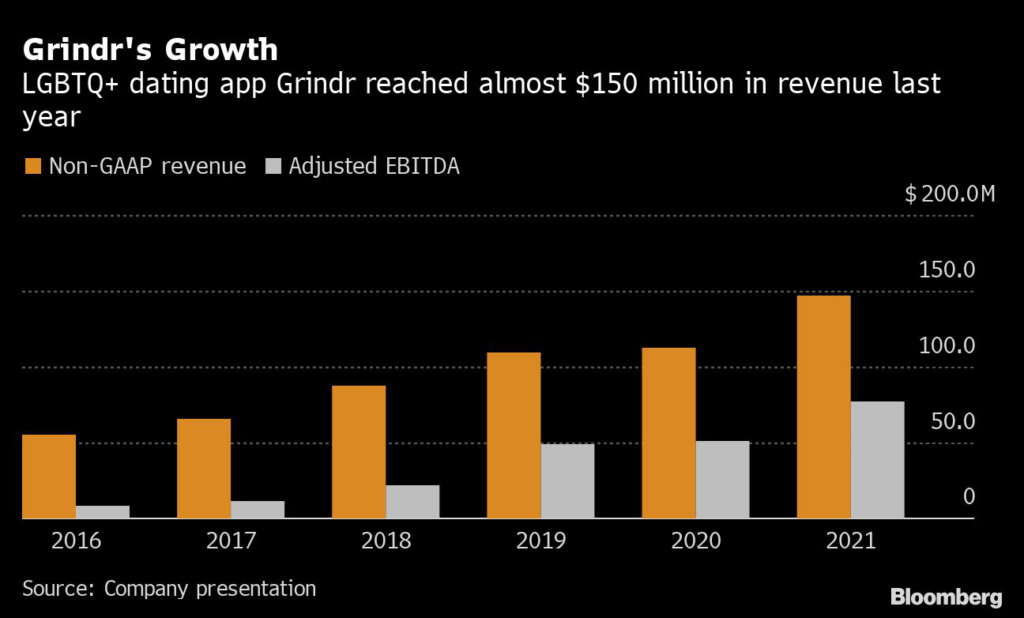
Revenue excluding certain items grew to $147 million in 2021, according to the company, a 30% increase compared with the prior year, with adjusted earnings before interest, tax, depreciation and amortization coming to $77 million, a 51% increase. For this year, Grindr is forecasting adjusted revenue growth of 35% to 40% over 2021.

The majority of Grindr’s revenue is from subscriptions, while a smaller portion comes from ad revenue. The company has faced issues with user privacy as the Wall Street Journal reported that a digital advertiser sold location data that could compromise users’ identities. 

Grindr is choosing to go public through an investment vehicle that was once one of the hottest trends on Wall Street, drawing financiers, politicians and celebrities, who were able to make easy millions from investors piling into them. But, the shine is coming off after regulators outlined new plans aimed at tightening oversight of SPACs, including exposing underwriters to greater liability risk. Goldman Sachs Group Inc. is pulling out of working with most SPACs it took public, throwing into doubt the fate of billions of dollars raised for them, Bloomberg reported.

Read more about how more banks are pulling out of doing SPAC deals over potential liability concern

Grindr’s SPAC deal is expected to close by the end of the year pending regulatory and stockholder approval.

(Updats with aftermarket trading.)

More stories like this are available on bloomberg.com

©2022 Bloomberg L.P.

China’s Other Gaming Giant Is Quietly Snapping Up Global Talent

(Bloomberg) — Jenova Chen needed money to put his latest game out in China. It was 2016, right after Tencent Holdings Ltd. made a splash by taking over Clash of Clans studio Supercell Oy, and Chen was counting on the newly acquisitive internet giant. 

But when Tencent passed, calling his novel mix of stylized designs and free-play too risky, it was the smaller NetEase Inc. that swooped in. Founder William Ding flew all the way to San Francisco and spent hours with Chen to seal the deal, unheard-of back then for the reclusive Chinese billionaire. 

“He struck me as a product manager, not a banker,” Chen said last month. “NetEase looked at my game from a creator’s perspective, and Tencent cared more about the business aspect of it.”

That perception helped propel Netease’s evolution from struggling web portal to Chinese gaming giant. After more than a decade of toiling in Tencent’s shadow, NetEase’s gaming empire now surpasses Activision Blizzard Inc. or Electronic Arts Inc. in revenue in large part because of its reputation as a champion of developers, willing to bet on creative talent. 

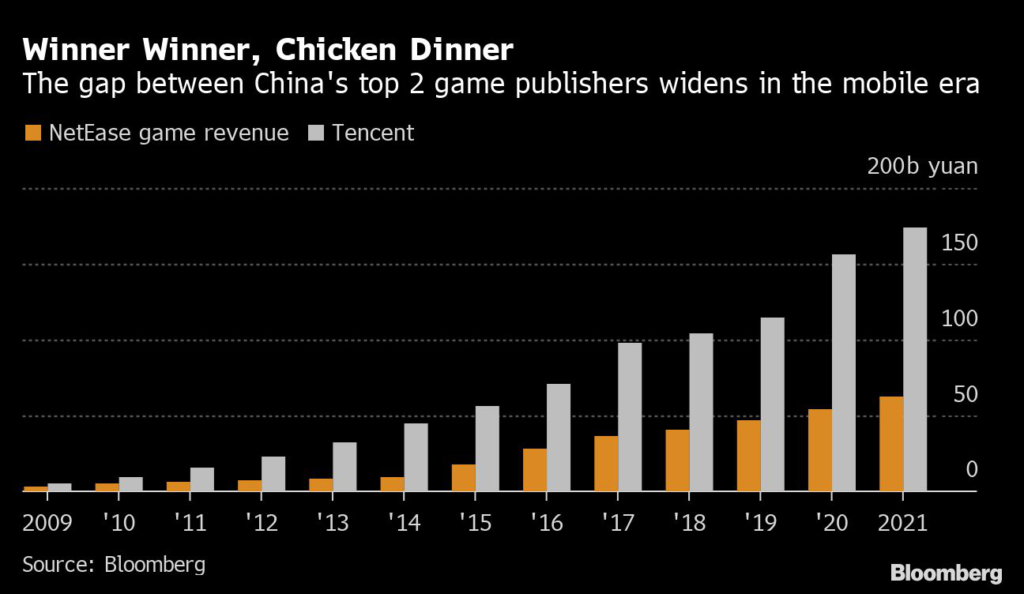
It portrays itself today as the anti-Tencent: a constellation of studios laser-focused on games and unafraid to take risks, while its bigger rival juggles a vast social media and fintech enterprise. Despite being just over a 10th of Tencent’s size, NetEase’s draw for many Chinese developers is a singular focus on gaming and a track record of original hits like Fantasy Westward Journey. 

The trick now is to sell that to global developers. One of Ding’s oft-espoused mantras is “embrace your inner geek,” borrowed from Warcraft studio Blizzard. That could resonate with the game creator community, as NetEase and Tencent accelerate their international endeavors to escape a Chinese government crackdown. On Thursday, NetEase opened its first development studio in Austin, Texas — Jackalope, to be led by Jack Emmert, the comics and role-playing nut who helped forge enduring franchises such as DC Universe Online and Neverwinter. 

NetEase’s rise as a bona fide competitor offers global game builders a second window into the $44 billion Chinese gaming arena — the world’s largest — and could undermine Tencent’s longstanding dominance on online entertainment. 

It’s a stark reversal from a decade ago, when Ding’s outfit was best known as the mere local distributor of blockbuster games like World of Warcraft. In five years, NetEase wants to put its name on a quarter of new triple-A releases in the global market, through everything from self-development to investment and publishing. And by the same time, it wants to generate half of its gaming sales from outside China, executives said in exclusive interviews with Bloomberg News, revealing previously unreported targets.

“I don’t think it would be fair to think of us as a Tencent equivalent,” said Simon Zhu, the Seattle-based investment chief for NetEase Games. “For a platform provider, games are just one of the many ways to monetize traffic. For us, content and talent are everything.”

NetEase has a lot of ground to make up. It generates about 10% of its gaming revenue from abroad, versus about a quarter for Tencent. The disparity shows up in their investment portfolios, with Tencent placing far bigger bets on the likes of Ubisoft Entertainment SA and Activision.

Because NetEase can’t match Tencent’s deep pockets, it’s gambling on talent — people like Emmert or Toshihiro Nagoshi, the industry icon behind the “Yakuza” series who left Sega Sammy Holdings Inc. to join NetEase in January. Nagoshi and his team are now making a new console game for NetEase — an aggressive move given that neither Chinese company has a track record of developing titles for the Xbox, PlayStation or Switch, which are almost non-existent in their home country.

Other publishers in China and the U.S. had approached him too, Nagoshi said, without disclosing names. He turned down fatter paychecks because NetEase promised him more creative freedom.

“It’s not about how much investment or salary they are willing to give,” he said through a translator. “NetEase shows the greatest respect to creativity among all.”

Emmert too considered factors beyond mere numbers when he decided to throw in his lot with NetEase. For one, they promised to free the former studio CEO from meetings and spreadsheets. Importantly, it appeared to be full of like-minded souls. Zhu, the NetEase investment chief, says he spends four hours a day gaming.

NetEase’s gaming czar, Ding Yingfeng, invited Emmert to his Guangzhou office four years ago. During lunch, a staffer brought Ding a new card game he had just ordered, whereupon they struck up a conversation about Magic: The Gathering. That appealed to Emmert, who estimates his own comic collection weighs in at about 1.2 tons. 

“This guy is super high-up,” Emmert said. “But he’s just a gamer. It was an incredible thing.”

NetEase intends to free up talent like Emmert and Nagoshi by adopting an outsourcing model not unlike the one Apple Inc. uses to get chips or its iPhones made, explains Vice President Ethan Wang. The idea is to let the talent focus on core mechanics and storylines for triple-A games, while offering them technical support in labor-intensive areas like art design and bug-testing. Over time, NetEase’s Chinese team will also pick up how to make top-notch console games in-house.

“The most important thing for games is creativity,” NetEase founder Ding said in an emailed response to Bloomberg News. “Even after successes, we need to keep polishing games and operate them for the long term, in the spirit of craftsmanship.”

Done right, it could finally help NetEase to gain recognition from the Western development community. Back in 2017, on the sidelines of the Game Developers Conference in San Francisco, Zhu had to spend most of his pitch meetings explaining who his employer was. “I would take it as a win as long as someone agreed to meet me for a second time,” he said.

Getting it right abroad has become imperative in part because of Beijing. Revenue for the first quarter is expected to grow 11% — the slowest pace in two years -– after regulators froze game approvals in July. While that suspension lifted last month, regulators have made plain their willingness to punish an industry it accuses of encouraging addiction and even damaging children’s eyesight.

Chen, the developer who swayed Ding years ago, is counting on NetEase once more. That investment helped him release Sky: Children of the Light to 160 million downloads since 2019. Chen has since expanded his team sixfold to 120 people and in March, TPG and Sequoia Capital injected $160 million into his studio Thatgamecompany.

“While Tencent can always outbid them, NetEase has a good nose for bargains,” Chen said. “They are going to invest in the leaders of each niche market in the game industry.”

More stories like this are available on bloomberg.com

©2022 Bloomberg L.P.

Bitcoin Washout Is Leaving Mom-and-Pop Buyers Holding the Bag

(Bloomberg) — There’s a crypto refrain when prices crash precipitously like this: The selloff is washing out the short term-focused non-believers, known as weak hands, strengthening the industry in its wake. 

It’s a glib way to think of all those who had joined the market as Bitcoin’s price rose to an all-time high at the end of last year — including institutions and small-time at-home investors, many of whom are deeply underwater on their investments now.

A measure called MVRV — which divides market value by the average purchase price — shows that short-term holders, on average, purchased Bitcoin at around $47,500. Another gauge, called the spent-output-profit ratio (SOPR), indicates those kind of investors are selling at a loss right now, according to an analysis by Genesis Global that uses Glassnode data. 

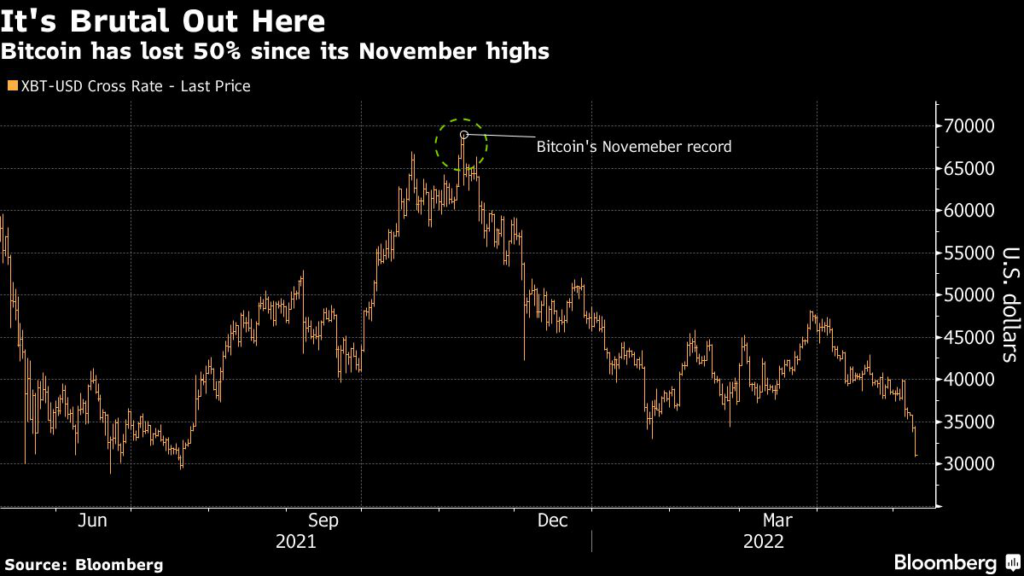
And it’s not just those who have held the coin for a few months. More than half of traders who held crypto at the end of 2021 had gotten in that year, crypto-firm Grayscale Investments said at the time. Bitcoin’s average price in 2021 hovered around $47,300. It was near $32,000 on Monday in New York trading.

“Absolutely a ton of people are down,” said Stephane Ouellette, chief executive of FRNT Financial Inc. “Anyone who bought BTC for the first time in 2021 is down.”

Crypto fans have long argued that digital assets would hold up well during turbulent times. Many had said Bitcoin would prove to be a good inflation hedge thanks to its limited supply. It was also supposed to hold up better amid economic and geopolitical crises because it’s not tied to any government and has no centralized authority. 

Instead, digital-asset investors are suffering through an environment that’s put a lot of risky assets through the wringer this year. The Federal Reserve and other central banks are raising interest rates to combat inflation just as the economic backdrop is softening. In this environment, Bitcoin, the largest digital asset by market value, has been cut in half since its November record. It’s seen five straight weeks of declines and just one positive day out of the last 11 sessions, including Monday’s. 

“Cryptocurrencies are risk assets,” said David Spika, president and chief investment officer of GuideStone Capital Management. “‘This should be a good inflation hedge.’ Wrong. It is a speculative asset that is not going to perform well in an environment like this.”

During its downfall, Bitcoin has largely moved in tandem with other riskier assets, analysts have noted. Its correlation to tech stocks has been particularly pronounced, with both the coin and the Nasdaq 100 reaching highs in November. The 90-day correlation coefficient of Bitcoin and the tech gauge now stands above 0.68, the highest such reading in Bloomberg data going back to 2010. A coefficient of 1 means the assets are moving in lockstep, while minus-1 would show they’re moving in opposite directions. 

“Anyone who bought tech stocks over the past year is underwater, too, and I group them together,” said Peter Boockvar, chief investment officer at Bleakley Advisory Group. 

To be sure, short-term investors aren’t all necessarily retail — a lot of institutional players also started to dabble in crypto in recent years. Still, the crypto craze had caught the eye of a lot of at-home traders who had been stuck at home during the pandemic and who deployed money into a market that went up in 2020 and 2021. 

In addition, the average purchase price is just that — an average — meaning that Bitcoin reaching that level again doesn’t necessitate all those investors break even once more, said Noelle Acheson, head of market insights at Genesis. “It’s likely that more will be, since short-term holders are more prone to panic-selling, and so the average purchase price is likely to drop fast,” she said. 

As to what it would take for Bitcoin to reclaim its old highs is anyones guess. In the meantime, many are projecting that the coin, and other cryptos, will come out on the other end stronger. The shakeout will leave behind long-term HODLers who aren’t scared enough to offload their holdings. Famed investor Marc Cuban thew in his two cents, tweeting that crypto is going through the same lull the early internet went through. 

Still, the Fed is dead-set on bringing inflation down through a series of interest-rate hikes, and Bitcoin, and other riskier assets, could meander along all year in this tighter-monetary-policy environment. 

“Bitcoin is under tremendous sell pressure,” said Steven McClurg, CIO at Valkyrie Investments. “Barring an extraordinary event, it wouldn’t surprise me for us touch $25,000 before we start to see some form of stability. That said, we are more likely to see sideways trading through to the fourth quarter than we are to see a rally carry us through the summer.”

More stories like this are available on bloomberg.com

©2022 Bloomberg L.P.

Games Giant’s Pitch for Global Talent: ‘Embrace Your Inner Geek’

(Bloomberg) — Jenova Chen needed money to put his latest game out in China. It was 2016, right after Tencent Holdings Ltd. made a splash by taking over Clash of Clans studio Supercell Oy, and Chen was counting on the newly acquisitive internet giant. 

But when Tencent passed, calling his novel mix of stylized designs and free-play too risky, it was the smaller NetEase Inc. that swooped in. Founder William Ding flew all the way to San Francisco and spent hours with Chen to seal the deal, unheard-of back then for the reclusive Chinese billionaire. 

“He struck me as a product manager, not a banker,” Chen said last month. “NetEase looked at my game from a creator’s perspective, and Tencent cared more about the business aspect of it.”

That perception helped propel Netease’s evolution from struggling web portal to Chinese gaming giant. After more than a decade of toiling in Tencent’s shadow, NetEase’s gaming empire now surpasses Activision Blizzard Inc. or Electronic Arts Inc. in revenue in large part because of its reputation as a champion of developers, willing to bet on creative talent. 

It portrays itself today as the anti-Tencent: a constellation of studios laser-focused on games and unafraid to take risks, while its bigger rival juggles a vast social media and fintech enterprise. Despite being just over a 10th of Tencent’s size, NetEase’s draw for many Chinese developers is a singular focus on gaming and a track record of original hits like Fantasy Westward Journey. 

The trick now is to sell that to global developers. One of Ding’s oft-espoused mantras is “embrace your inner geek,” borrowed from Warcraft studio Blizzard. That could resonate with the game creator community, as NetEase and Tencent accelerate their international endeavors to escape a Chinese government crackdown. On Thursday, NetEase opened its first development studio in Austin, Texas — Jackalope, to be led by Jack Emmert, the comics and role-playing nut who helped forge enduring franchises such as DC Universe Online and Neverwinter. 

NetEase’s rise as a bona fide competitor offers global game builders a second window into the $44 billion Chinese gaming arena — the world’s largest — and could undermine Tencent’s longstanding dominance on online entertainment. 

It’s a stark reversal from a decade ago, when Ding’s outfit was best known as the mere local distributor of blockbuster games like World of Warcraft. In five years, NetEase wants to put its name on a quarter of new triple-A releases in the global market, through everything from self-development to investment and publishing. And by the same time, it wants to generate half of its gaming sales from outside China, executives said in exclusive interviews with Bloomberg News, revealing previously unreported targets.

“I don’t think it would be fair to think of us as a Tencent equivalent,” said Simon Zhu, the Seattle-based investment chief for NetEase Games. “For a platform provider, games are just one of the many ways to monetize traffic. For us, content and talent are everything.”

NetEase has a lot of ground to make up. It generates about 10% of its gaming revenue from abroad, versus about a quarter for Tencent. The disparity shows up in their investment portfolios, with Tencent placing far bigger bets on the likes of Ubisoft Entertainment SA and Activision.

Because NetEase can’t match Tencent’s deep pockets, it’s gambling on talent — people like Emmert or Toshihiro Nagoshi, the industry icon behind the “Yakuza” series who left Sega Sammy Holdings Inc. to join NetEase in January. Nagoshi and his team are now making a new console game for NetEase — an aggressive move given that neither Chinese company has a track record of developing titles for the Xbox, PlayStation or Switch, which are almost non-existent in their home country.

Other publishers in China and the U.S. had approached him too, Nagoshi said, without disclosing names. He turned down fatter paychecks because NetEase promised him more creative freedom.

“It’s not about how much investment or salary they are willing to give,” he said through a translator. “NetEase shows the greatest respect to creativity among all.”

Emmert too considered factors beyond mere numbers when he decided to throw in his lot with NetEase. For one, they promised to free the former studio CEO from meetings and spreadsheets. Importantly, it appeared to be full of like-minded souls. Zhu, the NetEase investment chief, says he spends four hours a day gaming.

NetEase’s gaming czar, Ding Yingfeng, invited Emmert to his Guangzhou office four years ago. During lunch, a staffer brought Ding a new card game he had just ordered, whereupon they struck up a conversation about Magic: The Gathering. That appealed to Emmert, who estimates his own comic collection weighs in at about 1.2 tons. 

“This guy is super high-up,” Emmert said. “But he’s just a gamer. It was an incredible thing.”

NetEase intends to free up talent like Emmert and Nagoshi by adopting an outsourcing model not unlike the one Apple Inc. uses to get chips or its iPhones made, explains Vice President Ethan Wang. The idea is to let the talent focus on core mechanics and storylines for triple-A games, while offering them technical support in labor-intensive areas like art design and bug-testing. Over time, NetEase’s Chinese team will also pick up how to make top-notch console games in-house.

“The most important thing for games is creativity,” NetEase founder Ding said in an emailed response to Bloomberg News. “Even after successes, we need to keep polishing games and operate them for the long term, in the spirit of craftsmanship.”

Done right, it could finally help NetEase to gain recognition from the Western development community. Back in 2017, on the sidelines of the Game Developers Conference in San Francisco, Zhu had to spend most of his pitch meetings explaining who his employer was. “I would take it as a win as long as someone agreed to meet me for a second time,” he said.

Getting it right abroad has become imperative in part because of Beijing. Revenue for the first quarter is expected to grow 11% — the slowest pace in two years -– after regulators froze game approvals in July. While that suspension lifted last month, regulators have made plain their willingness to punish an industry it accuses of encouraging addiction and even damaging children’s eyesight.

Chen, the developer who swayed Ding years ago, is counting on NetEase once more. That investment helped him release Sky: Children of the Light to 160 million downloads since 2019. Chen has since expanded his team sixfold to 120 people and in March, TPG and Sequoia Capital injected $160 million into his studio Thatgamecompany.

“While Tencent can always outbid them, NetEase has a good nose for bargains,” Chen said. “They are going to invest in the leaders of each niche market in the game industry.”

More stories like this are available on bloomberg.com

©2022 Bloomberg L.P.
Microsoft to Help Cover Workers’ Travel Costs for Abortions

(Bloomberg) — Microsoft Corp. will help cover the costs of employees having to travel to get abortions or gender-affirming care, a response to looming new restrictions in states around the U.S. 

The software maker will “support employees and their enrolled dependents in accessing critical health care — which already includes services like abortion and gender-affirming care — regardless of where they live across the U.S.,” according to a statement Monday. “This support is being extended to include travel expense assistance for these and other medical services where access to care is limited in availability in an employee’s home geographic region.”

Microsoft is the latest corporate giant to confront the issue following the release of a draft Supreme Court opinion last week that would overturn the Roe v. Wade decision — a landmark ruling that legalized abortion throughout the U.S. Amazon.com Inc. said earlier this month that it would cover as much as $4,000 in travel expenses related to medical procedures, including abortion services. Citigroup Inc., Lyft Inc. and Uber Technologies Inc. have made similar pledges.

Beyond the Supreme Court case, states have sought to impose new rules limiting gender-affirming health care for transgender children. Earlier this year, Microsoft joined Apple Inc. and other companies in urging Republican Texas Governor Greg Abbott to scrap such an order.

Other companies are debating whether to update their policies as well. That includes Goldman Sachs Group Inc. and JPMorgan Chase & Co., which are discussing whether to cover travel costs for abortions, Bloomberg reported last week.

In response to the moves, Republican Senator Marco Rubio of Florida has introduced a bill to remove tax breaks for “woke corporations.” The bill would prohibit employers from deducting expenses related to their employees’ abortion-travel costs.

(Updates with Texas order in fourth paragraph.)

More stories like this are available on bloomberg.com

©2022 Bloomberg L.P.

MicroStrategy’s Bitcoin Bet on the Verge of Turning Negative

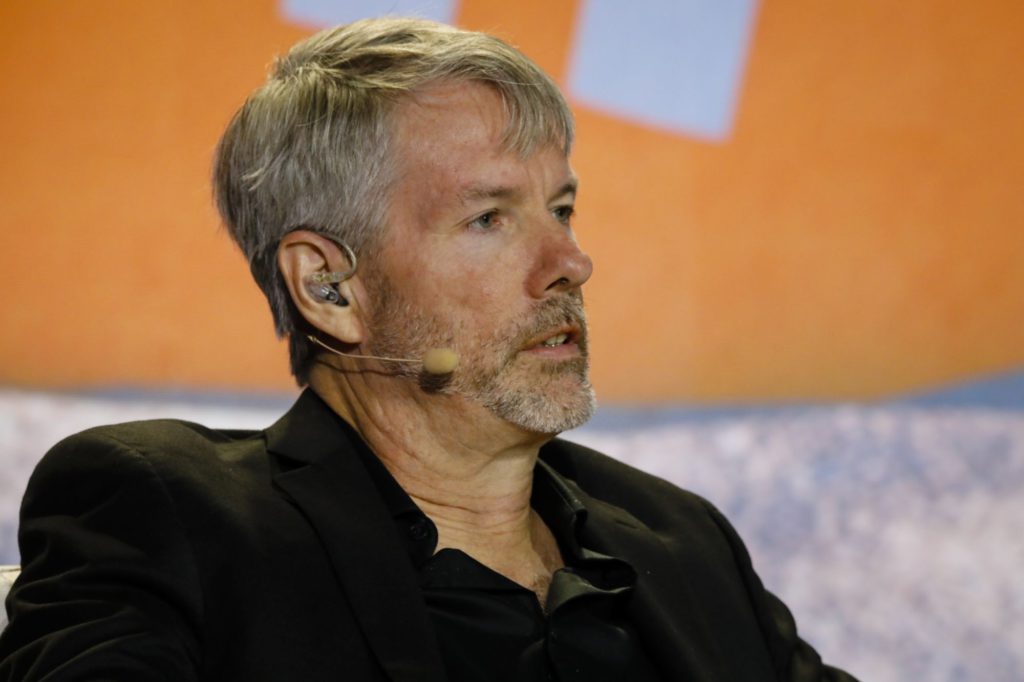
(Bloomberg) — MicroStrategy Inc. Chief Executive Michael Saylor’s norm-breaking decision to add Bitcoin to the balance sheet of the software maker is on the verge of turning sour.

When the price of Bitcoin briefly dropped under $30,700 on Monday, the value of the Tysons Corner, Virginia-based company’s Bitcoin holdings dropped below their average purchase price. MicroStrategy and subsidiaries held 129,218 Bitcoins as of April 4, a company filing shows. The largest cryptocurrency by market value has dropped more than 50% from its record high set in November. The crypto holdings are valued at around $4 billion.

Saylor has been the highest profile corporate advocate of buying Bitcoin. The company started acquiring Bitcoin for its balance sheet in August 2020, with Saylor citing the Federal Reserve’s relaxing of its inflation policy for helping to convince him to get out of cash. MicroStrategy has also issued bonds to boost its Bitcoin holdings on the balance sheet. It recently entered into a loan that is backed by Bitcoin. 

Saylor has pledged to continue to buy Bitcoin and even joked about it in a Twitter posting Monday that referenced earlier criticism that implied he should be working for McDonald’s, which has been a software customer of the enterprise software maker. 

While MicroStrategy touted its gains from the crypto assets, it has written down the value of its Bitcoin holdings when the market price has dipped below the purchase price. The company took a $170 million impairment charge for the last quarter and over $1 billion in writedowns related to its crypto holding. The company took a $170 million impairment charge for the last quarter. 

MicroStrategy shares had soared since Saylor started buying Bitcoin, gaining more than fourfold before turning negative this year along with the price of Bitcoin. The stock fell 26% on Monday, the biggest drop since 2017, as Bitcoin fell as much as 11%.   

More stories like this are available on bloomberg.com

©2022 Bloomberg L.P.
Close Bitnami banner
Bitnami