

Bloomberg

Match Sues Google Over App Store Billing Rules

(Bloomberg) — Match Group Inc. accused Alphabet Inc.’s Google in a lawsuit of acting as a monopolist with its app store billing rules, the latest escalation in a brawl over the mobile-app industry. 

Match Group, which operates dating apps such as Tinder and OkCupid, alleged that Google breaks federal and state laws and abuses its power with a requirement that app developers use its billing system on Android devices. 

“Ten years ago, Match Group was Google’s partner. We are now its hostage,” Match Group said in a complaint filed Monday in northern California federal court. “Blinded by the possibility of getting an ever-greater cut of the billions of dollars users spend each year on Android apps, Google set out to monopolize the market for how users pay for their Android apps.”

Google, like Apple Inc., has faced enormous recent legal and political scrutiny over the commission fees and billing restrictions both companies apply to paid services in their app stores. Congress is currently weighing a bill to force Google and Apple to change their business models.

In response to public pressure, Google has halved its 30% fee for some apps. But the company said it would tighten its rules that require the use of its billing system for in-app purchases, citing security concerns. Google gave a June 1 deadline to comply or be removed from its Play Store. 

In March, Google announced it was letting select apps offer their own billing service in addition to Google’s on Android devices. Spotify Technology SA, another app store critic, said it was using this option and Google suggested more companies would follow.

Not Match Group, apparently. “This lawsuit is a measure of last resort,” Chief Executive Officer Shar Dubey wrote in a statement. The executive said her company tried “in good faith” to resolve its concerns with Google but was left with “no choice but to take legal action.”  

Learn more about why app store fees are controversial

In the filing, Match Group said that it asked Google to adopt this new “user billing” feature but Google refused.

A Google spokesperson said in a statement that Match would still be able to reach consumers through other app stores available on Android devices or the web. “This is just a continuation of Match Group’s self-interested campaign to avoid paying for the significant value they receive from the mobile platforms they’ve built their business on,” the spokesperson said. “Like any business, we charge for our services, and like any responsible platform, we protect users against fraud and abuse in apps.”

Match is forecasting $42 million in additional costs for Google’s Play Store during 2022, chief financial officer Gary Swidler told analysts last week. That’s on top of the $100 million in payments to Google the company expects to make. Swidler said that Match customers use the company’s in-app billing system three times as often as they use Google’s own service.

Epic Games Inc., the maker of Fortnite, has previously sued both Apple and Google over similar allegations.

A federal judge ruled last year in Epic’s case that Apple had to let developers direct users to web payments services outside of its app store, but stopped short of calling Apple a monopolist. 

Match Group, which was spun off from IAC/InterActiveCorp. in 2020, is a massive Google advertiser and has become a frequent critic of its business practices. The company posted its lawsuit publicly under the website, EndtheGoogleTax.com.

The case is Match Group LLC v. Google LLC, 22-cv-02746, U.S. District Court, Northern District of California.

(Updates with comments from Google in ninth paragraph. An earlier version of the story corrected a description of Match Group to note it was spun off from IAC/InterActive Corp.)

More stories like this are available on bloomberg.com

©2022 Bloomberg L.P.
MicroStrategy’s Stock Plunge Deepens as Bitcoin, Miners Slump

(Bloomberg) — Shares of MicroStrategy Inc. fell by the most since 2017 as the company, often used as a proxy for Bitcoin, followed the world’s largest cryptocurrency lower amid a broader selloff in risk assets.

The enterprise software maker run by Bitcoin evangelist Michael Saylor declined 26% on Monday as the price of Bitcoin hovered near a key threshold of $30,000 and the benchmark S&P 500 declined about 3.2% on concerns tightening monetary policy could throw the economy into a recession.

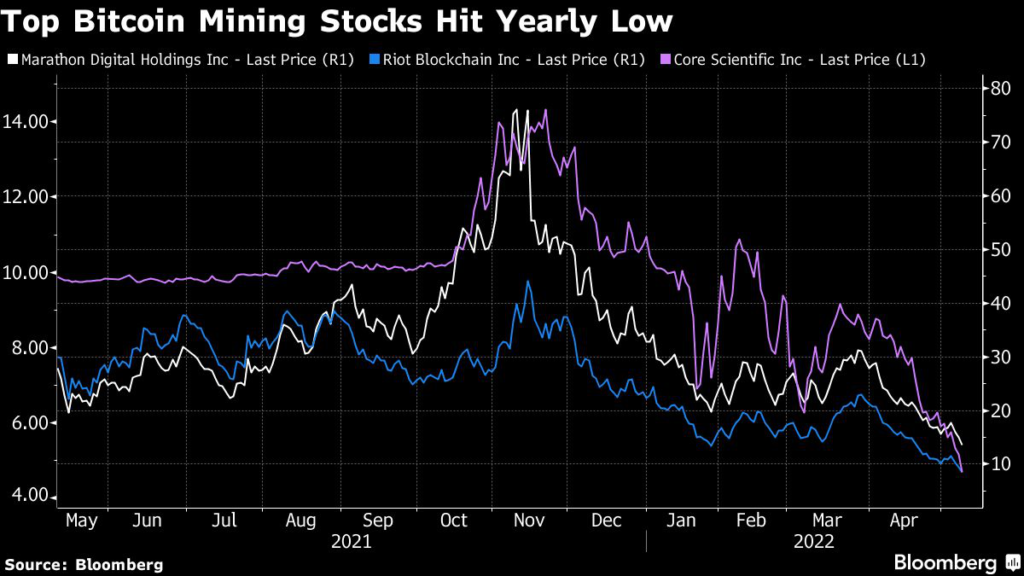
Other crypto-exposed stocks, including top miners such as Marathon Digital Holdings, also saw sharp declines. Marathon, the largest public miner in the U.S. by market value, dropped 19%, bringing its year-to-date losses to 63%. Meanwhile, Core Scientific Inc. fell 13% to a new low and Riot Blockchain Inc. declined 19% to the lowest since November 2020.

Many crypto-related stocks will move in lockstep with Bitcoin as such companies have large amounts of the mined token on their balance sheets and can be used as a proxy by investors who do not want to directly hold Bitcoin in their portfolios. 

“Crypto and equity markets are largely selling off in tandem due to a broad risk-off environment where many investors are moving to cash,” Steven McClurg, chief investment officer of Valkyrie Investments, said. “The correlation between the two asset classes has grown more pronounced in recent months because the number of publicly traded companies involved in blockchain and digital assets continues to grow, and is not likely to reverse course.”

Over the weekend, Bitcoin also fell below a key level of $33,000 after a selloff in growth and technology stocks followed moves by the Federal Reserve to boost interest rates in order to tame decades-high inflation. The tech-heavy Nasdaq 100 is suffering heavy losses, down 26% from a high in November, while the S&P 500 has shed about 15% over the same time period. 

“Now that some corporate treasuries are hovering near their cost basis, markets are waiting and watching to see if shareholders will force some de-risking,” Josh Lim, head of derivatives at New York-based brokerage Genesis Global Trading, said. 

Backers often champion Bitcoin as store of value similar to gold that’s uncorrelated with other financial markets. However, the digital currency has been among the most hard-hit asset classes by the risk-off environment. 

The losses come after shares of miners spiked late last year, along with Bitcoin, after a ban on crypto mining in China enabled the rest of the world to mine tokens with less competition. However, since then, shares have fallen along with Bitcoin and as margins have deteriorated on higher energy prices stemming from sanctions on Russian energy imports.

“In the short term, we believe the markets will continue to sell off through the summer, especially if rate hikes continue through the June and July FOMC meetings, before staging a potential rally through the end of the year in a pattern that has largely established itself over the past decade,” McClurg said. “One thing to watch is the yield curve, as an inversion would be a harbinger of further selloff. Recession is imminent.”

(Updates shares. A previous version corrected to say the price of Bitcoin is near $30,000.)

More stories like this are available on bloomberg.com

©2022 Bloomberg L.P.

Biden Team Sees Tilt to China Buoyed as Putin Falters in Ukraine

(Bloomberg) — As Europe’s largest conflict since World War II rages in Ukraine, top Biden administration aides are increasingly convinced it could provide the U.S. with an unexpected advantage — against China.

U.S. officials see the conflict’s toll and the slew of sanctions placed on Moscow as leaving Russia hobbled for years to come. Combined with bolstered European defense spending, that means the U.S. may have a freer hand to accelerate its long-term shift toward China, viewed as America’s biggest future challenge, according to several officials interviewed by Bloomberg News.

The officials acknowledge that the war’s outcome is uncertain. And previous attempts to channel U.S. government attention toward Asia have ended up derailed by events in the Middle East and elsewhere, including former President Barack Obama’s “pivot” to Asia. 

But even with so much of the administration’s bandwidth focused on Ukraine, the officials say they believe this time could be different. They and top lawmakers from both parties warn that Beijing is closely watching the U.S. and allied response to the invasion, drawing potential lessons for any tensions over Taiwan.

“The war in Ukraine could end up being bad for the pivot in the short-term, but good in the long-term,” said Richard Fontaine, the chief executive officer of the Center for a New American Security and an adviser to late Republican Senator John McCain. 

The move toward Asia is seen as critical, with President Joe Biden and his top aides saying China is increasingly trying to use its economic and military clout to bend the “rules-based international order” to its will, citing the country’s moves to take greater control of Hong Kong, expand its presence in the South China Sea and crack down on dissent and human rights in the Xinjiang region. Chinese officials dispute those characterizations and say the U.S. should get over its “Cold War” view of the world.

Why the Solomon Islands’ China Pact Has U.S. Riled: QuickTake

Although Russia’s invasion of Ukraine initially appeared to put China — which has long touted its support for “territorial integrity” — in a bind, officials in Beijing have continued to tout their partnership with Moscow.

But with the war now dragging out and Russia’s military shortcomings becoming more obvious, one senior U.S. official said that a Beijing-Moscow diplomatic alliance originally viewed as a force multiplier for China increasingly looks more like an anchor.

Defense Secretary Lloyd Austin has been explicit about Washington’s hope that Putin’s setbacks in Ukraine will undermine Moscow. Russia “has already lost a lot of military capability, and a lot of its troops quite frankly,” Austin told reporters on April 25. “We want to see Russia weakened to the degree that it can’t do the kinds of things that it has done in invading Ukraine.”

Surprised by the outbreak of war on the continent, European nations rushed to accelerate defense spending. And Finland and Sweden, long reluctant to join the North Atlantic Treaty Organization, have sought membership. 

How U.S. Is Targeting Chinese Firms for Delisting: QuickTake

Even Germany, which before the war resisted both ramping up defense outlays to the 2% of GDP target set by NATO and sending modern weapons to other countries, has changed tack. If implemented, the shift would make Germany the world’s third-largest military spender — up from seventh in 2020.

Two U.S. defense officials who spoke on condition of anonymity said that if the Ukraine crisis leaves Europe more capable of defending itself, it could free up the U.S. to do more in Asia. That would likely mean a range of actions, including shifting troops and weaponry and expanding economic and political ties across the Indo-Pacific. 

The Biden administration had been taking steps to shift resources and energy toward Asia before the war. 

Pacific NATO

For starters, the president and his team sought to bolster the Quad grouping with Japan, India and Australia. The U.S. also reached a controversial agreement with the U.K. and Australia — at France’s expense — to share nuclear submarine technology with Sydney. That development was decried in Beijing, which has accused America of trying to establish an Indo-Pacific version of NATO. 

With a semiconductor shortage undercutting the U.S. economy, the Biden administration moved to shore up and diversify supply lines, pressing for legislation being negotiated between House and Senate lawmakers to get more chip-making moved back to America. 

The administration’s focus on Asia will also be front and center when Biden travels to South Korea and Japan later this month, a trip meant to meet the nations’ new leaders on their home turf as well as demonstrate unity against another national security priority: North Korea. 

Despite those efforts, there’s plenty that could go wrong with the administration’s plans. In the short term, events in Ukraine have consumed the attention of cabinet officials and their deputies across Washington’s national security apparatus. Another foreign crisis or terrorist attack could quickly erupt, drowning out efforts to look toward Asia. 

China Speech

Most glaringly, 16 months into Biden’s presidency, the administration hasn’t publicly detailed its strategy toward China, and it has shied away from promoting freer trade as a counterweight to Beijing in Asia. Officials at one point said the China policy would be shared by the end of 2021, a deadline that came and went. A scheduled speech outlining the policy by Antony Blinken last week was delayed after the secretary of state contracted Covid-19. No new date for its release has been announced. 

Chinese officials are skeptical of the idea that the war in Ukraine might aid the U.S. pivot to Asia. And they aren’t waiting to see how the situation unfolds. Beijing officials projected that defense spending will grow 7.1% this year, the fastest pace since 2019.  

One Chinese diplomat said that increased German defense spending and a weaker Russia could end up emboldening Europe’s push for what French President Emmanuel Macron has called “strategic autonomy,” opening up the possibility that Europe could split with the U.S. over China ties. Another said it’s too early to tell what the long-term implications of the conflict will be, but that China is ready to compete with the U.S. in Asia either way. 

Not all Biden administration officials are in lockstep behind the idea that events in Ukraine will help the U.S. One senior official said there’s still potential the U.S. will double down on Europe at the expense of Asia, a tendency that could be reinforced by Ukraine. The person said the still-uncertain outcome of the conflict will be crucial to determining what happens. 

Even if Russia — which has faced major downturns in the past including the collapse of the Soviet Union and an economic crisis in the late 1990s — emerges from the Ukraine war weaker, it will remain a nuclear power, one with a predilection for unpredictable behavior. 

China “doesn’t need a strong Russia, they just need a surly Russia that keeps the U.S. worried,” said Daniel Russel, a former assistant secretary of State for East Asian and Pacific Affairs in the Obama administration. “You’d have to believe that Putin was going to stop being a serious mischief maker to believe that leaving Putin management to Germany would be plausible.” 

More stories like this are available on bloomberg.com

©2022 Bloomberg L.P.
Weak Yen Seen Boosting Toyota’s Profit, Focus on Annual Outlook

(Bloomberg) — Strong sales and the yen’s historic fall are projected to boost Toyota Motor Corp.’s profit for the recent fiscal year, with the focus shifting to whether the world’s biggest carmaker can sustain growth in the face of economic headwinds and an uncertain supply outlook.

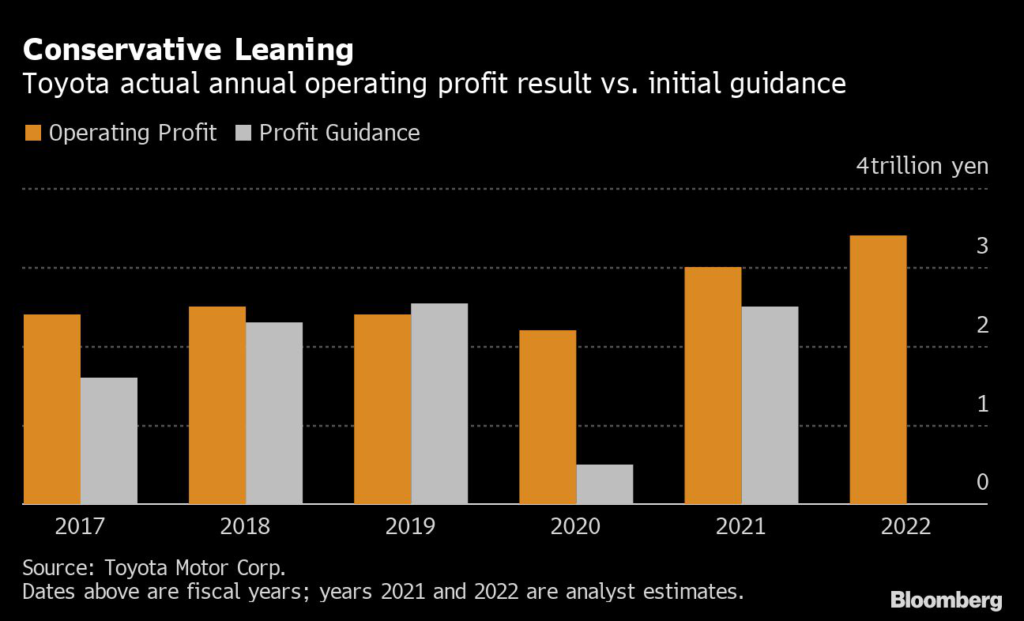
Analysts, on average, estimate that Toyota will show an operating profit of 3 trillion yen ($23 billion) for the period ended March when it reports results Wednesday. That would top the Japanese automaker’s most recent forecast for 2.8 trillion yen. Analysts are predicting a 3.4 trillion yen profit for the current year, which began April 1.

Toyota’s sales have been robust in recent months. While January-March unit sales dipped 4.2% from record highs seen during the same quarter a year earlier, it marked a recovery from the prior quarter’s 12% decline. Those bolstered figures led the carmaker to post its second-highest unit sales figure ever for the recently ended fiscal year. 

Read more: Toyota Tops Annual Sales Goal With Second-Highest Total Ever

On top of strong sales, a weakened yen — which recently hit 20-year lows — is inflating the value of profits that Toyota earns overseas. Currency moves are helping Toyota and other Japanese automakers beat back numerous other headwinds, according to Bloomberg Intelligence. 

The question is how long such conditions will last.

Toyota, along with other global carmakers, has faced a myriad of disruptions, on top of the persistent shortage of semiconductors for automobiles. The automaker is facing higher material costs related in part to the Russia-Ukraine war and continuing Covid-19 outbreaks in China, which have recently seen the automaker’s plant in Jilin Province shuttered for more than a month.  

Read more: World’s Top Carmakers Feeling Full Force of China Covid Stance

Jefferies Financial Group Inc. downgraded Toyota’s rating to hold last month, citing “too bullish” expectations with regard to auto industry earnings for the fiscal year through March 2023. The aggravation of cost inflation due to the Ukraine crisis and a potential slowdown in global economic growth are likely to cause “considerable damage” to the entire auto sector, analyst Takaki Nakanishi wrote.

Other analysts maintain that the weakened yen will continue to offset other negative factors, as least for the upcoming half year or so. Though Toyota tends to issue conservative outlooks, the automaker’s forecast for the current fiscal year ending March 2023 will provide insight into its assessment of countervailing factors.

Toyota shares rose more than 30% over the fiscal year ended March and have been little changed over the past month.

More stories like this are available on bloomberg.com

©2022 Bloomberg L.P.
U.S. Regulators Considering Plan B If Congress Fails to Act on Crypto

(Bloomberg) — Financial market regulators are considering steps they could take to rein in the crypto market if Congress doesn’t pass legislation, the head of Wall Street’s top derivatives regulator said. 

“In the absence of clear direction from Congress, which I know they’re working on, it’s our responsibility to work together and to come up with solutions to the extent that we’re able to within the authority that we currently have,” Commodity Futures Trading Commission Chairman Rostin Behnam said Monday in an interview with Bloomberg News. 

Crypto firms have been looking for clarity on the regulations they should follow. Many have pushed for the CFTC to take on an expanded role–an idea backed by a recent bipartisan bill introduced in the House. Currently, the regulator’s powers are limited to policing derivatives based on Bitcoin and Ether and investigating fraud or manipulation in underlying crypto markets. Meanwhile, Securities and Exchange Commission Chair Gary Gensler has said he thinks most digital assets are securities that are subject to his agency’s rules. 

The two bodies haven’t reached any agreements on their respective roles should Congress fail to step in and draw clear jurisdictional lines, Behnam said. But the staffs are actively talking, he added. 

Tough Enough?

Behnam rejected any notion that the CFTC would be friendlier toward the crypto industry than other financial regulators. 

“That is completely false, and that’s a bad narrative,” he said. “I’m as tough as anyone in this city, and our jurisdiction and our authority is as tough as anyone’s as well.”

The number of CFTC enforcement actions and settlements tied to crypto activities has steadily grown over the last several years. Between 2015 and 2021, the regulator filed charges against or settled with at least 30 firms involved in digital assets and levied fines and disgorgements totaling more than $787 million, according to a report from Solidus Labs. 

The CFTC is a “natural fit” to regulate more of the market, given its long track record of enforcement and overseeing crypto derivatives, Behnam said. 

“We have experts at the agency; we have a very robust understanding of the marketplace,” he said. 

More stories like this are available on bloomberg.com

©2022 Bloomberg L.P.

Rogers, Shaw Drop After Antitrust Body Sues to Stop Tie-Up

(Bloomberg) — Canada’s antitrust body officially launched its case to block Rogers Communications Inc.’s $16 billion takeover of Shaw Communications Inc., saying it will harm consumers by removing a company that has helped drive wireless bills lower.

The federal Competition Bureau said it’s seeking a “full block” of the deal, which is one of the country’s largest-ever mergers. It said Shaw’s Freedom Mobile division has helped keep Canada’s three dominant telecommunications companies in check by competing with “aggressive” pricing and better data plans. 

“Eliminating Shaw would remove a strong, independent competitor in Canada’s wireless market — one that has driven down prices, made data more accessible, and offered innovative services to its customers,” Matthew Boswell, Canada’s competition commissioner, said in a statement. “We are taking action to block this merger to preserve competition and choice for an essential service that Canadians expect to be affordable and high quality.”

The move confirms a news release early Saturday from Rogers and Shaw saying they expected the regulator to sue. Shaw tumbled 7.2% Monday to C$34.87 — its biggest drop since March 2020. Rogers declined 4.1%. 

Rogers and Shaw will have to agree to changes or divestitures that satisfy the Competition Bureau or fight it at the country’s Competition Tribunal. The latter could take six months or more. 

The companies have said they remain committed to the deal and extended the closing deadline to July 31. Rogers has agreed to sell all of Freedom Mobile, but the bureau may also want to ensure the buyer has the capacity to invest heavily in the business. 

Settling with the antitrust watchdog is the best option for Rogers and Shaw, according to Robin Shaban, a competition expert and co-founder of consulting firm Vivic Research in Ottawa. 

“At the end of the day, no one really wants litigation. It’s not pleasant. It’s not cost effective,” Shaban said. “So if there’s a way to remedy the situation without having to litigate, that makes sense.”

A spokesperson for Rogers declined to comment, saying the company wants to see the bureau’s application first. 

Turning to Quebecor 

Some analysts say the companies can still complete the transaction despite Boswell’s objection. 

“Sometimes the Competition Bureau just wants to slow things, put forward its arguments to be discussed with or without the Competition Tribunal, and possibly resolve issues,” National Bank Financial analyst Adam Shine said in a note to investors. He kept his target price on Shaw at C$40.50, which is the offer from Rogers. 

To settle the matter out of court, Rogers has opened the door to selling assets to Montreal-based communications firm Quebecor Inc., according to a person familiar with the matter. 

Rogers has drafted a deal to sell Freedom to Xplornet Communications Inc. But it’s possible that Quebecor ownership would be more acceptable to regulators because it already has 1.6 million wireless customers and has been a big spender on 5G spectrum. 

Quebecor spent C$830 million ($639 million) on wireless licenses in an auction last year, and some are in Western Canada and could potentially be used to upgrade Freedom’s service, which isn’t a 5G network. Quebecor Chief Executive Officer Pierre Karl Peladeau has publicly expressed interest in buying Freedom under the right conditions. 

“What it means is the bureau is trying to put pressure on the parties, Rogers and Shaw, to conduct a fairer sale of Freedom wireless — to try to find a stronger competitor to offload it to” than Xplornet, according to Mark Warner, principal at MAAW Law in Toronto. 

“I’m not sure it really means we’ll actually see a contested merger. We might,” Warner said on BNN Bloomberg Television prior to the competition bureau’s statement. “But we do know that the commissioner of competition, Matthew Boswell, has talked about using the threat of litigation, if not litigation itself, to get better outcomes in negotiated settlements from parties.”  

Wireless appears to be the only major antitrust problem. The bureau’s statement doesn’t address the cable and internet businesses that Shaw is selling, which have very little overlap with Rogers. Shaw operates cable systems mostly in Western Canada, while Rogers is in Ontario and the Atlantic provinces. 

Shaw’s Freedom Mobile division is Canada’s fourth-largest provider, with a presence in several major markets including Toronto and Vancouver. Rogers has long been the largest wireless company in Canada, with more than 11 million subscribers.

(Updates closing share price)

More stories like this are available on bloomberg.com

©2022 Bloomberg L.P.
Nasdaq 100 Rout Erases $1.5 Trillion in Market Value in 3 Days

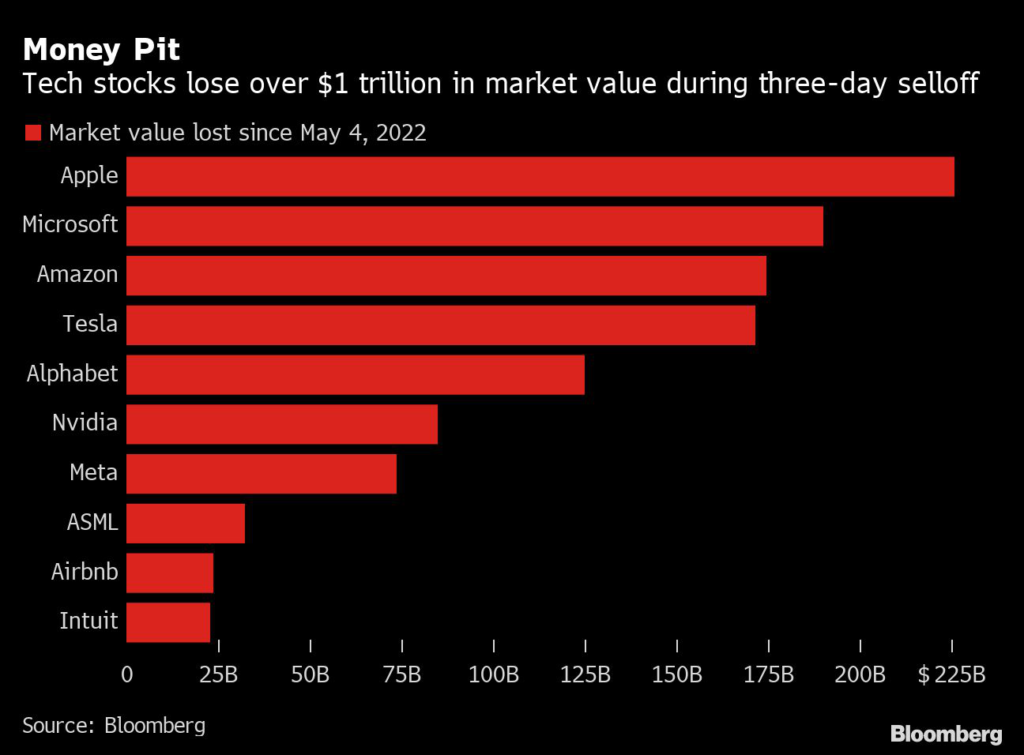
(Bloomberg) — Three days of heavy selling in technology stocks has erased about $1.5 trillion in market value from the Nasdaq 100 Index. 

The tech-heavy benchmark sank 4% on Monday, extending its decline to 10% since the Federal Reserve raised interest rates half a percentage point last week and Chair Jerome Powell signaled the Fed would continue hiking at that pace. That’s the biggest three-day drop for the index since September 2020, according to data compiled by Bloomberg.

Tech wasn’t alone in this slump. The S&P 500 tumbled 3.2% and closed at 3,991, below the psychologically key 4,000 point threshold. Broad stocks benchmark is in its worst three-day stretch since its March 20, 2020, pandemic low.

The Nasdaq 100 is down 25% this year amid a jump in U.S. Treasury yields and mounting concerns that higher interest rates and soaring inflation could tip the U.S. economy into recession. It’s the biggest drawdown since the start of the Covid-19 pandemic when the index dropped 28% in the span of about a month.

Few tech companies have been spared in this year’s selloff. Microsoft Corp. sank below $2 trillion in market value on Monday for the first time since June 2021, with the stock now down 21% this year. Amazon.com Inc. has fallen more than 40% from a 2021 record.

Apple Inc. came within a whisker of being surpassed by oil giant Saudi Aramco as the world’s biggest company after falling as much as 3.7% on Monday. The iPhone maker closed with a market value of $2.47 trillion after falling 14% this year, while Aramco sits at $2.45 trillion. 

Cybersecurity stocks Crowdstrike Holdings Inc., Zscaler Inc. and Okta Inc. are among the biggest Nasdaq 100 decliners over the past three days, with each falling more than 26%.

(Updates with closing prices throughout and details on Apple’s market cap.)

More stories like this are available on bloomberg.com

©2022 Bloomberg L.P.
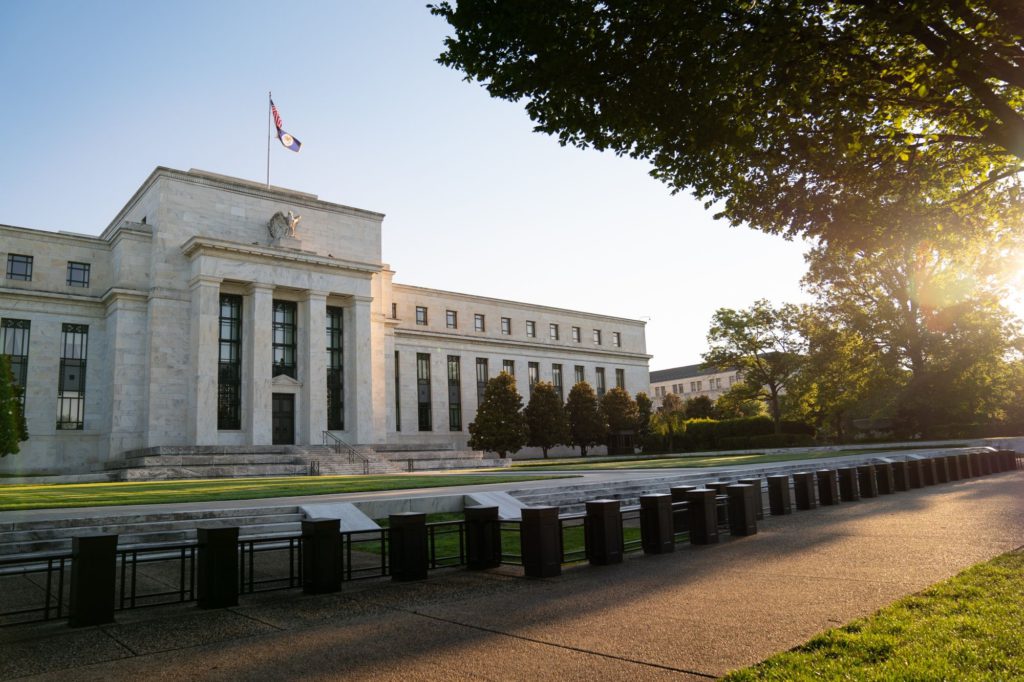
Fed Warns of Worsening Market Liquidity in Stability Report

(Bloomberg) — The Federal Reserve warned of deteriorating liquidity conditions across key financial markets amid rising risks from the war in Ukraine, monetary tightening and high inflation in a semi-annual report published Monday.

“According to some measures, market liquidity has declined since late 2021 in the markets for recently-issued U.S. cash Treasury securities and for equity index futures,” the U.S. central bank said in its Financial Stability Report.

“While the recent deterioration in liquidity has not been as extreme as in some past episodes, the risk of a sudden significant deterioration appears higher than normal,” the report said. “In addition, since the Russian invasion of Ukraine, liquidity has been somewhat strained at times in oil futures markets, while markets for some other affected commodities have been subject to notable dysfunction.”

In a statement accompanying the release of the report, Fed Governor Lael Brainard said the war “has sparked large price movements and margin calls in commodities market and highlighted a potential channel through which large financial institutions could be exposed to contagion.”

“From a financial stability perspective, since most participants access commodities futures markets through a large bank or broker-dealer that is a member of the relevant clearing house, these clearing members are exposed to risk when clients face unusually elevated margin calls,” Brainard said. “The Federal Reserve is working with domestic and international regulators to better understand the exposures of commodity market participants and their linkages with the core financial system.”

The S&P 500 index of U.S. stocks tumbled Monday to the lowest levels in more than a year and is now almost 17% below the record high set on Jan. 3. The decline in asset prices has coincided with a move toward sharp monetary policy tightening by central banks around the world, including the Fed, to address ongoing inflationary pressures.

“Elevated inflation and rising rates in the United States could negatively affect domestic economic activity, asset prices, credit quality, and financial conditions more generally,” the report said. It also called out U.S. house prices, which it said “could be particularly sensitive to shocks” given high valuations.

The Fed last week authorized a half-percentage point increase in its benchmark interest rate, marking the largest single hike since 2000, and its chair, Jerome Powell told reporters afterward it was on track to follow up the move with additional half-point increases at each of its next two policy meetings in June and July.

In the report, the Fed also reiterated concerns over financial risks posed by stablecoins, a fast-growing type of cryptocurrency that’s designed to maintain a steady value in relation to a hard currency like the U.S. dollar. The coins are “vulnerable to runs” and there’s a lack of transparency around the assets that are used to back the tokens, it said.

“Additionally, the increasing use of stablecoins to meet margin requirements for levered trading in other cryptocurrencies may amplify volatility in demand for stablecoins and heighten redemption risks,” the report said.

(Updates with statement from Fed Governor Lael Brainard in fourth paragraph.)

More stories like this are available on bloomberg.com

©2022 Bloomberg L.P.
Novogratz Sees ‘More Damage to Be Done’ After Crypto Rout

(Bloomberg) — Michael Novogratz, the billionaire cryptocurrency investor who leads Galaxy Digital Holdings Ltd., said he expects the digital-asset market to be “volatile and difficult” for at least the next few quarters as it remains tied to moves in U.S. equities. 

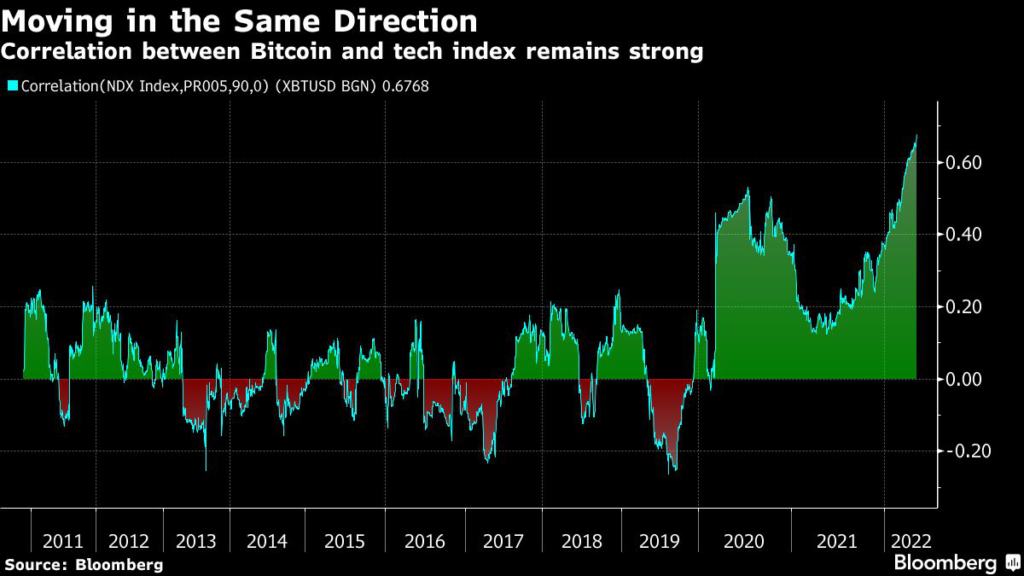
“Crypto probably trades correlated to the Nasdaq until we hit a new equilibrium,” Novogratz said on Galaxy’s first-quarter earnings call on Monday. “My instinct is there’s some more damage to be done, and that will trade in a very choppy, volatile and difficult market for at least the next few quarters before people are getting some sense that we’re at an equilibrium.”  

He repeated his call that Bitcoin will hold at the $30,000 range, and Ethereum at the $2,000 level. But if the Nasdaq Composite falls to 11,000, “there’s a shot” that Bitcoin will breach $30,000, he said in an interview with Bloomberg TV. 

Bitcoin fell as low as $30,339 on Monday, the least since July 2021. Ether dropped as low as $2,226, while the Nasdaq Composite fell 4.3% to 11,623.

Algorithmic stablecoins, such as TerraUSD, which lost its peg over the weekend, are creating volatility in all crypto, though he expects the stablecoin system to survive. “They are defending it. We will see how it goes. Certainly it’s not good for the overall ecosystem if it doesn’t go well,” said Novogratz, who is an investor in Terraform Labs. 

Read More: Terra Stablecoin Backer to Lend Tokens After Losing Dollar Link

He’s still optimistic about crypto’s long-term prospect given the momentum of institutional adoptions even with Bitcoin down more than 50% from its record high reached in November. The new institutional players are “coming in with a very long term focus,” he said, citing BlackRock Inc, Blackstone Inc., Citadel, and Apollo Global Management Inc. as examples.

Galaxy Digital, which offers businesses ranging from crypto trading and asset management to mining, posted a loss in the first quarter against a backdrop of large digital asset price declines. 

The net comprehensive loss was $111.7 million, compared to a gain of $858.2 million in the year-ago period, primarily due to unrealized losses on digital assets and investments in its trading and principal investment businesses. That was partially offset by profitability in investment banking and mining units. The company had warned of a loss of $110 million to $130 million in the first quarter through March 28, citing market volatility. 

Galaxy said its asset management unit was managing $2.7 billion as of March 31, a 5% decline from end of last year.  

(Adds Novogratz’s comments on Bloomberg TV starting in the third paragraph.)

More stories like this are available on bloomberg.com

©2022 Bloomberg L.P.

Rivian Tumbles as IPO Lockup Expiration Means Ford, Amazon Can Finally Sell

(Bloomberg) — Shares of Rivian Automotive Inc. sank 21% as some early stakeholders got their first chance to unload shares on Monday. 

Selling restrictions on certain Rivian insiders and investors ended on Sunday, freeing up a sizable chunk of the electric-vehicle maker’s float for public trading. The stock has now collapsed 87% from its November high. Now, the focus turns to the company’s two most prominent corporate backers — Amazon.com Inc. and Ford Motor Co. — and whether they start reducing their stakes. 

About 720 million Rivian shares are estimated to have become eligible for sale as the market opened. The company had a float of about 182.5 million shares as of April 11, according to Bloomberg data. Amazon owns about 17.7% of Rivian, while Ford owns 11.4%. 

Few on Wall Street expect Amazon to lighten its position, but Ford is a different story. On Saturday, CNBC’s David Faber tweeted that Ford plans to sell eight million Rivian shares through Goldman Sachs.

“We would not be surprised by a stake sale/reduction by Ford post Rivian’s lockup expiration,” Robert W. Baird analyst George Gianarikas wrote in a note on May 1. Ford, which invested $1.2 billion in Rivian, has been non-committal about its investment, and its own electric pickup truck, the F150 Lightning, is having early success, he said. Rivian is also making an electric pickup.  

“We’ll look at everything,” Ford’s Chief Executive Officer Jim Farley said of his company’s Rivian stake in a Bloomberg TV interview in January. “Everything is on the table.”    

“We haven’t been/aren’t presently commenting on Rivian, including about CNBC’s report,” a Ford spokesman said Monday in an emailed statement. 

Amazon also declined to comment on its plans. Gianarikas said he does not expect the e-commerce giant to reduce its stake, pointing to its order of 100,000 Rivian electric delivery vehicles. Indeed, in its statement to Bloomberg Amazon said that it was “committed” to work with Rivian to put those electric delivery vehicles on the road by 2030.

Abdul Latif Jameel, a Saudi Arabia-based group and an investor in Rivian, said it has no plans to sell shares. Jameel holds almost 114 million Rivian shares, or about 12.8% stake, through Global Oryx — making it the third biggest holder in the company after T Rowe Price Group Inc. and Amazon.

Bottoming Out

Rivian was the largest U.S. IPO of 2021. It went public amid great fanfare as investors thirsted for EV companies with a growing push from governments and policy makers around the world to move toward clean transportation options. Enthusiasm peaked within days of its Nov. 10 public debut, driving its market capitalization to over $150 billion. 

Since then, however, the stock has cratered from a high of $172 on Nov. 16 to around $23 as market sentiment soured on riskier growth stocks, with rising inflation and Federal Reserve interest-rate hikes increasing the lure of haven assets. In addition, supply-chain shortages and soaring raw material costs have crippled new EV companies, forcing them to lower production targets and making their valuations look even more expensive.

Of course, Rivian isn’t the only IPO from last year that has faltered. Other high-profile stocks that made their trading debuts in 2021 like Robinhood Markets Inc., Coinbase Global Inc., Coupang Inc., Didi Global Inc., Globalfoundries Inc., Nu Holdings Ltd. and Bumble Inc. are deeply in the red this year. 

While IPO lockup expiries typically lead to more volatility and weakness in stocks, they can have an upside. At times they can serve as a “clearing event” by removing uncertainties, thereby driving the share price higher, Gianarikas said in an interview. 

In addition, the stock’s severe selloff could deter big stakeholders from selling near a low. 

“As an investor Ford may be taking a longer term view, and may not want to sell at the bottom,” Edward D. Jones analyst Jeff Windau said. 

(Updates stock move in first deck and first, second and eleventh paragraphs,)

More stories like this are available on bloomberg.com

©2022 Bloomberg L.P.

Close Bitnami banner
Bitnami
