Bloomberg

El Salvador Buys Bitcoin Dip, Adding 500 Coins to Holdings

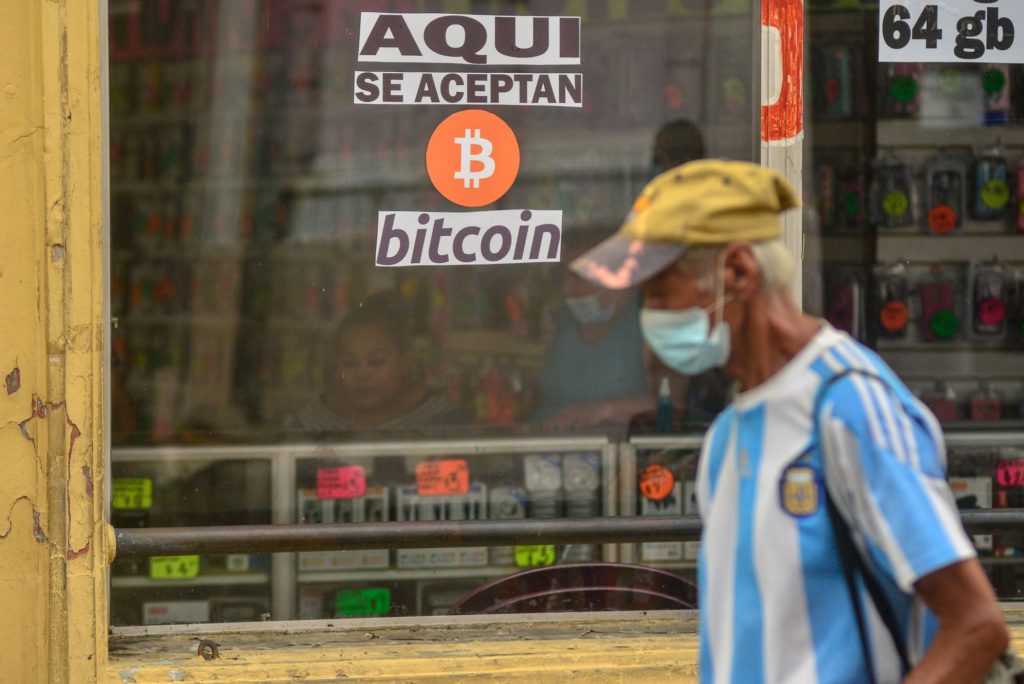
(Bloomberg) — El Salvador’s government bought 500 Bitcoins on Monday, in its largest purchase to date of the cryptocurrency. A wider markets rout has driven Bitcoin’s price below $31,000 for the first time since July 2021. 

The government bought the coins at an average price of $30,744, President Nayib Bukele said on Twitter. The government has purchased 2,301 Bitcoins since making it legal tender in September last year, according to data tracked by Bloomberg. 

(Adds table showing Bukele’s announced Bitcoin purchases)

More stories like this are available on bloomberg.com

©2022 Bloomberg L.P.

DigitalBridge Is Vying to Buy Data-Center Company Switch

(Bloomberg) — DigitalBridge Group Inc. has emerged as a suitor for data-center operator Switch Inc., according to people familiar with the matter. 

DigitalBridge is vying against an arm of Brookfield Asset Management Inc. for Las Vegas-based Switch, said the people, who asked to not be identified because the matter is private. Any deal, if reached, may be announced on Tuesday, when Switch is slated to report earnings.

Switch’s market capitalization stood at about $7 billion as of Monday afternoon. It’s possible DigitalBridge and Switch end talks without an agreement.

Switch and DigitalBridge representatives declined to comment.

Mergers and acquisitions of data-center companies have proliferated, in part due to the sector’s fragmented nature and relatively strong growth dynamics. Switch is among the largest of such firms listed in the U.S., after giants Digital Realty Trust and Equinix Inc. Rival CyrusOne Inc. last year agreed to be acquired by KKR & Co. and Global Infrastructure Partners.

More stories like this are available on bloomberg.com

©2022 Bloomberg L.P.

Microsoft Has $1.3 Billion at Stake for Combat Goggles

(Bloomberg) — Microsoft Corp. has an initial $1.3 billion at stake in a test beginning later this month on whether its HoloLens augmented-reality goggles can be turned into an effective combat system for the U.S. Army.

The monthlong test from May 23 to June 17 will be evaluated by the Pentagon’s testing office to determine whether the headset is ready for full production and initial deployment.

The project by the Redmond, Washington-based company aims to develop a “heads-up display” for U.S. ground forces, similar to those for fighter pilots. The Integrated Visual Augmentation System would let commanders project information onto a visor in front of a soldier’s face and would include features such as night vision. 

So far, the Army and the testing office have indicated the goggles show promise but aren’t ready for combat deployment, and the service delayed putting them in the field in favor of this month’s evaluation.

“We’ll be looking carefully at those results to inform, ultimately, where we go” with the program, Army Secretary Christine Wormuth told the Senate Armed Services Committee on Wednesday. “I feel pretty comfortable where that program is,” she said. “We’ve been working very closely with Microsoft, and I think that that program is on track.”

It’s been called a potential $21.9 billion program over 10 years for as many as 121,500 goggles, spare parts, logistics and program management support. In fact, “less than half of this total is possible for the U.S. Army,” Major General Anthony Potts, the service’s program executive officer for soldier systems, told the Pentagon inspector general in the service’s rebuttal to a critical report released last month.

The $21.9 billion represents “a contract ceiling that includes all possible hardware, components, and services over a 10-year period at the worst possible pricing structure,” Potts wrote. He said the full estimate also includes “all possible sales to sister services, Foreign Military Sales and all maximized service contracts.” 

At the time a Microsoft official said in an email that the company continues to develop the goggles as a “transformational platform” that will enhance soldier safety and effectiveness, without addressing the questions about the contract’s potential size. Microsoft declined on Thursday to offer further comment.

This month’s crucial test will focus on whether a light infantry unit equipped with the goggles can accomplish its missions in a simulated combat environment, demonstrating “proficiency in soldier lethality tasks while maintaining situational awareness and enabling the commander’s decision-making,” test office spokeswoman Jessica Maxwell said.

Soldiers will be assessed while wearing the device in day and night as they share graphics, information on positions “and the ability to detect and engage targets,” according to the testers. The goggles will be evaluated on whether the field of view and comfort allows for good mobility so that soldiers can accomplish tasks.

Whatever the final program value over the next decade, a positive “Rapid Fielding Report” from the test office could free up at least $1.3 billion in spending that’s on hold or requested, starting with $167 million in unspent fiscal 2021 procurement money and $405 million this year.

There’s also $333 million of a $373 million order placed in March 2021 for the initial 5,000-goggle order; only $40 million has been paid to Microsoft. The Army won’t take delivery until the May test is successfully completed, according to service spokesman Jamal Beck. 

There’s an additional $400 million requested in fiscal 2023 procurement funds for a new order for as many as 6,898 sets of goggles.

(Corrects spelling of HoloLens product in first paragraph of story published on May 6)

More stories like this are available on bloomberg.com

©2022 Bloomberg L.P.

Bitcoin’s Unraveling Tops 50% From Peak With Drop Below $31,000

(Bloomberg) —

Bitcoin extended losses, dropping below $31,000 for the first time since July 2021, putting its decline from a November record high to more than 50% amid a global flight from riskier investments.

The world’s largest digital token fell as much as 11% to $30,339 in New York. The one-day intraday drop is the largest since Jan. 21. Ether fell as much as 11%, while Solana dropped 14% and Avalanche dipped 18%.

“We’re seeing a slow motion meltdown, partially because it’s mostly been long holders selling” instead of levered liquidations, said Josh Lim, head of derivatives at New York-based brokerage Genesis Global Trading. “Now that some corporate treasuries are hovering near their cost basis, markets are waiting and watching to see if shareholders will force some de-risking.”

Michael Novogratz, the billionaire cryptocurrency investor who leads Galaxy Digital Holdings Ltd., warned that he expects things to get worse before they get better. 

“Crypto probably trades correlated to the Nasdaq until we hit a new equilibrium,” Novogratz said on Galaxy’s first-quarter earnings call on Monday. “My instinct is there’s some more damage to be done, and that will trade in a very choppy, volatile and difficult market for at least the next few quarters before people are getting some sense that we’re at an equilibrium.”  

Tightening monetary policy to combat runaway inflation and ebbing liquidity are turning investors away from speculative assets across global markets. 

Do Kwon, the founder of Terraform Labs, which powers the Terra blockchain, is moving to shore up its algorithmic stablecoin after the cryptocurrency lost its peg to the dollar amid the markets rout.

Luna Foundation Guard, the association created to support the decentralized token and Terra blockchain, said it will issue loans worth about $1.5 billion in Bitcoin and TerraUSD to help strengthen TerraUSD’s peg after it dropped below a $1 on Saturday as crypto markets continued to plummet. Kwon captured the attention of the crypto world earlier this year by pledging to buy as much as $10 billion in Bitcoin to prop up Terra. 

“We’re watching carefully to see how the market fares over the next 24 hours,” Steven Goulden, senior research analyst at crypto market maker Cumberland DRW, said in an email. “Including whether mechanisms being introduced to help increase reliance, such as LFG lending out Bitcoin to OTC trading firms, will be enough to hold in times of deep stress or if we need additional stabilization mechanisms.”

Rising interest rates are giving individual and institutional investors pause for thought about the crypto market outlook, according to Edul Patel, chief executive officer of Mudrex, an algorithm-based crypto investment platform. Bitcoin’s more than 30% decline in 2022 compares with a retreat of more than 10% in global bonds and shares, and a 2.5% advance in gold. 

“The downward trend is likely to continue for the next few days,” he said, adding Bitcoin could test the $30,000 level.

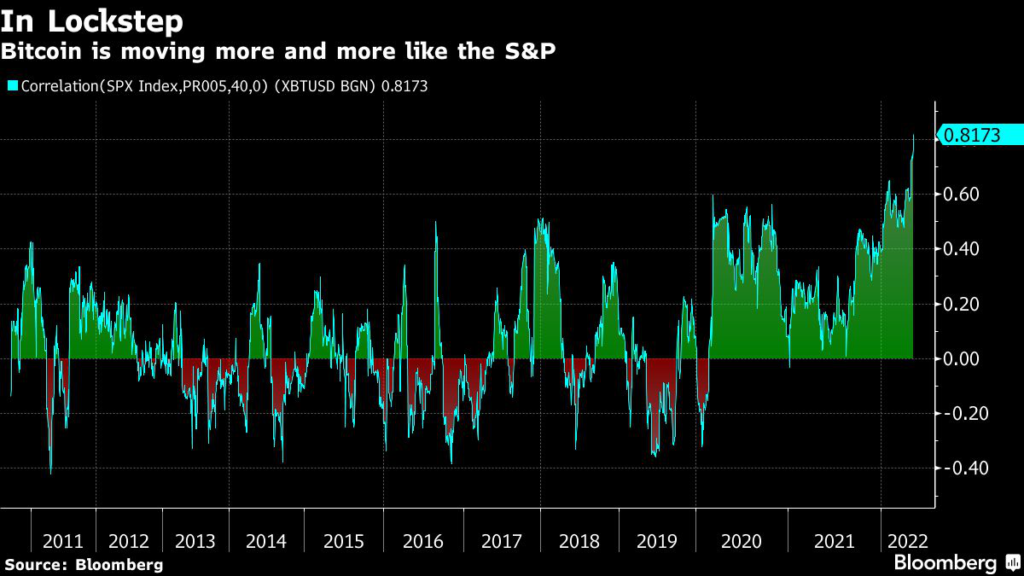
Bitcoin’s recent decline puts it at risk of firmly dropping out of the range where it’s been trading in 2022, completely reversing the most recent bull run that drove the token to a record of almost $69,000 in November. With its 40-day correlation with the S&P 500 stock benchmark at a record 0.82, according to data compiled by Bloomberg, any further hit to equities sentiment would risk dragging Bitcoin down as well. 

A correlation of 1 means two assets move in perfect lockstep; a reading of -1 means they move in opposite directions.  

More stories like this are available on bloomberg.com

©2022 Bloomberg L.P.
Biden Says Infrastructure Law Cut Internet Bills for Millions

(Bloomberg) — President Joe Biden said that his infrastructure law had cut broadband internet bills for millions of Americans, casting the program as part of his efforts to fight high inflation. 

But Biden urged millions more families who qualify but haven’t signed up to take advantage of the initiative, called the Affordable Connectivity Program.

Families earning twice the federal poverty level or less, about $55,500, are eligible for a $30 per month discount on internet services. So are those receiving many other federal benefits for low-income people, including Medicaid, Pell grants and food aid. 

The Biden administration said Monday that 20 of the largest broadband providers would make high-speed plans — at least 100 megabits per second — available for $30, making the plans free after the discount. The companies cover about 80% of the U.S. population.

“We made sure there would be no hidden fees, no tricks — this is straight-up stuff,” Biden said.

He added later: “My top priority is fighting inflation and lowering prices for families and things they need.”

More than 11.7 million households are participating in the $14.2 billion program already, but about 48 million are eligible, according to the White House. Participating companies include the nation’s two largest cable providers, Comcast Corp. and Charter Communications Inc., as well as Verizon Communications Inc. and AT&T Inc.

Biden and Vice President Kamala Harris said the program could prevent low-income families from having to use communal internet access, describing parents parking at McDonald’s Corp. restaurants so their children can do school work.

“In the 21st century, access to the internet is essential for success,” Harris said.

Critics of U.S. broadband providers have long complained that their basic internet plans are too expensive. Biden’s White House last year said that “Americans pay too much for the internet” and pledged to reduce prices. 

“For the millions of Americans who do not qualify for the ACP, broadband will continue to be priced as a luxury,” Chris Lewis, president of Public Knowledge, a group that advocates for an open and more affordable internet, said in a statement. “How can a broadband company afford to offer service for $30 at high speeds for some, but not for others?”

Internet providers said government funding helps to make service more widely available to low-income Americans.

“Internet for all requires the partnership of business and government, and we are pleased to be working with the administration, Congress and FCC to ensure everyone has accessible, affordable and sustainable broadband service,” AT&T Chief Executive Officer John Stankey said in an email.

Dave Watson, president of Comcast Cable, in a statement called the Affordable Connectivity Program “a historic opportunity to close the digital divide.” 

The U.S. government launched a website, GetInternet.Gov, to allow people to find a qualifying plan, among other measures to increase the number of households that are participating. 

More stories like this are available on bloomberg.com

©2022 Bloomberg L.P.
Yellen Says Ukraine War Brings Uncertainty for Global Economy

(Bloomberg) — Treasury Secretary Janet Yellen highlighted continuing dangers to the global economy from Russia’s invasion of Ukraine and the pandemic, in prepared remarks to lawmakers on an annual financial-risk report.

“There is the potential for continued volatility and unevenness of global growth as countries continue to grapple with the pandemic,” Yellen said in the text of remarks released Monday by the Treasury Department. “Russia’s unprovoked invasion of Ukraine has further increased economic uncertainty.”

Yellen is scheduled to appear before the Senate Banking Committee at 10 a.m. Tuesday, and again before the House Financial Services Committee on Thursday to brief lawmakers on the annual report of the Financial Stability Oversight Council, which she chairs.

While she also expressed concerns about some asset valuations, the Treasury chief saw no immediate threat to the stability of financial markets.

“The U.S. financial system has continued to function in an orderly manner, though valuations of some assets remain high compared with historical values,” she said.

In summarizing the annual FSOC report, which was released in December, Yellen also said:

  • While U.S. banks weathered the pandemic well, events of March 2020 revealed that many nonbank financial institutions were vulnerable to financial stresses due to liquidity mismatches and the use of leverage
  • The council continues to study ways to improve resiliency in the Treasury securities market
  • The council continues to push banks to identify climate-related financial risks
  • The council is drafting a report on digital assets that will identify financial stability risks and regulatory gaps

More stories like this are available on bloomberg.com

©2022 Bloomberg L.P.

Better Hires Ex-Goldman Partner Talwar With Eyes on Listing

(Bloomberg) — Embattled online mortgage lender Better is turning to a former Goldman Sachs Group Inc. consumer-banking veteran to help it pursue a public listing just as rising interest rates pressure the business already reeling from a slew of personnel missteps.

The company appointed Harit Talwar as non-executive chairman, according to an internal memo from Chief Executive Officer Vishal Garg seen by Bloomberg News. He starts effective immediately and will “provide strategic direction to achieve Better’s long-term goals,” according to the memo.

Talwar’s appointment comes as Better grapples with hikes in interest rates that weighed on the company’s loan volume, leading it to make staff reductions over the past several months. The cuts sparked backlash after a December round of firings was carried out over Zoom, and Garg took a hiatus from the company for his handling of the situation.

“There will be challenges, both internal and external, but the goal is to build a business which we are proud of. The goal is to go public,” Talwar said in a phone interview. “It is mission-centric, it is customer-centric, it has the track record, and it has challenges. And this is exactly the kind of situation in my career I’ve always jumped in.”

In Talwar, Better is getting a banking veteran with more than three decades of experience who built and led Goldman Sachs consumer-lending unit Marcus. Goldman hired Talwar in 2015 from Discover Financial Services, where he had headed the company’s U.S. cards division. He left Goldman late last year and was named to the board of payments firm Mastercard Inc. in January.

“Harit was a critical senior hire for Goldman Sachs in the early stages of our consumer business,” former Goldman Sachs CEO Lloyd Blankfein said in an interview. “Better is lucky to have him as chairman.”

The non-executive chairman position was among leadership roles the company’s board said it would create and fill in the wake of an independent review carried out in the aftermath of the December firings. Talwar’s appointment follows the hiring of Richard Benson-Armer as chief people, performance, and culture officer in March. The company is still looking for a president.

SPAC Transaction

Better is preparing to go public via a special purpose acquisition company, a vehicle that lists on a public stock exchange to raise money so it can buy another firm. The company pushed back its listing late last year after revising terms of the deal.

A Securities and Exchange Commission crackdown as well as souring markets have chilled the market for SPAC deals. The IPOX SPAC Index fell 9.5% in the first quarter of 2022, the worst performance since its July 2020 launch, and has lost more than 22% over the past three quarters. 

Bloomberg reported earlier Monday that Goldman is pulling out of working with most SPACs it took public, throwing into doubt the fate of billions raised for those blank-check vehicles. 

Better offers mortgage, real estate and homeowners’ insurance products online and eliminates origination fees and commissions. The company has been steadily cutting its workforce and had about 5,800 team members at the end of March this year, compared with 9,300 at the end of December.

“Harit will bring incredible practical knowledge,” former Mastercard CEO Ajay Banga said in an interview. “He’s someone who has credibility, maturity, gray hair and the ability to be a humane leader.”

(Adds quotes from Blankfein, Banga from sixth paragraph.)

More stories like this are available on bloomberg.com

©2022 Bloomberg L.P.
Palantir’s Plunge Drags Down Mega-Donor Peter Thiel’s Wealth

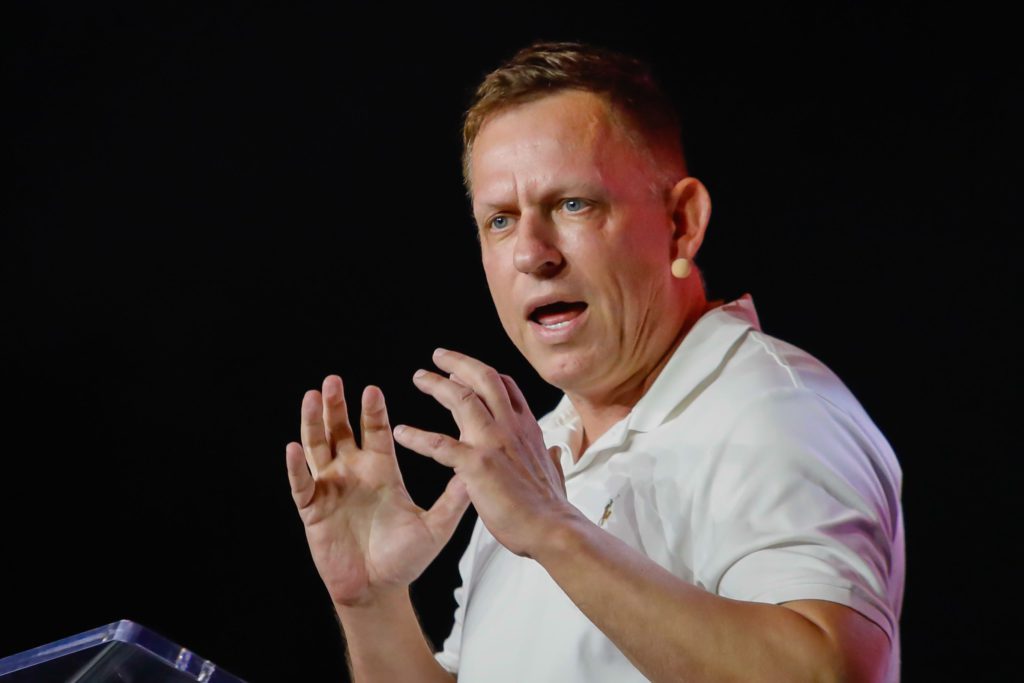
(Bloomberg) — The tech sector meltdown is chipping away at the fortune of Peter Thiel. 

Palantir Technologies Inc., Thiel’s single-biggest equity position, plummeted as much as 23% Monday after it reported widening losses and tepid revenue growth. The slump erased about $270 million from the value of Thiel’s stake. So far this year he’s shed 19% of his net worth, now valued at $7.4 billion, according to the Bloomberg Billionaires Index. 

Read more: Palantir Craters Most Since 2020 on Wider-Than-Expected Loss  

Along with Alex Karp and others, Thiel co-founded the Denver-based software maker that specializes in data analytics and is known for its work supporting national defense and government entities. The company expects government revenue to increase this year against a backdrop of rising global conflict and risk. 

On a conference call Monday with analysts, Chief Executive Officer Karp emphasized the threat of nuclear war. That didn’t do much to blunt a selloff. 

“They have done a decent job of disappointing the investor base over and over,” said Michael Iavarone, an investment adviser at PHX Financial, which has sold a large portion of its Palantir position but still holds some shares. “Unless they come up with a catalyst, such as a buyback or major new contract, they will continue to get punished. Karp has made massive sales and is the most overpaid CEO in history based on what the stock has done.”

Karp, 54, was awarded a pay package last year valued at $264.2 million, including salary, stock and options grants, according to data compiled by Bloomberg. The value of Karp’s equity has sunk significantly due to the decline in markets. 

A Palantir spokesperson didn’t immediately respond to a request for comment.

For Thiel, 54, the drop in value of Palantir shares is cushioned by a significant cash position. Sales of former stakes, including PayPal Holdings Inc. and Meta Platform Inc.’s Facebook, as well as inflows from his venture capital group Founders Fund have helped him amass an estimated $4 billion in cash or other closely held assets.

Thanks to that pile, Thiel has become increasingly active in politics as a backer of candidates aligned with former President Donald Trump. Earlier this year, Thiel relocated to south Florida and stepped down from the board of Meta in order to focus on supporting candidates ahead of November’s midterm elections. He donated $10 million to the successful campaign of “Hillbilly Elegy”-author JD Vance in Ohio’s Republican primary race for Senate. 

Still, the majority of Thiel’s net worth is tied to tech companies, most notably through Founder’s Fund. The venture firm has backed startups including SpaceX, Lyft Inc., Spotify Technology SA and real estate company Compass Inc. The fund’s assets have swelled in recent years, alongside valuations, leaving it vulnerable if the tech rout persists and leads to an abrupt cooling in the number and scale of deals. 

More stories like this are available on bloomberg.com

©2022 Bloomberg L.P.
Pandemic-Era Darlings Morph Into Symbols of New Market Wreckage

(Bloomberg) — Stock markets continued to sink following last week’s recession worries, fueled by the Federal Reserve’s rate decision and the threat to global growth from China’s continued Covid lockdowns. The fear could be seen across asset classes, as traders offloaded equities and other risk assets in favor of cash.

Within the sea of red, some of the days’ biggest losers were investments that once surfed on waves of optimism: newly public companies would outperform; Cathie Wood’s flagship fund would regain its previous highs; cryptocurrency would shine as an alternate investment class. On Monday, markets appeared to give up on all these dreams. 

“One of the things that we’ve learned, at least in this cycle, is that these speculative growthy disruptive alternate high-risk high-reward asset classes were far more rate sensitive than maybe folks thought they were,” said Steve Chiavarone, senior portfolio manager at Federated Hermes.

IPOs Deflated

Newly public companies, many of which are projected to post profits years down the line still, have been particularly hard hit. The Renaissance IPO ETF (ticker IPO) lost as much as 8.7% on Monday, the most since March 2020. The fund has dropped roughly 50% since the start of the year. 

For Michael O’Rourke, chief market strategist at Jonestrading, many of these names are “concept stocks” that lack profitability and require access to capital markets to survive. “As investors retrench and liquidity dries up, such companies are at an even greater risk,” he said.

Tech Hit

A Goldman Sachs basket of non-profitable tech companies dropped more than 9% at one point Monday. It’s lost roughly 25% over the past two weeks alone and is trading at its lowest levels since May of 2020. 

“Valuations now matter. Investors are demanding profits,” said Peter Boockvar, chief investment officer at Bleakley Advisory Group. 

Transformation Trashed

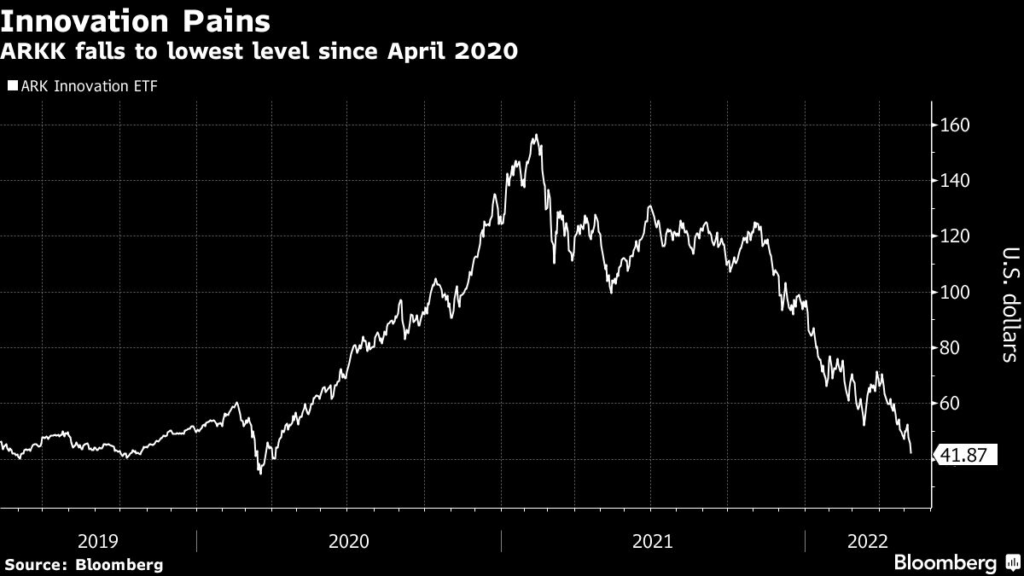
Cathie Wood’s flagship Innovation ETF (ARKK) experienced its worst month ever in April and its shares are down 51% in 2022. Wood and her firm, ARK Investment Management, have been among the highest-profile victims of the stock selloff, with her flagship fund sagging as much as 9.3% Monday.

Bitcoin Selloff Accelerates

Bitcoin has also been hard-hit, with the digital coin losing 50% since its November peak to fall below $32,000. The digital token has been down for five straight weeks and last week alone lost 11%, according to data compiled by Bloomberg. Other cryptocurrencies have also slid, with an index of 100 digital assets down roughly 30% since the start of the year.

Oil Slump

The energy sector was the worst-performing in the S&P 500, falling as much as 7.5%. After the European Union said it would will drop a proposed ban on its vessels transporting Russian oil to third-party countries, West Texas Intermediate crude sank below $103 a barrel. And Saudi Arabia lowered oil prices for buyers in Asia as coronavirus lockdowns in China cut into demand. 

More stories like this are available on bloomberg.com

©2022 Bloomberg L.P.
Lacavera Says $2.9 Billion Bid for Shaw Unit Is Still on Table

(Bloomberg) — Canadian entrepreneur Anthony Lacavera says he’s still ready to buy wireless assets from Rogers Communications Inc. if it helps the telecommunications company solve the antitrust problems in a $16 billion acquisition. 

Rogers is trying to buy Shaw Communications Inc. in what would be one of Canada’s largest deals ever, but the country’s Competition Bureau is opposed to the deal. Rogers has said it will divest all of Shaw’s wireless assets, which operate under the name Freedom Mobile, to deal with the bureau’s concerns. 

Lacavera, the founder and chairman of Globalive Capital Inc., made an offer in March to buy Freedom Mobile for C$3.75 billion ($2.9 billion) that went nowhere. He says it’s still on the table and that he wants to talk to Rogers about it again. 

“Our offer stands. It’s a funded, fully-financed offer. We’ve presented Rogers with evidence of the funding partners,” Lacavera said in a phone interview. “I plan to be in communication with Rogers this week.” 

A spokesperson for Toronto-based Rogers declined to comment. 

Freedom Mobile is a business Lacavera knows well because he started the company, launching service in Canada in 2009 under the brand Wind Mobile. The company was recapitalized in 2014. Shaw struck a deal to buy the company in 2015 and renamed it. 

It isn’t clear whether Rogers wants to deal with Lacavera, nor whether an acquisition of Freedom by him would resolve the Competition Bureau’s concerns.

Rogers has held an auction for Freedom Mobile and has other potential buyers for it, including Xplornet Communications Inc., which is backed by New York-based investment firm Stonepeak Partners LP. 

Some analysts have said they believe the antitrust agency wants to see whether Rogers can cut a deal with Quebecor Inc., a Montreal-based communications company that’s a major wireless operator in the province of Quebec. It has about 1.6 million wireless subscribers compared with Shaw’s 2.2 million, according to the companies’ latest quarterly disclosures. 

The competition bureau’s action “puts Quebecor in an improved negotiating position,” BMO Capital Markets analyst Tim Casey said in a note to investors. “That said, we believe Quebecor will have to demonstrate how it can generate a better return from Freedom than Shaw has reported.” 

Lacavera said he believes an independent, pure-play wireless company has a better chance of bringing price competition to the market than one that’s owned by a regional cable provider such as Quebecor. Those companies will always be reluctant to cut wireless prices out of fear that larger rivals such as BCE Inc. and Telus Corp. will retaliate by going after their profitable cable television and internet customers, he said. 

More stories like this are available on bloomberg.com

©2022 Bloomberg L.P.
Close Bitnami banner
Bitnami